8 Best AI Support Tools for Multi-Tenant Platforms in 2026
Multi-tenant platforms demand support tools that can distinguish between tenants, access tenant-specific context, and escalate intelligently — capabilities generic chatbots lack. This guide ranks the 8 best AI support tools for multi-tenant platforms in 2026, evaluated on tenant-aware context handling, integration depth, escalation logic, and scalability for B2B SaaS and marketplace environments.
 Grant CooperFounder12 min read
Multi-tenant platforms face a support challenge that single-product companies simply don't. Every customer operates in their own environment, with their own configurations, users, and workflows — yet they all expect fast, accurate, personalized support. A generic chatbot that can't distinguish between tenants, access tenant-specific context, or escalate intelligently creates more friction than it resolves.
The tools in this list are built, or well-suited, to handle that complexity. We evaluated each on tenant-aware context handling, integration depth, escalation logic, and scalability. Whether you're running a B2B SaaS platform with hundreds of accounts or a marketplace with thousands of sub-organizations, these tools can help you deliver consistent, intelligent support without exploding your headcount.
For deeper background on how AI is reshaping support automation, see our Zendesk vs AI support platform breakdown and our customer support agent feature overview.
1. Halo AI
Best for: B2B SaaS and multi-tenant platforms needing deep context awareness and full business stack integration.
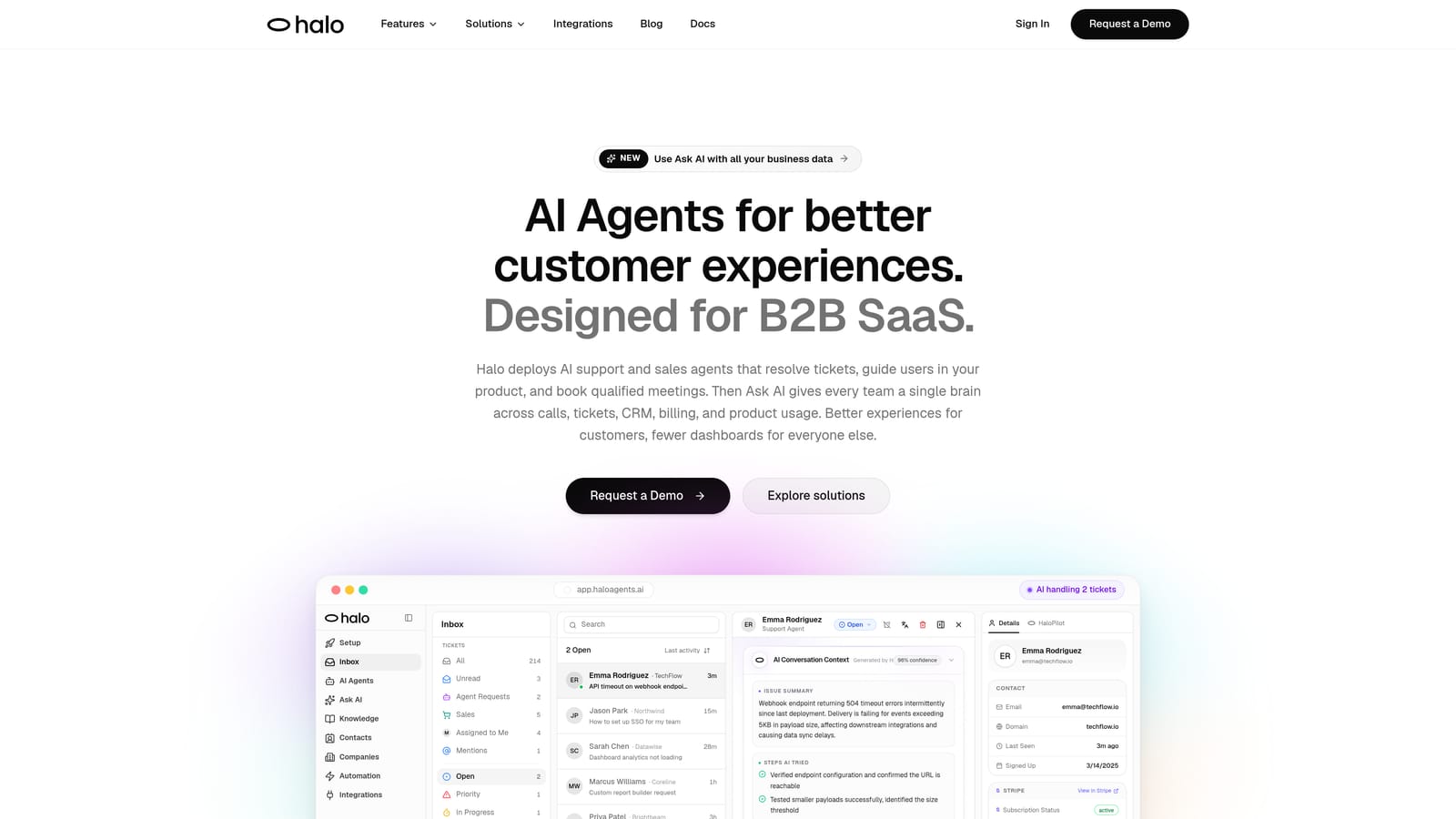
Halo AI is an AI-first customer support platform purpose-built for the complexity of multi-tenant B2B environments, where context, isolation, and integration depth aren't optional extras.
Where This Tool Shines
What sets Halo apart in a multi-tenant context is its page-aware architecture. The AI agent can see exactly what a user sees within their tenant environment, which means it isn't guessing at context — it's working with the actual interface state, the specific account configuration, and the user's current workflow. That's a meaningful difference when your customers each have unique setups.
Halo is also built as an AI-first platform, not a bolt-on layer over a legacy helpdesk. This means the learning loop is native: every resolved ticket feeds back into the system, making the AI progressively smarter across your entire tenant base without requiring manual retraining.
Key Features
Page-Aware Chat Widget: The AI sees exactly what the user sees in their tenant environment, enabling precise, context-specific guidance rather than generic answers.
Intelligent AI Agents: Resolves support tickets autonomously and continuously learns from every interaction to improve future responses.
Smart Inbox with Business Intelligence: Goes beyond ticket management to surface customer health signals, anomaly detection, and revenue intelligence from support interactions.
Auto Bug Ticket Creation: Automatically generates and routes bug reports to Linear or your preferred issue tracker, closing the loop between support and engineering.
Live Agent Handoff: Escalates to human agents with full context preserved, so agents never start from scratch.
Deep Integration Stack: Connects natively with Linear, Slack, HubSpot, Intercom, Stripe, Zoom, PandaDoc, and Fathom, giving support agents a complete picture of every customer relationship.
Best For
Product teams and support leaders at B2B SaaS companies who need AI that understands tenant-specific context, connects to their entire business stack, and delivers intelligence beyond basic ticket deflection. Particularly strong for platforms where support quality directly influences retention and expansion revenue.
Pricing
Contact for pricing. A demo is available at haloagents.ai/demo to see the platform in action with your specific use case.
2. Intercom (Fin AI Agent)
Best for: Teams already on Intercom who want AI-powered resolution without switching platforms.
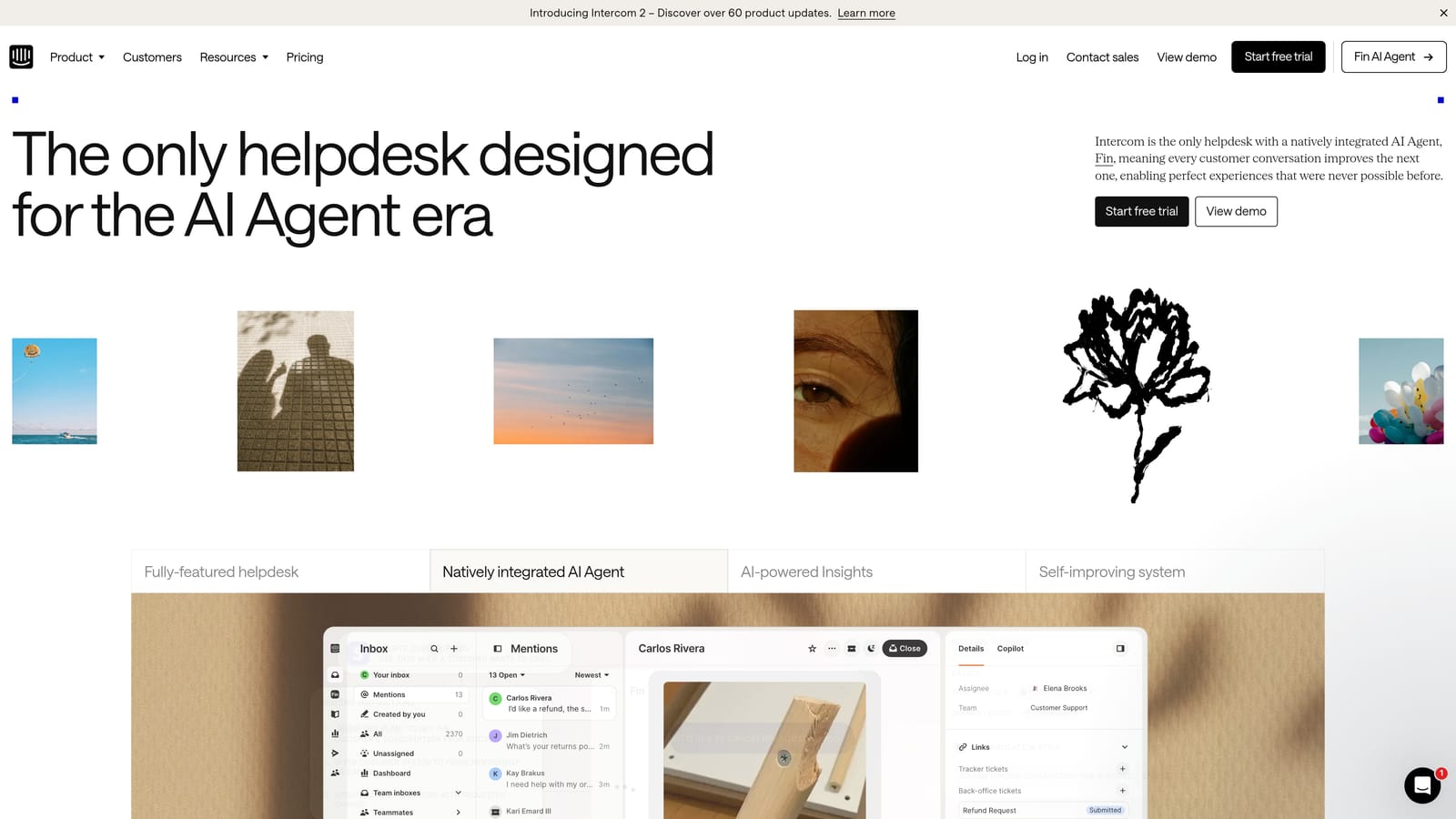
Intercom is a conversational support platform whose Fin AI Agent resolves tickets using your existing help content and hands off to human agents without breaking the conversation flow.
Where This Tool Shines
Fin AI Agent is well-suited for teams that have invested in building out their help center and want to put that content to work automatically. It draws on your existing documentation to resolve incoming conversations, which means the quality of your knowledge base directly influences how well Fin performs.
The handoff experience within Intercom's shared inbox is notably smooth. When Fin can't resolve something, it passes the conversation to a human agent with full context intact, which is critical for multi-tenant environments where context loss during escalation creates real frustration.
Key Features
Fin AI Agent: Resolves conversations autonomously using your help content and prior conversation history.
Smooth Human Handoff: Escalates within Intercom's shared inbox with conversation context fully preserved.
Multi-Channel Support: Handles chat, email, and social channels from a single platform.
Workflow Automation Builder: Lets teams create custom routing and automation rules without engineering involvement.
Conversation Analytics: Provides reporting on resolution rates, response times, and conversation trends.
Best For
Growing SaaS teams already using Intercom as their primary support channel who want to layer AI resolution on top of their existing setup without a full platform migration. Note that Halo AI offers a native Intercom integration for teams who want deeper AI capabilities while keeping Intercom in their stack.
Pricing
Fin AI Agent is priced per resolution; base plans start around $39 per seat per month. Verify current pricing at intercom.com.
3. Zendesk AI
Best for: Enterprise teams running high-volume support operations who need AI layered into an established helpdesk workflow.
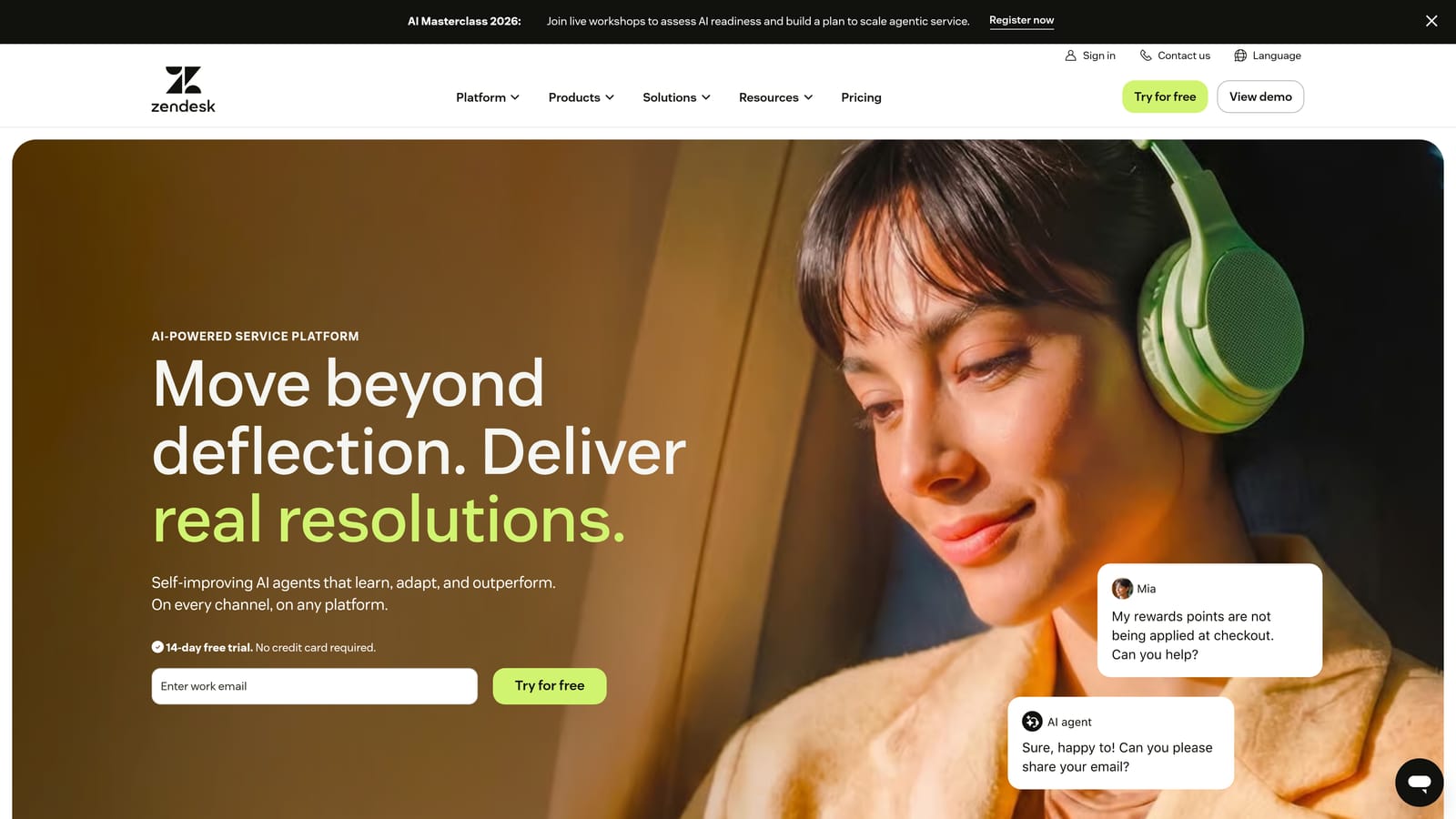
Zendesk is an enterprise helpdesk suite with native AI capabilities for intelligent triage, routing, and agent assist across large-scale support operations.
Where This Tool Shines
Zendesk's strength is its maturity. It's a deeply established platform with a large marketplace of integrations, robust compliance controls, and reporting infrastructure that enterprise teams rely on. The AI features, including intelligent triage and AI-generated macros, layer on top of that foundation rather than replacing it.
For multi-tenant platforms with complex routing requirements, Zendesk's intelligent routing can direct tickets to the right team based on content, account type, or custom rules. The tradeoff is that Zendesk AI functions more as an enhancement to human workflows than as a fully autonomous resolution engine.
Key Features
AI-Powered Triage and Routing: Automatically categorizes and routes incoming tickets based on intent, urgency, and account attributes.
AI-Generated Macros and Suggested Responses: Surfaces relevant response templates and suggestions to help agents reply faster.
Advanced Analytics Suite: Provides detailed reporting on team performance, ticket volume trends, and customer satisfaction.
Third-Party Integration Marketplace: Connects with hundreds of business tools through Zendesk's app marketplace.
Enterprise Security and Compliance: Meets enterprise-grade requirements for data security, access controls, and compliance certifications.
Best For
Enterprise organizations with large support teams already invested in Zendesk who want to add AI capabilities incrementally without migrating to a new platform. For a direct comparison with AI-native alternatives, see our Zendesk vs AI support platform breakdown.
Pricing
Suite plans start around $55 per agent per month; AI add-ons are available at additional cost. Verify current pricing at zendesk.com.
4. Freshdesk (Freddy AI)
Best for: SMB-to-mid-market teams on the Freshworks stack who want AI across self-service, agent assist, and analytics.
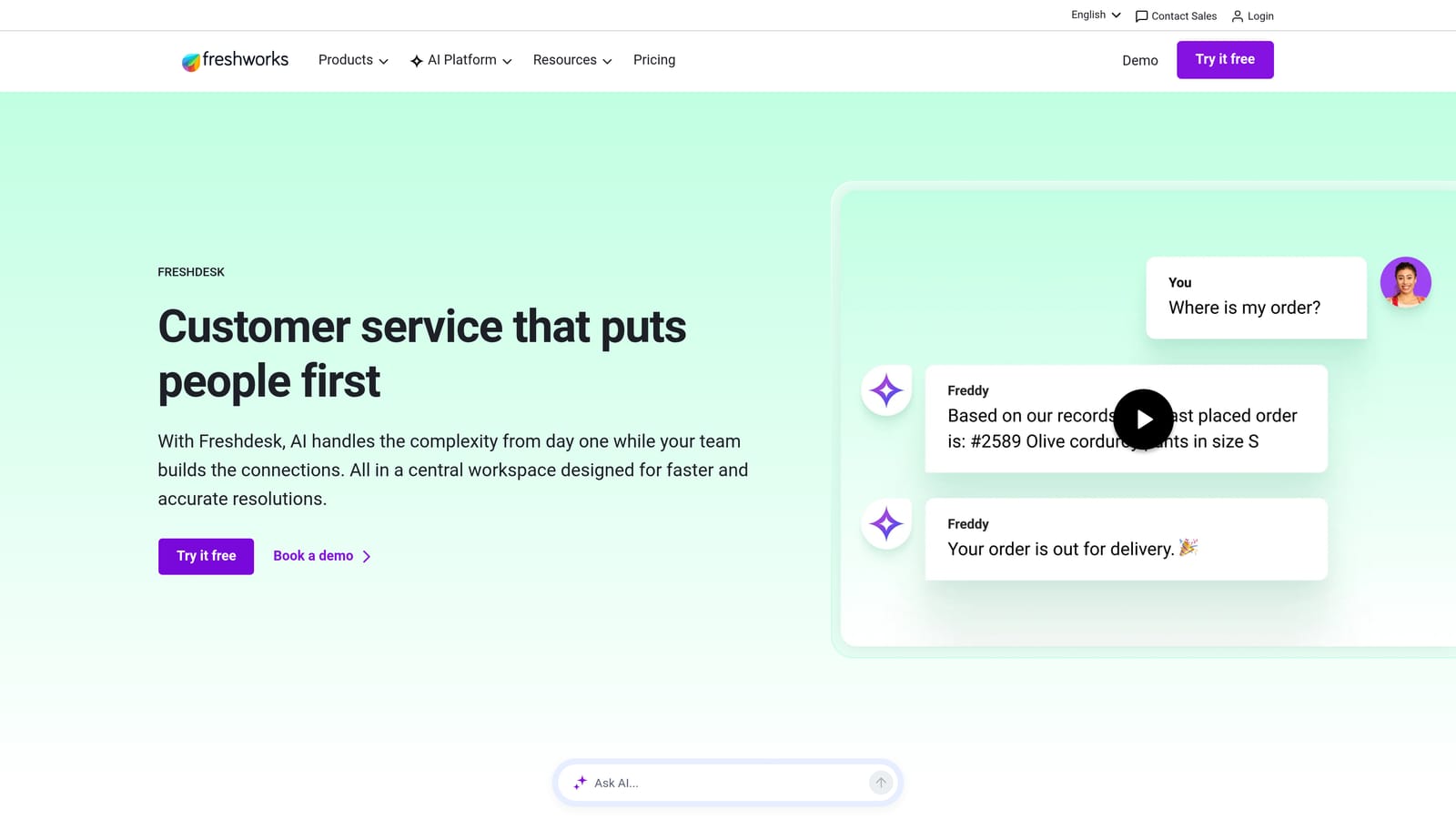
Freshdesk is a cloud-based helpdesk platform with Freddy AI providing agent assist, self-service automation, and predictive support analytics within the broader Freshworks ecosystem.
Where This Tool Shines
Freddy AI covers multiple layers of the support workflow: self-service deflection, in-conversation agent suggestions, and predictive analytics that flag anomalies before they become problems. For teams already using Freshworks products like Freshdesk CRM or Freshservice, the integration between these tools is a genuine advantage.
The free tier and relatively accessible pricing make Freshdesk a practical starting point for growing platforms that need AI support capabilities without committing to enterprise-level spend upfront.
Key Features
Freddy Self Service Bot: Automates common customer inquiries and deflects tickets before they reach the queue.
Freddy Agent Assist: Provides real-time AI suggestions and knowledge retrieval to agents during live conversations.
Freddy Insights: Delivers predictive analytics and anomaly alerts to help teams get ahead of support volume spikes.
Omnichannel Ticketing: Manages email, chat, phone, and social channels from a unified inbox.
Native Freshworks Integration: Connects seamlessly with Freshdesk CRM, Freshservice, and other Freshworks products.
Best For
Small-to-mid-market SaaS teams on the Freshworks ecosystem who want a cost-effective path to AI-assisted support with room to grow into more advanced capabilities over time.
Pricing
Free tier available; paid plans start around $15 per agent per month. Freddy AI features are available on higher tiers. Verify current pricing at freshdesk.com.
5. Ada
Best for: Enterprise teams who need AI that completes tasks, not just answers questions.
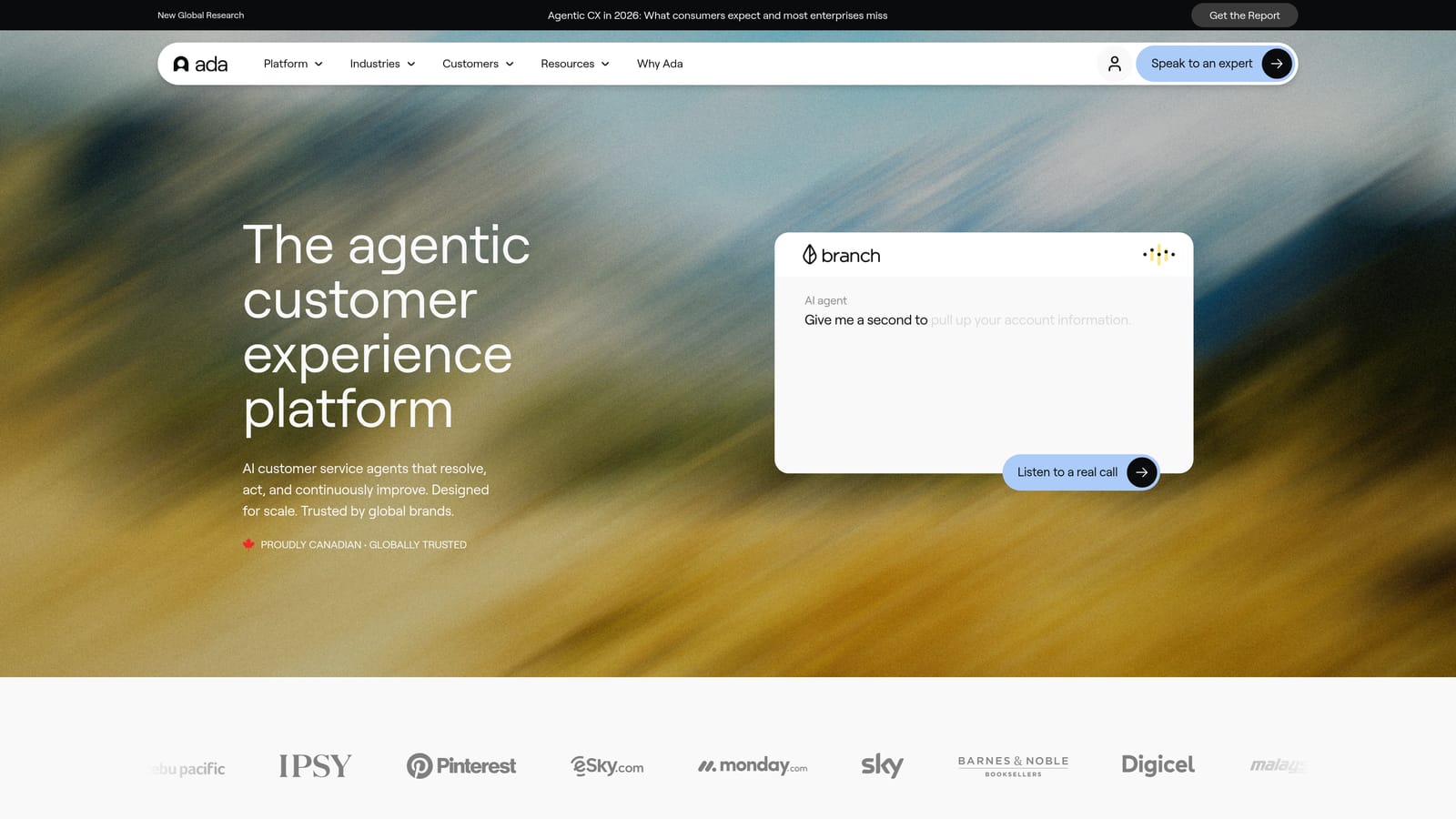
Ada is a no-code AI agent platform that enables enterprises to build action-based AI capable of executing tasks across channels, going well beyond simple FAQ responses.
Where This Tool Shines
Ada's key differentiator is its action-based approach. Rather than just retrieving answers from a knowledge base, Ada's AI agents can execute actual tasks: processing refunds, performing account lookups, updating user information, and completing workflows that would otherwise require a human agent. For multi-tenant platforms with complex self-service requirements, this is a meaningful capability.
The no-code builder makes it accessible to operations and product teams who need to configure the AI without relying on engineering resources for every update. That said, the initial setup investment is more substantial than plug-and-play alternatives.
Key Features
Action-Based AI: Executes tasks like refunds, lookups, and account updates rather than simply retrieving answers.
No-Code Builder: Allows non-technical teams to configure AI behavior, conversation flows, and integrations.
Multi-Channel Deployment: Deploys across web, mobile, and major messaging platforms from a single configuration.
CRM and Helpdesk Integrations: Connects with major CRMs and helpdesk platforms to pull customer data into conversations.
Containment Reporting: Provides detailed analytics on conversation containment rates and deflection performance.
Best For
Enterprise teams with complex self-service requirements who need AI that can take action on behalf of customers, and who have the resources to invest in proper configuration and ongoing optimization.
Pricing
Enterprise pricing. Contact Ada for a quote at ada.cx.
6. Forethought
Best for: Ops-focused teams who want to improve routing accuracy and reduce handle time without replacing their existing helpdesk.
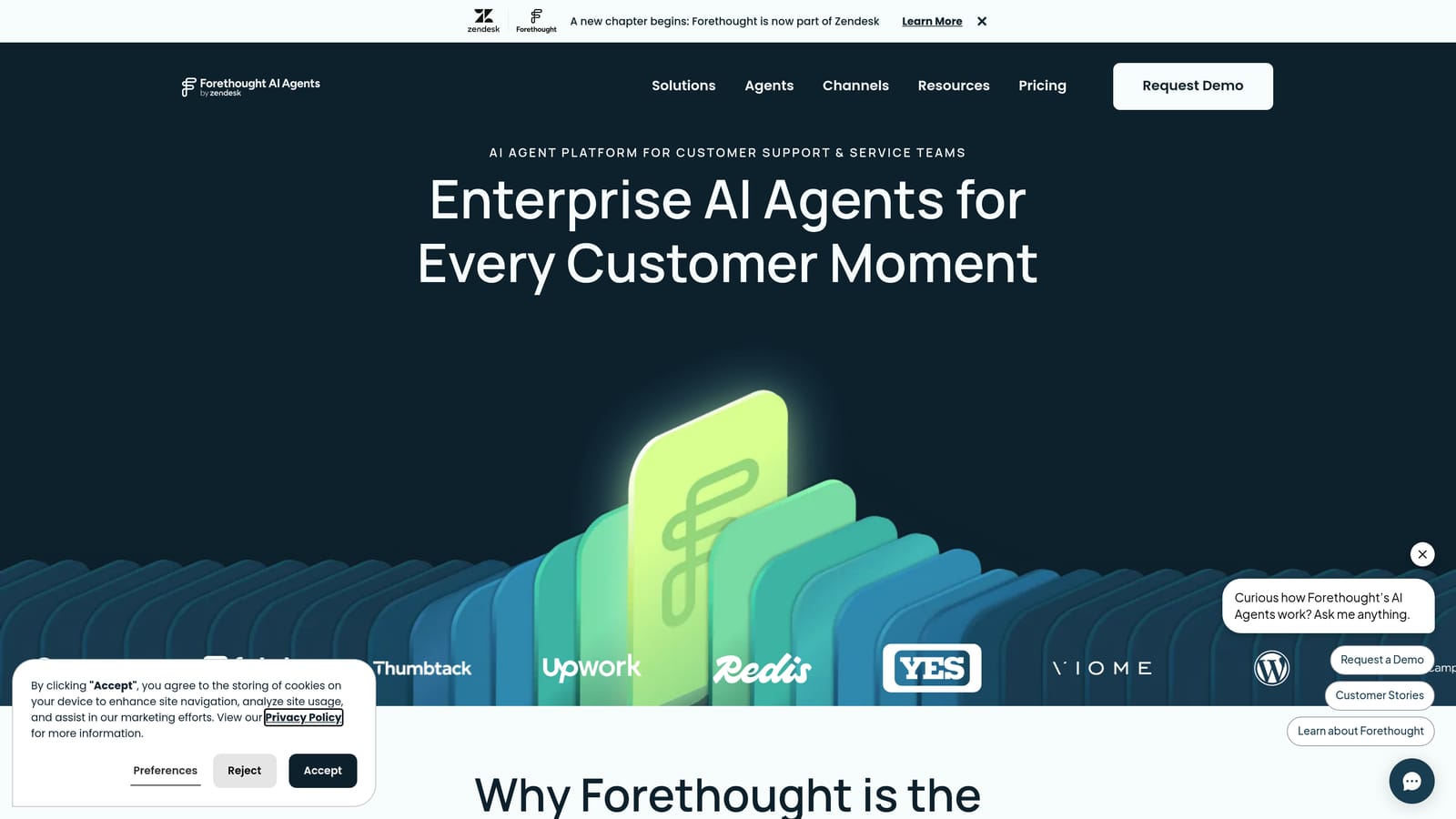
Forethought is an AI triage and agent assist platform designed to layer on top of existing helpdesks, improving routing accuracy and reducing handle time without requiring a full platform migration.
Where This Tool Shines
Forethought's core value proposition is additive: it makes your existing helpdesk smarter without asking you to rip and replace it. For teams with significant investment in Zendesk, Salesforce Service Cloud, or similar platforms, this is a practical path to AI-enhanced support without the disruption of a migration.
The AI triage capabilities are particularly strong for multi-tenant environments where tickets need to be routed to the right team based on account type, issue category, and urgency simultaneously. Forethought handles that complexity at the intake stage, before tickets ever reach an agent queue.
Key Features
AI-Powered Triage and Auto-Tagging: Automatically categorizes and tags incoming tickets based on content and intent.
Intelligent Routing: Routes tickets to the appropriate team or agent based on configurable logic and AI classification.
Agent Assist: Surfaces suggested responses and relevant knowledge articles to agents during live ticket handling.
Solve AI: Provides automated ticket deflection for common inquiries before they reach the queue.
Helpdesk Compatibility: Works alongside Zendesk, Salesforce, and other major helpdesk platforms without replacing them.
Best For
Support operations teams at mid-market and enterprise companies who want measurable improvements in routing efficiency and handle time using their existing helpdesk infrastructure.
Pricing
Custom pricing. Contact Forethought at forethought.ai for a quote.
7. Kustomer
Best for: Relationship-driven support operations where full customer history across every touchpoint is central to the support experience.
Kustomer is a CRM-native support platform that unifies customer history across all channels, with AI built around the complete customer timeline rather than individual tickets.
Where This Tool Shines
Kustomer's architecture treats every customer interaction as part of a continuous relationship, not a series of isolated tickets. The unified timeline view gives agents immediate access to a customer's full history across channels, which is particularly valuable in multi-tenant environments where account context significantly affects how an issue should be handled.
The proactive support capabilities are worth noting: Kustomer can trigger outreach based on customer behavior signals, which opens the door to getting ahead of issues before customers need to reach out at all.
Key Features
Unified Customer Timeline: Aggregates all customer interactions across every channel into a single chronological view.
AI-Powered Routing and Suggested Responses: Routes conversations intelligently and surfaces AI-generated response suggestions based on customer context.
Proactive Support Triggers: Initiates outreach based on customer behavior signals before issues escalate to formal tickets.
Deep CRM Data Integration: Embeds CRM data directly into every support interaction for full relationship context.
Workflow Automation: Supports complex support processes with configurable automation rules across the customer lifecycle.
Best For
High-volume support teams in relationship-driven businesses where customer history and account context are as important as issue resolution speed. Well-suited for platforms where retention depends on high-touch, personalized support experiences.
Pricing
Plans start around $89 per agent per month. Verify current pricing at kustomer.com.
8. Tidio (Lyro AI)
Best for: Smaller platforms and early-stage SaaS teams who need AI support automation with fast setup and accessible pricing.
Tidio is an accessible AI support platform whose Lyro AI agent handles customer conversations autonomously, designed for fast deployment with minimal engineering overhead.
Where This Tool Shines
Lyro AI stands out for how quickly it can be operational. It learns from your existing FAQ and help content, meaning teams can go from zero to AI-powered support in a short timeframe without a heavy configuration process. For early-stage platforms that need to extend their support capacity without hiring, that speed is a real advantage.
The pricing model is also notably accessible compared to enterprise alternatives, making Tidio a practical option for smaller teams that need genuine AI capabilities without a significant budget commitment.
Key Features
Lyro AI Agent: Handles customer conversations end-to-end autonomously, drawing on your existing help content to resolve inquiries.
Fast Setup: Gets operational quickly using existing FAQ and documentation without complex configuration requirements.
Live Chat Fallback: Seamlessly transfers conversations to human agents when Lyro reaches the limits of what it can resolve.
E-Commerce and CMS Integrations: Connects with Shopify, WordPress, and other common platforms popular with smaller teams.
Affordable Pricing: Accessible price points designed for teams that aren't yet at enterprise scale.
Best For
Startups and smaller SaaS platforms that need AI support automation now, without the setup complexity or cost of enterprise solutions. Also a reasonable option for teams that want to test AI-powered support before committing to a more comprehensive platform.
Pricing
Free tier available; Lyro AI plans start around $29 per month. Verify current pricing at tidio.com.
Which Tool Is Right for Your Platform?
The right choice depends heavily on where you are in your growth journey and what your support operation actually needs right now.
If you're running a B2B SaaS platform where tenant context, integration depth, and continuous learning are non-negotiable, Halo AI is built for exactly that environment. The page-aware architecture and business intelligence layer make it particularly well-suited for platforms where support quality is tied directly to retention and expansion.
For enterprise teams already deeply invested in Zendesk, adding AI capabilities through Zendesk's native features or layering Forethought on top is a lower-disruption path. If your team lives in Intercom, Fin AI Agent extends what you already have without a migration.
Growing teams on a budget should look seriously at Freshdesk's Freddy AI for a cost-effective full-stack option, or Tidio's Lyro AI for the fastest path to autonomous support at an accessible price point. For relationship-driven, high-touch support operations, Kustomer's CRM-native approach and unified customer timeline offer something the pure-play AI tools don't.
Ada is worth evaluating when your self-service requirements go beyond answering questions into actually completing tasks on behalf of customers, though it comes with a higher setup investment.
Your support team shouldn't scale linearly with your customer base. Let AI agents handle routine tickets, guide users through your product, and surface business intelligence while your team focuses on complex issues that need a human touch. See Halo in action and discover how continuous learning transforms every interaction into smarter, faster support.