AI Support Implementation Timeline: From Planning to Full Deployment
Implementing AI support isn't just about technology deployment—it's about your organization's readiness. This comprehensive guide reveals the real ai support implementation timeline factors that determine success, from documentation quality and stakeholder alignment to the critical difference between going "technically live" and achieving "effectively operational" status, helping you set realistic expectations beyond vendor promises of 48-hour deployments.
 Matt PattoliFounder15 min read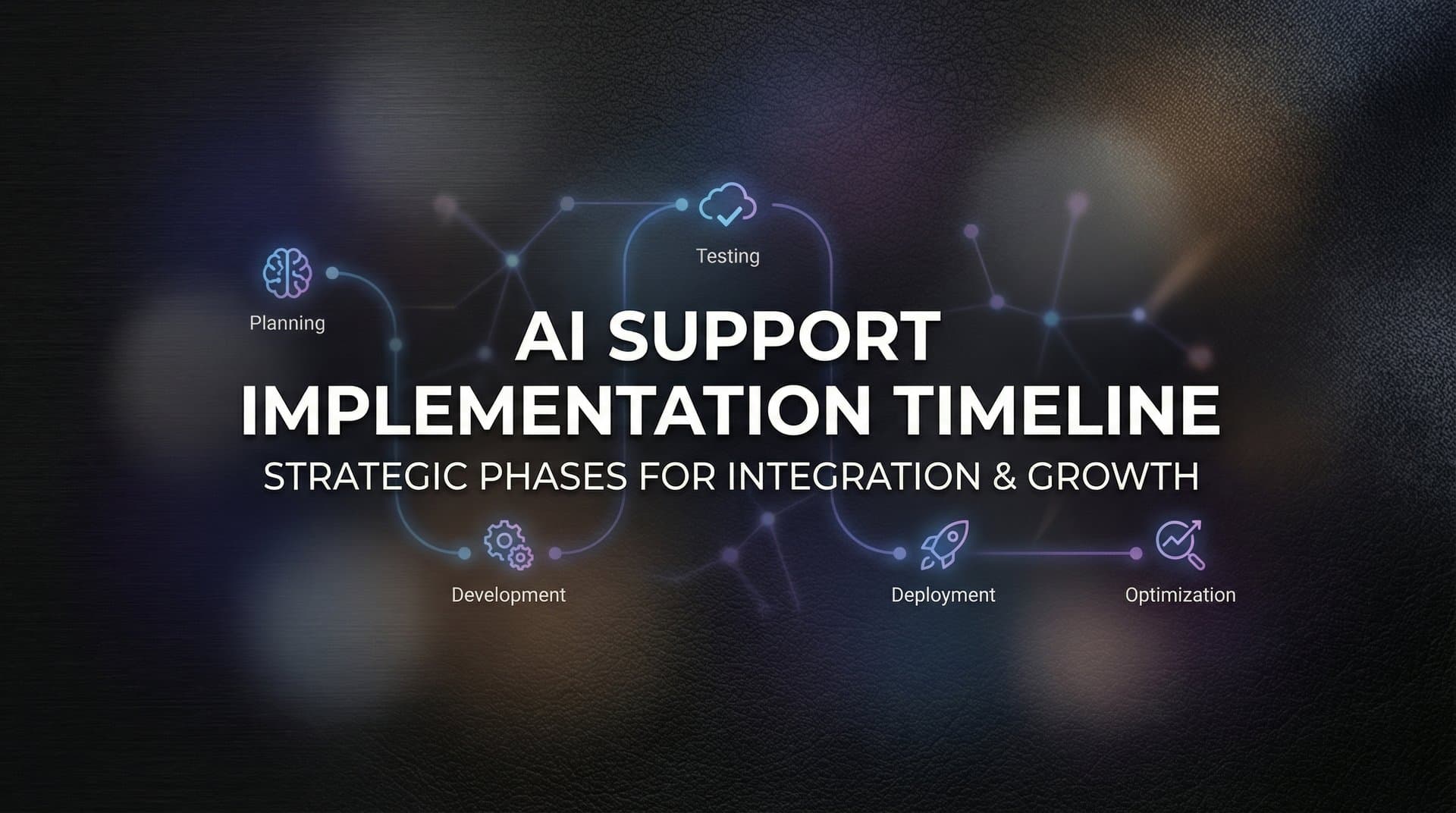
You're three months into evaluating AI support solutions, and every vendor demo ends with the same question from your CFO: "How long until this is actually working?" The sales rep smiles confidently: "We can have you live in 48 hours." Your support lead shifts uncomfortably, remembering the last "quick implementation" that took six months and still doesn't work right.
Here's the truth nobody wants to say upfront: AI support implementation timelines aren't really about the technology. They're about you—your documentation quality, your stakeholder alignment, your willingness to start imperfectly. The companies that deploy AI support fastest aren't the ones with the biggest budgets or the simplest tech stacks. They're the ones who understand that "technically live" and "effectively operational" are completely different milestones.
This guide breaks down what actually happens during AI support implementation, what drives your timeline, and how to set realistic expectations with everyone from your CEO to your frontline agents. No vendor promises, no glossy case studies with conveniently round numbers—just the honest roadmap teams wish they had before starting.
The Four Phases Every AI Support Rollout Follows
AI support implementation isn't a single event—it's a progression through distinct phases, each with different objectives and success criteria. Understanding these phases helps you allocate time realistically and recognize when you're actually ready to move forward.
Phase 1: Discovery and Scoping
This is where most teams either set themselves up for success or lock in months of frustration. Discovery means understanding your current support reality: ticket volume distribution, complexity patterns, seasonal fluctuations, and existing workflows. You're not just counting tickets—you're identifying which types of inquiries consume the most agent time, which questions get asked repeatedly, and where your current process creates bottlenecks.
The best discovery phases involve pulling six months of ticket data and categorizing it honestly. What percentage are truly simple ("Where's my invoice?") versus genuinely complex ("Your API returns inconsistent data when we use OAuth with our legacy system")? How many tickets could be resolved with existing documentation if customers could find it? Where do agents spend time hunting for information that should be readily available?
This phase also surfaces uncomfortable truths about documentation quality. Many teams discover their knowledge base is either outdated, incomplete, or organized in ways that made sense three years ago but don't reflect current product reality. Facing these gaps now prevents discovering them during pilot testing when stakeholders are watching.
Phase 2: Integration and Configuration
Now you're connecting systems and configuring workflows. This means linking your AI platform to your helpdesk system (Zendesk, Freshdesk, Intercom), knowledge bases, business tools, and any other systems that contain information needed for ticket resolution. Modern platforms with pre-built integrations can compress this dramatically compared to custom API work.
Configuration extends beyond technical connections. You're defining routing rules, escalation triggers, and handoff protocols. When should the AI attempt resolution versus immediately routing to a human? What information should be captured before escalation? How should the AI handle edge cases or requests outside its current scope?
This phase also includes setting up the AI's initial knowledge framework—feeding it documentation, FAQs, past ticket resolutions, and product information. The AI isn't learning yet in the full sense; it's ingesting the raw material it will learn from during the next phase.
Phase 3: Training and Testing
This is where your AI support system transforms from a configured tool into an intelligent agent. The AI analyzes historical ticket data, identifies resolution patterns, and begins understanding the nuances of how your team actually solves problems—not just what the documentation says, but how experienced agents handle real customer situations.
Controlled pilot testing starts here. You're not unleashing the AI on your entire ticket queue; you're selecting a subset of ticket types or a small customer segment for initial deployment. This lets you monitor performance closely, identify gaps in training data, and refine responses before expanding coverage.
The key insight: This phase never truly ends. AI support systems with continuous learning capabilities keep refining their understanding with every interaction. But there's a crucial threshold where the AI reaches acceptable resolution rates and can begin handling real tickets at scale. That's your graduation point to Phase 4.
Phase 4: Gradual Rollout and Optimization
You're expanding coverage systematically—adding ticket types, increasing the percentage of tickets the AI handles autonomously, and extending to additional channels or customer segments. This isn't a single "go live" moment; it's a deliberate expansion guided by performance metrics at each stage.
Optimization happens in parallel. You're analyzing which ticket types the AI handles exceptionally well and which still need improvement. You're refining escalation triggers based on real performance data. You're discovering edge cases your discovery phase didn't anticipate and adding them to the AI's knowledge framework.
This phase also includes the human element: training your support team to work alongside AI agents, adjusting their workflows to focus on complex issues, and helping them understand their evolving role. The best implementations treat this as a partnership evolution, not a replacement scenario.
What Actually Determines Your Timeline
Implementation speed isn't primarily about the AI platform's capabilities—it's about three factors that vary dramatically between organizations. Understanding where you stand on each helps you predict your realistic timeline.
Technical Complexity: Your Integration Reality
The number and nature of systems you need to connect creates your technical baseline. A company using Zendesk with a Notion knowledge base and Slack for internal communication has a straightforward integration landscape. A company with a custom-built ticketing system, multiple regional helpdesks, legacy CRM databases, and compliance requirements around data access faces exponentially more complexity.
API availability matters enormously. Modern SaaS tools with robust APIs and webhooks integrate quickly. Legacy systems requiring custom middleware or manual data exports add weeks to your timeline. If your critical business data lives in systems without API access, you're looking at workarounds that introduce ongoing maintenance overhead.
Data migration requirements can be deceptive. Moving ticket history sounds straightforward until you encounter inconsistent categorization, missing metadata, or format incompatibilities. Clean, well-structured historical data accelerates AI training. Messy data requires cleanup before it becomes useful, and cleanup always takes longer than expected.
Organizational Readiness: The Human Factor
Your documentation quality is the single biggest predictor of training phase duration. If your knowledge base accurately reflects current product functionality, uses consistent terminology, and covers common customer questions comprehensively, your AI can learn quickly. If documentation is scattered across Google Docs, Notion pages, Slack threads, and tribal knowledge in senior agents' heads, you're facing a documentation project before you can effectively train AI. Building an automated support knowledge base that scales with your product becomes essential.
Team bandwidth for collaboration determines how quickly you move through decision points. AI implementation requires input from support leaders, product teams, IT/security, and often legal or compliance. If these stakeholders can dedicate focused time to reviews and approvals, you maintain momentum. If they're stretched thin and implementation reviews compete with other priorities, each phase stretches.
Approval processes vary wildly between organizations. Startups might have a founder who can greenlight decisions in real-time. Enterprise companies might require security reviews, change advisory board approvals, vendor assessments, and pilot program authorizations—each with its own timeline. Understanding your approval reality upfront prevents surprise delays.
Scope Decisions: What You're Actually Building
Starting with a single channel versus omnichannel deployment dramatically affects timeline. Implementing AI support for email tickets only is faster than simultaneously deploying across email, chat, social media, and phone. Many successful implementations start narrow and expand once the initial channel proves successful.
The automation level you target matters. Full autonomous resolution for a subset of ticket types can be achieved faster than attempting partial automation across all ticket types. Agent-assist mode (where AI suggests responses for human approval) can deploy faster than fully autonomous mode, giving teams confidence before expanding AI authority.
Geographic and language scope adds complexity. Single-market, English-only deployment is straightforward. Multi-region deployment with localization requirements, regional compliance variations, and language support multiplies complexity. Be honest about whether you need global coverage on day one or can expand regionally after proving the concept.
Realistic Timelines by Company Size and Complexity
Implementation timelines cluster into recognizable patterns based on organizational characteristics. These ranges assume reasonable documentation quality and engaged stakeholders—adjust expectations if those foundations are shaky.
Lean Startups with Simple Stacks: 2-4 Weeks
Small companies using modern SaaS tools with standard integrations can move remarkably fast. A startup with 50-200 support tickets weekly, using Intercom or Zendesk with a straightforward knowledge base, can often reach operational deployment within two to four weeks.
The advantages here are speed and simplicity. Fewer stakeholders mean faster decisions. Smaller ticket volumes mean the AI can learn patterns quickly. Modern tool stacks with pre-built integrations eliminate custom development work. And startup teams are often comfortable with "good enough" initial deployments that improve over time rather than demanding perfection upfront.
The typical breakdown: Week one for discovery and scoping, week two for integration and initial configuration, week three for training and pilot testing with a small ticket subset, week four for expanding coverage and initial optimization. By the end of week four, the AI is handling a meaningful percentage of incoming tickets autonomously.
This timeline assumes documentation exists and is reasonably current. If your knowledge base needs significant work, add one to two weeks for documentation improvement before starting the implementation clock.
Mid-Market Companies with Multiple Tools: 4-8 Weeks
Companies with 200-2,000 tickets weekly, multiple integrated business tools, and established support processes typically need four to eight weeks for effective deployment. The additional time reflects integration complexity, more stakeholders in the approval process, and larger volumes of historical data to analyze.
These implementations often involve connecting the AI platform to helpdesk systems, CRM platforms, billing systems, product analytics tools, and internal communication platforms. Each integration requires configuration, testing, and validation. Security reviews become more formal. Change management processes require documentation and stakeholder sign-offs.
The pilot phase extends here because there's more to test. With higher ticket volumes and more ticket type diversity, you want confidence across a broader range of scenarios before full rollout. This isn't perfectionism—it's appropriate risk management when support operations are business-critical.
Successful mid-market implementations often use a phased rollout strategy: Start with the highest-volume, lowest-complexity ticket types to demonstrate value quickly. Once those are performing well, expand to more complex categories. This builds stakeholder confidence and generates internal champions who advocate for broader adoption.
Enterprise with Compliance Requirements: 8-16 Weeks
Large organizations with thousands of weekly tickets, complex tool ecosystems, regulatory compliance requirements, and formal change management processes should plan for two to four months from kickoff to meaningful operational deployment.
The extended timeline reflects necessary governance. Security teams need to review data handling practices, access controls, and integration security. Compliance teams need to validate that AI-generated responses meet regulatory requirements for industries like healthcare, financial services, or government contracting. Legal teams review vendor contracts, data processing agreements, and liability considerations.
Enterprise implementations also involve more extensive change management. You're not just deploying technology—you're changing workflows for potentially hundreds of support agents across multiple teams or regions. Training programs, documentation updates, and transition planning all require time and coordination.
The advantage enterprises have is resources. Larger implementations often include dedicated project managers, technical resources for integration work, and executive sponsorship that can accelerate decision-making when needed. The timeline is longer, but the foundation is often more solid.
Phased rollouts are standard here: Pilot with a single team or region, validate performance and refine processes, then expand systematically. This approach manages risk and builds organizational confidence before company-wide deployment.
The Hidden Timeline Killers (And How to Avoid Them)
Three factors kill implementation timelines more than any technical challenge. Recognizing them early lets you address them proactively rather than discovering them mid-implementation when momentum stalls.
Documentation Debt: The AI's Learning Limitation
AI support systems learn from your existing knowledge base, historical ticket resolutions, and documentation. If that foundation is incomplete, outdated, or inconsistent, the AI can't learn effectively no matter how sophisticated the platform. This is the most common timeline killer because teams underestimate the documentation work required.
The symptoms appear during pilot testing. The AI handles some ticket types brilliantly but struggles with others that should be straightforward. Investigation reveals that documentation for those topics is three years old, references deprecated features, or simply doesn't exist. Now you're pausing implementation to create documentation that should have existed already.
The fix is painful but necessary: Documentation audit before implementation begins. Review your knowledge base honestly. What percentage of articles accurately reflects current product functionality? Where are the gaps? What topics generate frequent tickets but lack documentation? Address the worst gaps before starting AI training, or plan for extended training phases while documentation catches up. Learning how to build automated support documentation that scales can prevent these delays.
Some teams try to shortcut this by having the AI learn solely from historical ticket resolutions. This works for some ticket types but creates problems when agent responses were inconsistent, when product functionality has changed, or when resolutions involved undocumented workarounds that shouldn't be perpetuated.
Stakeholder Misalignment: The Decision Bottleneck
AI implementation requires decisions at every phase: Which ticket types to prioritize, what resolution rates justify expansion, when to escalate versus attempt resolution, how to measure success. When stakeholders aren't aligned on these decisions upfront, each phase stalls while you build consensus.
The pattern is predictable. You finish pilot testing and present results to stakeholders. Support leadership is thrilled with 70% autonomous resolution rates. Product leadership questions why the AI isn't handling more complex technical questions. The CFO asks why you're not seeing cost savings yet when the AI is "live." Each stakeholder had different expectations, and now you're negotiating instead of implementing.
The prevention is unglamorous but effective: Alignment meetings before implementation starts. Get stakeholders to agree on success metrics for each phase, escalation protocols, and the timeline for measuring ROI. Document these agreements and reference them when questions arise later.
Be specific about what success looks like at each milestone. "The AI will handle 50% of tier-one tickets autonomously by week six" is measurable and clear. "The AI will significantly reduce support costs" is vague and invites disagreement about whether you've achieved it. Vague goals create implementation delays when stakeholders disagree about whether you've met them.
Perfectionism in Pilot: The Expansion Trap
Many implementations stall in pilot phase because teams wait for perfect performance before expanding. The AI handles 75% of pilot tickets successfully, but the team focuses on the 25% it missed rather than expanding coverage. Months pass while they tune and refine, trying to reach 95% success rates before moving forward.
This is a trap because AI support systems improve through exposure to diverse scenarios. Keeping the AI in a limited pilot prevents it from encountering the edge cases and variations that drive learning. You're optimizing for a narrow slice of tickets while delaying the broader learning that comes from expanded deployment.
The mindset shift: Treat pilot success as "good enough to expand" rather than "perfect before expanding." If your AI handles 70-80% of pilot tickets successfully and escalates appropriately when uncertain, that's sufficient to expand to additional ticket types or customer segments. The AI will improve faster with broader exposure than with extended optimization in a limited pilot.
Set expansion criteria upfront: "When we achieve 70% autonomous resolution with less than 5% escalations requiring manager intervention, we expand to the next ticket category." This prevents endless optimization cycles and maintains implementation momentum.
Building Your Implementation Roadmap
A realistic implementation roadmap balances speed with sustainability. You want to move quickly enough to generate value and maintain stakeholder confidence, but not so fast that you skip foundations that prevent long-term success.
Pre-Launch Checklist: Foundation Before Implementation
Before your official implementation kickoff, ensure you have these elements ready. Missing any of them will surface as delays later, so addressing them upfront accelerates everything that follows.
Historical ticket data: Six to twelve months of ticket history with consistent categorization. If your categorization is inconsistent or incomplete, clean it now. The AI learns patterns from this data—garbage in, garbage out.
Current documentation: Knowledge base articles, FAQs, troubleshooting guides, and product documentation that accurately reflects current functionality. Flag known gaps so you can prioritize filling them during implementation.
Integration credentials and access: API keys, admin access, and necessary permissions for all systems you're integrating. Waiting for IT to provision access adds days or weeks to your timeline.
Stakeholder availability: Confirmed time commitments from everyone needed for decisions and reviews. A two-week implementation timeline means nothing if your key stakeholder is unavailable for three of those weeks.
Success metrics defined: Clear, measurable criteria for each implementation phase. What does "successful pilot" mean quantitatively? When do you expand coverage? What triggers optimization versus moving forward? Understanding automated support performance metrics helps you define these criteria effectively.
Milestone Planning: Weekly Goals and Decision Points
Break your implementation into weekly milestones with specific deliverables and decision points. This creates accountability and helps you recognize when you're falling behind early enough to adjust.
Week one might focus on discovery completion and integration setup. The decision point: Do we have sufficient historical data and documentation quality to proceed, or do we need to address gaps first? Week two focuses on initial AI training and configuration. The decision point: Is the AI demonstrating basic understanding of ticket patterns, or do we need to refine training data?
Week three launches pilot testing with a controlled ticket subset. The decision point: Are resolution rates and escalation patterns acceptable for this limited scope? Week four expands pilot coverage or begins full rollout depending on week three results.
Each milestone should have a clear owner, specific deliverables, and a decision point that determines whether you proceed or iterate. This structure prevents drift where weeks pass without clear progress because nobody's sure what should happen next.
Success Metrics by Phase: Knowing You're On Track
Different metrics matter at different implementation stages. Tracking the right metrics for each phase helps you recognize success and identify problems early.
Discovery and scoping phase: Measure completeness of ticket categorization, documentation coverage percentage, and stakeholder alignment on priorities. Success means you understand your current state accurately and everyone agrees on the path forward.
Integration and configuration phase: Track integration completion, data flow validation, and system connectivity. Success means all your systems are talking to each other reliably and data is flowing correctly.
Training and pilot phase: Monitor autonomous resolution rate, escalation accuracy (is the AI escalating appropriately versus too frequently or too rarely?), and response quality as rated by agents reviewing AI-generated responses. Success means the AI is learning effectively and handling pilot tickets at acceptable rates. Setting up an effective automated support escalation workflow ensures complex issues route correctly.
Rollout and optimization phase: Track coverage expansion (percentage of ticket types where AI is active), resolution rate by ticket category, customer satisfaction scores, and agent time savings. Success means you're expanding systematically while maintaining quality.
Avoid vanity metrics like "number of tickets touched by AI" if most of those touches are low-value suggestions agents ignore. Focus on metrics that reflect genuine value: tickets fully resolved without agent intervention, reduction in average handling time, improvement in support ticket resolution time.
Moving Forward with Realistic Expectations
Implementation timelines ultimately depend less on the AI platform and more on your organizational readiness. The companies that deploy AI support fastest aren't lucky or unusually simple—they're prepared. They've addressed documentation gaps, aligned stakeholders on success criteria, and committed resources to move through phases deliberately but efficiently.
The timeline factors within your control—documentation quality, stakeholder alignment, scope clarity—have more impact than technical complexity. A well-prepared enterprise with complex integrations often deploys faster than an unprepared startup with a simple stack. Preparation beats simplicity every time.
Remember that "going live" isn't the finish line—it's the starting line for continuous improvement. Modern AI support platforms learn from every interaction, improving resolution rates and expanding capabilities over time. The initial implementation timeline gets you operational, but the real value compounds through ongoing learning and optimization.
Your support team shouldn't scale linearly with your customer base. Let AI agents handle routine tickets, guide users through your product, and surface business intelligence while your team focuses on complex issues that need a human touch. See Halo in action and discover how continuous learning transforms every interaction into smarter, faster support.