9 Best AI Support Platforms for Ecommerce in 2026
This guide compares the 9 best AI support platforms for ecommerce in 2026, evaluating each solution on ecommerce-specific capabilities like order tracking automation, returns handling, and Shopify integration depth. Whether you're a DTC brand or multi-storefront operation, it helps you identify the right platform to autonomously resolve high ticket volumes, personalize responses with live order data, and scale support without adding headcount.
 Matt PattoliFounder13 min read
Ecommerce support teams face a challenge that most generic helpdesks weren't designed to solve. High ticket volumes driven by order tracking, returns, sizing questions, and payment issues arrive constantly, often with razor-thin margins that make scaling headcount impractical. The good news is that AI support platforms built specifically for ecommerce workflows can resolve routine inquiries autonomously, personalize responses using live order data, and escalate complex issues to human agents without friction.
But not every AI platform is built with ecommerce in mind. Some excel at Shopify integration, others at multi-channel coverage, and a few go deeper with business intelligence that turns support data into revenue insights. We evaluated these platforms based on ecommerce-specific capabilities, integration depth with popular commerce stacks, automation accuracy, pricing transparency, and scalability. Whether you're running a DTC brand on Shopify or managing a multi-storefront B2B operation, here are the top AI support platforms worth considering today.
1. Halo AI
Best for: Ecommerce teams wanting autonomous AI agents with built-in business intelligence and deep stack integrations.
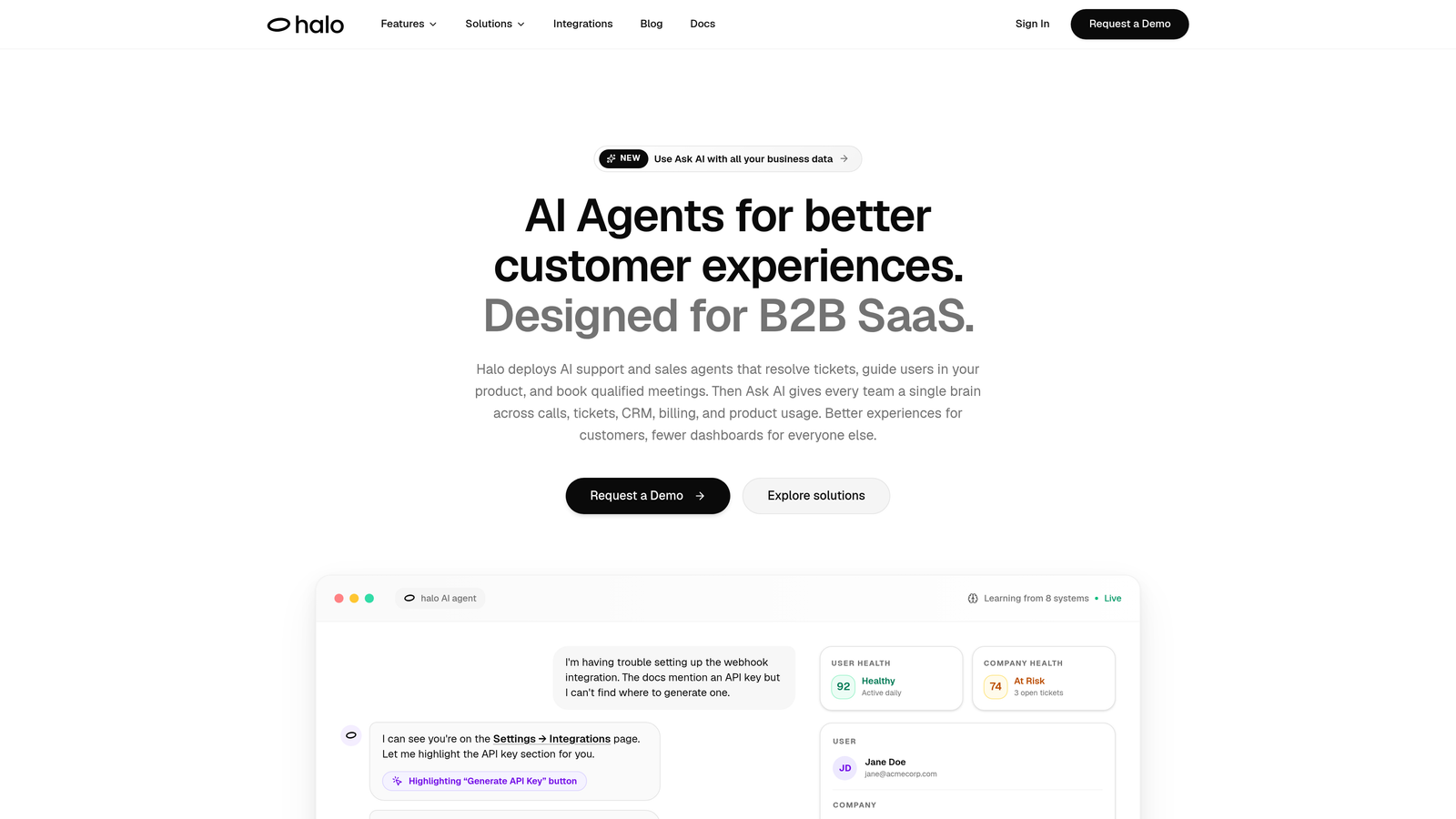
Halo AI is an AI-first customer support platform that resolves tickets autonomously, guides users visually through your product, and surfaces revenue intelligence from every support interaction.
Where This Tool Shines
What separates Halo from most support tools is that AI isn't a feature bolted onto an existing helpdesk. It's the architecture. Every ticket resolved, every conversation handled, every escalation logged feeds back into the system to make the next interaction smarter. For ecommerce teams dealing with repetitive WISMO queries and return requests, that continuous learning compounds quickly.
The page-aware chat widget is particularly valuable in an ecommerce context. Rather than serving generic responses, Halo's AI sees what the customer sees on any given page, whether that's a product detail page, checkout, or order history. That context shapes every response, making guidance feel relevant rather than robotic.
Key Features
Page-Aware Chat Widget: The AI understands which page a customer is on and provides contextually relevant visual guidance, reducing back-and-forth for navigation and checkout issues.
Autonomous AI Agents: Halo's agents resolve tickets end-to-end and learn from every interaction, improving resolution accuracy over time without manual retraining.
Smart Inbox with Business Intelligence: Beyond ticket management, the smart inbox surfaces customer health signals, revenue intelligence, and anomaly detection, turning support data into strategic insights.
Auto Bug Ticket Creation: When support conversations reveal product issues, Halo automatically creates bug tickets in connected systems like Linear, removing manual triage from your engineering workflow.
Deep Ecommerce Integrations: Native connections to Shopify, Stripe, Intercom, HubSpot, Slack, Linear, Zoom, PandaDoc, and Fathom give Halo full context across your commerce and operations stack.
Best For
Ecommerce and SaaS teams that want AI to handle the full support lifecycle autonomously, not just deflect tickets. Particularly strong for teams that also want business intelligence from support data, or those managing complex multi-tool stacks where context from Stripe, Shopify, and HubSpot all need to inform agent responses.
Pricing
Contact for pricing; a usage-based model is available, making it accessible for teams that want costs tied to actual resolution volume rather than seat counts.
2. Gorgias
Best for: Shopify and BigCommerce stores that need agents to take order actions directly from the ticket view.
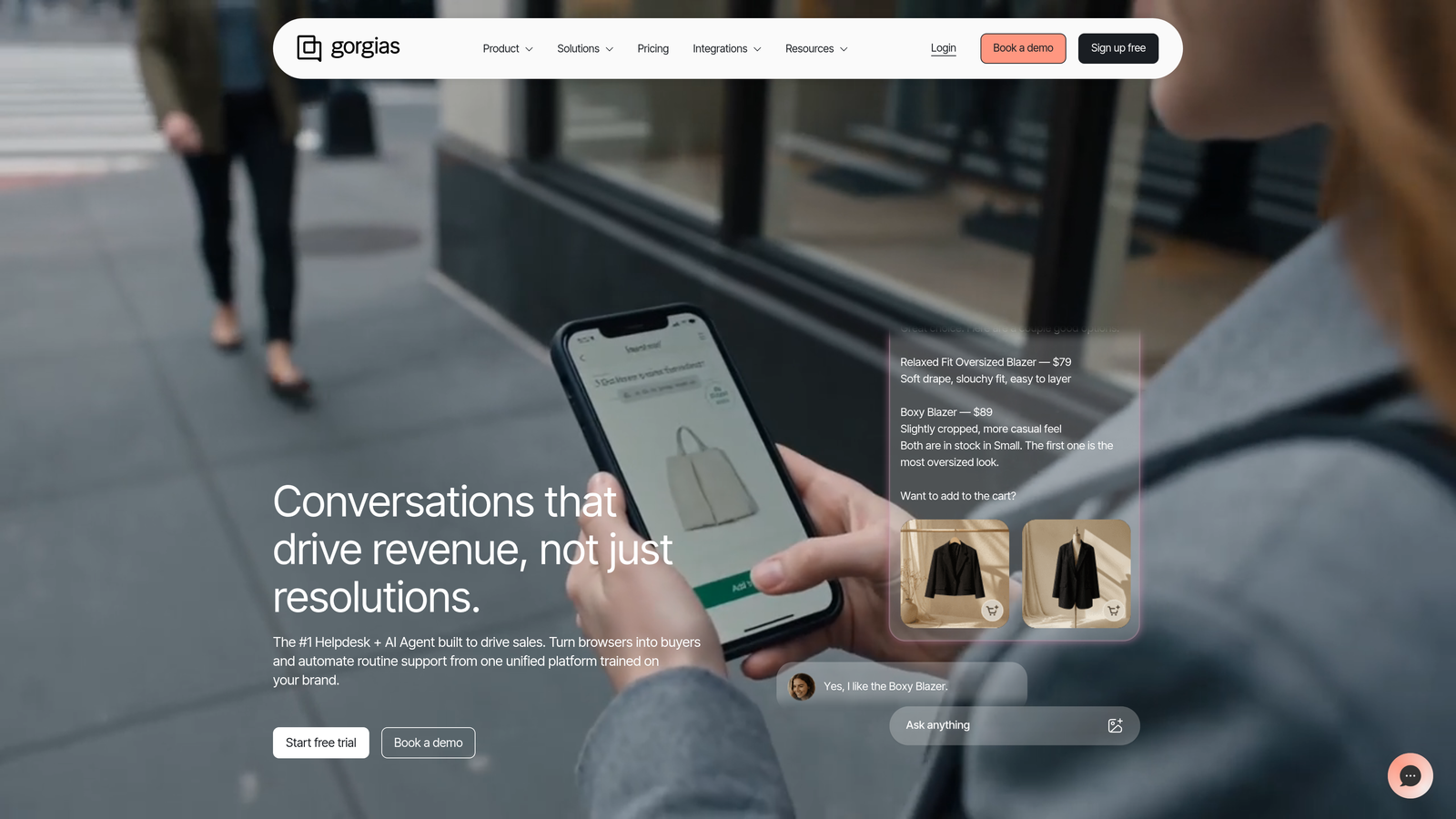
Gorgias is an ecommerce-native helpdesk that lets both human agents and AI respond to tickets with full order context and take direct actions like issuing refunds or cancellations.
Where This Tool Shines
Gorgias was built from the ground up for ecommerce, and it shows. The order sidebar pulls live Shopify or BigCommerce data directly into the ticket view, so agents never need to switch tabs to look up order status, shipping details, or customer history. That alone reduces handle time significantly for high-volume stores.
The revenue tracking dashboard is a standout feature that many competing tools lack. It ties support interactions to conversion data, helping teams understand which conversations actually drive purchases and which are pure cost centers.
Key Features
Native Ecommerce Integrations: Deep Shopify, BigCommerce, and Magento integrations with a live order sidebar visible in every ticket.
AI Auto-Responses: Automated replies for common ecommerce queries like order status, shipping estimates, and return policies.
Macros and Rules Engine: Automated ticket routing, tagging, and response templates that reduce manual work for repetitive request types.
Revenue Tracking Dashboard: Connects support interactions to sales data, giving visibility into support's impact on revenue.
Multi-Channel Coverage: Unified inbox across email, live chat, social media, and SMS.
Best For
DTC brands and mid-market Shopify or BigCommerce stores that want a purpose-built ecommerce helpdesk with strong order action capabilities. Less suited for teams needing advanced AI autonomy or deep business intelligence beyond support metrics.
Pricing
Starts at $10/month for 10 tickets; pricing scales with ticket volume, which can become expensive for high-volume stores during peak seasons.
3. Tidio
Best for: Small to mid-sized ecommerce stores looking for an affordable AI chatbot with quick Shopify or WooCommerce setup.
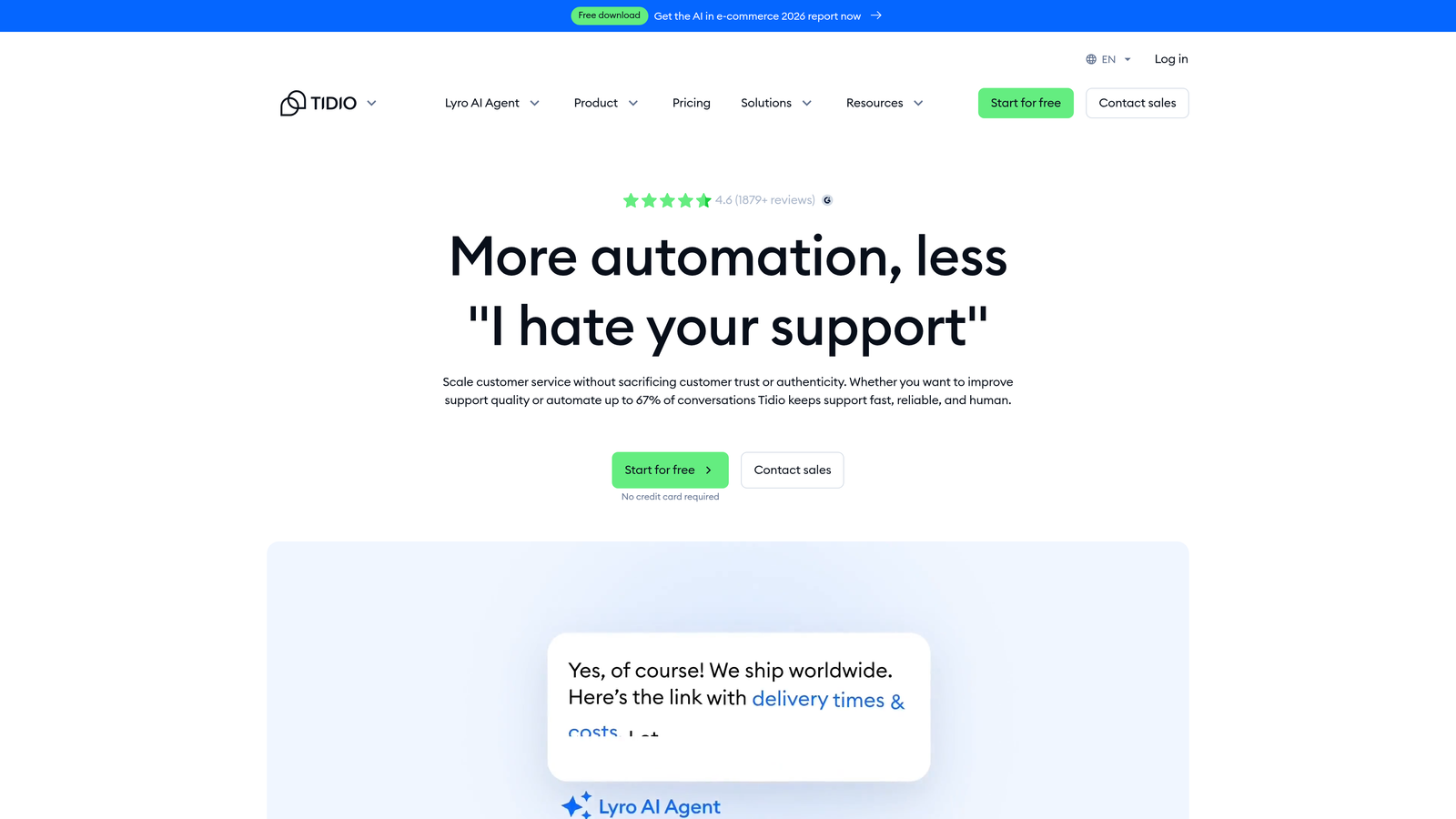
Tidio is a budget-friendly live chat and AI chatbot platform with a dedicated Lyro AI assistant, ecommerce templates, and a no-code builder that gets stores up and running fast.
Where This Tool Shines
Tidio's strength is accessibility. The visual chatbot builder requires no technical knowledge, and the Shopify and WooCommerce plugins mean most stores can deploy a functioning AI chatbot in under an hour. For small teams without a dedicated support engineer, that matters.
Lyro, Tidio's conversational AI, is trained on your existing help content and handles common questions with reasonable accuracy. It won't match the autonomy of enterprise-grade AI agents, but for stores primarily dealing with FAQ-style inquiries, it covers a solid portion of ticket volume.
Key Features
Lyro AI Chatbot: Conversational AI trained on your help content, with ecommerce-specific templates for common query types.
No-Code Visual Builder: Drag-and-drop chatbot flow builder with no technical setup required.
Shopify and WooCommerce Plugins: One-click installation for the two most popular ecommerce platforms.
Live Chat with Visitor Tracking: Real-time visitor monitoring with canned responses to speed up human agent replies.
Free Tier: Basic chatbot and live chat functionality available at no cost, making it accessible for new stores.
Best For
Small ecommerce businesses and solo operators who need an affordable, easy-to-deploy chatbot without complex configuration. Teams that outgrow Tidio's AI capabilities often migrate to more autonomous platforms as ticket volume scales.
Pricing
Free tier available; paid plans start at $29/month; Lyro AI is an add-on from $39/month, which can add up if you need both live chat and AI capabilities.
4. Zendesk AI
Best for: Large ecommerce operations needing enterprise-grade omnichannel support with robust analytics and a deep integration marketplace.
Zendesk AI is an enterprise omnichannel support platform with autonomous AI agents, advanced reporting, and an extensive app marketplace that covers virtually every ecommerce tool in the market.

Where This Tool Shines
Zendesk's maturity shows in its analytics and configurability. Custom reporting dashboards, SLA management, and intelligent routing give large support operations the operational visibility they need to manage teams across time zones and channels. The app marketplace is genuinely massive, with connectors for Shopify, BigCommerce, Salesforce, and hundreds of other tools.
The AI agents have improved considerably and can now handle ecommerce-specific contexts with reasonable autonomy. For enterprises already invested in the Zendesk ecosystem, the AI layer adds meaningful automation without requiring a platform migration.
Key Features
AI Agents: Autonomous ticket resolution with ecommerce context pulled from connected platforms.
Omnichannel Support: Unified coverage across email, chat, phone, social media, and messaging apps like WhatsApp and Facebook Messenger.
Advanced Analytics: Custom reporting dashboards with SLA tracking, agent performance metrics, and ticket trend analysis.
App Marketplace: Thousands of integrations including Shopify, BigCommerce, and major ecommerce tools.
Intelligent Routing: AI-powered ticket routing based on content, intent, and agent availability.
Best For
Enterprise ecommerce brands and multi-brand retailers with large support teams, complex routing needs, and existing Zendesk infrastructure. The pricing and configuration complexity make it less practical for smaller stores.
Pricing
Starts at $19/agent/month for the Support Team plan; AI features are available on higher tiers starting from $55/agent/month, which adds up quickly for large teams.
5. Intercom Fin
Best for: Ecommerce brands that want to blend customer support with proactive engagement, upsells, and onboarding in a single platform.
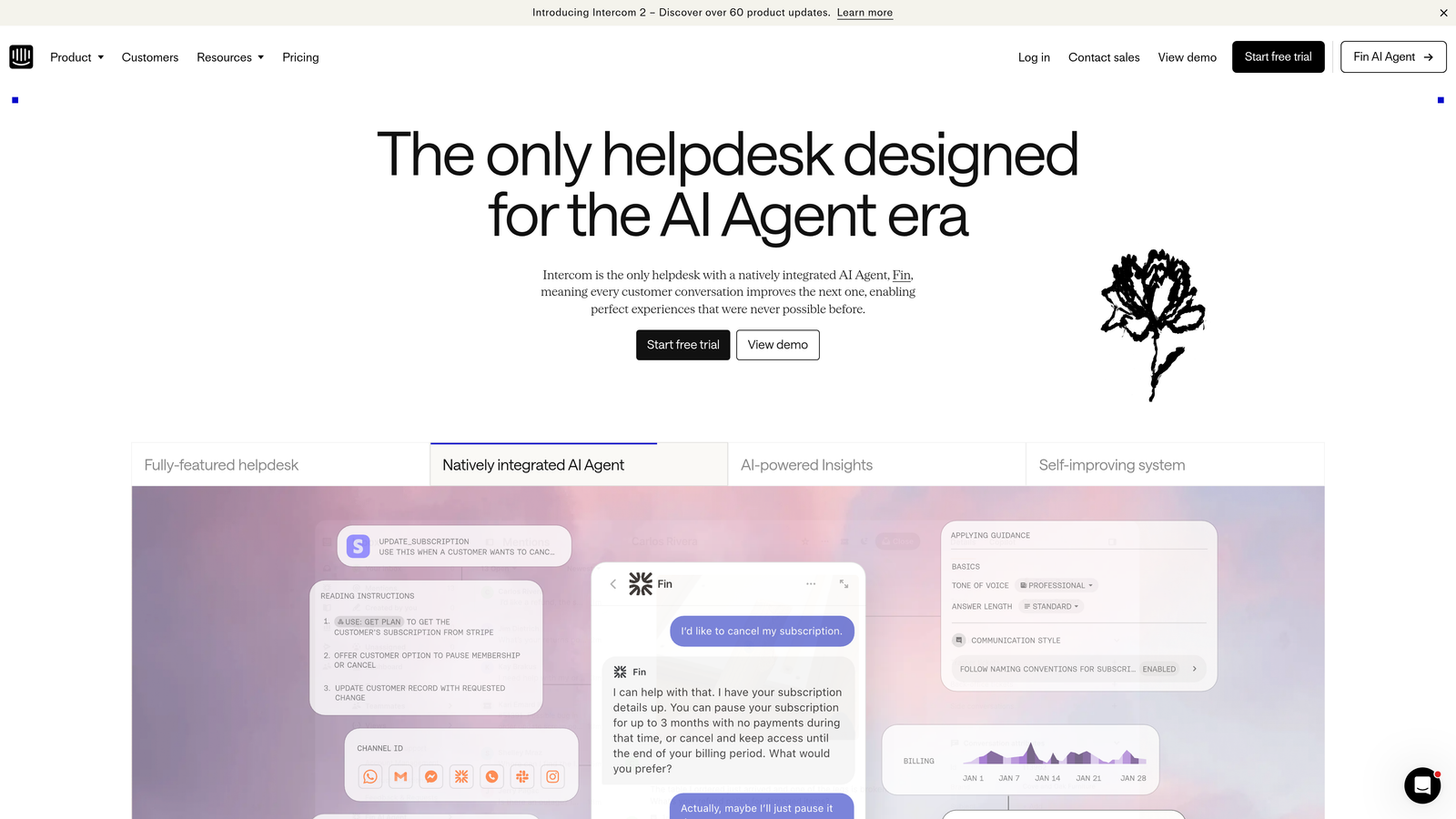
Intercom Fin is a conversational AI agent that resolves support questions using your knowledge base, while the broader Intercom platform handles proactive messaging, product tours, and customer lifecycle engagement.
Where This Tool Shines
Fin's knowledge base integration is clean and cited, meaning customers see which help article informed the AI's answer. That transparency builds trust, particularly for ecommerce customers who are skeptical of automated responses. The per-resolution pricing model also aligns costs with actual value delivered, rather than charging for seats that may sit idle.
Where Intercom really differentiates is the combination of reactive support and proactive engagement. Cart abandonment messages, onboarding tooltips, and product tours live in the same platform as your support inbox, giving ecommerce teams a unified view of the customer journey.
Key Features
Fin AI Agent: Resolves questions using your knowledge base with cited sources visible to customers.
Proactive Messaging: In-app and on-site messages for cart abandonment recovery, upsells, and promotional campaigns.
Custom Workflows: Bots and automation flows for order status, returns, FAQs, and escalation paths.
Unified Inbox: Consolidated view across chat, email, and social channels.
Product Tours and Tooltips: In-product guidance tools for onboarding and self-service education.
Best For
Ecommerce brands that view support and customer engagement as connected functions, and want a single platform to manage both. The per-resolution pricing for Fin suits teams with moderate ticket volumes but can become costly at scale.
Pricing
Starts at $39/seat/month; Fin AI is charged per resolution from $0.99/resolution, so total cost depends heavily on your ticket volume and resolution rate.
6. Ada
Best for: Enterprise ecommerce brands needing multilingual AI support with no-code automation and global deployment capabilities.
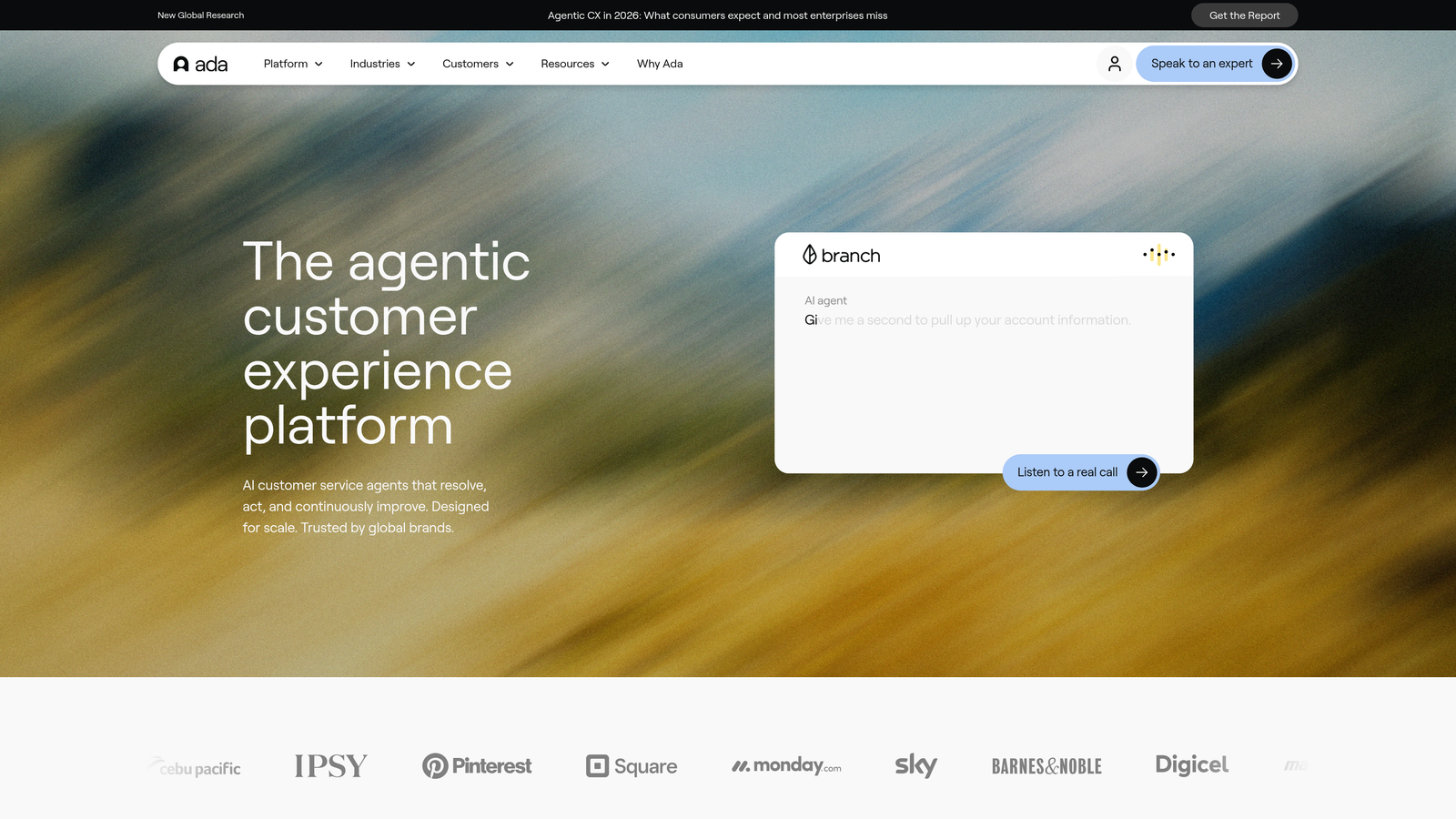
Ada is a no-code AI automation platform with multilingual support across 50+ languages, ecommerce action integrations, and enterprise-grade scalability for global operations.
Where This Tool Shines
Ada's multilingual capabilities are among the strongest in the market, making it particularly well-suited for ecommerce brands selling internationally. The no-code conversation builder lets non-technical teams design and iterate on automation flows without engineering involvement, which reduces time-to-deployment considerably.
The containment rate analytics are genuinely useful for ecommerce operations managers. Understanding what percentage of conversations the AI handles without human escalation, and where the drop-off points are, helps teams continuously improve automation coverage.
Key Features
No-Code Bot Builder: Drag-and-drop conversation design that non-technical teams can manage independently.
Ecommerce Action Integrations: Connects to ecommerce platforms to handle order lookup, returns, and exchanges autonomously.
Multilingual AI: Supports 50+ languages for global ecommerce deployments.
Omnichannel Deployment: Available across web, mobile, social media, and messaging platforms.
Containment Rate Analytics: Dashboard tracking AI resolution rates and CSAT scores to measure automation effectiveness.
Best For
Global ecommerce brands with diverse customer bases across multiple languages and regions. Also strong for enterprise teams that want non-technical staff to own and iterate on automation flows without relying on engineering resources.
Pricing
Custom pricing; contact Ada's sales team for a quote. The enterprise focus means pricing typically reflects larger deployment scales.
7. Freshdesk Freddy AI
Best for: Growing ecommerce teams that need strong AI-assisted helpdesk capabilities at competitive price points with a free tier for small operations.
Freshdesk Freddy AI is an AI-enhanced helpdesk from Freshworks offering automatic ticket triage, suggested responses, and omnichannel support at pricing that remains accessible for mid-market ecommerce teams.
Where This Tool Shines
Freshdesk hits a useful middle ground between affordability and capability. Freddy AI handles automatic ticket classification and prioritization, which reduces the manual triage burden that overwhelms support teams during peak ecommerce seasons like Black Friday or post-holiday returns windows.
The self-service portal with knowledge base and community forums is well-developed for the price point. For ecommerce stores where many customer questions are genuinely answerable through documentation, a strong self-service layer can deflect a meaningful portion of incoming tickets before they reach the queue.
Key Features
Freddy AI Triage: Automatic ticket classification, prioritization, and suggested responses based on ticket content and history.
Ecommerce Integrations: Shopify and WooCommerce connectors available through the Freshworks Marketplace.
Omnichannel Ticketing: Unified inbox across email, live chat, phone, and social media.
Self-Service Portal: Knowledge base and community forum builder for customer self-resolution.
Free Tier: Up to 2 agents at no cost, making it accessible for very small ecommerce operations just getting started.
Best For
Small to mid-market ecommerce teams that need a capable, affordable helpdesk with AI assistance. Teams that need deep autonomous AI action capabilities or advanced business intelligence will find Freshdesk's AI layer more assistive than autonomous.
Pricing
Free tier for up to 2 agents; paid plans from $15/agent/month; AI features unlock on the Pro plan at $49/agent/month.
8. Richpanel
Best for: Shopify-first ecommerce brands that want customers to self-serve order management tasks without any agent involvement.
Richpanel is an ecommerce-first support platform with a branded self-service portal where customers can track orders, initiate returns, and modify purchases entirely on their own.
Where This Tool Shines
Richpanel's self-service portal is the standout feature. Rather than routing every order-related inquiry through an agent or chatbot, customers can take direct action themselves: track a package, submit a return request, or update an order, all within a branded portal that feels like an extension of the store. For ecommerce brands where WISMO queries dominate ticket volume, this is a meaningful deflection mechanism.
The AI-powered agent assist layer complements the self-service portal well. When customers do reach the inbox, agents get suggested replies and full order context pulled from Shopify or Magento, reducing resolution time for the tickets that do require human attention.
Key Features
Customer Self-Service Portal: Branded portal where customers independently handle order tracking, returns, and exchanges.
Native Ecommerce Integrations: Deep connections to Shopify, Magento, and WooCommerce with live order data.
AI Agent Assist: Suggested replies and order context surfaced for human agents handling escalated tickets.
Multi-Channel Inbox: Consolidated email, chat, social media, and phone support.
Performance Analytics: Revenue and support metrics tied together in a single reporting view.
Best For
Shopify and Magento stores with high order-related ticket volumes that want to reduce agent workload through customer self-service rather than purely AI automation. Strong for brands that prioritize a polished, on-brand customer portal experience.
Pricing
Starts at $29/month for Shopify stores; enterprise plans are available for larger operations and multi-storefront brands.
9. Siena AI
Best for: Ecommerce brands with a strong brand voice that need AI to maintain consistent tone and empathy across every customer interaction.
Siena AI is an AI-native customer support agent designed specifically for ecommerce, with persona-based brand voice consistency, empathy-aware tone matching, and autonomous order action capabilities.
Where This Tool Shines
Siena's differentiator is personality. Most AI support tools focus on resolution accuracy, and Siena does too, but it layers on a persona engine that maintains your brand's specific tone, whether that's warm and conversational, premium and formal, or playful and irreverent. For DTC brands where voice is a core part of the customer experience, that consistency across every automated interaction matters.
The empathy engine is a genuinely interesting capability. It adjusts the AI's tone based on detected customer sentiment, responding differently to a frustrated customer than to someone asking a neutral product question. That kind of contextual awareness reduces the robotic feeling that undermines customer trust in AI support.
Key Features
Persona-Based AI: Maintains consistent brand voice and personality across all automated interactions.
Autonomous Order Actions: Handles order modifications, tracking requests, and return initiations without agent involvement.
Empathy Engine: Adapts tone and response style based on real-time customer sentiment detection.
Multi-Channel Deployment: Available across email, social DMs, and live chat.
Shopify Integrations: Real-time order data access for accurate, context-rich responses.
Best For
Brand-forward DTC ecommerce companies where tone and voice consistency are as important as resolution speed. Siena suits teams that have invested in a distinct customer experience and don't want AI automation to flatten it.
Pricing
Custom pricing; contact Siena's sales team for a quote based on your volume and deployment needs.
Which Platform Is Right for Your Ecommerce Team?
The right choice depends on where you are, what you're optimizing for, and how much you want AI to actually own resolution versus assist your human agents.
For autonomous AI with business intelligence: Halo AI is the strongest option for teams that want AI to handle the full support lifecycle while also surfacing revenue signals, customer health data, and anomaly detection from support interactions. It's built AI-first, not AI-added.
For Shopify-native teams: Gorgias and Richpanel are purpose-built for ecommerce order workflows. Gorgias excels when agents need to take direct order actions from the ticket view; Richpanel shines when you want customers to self-serve those actions entirely.
For budget-conscious small stores: Tidio and Freshdesk both offer free tiers with meaningful functionality, making them practical starting points before ticket volume justifies a larger investment.
For enterprise scale: Zendesk AI brings the deepest integration marketplace and most mature analytics, while Ada handles global multilingual deployments with no-code flexibility.
For brand-voice-focused DTC brands: Siena AI's persona engine and empathy detection make it the standout choice when consistent brand tone is non-negotiable.
Your support team shouldn't scale linearly with your customer base. Let AI agents handle routine tickets, guide users through your product, and surface business intelligence while your team focuses on complex issues that need a human touch. See Halo in action and discover how continuous learning transforms every interaction into smarter, faster support.