9 Best AI Support Platforms for SaaS Companies in 2026
This guide evaluates the nine best AI support platforms for SaaS companies in 2026, helping teams move beyond generic helpdesk tools toward solutions that autonomously resolve tickets, integrate with SaaS tech stacks, and scale support without adding headcount. Platforms are compared based on AI resolution capabilities, SaaS-specific integrations, and analytics depth to match the unique demands of product-led support.
 Matt PattoliFounder13 min read
SaaS companies face a support challenge that's genuinely different from other industries. Your customers expect instant, contextual help that understands their product experience, not generic canned responses that could apply to anyone. And as your user base grows, throwing more headcount at the problem becomes unsustainable fast.
AI support platforms built for SaaS solve this by autonomously resolving tickets, learning from every interaction, and integrating deeply with your product and tech stack. But the market is crowded, and not every platform is built with SaaS workflows in mind. We evaluated dozens of options and narrowed the field to nine that genuinely deliver for SaaS teams, based on AI resolution capabilities, SaaS-specific integrations, analytics depth, and how well they handle the nuances of product-led support.
Here are the best AI support platforms for SaaS companies in 2026.
1. Halo AI
Best for: B2B SaaS teams that want AI-first, autonomous support with deep product context and business intelligence.
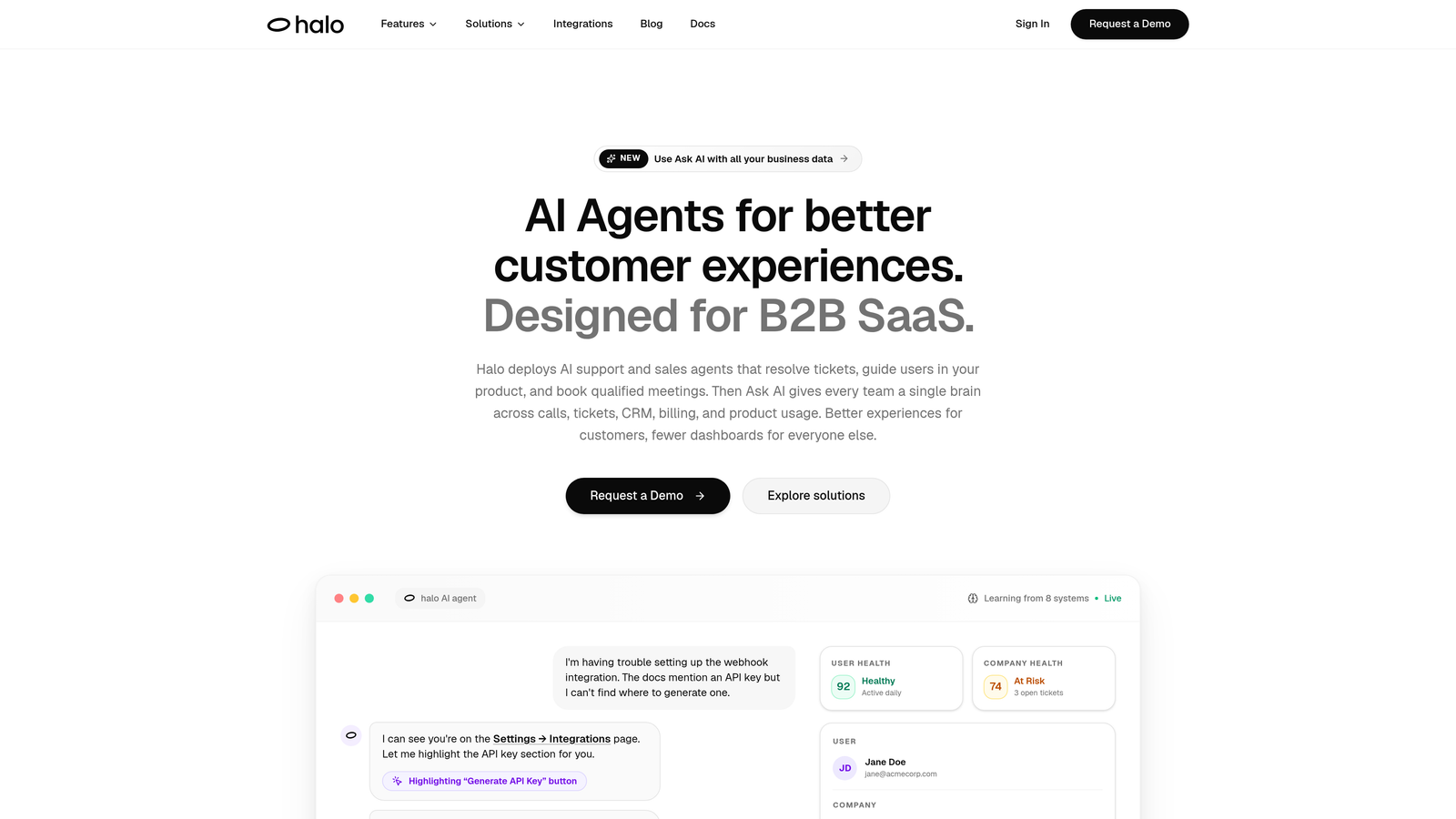
Halo AI is an AI-first support platform that deploys autonomous agents to resolve tickets, guide users with page-aware context, and surface actionable business intelligence from every support interaction.
Where This Tool Shines
What sets Halo apart from most platforms on this list is the architecture underneath it. Rather than layering AI onto a legacy helpdesk, Halo is built around AI resolution from the ground up. That distinction matters: the system is designed to learn continuously from every conversation, improving resolution quality over time rather than staying static after initial setup.
The page-aware context is particularly compelling for SaaS teams. Halo's agents can see what users are actually looking at in your product, which means guidance is visual and specific rather than generic. Combined with integrations across Linear, Slack, HubSpot, Intercom, Stripe, Zoom, and more, it connects support into your entire business stack rather than operating in isolation.
Key Features
Page-Aware AI Agents: Agents understand what users see in your product and deliver contextual, visual guidance rather than generic answers.
Continuous Learning Engine: The system improves resolution quality with every interaction, getting smarter as your product and customer base evolve.
Smart Inbox with Business Intelligence: Goes beyond support metrics to surface customer health signals, revenue intelligence, and anomaly detection from support data.
Auto Bug Ticket Creation: Automatically generates bug reports and integrates with Linear, Jira, and developer tooling so issues reach engineering without manual triage.
Live Agent Handoff: Complex issues escalate to human agents with full conversation context preserved, so customers never have to repeat themselves.
Best For
B2B SaaS companies scaling their support operations who want AI that does more than deflect tickets. Particularly strong for product-led growth teams where support, product feedback, and customer health signals need to connect. If you're currently managing support across multiple disconnected tools, Halo's integration depth makes it worth a serious look.
Pricing
Contact for pricing. Halo is designed for B2B SaaS teams actively scaling support operations, so pricing is tailored to team size and usage volume.
2. Intercom with Fin AI
Best for: Teams already invested in Intercom's ecosystem who want autonomous AI resolution built into their existing messenger.
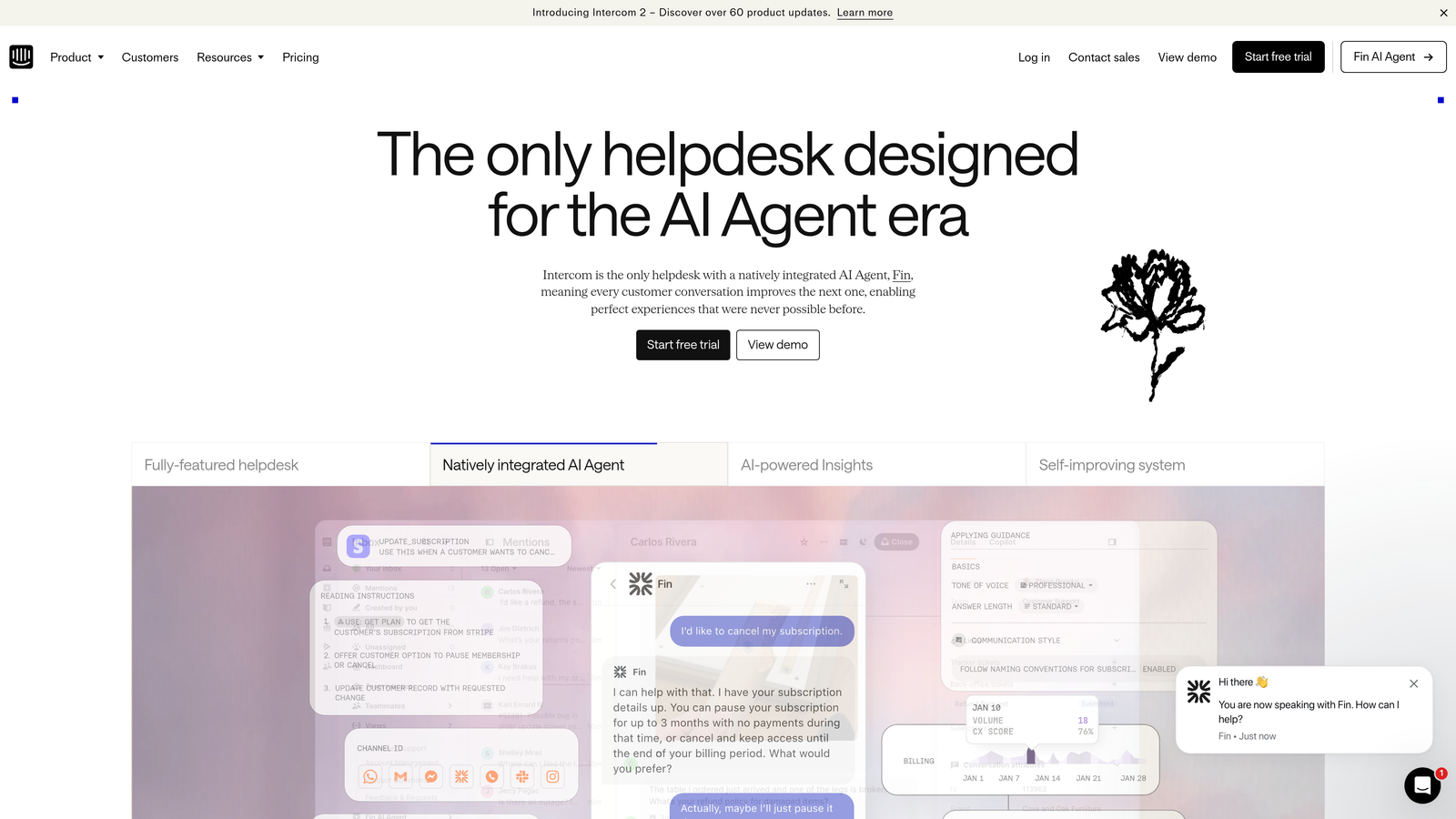
Intercom is a leading customer communications platform whose Fin AI agent resolves support questions autonomously using your knowledge base and custom content.
Where This Tool Shines
If your team is already using Intercom for in-app messaging and customer communication, Fin AI is a natural extension rather than a separate tool to manage. The integration is seamless: Fin lives inside the Intercom messenger your customers already interact with, which removes friction from deployment and adoption.
Fin has matured considerably and can handle nuanced questions by reasoning across multiple knowledge sources. The inbox-level AI features, including conversation summarization and tone adjustment, also help human agents work faster when Fin does escalate.
Key Features
Fin AI Agent: Trained on your help center and custom content to autonomously resolve support questions without human involvement.
Native Messenger Integration: Deploys directly inside Intercom's in-app messenger for a seamless customer experience.
Custom Answers and Workflows: Build brand-consistent, nuanced responses for scenarios that need more than a knowledge base lookup.
AI-Powered Inbox Features: Conversation summarization, tone adjustment, and reply suggestions help agents handle escalations more efficiently.
Best For
SaaS teams already using Intercom for customer messaging who want to add autonomous AI resolution without switching platforms. Less ideal if you need deep integrations with developer tooling or want business intelligence beyond support metrics.
Pricing
Fin AI is charged per resolution. Intercom plans start at $39/seat/month, with Fin pricing layered on top based on volume.
3. Zendesk AI
Best for: Larger SaaS organizations that need enterprise-grade AI across multi-channel support operations.
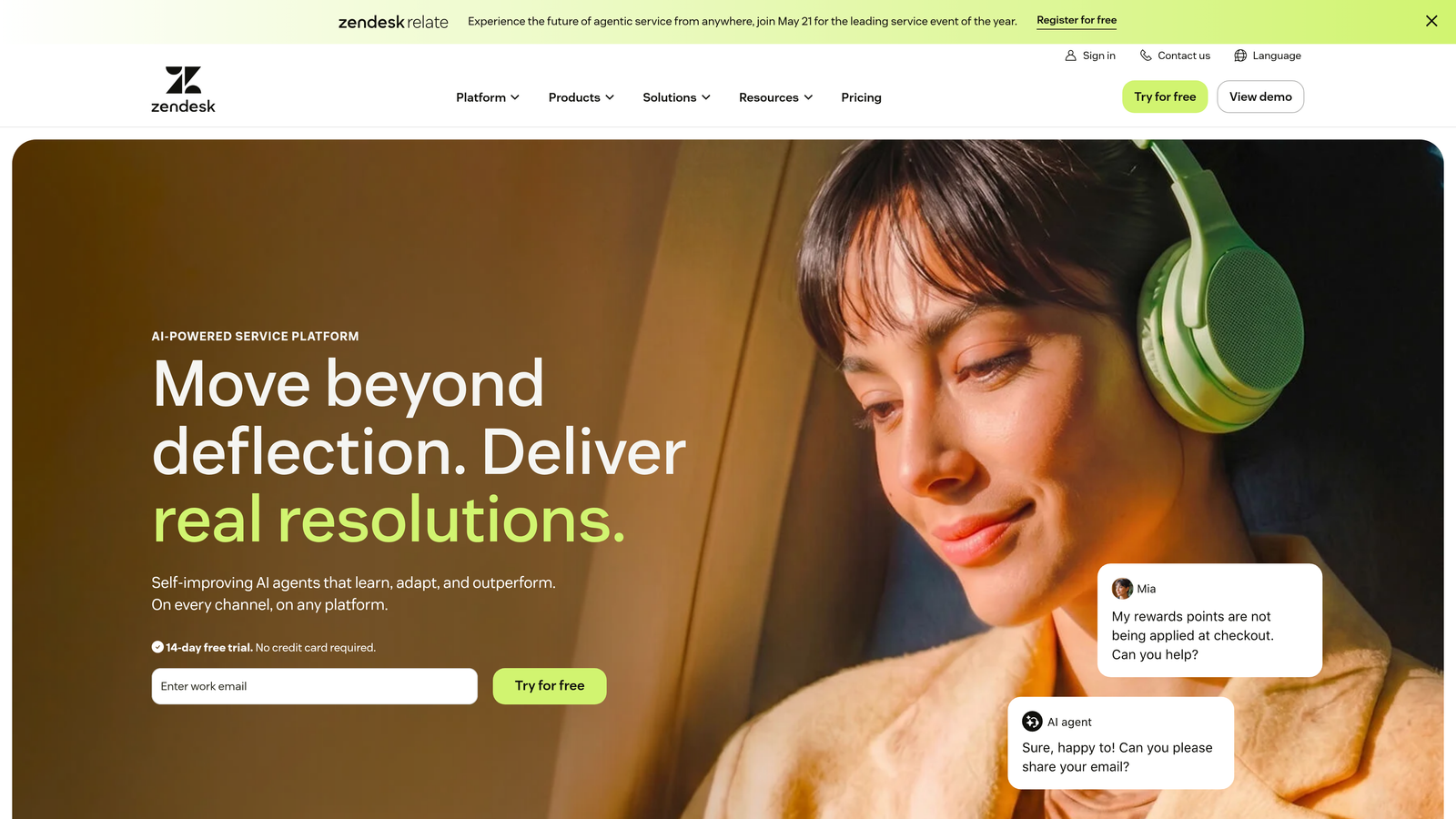
Zendesk is one of the most established names in customer support, with AI capabilities now spanning autonomous agents, intelligent triage, agent assist, and analytics across its entire suite.
Where This Tool Shines
Zendesk's strength is breadth. Its AI capabilities touch every part of the support workflow: routing and triage on the way in, agent assist while tickets are being handled, and reporting on the way out. For teams managing high volumes across email, chat, and messaging simultaneously, having AI embedded across all channels in a single platform reduces operational complexity.
The marketplace is also a genuine asset. Hundreds of third-party integrations mean Zendesk can connect to nearly anything in your stack, though the depth of those integrations varies considerably.
Key Features
AI Agents: Handle autonomous resolution across email, chat, and messaging channels without human intervention.
Intelligent Triage: Automatically detects intent, identifies language, and analyzes sentiment to route and prioritize tickets at scale.
Agent Assist: Surfaces AI-suggested replies, ticket summaries, and macro recommendations to speed up human agent responses.
Robust Reporting: Comprehensive analytics across all channels with customizable dashboards for support operations visibility.
Extensive Marketplace: Hundreds of integrations with third-party tools covering CRM, billing, project management, and more.
Best For
Mid-market to enterprise SaaS companies with established support operations and high ticket volumes across multiple channels. The platform's complexity and cost make it less suitable for early-stage teams or those wanting a leaner, AI-native setup.
Pricing
Suite plans start at $55/agent/month. Advanced AI features are available as a paid add-on on top of base plan pricing.
4. Freshdesk Freddy AI
Best for: Growing SaaS teams that want capable AI support features at a more accessible price point.
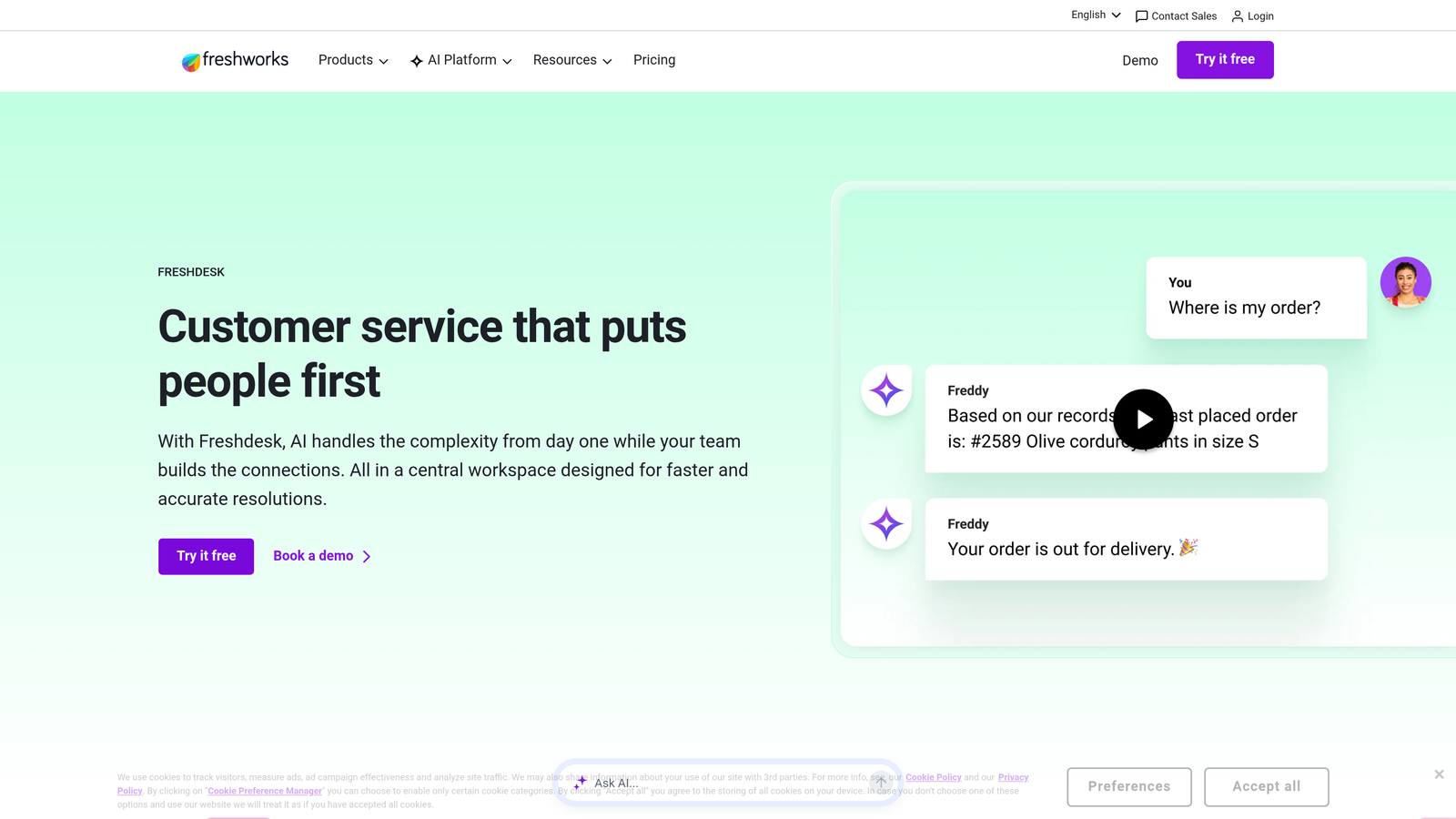
Freshdesk is Freshworks' helpdesk platform, with Freddy AI powering self-service bots, agent assist, and analytics at a price point that makes enterprise-grade AI more accessible.
Where This Tool Shines
Freshdesk with Freddy AI occupies an interesting middle ground: it's more feature-rich than lightweight tools like Tidio but more affordable than Zendesk or enterprise-focused platforms. For SaaS companies at the growth stage, that balance is often exactly what's needed.
The omnichannel coverage is solid, spanning email, chat, phone, and social from a single interface. Freddy AI's agent assist features are particularly useful for teams where human agents still handle a significant share of tickets and need AI to help them work faster.
Key Features
Freddy AI Chatbots: Automated self-service resolution trained on your knowledge base to handle common queries without agent involvement.
Agent Assist: Canned response suggestions, ticket summarization, and next-best-action recommendations for human agents.
Omnichannel Support: Unified inbox covering email, chat, phone, and social channels in one platform.
AI-Suggested Knowledge Articles: Freddy surfaces relevant help content for both customers and agents during interactions.
Best For
SaaS companies at the growth stage that need solid AI-assisted support across multiple channels without the enterprise price tag. Also a good fit for teams migrating off simpler tools who want a more capable platform without the complexity of Zendesk.
Pricing
A free tier is available for small teams. The Pro plan starts at $49/agent/month and includes Freddy AI features.
5. Ada
Best for: SaaS companies that want AI to genuinely resolve customer problems, not just deflect tickets.
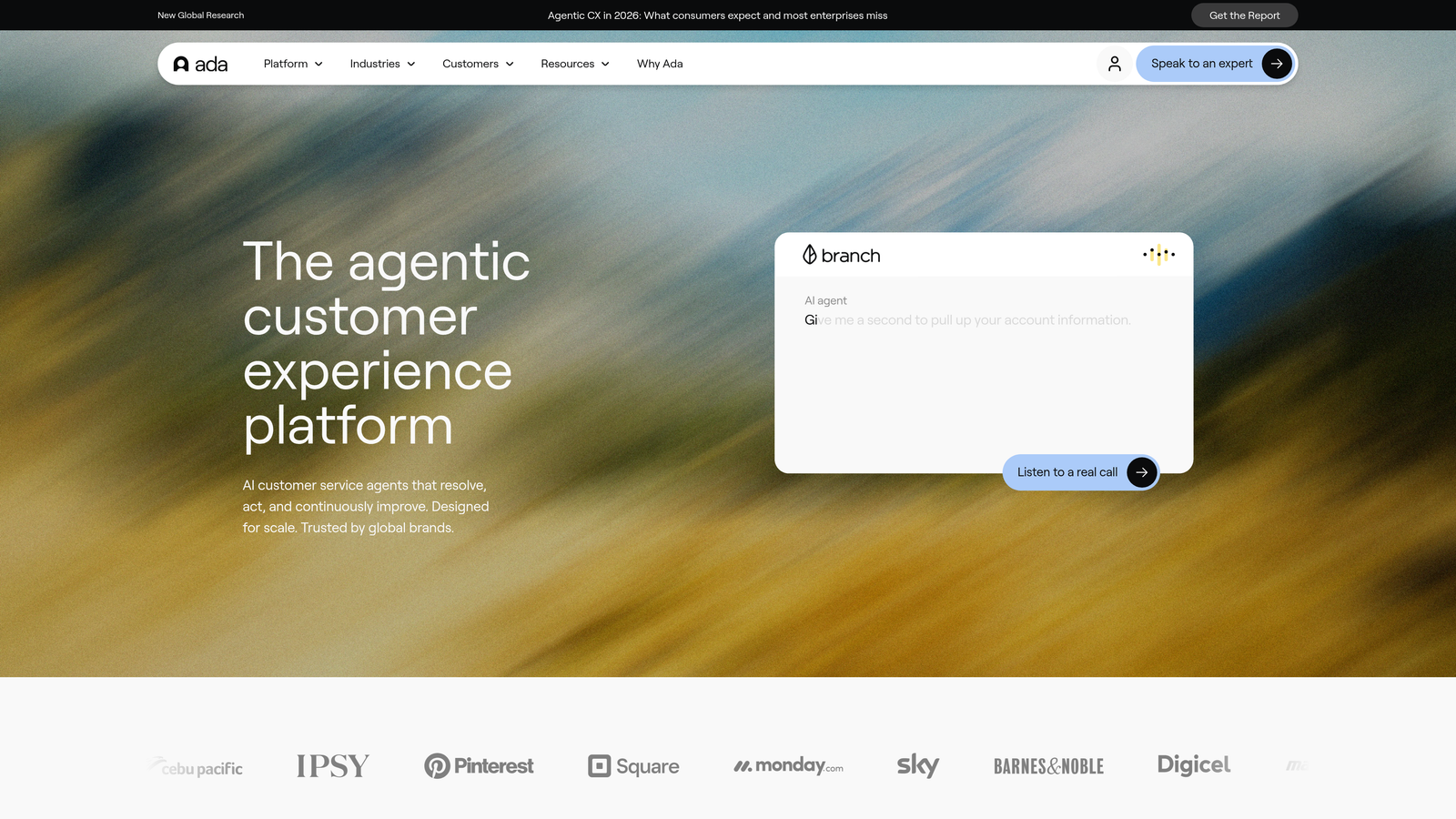
Ada is a purpose-built AI agent platform focused on autonomous resolution, designed for brands that want AI to actually solve customer problems across chat, email, and voice.
Where This Tool Shines
Ada makes an important philosophical distinction: the goal is resolution, not deflection. Many AI support tools optimize for keeping customers away from agents, which often means leaving problems unsolved. Ada's AI reasons across knowledge sources and takes real actions, such as processing refunds, updating account information, or triggering downstream workflows via API.
This action-oriented approach makes Ada particularly relevant for SaaS companies where support often involves account changes, subscription management, or product-specific actions that require more than an informational response.
Key Features
Action-Oriented AI Agent: Reasons across knowledge sources and takes real actions via API, including processing refunds, updating accounts, and triggering workflows.
Multi-Channel Deployment: Available across web chat, email, SMS, and voice for consistent AI resolution regardless of channel.
Resolution-Focused Analytics: Measures actual resolution outcomes rather than deflection rates, giving a more honest view of AI performance.
Custom Reasoning Flows: Build nuanced resolution logic for complex scenarios that go beyond simple FAQ matching.
Best For
SaaS companies with complex support scenarios that require AI to take actions, not just answer questions. Particularly strong for subscription management, account operations, and any support workflow where resolution means doing something, not just saying something.
Pricing
Custom pricing based on resolution volume. Contact Ada directly for quotes tailored to your support scale.
6. Tidio
Best for: Smaller SaaS teams or early-stage companies exploring AI support for the first time.
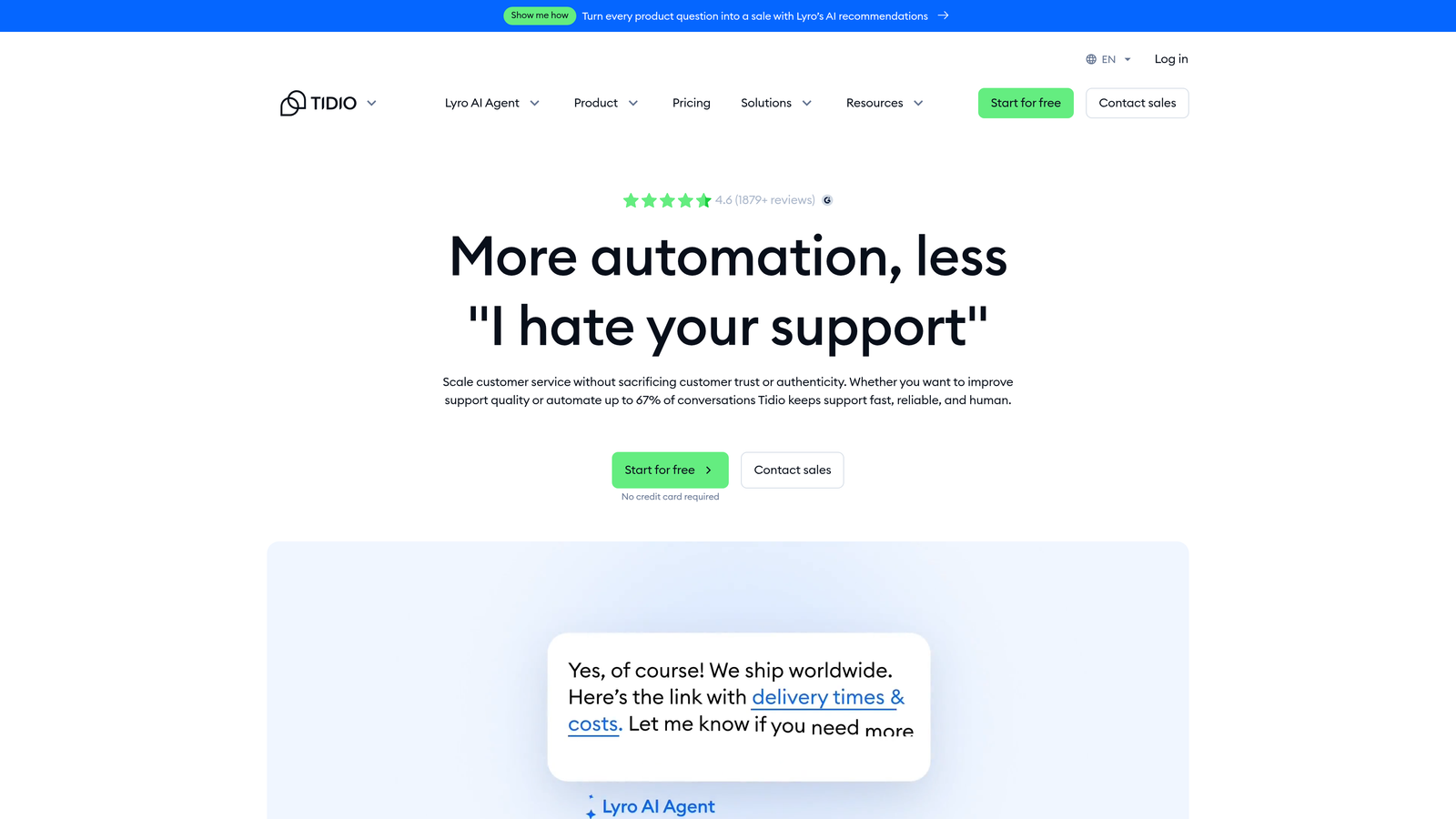
Tidio combines a user-friendly live chat widget with Lyro, its AI chatbot, making it an accessible entry point for teams that want to add AI support without a complex implementation.
Where This Tool Shines
Tidio's real advantage is simplicity. Setup is fast, the interface is clean, and Lyro can start handling common queries quickly after being trained on your FAQ and help content. For teams that don't have a dedicated support ops function, that low barrier to entry matters.
The visual chatbot builder also lets non-technical team members create custom conversation flows without writing code, which keeps iteration in the hands of support managers rather than engineering.
Key Features
Lyro AI Chatbot: Trained on your FAQ and help content to automatically handle common support queries.
Visual Chatbot Builder: Drag-and-drop interface for building custom conversation flows without any coding.
Live Chat with AI Handoff: Smooth transition from AI to human agent when conversations require a human touch.
Simple Integrations: Connects to common website platforms and basic tooling for quick deployment.
Best For
Early-stage SaaS teams or smaller companies that want to test AI-assisted support before committing to a more complex platform. Tidio is a good starting point, though growing teams will likely outgrow its capabilities as ticket volume and complexity increase.
Pricing
A free plan is available. Lyro AI starts at $39/month for 50 conversations, with higher tiers for greater volume.
7. Forethought
Best for: SaaS teams that want AI capabilities layered on top of their existing helpdesk without replacing it.
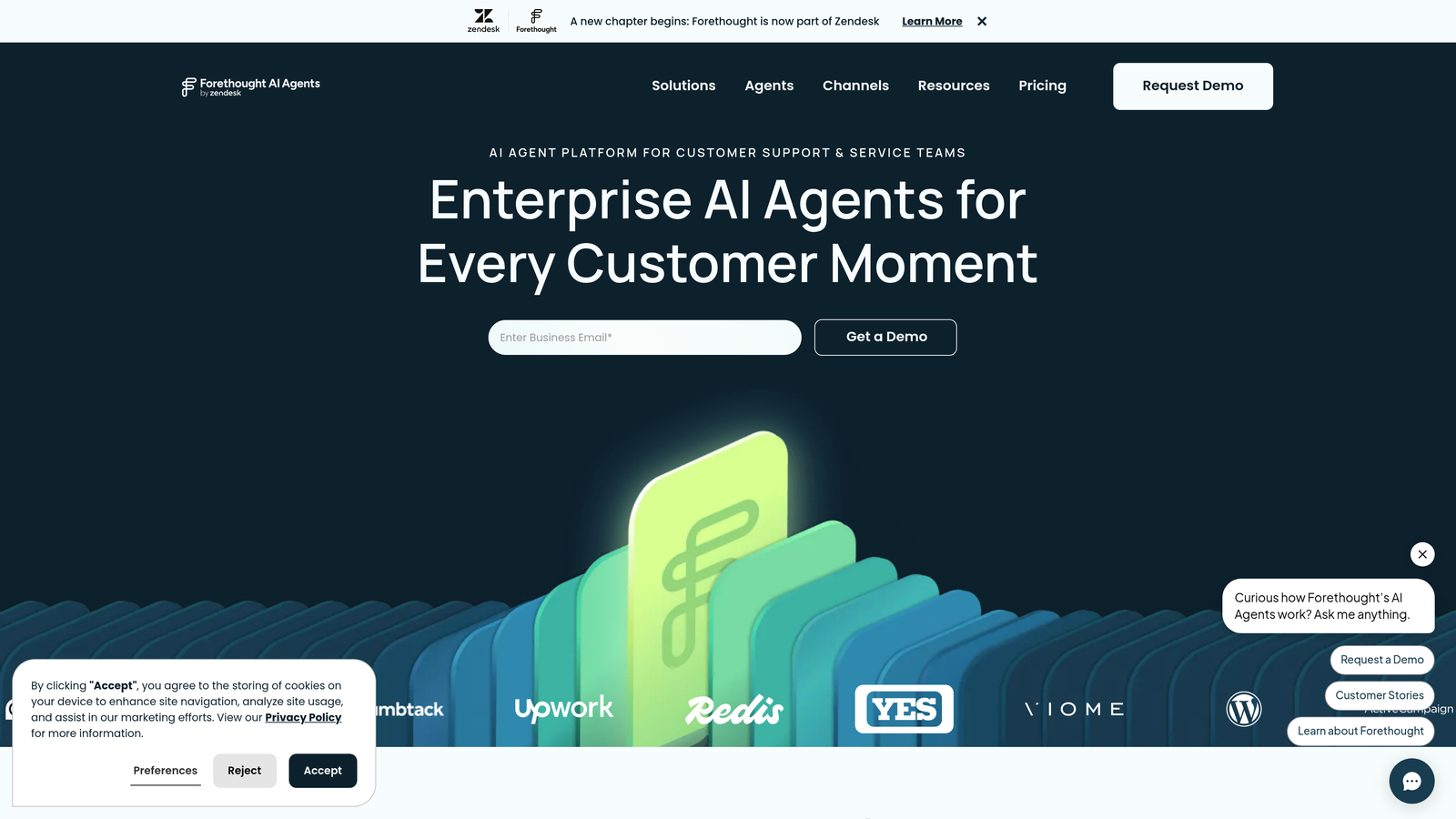
Forethought adds AI-powered triage, routing, and resolution capabilities on top of existing helpdesks like Zendesk and Salesforce, making it a strong choice for teams that want AI without a platform migration.
Where This Tool Shines
Forethought's positioning is smart for a common real-world scenario: you've already invested in a helpdesk, your team knows it, and switching isn't practical. Rather than asking you to replace your stack, Forethought layers intelligence on top of it. Incoming tickets get automatically categorized, prioritized, and routed. Agents get real-time knowledge suggestions surfaced during ticket handling. And Solve AI can handle autonomous resolution for common requests.
The result is AI augmentation of an existing workflow rather than a full platform change, which reduces adoption friction significantly.
Key Features
AI-Powered Triage: Automatically categorizes, prioritizes, and routes incoming tickets based on content and intent.
Solve AI: Handles autonomous resolution of common support requests via chat and email.
Agent Assist: Real-time knowledge suggestions surfaced to agents while they're actively handling a ticket.
Helpdesk Integration Layer: Works on top of Zendesk, Salesforce Service Cloud, and other major platforms without replacing them.
Best For
SaaS teams that have already invested in Zendesk or Salesforce and want to add meaningful AI capabilities without a disruptive migration. Also strong for teams where human agents handle a significant ticket share and need AI to help them work more efficiently.
Pricing
Custom pricing. Contact Forethought directly for SaaS-specific plans tailored to your support volume and stack.
8. Drift (Salesloft)
Best for: B2B SaaS companies where support conversations connect directly to sales and customer success outcomes.
Drift, now part of Salesloft, brings conversational AI to the intersection of support and revenue, useful for teams where helping a customer and expanding an account are closely related activities.
Where This Tool Shines
Drift's differentiation is its revenue connection. Most support platforms treat support as a cost center to optimize. Drift treats conversations as revenue opportunities, linking support interactions to pipeline data and expansion signals. For B2B SaaS companies where customer success and sales work closely together, that framing is genuinely valuable.
The integration with Salesloft's broader sales engagement platform also means that a support conversation that reveals an upsell opportunity can be routed to the right sales rep with full context, rather than falling through the cracks.
Key Features
Conversational AI Chatbots: Handle support queries and qualify leads simultaneously within a single conversation.
Revenue-Connected Insights: Links support interactions to pipeline data and expansion opportunities for a fuller customer picture.
Salesloft Platform Integration: Connects to the broader sales engagement suite for seamless handoff between support and sales motions.
Playbook-Driven Automation: Routes conversations to the right team based on customizable playbooks and customer attributes.
Best For
B2B SaaS companies with strong alignment between support, customer success, and sales, particularly those already using Salesloft for sales engagement. Less relevant for product-led growth companies where support is more self-service oriented.
Pricing
Drift is included in Salesloft platform plans. Contact Salesloft for current pricing based on team size and use case.
9. Help Scout with AI Assist
Best for: SaaS teams that want AI to augment human agents rather than replace them, with a focus on quality and simplicity.
Help Scout takes a deliberately human-centered approach, using AI to help agents draft better replies, summarize conversations, and work more efficiently, without trying to remove humans from the equation entirely.
Where This Tool Shines
Help Scout's philosophy is refreshingly honest: not every support interaction should be handled by AI, and the goal is making human agents exceptional rather than replacing them. The AI Drafts feature generates full reply drafts based on conversation context and your knowledge base, which agents can review and send rather than writing from scratch. The quality of support often improves while handling time drops.
The shared inbox is also genuinely well-designed for collaborative teams. It's clean, intuitive, and built around how support teams actually work together, which reduces the training overhead that comes with more complex platforms.
Key Features
AI Drafts: Generates complete reply drafts based on conversation context and knowledge base content for agents to review and send.
AI Summarize: Instant conversation overviews for handoffs, escalations, or when an agent picks up a mid-conversation ticket.
AI Assist: Adjusts tone, length, and translation of agent replies to match brand voice and customer needs.
Collaborative Shared Inbox: Clean, intuitive inbox designed for team-based support with minimal operational overhead.
Best For
SaaS teams where support quality and human connection are central to the customer experience, and where the goal is making agents faster and better rather than removing them from conversations. Also a strong fit for teams that value simplicity and want a tool their agents will actually enjoy using.
Pricing
Standard plan is $25/user/month. The Plus plan is $50/user/month and includes the full suite of advanced AI features.
Finding the Right AI Support Platform for Your SaaS Stack
The nine platforms above cover a wide spectrum, from autonomous AI agents that resolve tickets end-to-end, to AI-augmented tools that make human agents more effective. Choosing the right one depends on where you are in your support maturity and what problem you're actually trying to solve.
If you're looking for the most comprehensive AI-first approach, with page-aware context, continuous learning, and business intelligence built in from the start, Halo AI is the strongest option for B2B SaaS teams. If you're already deep in the Intercom ecosystem, Fin AI is the path of least resistance. If you need AI layered on top of an existing Zendesk setup, Forethought is purpose-built for exactly that scenario.
A few questions worth asking before you decide:
Do you need autonomous resolution or agent augmentation? Platforms like Halo AI and Ada are built to resolve tickets without human involvement. Help Scout and Forethought are better suited to teams where agents stay in the loop.
How important is integration depth? SaaS teams with complex stacks, including developer tools, CRM, billing, and communication platforms, need a platform that connects to all of it. Shallow integrations create data silos that undermine the value of AI.
What does "success" look like beyond support metrics? The most sophisticated platforms surface customer health signals, churn indicators, and product feedback from support data. If that intelligence matters to your team, it should factor heavily into your decision.
Your support team shouldn't scale linearly with your customer base. Let AI agents handle routine tickets, guide users through your product, and surface business intelligence while your team focuses on complex issues that need a human touch. See Halo in action and discover how continuous learning transforms every interaction into smarter, faster support.