9 Best AI Support Software for Product Companies in 2026
This guide reviews the 9 best AI support software for product companies in 2026, evaluating each tool on AI autonomy, product-context awareness, integration depth, and scalability. Whether you run a lean startup or a growing SaaS team, it cuts through generic helpdesk options to surface solutions purpose-built for the complex, context-heavy support challenges product teams actually face.
 Grant CooperFounder14 min read
Product companies face a support challenge that most helpdesk tools weren't designed to solve. Your customers aren't just asking how to reset a password. They're hitting edge-case bugs mid-onboarding, struggling with workflows that made sense in your roadmap but not in production, and asking questions that require real product context to answer well. A generic ticketing system with AI bolted on doesn't cut it.
AI support software built for product teams goes further: resolving tickets autonomously, surfacing product health signals, and handing off complex issues to humans without losing the thread. The tools on this list were evaluated on AI autonomy, product-context awareness, integration depth, business intelligence capability, and scalability. Whether you're a lean startup or a scaling SaaS team, there's a strong option here.
One disclosure worth making upfront: Halo AI is our product, and it sits at #1 on this list. We believe it's the strongest fit for product companies specifically, but we've been straightforward about where each tool wins and who each one serves best.
1. Halo AI
Best for: B2B SaaS and PLG product teams that need AI-first support with deep product context.
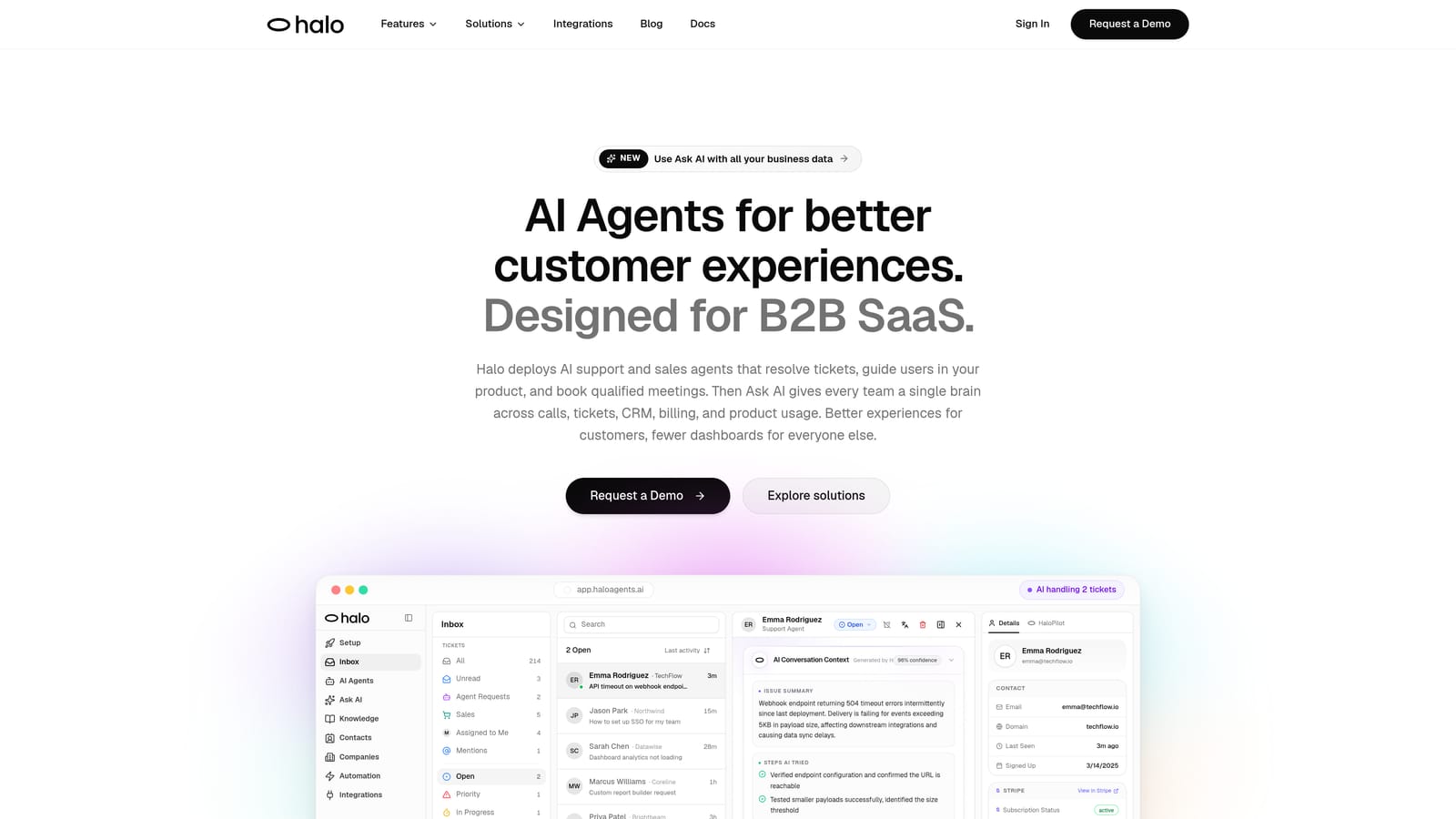
Halo AI is an AI-first customer support platform built specifically for product companies, not a traditional helpdesk with AI layered on top.
Where This Tool Shines
What separates Halo from most tools on this list is architecture. It was built AI-first, which means the intelligence isn't a feature sitting on top of a legacy ticketing system. The AI agents understand what a user is actually doing in your product at the moment they ask for help, not just what they typed into a chat box.
That page-aware context matters enormously for product companies. When a user is stuck on step three of your onboarding flow, Halo's agent already knows where they are and can guide them through it visually. When the AI detects a pattern that looks like a product bug, it automatically creates a ticket in Linear and routes it to your engineering team, without anyone on support having to triage it manually.
Key Features
Page-Aware AI Agents: The AI sees what the user sees in your product, enabling contextual guidance and resolution without the user having to explain their situation from scratch.
Auto Bug Ticket Creation: When the AI identifies a product issue, it automatically generates a structured bug ticket routed directly to Linear, closing the loop between support and engineering.
Smart Inbox with Business Intelligence: Beyond support metrics, the inbox surfaces customer health signals, revenue anomalies, and product usage patterns that would otherwise be buried in ticket data.
Live Agent Handoff with Full Context: When a conversation escalates to a human, the agent receives complete context. No user has to repeat themselves.
Deep Integration Stack: Native connections to Linear, Slack, HubSpot, Intercom, Stripe, Zoom, PandaDoc, and Fathom, covering the full product and revenue stack.
Continuous Learning: Every resolved interaction improves the AI's resolution quality over time, compounding value as your product and customer base evolve.
Best For
Product teams that want support to do more than manage ticket volume. Halo is particularly strong for B2B SaaS companies where support conversations carry revenue signals, and for PLG teams where onboarding friction directly impacts activation and retention.
Pricing
Contact for pricing. You can book a demo directly at haloagents.ai to see the platform in context of your specific use case.
2. Intercom
Best for: Teams that want a mature, all-in-one customer messaging platform with a capable AI agent.
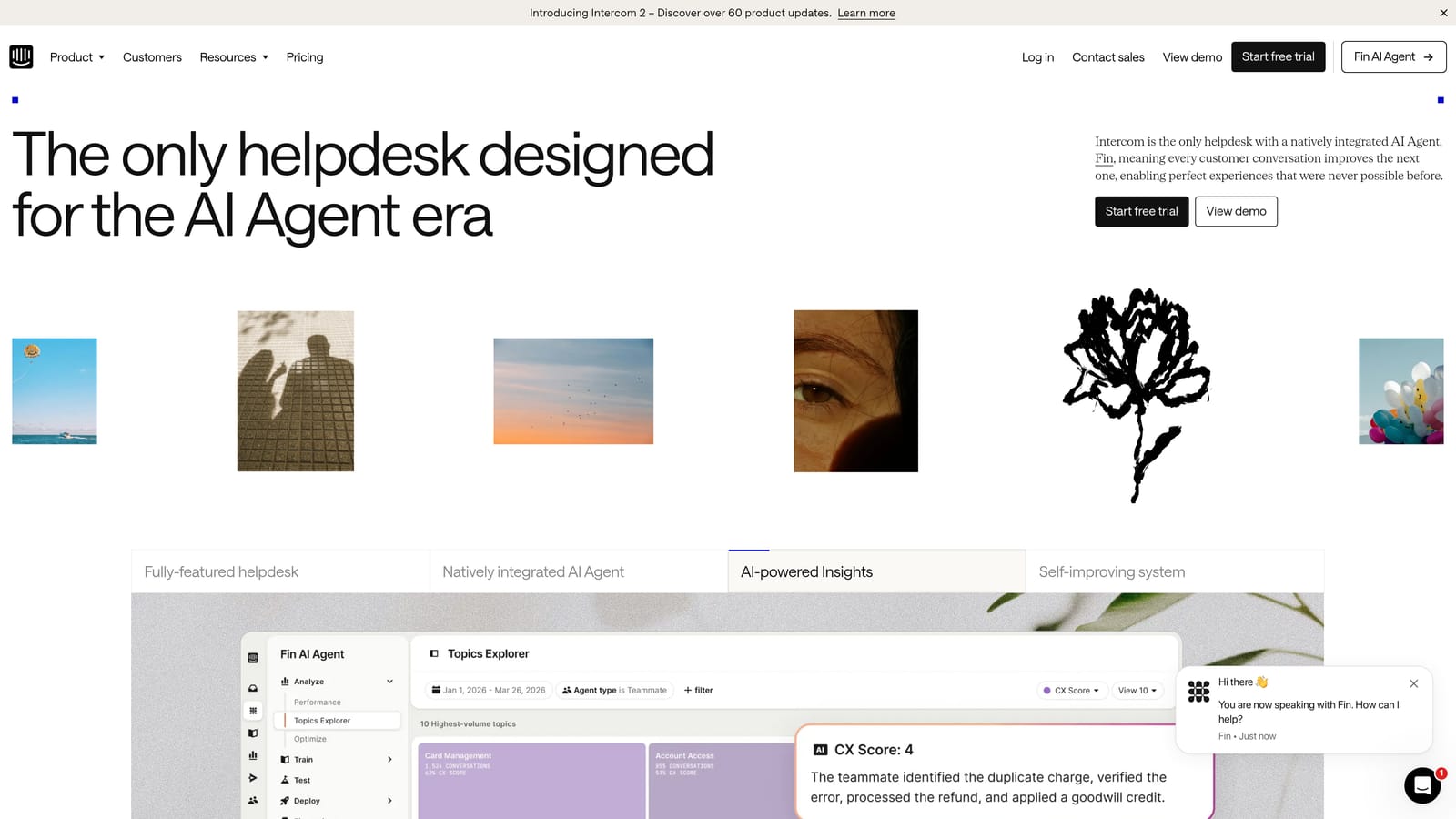
Intercom is one of the most established customer messaging platforms, with Fin, its AI agent built on large language models, handling autonomous resolution across chat and email.
Where This Tool Shines
Intercom's messenger experience is genuinely best-in-class. The in-app chat, product tours, and onboarding flows are polished and deeply integrated, making it a strong choice for product teams that want their support and onboarding experience to feel cohesive. Fin handles a meaningful portion of queries autonomously and is trained to stay grounded in your help content rather than hallucinating answers.
The tradeoff is cost and architecture. Intercom's pricing scales quickly, particularly when Fin's per-resolution billing is factored in alongside seat costs. The AI is powerful, but it sits on top of a platform that was originally built around human-to-human messaging, which means some of the deeper product-context capabilities require workarounds.
Key Features
Fin AI Agent: Resolves support queries autonomously across chat and email, drawing on your help center content and trained responses.
Unified Inbox: Combines email, chat, and in-app messaging into a single workspace for support teams.
Product Tours and Onboarding Flows: Built-in tooling for creating guided product experiences without a separate tool.
Robust Reporting and CSAT: Solid analytics for tracking resolution rates, satisfaction, and team performance.
App Marketplace: A large ecosystem of integrations covering CRM, analytics, and productivity tools.
Best For
Product teams that prioritize in-app messaging quality and want onboarding flows and support in a single platform. Also well-suited for companies that already have Intercom embedded and want to layer in AI without migrating.
Pricing
Starts at approximately $39/seat/month; Fin AI usage is billed separately per resolution. Verify current pricing at intercom.com before budgeting.
3. Zendesk
Best for: Larger product teams with dedicated support operations that need enterprise-grade ticketing infrastructure.
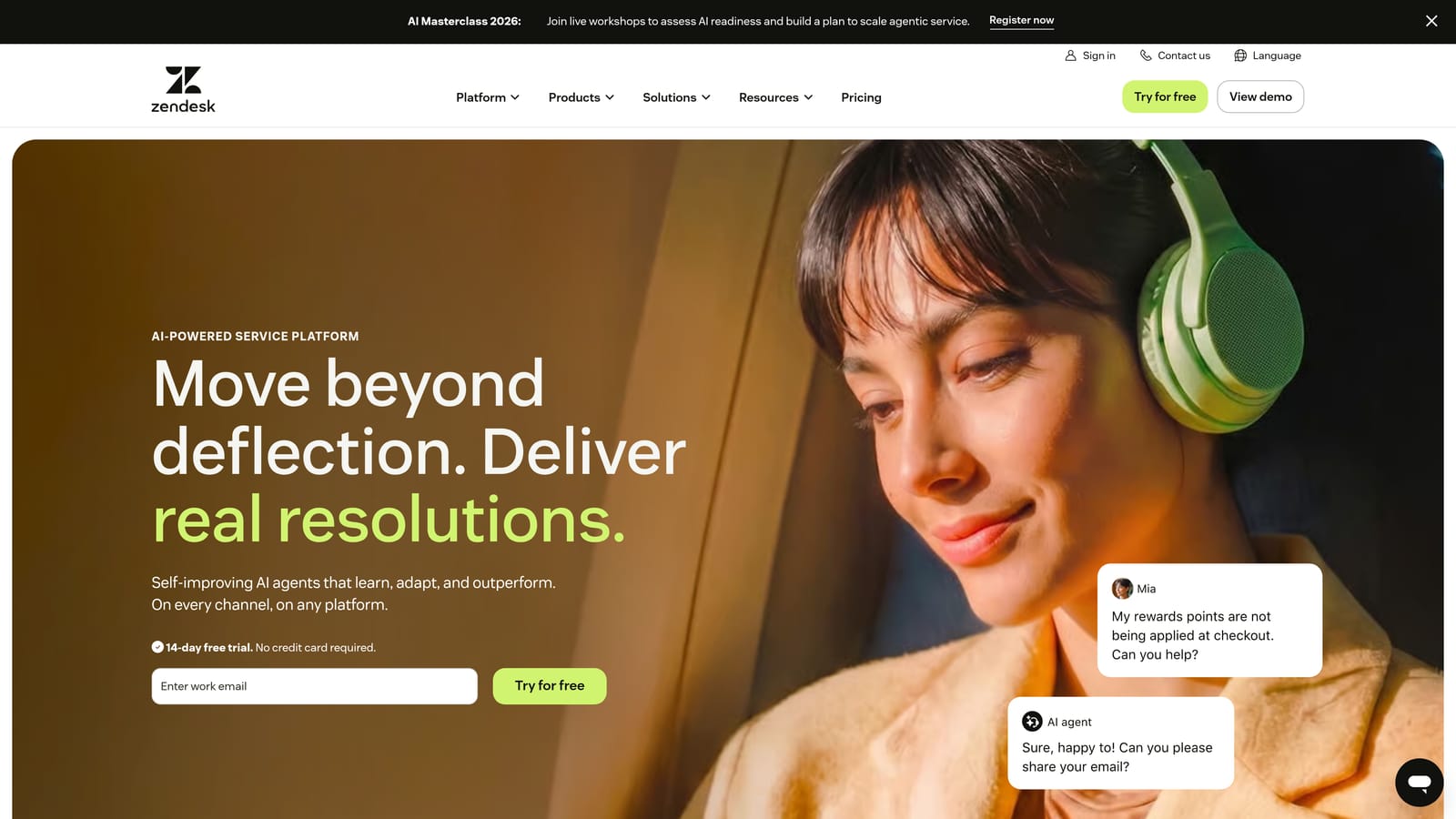
Zendesk is the dominant enterprise helpdesk platform, now with Zendesk AI providing intelligent triage, suggested responses, and automated workflows layered onto its mature ticketing foundation.
Where This Tool Shines
Zendesk's strength is depth. The ticketing infrastructure is battle-tested at enterprise scale, the SLA management is highly configurable, and the integration marketplace is extensive. For larger product companies with dedicated support teams and complex workflows, Zendesk provides the operational control that smaller tools can't match.
The honest caveat: Zendesk can feel heavyweight for lean product teams. The AI capabilities have improved significantly with Zendesk AI's triage and routing intelligence, but they're enhancements to an existing helpdesk architecture rather than a ground-up AI approach. Setup and configuration require real investment, and pricing scales steeply with team size.
Key Features
Zendesk AI: Intelligent triage, routing, and agent suggestions that reduce manual handling across high-volume inboxes.
Configurable Ticketing Workflows: Highly flexible SLA management, routing rules, and automation for complex support operations.
Extensive Integration Marketplace: Hundreds of integrations covering virtually every business tool category.
Advanced Analytics Suite: Deep reporting on ticket volume, resolution time, agent performance, and customer satisfaction.
Omnichannel Support: Email, chat, voice, and social channels managed from a single platform.
Best For
Product companies with 20+ person support teams, complex SLA requirements, or enterprise customers who expect formal support operations. Less suited for early-stage teams where the configuration overhead outweighs the benefits.
Pricing
Suite plans start around $55/agent/month. Verify current pricing at zendesk.com, as enterprise tiers vary significantly.
4. Freshdesk
Best for: SMB product teams that need solid helpdesk functionality with AI assist at accessible pricing.
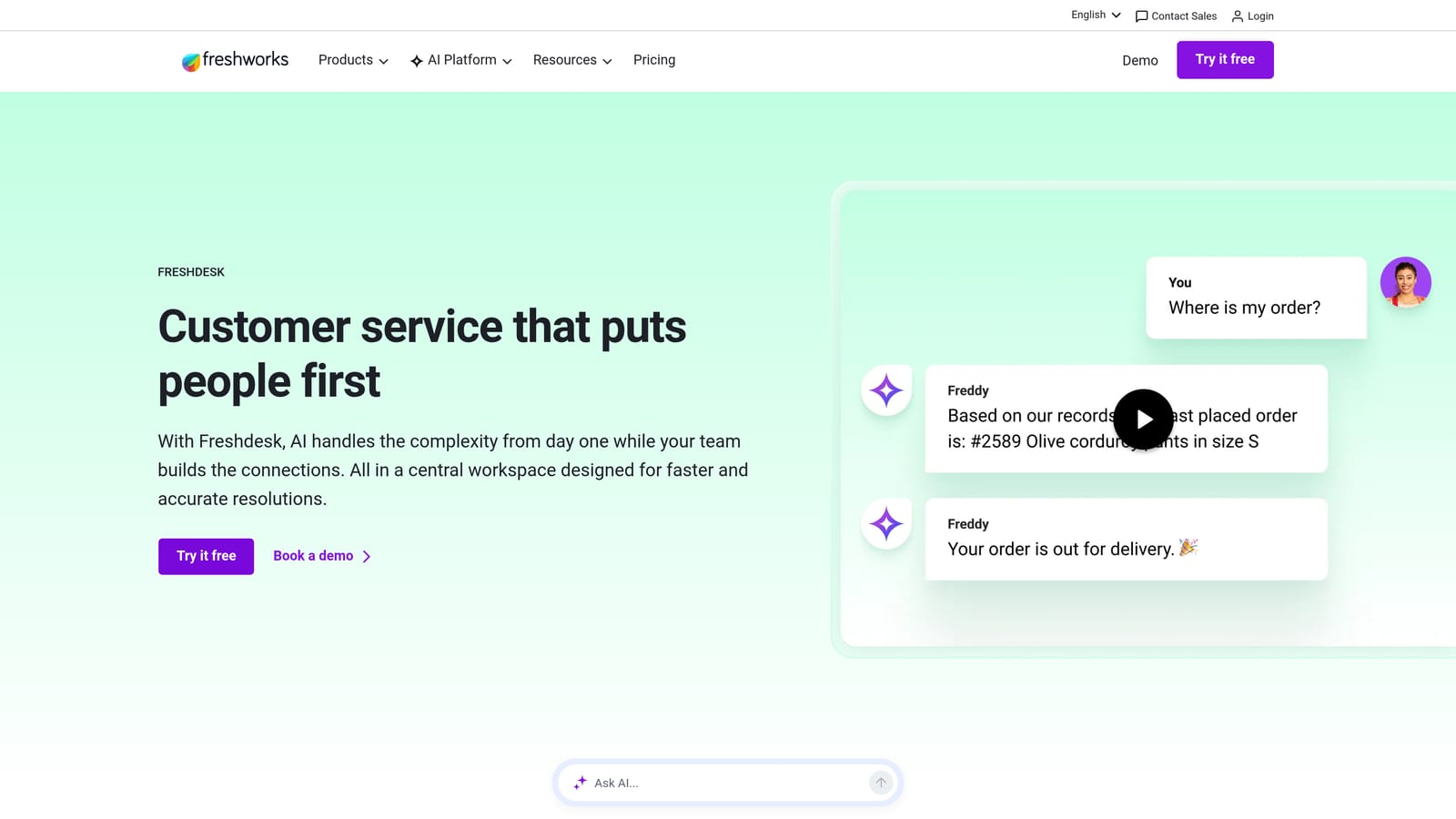
Freshdesk is a full-featured helpdesk platform with Freddy AI providing ticket automation, agent assist, and self-service capabilities at price points that work for smaller product teams.
Where This Tool Shines
Freshdesk occupies a practical middle ground: more capable than simple chat tools, more accessible than Zendesk. Freddy AI handles ticket categorization, suggested responses, and summarization, reducing the manual work agents spend on routine queries. The free tier makes it genuinely viable for early-stage teams that need structure without upfront cost.
The AI capabilities are still maturing relative to AI-first platforms. Freddy is solid for agent augmentation but isn't designed for the kind of autonomous end-to-end resolution that newer AI-native tools offer. For product teams whose primary goal is deflection and autonomous resolution, this gap is worth noting.
Key Features
Freddy AI: Covers ticket categorization, suggested responses, and conversation summarization to reduce agent workload.
Freddy Self Service: Customer-facing automated resolution for common queries, reducing inbound ticket volume.
Omnichannel Inbox: Email, chat, phone, and social channels unified in a single workspace.
Collision Detection: Prevents multiple agents from working on the same ticket simultaneously.
Free Tier: A functional free plan for small teams getting started with structured support.
Best For
Product teams at the SMB stage that need organized helpdesk infrastructure with AI assist, without Zendesk-level pricing. Also a good fit for teams already in the Freshworks ecosystem.
Pricing
Free plan available; paid plans start around $15/agent/month. Verify current pricing at freshdesk.com.
5. Tidio
Best for: Product teams with high inbound chat volume that want fast, low-code AI deployment.
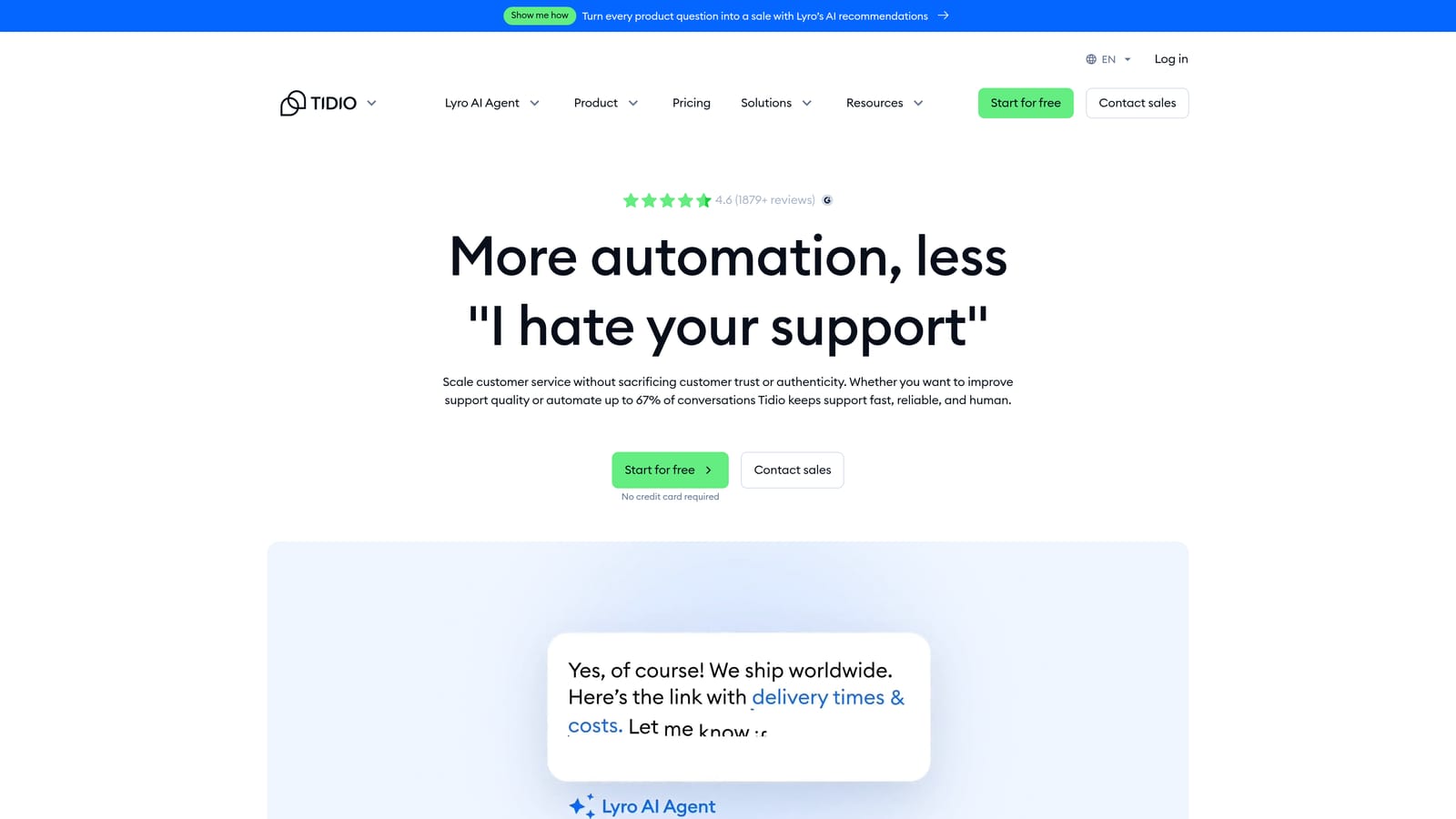
Tidio is a live chat and AI chatbot platform featuring Lyro, an AI agent that handles a high proportion of customer conversations autonomously with minimal setup overhead.
Where This Tool Shines
Tidio's primary advantage is speed to value. Lyro can be deployed quickly without deep technical configuration, and it handles a meaningful share of chat conversations autonomously. For product teams that are primarily managing chat-based support and want AI deflection running fast, Tidio is one of the most accessible options on this list.
The scope is more focused than platforms like Intercom or Zendesk. Tidio is strong at chat, but it wasn't built for complex ticket workflows, deep product context, or the kind of business intelligence that product teams increasingly need from their support data. Think of it as a specialized tool rather than a full support platform.
Key Features
Lyro AI Chatbot: Handles autonomous conversation resolution, drawing on your support content to answer queries without agent involvement.
Live Chat with Agent Takeover: Smooth handoff from AI to human agents, accessible from any device.
Visual Chatbot Builder: No-code flow builder for creating custom conversation paths and escalation logic.
Proactive Chat Triggers: Visitor behavior tracking that initiates conversations based on user actions.
E-commerce and CRM Integrations: Connects to common platforms, though the integration depth is narrower than enterprise tools.
Best For
Early-stage product teams or those with primarily chat-based support who want AI deflection running quickly without a large implementation project. Less suited for teams managing complex ticket workflows or needing deep product integrations.
Pricing
Free plan available; Lyro AI plans start around $29/month. Verify current pricing at tidio.com.
6. Forethought
Best for: Teams that want to add AI intelligence to an existing helpdesk without migrating platforms.
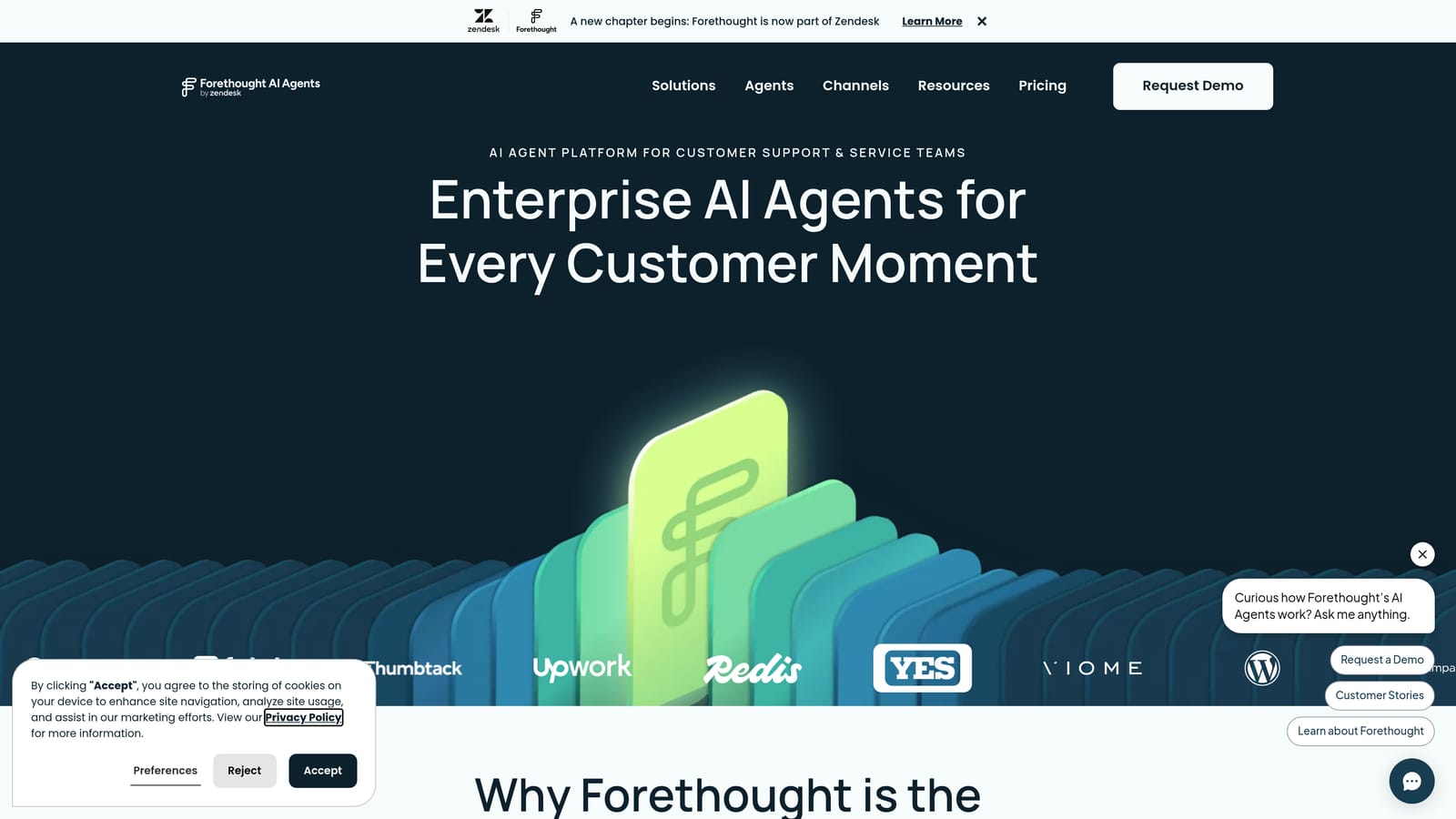
Forethought is an AI layer that sits on top of your existing helpdesk, handling triage, routing, and resolution without requiring you to replace your current infrastructure.
Where This Tool Shines
Forethought's positioning is distinct from most tools on this list: it's designed to augment your existing setup rather than replace it. If your team is embedded in Zendesk or Salesforce and a platform migration isn't realistic, Forethought adds meaningful AI capability without disruption. The triage and routing intelligence is particularly strong, reducing the manual sorting that consumes agent time at scale.
The natural limitation is that it doesn't replace the underlying helpdesk. You're still paying for and maintaining your existing platform, plus Forethought on top. For teams evaluating a fresh start, an AI-native platform may be a cleaner solution. But for teams with significant investment in existing tooling, this approach has real practical value.
Key Features
Solve AI: Autonomous ticket resolution via email and chat, deflecting queries before they reach an agent.
Triage AI: Intelligent routing and prioritization that gets tickets to the right place faster.
Assist AI: Agent-facing response suggestions and knowledge surfacing to speed up human resolution.
Discover AI: Analytics layer for identifying support patterns, workflow gaps, and optimization opportunities.
Native Helpdesk Integrations: Direct integrations with Zendesk, Salesforce, ServiceNow, and other major platforms.
Best For
Product companies already invested in enterprise helpdesks that want to add AI intelligence without a migration. Also strong for support ops teams focused on triage efficiency at high ticket volumes.
Pricing
Custom pricing. Contact Forethought directly at forethought.ai for a quote.
7. Kustomer
Best for: Product teams where customer context, usage history, and CRM data are central to support quality.
Kustomer is a CRM-native customer service platform that unifies support history, product usage data, and purchase records into a single customer timeline, with AI features for automation and agent assistance.
Where This Tool Shines
Kustomer's differentiator is its data model. Rather than treating support as a separate system from customer data, it builds a unified timeline that gives agents complete visibility into who they're talking to, what they've done in the product, and what their history looks like. For product companies where support quality depends on context, this is genuinely valuable.
The AI features are present and functional, covering routing, automation, and agent assistance. But Kustomer's real strength is the underlying CRM architecture rather than AI-first resolution. Teams evaluating Kustomer primarily for autonomous ticket deflection may find AI-native platforms more capable in that specific dimension.
Key Features
Unified Customer Timeline: All interaction history, product usage data, and purchase records in a single view for every customer.
AI-Powered Routing: Automated workflows and intelligent routing to reduce manual handling.
Omnichannel Support: Context preserved across channels so customers don't have to repeat themselves.
Deep CRM Data Model: Rich customer segmentation and data structure that goes well beyond standard helpdesk records.
Customizable Reporting: Flexible dashboards for tracking both support performance and customer health metrics.
Best For
Product companies where customer context is complex and high-value, particularly those serving enterprise customers where support conversations involve billing, usage, and relationship history simultaneously.
Pricing
Enterprise pricing. Contact Kustomer directly at kustomer.com for current rates.
8. Help Scout
Best for: Teams that prioritize support quality and human connection, with AI as a co-pilot rather than a replacement.
Help Scout is a human-first support platform that positions AI as an agent augmentation tool, with clean shared inbox tooling, a strong knowledge base builder, and an in-product help widget.
Where This Tool Shines
Help Scout has a clear philosophy: support should feel human, and AI should make agents better rather than replace them. The AI Summarize and AI Assist features are genuinely useful, reducing the time agents spend on drafting and context-gathering without removing the human judgment from the conversation. The UX is consistently clean and approachable, which matters for teams that don't want to spend weeks on configuration.
The tradeoff is deflection. Help Scout isn't optimized for autonomous ticket resolution at scale. If your primary goal is reducing ticket volume through AI handling, other tools on this list will serve that objective more directly. Help Scout is a better fit for teams where support quality and customer relationship are the primary metrics.
Key Features
AI Summarize: Instant conversation summaries that bring agents up to speed without reading full threads.
AI Assist: Draft response generation and tone adjustment to speed up agent replies.
Docs Knowledge Base: Built-in knowledge base builder with AI-powered search for customer self-service.
Shared Inbox with Collision Detection: Clean team inbox with private notes and duplicate-response prevention.
Beacon In-Product Widget: Embeddable help widget that surfaces relevant docs and chat inside your product.
Best For
Product teams that prioritize high-quality, relationship-driven support and want AI to assist their human agents rather than replace them. Particularly well-suited for companies with complex or sensitive customer conversations.
Pricing
Starts around $22/user/month. Verify current pricing at helpscout.com.
9. Drift (Salesloft)
Best for: PLG product teams where support conversations have direct revenue implications.
Drift, now part of Salesloft, is a conversational AI platform that blends support and sales conversations, using AI to handle routing, qualification, and initial resolution while identifying revenue opportunities.
Where This Tool Shines
Drift occupies a unique position on this list because it was designed at the intersection of support and sales. For PLG companies where a support conversation with a power user might reveal an expansion opportunity, or where a trial user hitting friction is a revenue risk, Drift's ability to blend these conversations is genuinely differentiated. The revenue intelligence signals that surface from support interactions are a capability most pure helpdesk tools don't offer.
The context to keep in mind: Drift's acquisition by Salesloft means its roadmap is increasingly oriented toward sales engagement. Teams evaluating it primarily as a support platform should verify that the product direction continues to serve that use case. It's strongest for companies where the support-to-sales handoff is a critical workflow.
Key Features
Conversational AI: Handles chat-based support queries and sales qualification in a unified conversation layer.
AI-Powered Meeting Booking: Routes and books meetings with the right team members directly from a conversation.
High-Intent Visitor Alerts: Real-time signals when high-value visitors are active, enabling timely human outreach.
Revenue Intelligence from Support: Surfaces expansion signals and revenue risk indicators from support conversation patterns.
Salesloft Integration: Native connection to Salesloft's sales engagement platform for seamless support-to-sales handoff.
Best For
PLG and sales-led product companies where the boundary between support and sales is intentionally blurred, and where surfacing revenue signals from customer conversations is a strategic priority.
Pricing
Custom pricing. Contact Drift or Salesloft directly at drift.com for current rates.
Which Tool Is Right for Your Team
The honest answer is that the right choice depends heavily on what you're optimizing for. Here's a quick framework to narrow it down.
If you're a B2B SaaS or PLG product team that wants AI-first support with page-aware context, automatic bug routing to Linear, and business intelligence signals beyond ticket metrics, Halo AI was built for exactly this use case. It's the only tool on this list designed from the ground up for product companies rather than adapted from a general helpdesk.
If you're already embedded in a mature platform and want the best AI agent layered on top, Intercom's Fin is the strongest option. If you need enterprise-grade ticketing infrastructure with AI triage, Zendesk is the established choice. For SMB teams watching budget carefully, Freshdesk's Freddy AI offers solid capability at accessible pricing. For teams that want to add AI to an existing helpdesk without migrating, Forethought is the cleanest path.
If your priority is support quality over deflection volume, Help Scout's human-first approach is worth serious consideration. If customer context and CRM data are central to your support quality, Kustomer's unified timeline is genuinely differentiated. For PLG teams where support and revenue intersect, Drift brings a capability set no other tool on this list matches.
Your support team shouldn't scale linearly with your customer base. Let AI agents handle routine tickets, guide users through your product, and surface business intelligence while your team focuses on complex issues that need a human touch. See Halo in action and discover how continuous learning transforms every interaction into smarter, faster support.