9 Best AI Support Software for Tech Companies in 2026
This guide reviews the 9 best AI support software for tech companies in 2026, evaluating each tool on AI capability, integration ecosystem, and fit for SaaS and tech product teams. Whether you're a startup or enterprise, it helps you find a solution that resolves tickets autonomously and scales with your product without adding headcount.
 Matt PattoliFounder14 min read
Tech companies face a support challenge that generic helpdesk tools weren't built to solve. Your users are technically sophisticated, your product ships updates constantly, and adding headcount every time you release a new feature isn't a sustainable strategy. AI support software purpose-built for tech companies can resolve tickets autonomously, understand product context, detect bugs before they become crises, and escalate to human agents only when genuinely needed.
This list covers the strongest options available in 2026, evaluated on AI capability depth, integration ecosystem, technical user experience, and how well each tool fits the realities of SaaS and tech product teams. Whether you're a startup looking to punch above your weight in support quality or an enterprise trying to reduce ticket volume without sacrificing customer experience, there's a fit here for you.
For more background on the space, see our guides to automated customer support and AI helpdesk software.
1. Halo AI
Best for: SaaS and tech companies wanting AI-first autonomous support with deep product context.
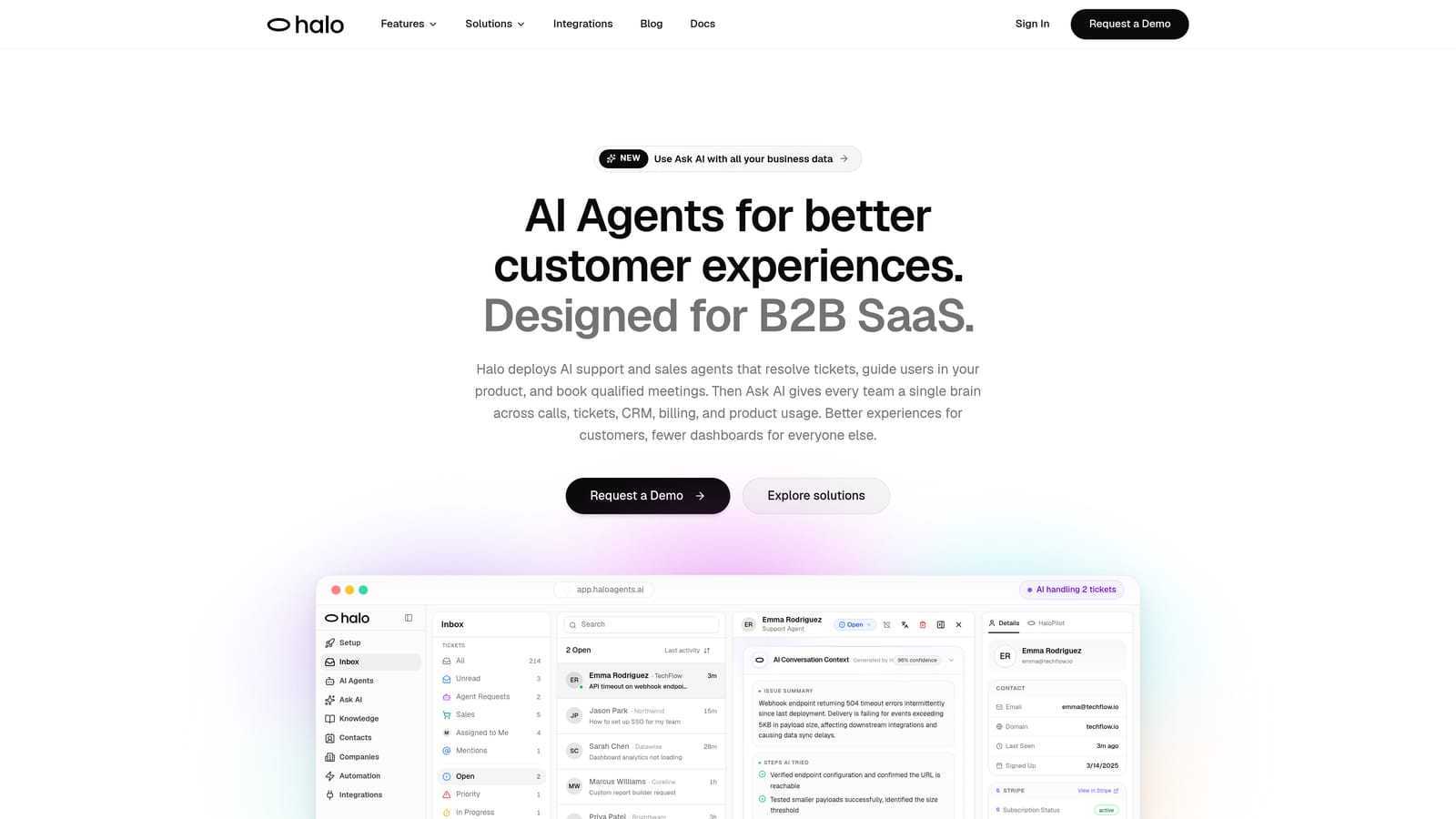
Halo AI is an AI-first customer support platform built specifically for SaaS and tech product teams, deploying intelligent agents that resolve tickets, guide users through the product UI, auto-create bug reports, and surface business intelligence signals from support data.
Where This Tool Shines
Most AI support tools treat every user interaction the same way regardless of where the user is in your product. Halo's page-aware architecture changes that: the AI agent sees what the user sees in the product UI, which means it can provide contextually accurate guidance rather than generic FAQ deflection. For technical products with complex workflows, this distinction matters enormously.
The other standout capability is what Halo does with support data beyond resolving tickets. Its smart inbox surfaces customer health signals, revenue anomalies, and churn indicators alongside incoming conversations. Your support queue becomes an intelligence layer, not just a to-do list. Continuous learning from every resolved interaction means the system compounds in accuracy over time rather than staying static.
Key Features
Page-Aware AI Agents: The AI sees the user's current product context, enabling precise UI guidance rather than generic answers.
Autonomous Ticket Resolution: Agents resolve common and complex queries independently, learning from each interaction to improve future responses.
Auto Bug Ticket Creation: Detected issues are automatically routed as bug tickets to Linear or connected developer tools, closing the loop between support and engineering.
Smart Inbox with Business Intelligence: Customer health signals, revenue anomalies, and churn indicators are surfaced directly in the support interface.
Live Agent Handoff: Complex issues requiring human judgment are escalated seamlessly, with full conversation context preserved for the receiving agent.
Integration Ecosystem: Connects to Linear, Slack, HubSpot, Intercom, Stripe, Zoom, PandaDoc, and Fathom, covering the full SaaS operational stack.
Best For
Halo is best suited to B2B SaaS companies and tech product teams that want AI to be the foundation of their support operation rather than an add-on. Particularly strong for teams already using Linear for engineering workflows and HubSpot or Stripe for customer data, where the integration depth unlocks the most value.
Pricing
Contact for pricing. Halo uses a custom pricing model suited to team size and usage volume. Worth requesting a demo to understand the full capability set before comparing costs.
2. Intercom
Best for: Tech companies already in the Intercom ecosystem wanting mature AI on top of proven messaging infrastructure.
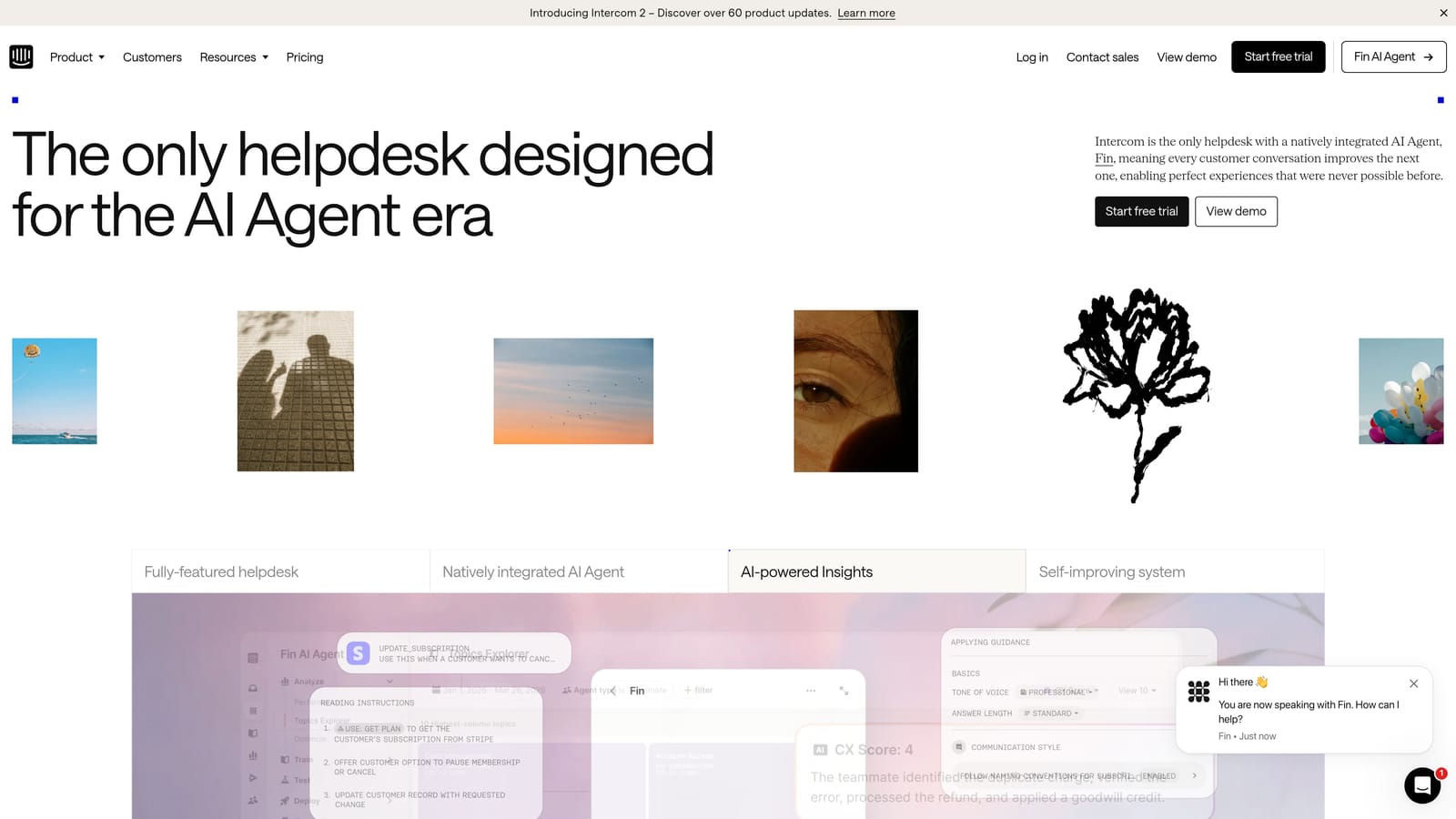
Intercom is one of the most established customer messaging platforms, combining its Fin AI agent with robust conversation routing, in-app messaging, and a large integration marketplace.
Where This Tool Shines
Fin, Intercom's GPT-4-based AI agent, handles a meaningful portion of inbound queries autonomously and has benefited from years of real-world training data across a wide range of tech company use cases. The conversation routing infrastructure is mature and configurable, which matters when you're managing multiple product lines or customer segments with different support needs.
Intercom's built-in product tour and onboarding flow capabilities also make it a natural fit for companies that want to connect support with user education. The 300+ app integrations mean it slots into most existing tech stacks without heavy custom development.
Key Features
Fin AI Agent: GPT-4-based autonomous resolution for common queries, with configurable fallback to human agents.
Omnichannel Messaging: Unified chat, email, and in-app messaging with consistent conversation history across channels.
Conversation Routing: AI-assisted routing rules and agent workflows that direct conversations to the right team or response.
Product Tours and Onboarding: Built-in tools for user education that connect naturally with support conversations.
Integration Marketplace: 300+ integrations including Salesforce, HubSpot, and Stripe for customer data context.
Best For
Teams already running Intercom for customer messaging who want to extend into AI-powered resolution without migrating platforms. Also a strong choice for product-led growth companies where in-app messaging and onboarding flows are central to the user experience.
Pricing
Starts around $39/seat/month, though costs scale significantly with usage volume and AI resolution rates. Verify current pricing directly with Intercom, as the model has evolved.
3. Zendesk AI
Best for: Enterprise tech teams with complex routing requirements, compliance needs, and large agent organizations.
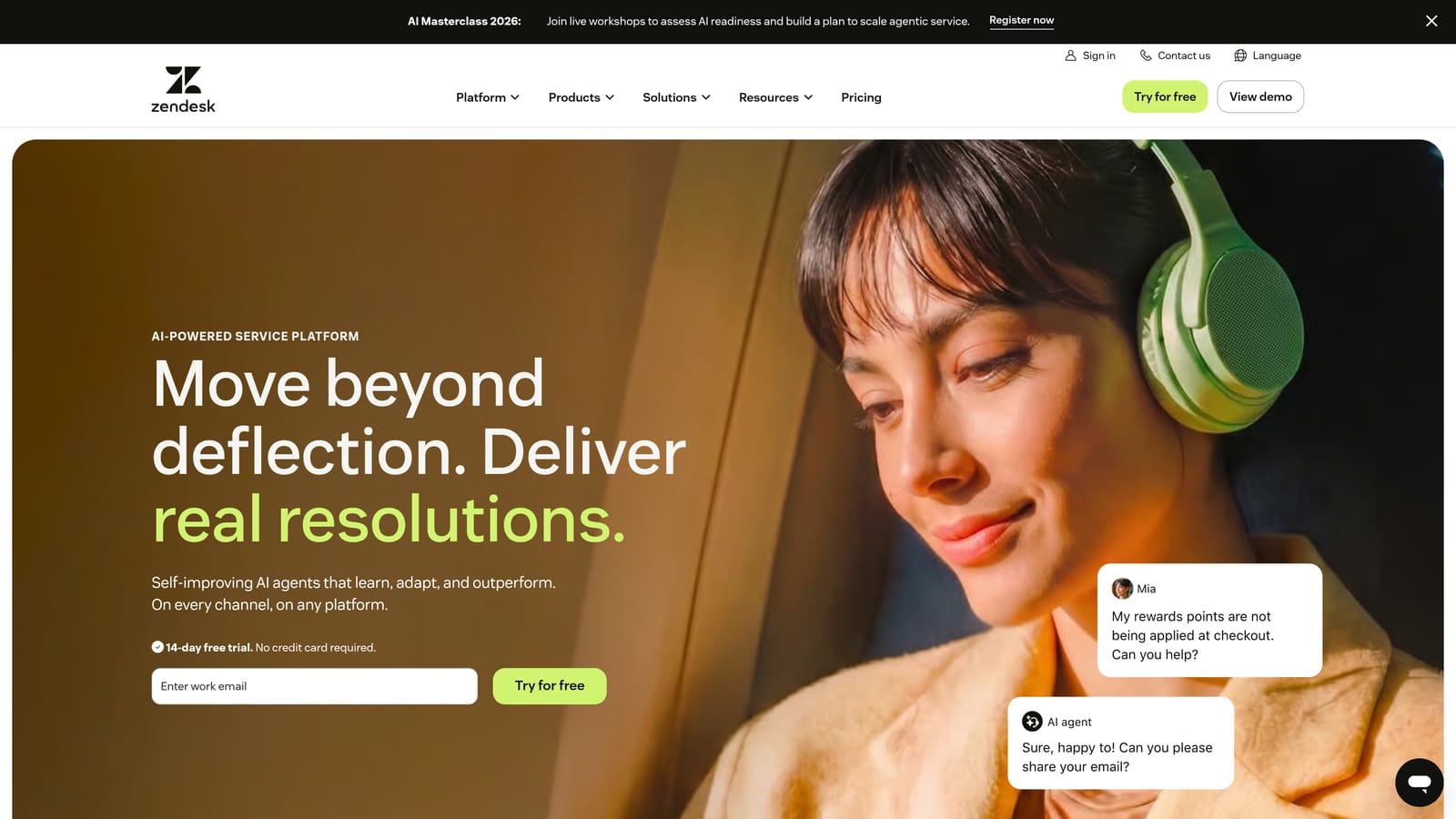
Zendesk AI layers an AI suite onto the dominant enterprise helpdesk platform, covering intelligent triage, agent copilot, macro suggestions, and knowledge base automation.
Where This Tool Shines
Zendesk's strength is its infrastructure depth. The 1,000+ marketplace integrations, enterprise-grade security controls, and highly configurable routing rules make it the default choice for large tech organizations with complex operational requirements. If your support team has 50+ agents across multiple regions with different escalation paths, Zendesk handles that complexity well.
The AI capabilities, while not architecturally native, are genuinely useful: intelligent triage reduces manual sorting, agent copilot surfaces relevant knowledge in real time, and knowledge base gap detection helps content teams identify what's missing before users hit dead ends.
Key Features
Intelligent Triage: AI-powered ticket classification and routing that reduces manual sorting and improves first-response accuracy.
Agent Copilot: Real-time response suggestions and knowledge retrieval surfaced in the agent workspace.
Knowledge Base Automation: Content generation assistance and gap detection to keep documentation current with product changes.
Macro Suggestions: AI-recommended response templates based on ticket content and historical patterns.
Enterprise Compliance: SOC 2, HIPAA, and GDPR controls for organizations with strict data governance requirements.
Best For
Large enterprise tech companies with complex compliance requirements, multi-region support teams, and existing Zendesk investments. Less ideal for startups or companies prioritizing AI-first autonomous resolution over process management infrastructure.
Pricing
Suite plans start around $55/agent/month; AI add-ons are priced separately and can add meaningful cost at scale. Verify current pricing before budgeting.
4. Freshdesk (Freddy AI)
Best for: Growing tech teams wanting capable AI-assisted support at a more accessible price point than enterprise alternatives.
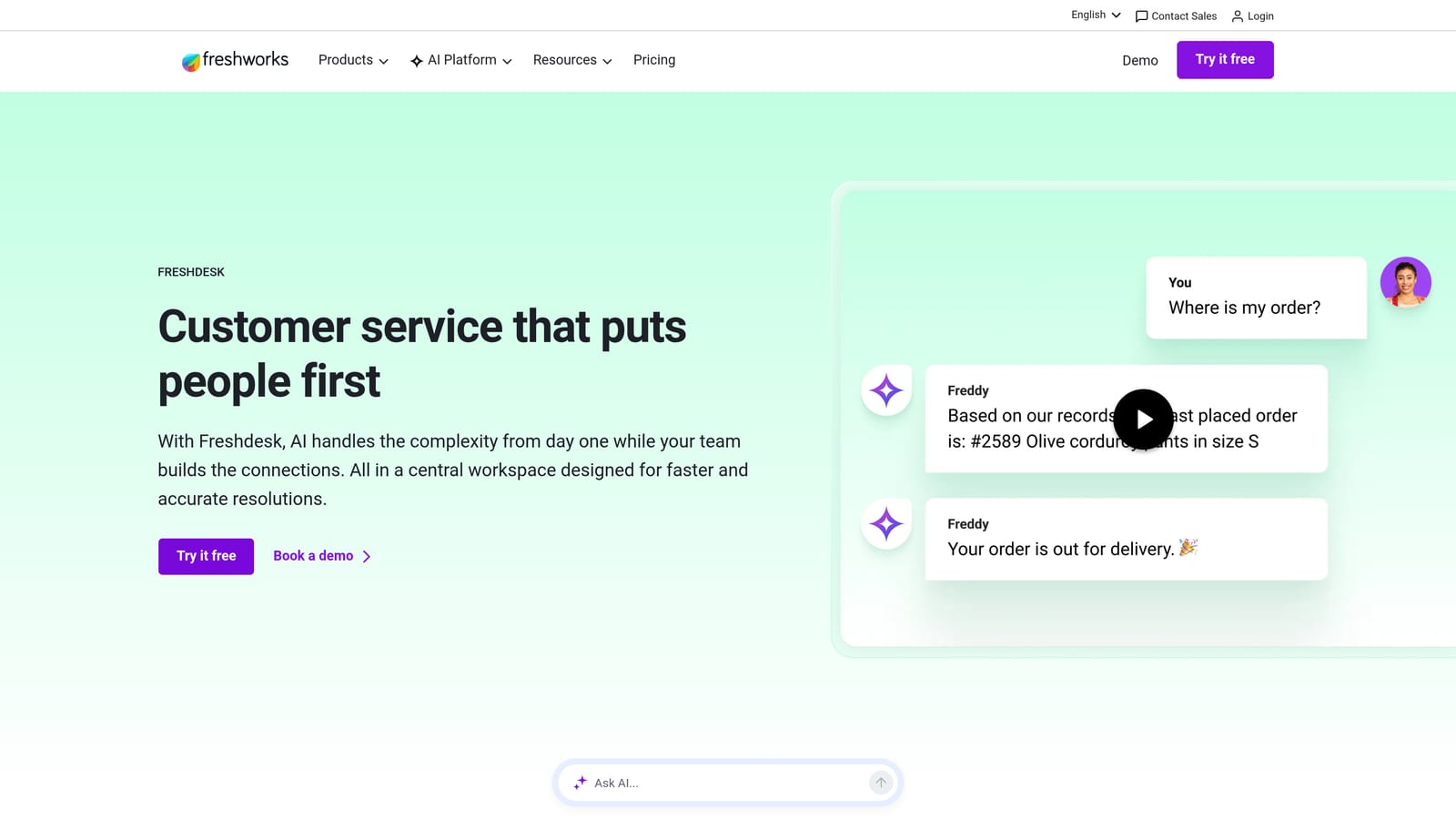
Freshdesk combines a solid helpdesk foundation with Freddy AI handling self-service deflection, agent assistance, and support analytics across tiers.
Where This Tool Shines
Freshdesk's pricing accessibility is a genuine differentiator. Teams that need meaningful AI capability without committing to enterprise-tier budgets will find Freddy Copilot's real-time agent assist and Freddy Self Service's deflection workflows cover a lot of ground. The free tier also makes it a low-risk starting point for smaller teams evaluating AI support tools.
Integration with the broader Freshworks suite (CRM, ITSM) is a natural advantage for companies already in that ecosystem. Freddy Insights adds support trend detection and analytics that help team leads identify patterns before they escalate into problems.
Key Features
Freddy Self Service: AI-powered deflection that resolves common queries before they reach an agent.
Freddy Copilot: Real-time agent assistance with response suggestions, summarization, and knowledge retrieval.
Freddy Insights: Trend detection and support analytics for identifying patterns and performance gaps.
Freshworks Suite Integration: Native connection to Freshworks CRM and ITSM tools for unified customer data.
Free Tier: Available for small teams, making it a genuinely accessible entry point into AI-assisted support.
Best For
Growing tech companies and startups that need capable AI support tooling without enterprise pricing. Also a natural fit for teams already using Freshworks products for CRM or IT service management.
Pricing
Free tier available; paid plans start around $15/agent/month. Freddy AI capabilities unlock at higher tiers. Verify current plan structure directly with Freshworks.
5. Tidio
Best for: Startups and smaller tech teams that need AI-powered chat deployed quickly with minimal technical overhead.
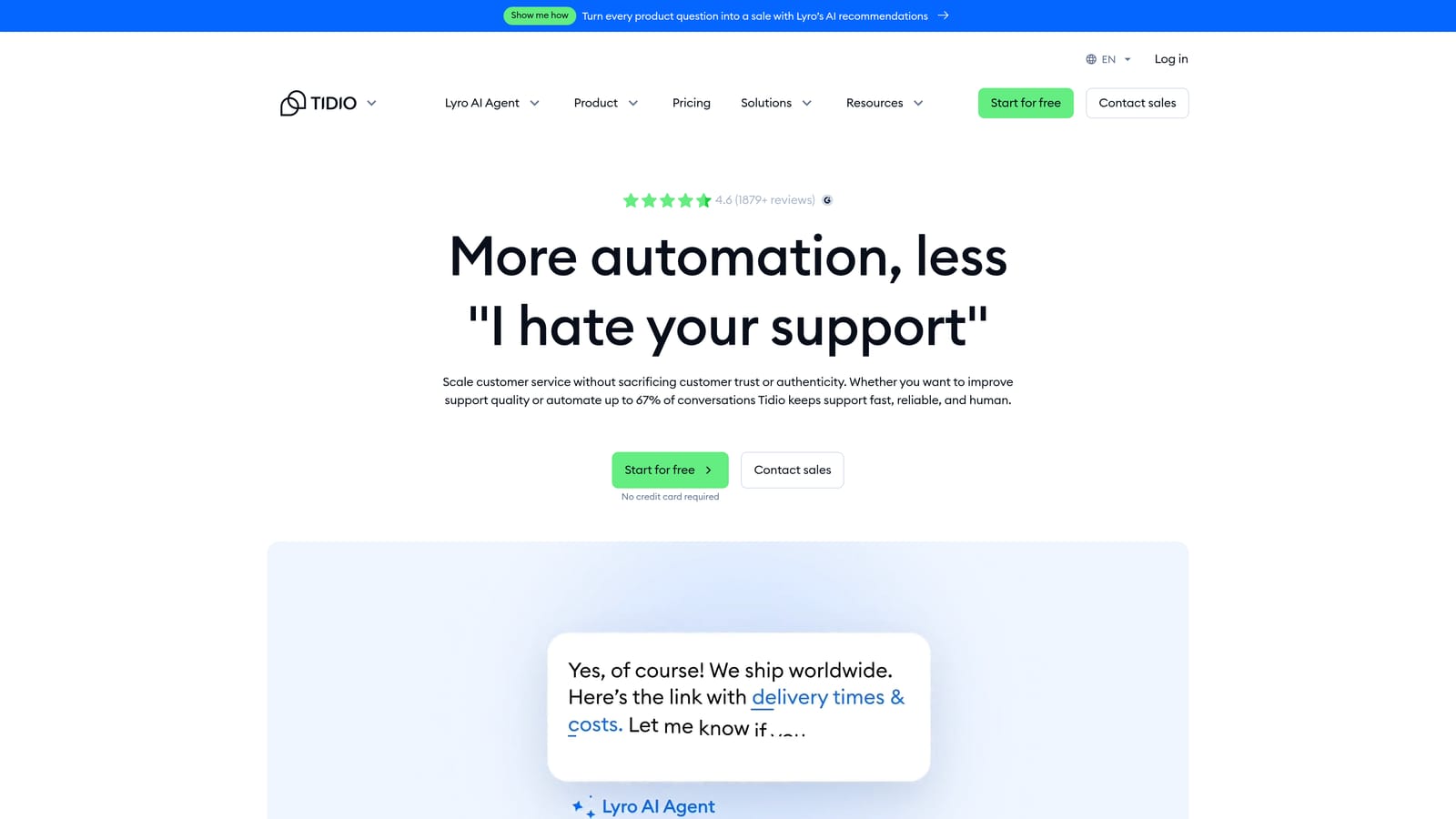
Tidio is a fast-to-deploy AI chat platform featuring its Lyro AI agent and a visual flow builder, designed for teams that need something live quickly without a lengthy implementation cycle.
Where This Tool Shines
Speed of deployment is Tidio's clearest advantage. Where enterprise platforms can take weeks to configure, Tidio can be live in hours. The visual flow builder lets non-technical team members build and modify automations without engineering support, which is valuable for early-stage companies where resources are stretched thin.
Lyro handles conversational query resolution competently for common support scenarios. For startups whose primary support volume involves standard product questions and onboarding queries, that coverage is often sufficient to meaningfully reduce agent workload.
Key Features
Lyro AI Agent: Conversational AI that resolves common queries and escalates to human agents when needed.
Visual Flow Builder: No-code automation builder for creating support workflows without engineering involvement.
Live Chat with Agent Fallback: Seamless handoff from AI to human agents within the same conversation thread.
Email and Messenger Integration: Connects chat with email and social messaging channels for broader coverage.
Fast Setup: Minimal technical requirements mean most teams can go live without a dedicated implementation project.
Best For
Early-stage startups and smaller tech companies that need a capable AI chat solution deployed quickly. Less suited to complex technical support scenarios, enterprise-scale ticket volumes, or teams requiring deep developer toolchain integrations.
Pricing
Free tier available; paid plans start around $29/month. One of the more accessible entry points in the market. Verify current plan details with Tidio directly.
6. Kustomer
Best for: Consumer tech and B2C SaaS companies that want a unified customer timeline across support, sales, and product usage data.
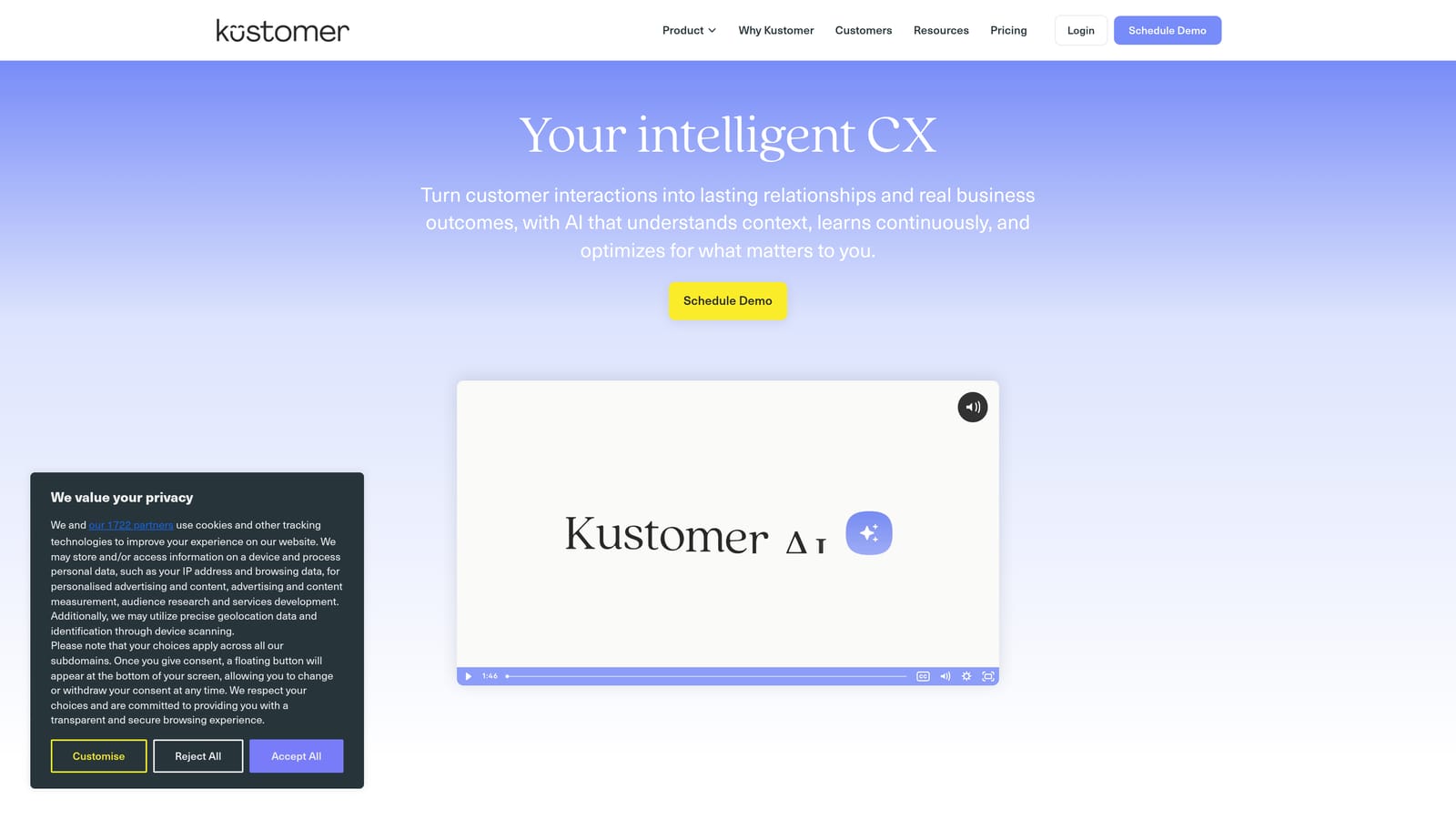
Kustomer is a CRM-first support platform that consolidates every customer touchpoint into a single timeline, with AI automation handling routing and response suggestions across that unified view.
Where This Tool Shines
Kustomer's unified customer timeline is genuinely differentiated. Rather than treating support as an isolated function, it surfaces sales history, product usage data, and previous interactions alongside the current conversation. Agents arrive at every interaction with full context, which reduces the friction of customers having to repeat themselves and enables more personalized responses.
The AI routing and response suggestion layer works effectively on top of that data richness. For consumer tech companies where customer lifetime value varies significantly and high-value customers need differentiated treatment, Kustomer's architecture supports that kind of tiered service model naturally.
Key Features
Unified Customer Timeline: All touchpoints across support, sales, and product usage consolidated in a single agent view.
AI-Powered Routing: Conversation routing and response suggestions driven by customer data and conversation context.
Omnichannel Coverage: Chat, email, SMS, social, and voice channels managed in one unified interface.
Custom Reporting: Flexible business intelligence and reporting tools for support performance and customer trends.
Key Integrations: Shopify, Salesforce, Slack, and custom API access for connecting additional data sources.
Best For
Consumer tech companies, B2C SaaS, and tech businesses with high-LTV customer relationships where full customer context in every support interaction is a meaningful differentiator. Less optimized for pure B2B enterprise support workflows.
Pricing
Starts around $89/agent/month. Verify current pricing directly with Kustomer before comparing to alternatives.
7. Forethought
Best for: Enterprise tech teams wanting AI triage and deflection without migrating away from their existing helpdesk platform.
Forethought is an AI layer designed to sit on top of existing helpdesks, adding intelligent triage, deflection, and routing capabilities without requiring a platform migration.
Where This Tool Shines
The core value proposition is additive AI without disruption. If your organization has significant investment in Zendesk, Salesforce Service Cloud, or ServiceNow, ripping and replacing that infrastructure is a major undertaking with real organizational risk. Forethought solves for AI uplift within your existing environment, handling triage, deflection, and routing while your underlying helpdesk handles the rest.
Sentiment detection and priority scoring are particularly useful for tech companies managing high-volume inbound. Surfacing which tickets need urgent attention and which can be deflected before ticket creation reduces queue noise and helps agents focus where they matter most.
Key Features
AI Triage and Classification: Intelligent ticket categorization and routing layered onto your existing helpdesk infrastructure.
Deflection Workflows: Resolves queries before ticket creation, reducing volume that reaches human agents.
Helpdesk Integrations: Works with Zendesk, Salesforce Service Cloud, ServiceNow, and Freshdesk without requiring migration.
Sentiment Detection: Identifies tone and urgency signals to prioritize tickets that need immediate attention.
No Migration Required: Designed explicitly to augment rather than replace existing helpdesk investments.
Best For
Enterprise tech organizations locked into existing helpdesk contracts that want meaningful AI capability without the disruption of a full platform switch. Less suited to companies open to building on an AI-native foundation from the start.
Pricing
Custom enterprise pricing. Contact Forethought directly for a quote based on volume and integration requirements.
8. Gladly
Best for: Tech companies with high-LTV customer relationships where human connection and conversation continuity are core to the support experience.
Gladly is a people-centered support platform that replaces ticket numbers with persistent customer conversations across channels, with AI assisting agents rather than replacing them.
Where This Tool Shines
Gladly's persistent conversation model is architecturally distinct from ticket-based systems. Every interaction a customer has, across any channel, lives in a single ongoing conversation thread. Agents see the full history without hunting through ticket IDs, and customers don't experience the frustration of repeating context when they switch from chat to email to voice.
The AI here is deliberately positioned as agent assistance rather than autonomous replacement. For tech companies where support quality and relationship continuity are brand assets, that philosophy aligns well. Customer lifetime value data surfaced in the agent view also enables differentiated service for high-value accounts.
Key Features
Persistent Conversation Model: Full customer history across all channels in one ongoing thread, with no ticket numbers to manage.
Omnichannel in One View: Chat, email, voice, SMS, and social handled within a unified agent interface.
AI Agent Assist: Response suggestions and knowledge retrieval that support agents rather than replace them.
Customer LTV Visibility: Lifetime value data surfaced in the agent view to enable differentiated service for high-value customers.
Task Automation: Routine support actions automated to reduce repetitive agent workload.
Best For
Consumer tech companies and B2C SaaS businesses where relationship quality and conversation continuity are differentiators. Teams that want AI to assist human agents rather than operate autonomously will find Gladly's philosophy a natural fit.
Pricing
Starts around $150/agent/month, positioning it at the premium end of the market. Verify current pricing with Gladly directly.
9. Help Scout
Best for: Developer tools, open-source projects, and tech companies where support voice and empathy are central brand values.
Help Scout is a human-first shared inbox and chat platform with AI drafting and summarization features, built for teams where the quality and tone of support communication matters as much as resolution speed.
Where This Tool Shines
Help Scout has built a strong following among developer tools companies and open-source projects because it treats support as a relationship function rather than a throughput problem. The shared inbox with collision detection prevents duplicate replies, internal notes keep team context organized, and the Beacon chat widget integrates cleanly into product UIs without feeling intrusive.
The AI features, including draft assistance and conversation summarization, are positioned as tools that help agents write better responses faster, not as autonomous resolution engines. For companies where a support reply that feels genuinely human is a brand requirement, that distinction is meaningful. Pricing is transparent and predictable, which is refreshing in a market full of usage-based complexity.
Key Features
Shared Inbox with Collision Detection: Prevents duplicate agent replies and keeps team coordination visible within the conversation view.
Beacon Chat Widget: In-product chat with knowledge base integration for self-service before agent escalation.
AI Draft Assistance: Helps agents write responses faster without replacing the human voice in the reply.
Conversation Summarization: AI-generated summaries for quick context when agents pick up ongoing threads.
Docs Knowledge Base: Built-in knowledge base with AI-assisted content suggestions to keep documentation current.
Best For
Developer tools companies, open-source projects, and tech businesses where support tone is a brand asset and autonomous AI resolution isn't the primary goal. Teams that want predictable pricing and a clean, focused interface rather than a feature-heavy platform will find Help Scout fits naturally.
Pricing
Starts around $22/user/month, making it one of the more affordable options for teams that don't need enterprise-scale AI capabilities. Verify current plan details with Help Scout directly.
Which Tool Is Right for Your Team
The right choice here depends on where you are as a company and what you actually need AI to do in your support operation. Here's a quick-reference frame for the most common scenarios.
Early-stage SaaS startup: Tidio gets you live quickly and affordably. Freshdesk's free tier is worth evaluating if you anticipate growing into more structured workflows. If you want AI-first architecture from day one and are willing to invest in a platform that scales with you, Halo AI is the strongest foundation.
Growing B2B SaaS team: Halo AI's page-aware agents, auto bug ticket creation, and Linear integration make it purpose-built for this segment. Intercom is a strong alternative if you're already deep in their ecosystem and want to extend rather than migrate.
Enterprise tech organization with existing helpdesk: If migration isn't on the table, Forethought adds meaningful AI capability to Zendesk, Salesforce, or ServiceNow without disruption. If you're open to re-platforming, Zendesk AI handles enterprise routing complexity well.
Consumer tech or high-LTV B2C: Kustomer's unified customer timeline or Gladly's persistent conversation model both address the relationship continuity problem that ticket-based systems handle poorly.
Developer tools or open-source: Help Scout's human-first approach and transparent pricing resonate with teams where support voice is part of the brand identity.
Before finalizing any decision, check integration compatibility with your specific stack. The tools that connect to your existing CRM, billing system, and engineering workflow (Linear, Jira, or GitHub) will deliver meaningfully more value than those that require manual data bridging.
Your support team shouldn't scale linearly with your customer base. Let AI agents handle routine tickets, guide users through your product, and surface business intelligence while your team focuses on complex issues that need a human touch. See Halo in action and discover how continuous learning transforms every interaction into smarter, faster support.