9 Best AI Support Software Packages for B2B Teams in 2026
B2B support teams in 2026 are moving beyond basic chatbots to evaluate full-stack ai support software packages that autonomously resolve tickets, integrate deeply with existing tech stacks, and deliver actionable business intelligence. This guide reviews the nine best options across key dimensions including autonomous resolution, integration depth, analytics, and scalability to help teams choose the right platform for their specific needs and growth stage.
 Grant CooperFounder14 min read
The days of slapping a basic chatbot onto your support page and calling it "AI" are over. B2B teams in 2026 are evaluating a fundamentally different category of software: full-stack AI support platforms that autonomously resolve tickets, integrate deeply with your tech stack, and surface business intelligence that goes well beyond support metrics.
Choosing the right AI support software package isn't just a helpdesk decision anymore. It's a strategic choice that affects your engineering workflows, customer health visibility, and your team's ability to scale without proportionally growing headcount.
To build this list, we evaluated tools across five dimensions: autonomous resolution capabilities, integration depth, analytics and reporting, scalability for B2B teams, and pricing transparency. Whether you're running a lean startup or managing enterprise-level support volume, the right fit depends heavily on whether you want an AI-native platform built from the ground up or an AI layer added to an existing helpdesk.
Here are the top AI support software packages worth evaluating for your B2B team this year.
1. Halo AI
Best for: B2B teams wanting an AI-first support platform that learns, integrates deeply, and scales without adding headcount.
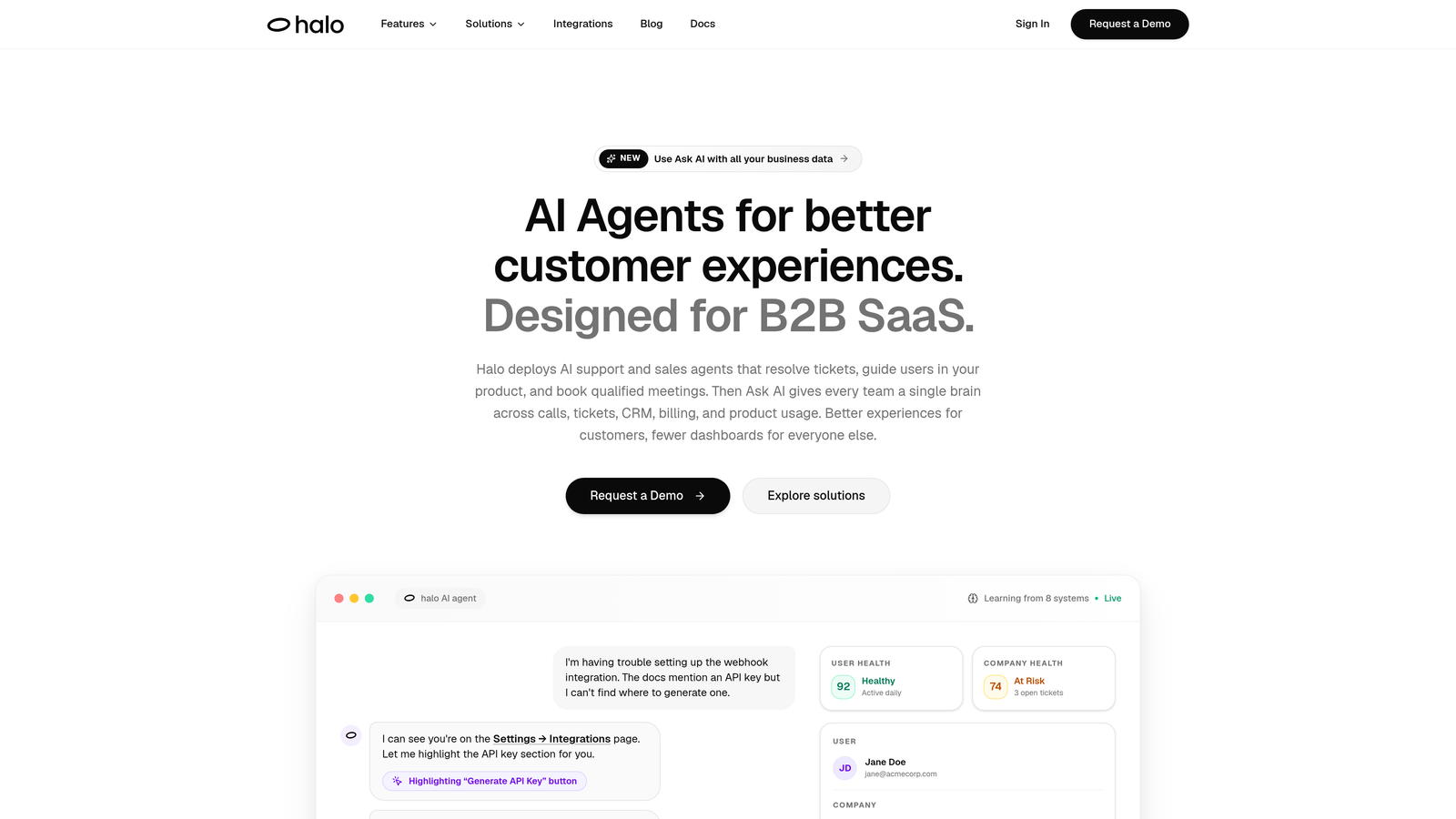
Halo AI is an AI-native customer support platform that deploys intelligent agents to resolve tickets, guide users with page-aware context, and surface business intelligence across your entire customer base.
Where This Tool Shines
What separates Halo from most tools on this list is the architecture. It wasn't built as a helpdesk with AI features added later. The entire platform is designed around AI agents that continuously learn from every interaction, improving resolution quality over time rather than staying static after initial setup.
The page-aware context is particularly compelling for B2B SaaS teams. Halo's agents can see what users see inside your product, enabling visual UI guidance that's contextually relevant rather than generic. Pair that with automatic bug ticket creation that routes directly to Linear or Jira, and you have a support platform that actively connects customer experience to your engineering workflow.
Key Features
Page-Aware AI Agents: Agents understand the specific page or product state a user is on, enabling contextual visual guidance rather than generic FAQ responses.
Auto Bug Ticket Creation: Automatically creates and routes bug reports to Linear, Jira, and other engineering tools when support interactions reveal product issues.
Smart Inbox with Business Intelligence: Goes beyond support metrics to surface customer health signals, revenue intelligence, and anomaly detection from interaction patterns.
Continuous Learning: Every resolved ticket and interaction feeds back into the AI to improve future resolution quality and accuracy.
Deep Integration Stack: Connects natively with Slack, HubSpot, Intercom, Stripe, Zoom, PandaDoc, Fathom, and more for a unified view across your business tools.
Best For
B2B SaaS companies and product teams that want an AI-native platform rather than a traditional helpdesk with AI bolted on. Especially strong for teams that need support intelligence to feed back into product, engineering, and revenue workflows.
Pricing
Contact for pricing. Halo is designed for B2B teams scaling support operations without proportionally scaling headcount, so pricing is typically scoped to team size and resolution volume.
2. Zendesk AI
Best for: Enterprise teams already invested in the Zendesk ecosystem wanting to add AI capabilities to mature ticketing infrastructure.
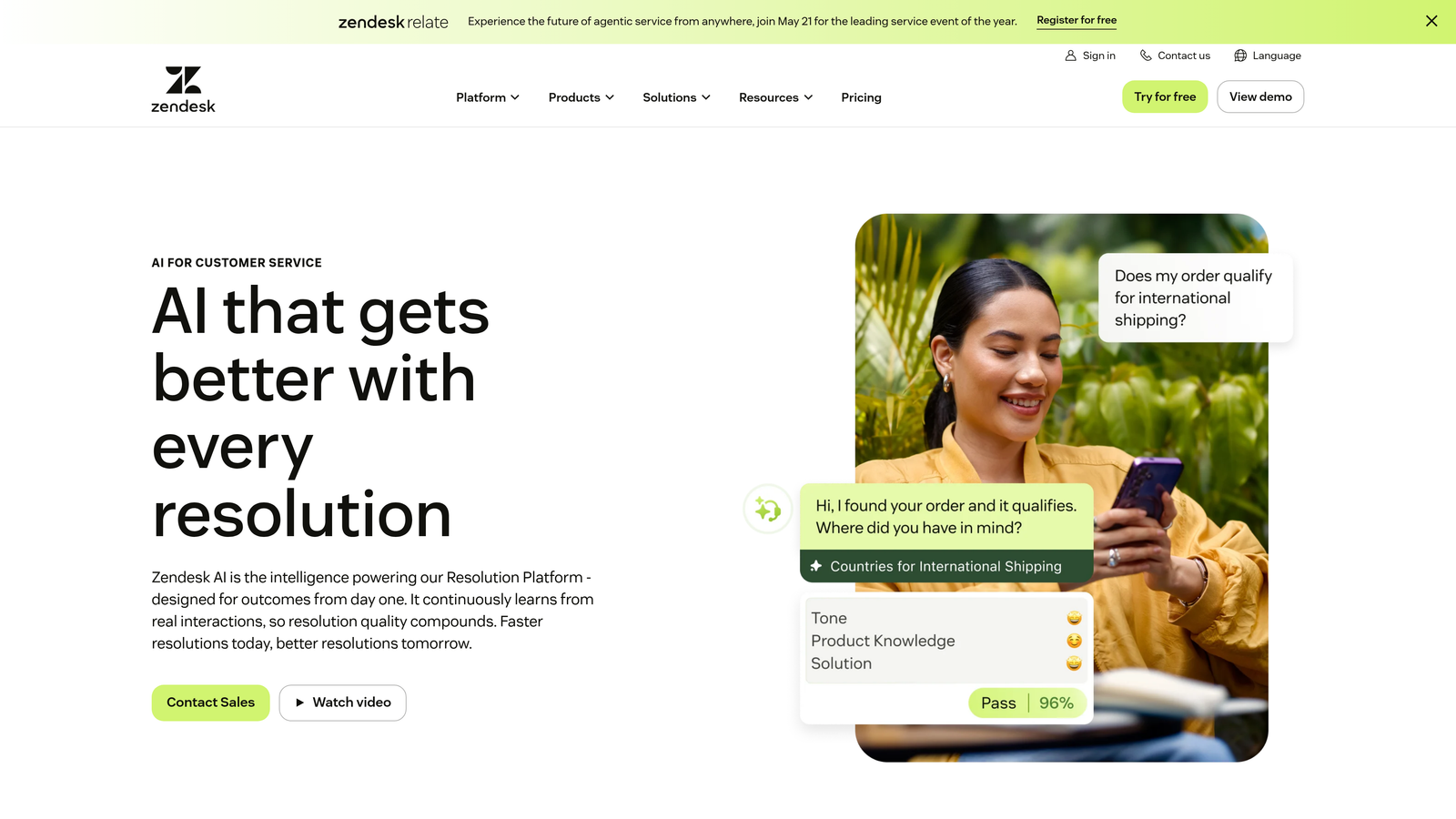
Zendesk AI is an enterprise-grade AI layer built on top of Zendesk's established helpdesk platform, offering AI agents, intelligent triage, and agent assist tools across every channel.
Where This Tool Shines
Zendesk's strength is its maturity. If your team has years of ticket data, workflows, and integrations built on Zendesk, the AI layer gives you a path to automation without ripping out your existing infrastructure. The intelligent triage capabilities are particularly well-developed, automatically classifying intent, language, and sentiment at scale.
The app marketplace is a genuine differentiator with over 1,500 integrations available. For enterprise teams with complex, multi-system environments, that breadth of connectivity is hard to match.
Key Features
AI Agents: Automated ticket resolution across email, chat, and messaging channels without requiring human involvement for common inquiries.
Intelligent Triage: Automatically classifies tickets by intent, language, and sentiment to route them to the right team or workflow.
Agent Assist: Surfaces AI-suggested replies and relevant knowledge base articles for human agents during live interactions.
App Marketplace: Access to 1,500+ integrations covering CRM, billing, engineering, and communication tools.
Advanced Analytics: Custom reporting dashboards with deep visibility into ticket volume, resolution rates, and team performance.
Best For
Larger enterprises already on Zendesk who want to layer AI capabilities into existing workflows without platform migration. Less ideal for teams starting fresh who want an AI-native architecture.
Pricing
Suite plans start around $55 per agent per month. Advanced AI features may require an additional add-on at extra cost, so factor that into total pricing comparisons.
3. Intercom Fin
Best for: Product-led growth companies that need strong in-app messaging alongside AI-powered support resolution.
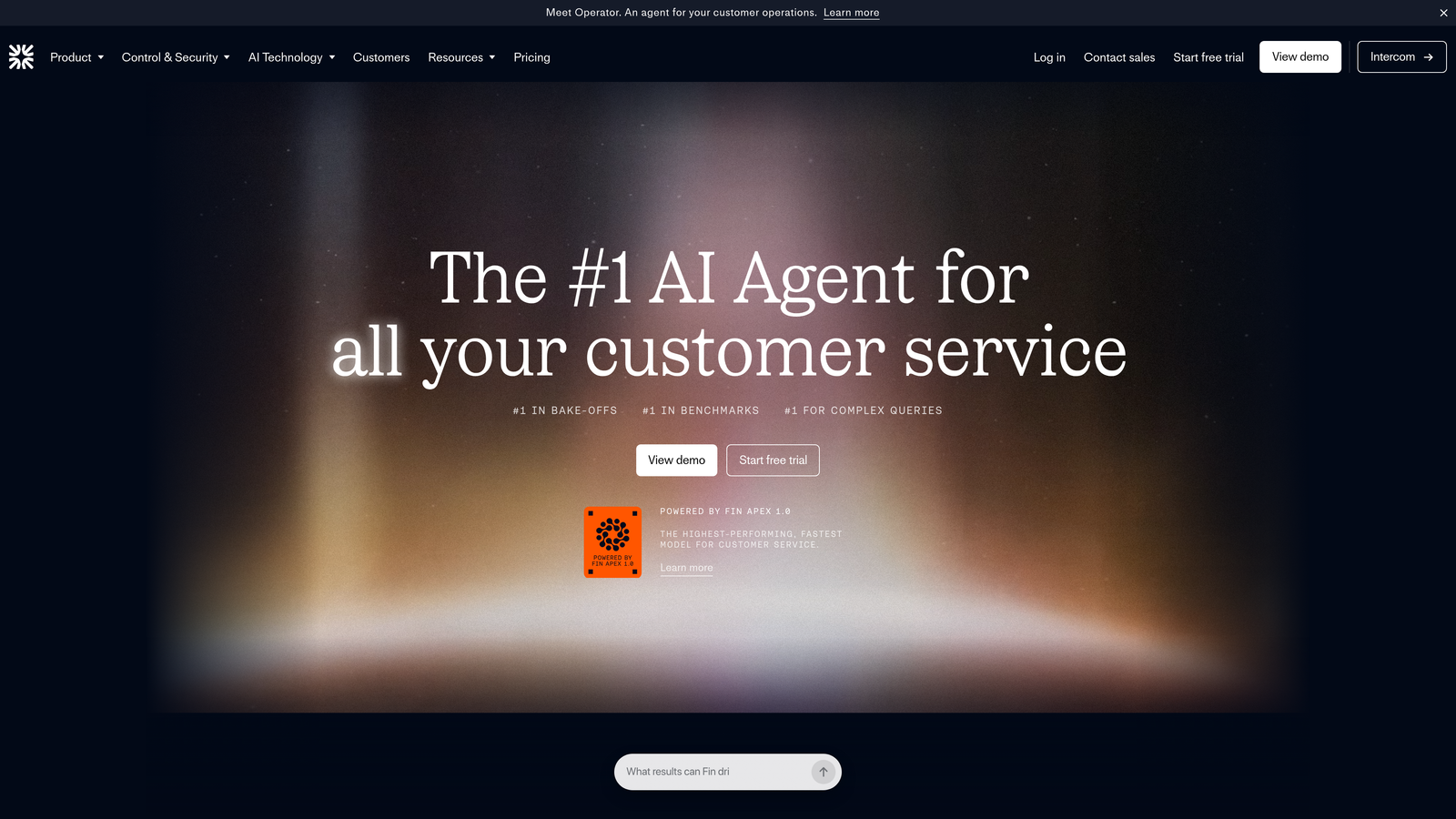
Intercom Fin is an AI-powered support agent built into Intercom's conversational platform, designed to resolve customer questions using your existing help center content while maintaining strong in-app engagement capabilities.
Where This Tool Shines
Fin's core strength is its tight integration with Intercom's broader product suite. If your team already uses Intercom for onboarding flows, product tours, and in-app messaging, Fin extends that into automated support resolution without requiring a separate platform. The AI agent draws directly from your help center content, making initial setup relatively straightforward.
The Fin AI Copilot feature is worth noting for teams with hybrid support models. It provides real-time AI suggestions to human agents during live conversations, which can meaningfully reduce handle time on complex tickets.
Key Features
Fin AI Agent: Resolves customer questions by drawing on your existing help center and knowledge base content automatically.
In-App Messaging and Product Tours: Proactive engagement tools for onboarding, feature adoption, and user education built into the same platform.
Customizable AI Personality: Adjustable tone and communication style to match your brand voice across customer interactions.
Fin AI Copilot: Real-time AI suggestions for human agents handling live conversations to improve speed and accuracy.
PLG Tooling: In-app surveys, feature adoption tracking, and engagement analytics designed for product-led growth teams.
Best For
PLG-focused SaaS companies that want support and customer engagement in a single platform. Teams that already use Intercom for messaging will get the most value from Fin without additional integration overhead.
Pricing
Essential plan starts at $29 per seat per month. The Fin AI agent is charged per resolution, so costs scale with support volume rather than team size alone.
4. Freshdesk Freddy AI
Best for: Growing teams wanting AI-powered support at competitive price points with a free entry tier available.
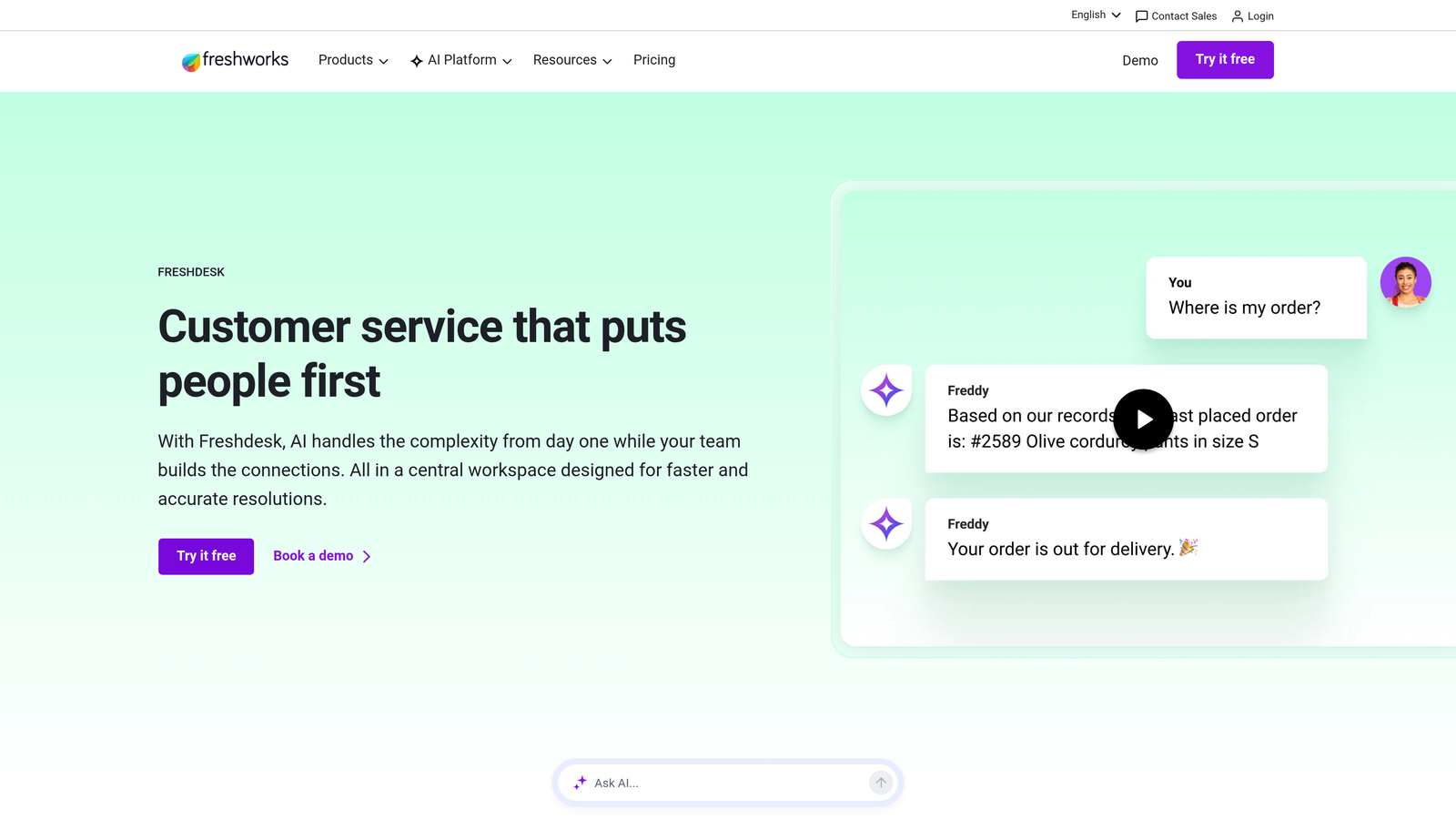
Freshdesk with Freddy AI is Freshworks' AI-enhanced helpdesk offering automated ticket handling, intelligent routing, and agent assist capabilities across an accessible pricing structure.
Where This Tool Shines
Freshdesk's value proposition is accessibility. The free plan and low-cost entry tiers make it one of the few AI support platforms where smaller B2B teams can get started without a significant upfront commitment. Freddy AI handles the core automation tasks well: routing, suggested responses, and knowledge base surfacing.
For teams scaling from manual support processes, the combination of affordable pricing and solid AI fundamentals makes Freshdesk a practical starting point before potentially migrating to a more AI-native platform as complexity grows.
Key Features
Freddy AI Agent: Handles automated customer interactions across multiple channels, deflecting common inquiries without agent involvement.
Auto-Triage and Routing: Intelligently assigns tickets based on agent skill, workload, and ticket content for efficient queue management.
AI-Suggested Responses: Recommends replies and canned responses to agents during live ticket handling to speed up resolution.
Knowledge Base with AI Search: Built-in knowledge base with AI-powered article suggestions surfaced at the right moment.
Affordable Tiering: Free plan available with AI features unlocking progressively across paid tiers.
Best For
Small to mid-size B2B teams that need functional AI support capabilities without enterprise pricing. Also a good fit for teams new to AI support tooling who want a lower-risk entry point.
Pricing
Free plan available. Paid plans start around $15 per agent per month, with AI features becoming more robust in higher-tier plans.
5. Ada
Best for: High-volume B2B operations requiring multilingual automated resolution across chat, email, voice, and social channels.
Ada is a purpose-built AI agent platform engineered for high-volume automated resolution across multiple channels and languages, with a reasoning engine capable of handling complex, multi-step customer workflows.
Where This Tool Shines
Ada is built for scale. Where many AI support tools handle simple FAQ deflection well but struggle with complex, multi-step workflows, Ada's reasoning engine is designed specifically to handle nuanced customer interactions that require conditional logic and multiple data lookups. This makes it particularly strong for B2B use cases with intricate product workflows or compliance requirements.
The multilingual capabilities are genuinely impressive, covering 50+ languages without requiring manual translation work. For B2B teams with international customer bases, that's a significant operational advantage over platforms that treat multilingual support as an afterthought.
Key Features
Omnichannel AI Agent: Handles customer interactions across chat, email, voice, and social channels from a single platform.
Multilingual Support: Automated resolution in 50+ languages without manual translation or separate language-specific configuration.
No-Code Conversation Design: Visual interface for building and training AI conversation flows without engineering resources.
Reasoning Engine: Handles complex, multi-step customer workflows that go beyond simple FAQ matching and require conditional logic.
CRM and Helpdesk Integrations: Connects with major CRM, helpdesk, and e-commerce platforms to pull context into conversations.
Best For
Enterprise B2B teams with high support volume, international customers, or complex workflow requirements that exceed what simpler AI tools can handle reliably.
Pricing
Custom pricing based on resolution volume. Contact Ada's sales team for a quote tailored to your support scale and channel requirements.
6. Tidio
Best for: Small to mid-size businesses wanting fast AI support setup with minimal implementation complexity.
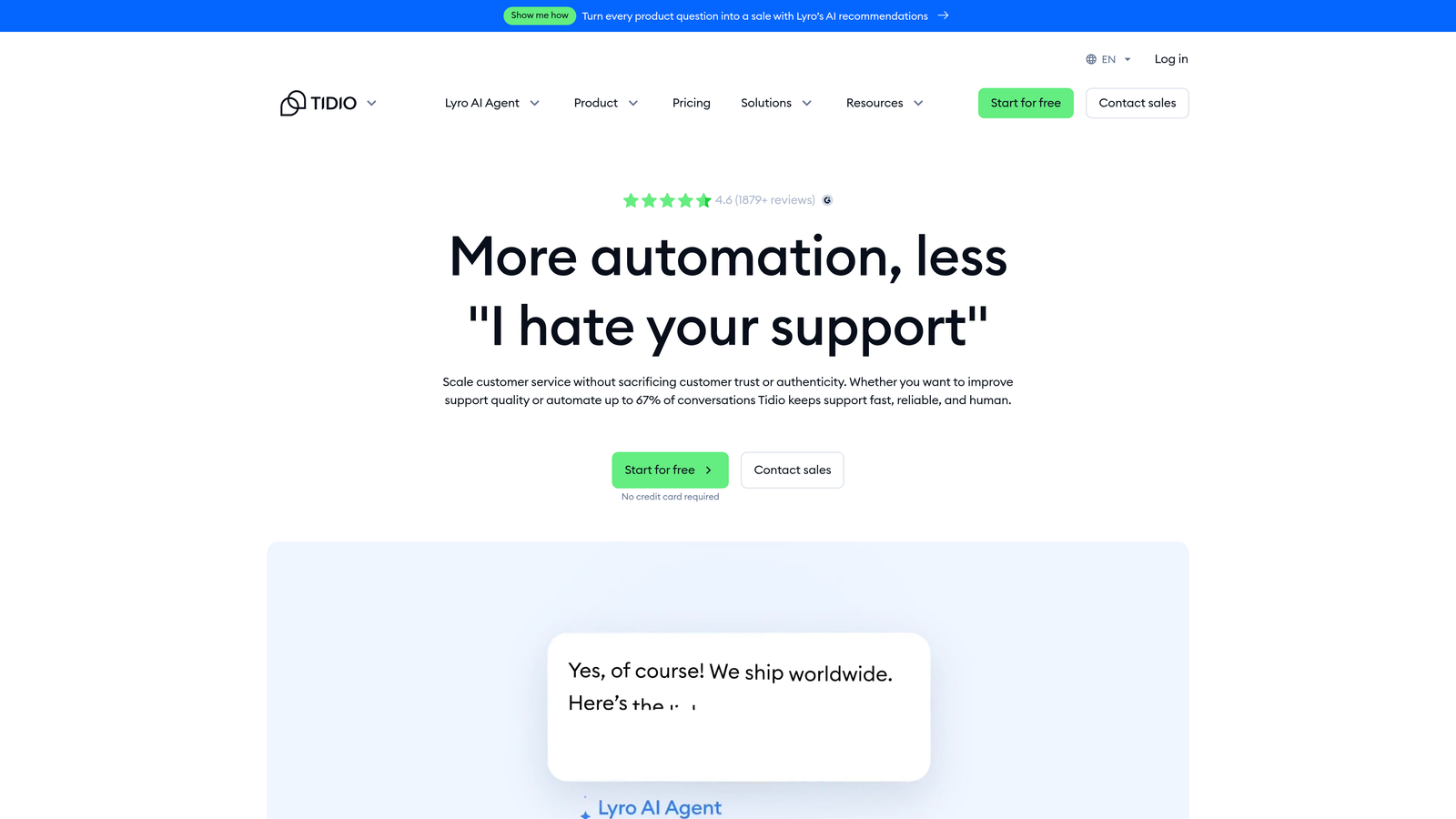
Tidio is an approachable AI chatbot and live chat platform featuring Lyro AI, designed for teams that want quick deployment and easy management without deep technical resources.
Where This Tool Shines
Tidio's strongest selling point is speed to value. Lyro AI learns from your existing FAQ and support content, meaning teams can get a functional AI support agent running relatively quickly compared to platforms requiring extensive training data or complex configuration. The visual chatbot flow builder makes customization accessible without engineering involvement.
The live chat handoff is seamlessly integrated, so when Lyro can't resolve an inquiry, the transition to a human agent feels natural rather than disruptive. For teams running lean support operations, that hybrid model works well in practice.
Key Features
Lyro AI Chatbot: Learns from your FAQ and support content to answer customer questions automatically without manual rule-building.
Visual Flow Builder: No-code interface for building custom chatbot automation flows and conversation paths.
Live Chat Handoff: Seamless escalation from AI to human agent when Lyro reaches the limits of its resolution capability.
E-commerce Integrations: Native connections with Shopify, WooCommerce, and other e-commerce platforms for order and product context.
Visitor Tracking: Engagement analytics showing visitor behavior and interaction patterns to inform support content improvements.
Best For
Small to mid-size businesses, particularly e-commerce and SMB SaaS teams, that want functional AI support without the implementation overhead or pricing of enterprise platforms.
Pricing
Free plan available. Lyro AI starts around $29 per month, with paid plans scaling based on conversation volume rather than seat count.
7. Forethought
Best for: Enterprise teams wanting AI triage and resolution capabilities layered on top of an existing helpdesk without platform migration.
Forethought is an enterprise AI platform focused on intelligent ticket triage, automated resolution, and agent assist, designed to operate as an intelligent layer on top of your current helpdesk infrastructure.
Where This Tool Shines
Forethought's positioning as a helpdesk-agnostic AI layer is its core differentiator. If your team has significant investment in Zendesk, Salesforce Service Cloud, or another established platform, Forethought lets you add AI capabilities without abandoning that infrastructure. The SupportGPT foundation powers classification, routing, and response drafting in a way that integrates with existing workflows rather than replacing them.
The modular product structure (Solve for customer-facing resolution, Triage for classification, Assist for agent support) means teams can adopt the components most relevant to their current needs and expand from there.
Key Features
SupportGPT: Automated ticket classification, intelligent routing, and AI-drafted response suggestions powered by large language model capabilities.
Solve: Customer-facing AI agent for automated resolution of common inquiries before they reach human agents.
Triage: Intelligent ticket categorization and priority assignment to ensure the right tickets reach the right agents efficiently.
Assist: Real-time AI suggestions for human agents during live interactions to improve response quality and speed.
Helpdesk Compatibility: Designed to work on top of Zendesk, Salesforce, and other major helpdesk platforms without requiring migration.
Best For
Enterprise teams with established helpdesk infrastructure who want to add AI capabilities incrementally without a full platform replacement. Strong fit for organizations with complex routing logic and high ticket classification requirements.
Pricing
Custom enterprise pricing. Contact Forethought's sales team for a quote based on your resolution volume and helpdesk environment.
8. Kustomer
Best for: Teams wanting deep customer context in every interaction through a CRM-native support platform with AI automation layered in.
Kustomer is a CRM-first customer service platform that combines a unified customer timeline with AI-powered automation, giving support teams full context across every channel and touchpoint.
Where This Tool Shines
Kustomer's unified customer timeline is genuinely differentiated. Rather than treating each support ticket as an isolated event, Kustomer pulls together every interaction, purchase, behavior signal, and CRM data point into a single thread per customer. This gives agents and AI automation significantly more context than a traditional ticketing system provides.
The built-in CRM eliminates the need for a separate customer data tool, which simplifies the tech stack for teams that would otherwise be managing helpdesk and CRM separately. For B2B teams where customer relationship context matters deeply, that consolidation has real operational value.
Key Features
Unified Customer Timeline: Single-thread view combining all channels, CRM data, and interaction history for complete customer context.
AI Chatbots and Workflows: Automated handling of common inquiries with intelligent workflow triggers based on customer data and behavior.
Proactive Support Triggers: Automated outreach or escalation based on customer behavior signals and data patterns.
Built-In CRM: Native customer data management that eliminates the need for a separate CRM tool in many use cases.
Omnichannel Coverage: Unified support across email, chat, social, SMS, and voice from a single platform.
Best For
B2B teams where customer relationship context is central to support quality, particularly those who want to consolidate CRM and helpdesk functionality into a single platform.
Pricing
Enterprise pricing starting around $89 per user per month. Contact Kustomer's sales team for current plans and volume-based options.
9. HubSpot Service Hub
Best for: Teams already in the HubSpot ecosystem wanting AI-powered support with full CRM, marketing, and sales data visibility.
HubSpot Service Hub is an AI-powered service platform built natively into HubSpot's CRM, offering ticket automation, AI chatbot capabilities, and knowledge base tools with complete customer lifecycle visibility.
Where This Tool Shines
Service Hub's strongest argument is the native HubSpot integration. For teams already using HubSpot for CRM, marketing automation, and sales, adding Service Hub means support data flows directly into the same customer record that marketing and sales are already working from. That eliminates a significant data silo problem that many B2B teams struggle with across disconnected tools.
The Breeze AI chatbot handles conversational ticket resolution reasonably well, and the combination of automated SLA management, NPS tracking, and knowledge base search makes it a functional all-in-one option for teams that prioritize platform consolidation over cutting-edge AI resolution capabilities.
Key Features
Breeze AI Chatbot: Conversational AI for automated ticket resolution integrated directly into HubSpot's platform and customer data.
Native CRM Integration: Full visibility into HubSpot CRM, marketing, and sales data within every support interaction.
Ticket Automation: Automated routing, SLA management, and escalation workflows to keep support operations running efficiently.
Customer Feedback Tools: Built-in NPS surveys and customer satisfaction tracking to monitor support quality over time.
AI-Powered Knowledge Base: Smart search and article recommendations that surface the right content for agents and customers.
Best For
B2B teams already invested in HubSpot's platform who want to extend their existing CRM and marketing infrastructure into support without adopting a separate tool.
Pricing
Free tools available. Service Hub Starter at $20 per seat per month; Professional at $100 per seat per month with more advanced automation and AI features.
Which Tool Is Right for Your Team?
The right AI support software package depends on one core question: do you want an AI-native platform built around intelligent agents, or an AI layer added to an existing helpdesk? That distinction shapes everything from how the system learns over time to how deeply it integrates with your broader tech stack.
Here's a quick breakdown by use case to help you orient your evaluation:
Best for AI-first architecture: Halo AI. If you want a platform where AI is the foundation rather than a feature, Halo's page-aware agents, continuous learning, and business intelligence capabilities are purpose-built for B2B teams that want support to drive product and revenue insights, not just deflect tickets.
Best for existing Zendesk users: Zendesk AI. If you have significant infrastructure already built on Zendesk, adding the AI layer is the lowest-friction path to automation without disrupting what's working.
Best for PLG companies: Intercom Fin. Teams that need support and in-app engagement in one platform will find Fin's tight integration with Intercom's messaging suite genuinely useful.
Best budget option: Tidio or Freshdesk Freddy AI. Both offer free plans and accessible pricing for teams that need functional AI support without enterprise-level investment.
Best for enterprise triage: Forethought. For large teams with complex routing requirements and an existing helpdesk, Forethought's modular AI layer adds intelligence without requiring platform migration.
Best for CRM-native support: HubSpot Service Hub. Teams already running HubSpot across sales and marketing will benefit most from keeping support data in the same ecosystem.
Your support team shouldn't scale linearly with your customer base. Let AI agents handle routine tickets, guide users through your product, and surface business intelligence while your team focuses on complex issues that need a human touch. See Halo in action and discover how continuous learning transforms every interaction into smarter, faster support.