9 Best AI Support Tools for Small Business in 2026
Discover the 9 best AI support tools for small business in 2026, evaluated for ease of setup, pricing transparency, and performance without requiring a dedicated IT team. From full AI agent platforms to simple chatbot widgets, this guide helps budget-conscious small businesses automate ticket resolution and deliver fast, always-on customer support that competes with larger companies.
 Matt PattoliFounder14 min read
Small businesses face a unique customer support paradox: customers expect fast, always-on help, but hiring a full support team isn't always in the budget. AI support tools bridge that gap by automating ticket resolution, powering live chat, and surfacing insights that help lean teams punch above their weight.
With dozens of options flooding the market, choosing the right one can feel overwhelming, especially when you need something that works out of the box without a dedicated IT team to manage it. We evaluated these tools based on ease of setup, AI accuracy, integration flexibility, pricing transparency, and how well they serve teams with limited resources. Whether you need a full AI agent platform or a simple chatbot widget, this list covers the spectrum.
Here are the best AI support tools for small business in 2026.
1. Halo AI
Best for: B2B small businesses that want autonomous AI agents resolving tickets end-to-end without scaling headcount.
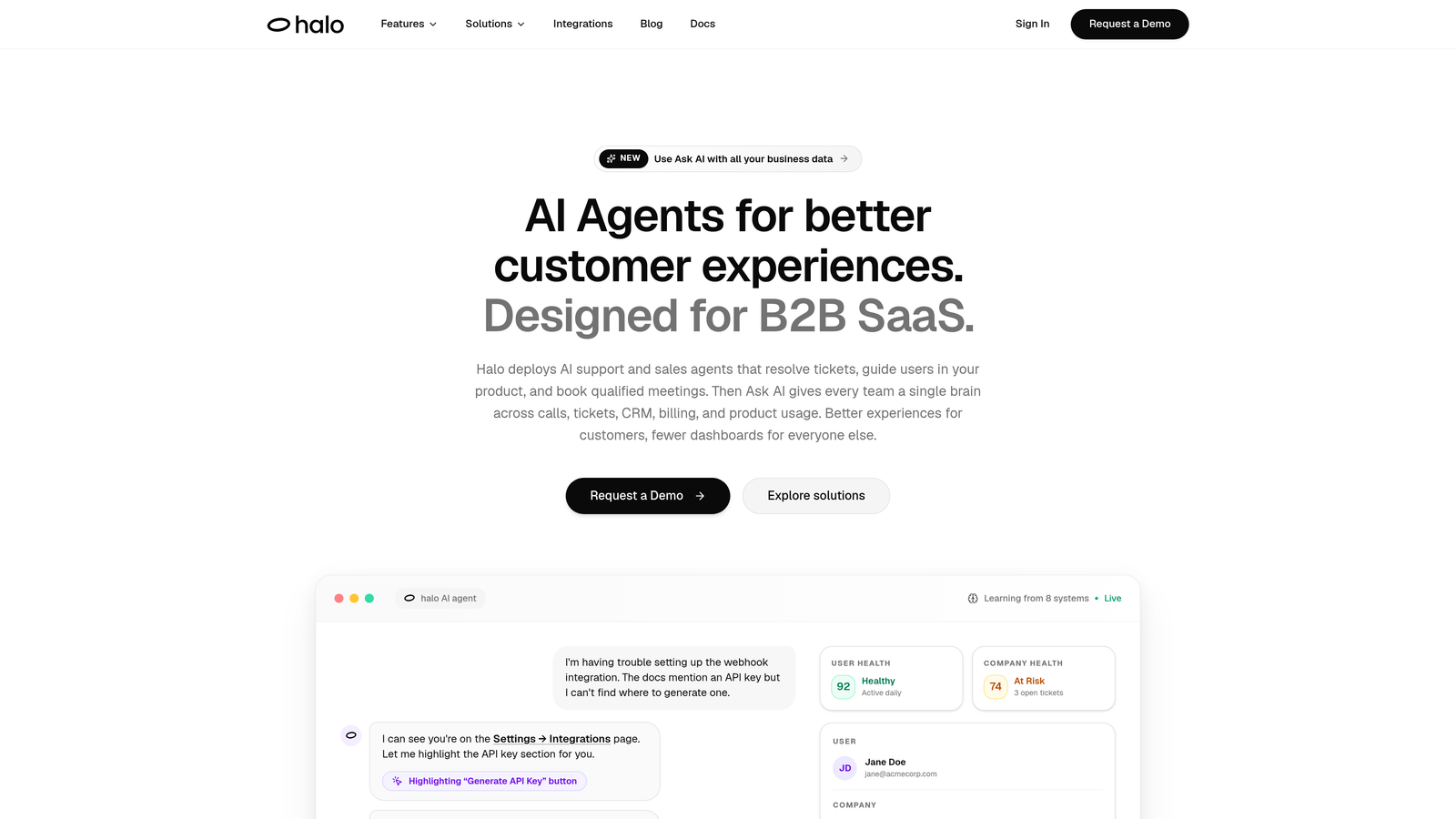
Halo AI is an AI-first customer support platform that deploys autonomous agents to resolve tickets, guide users with page-aware context, and generate business intelligence for lean teams.
Where This Tool Shines
What separates Halo from most tools on this list is that AI isn't a feature layered on top of a helpdesk. It's the foundation. Halo's agents don't just suggest replies for a human to approve; they resolve tickets end-to-end, learning from every interaction to get smarter over time.
The page-aware chat widget is a standout capability. Rather than offering generic help content, it understands what screen a user is on and delivers contextually relevant guidance, essentially seeing what your customer sees. For small teams that can't staff a support agent for every product question, this kind of contextual intelligence can meaningfully reduce inbound ticket volume.
Key Features
Autonomous Ticket Resolution: AI agents handle support tickets from start to finish, escalating to humans only when genuinely needed.
Page-Aware Chat Widget: The widget understands in-app context and delivers visual UI guidance based on where users are in your product.
Smart Inbox with Business Intelligence: Goes beyond ticket management to surface customer health signals, anomaly detection, and revenue intelligence.
Auto Bug Ticket Creation: Automatically generates bug reports and routes them to Linear, Slack, HubSpot, or other connected tools without manual effort.
Live Agent Handoff: Seamlessly escalates complex issues to human agents with full conversation context preserved, so customers never have to repeat themselves.
Best For
Growing B2B SaaS teams and product-led companies that need support to scale without proportionally scaling headcount. Particularly well-suited for teams already using tools like Intercom, HubSpot, Slack, Linear, or Stripe who want a connected, intelligent support layer.
Pricing
Contact for pricing. Halo is designed for growing B2B teams, so pricing is tailored based on volume and integration needs rather than a one-size-fits-all seat model.
2. Intercom
Best for: Teams wanting a unified messaging platform with a capable AI agent that resolves questions from your existing knowledge base.
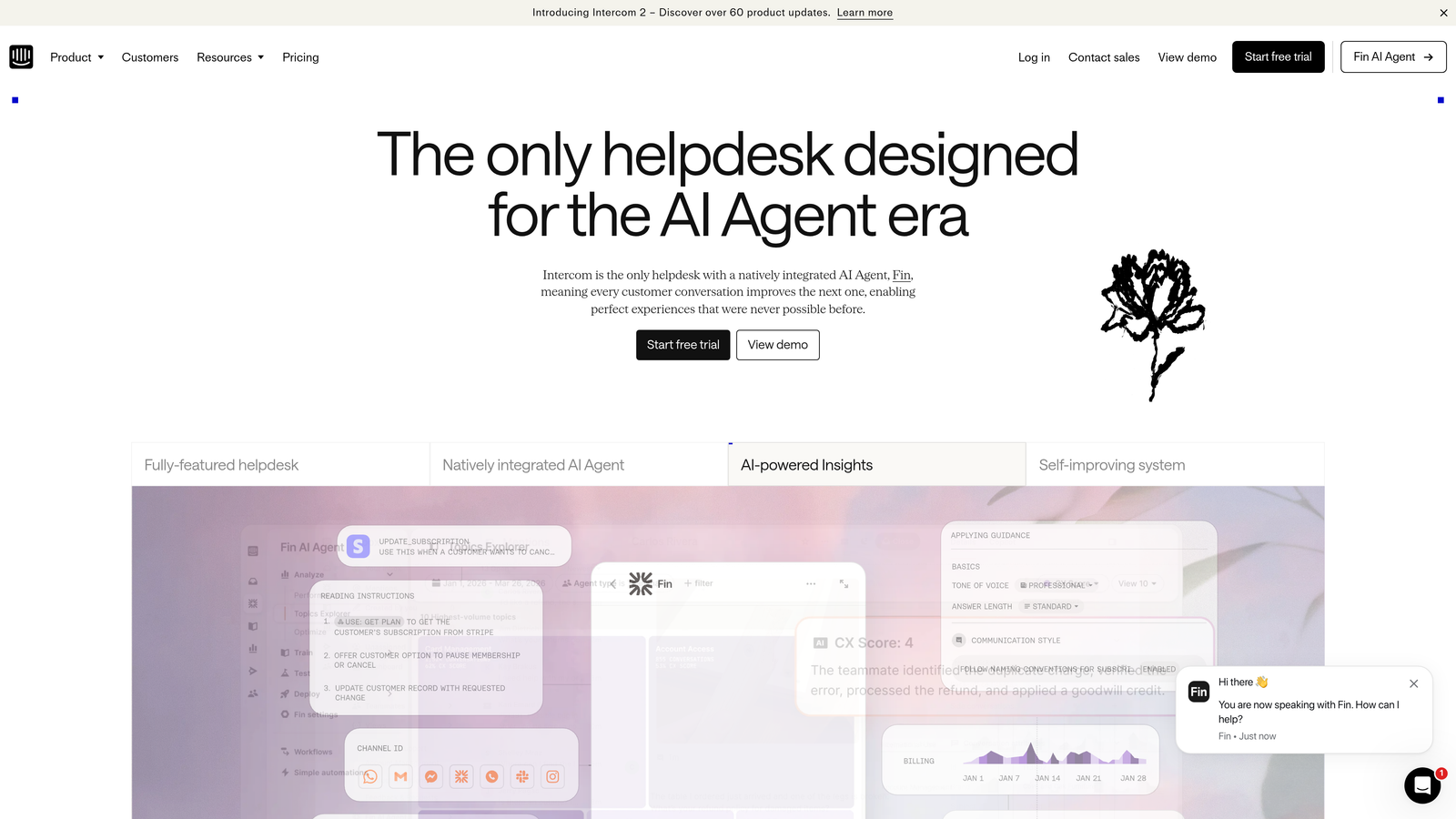
Intercom is a unified customer messaging platform featuring Fin, an AI agent that resolves support questions using your knowledge base and conversation history.
Where This Tool Shines
Intercom has built one of the most mature AI agents in the market with Fin. It draws on your help center content and past conversations to answer questions with impressive accuracy, and it handles a wide variety of query types without requiring manual flow-building.
The platform's unified inbox, which consolidates chat, email, and social channels, makes it easier for small teams to stay on top of everything in one place. The per-resolution pricing model for Fin is worth understanding upfront: it can be cost-effective if your AI resolution rate is high, but costs can climb if Fin frequently escalates to humans.
Key Features
Fin AI Agent: Resolves customer questions autonomously using your knowledge base and conversation history.
Unified Inbox: Consolidates chat, email, and social channels into a single agent workspace.
Knowledge Base Builder: Rich help center creation with AI-assisted content suggestions.
Product Tours and In-App Messaging: Guide users through features with targeted in-app messages and walkthroughs.
Per-Resolution Pricing for AI: Fin is charged per successful resolution, aligning cost with actual AI performance.
Best For
Small to mid-sized businesses that want a polished, all-in-one messaging and support platform with a proven AI agent. Best suited for teams with a solid existing knowledge base that Fin can draw from immediately.
Pricing
Starts at $39/seat/month; Fin AI is charged separately per resolution, so total cost depends on your support volume and AI resolution rate.
3. Zendesk AI
Best for: Small businesses that anticipate growth and want enterprise-grade infrastructure from day one.
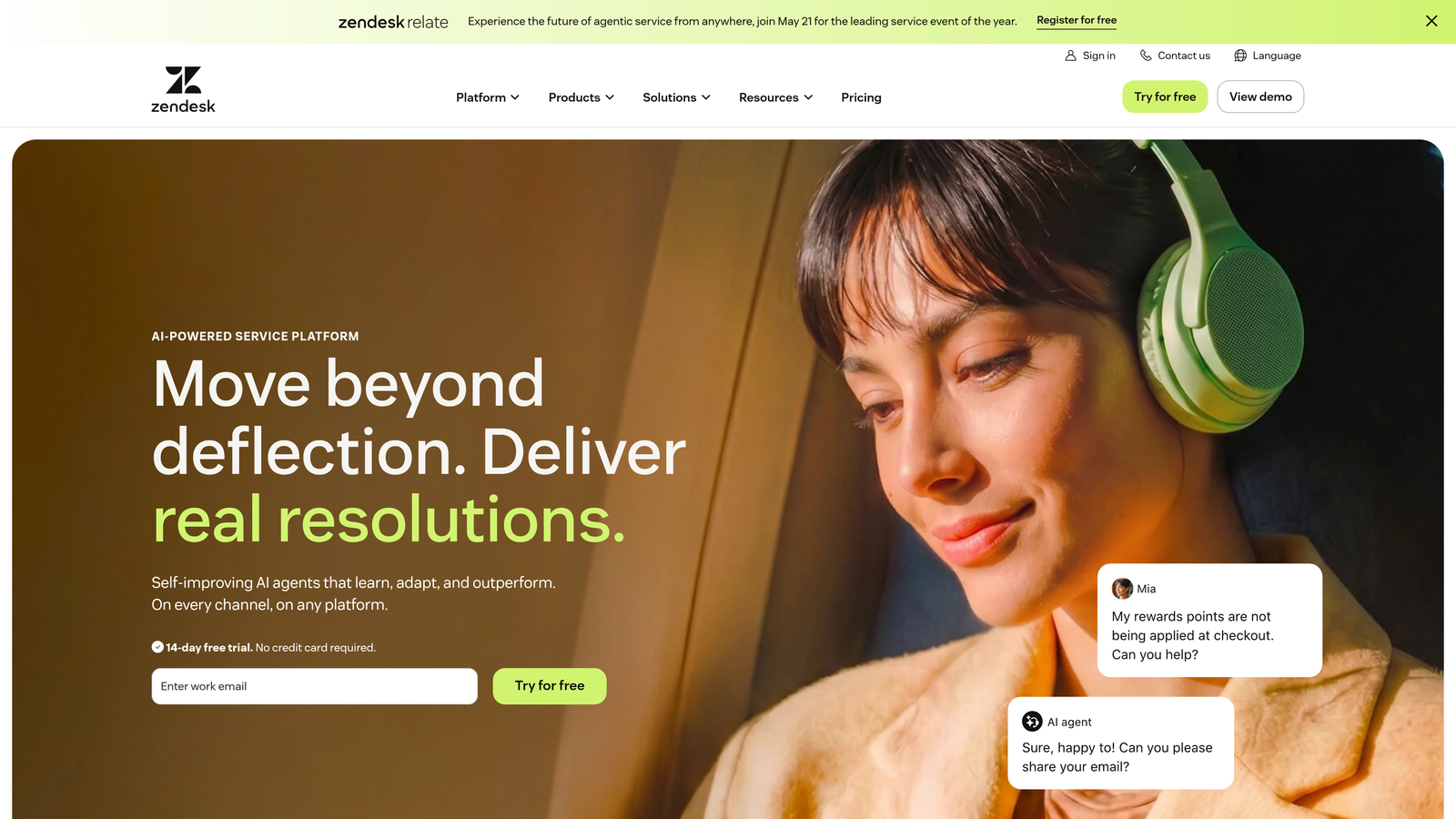
Zendesk is an enterprise-grade helpdesk platform with AI add-ons for ticket routing, answer suggestions, and agent productivity, now accessible to smaller teams through lower-tier plans.
Where This Tool Shines
Zendesk's greatest strength is its depth. The platform has been around long enough to have solved nearly every helpdesk edge case, and its app marketplace with over 1,500 integrations means it connects to almost any tool your business already uses.
The AI capabilities, including Answer Bot for self-service and agent assist for suggested replies, are solid additions rather than core differentiators. For small businesses, Zendesk can feel like a lot of platform for a simple need, but if you're planning to scale quickly, starting on Zendesk avoids a painful migration later.
Key Features
AI-Powered Ticket Routing: Automatically prioritizes and routes incoming tickets based on content and urgency.
Answer Bot: Deflects common questions with automated self-service responses before tickets reach an agent.
Agent Assist: Surfaces suggested replies and macros to help agents respond faster.
1,500+ App Marketplace: Extensive integrations covering CRM, e-commerce, analytics, and communication tools.
Omnichannel Support: Handles email, chat, phone, and social from a single platform.
Best For
Small businesses with complex support workflows or those expecting rapid growth who want a platform that won't require replacement as they scale. Less ideal for teams seeking a lightweight, quick-setup solution.
Pricing
Suite Team starts at $55/agent/month; AI features are available as add-ons, which can increase total cost meaningfully depending on the features you need.
4. Freshdesk (Freddy AI)
Best for: Budget-conscious small teams that need a capable helpdesk with AI features and a free starting point.
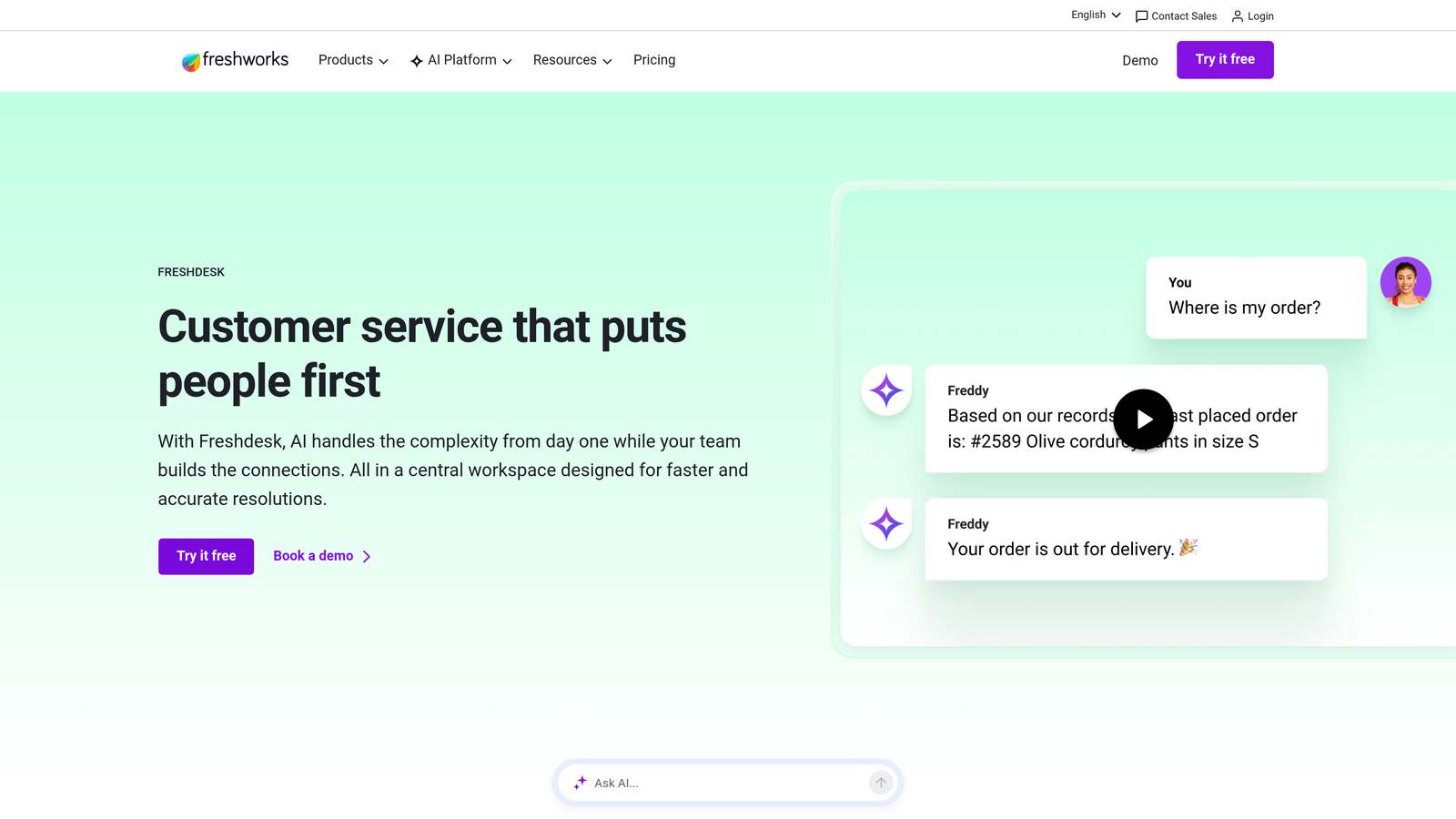
Freshdesk is a budget-friendly helpdesk with a generous free tier and Freddy AI for auto-triage, suggested responses, and canned workflows.
Where This Tool Shines
Freshdesk's free plan for up to two agents is genuinely useful, not a stripped-down teaser. It covers email and social ticketing with enough functionality to run basic support operations without spending anything. That makes it a natural starting point for early-stage businesses.
Freddy AI adds meaningful automation as you move to paid tiers, handling ticket classification, priority assignment, and suggested agent responses. It won't match the autonomous resolution depth of dedicated AI agent platforms, but for a team primarily handling support manually with some AI assistance, Freddy does the job well at a fair price.
Key Features
Free Plan for 2 Agents: Covers email and social ticketing with no time limit, making it a genuine starting point for new businesses.
Freddy AI: Handles ticket classification, prioritization, and generates suggested responses for agents.
Automation Rules: Configurable routing logic and SLA management without needing technical expertise.
Self-Service Portal: Knowledge base and customer portal for deflecting common questions before they become tickets.
Marketplace Integrations: Connects with Slack, Shopify, Salesforce, and dozens of other popular tools.
Best For
Early-stage businesses and small teams watching costs closely. Freshdesk is an excellent choice for companies that want to start free and grow into paid AI features without switching platforms as their needs evolve.
Pricing
Free tier available for up to 2 agents; paid plans start at $15/agent/month, making it one of the most affordable paid options on this list.
5. Tidio
Best for: E-commerce businesses wanting an AI chatbot that integrates directly with Shopify or WooCommerce.
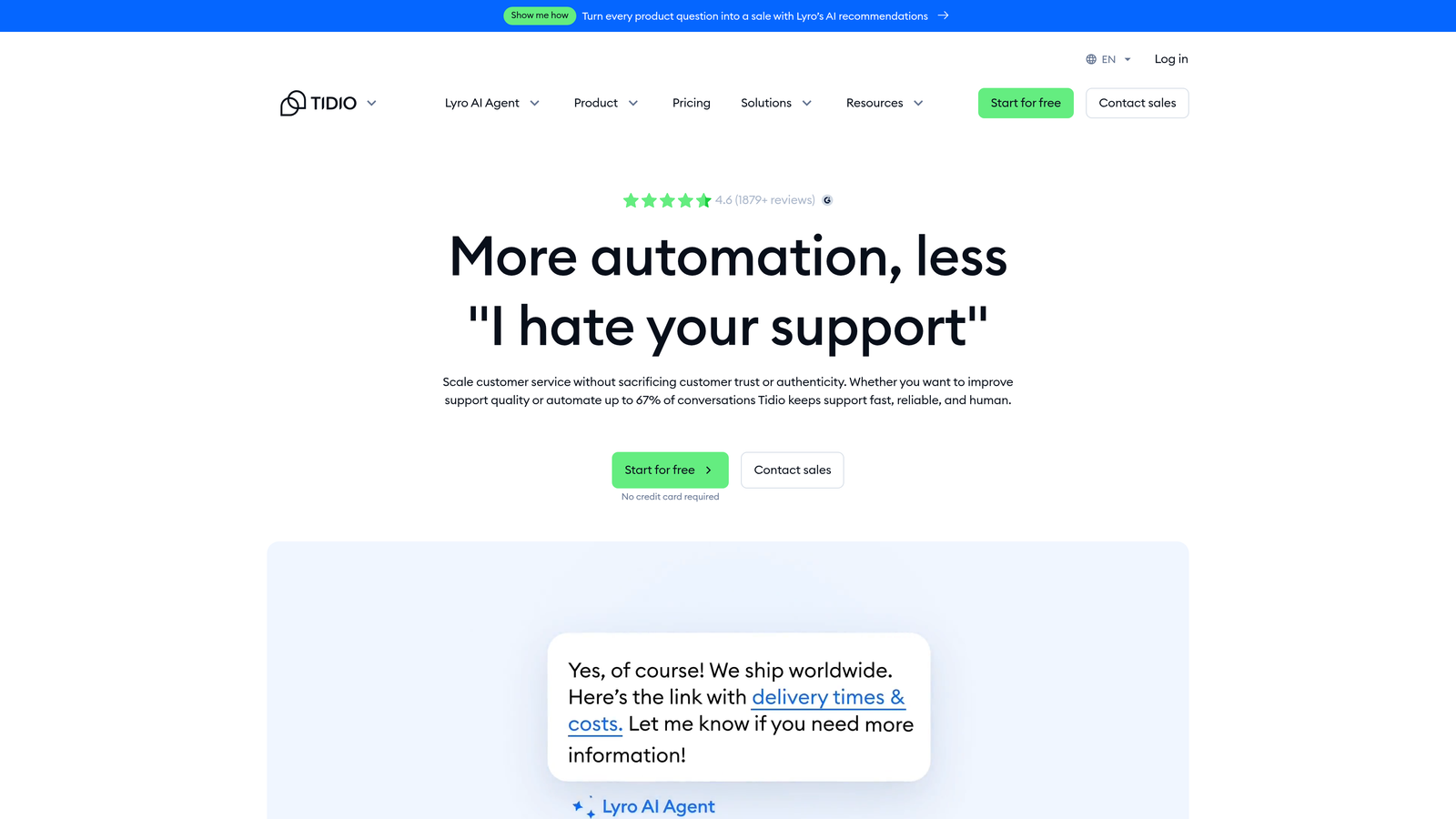
Tidio is a live chat and AI chatbot platform built for e-commerce, with Lyro AI that learns from your FAQ content and native Shopify and WooCommerce integrations.
Where This Tool Shines
Tidio is purpose-built for online retailers. The Lyro AI chatbot trains on your existing support content and FAQ pages, which means setup time is minimal if you already have documentation in place. It handles the kinds of questions e-commerce customers ask most: order status, returns, product availability, and shipping timelines.
The visual drag-and-drop flow builder gives non-technical users full control over chatbot logic without writing a single line of code. For a Shopify store owner managing support solo, Tidio can handle a significant portion of repetitive questions automatically while live chat remains available for anything more complex.
Key Features
Lyro AI Chatbot: Trained on your support content to answer customer questions conversationally without manual flow-building.
Visual Flow Builder: Drag-and-drop chatbot builder for creating custom conversation paths without code.
Native E-Commerce Integrations: Direct connections to Shopify, WooCommerce, and WordPress with order data access.
Live Chat with Visitor Tracking: See what visitors are browsing in real time and proactively engage before they leave.
Multichannel Reach: Covers website, email, Messenger, and Instagram from a single dashboard.
Best For
Small e-commerce businesses and online retailers, particularly those on Shopify or WooCommerce, who want an AI chatbot that understands their product catalog and order data without complex configuration.
Pricing
Free plan available with basic live chat; Lyro AI starts at $39/month, which includes a set number of AI-handled conversations per month.
6. HubSpot Service Hub
Best for: Businesses already using HubSpot CRM that want support tightly connected to their customer and deal data.
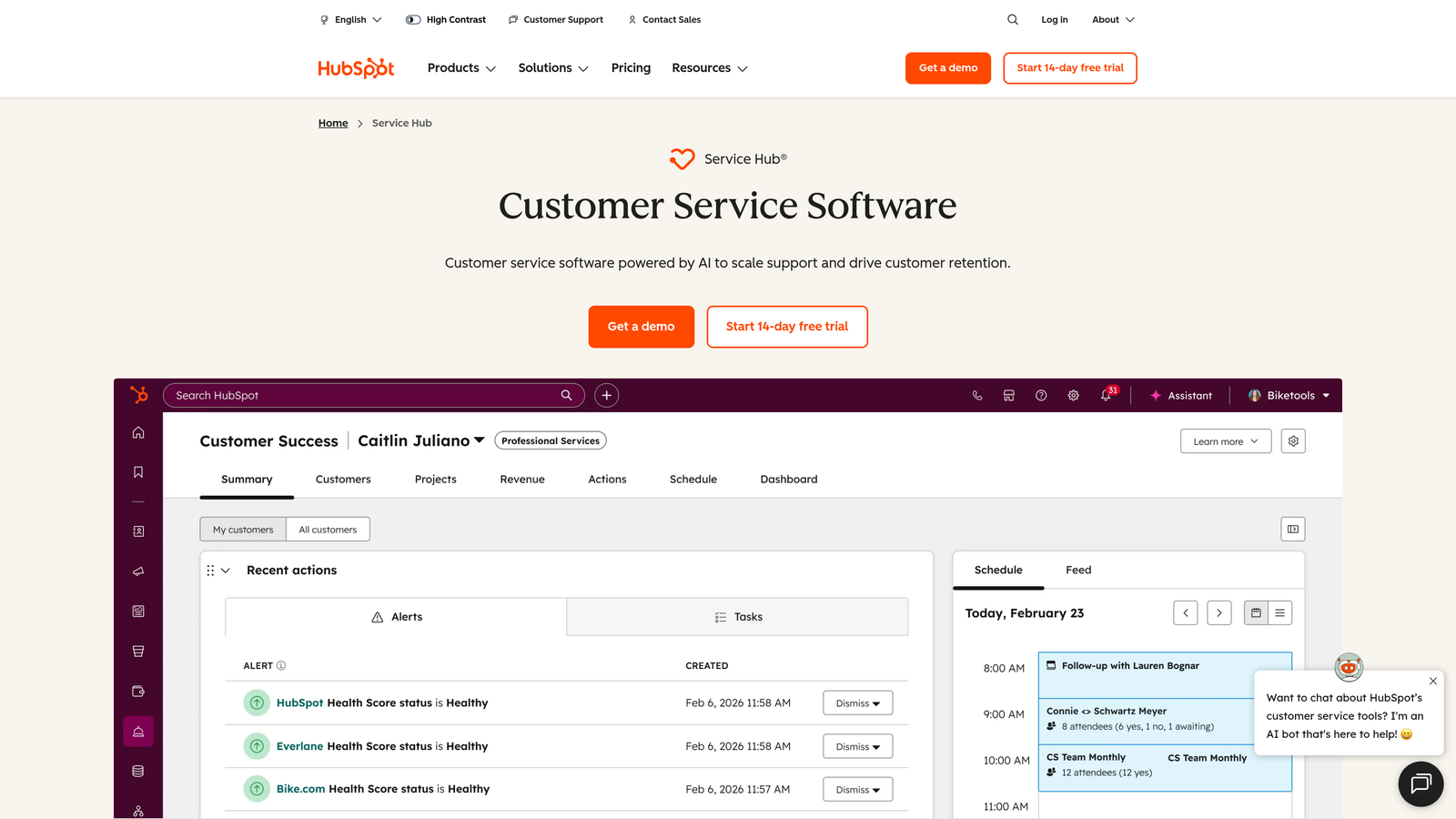
HubSpot Service Hub is a customer service platform tightly integrated with HubSpot CRM, offering AI chatbots, ticketing, and a knowledge base that leverages your full customer data.
Where This Tool Shines
If your business runs on HubSpot, Service Hub is the most natural extension. The AI chatbot connects directly to CRM contact records and deal history, so conversations are automatically enriched with context that standalone support tools simply don't have. An agent handling a support ticket can immediately see the customer's purchase history, open deals, and previous interactions without switching tabs.
The free tier is genuinely useful for early-stage teams, covering shared inbox, basic ticketing, and limited chatbot functionality. As you upgrade, AI-powered search in the knowledge base and more advanced automation become available without needing to integrate a separate tool.
Key Features
CRM-Connected AI Chatbot: Chatbot interactions are linked to HubSpot contact records, deals, and company data automatically.
Shared Inbox with Ticket Routing: Automated ticket creation and assignment from email, chat, and form submissions.
AI-Powered Knowledge Base: Search functionality that surfaces the most relevant articles for customer self-service.
Customer Portal: Lets customers log in to track and manage their own support tickets.
Native HubSpot Integration: Seamless connection to Marketing Hub and Sales Hub for a full customer lifecycle view.
Best For
Small businesses already invested in the HubSpot ecosystem. If you're not using HubSpot CRM, the integration advantage disappears and other tools on this list may offer better standalone value.
Pricing
Free tools available with core features; Starter plan begins at $20/seat/month, making it accessible for small teams already paying for HubSpot's other hubs.
7. Zoho Desk (Zia AI)
Best for: Small businesses in the Zoho ecosystem that want competitive pricing with solid AI capabilities.
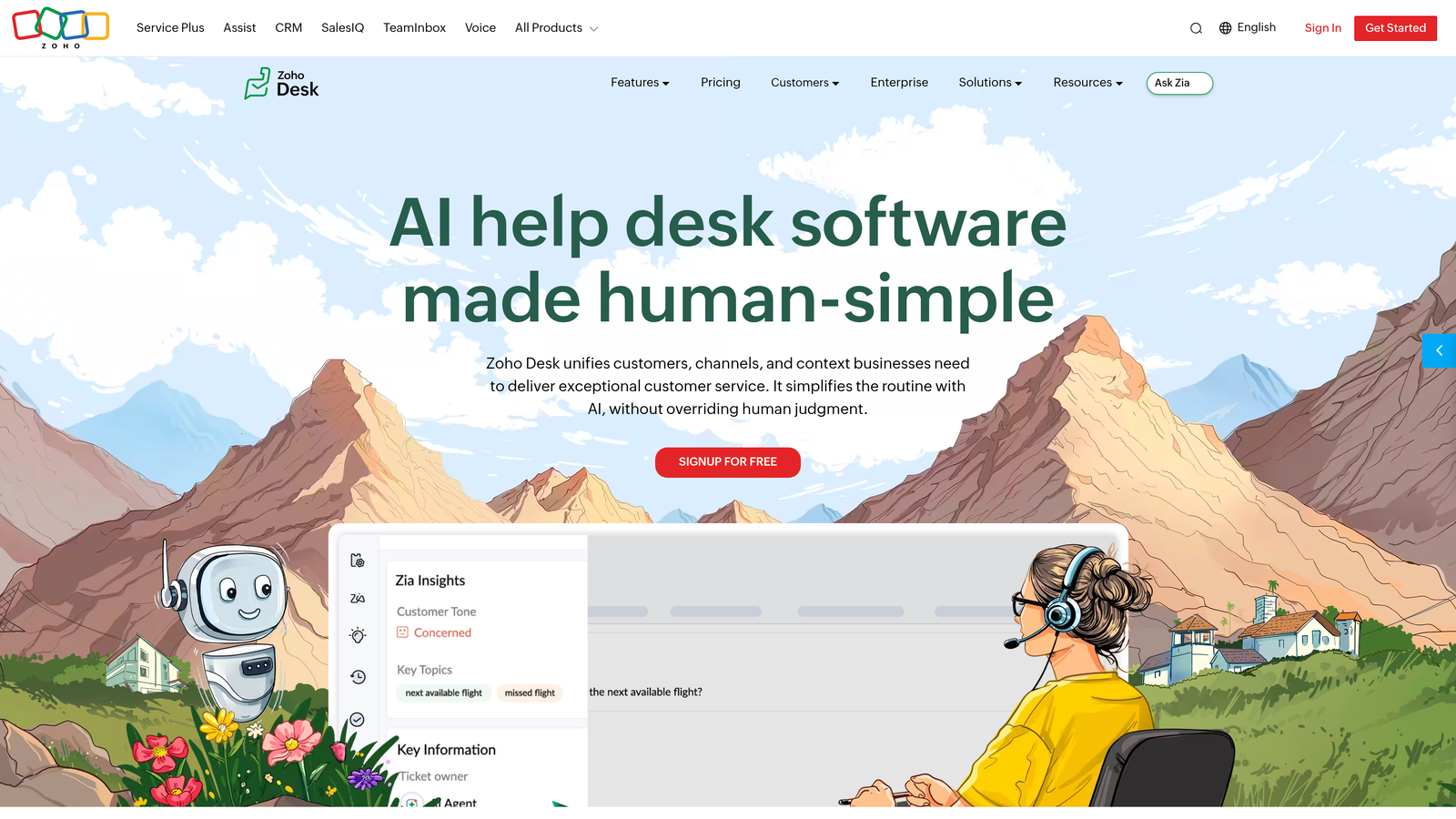
Zoho Desk is an AI-enhanced helpdesk within the Zoho ecosystem, featuring Zia for sentiment analysis, ticket tagging, and anomaly detection at competitive pricing.
Where This Tool Shines
Zoho Desk punches above its price point. Zia AI brings capabilities you'd typically expect from more expensive platforms, including sentiment analysis on incoming tickets, automatic tagging, and anomaly detection that flags unusual spikes in support volume before they become crises.
For businesses already using Zoho CRM, Zoho Projects, or other Zoho apps, the depth of native integration is hard to match. Blueprint workflow automation also gives operations-minded teams a structured way to standardize support processes without relying on expensive consultants or developers.
Key Features
Zia Sentiment Analysis: Automatically reads the emotional tone of incoming tickets to help prioritize urgent or frustrated customers.
Automatic Ticket Tagging: Zia categorizes and tags tickets based on content, reducing manual triage work.
Anomaly Detection: Flags unusual ticket volume patterns so teams can respond proactively to emerging issues.
Multi-Channel Support: Covers email, phone, chat, social, and web forms from a unified workspace.
Blueprint Workflow Automation: Visual process builder for standardizing how support tickets move through stages.
Best For
Small businesses already using Zoho products, or those looking for an affordable helpdesk with meaningful AI features. The free plan for three agents makes it accessible for very small teams just getting started.
Pricing
Free plan for up to 3 agents; Standard plan starts at $14/agent/month, making Zoho Desk one of the most cost-effective paid options with AI capabilities on this list.
8. Help Scout
Best for: Service-oriented businesses that prioritize human connection and want AI to assist agents rather than replace them.
Help Scout is a human-first support platform with AI features designed to make agents faster and more effective, without removing the personal touch from customer interactions.
Where This Tool Shines
Help Scout occupies a distinct position on this list: it's built around the belief that great support feels human. The AI features, including AI Drafts and AI Summarize, are deliberately designed to assist agents rather than automate them away. This makes it a strong fit for businesses where customer relationships are a competitive advantage.
AI Drafts generates reply suggestions based on conversation context, which agents can edit and send rather than composing from scratch. AI Summarize condenses long conversation threads into quick overviews, which is particularly valuable during handoffs. These are practical time-savers that preserve the agent's voice rather than replacing it.
Key Features
AI Drafts: Generates contextual reply suggestions that agents can review, edit, and send, speeding up response times without removing human judgment.
AI Summarize: Produces quick conversation summaries for faster handoffs between team members.
Shared Inbox with Collision Detection: Prevents two agents from accidentally responding to the same conversation simultaneously.
Beacon Widget: Embedded help widget for in-app messaging and self-service article search.
Docs Knowledge Base: AI-powered instant answers surface relevant articles before customers submit a ticket.
Best For
Small businesses in professional services, consulting, or any industry where the quality of human interaction directly affects customer retention. Not the right fit if your goal is maximum ticket deflection through autonomous AI resolution.
Pricing
Starts at $25/user/month, with all core AI features included in the base plan rather than gated behind expensive add-ons.
9. ChatBot (by LiveChat)
Best for: Non-technical teams that need a deployable chatbot fast, without writing any code.
ChatBot is a no-code visual chatbot builder with pre-built templates and seamless handoff to LiveChat human agents, designed for teams that want fast deployment without engineering resources.
Where This Tool Shines
ChatBot's core value proposition is speed and simplicity. The visual drag-and-drop builder lets anyone on your team design conversation flows in hours, not weeks. Pre-built templates for support, lead generation, and e-commerce scenarios mean you don't have to start from a blank canvas.
The integration with LiveChat and HelpDesk creates a natural escalation path: the bot handles what it can, and when a conversation needs a human, it hands off cleanly with full context. For small businesses that want a chatbot presence without dedicating engineering time to it, ChatBot delivers a workable solution quickly.
Key Features
Visual Flow Builder: Drag-and-drop conversation design with no coding required, accessible to any team member.
Pre-Built Templates: Ready-made flows for common use cases including support, lead gen, and e-commerce scenarios.
AI Training from Your Content: Trains on your website and knowledge base content to improve answer accuracy over time.
One-Click Human Handoff: Escalates to LiveChat or HelpDesk agents with full conversation context at the point of transfer.
Multi-Platform Integrations: Connects with Shopify, WordPress, Facebook Messenger, and Slack.
Best For
Small business owners and non-technical operators who need a chatbot live quickly. Works well as a complement to a human support team rather than a full replacement for it.
Pricing
Starts at $52/month for unlimited active chatbots and basic integrations, with pricing scaling based on the number of valid chats handled per month.
Choosing the Right Tool for Your Business
The best AI support tool for your small business depends less on feature checklists and more on where you are right now and where you're headed. Here's a quick orientation to help you decide.
If you want autonomous AI that resolves tickets end-to-end: Halo AI is built for exactly this. It doesn't just assist agents; it handles tickets independently, learns continuously, and surfaces business intelligence that goes beyond support. It's the right choice for B2B teams that want support to scale without adding headcount.
If you want a full messaging platform with a proven AI agent: Intercom is the most mature option. Fin handles a wide range of queries well, and the unified inbox makes multi-channel management straightforward. Just model out the per-resolution costs before committing.
If budget is your primary constraint: Freshdesk's free tier is the most practical starting point, with a clear upgrade path as your needs grow. Zoho Desk is the best value on paid plans, especially if you're already in the Zoho ecosystem.
If you run an e-commerce store: Tidio's native Shopify and WooCommerce integrations, combined with Lyro AI trained on your content, make it the most purpose-fit option for online retailers.
If your business runs on HubSpot: Service Hub is the obvious choice. The CRM connection alone justifies it for teams already invested in that ecosystem.
If customer relationships are your competitive edge: Help Scout's human-first approach keeps agents in control while AI handles the repetitive parts. It's the right fit when the quality of human interaction matters as much as speed.
Your support team shouldn't scale linearly with your customer base. Let AI agents handle routine tickets, guide users through your product, and surface business intelligence while your team focuses on complex issues that need a human touch. See Halo in action and discover how continuous learning transforms every interaction into smarter, faster support.