9 Best AI Support Tools Pricing Comparison in 2026
Pricing models for AI customer support tools vary wildly — from per-seat and per-resolution to opaque enterprise tiers — making a true apples-to-apples AI support tools pricing comparison genuinely difficult. This guide breaks down nine leading platforms by pricing structure, included features, and ideal use case so B2B teams can make a confident, budget-smart decision in 2026.
 Grant CooperFounder14 min read
Choosing an AI customer support tool is no longer just a feature decision. It's a budget decision with real consequences. Pricing models across this category vary wildly: some charge per resolution, others per seat, per conversation, or via opaque enterprise tiers that require a sales call to decode. For B2B teams evaluating automation, this makes apples-to-apples comparison genuinely difficult.
This guide cuts through the noise. We've compared nine leading AI support tools on pricing structure, what's included at each tier, and which use cases each model actually fits. Whether you're a lean startup looking to deflect tickets without hiring, or a scaling SaaS team needing deep integrations and business intelligence, there's a meaningful difference between these platforms — and the wrong choice can cost you significantly more than you planned.
A Quick Note on Pricing Models Before You Compare
Before diving into individual tools, it helps to understand the four main pricing structures you'll encounter. Per-seat models (Zendesk, Freshdesk, Help Scout) are predictable but scale with headcount. Per-resolution models (Fin AI, some Intercom configurations) tie cost to outcomes but can become unpredictable at volume. Flat-tier SaaS models (Halo AI, Tidio) are easier to budget and scale with usage caps. Custom enterprise pricing (Forethought, Zendesk Enterprise) requires sales engagement and remains opaque until negotiated.
Knowing which model fits your growth trajectory is half the battle. Now, onto the tools.
Note: SaaS pricing changes frequently. All figures below reflect publicly available information as of mid-2026. Always verify current pricing directly on each vendor's website before making a decision.
1. Halo AI
Best for: B2B SaaS teams wanting AI-native support with business intelligence built in.
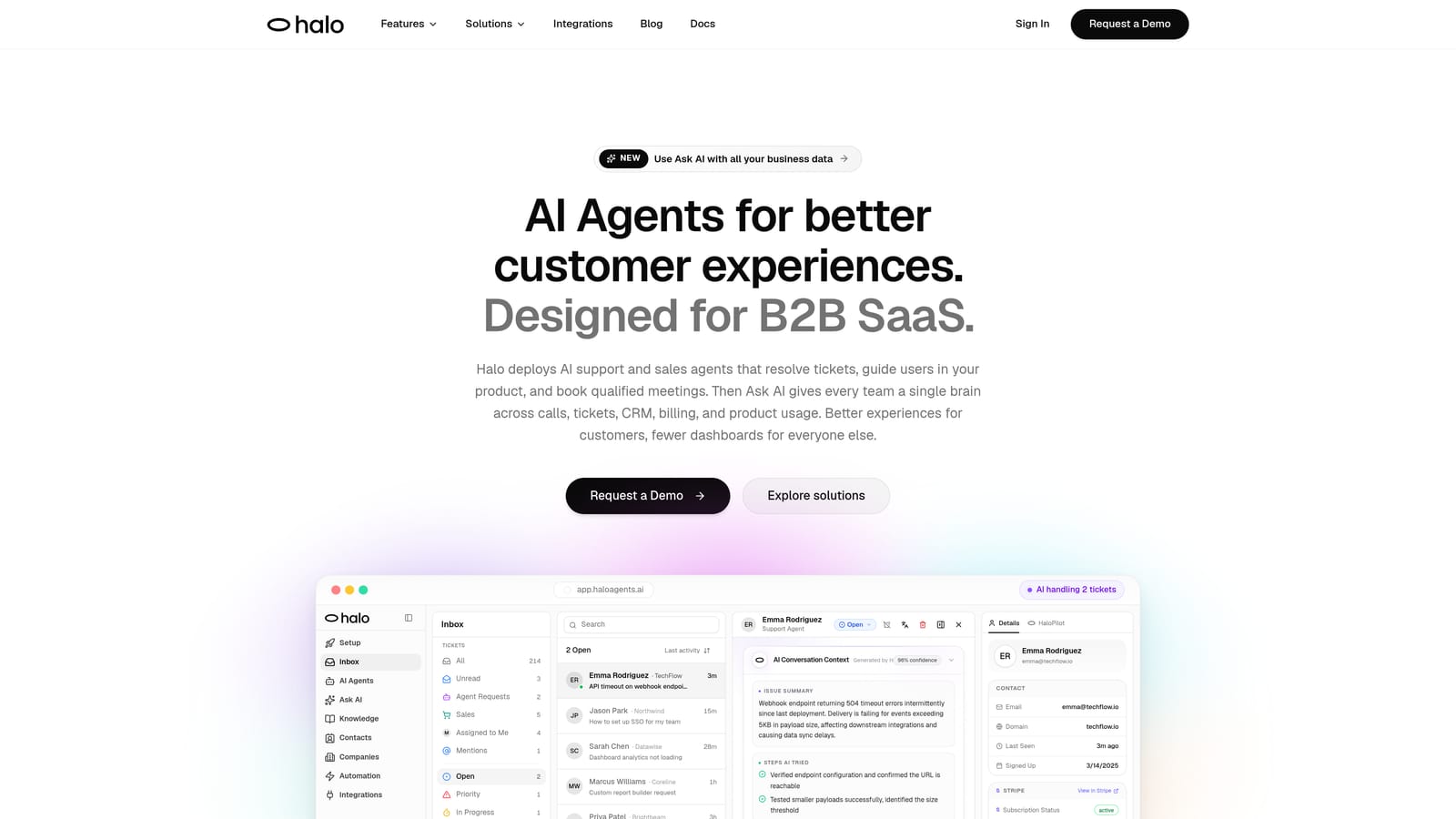
Halo AI is an AI-native customer support platform built specifically for B2B SaaS teams, where the AI isn't a bolt-on feature but the foundation of the entire product.
Where This Tool Shines
Most platforms on this list started as helpdesks and added AI later. Halo was built the other way around. That architectural difference shows up in how the AI actually behaves: it learns from every interaction, understands page-level context (meaning it sees what your user sees when they reach out), and surfaces business intelligence signals like customer health trends and revenue anomalies from support data.
For teams that want support to do more than close tickets, that intelligence layer is genuinely differentiated. The auto bug ticket creation that routes directly to Linear is a good example: it removes a manual handoff step that most SaaS support teams deal with daily.
Key Features
Intelligent AI Agents: Resolve support tickets autonomously and continuously improve through every interaction, reducing repetitive ticket volume over time.
Page-Aware Chat Widget: Sees what users see on any given page and provides contextual, visual guidance rather than generic responses.
Smart Inbox with Business Intelligence: Surfaces customer health signals, revenue anomalies, and trend detection directly from your support data.
Auto Bug Ticket Creation: Automatically generates and routes bug reports to Linear or your preferred issue tracker without manual intervention.
Live Agent Handoff: Escalates complex issues to human agents with full context preserved, so nothing gets repeated.
Deep Integrations: Connects with Linear, Slack, HubSpot, Intercom, Stripe, Zoom, PandaDoc, and Fathom for a unified workflow.
Best For
B2B SaaS teams that have outgrown reactive ticketing and want support to actively contribute to product and revenue intelligence. Particularly strong for teams using Linear for engineering and wanting tighter support-to-development feedback loops. Less suited for pure e-commerce or teams needing a traditional helpdesk UI.
Pricing
Tiered SaaS pricing with no per-resolution fees, designed for predictable scaling. Visit haloagents.ai for current plan details.
2. Intercom
Best for: Teams wanting an established omnichannel platform with AI resolution layered on top.
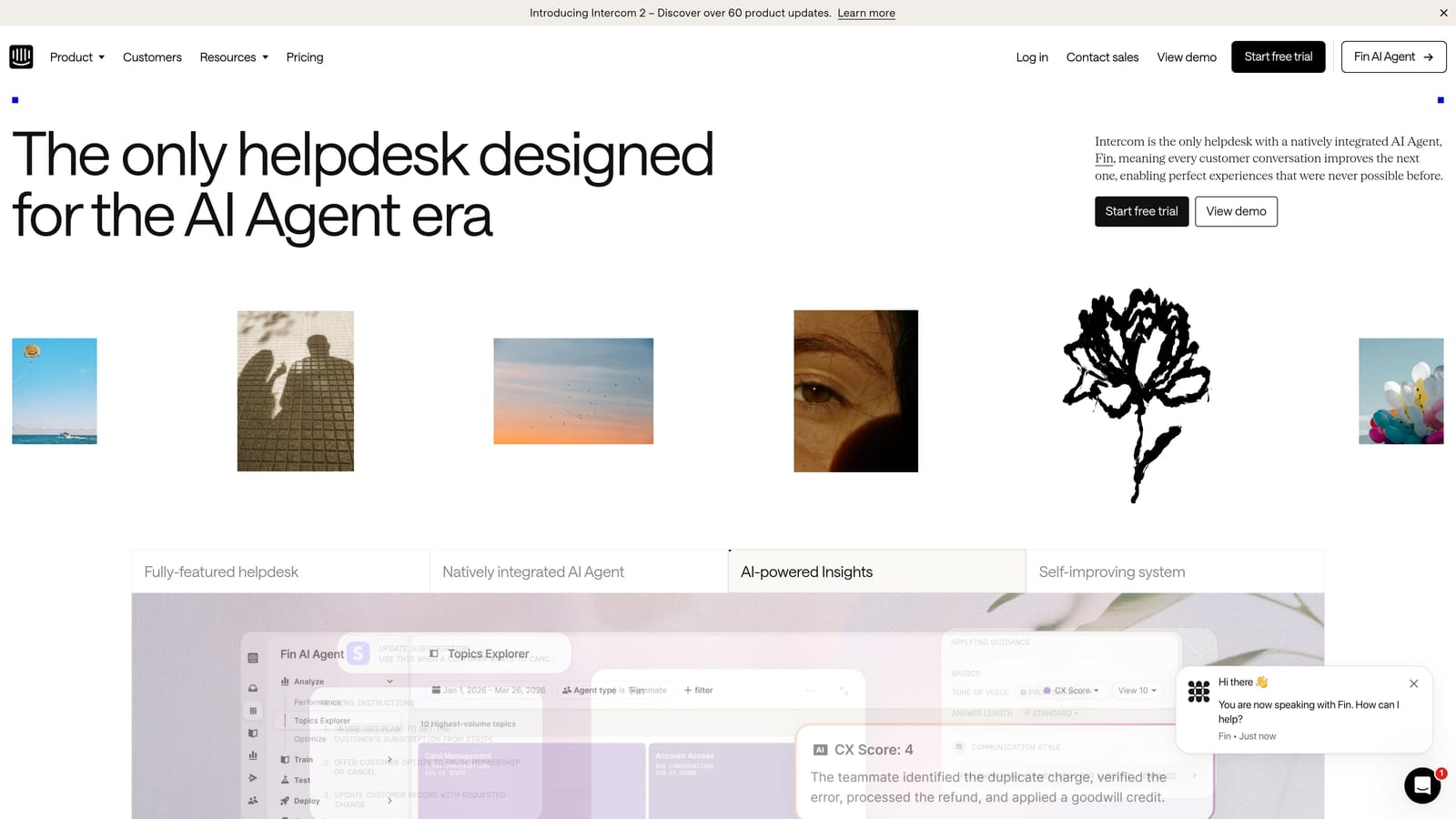
Intercom is one of the most recognized names in customer messaging, with Fin AI added as an automated resolution layer on top of its core platform.
Where This Tool Shines
Intercom's strength is its maturity. The platform handles email, chat, social, and phone in one inbox, with a well-developed workflow builder and an extensive app marketplace. For teams that need breadth of channel coverage and a proven ecosystem, it delivers.
The challenge is pricing complexity. Fin AI is charged per resolution on top of the base platform seat cost. As resolution volume grows, those two cost lines compound in ways that can surprise teams who didn't model the math carefully upfront.
Key Features
Fin AI Agent: Automated ticket resolution trained on your help content, with configurable handoff to human agents.
Omnichannel Inbox: Consolidates email, chat, social, and phone conversations in a single workspace.
Workflow Automation Builder: Visual builder for routing, escalation, and trigger-based automations.
AI Copilot for Agents: Assists human agents with suggested responses to speed up resolution time.
App Marketplace: Extensive third-party integrations across CRM, analytics, and productivity tools.
Best For
Mid-market to enterprise teams that need broad channel coverage and are comfortable navigating a layered pricing model. Teams with predictable, lower resolution volumes will find the per-resolution Fin cost manageable; high-volume teams should model total cost carefully.
Pricing
Base platform starts at approximately $39/seat/month (Essential tier), with Advanced and Expert tiers above that. Fin AI is charged additionally per resolution. Always verify current rates at intercom.com.
3. Zendesk AI
Best for: Large enterprises needing robust SLA management, compliance tooling, and deep customization.
Zendesk remains the enterprise helpdesk standard, with AI capabilities available as tiered add-ons layered onto its Suite plans.
Where This Tool Shines
Zendesk's breadth is hard to match. Over a thousand marketplace integrations, a custom app development platform (Sunshine), and enterprise-grade SLA and compliance tooling make it the default choice for large, regulated, or complex support organizations. It's a platform that can handle almost any requirement if you're willing to configure it.
The tradeoff is cost and complexity. AI features are gated behind higher Suite tiers and an additional Advanced AI add-on, meaning the price escalates quickly as you unlock more intelligence. Teams that need lightweight AI automation often find themselves paying for far more platform than they use.
Key Features
AI Triage and Routing: Automatic ticket classification, intent detection, and intelligent routing based on content.
Advanced AI Add-On: Intelligent triage, macro suggestions, and an agent copilot for assisted responses.
SLA Management: Robust service level agreement tracking and compliance reporting for enterprise requirements.
Integration Marketplace: 1,000+ pre-built app integrations across virtually every business tool category.
Sunshine Platform: Custom app and workflow development for teams with unique requirements.
Best For
Large enterprises with complex routing requirements, strict SLA obligations, and existing Zendesk contracts. Less cost-effective for smaller teams or those primarily needing AI automation without the full enterprise helpdesk stack.
Pricing
Suite plans start at approximately $55/agent/month (Team) and rise to $115+ for Professional. Advanced AI is a separate paid add-on. Enterprise pricing requires a sales conversation.
4. Freshdesk
Best for: SMBs and growing teams wanting a capable helpdesk with AI features at competitive price points.
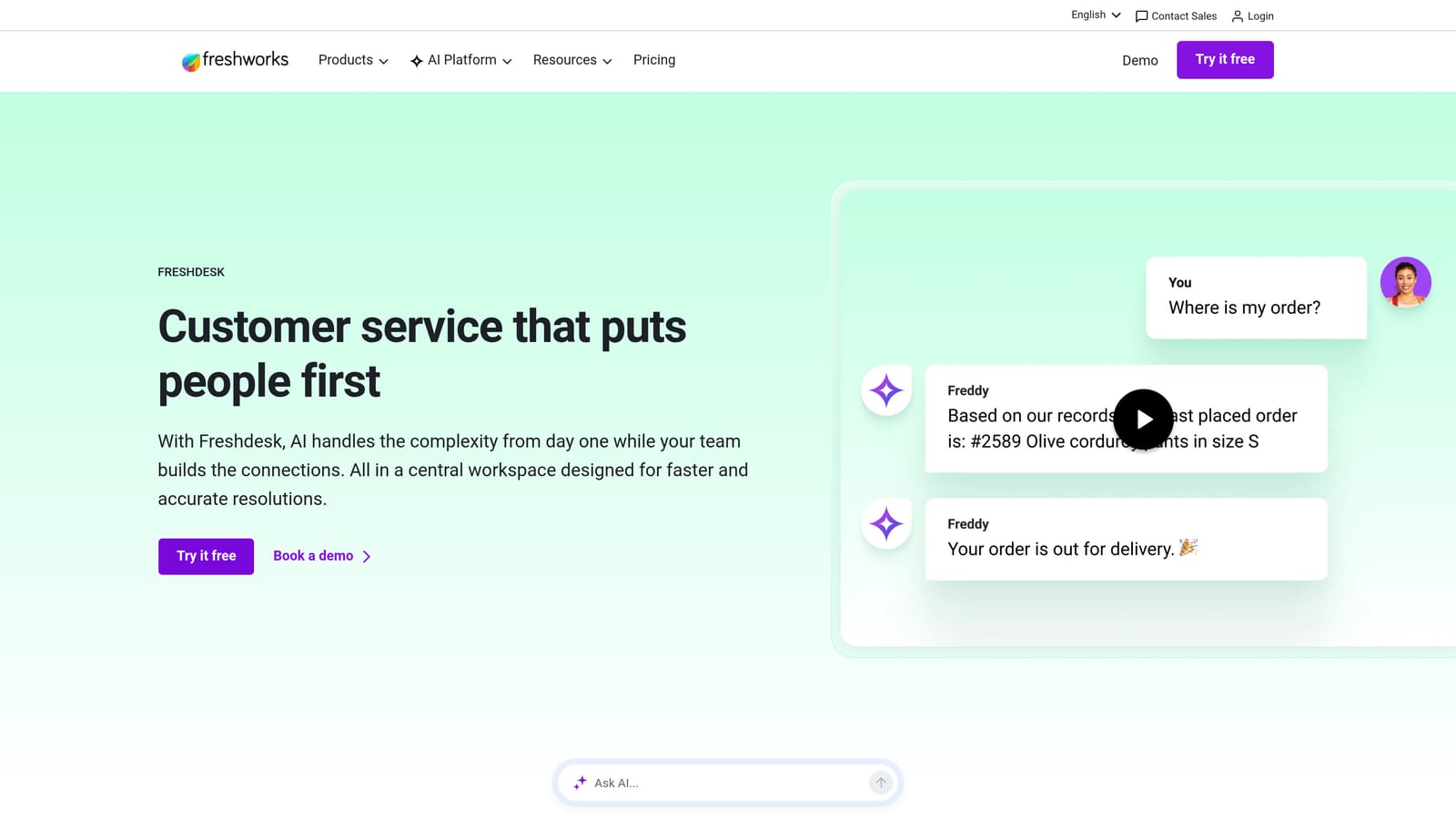
Freshdesk is a well-rounded helpdesk platform with Freddy AI built into its higher-tier plans, popular with teams that need solid functionality without enterprise pricing.
Where This Tool Shines
Freshdesk's free tier is a genuine entry point, not a stripped-down teaser. Growing teams can start there and graduate to paid tiers as their needs expand. The omnichannel coverage across email, chat, phone, and social is strong for the price, and Freddy AI adds real value at the Pro and Enterprise tiers with automated responses, ticket summarization, and suggested replies.
The main limitation for AI-focused buyers is that Freddy's more powerful capabilities are gated to higher tiers. Teams on Growth plans will find the AI features more limited than the marketing suggests.
Key Features
Freddy AI: Automated responses, ticket summarization, and suggested replies to speed up agent workflows.
Freddy Self Service: AI-powered chatbot builder for deploying automated self-service experiences.
Omnichannel Support: Unified inbox for email, chat, phone, and social media conversations.
Free Tier: Functional entry point for small teams with basic ticketing needs.
Marketplace Integrations: Pre-built connections to popular CRM, billing, and productivity tools.
Best For
SMBs and growing teams that want a reliable helpdesk with AI features included at a reasonable price. Strong for teams not requiring deep custom integrations or advanced business intelligence from their support data.
Pricing
Free tier available. Growth at approximately $15/agent/month, Pro at approximately $49/agent/month, Enterprise at approximately $79/agent/month. Freddy AI features are gated to Pro and Enterprise tiers. Verify current pricing at freshdesk.com.
5. Tidio
Best for: Small businesses and e-commerce teams wanting accessible AI chatbot automation without complex setup.
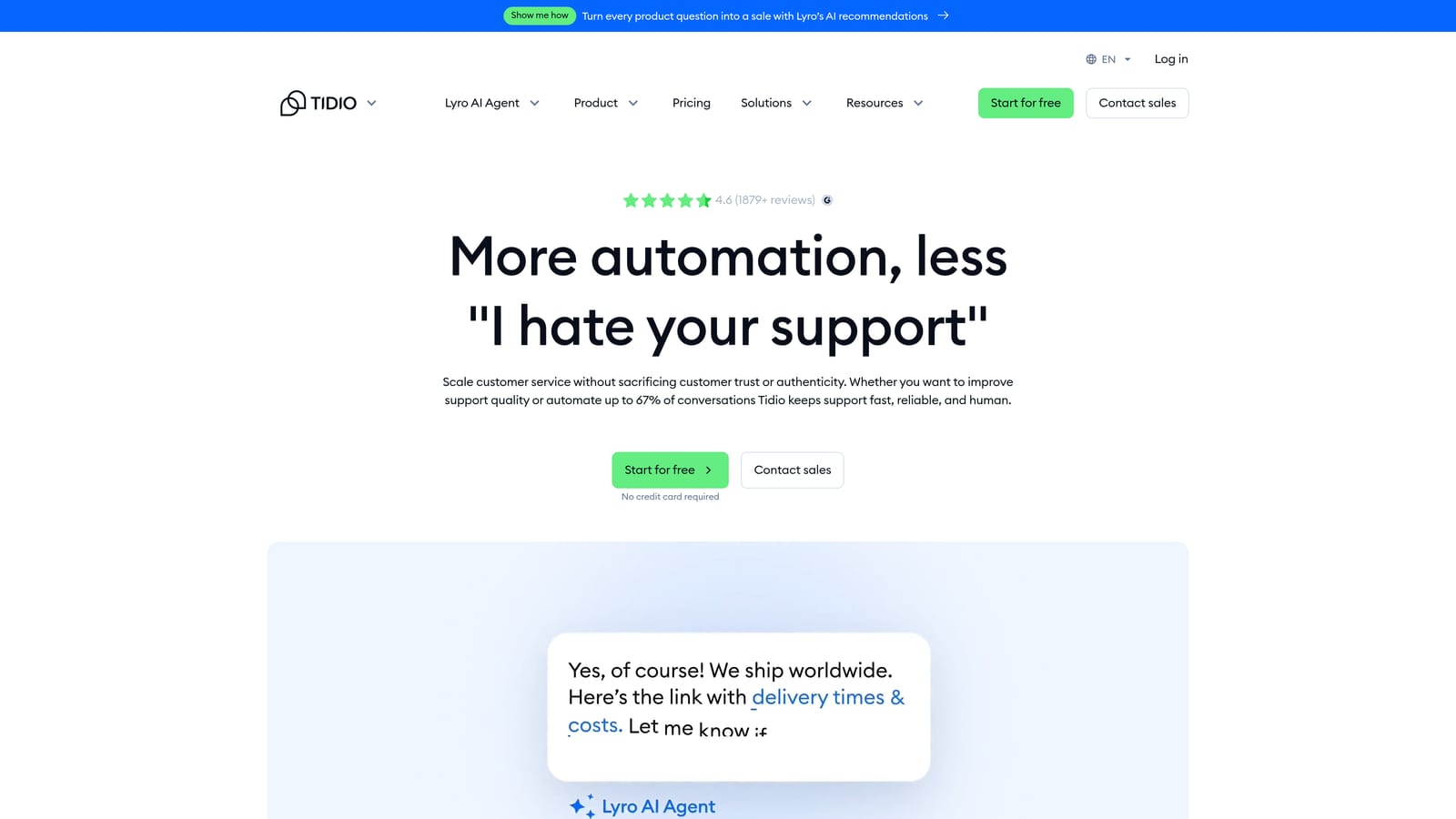
Tidio is a live chat and AI chatbot platform featuring Lyro AI, designed to make automation accessible for smaller teams and online retailers.
Where This Tool Shines
Tidio's strength is its accessibility. The no-code visual chatbot builder means teams without technical resources can deploy automated flows quickly. Lyro AI handles conversation automation well for common support scenarios, and the e-commerce integrations with Shopify, WooCommerce, and BigCommerce make it a natural fit for online retail support.
For B2B SaaS teams with complex routing needs or deep integration requirements, Tidio's capabilities are more limited. But for the use case it targets, the price-to-value ratio is genuinely strong.
Key Features
Lyro AI Chatbot: Automated conversation handling trained on your content, with human takeover when needed.
Visual Flow Builder: No-code chatbot builder for creating automated conversation paths without developer help.
Live Chat: Real-time agent chat with seamless handoff from automated to human conversations.
E-commerce Integrations: Native connections to Shopify, WooCommerce, and BigCommerce.
Free Tier: Entry-level access including limited Lyro AI conversations to test before committing.
Best For
Small businesses, e-commerce stores, and early-stage teams wanting affordable AI chat automation. Not well-suited for complex B2B SaaS workflows, multi-system integrations, or teams needing support data to feed into broader business intelligence.
Pricing
Free tier available. Paid plans from approximately $29/month. Lyro AI is priced per conversation with volume bundles available. Among the most accessible entry points in the market. Check tidio.com for current plan details.
6. Forethought AI
Best for: Enterprises with existing helpdesk contracts needing intelligent triage and deflection layered on top.
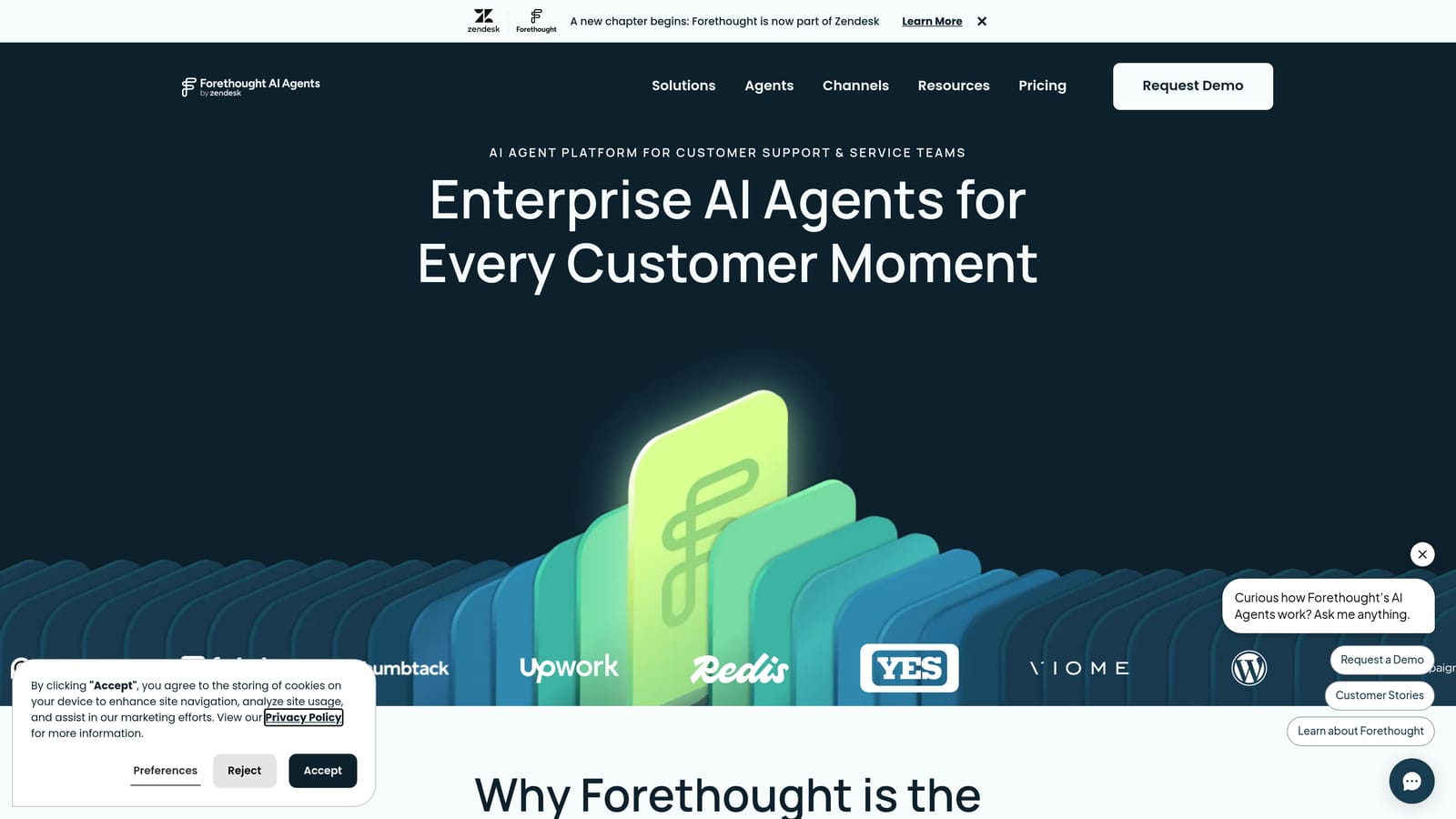
Forethought AI is an enterprise-focused platform designed to sit on top of existing helpdesks, adding intelligent triage, routing, and deflection without replacing the underlying system.
Where This Tool Shines
Forethought's modular approach is its key differentiator. Rather than asking teams to rip out Zendesk or Salesforce, it layers AI intelligence on top of whatever you already have. The Triage, Solve, Assist, and Discover modules each address a distinct part of the support workflow, and the Discover module's ability to surface knowledge gaps is particularly useful for teams trying to improve self-service over time.
The barrier is pricing opacity. There are no public rates, and the typical buyer is a larger organization with an existing enterprise support stack. Smaller teams or those without a dedicated procurement process will likely find the sales cycle more friction than it's worth.
Key Features
Triage AI: Intelligent ticket classification and routing based on intent, sentiment, and content analysis.
Solve AI: Automated resolution using your existing knowledge base content.
Assist AI: Agent productivity tool with suggested responses and contextual information surfacing.
Discover AI: Surfaces support insights and identifies knowledge gaps to improve self-service coverage.
Helpdesk Integrations: Works with Zendesk, Salesforce, ServiceNow, and other enterprise platforms.
Best For
Large enterprises with established helpdesk contracts that want to add AI intelligence without platform migration. Requires budget for custom pricing and a procurement process comfortable with sales-led evaluation.
Pricing
Custom enterprise pricing with no publicly listed rates. Requires a sales conversation. Typically suited to larger organizations with existing helpdesk commitments. Contact Forethought directly for a quote.
7. Fin AI
Best for: Teams wanting outcome-based pricing where cost is directly tied to successful resolutions.
Fin AI is Intercom's standalone AI agent product, built around a per-resolution pricing model that ties cost directly to demonstrated outcomes.
Where This Tool Shines
The per-resolution model is conceptually appealing: you only pay when Fin actually solves a problem. For teams that want clear ROI visibility, this framing makes budget conversations straightforward. Fin trains on your help center content and custom knowledge sources, supports multiple languages natively, and hands off to human agents cleanly when it hits the edge of its capability.
The nuance worth understanding is what counts as a "successful resolution." At scale, that definition matters a lot for cost modeling. Teams should clarify this with Intercom before committing, particularly if they expect high conversation volumes.
Key Features
Per-Resolution Pricing: Cost is charged only when Fin successfully resolves a conversation, not per seat or per conversation attempt.
Knowledge Source Training: Learns from your help center, custom content, and documentation to answer accurately.
Multilingual Support: Handles conversations in multiple languages without separate configuration.
Human Handoff: Escalates to live agents when conversations exceed Fin's resolution capability.
Standalone or Integrated: Available independently or as part of the broader Intercom platform.
Best For
Teams with moderate, predictable resolution volumes who want cost tied directly to outcomes. High-volume teams should model total cost carefully before committing. Works well as a standalone layer for teams already using a separate helpdesk.
Pricing
Per-resolution pricing model. No seat fees for the AI agent itself. Verify current per-resolution rates directly at intercom.com, as pricing changes frequently.
8. Help Scout
Best for: Teams wanting AI features included in standard plans without surprise upcharges.
Help Scout is a customer-first support platform known for its simplicity, clean UI, and AI features bundled into standard plans without heavy additional fees.
Where This Tool Shines
Help Scout's pricing transparency is genuinely refreshing in this market. AI Summarize, AI Assist, and AI Drafts are included across paid plans rather than gated behind a separate AI add-on. For teams tired of discovering that the AI features they wanted are always one tier up, that inclusion is a real differentiator.
The platform's simplicity also means fast agent onboarding. The shared inbox, live chat, and knowledge base are well-integrated, and the Beacon embeddable widget adds proactive messaging without complexity. The limitation is depth: teams needing advanced automation, complex routing logic, or deep business intelligence from support data will find Help Scout's capabilities more limited than AI-native platforms.
Key Features
AI Features Included: AI Summarize, AI Assist, and AI Drafts bundled into paid plans without separate add-on fees.
Shared Inbox: Collaborative team inbox with assignment, notes, and conversation history.
Beacon Widget: Embeddable help widget with proactive messaging and self-service content surfacing.
Customer Data Sidebar: Conversation history and customer context visible alongside every ticket.
Knowledge Base: Built-in Docs product for self-service content, integrated with Beacon.
Best For
Small to mid-sized teams that want straightforward, honest pricing with AI included. Strong for teams prioritizing simplicity and fast onboarding over deep automation or advanced routing. Less suitable for teams needing complex integrations or support-driven business intelligence.
Pricing
Standard at approximately $22/user/month, Plus at approximately $44/user/month, Pro at custom pricing. AI features included across paid plans. Verify current pricing at helpscout.com.
9. Zoho Desk AI (Zia)
Best for: Existing Zoho customers wanting AI support capabilities at highly competitive enterprise-tier pricing.
Zoho Desk includes Zia, its built-in AI assistant, offering sentiment analysis, smart tagging, and response suggestions within one of the most affordable enterprise-tier pricing structures in the market.
Where This Tool Shines
Zoho Desk's value proposition is strongest for teams already in the Zoho ecosystem. The native integration with Zoho CRM and Zoho Analytics creates a connected view of customer data that standalone tools struggle to replicate without custom work. Zia's sentiment analysis and anomaly detection add genuine intelligence to ticket management without requiring a separate AI platform.
For teams outside the Zoho ecosystem, the case is less compelling. The platform is capable, but the integration advantages that make it exceptional are largely Zoho-to-Zoho. Teams on Salesforce, HubSpot, or other CRMs will find the cross-platform integration story less seamless.
Key Features
Zia AI Assistant: Sentiment analysis, anomaly detection, ticket tagging, and response suggestions built into the platform.
Blueprint Workflows: Guided ticket workflows for process automation and consistent handling.
Omnichannel Support: Email, phone, chat, and social media unified in one inbox.
Zoho Ecosystem Integration: Deep native connections to Zoho CRM, Zoho Analytics, and other Zoho products.
Self-Service Portal: Guided conversations and customizable self-service portal builder for customer-facing automation.
Best For
Teams already using Zoho CRM or other Zoho products who want AI-enhanced support without leaving the ecosystem. Also a strong option for budget-conscious teams needing enterprise-tier AI features at a lower price point than Zendesk or Salesforce alternatives.
Pricing
Standard at approximately $14/agent/month, Professional at approximately $23/agent/month, Enterprise at approximately $40/agent/month. Zia AI is available on the Enterprise tier. Among the most affordable enterprise-tier AI pricing in the market. Verify current rates at zoho.com/desk.
Which Tool Fits Your Budget and Use Case
After comparing nine tools across very different pricing models, the right choice comes down to matching the pricing structure to your growth trajectory, not just the feature list.
If you're a B2B SaaS team that needs support to do more than close tickets, Halo AI's AI-native architecture stands apart. The combination of continuous learning, page-aware context, and business intelligence signals means support data actively contributes to product and revenue decisions. The flat-tier SaaS model also makes scaling costs predictable in a way that per-resolution models don't.
For budget-conscious SMBs and small teams, Tidio and Help Scout offer the most accessible entry points. Tidio wins on e-commerce fit and conversation-based pricing flexibility. Help Scout wins on pricing transparency and AI features included without upcharges.
For enterprises with existing helpdesk contracts and compliance requirements, Zendesk remains the default for a reason. Its depth of integrations and SLA tooling is hard to match. Forethought is worth evaluating if you want to add AI intelligence on top of an existing Zendesk or Salesforce investment without platform migration.
Fin AI's per-resolution model deserves serious consideration for teams that want cost tied directly to outcomes, but model the volume math carefully before committing.
Your support team shouldn't scale linearly with your customer base. Let AI agents handle routine tickets, guide users through your product, and surface business intelligence while your team focuses on complex issues that need a human touch. See Halo in action and discover how continuous learning transforms every interaction into smarter, faster support.