9 Best Automated Support Tools for Product Companies in 2026
Product companies face unique support demands that generic helpdesks can't meet — from mid-onboarding friction to real-time bug detection. This guide ranks the 9 best automated support for product companies tools in 2026, evaluated on AI capability, product integrations, scalability, and the technical complexity SaaS and software teams encounter daily.
 Matt PattoliFounder13 min read
Product companies face a support challenge that most helpdesk tools were never designed to solve. Your users aren't just customers with questions — they're navigating a living, evolving product, and when they hit a bug, get stuck mid-onboarding, or need a feature explained in context, a generic ticket queue simply doesn't cut it.
Automated support has matured well beyond FAQ bots. Today's best platforms deploy AI agents that resolve tickets autonomously, detect bugs, guide users through interfaces, and escalate intelligently to human agents when complexity demands it. The strongest tools now integrate deeply with your product stack, learn from every interaction, and surface intelligence your entire team can act on.
This list covers the top automated support tools specifically suited to product companies, evaluated on AI capability, product integrations, scalability, and how well each handles the technical complexity that SaaS and software teams deal with daily. Whether you're replacing a legacy helpdesk or building your support infrastructure from scratch, there's a right fit here for your team.
1. Halo AI
Best for: Product companies that need AI-first, context-aware support with deep product-stack integration
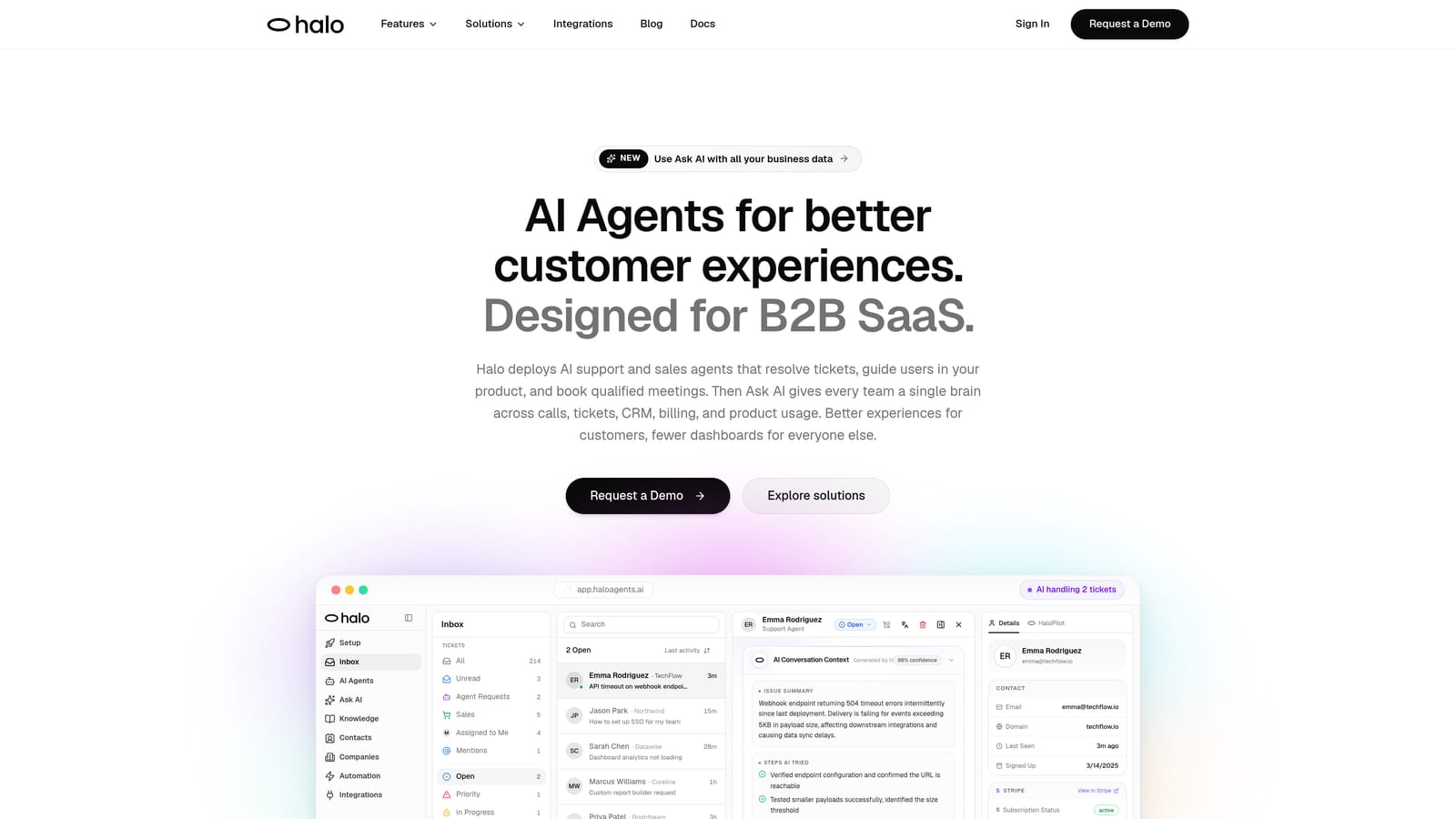
Halo AI is an AI-native customer support platform built specifically for product companies, not adapted from a legacy helpdesk.
Where This Tool Shines
What separates Halo from most tools on this list is its architecture. It wasn't built as a helpdesk with AI bolted on — it was designed from the ground up around autonomous AI agents, continuous learning, and the specific workflows that product teams deal with every day. That distinction matters when your support conversations frequently touch bugs, onboarding friction, and feature complexity.
The page-aware chat widget is a standout capability. The AI understands which screen or feature a user is currently on, delivering guidance that's genuinely contextual rather than generic. Pair that with auto bug ticket creation — which converts user-reported issues into structured bug reports automatically — and you have a support layer that feeds directly into your product development cycle.
Key Features
Page-Aware Chat Widget: Understands which product screen the user is on and delivers contextual visual guidance tailored to their exact moment of friction.
Autonomous Ticket Resolution: AI agents resolve support tickets end-to-end, with intelligent escalation to human agents when issues require a human touch.
Auto Bug Ticket Creation: Converts user-reported issues into structured bug reports automatically, closing the loop between support and engineering.
Smart Inbox with Business Intelligence: Surfaces customer health signals, revenue intelligence, and anomaly detection — going well beyond standard support metrics.
Deep Product-Stack Integrations: Connects natively with Linear, Slack, HubSpot, Intercom, Stripe, Zoom, PandaDoc, and Fathom.
Continuous Learning Architecture: Improves with every resolved interaction, getting smarter and more accurate over time without manual retraining.
Best For
B2B SaaS companies and product teams that want AI to handle the full support lifecycle, not just assist human agents. Particularly strong for teams where support conversations regularly surface product bugs, onboarding gaps, or feature adoption issues that need to feed back into engineering and product roadmaps.
Pricing
Contact for pricing. Halo is positioned for B2B SaaS and enterprise product teams; reach out directly for a tailored quote.
2. Intercom
Best for: Mid-market SaaS teams prioritizing in-app messaging and proactive engagement
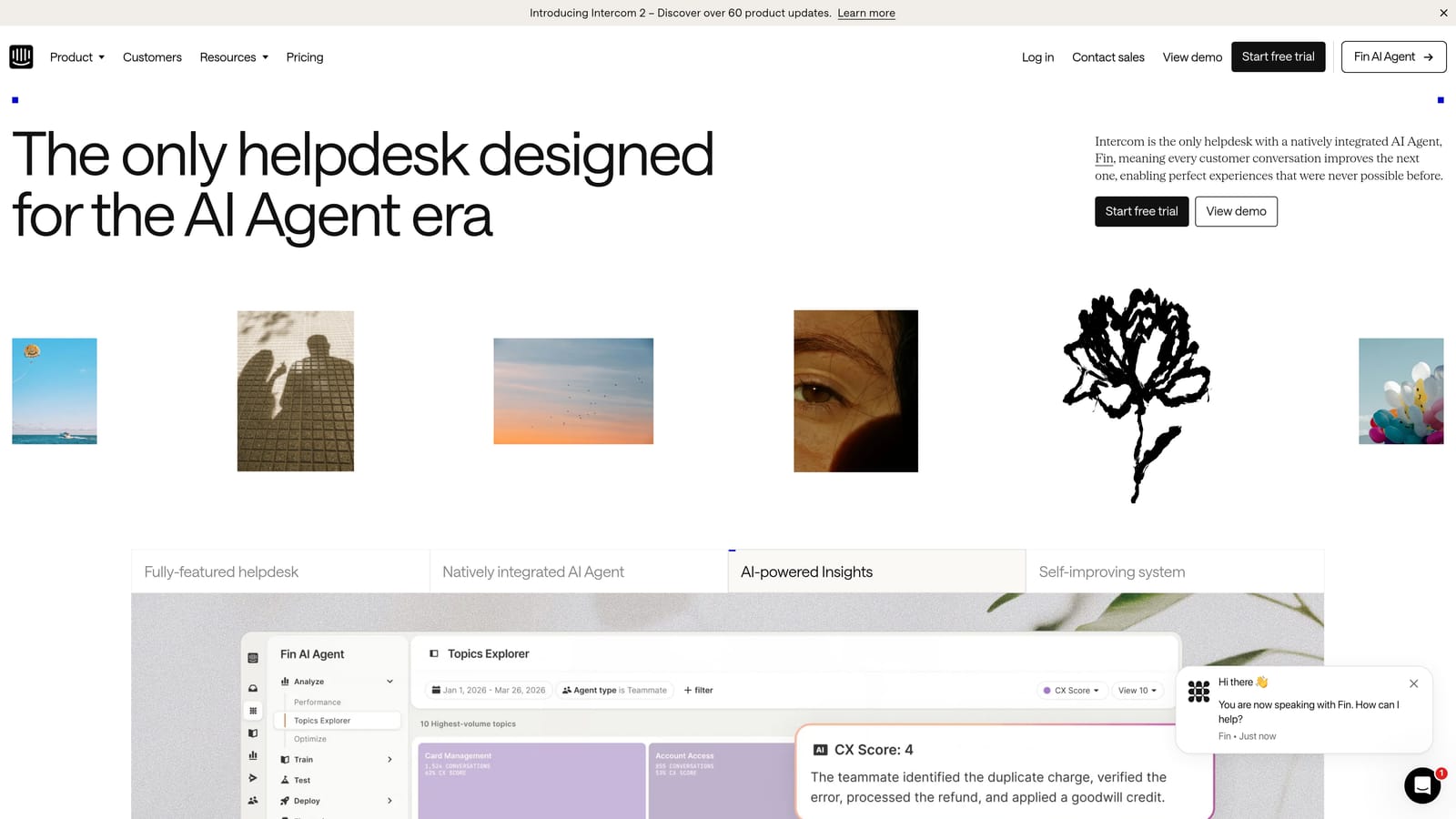
Intercom is one of the most established conversational support platforms, featuring Fin AI Agent for autonomous query resolution alongside rich in-app messaging capabilities.
Where This Tool Shines
Intercom's strength has always been in-product engagement. Product tours, proactive messages, and targeted in-app conversations make it easy to reach users at the right moment, not just after they've already submitted a ticket. Fin AI Agent, built on large language models, can handle a meaningful share of routine queries without human intervention.
The integration marketplace is extensive, and the shared inbox keeps human agents organized when escalations happen. For teams that want both support automation and proactive product engagement in a single platform, Intercom is a natural fit.
Key Features
Fin AI Agent: Built on large language models, capable of resolving common customer queries autonomously without human handoff.
In-App Messaging and Product Tours: Proactive engagement tools that reach users at key moments within your product experience.
Shared Inbox: Collaborative workspace for human agents handling escalations and complex conversations.
App Store Integrations: Over 1,000 integrations available, covering CRM, analytics, and product tools.
Conversation Analytics: Reporting on resolution rates, response times, and team performance.
Best For
Mid-market SaaS companies that want a mature platform combining proactive in-app engagement with AI-powered support. Teams already invested in Intercom's ecosystem will find the Fin AI Agent a natural extension of their existing setup.
Pricing
Starts at approximately $39/month for entry-level plans; AI features including Fin are available on higher tiers. Costs can scale significantly at volume.
3. Zendesk AI
Best for: Enterprise teams with high ticket volume and complex routing requirements
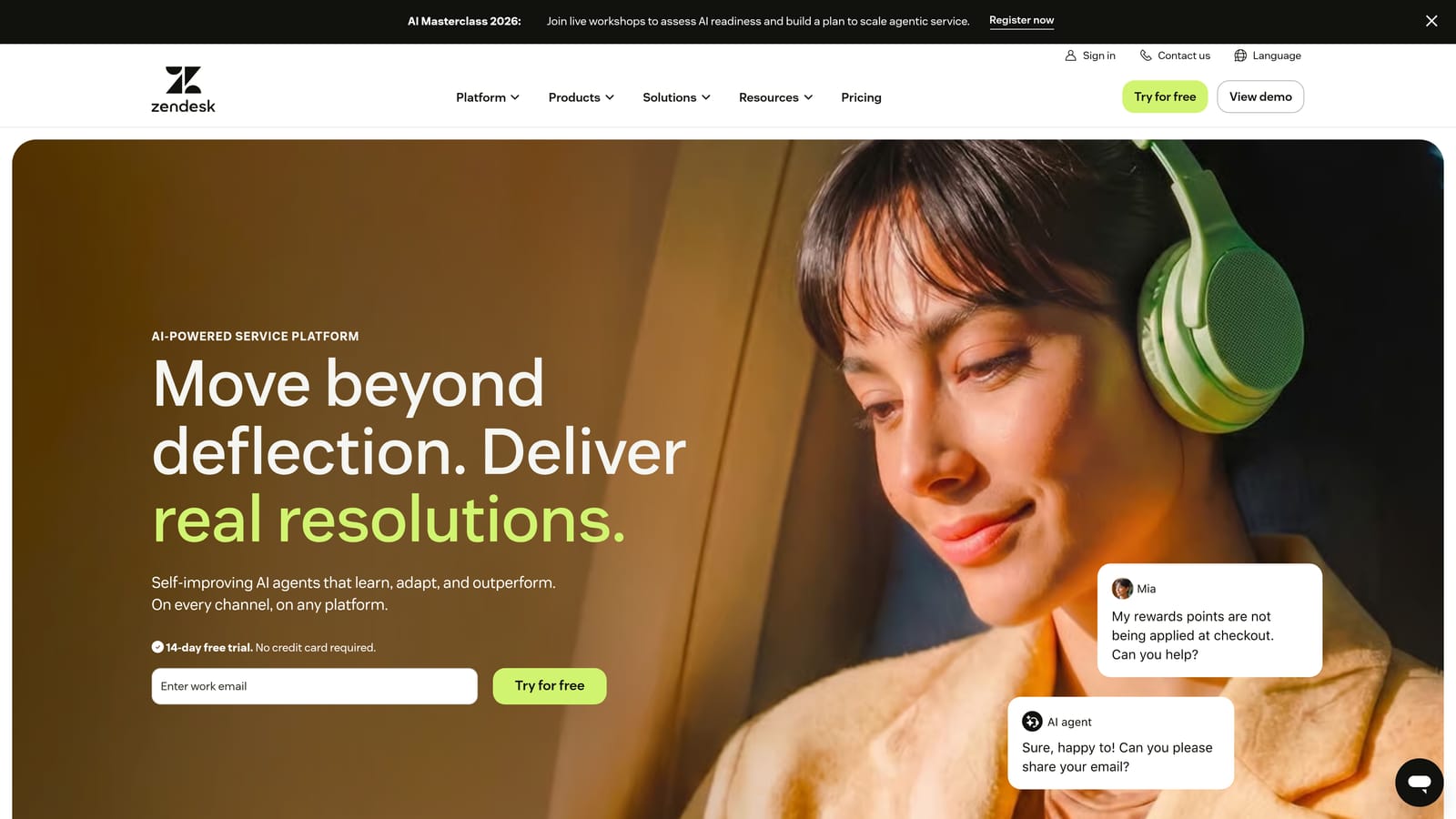
Zendesk is the industry's most established helpdesk platform, now layering AI agents, intelligent triage, and AI-assisted agent workflows on top of its powerful ticketing infrastructure.
Where This Tool Shines
If raw ticket volume and routing complexity are your primary challenges, Zendesk's infrastructure is hard to beat. Its automation rules, macros, and SLA management are deeply mature, and the AI layer adds meaningful efficiency: intelligent triage routes tickets based on intent and sentiment, while AI-assisted workspaces surface suggested replies and conversation summaries for agents.
The ecosystem is vast. With over 1,000 native integrations, Zendesk connects to virtually any tool in your stack. The trade-off is that AI feels additive to a ticket-centric architecture rather than foundational, and configuration can be complex for smaller teams.
Key Features
AI Agents: Self-service bots that deflect common tickets before they reach a human agent.
Intelligent Triage: Routes tickets automatically based on detected intent, sentiment, and priority signals.
AI-Assisted Agent Workspace: Provides suggested replies, conversation summaries, and next-step recommendations for human agents.
Advanced Reporting and SLA Management: Comprehensive analytics and service-level tracking for high-volume operations.
1,000+ Native Integrations: Connects to CRM, engineering, and product tools across the enterprise stack.
Best For
Enterprise product companies with large support teams, high ticket volumes, and complex routing needs. Less ideal for early-stage teams or those looking for an AI-first architecture rather than AI layered onto a traditional helpdesk.
Pricing
Suite plans start at approximately $55/agent/month; AI add-ons carry additional cost. Enterprise pricing available for larger deployments.
4. Freshdesk
Best for: Growing startups scaling support on a budget with omnichannel needs
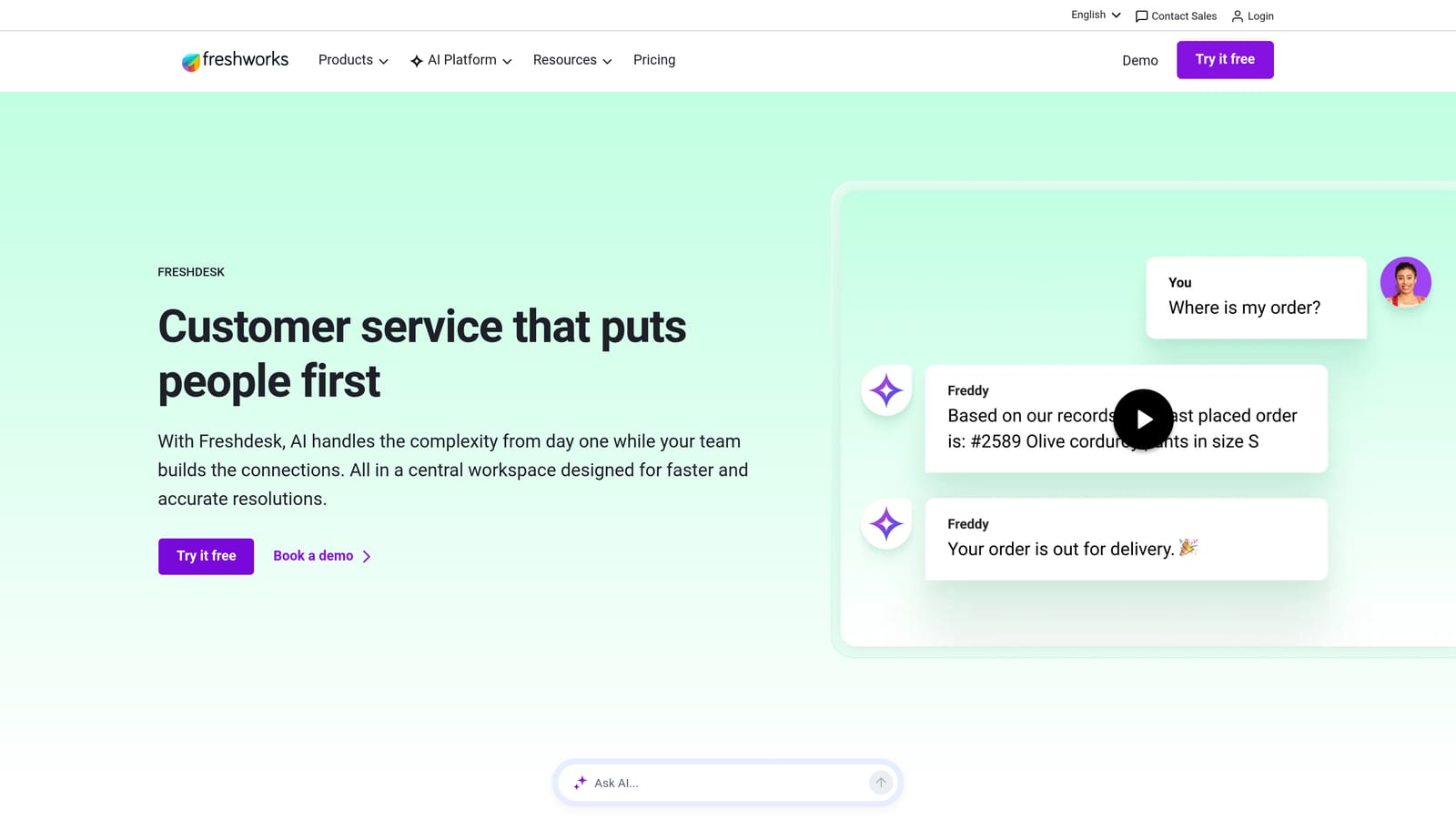
Freshdesk is a feature-rich helpdesk platform with Freddy AI for ticket automation, omnichannel support, and a generous free tier that makes it accessible for product teams in early growth stages.
Where This Tool Shines
Freshdesk's accessibility is a genuine differentiator. The free tier covers core helpdesk functionality, which means teams can get up and running without a significant upfront commitment. As you scale, Freddy AI adds ticket summarization, suggested replies, sentiment analysis, and a self-service bot that handles routine queries automatically.
Omnichannel coverage — email, chat, phone, and social — is included at mid-tier plans, making it practical for teams that need to consolidate support channels without investing in multiple tools.
Key Features
Freddy AI: Covers ticket summarization, suggested replies, sentiment analysis, and automated query handling via the Freddy Self Service bot.
Omnichannel Inbox: Unified support across email, chat, phone, and social channels.
Collision Detection: Prevents multiple agents from responding to the same ticket simultaneously.
Team Collaboration Tools: Internal notes, agent assignment, and shared ownership for complex tickets.
Free Tier: Core helpdesk features available at no cost, with paid plans scaling as the team grows.
Best For
Early-stage and growth-stage product companies that need a solid, affordable helpdesk with AI assistance. Teams with standard support workflows will find Freshdesk more than capable; those needing deep autonomous AI resolution may outgrow it.
Pricing
Free tier available; paid plans start at approximately $15/agent/month. Freddy AI features are included on higher-tier plans.
5. Tidio
Best for: Early-stage SaaS and smaller product teams needing fast deployment
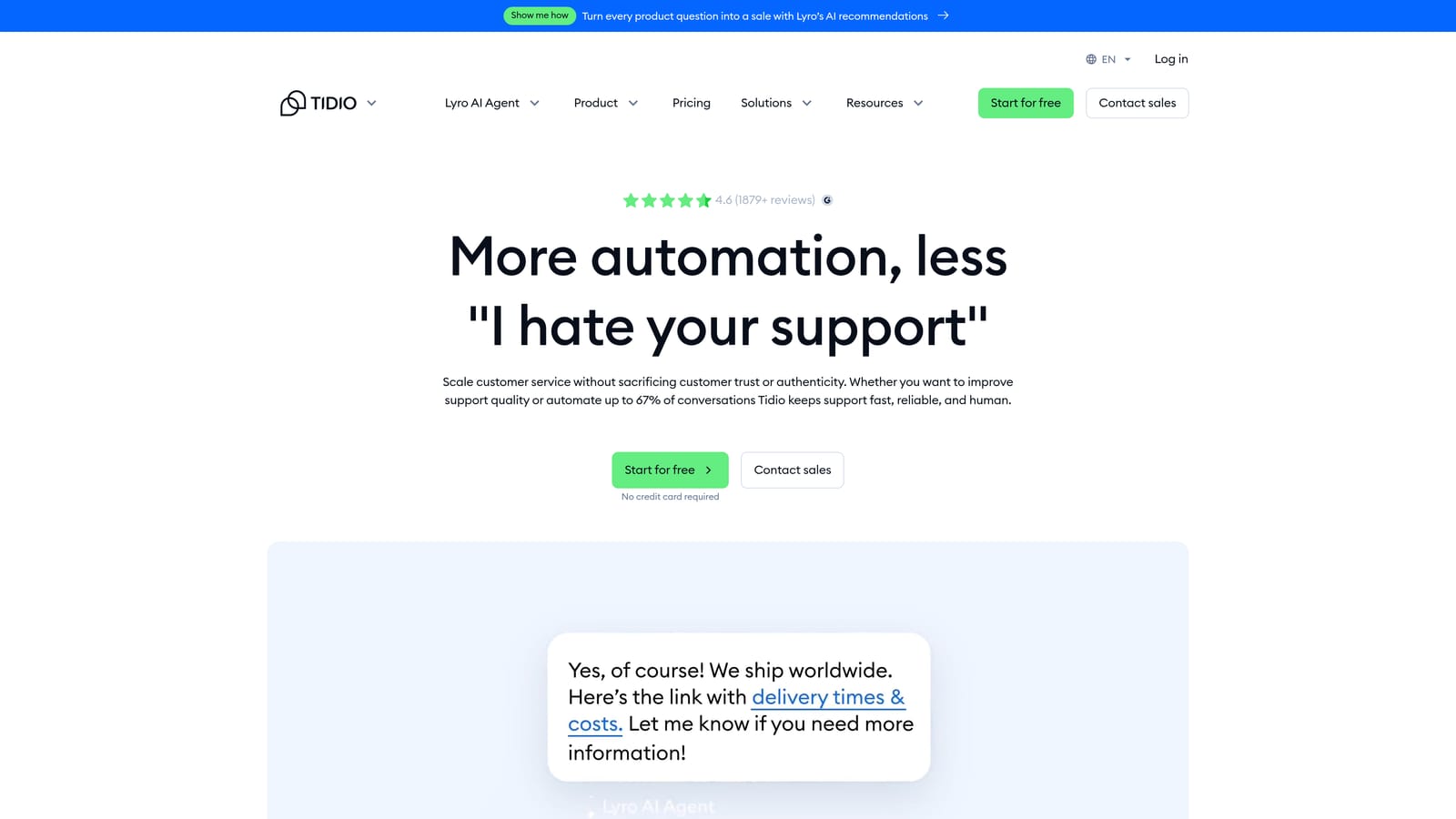
Tidio is a lightweight live chat and AI chatbot platform featuring Lyro AI, a conversational AI trained on your support content and designed for quick setup with minimal technical overhead.
Where This Tool Shines
Tidio's primary appeal is speed and simplicity. Lyro AI learns from your existing support content and can handle conversational queries with natural language understanding, without requiring a lengthy implementation project. For small teams that need something working quickly, this matters.
The visual chatbot flow builder lets non-technical team members build custom automation paths without writing code. Live chat and AI automation coexist in a single interface, reducing the tool sprawl that often plagues early-stage support stacks.
Key Features
Lyro AI Chatbot: Conversational AI with natural language understanding, trained on your own support content for relevant, accurate responses.
Visual Flow Builder: Drag-and-drop automation builder for creating custom chatbot paths without engineering support.
Live Chat and AI in One Platform: Seamless handoff between automated and human-handled conversations.
E-Commerce and CRM Integrations: Connects to common tools, though the integration depth is narrower than enterprise platforms.
Quick Setup: Minimal technical configuration required to go live.
Best For
Early-stage SaaS companies and smaller product teams that need affordable, fast-to-deploy chat and AI automation. Less suited for complex, high-volume technical support at scale.
Pricing
Free tier available; Lyro AI plans start at approximately $29/month. Affordable entry point for small teams.
6. Help Scout
Best for: Teams where human agents are central and AI serves as a productivity multiplier
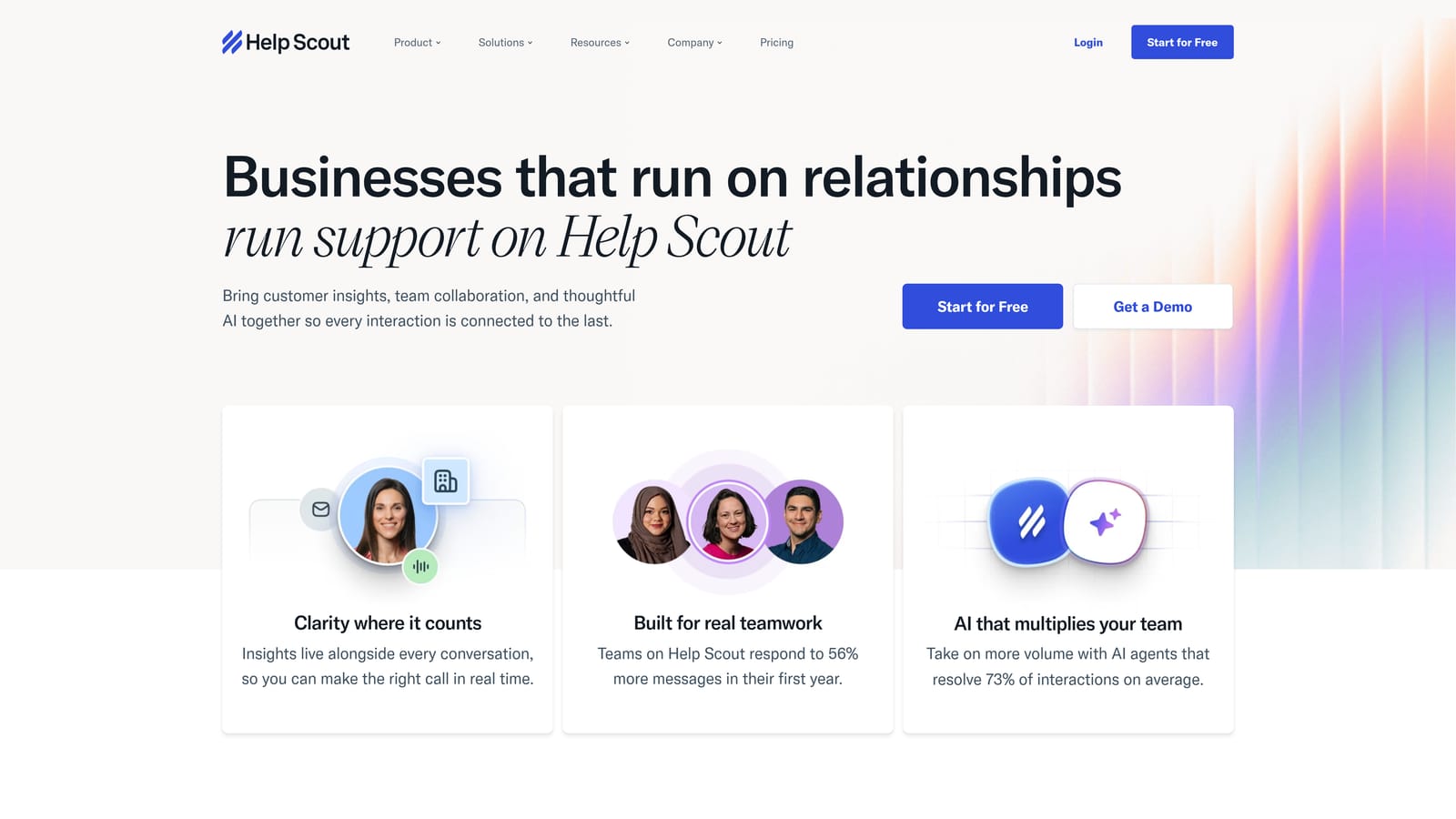
Help Scout is a shared inbox platform built around human-centered support, with AI Summarize, AI Drafts, and AI Assist tools that help agents work faster without removing them from the loop.
Where This Tool Shines
Help Scout's philosophy is that great support is fundamentally human, and AI should make human agents faster and better rather than replace them. The result is a clean, intuitive interface where AI tools enhance agent workflows without adding complexity. AI Summarize condenses long conversation threads instantly; AI Drafts generates suggested replies that agents can edit and send.
The included Docs knowledge base is a practical bonus: teams can build a self-service library without purchasing a separate tool, and it integrates naturally with the inbox experience.
Key Features
AI Summarize: Instantly condenses long conversation threads so agents get context without reading every message.
AI Drafts: Generates suggested reply drafts that agents can review, edit, and send.
AI Assist: Helps agents improve their own written responses for clarity and tone.
Docs Knowledge Base: Included in all plans, enabling self-service without an additional tool purchase.
Shared Inbox with Collision Detection: Clean team inbox with assignment, internal notes, and duplicate-prevention.
Best For
Product companies where human agents remain central to the support experience and AI is a productivity layer rather than an autonomous resolver. Particularly strong for teams that prioritize support quality and relationship-building over ticket deflection rates.
Pricing
Plans start at approximately $20/user/month. All plans include the Docs knowledge base.
7. Kustomer
Best for: B2B product companies with complex customer relationships and high-context support needs
Kustomer is a CRM-native customer support platform that unifies the full customer timeline with AI-powered intent detection and routing, built for high-context support environments.
Where This Tool Shines
Kustomer's defining characteristic is its unified customer view. Every interaction, order, support history, and product activity is consolidated into a single timeline, giving agents full context before they type a single word. For B2B product companies with long customer relationships and complex account histories, this eliminates the constant context-switching that frustrates both agents and customers.
AI-powered intent detection and routing ensure conversations reach the right agent with the right context attached. The workflow automation engine handles complex, multi-step support processes that simpler platforms can't manage.
Key Features
Unified Customer Timeline: Combines support history, CRM data, and product activity into a single, chronological view per customer.
AI Intent Detection: Identifies conversation intent automatically and routes to the appropriate team or workflow.
Omnichannel Inbox: Handles email, chat, voice, and social channels in a unified workspace.
Workflow Automation: Supports complex, multi-step support processes with conditional logic and custom triggers.
Deep CRM Integration: Native CRM data layer enables relationship-aware support at scale.
Best For
B2B product companies with established customer bases, long-term relationships, and complex data environments. Kustomer is enterprise-grade; early-stage teams may find it more than they need at this stage.
Pricing
Enterprise pricing model; contact Kustomer directly for a quote. Higher-end investment suited to companies with substantial support operations.
8. Drift (Salesloft)
Best for: PLG product companies where support conversations overlap with revenue expansion
Drift, now part of the Salesloft platform, is a conversational AI tool that spans support and sales workflows, making it particularly relevant for product-led growth companies.
Where This Tool Shines
Drift occupies an interesting space: it treats support conversations as potential revenue moments. For PLG companies where a user's support question might indicate an upsell opportunity or expansion trigger, Drift's AI can identify those signals and route accordingly, bringing in a sales rep or account manager at the right moment.
The integration with Salesloft's revenue platform adds pipeline acceleration capabilities that no pure-play support tool offers. If your support and sales motions are genuinely intertwined, this convergence is valuable.
Key Features
AI-Powered Conversational Chat: Handles both support queries and sales qualification within a single conversation interface.
Intelligent Routing: Directs conversations to the right human, whether support agent, account executive, or success manager.
Account-Based Personalization: Tailors conversations based on account data and engagement history.
Salesloft Revenue Integration: Connects support interactions directly into pipeline management and revenue workflows.
Meeting Scheduling: Allows users to book meetings with the right team member from within the conversation.
Best For
PLG SaaS companies where support and revenue expansion overlap meaningfully. Less suited for teams where support is purely a cost center and revenue conversations happen through separate channels.
Pricing
Enterprise-focused pricing; contact Drift/Salesloft directly for a quote. Investment reflects the combined support and revenue platform positioning.
9. Chatwoot
Best for: Technical teams needing full data control, deep customization, and an open-source foundation
Chatwoot is an open-source, self-hostable omnichannel support platform giving technical product teams complete data sovereignty and extensive customization options.
Where This Tool Shines
Chatwoot's open-source model is its core differentiator. For product companies with strict data residency requirements, privacy constraints, or simply a preference for owning their infrastructure, self-hosting Chatwoot provides a level of control that no commercial SaaS platform can match. Your data stays where you put it.
The API-first architecture means technical teams can integrate custom AI models, connect to proprietary internal tools, or build entirely bespoke support workflows on top of the Chatwoot foundation. The active open-source community contributes regular updates, and cloud-hosted plans are available for teams that want the flexibility without managing their own infrastructure.
Key Features
Open-Source Codebase: Full access to the source code, enabling deep customization and self-hosting for complete data sovereignty.
Omnichannel Inbox: Supports email, live chat, social media, WhatsApp, and more in a unified workspace.
API-First Architecture: Enables custom AI integrations, proprietary tool connections, and bespoke workflow development.
Team Management Tools: Canned responses, conversation labels, and agent assignment for organized team operations.
Active Community: Regular updates and community contributions keep the platform evolving without depending on a single vendor's roadmap.
Best For
Technical product teams, privacy-conscious companies, and organizations that need deep customization or operate in regulated environments. Teams should be comfortable with technical setup for self-hosted deployments; AI capabilities are growing but less mature than commercial AI-first platforms.
Pricing
Free for self-hosted deployments; cloud plans start at approximately $19/month. One of the most cost-effective options on this list for teams with technical capacity to self-host.
Which Tool Is Right for Your Product Company?
The right choice depends on where you are as a company, what your support conversations look like, and how deeply you want AI embedded in your workflows.
If you're building AI-first from the ground up: Halo AI is the strongest fit for product companies that want autonomous ticket resolution, page-aware context, and business intelligence baked into the support layer, not added on top of a legacy system.
If you need mature helpdesk infrastructure with AI added: Zendesk AI handles enterprise-scale volume and routing complexity. Freshdesk offers a more accessible entry point with a generous free tier for teams still scaling.
If in-app engagement and proactive messaging are priorities: Intercom's combination of Fin AI Agent and product tours makes it a strong choice for mid-market SaaS focused on user activation and retention.
If your team is small and speed-to-value matters most: Tidio deploys quickly and doesn't require engineering resources to get running. Help Scout is the right call if you want AI to make human agents faster rather than replace them.
If you have complex customer relationships or revenue-support overlap: Kustomer's unified customer timeline suits high-context B2B environments. Drift fits PLG companies where support and expansion conversations naturally intersect.
If data control and customization are non-negotiable: Chatwoot's open-source model gives technical teams full ownership of their support infrastructure at a fraction of the cost of commercial platforms.
Your support team shouldn't scale linearly with your customer base. Let AI agents handle routine tickets, guide users through your product, and surface business intelligence while your team focuses on complex issues that need a human touch. See Halo in action and discover how continuous learning transforms every interaction into smarter, faster support.