9 Best Automated Support Intelligence Platforms in 2026
Traditional helpdesks manage tickets — but an Automated Support Intelligence Platform goes further, combining AI-powered resolution with deep analytics and CRM integrations to turn support data into actionable business intelligence. This guide ranks the 9 strongest platforms of 2026, evaluated on AI capabilities, integration breadth, analytics quality, and B2B scalability.
 Grant CooperFounder15 min read
Your helpdesk is full of data. But is it telling you anything useful? Most traditional support platforms are built to manage tickets, not to surface intelligence. They'll tell you how many tickets came in and how long they took to close. They won't tell you which customers are about to churn, where your product is confusing users, or why the same question keeps appearing week after week.
That's the gap automated support intelligence platforms are designed to fill. These tools combine AI-powered ticket resolution with analytics, business signals, and deep integrations across your stack — so support becomes a source of insight, not just a cost center to manage.
To build this list, we evaluated platforms on four criteria: depth of AI capabilities, integration breadth across CRM and product tools, quality of analytics and intelligence outputs, and scalability for B2B teams. Whether you're running a lean support operation or managing a complex enterprise environment, this list covers the strongest options available today. You can also explore our guides on automated customer support and customer support intelligence analytics for deeper context on the category.
1. Halo AI
Best for: B2B SaaS teams that want AI-first support with business intelligence built in.
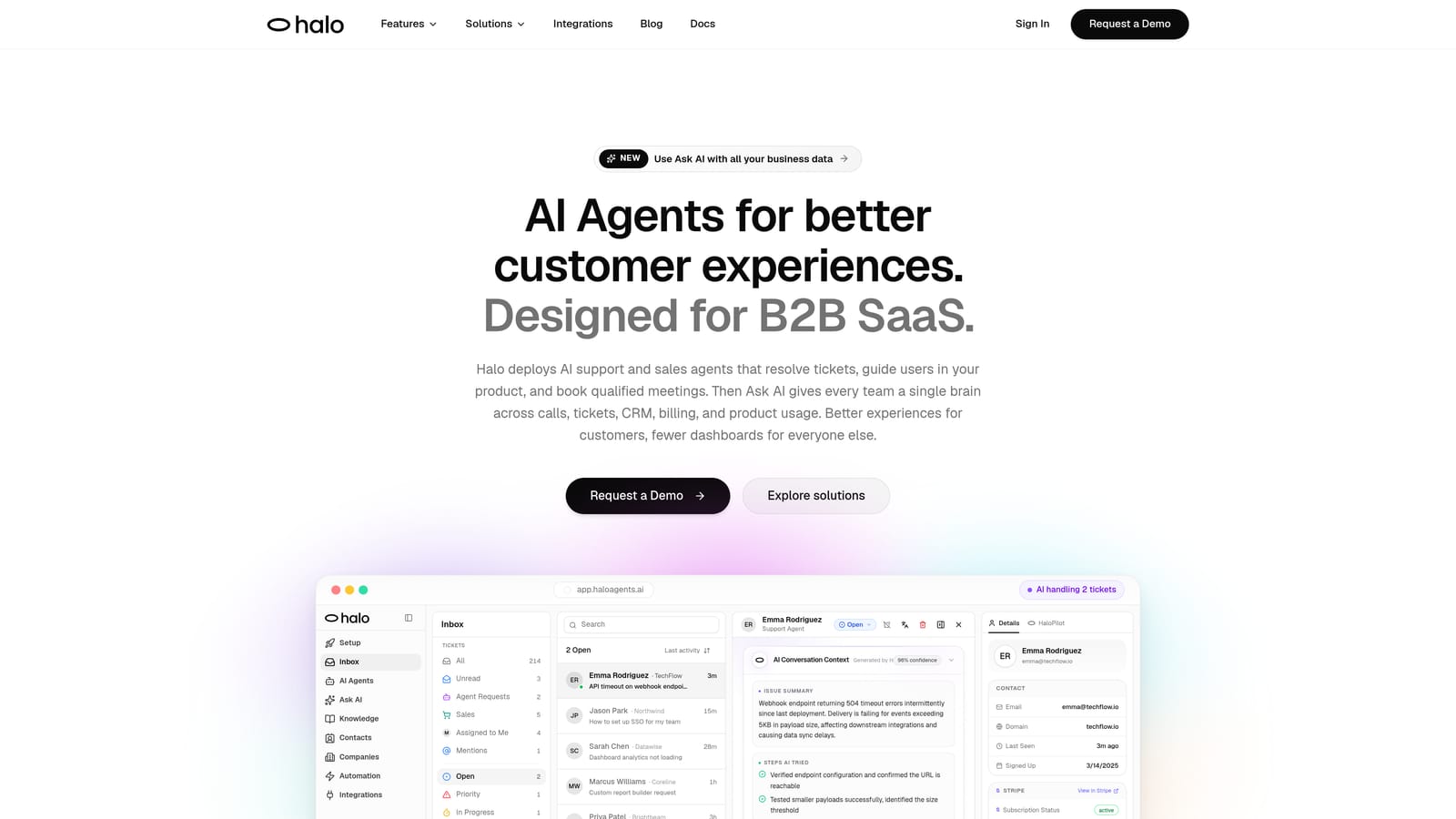
Halo AI is an AI-first customer support platform built specifically for B2B SaaS teams that need more than ticket deflection.
Where This Tool Shines
Most AI support tools are retrofitted onto legacy helpdesk infrastructure. Halo was built from the ground up as an AI-first platform, which means the intelligence isn't layered on top of an existing workflow — it's the foundation. The result is a system that doesn't just respond to support requests but actively learns from every interaction to become more effective over time.
What genuinely sets Halo apart is the page-aware context layer. The AI agent sees what the user sees in real time, which means it can provide specific UI guidance rather than generic documentation links. For SaaS products with complex workflows, this makes a meaningful difference in resolution quality.
Key Features
Page-Aware AI Agents: The agent understands exactly where a user is in your product and delivers contextual guidance tied to that specific screen or workflow.
Continuous Learning: Every resolved ticket feeds back into the model, so the AI improves with your product and your customer base over time.
Auto Bug Ticket Creation: When users report issues that look like bugs, Halo automatically creates and routes tickets to Linear or equivalent engineering tools — no manual triage required.
Smart Inbox with Business Intelligence: The inbox surfaces customer health signals, revenue anomalies, and churn indicators alongside support conversations, turning your support queue into a business intelligence feed.
Live Agent Handoff: Complex issues escalate to human agents with full conversation context preserved, so customers never have to repeat themselves.
Broad Integration Stack: Connects natively with Slack, HubSpot, Intercom, Stripe, Zoom, PandaDoc, and Fathom — meaning support data flows into your entire business stack, not just your helpdesk.
Best For
B2B SaaS companies that want support to do more than resolve tickets. Halo is particularly well suited for product-led growth teams where support conversations contain valuable signals about user behavior, product friction, and revenue health. If you're still running a legacy helpdesk with AI bolted on, Halo represents a fundamentally different approach.
Pricing
Contact for pricing. Halo is designed for B2B SaaS teams at scale, so pricing is customized based on team size and integration requirements.
2. Zendesk AI
Best for: Enterprise support teams with complex routing, SLA management, and large agent workforces.
Zendesk AI is the AI layer built on top of Zendesk's industry-standard ticketing infrastructure, adding autonomous agents, agent copilot capabilities, and intelligent triage to one of the most widely deployed support platforms in the world.
Where This Tool Shines
Zendesk's core strength is its maturity. Decades of enterprise deployment mean the platform handles complex routing logic, SLA enforcement, and multi-team workflows with reliability that newer platforms haven't yet matched. The AI features — particularly Copilot for agent assist and intelligent triage — integrate directly into workflows that many support teams already know well.
For organizations with large agent teams and sophisticated escalation structures, Zendesk AI adds meaningful efficiency without requiring a platform migration. The tradeoff is that the AI is built around human-agent workflows first, which means it's optimizing an existing process rather than reimagining it.
Key Features
AI Agents: Handles autonomous ticket resolution across email, chat, and voice channels without human involvement.
Copilot: Provides real-time response suggestions, knowledge base recommendations, and draft assistance for live agents.
Intelligent Triage: Classifies and routes tickets based on detected intent and sentiment before an agent touches them.
Advanced Reporting: Comprehensive analytics dashboard covering resolution rates, agent performance, and customer satisfaction trends.
Integration Ecosystem: Connects with a wide range of CRM, e-commerce, and productivity tools through the Zendesk Marketplace.
Best For
Enterprises already invested in the Zendesk ecosystem, or large support organizations that need proven infrastructure alongside AI capabilities. Less suited for teams looking for an AI-first architecture or deep business intelligence outputs beyond support metrics.
Pricing
AI features are included in Suite plans starting at approximately $115 per agent per month. Enterprise pricing is available on request and scales significantly at higher tiers.
3. Intercom Fin
Best for: Conversational support teams already using the Intercom messenger ecosystem.
Intercom Fin is Intercom's GPT-powered AI agent designed to resolve support queries directly within the Intercom messenger, trained on your help center and knowledge base content.
Where This Tool Shines
Fin's strength is conversational accuracy. It's built to handle the kind of product and process questions that typically flood support queues, and it does so within the messenger interface users are already interacting with. The handoff experience is particularly smooth — when Fin can't resolve something, it escalates within the same thread without breaking the conversation flow.
The per-resolution pricing model is worth noting. For teams with predictable, high-volume query patterns, it can be cost-effective. For teams with more complex, varied tickets, costs can scale in ways that require careful monitoring.
Key Features
Knowledge Base Resolution: Trains directly on your existing help center content to answer product and process questions with high accuracy.
In-Thread Handoff: Escalates to human agents within the same messenger conversation, preserving full context.
Multi-Language Support: Handles queries in multiple languages without additional configuration.
Resolution Rate Reporting: Tracks what percentage of conversations Fin resolves autonomously versus escalating.
Native Intercom Integration: Works entirely within the Intercom platform, making adoption straightforward for existing users.
Best For
Companies that are already on Intercom and want to add AI resolution without switching platforms. Also well suited for product teams with rich help center content that Fin can immediately learn from. Less ideal for teams that need deep business intelligence or multi-system integrations beyond the Intercom ecosystem.
Pricing
Fin charges per successful resolution. Base Intercom plans start at approximately $39 per seat per month, with Fin costs layered on top based on resolution volume.
4. Freshdesk Freddy AI
Best for: Mid-market teams wanting a full AI suite at competitive pricing within the Freshworks ecosystem.
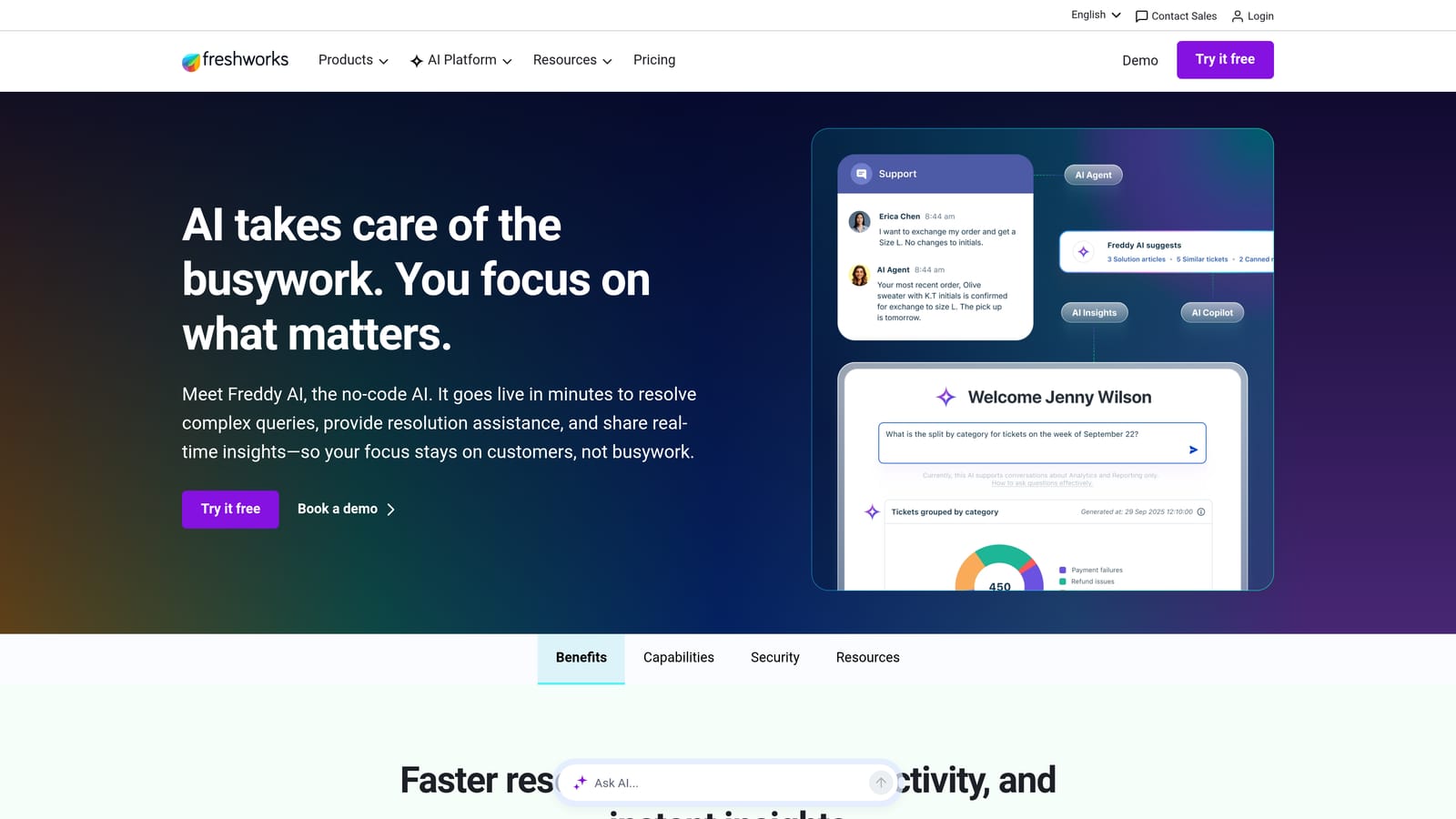
Freshdesk Freddy AI is Freshworks' AI suite spanning self-service automation, agent copilot assistance, and analytics — all built into the Freshdesk helpdesk environment.
Where This Tool Shines
Freddy's modular structure is its practical advantage. Teams can deploy Freddy Self Service for deflection, Freddy Copilot for agent assistance, and Freddy Insights for analytics — either together or incrementally. This makes it easier to adopt AI capabilities without overhauling your entire support operation at once.
The pricing is genuinely competitive for the mid-market. Organizations that need capable AI features without enterprise-level investment will find Freddy's value proposition compelling, particularly if they're already using Freshdesk as their primary helpdesk.
Key Features
Freddy Self Service: AI-powered deflection and chatbot flows that resolve common queries before they reach agents.
Freddy Copilot: Provides response suggestions, ticket summarization, and tone adjustment for live agents handling complex cases.
Freddy Insights: Analytics and performance reporting that surfaces trends across ticket volume, resolution rates, and agent performance.
Omnichannel Support: Covers email, chat, phone, and social channels within a unified interface.
Competitive Pricing: One of the more accessible AI-enhanced helpdesks for teams not yet at enterprise scale.
Best For
Mid-market support teams already in the Freshworks ecosystem, or growing companies that want a full-featured AI suite without committing to enterprise-tier pricing. The intelligence layer is functional but not as deep as purpose-built analytics platforms.
Pricing
Freddy AI add-on starts at approximately $29 per agent per month. Base Freshdesk plans begin at around $15 per agent per month, making the combined cost accessible for growing teams.
5. Salesforce Einstein for Service
Best for: Enterprise teams already running on Salesforce who want AI powered by full CRM context.
Salesforce Einstein for Service is the AI layer within Service Cloud, using the full Salesforce CRM data model to power intelligent case routing, agent recommendations, and automated workflows.
Where This Tool Shines
Einstein's unique advantage is access to the entire Salesforce data ecosystem. When the AI makes a routing decision or generates an agent recommendation, it can draw on account history, opportunity data, marketing interactions, and service records simultaneously. That breadth of context is difficult to replicate in platforms that operate outside the Salesforce environment.
For enterprise teams with complex support structures tied to account management and sales cycles, this level of CRM integration translates into meaningfully better recommendations. The implementation complexity and cost, however, make it a poor fit for teams not already invested in the Salesforce ecosystem.
Key Features
AI Case Classification and Routing: Automatically classifies and routes cases using full CRM context, not just ticket content.
Einstein Copilot: Delivers real-time agent guidance and knowledge suggestions during live case handling.
Predictive CSAT and Churn Signals: Draws on CRM data to flag accounts at risk before a support issue escalates.
Automated Workflow Triggers: Initiates workflows based on case intelligence — escalations, follow-ups, and account alerts.
Cross-Cloud Integration: Deep connectivity with Sales Cloud, Marketing Cloud, and Data Cloud for unified customer intelligence.
Best For
Large enterprises already running Salesforce as their CRM and service platform. The value compounds significantly for teams where support, sales, and marketing data all live in the Salesforce ecosystem. Not recommended for teams outside that ecosystem due to implementation complexity and cost.
Pricing
Service Cloud starts at approximately $75 per user per month. Einstein add-ons vary by feature set, and enterprise implementations typically involve significant additional investment in configuration and licensing.
6. Kustomer AI
Best for: High-volume consumer brands that need full omnichannel context in every AI interaction.
Kustomer is a CRM-first customer service platform with AI capabilities built around a unified customer timeline, giving both agents and AI a complete picture of every interaction across every channel.
Where This Tool Shines
Kustomer's defining feature is the customer timeline: a unified view of every interaction a customer has had across email, chat, SMS, social, and voice. When AI processes a new request, it has access to that full history — which means intent detection and automated resolution flows benefit from context that most platforms simply don't have.
The proactive outreach capability is also notable. Kustomer can trigger automated outreach based on customer behavior signals, which moves the platform beyond reactive support into proactive customer success territory.
Key Features
Unified Customer Timeline: Aggregates all channel interactions into a single view that AI and agents can draw on for every conversation.
AI Intent Detection: Identifies customer intent and routes to automated resolution flows or human agents based on complexity.
Omnichannel Coverage: Handles email, chat, SMS, social, and voice within a single platform.
Proactive Outreach Automation: Triggers automated messages based on customer behavior patterns and signals.
Intelligence Dashboards: Reporting and analytics designed for support leadership to track performance across channels and teams.
Best For
High-volume consumer brands with complex omnichannel support needs. Kustomer is less focused on B2B SaaS use cases and the deep product-context intelligence that B2B teams typically need. Teams with a consumer-facing model and high interaction volumes will find the timeline-centric approach particularly valuable.
Pricing
Enterprise plans start at approximately $89 per user per month. Contact Kustomer directly for specifics on AI feature pricing within enterprise tiers.
7. Tidio Lyro
Best for: Small teams and growing SaaS companies that need fast AI deployment without enterprise complexity.
Tidio Lyro is Tidio's conversational AI agent built for SMBs and growing teams, offering knowledge-base-trained responses and live chat escalation with a setup measured in hours rather than weeks.
Where This Tool Shines
Lyro's practical advantage is speed to value. For teams without a dedicated support ops function or the resources to configure a complex AI platform, Lyro gets you to a functional AI agent quickly. It trains on your existing FAQ and knowledge base content, which means it leverages documentation you've already invested in creating.
The pricing is genuinely accessible for smaller teams. While enterprise platforms charge per agent seat, Lyro's volume-based model means small teams can deploy AI resolution without committing to significant monthly spend upfront.
Key Features
Knowledge Base Training: Learns from your existing FAQ and help content without requiring custom training or data preparation.
Fast Deployment: Typically live within hours, making it accessible for teams without technical implementation resources.
Live Chat Escalation: Hands off to human agents smoothly when queries exceed the AI's resolution capability.
Conversation Analytics: Tracks resolution rates and conversation patterns to help teams understand where the AI is performing and where gaps exist.
Accessible Pricing: Volume-based model that works for teams not yet at enterprise scale.
Best For
Small to mid-sized teams that need AI-assisted support without the implementation overhead of enterprise platforms. Lyro is a strong starting point, but teams that grow into needing deeper business intelligence or complex integrations will likely need to evaluate more comprehensive platforms over time.
Pricing
Lyro starts at approximately $29 per month for up to 50 conversations, with pricing scaling by conversation volume as usage grows.
8. Forethought AI
Best for: Teams that want to understand and reduce ticket volume, not just automate individual responses.
Forethought specializes in support intelligence: triage, routing, and knowledge gap analysis that helps teams address the root causes of ticket volume rather than just processing individual tickets more efficiently.
Where This Tool Shines
Most AI support tools focus on resolving tickets faster. Forethought focuses on understanding why tickets are being created in the first place. Its knowledge gap identification capability surfaces where your help content is failing users — which queries are arriving that your knowledge base can't adequately answer — and turns that into actionable content recommendations.
The intelligence layer approach also means Forethought works alongside your existing helpdesk rather than replacing it. For teams that have invested heavily in Zendesk, Salesforce, or Freshdesk and aren't ready to migrate, this overlay model is a practical way to add intelligence without disruption.
Key Features
AI Triage: Classifies and prioritizes incoming tickets before agents see them, reducing the cognitive load of queue management.
Knowledge Gap Identification: Surfaces topics and queries that your existing help content doesn't adequately address, with recommendations for what to create.
Solve Module: Self-service AI that deflects common queries before they reach the queue.
Assist Module: Agent copilot that provides real-time knowledge suggestions and response recommendations during live case handling.
Ticket Deflection Analytics: Tracks what's being deflected, what's not, and what content changes would improve deflection rates over time.
Best For
Mid-market to enterprise support teams that want to add intelligence to an existing helpdesk investment. Particularly valuable for teams dealing with recurring ticket patterns and knowledge base gaps that are driving unnecessary volume. Works best as a complement to an existing platform rather than a standalone solution.
Pricing
Contact for pricing. Forethought is typically positioned for mid-market to enterprise customers, and pricing is customized based on ticket volume and feature configuration.
9. Assembled
Best for: Support ops leaders managing both AI tooling and human team capacity simultaneously.
Assembled is a workforce management and support intelligence platform combining demand forecasting, scheduling, and real-time performance analytics — designed for ops-focused leaders who need to optimize both AI and human resources together.
Where This Tool Shines
Assembled occupies a distinct position in this list: it's not primarily a ticket resolution AI. It's an operations intelligence platform that helps support leaders understand capacity, forecast demand, and make staffing decisions informed by real data. As AI tooling handles more ticket volume, the question of how to right-size human teams becomes more complex — and Assembled is built to answer it.
The real-time adherence and queue monitoring dashboards give ops leaders visibility into what's happening across both AI-handled and agent-handled interactions, which is increasingly important as support teams operate in hybrid human-AI environments.
Key Features
Demand Forecasting: Predicts ticket volume and staffing requirements based on historical patterns and upcoming business events.
Staffing Optimization: Generates scheduling recommendations that match human capacity to forecasted demand.
Real-Time Queue Monitoring: Provides live visibility into queue health, agent adherence, and emerging volume spikes.
Performance Analytics: Tracks performance across both agent-handled and AI-assisted interactions for unified reporting.
Helpdesk Integrations: Connects with Zendesk, Salesforce, Intercom, and other major platforms to pull interaction data into forecasting models.
Best For
Support operations leaders at mid-market to enterprise companies managing teams of meaningful size. Assembled is a strong complement to ticket-resolution AI tools, not a replacement for them. Teams that already have AI handling a portion of their volume and need to optimize the human layer alongside it will find Assembled particularly valuable.
Pricing
Contact for pricing. Assembled scales by team size and feature set, making it most cost-effective for larger support organizations where forecasting accuracy has meaningful operational impact.
Which Platform Is Right for Your Team?
The right choice depends on where you are, what you're optimizing for, and how much of your stack you're willing to rebuild versus extend.
If you're a B2B SaaS team that wants an AI-first foundation with business intelligence built in, Halo AI is the strongest purpose-built option. Its page-aware context, continuous learning, and smart inbox that surfaces churn signals and revenue anomalies make it genuinely different from helpdesks that have added AI as a feature layer.
If you're a large enterprise already on Salesforce, Einstein for Service is the natural choice — the CRM integration depth is difficult to replicate elsewhere. Similarly, if your team is deeply invested in Zendesk, layering Zendesk AI onto existing infrastructure is a lower-risk path than a full migration.
For mid-market teams watching budget carefully, Freshdesk Freddy AI offers a capable full suite at accessible pricing. Small teams that need to move fast should look at Tidio Lyro — it's the fastest path to functional AI resolution without implementation overhead.
If your goal is to understand ticket root causes rather than just automate responses, Forethought's intelligence overlay is worth serious consideration. And if you're an ops leader managing hybrid human-AI teams, Assembled fills a gap that pure resolution tools don't address.
Your support team shouldn't scale linearly with your customer base. Let AI agents handle routine tickets, guide users through your product, and surface business intelligence while your team focuses on complex issues that need a human touch. See Halo in action and discover how continuous learning transforms every interaction into smarter, faster support.
For a practical guide on rolling out any of these tools, our walkthrough on how to implement AI customer support covers the key decisions and sequencing that determine whether an AI deployment succeeds or stalls.