9 Best Automated Support Tools for Tech Companies in 2026
As support volume scales faster than headcount can, automated support tools for tech companies offer a smarter path forward — handling repetitive tickets, routing complex issues, and driving resolution without growing your team. This guide covers nine top-rated tools in 2026, from AI-native platforms to specialized automation layers, evaluated specifically for B2B SaaS and tech teams.
 Matt PattoliFounder13 min read
Tech companies face a familiar paradox: as your product grows, so does your support volume, but scaling headcount to match isn't sustainable. Automated support tools solve this by handling repetitive tickets, routing complex issues, and surfacing insights that help your team work smarter.
Not all automation is created equal, though. Some tools bolt AI onto legacy helpdesk infrastructure. Others are built AI-first, with continuous learning and deep integrations baked in from day one. The right choice depends on your stack, your team size, and how much you want automation to actually own resolution versus just triage.
This list covers nine tools worth serious consideration in 2026, from AI-native platforms to specialized automation layers. Each has been selected for real-world relevance to B2B SaaS and tech teams. For broader context on how AI is reshaping the space, see our Zendesk vs AI support platform breakdown.
1. Halo AI
Best for: B2B SaaS teams that want AI to own ticket resolution end-to-end, not just assist agents
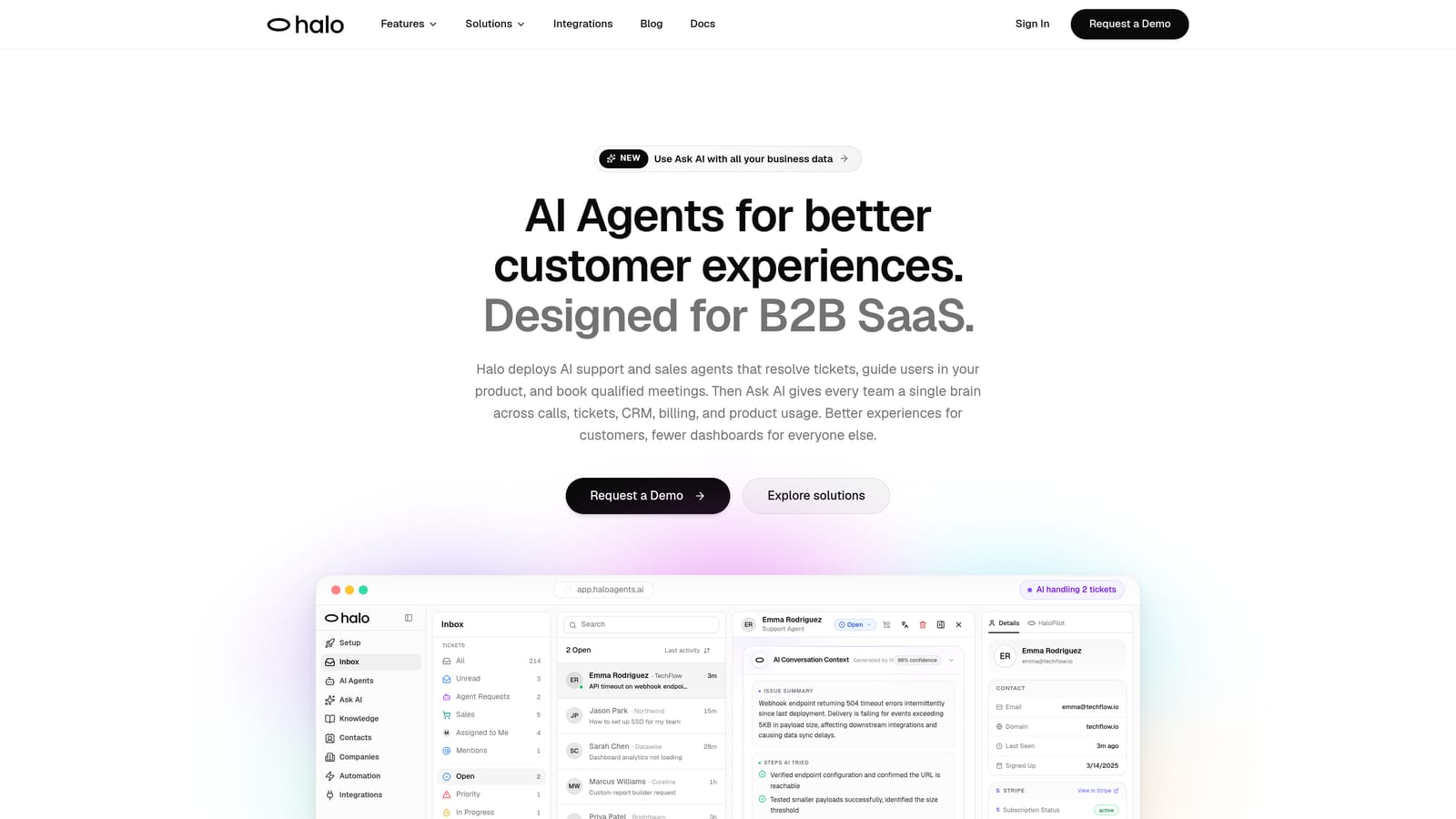
Halo AI is an AI-native customer support platform that deploys intelligent agents to resolve tickets, guide users through your product with page-aware context, and surface business intelligence signals while continuously learning from every interaction.
Where This Tool Shines
Halo's most distinctive capability is page-aware context: the AI agent actually sees what the user sees inside your product, enabling it to provide visual, step-by-step guidance rather than generic documentation links. This matters enormously for SaaS companies where support queries are often tied to specific product states, user configurations, or workflow stages.
Beyond resolution, Halo's smart inbox surfaces business intelligence that most support tools ignore entirely. Customer health signals, anomaly detection, and revenue intelligence turn your support queue into a strategic data source, not just a task list. For teams that want AI to own outcomes rather than just assist, this architecture is fundamentally different from helpdesk platforms with AI layered on top.
Key Features
Page-Aware AI Agents: The agent sees the user's current product context and delivers targeted visual guidance, not generic help articles.
Continuous Learning Engine: Every resolved ticket feeds back into the system, improving resolution quality over time without manual retraining.
Smart Inbox with Business Intelligence: Surfaces customer health signals, anomaly detection, and revenue intelligence directly from support data.
Auto Bug Ticket Creation: Automatically generates and routes bug reports to Linear or equivalent project management tools when issues are detected.
Live Agent Handoff: Complex issues escalate to human agents with full conversation context preserved, so nothing gets lost in the transfer.
Deep Integrations: Connects with Zendesk, Intercom, Freshdesk, Slack, HubSpot, Stripe, Linear, Zoom, PandaDoc, and Fathom.
Best For
B2B SaaS and tech companies that want AI to handle resolution autonomously, not just triage. Particularly strong for product-led growth companies where in-product guidance is a core part of the support experience, and for teams that want support data to inform product and revenue decisions.
Pricing
Contact for pricing. A demo is available at haloagents.ai.
2. Intercom
Best for: Teams already in the Intercom ecosystem wanting conversational AI without a platform migration
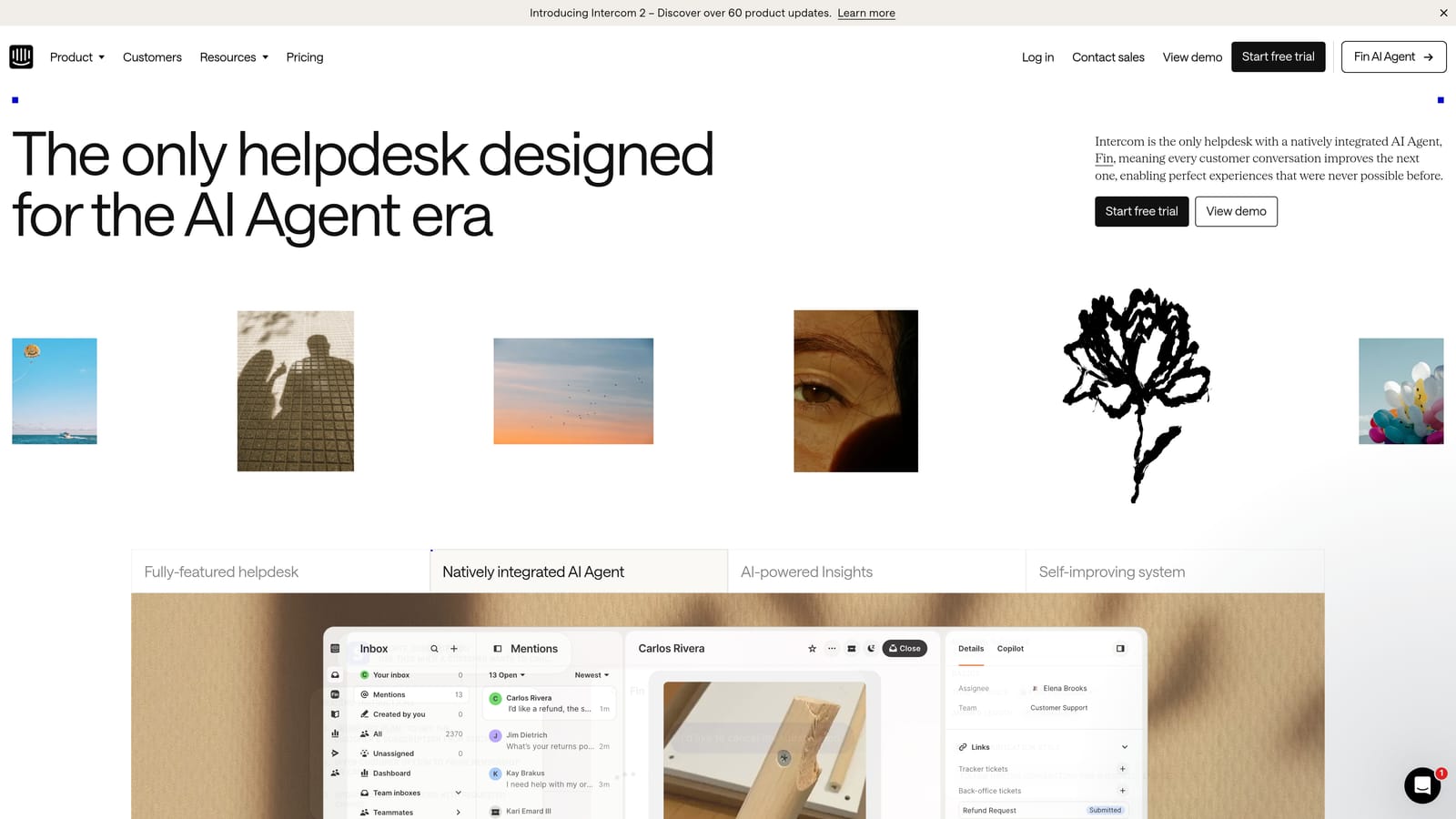
Intercom is a customer messaging platform with Fin, an AI agent built on top of Intercom's messaging infrastructure to handle support queries using your existing help content.
Where This Tool Shines
Intercom's strength is the combination of conversational support and in-product messaging in a single platform. Fin AI agent handles common queries by drawing on your help center content, and the unified inbox consolidates live chat, email, and in-app messaging in one place. If your team already uses Intercom for customer engagement, adding Fin for automated resolution is a natural extension rather than a new system to adopt.
The proactive messaging and product tour capabilities are genuinely useful for onboarding automation, making Intercom more than just a reactive support tool. It works across the customer journey in a way that pure helpdesk platforms don't.
Key Features
Fin AI Agent: Handles autonomous query resolution using your existing help center content with no additional training data required.
Unified Inbox: Consolidates live chat, email, and in-app messaging for a single agent view across channels.
Proactive Messaging and Product Tours: Enables onboarding automation and customer education without human intervention.
Workflow Builder: Visual editor for creating ticket routing rules, escalation logic, and automated follow-up sequences.
Resolution Reporting: Tracks resolution rates, CSAT scores, and team performance in a centralized dashboard.
Best For
Companies already using Intercom for customer communication who want to layer in AI resolution without switching platforms. Also well-suited for teams where proactive messaging and onboarding automation are as important as reactive support handling.
Pricing
Starts at approximately $39 per seat per month. Fin AI resolution is priced per resolution, which can escalate costs at higher volumes. Verify current pricing on Intercom's website.
3. Zendesk
Best for: Large enterprise teams with complex SLA requirements and deep reporting needs
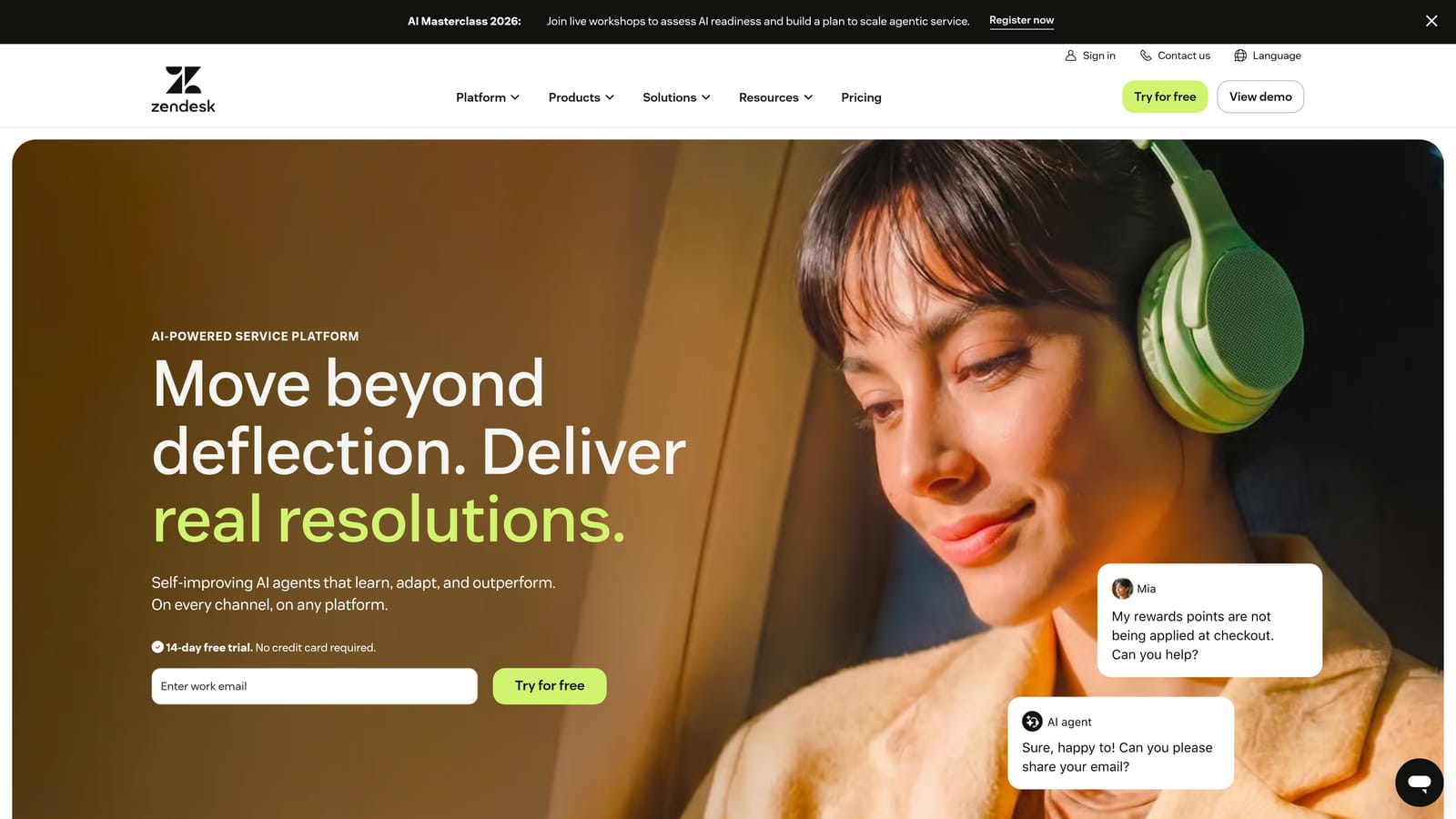
Zendesk is an enterprise-grade helpdesk platform with AI features including intelligent triage, suggested replies, and AI-powered agents layered on top of its mature ticketing infrastructure.
Where This Tool Shines
Zendesk's core strength is its ticketing infrastructure, which remains one of the most robust in the market. For large teams managing high volumes across multiple channels with strict SLA requirements, the platform's reporting depth, compliance tooling, and marketplace of third-party integrations are genuinely hard to match.
The AI capabilities have improved meaningfully in recent iterations, with intelligent triage and Zendesk AI agents handling first-response automation. That said, the AI features feel incremental rather than foundational. Teams that prioritize autonomous resolution over ticketing infrastructure may find the AI capabilities secondary to the platform's core identity.
Key Features
AI-Powered Triage: Automatically classifies and routes incoming tickets based on content, intent, and priority signals.
Zendesk AI Agents: Handles automated first-response for common queries before escalating to human agents.
Advanced SLA Management: Configurable SLA policies with compliance tracking and breach alerting.
Third-Party Marketplace: Extensive ecosystem of integrations covering CRM, billing, project management, and more.
Custom Reporting Dashboards: Flexible analytics for tracking ticket volume, resolution time, agent performance, and customer satisfaction.
Best For
Enterprise support teams with large agent headcounts, multi-channel complexity, and strict reporting or compliance requirements. Less ideal for smaller teams or companies where autonomous AI resolution is the primary goal rather than a supporting feature.
Pricing
Suite plans start at approximately $55 per agent per month. AI add-ons are priced separately. Verify current tiers on Zendesk's website.
4. Freshdesk
Best for: Cost-conscious mid-market teams wanting omnichannel support with AI assistance
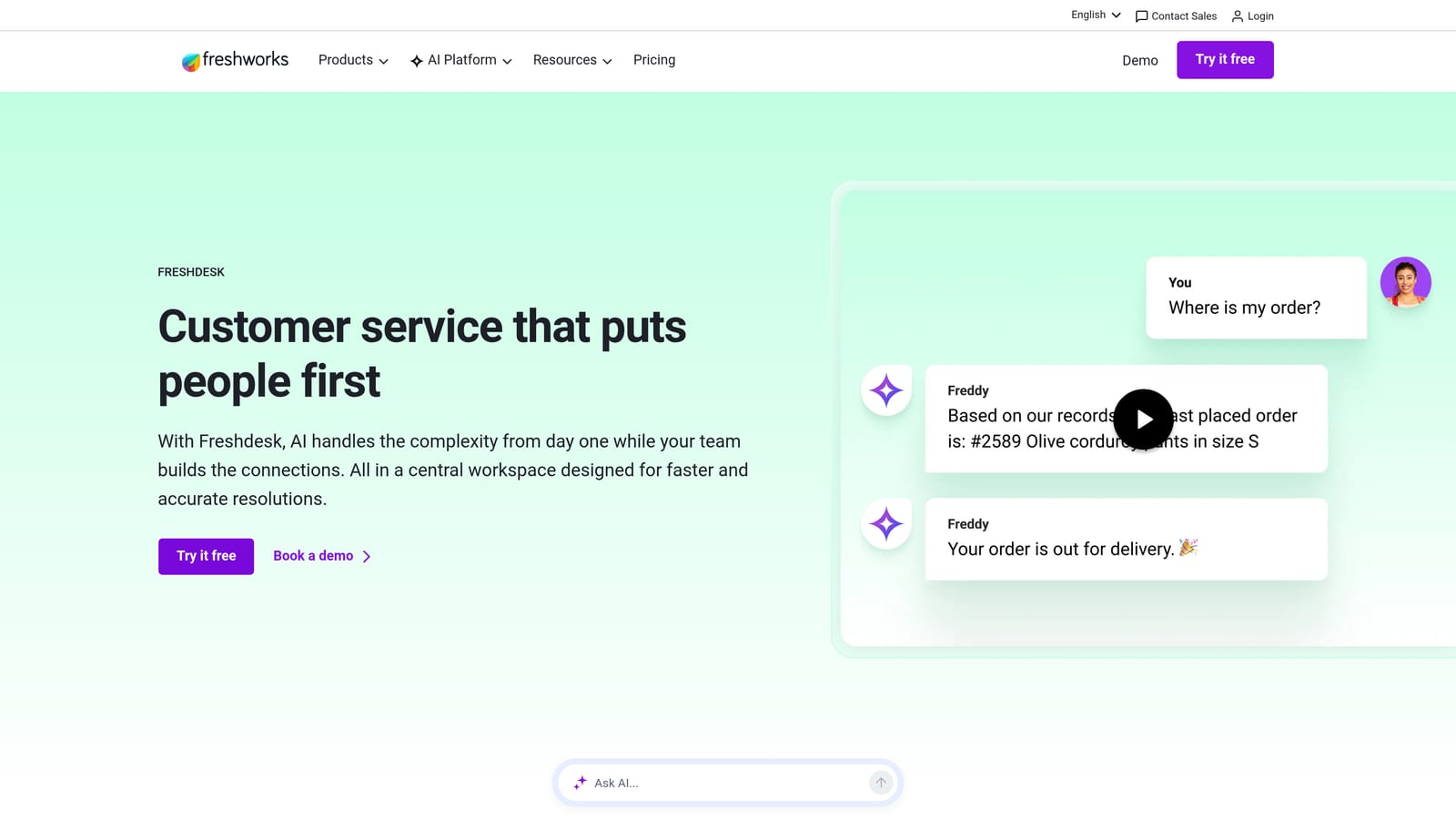
Freshdesk is an omnichannel helpdesk platform with Freddy AI providing ticket classification, suggested responses, and self-service automation across email, chat, and phone.
Where This Tool Shines
Freshdesk competes directly with Zendesk on features while often coming in at a lower price point, which makes it a compelling option for mid-market teams that need omnichannel coverage without enterprise-level spend. The free tier is genuinely useful for small teams getting started, and the paid tiers scale reasonably as volume grows.
Freddy AI handles the core automation tasks well: ticket classification, auto-assignment, and suggested replies reduce manual triage without requiring significant configuration. The self-service bot (Freddy Self Service) adds knowledge base deflection, which helps contain inbound volume before tickets are created.
Key Features
Freddy AI Triage: Automatically classifies tickets, assigns them to the right agent or team, and suggests replies based on historical data.
Freddy Self Service: AI-powered chatbot and knowledge base integration for deflecting common queries before they become tickets.
Omnichannel Support: Unified inbox across email, chat, phone, and social channels.
Collision Detection: Prevents multiple agents from working on the same ticket simultaneously.
Marketplace Integrations: Connects with common SaaS tools across CRM, project management, and communication categories.
Best For
Mid-market tech companies that need omnichannel coverage and AI-assisted triage at a competitive price point. A strong alternative to Zendesk for teams where budget is a meaningful constraint and enterprise-level complexity isn't required.
Pricing
Free tier available. Paid plans start at approximately $15 per agent per month. AI features are available on higher tiers. Verify current pricing on Freshdesk's website.
5. Tidio
Best for: Small to mid-sized companies needing fast deployment with conversational AI
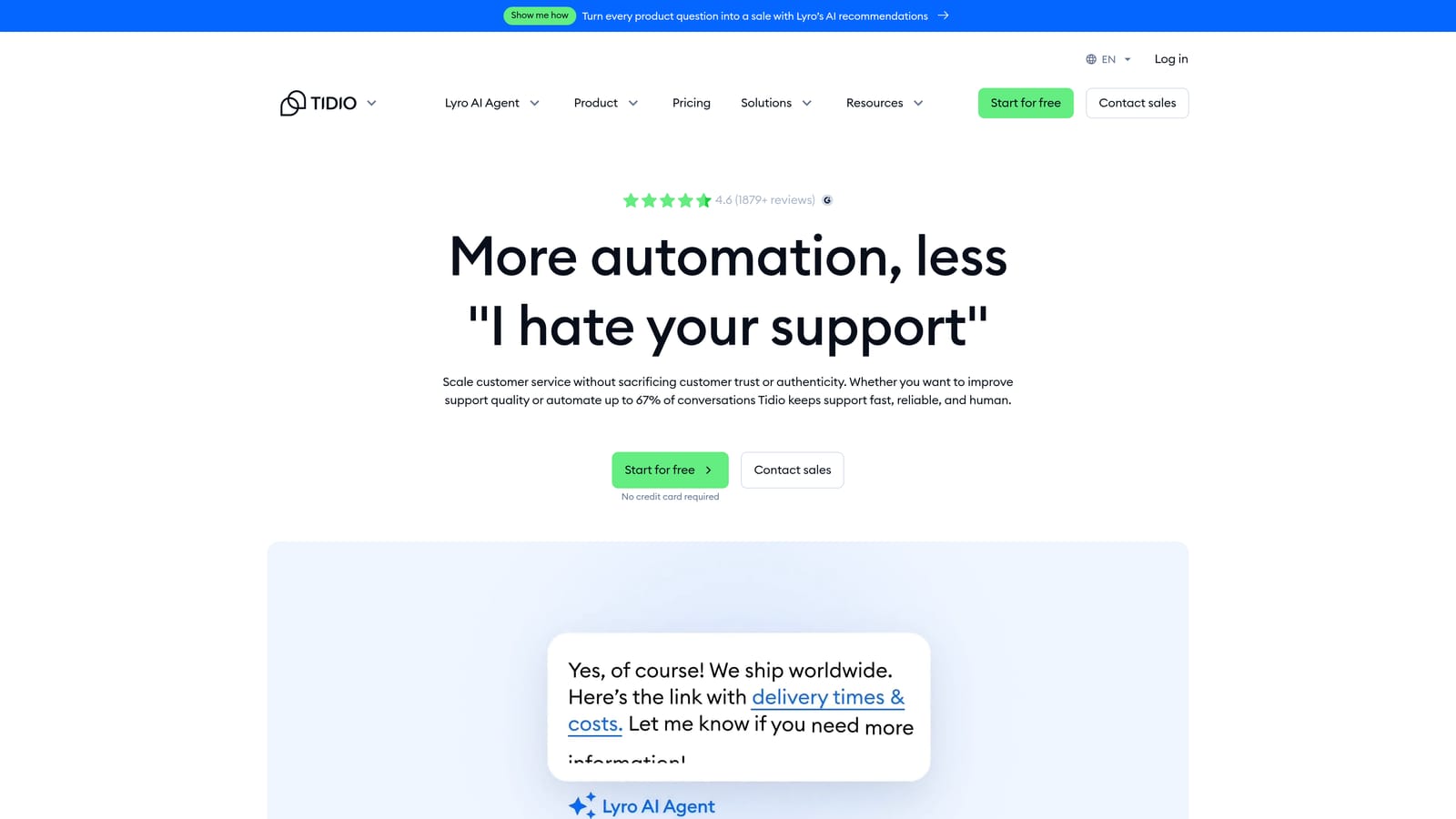
Tidio is a live chat and AI chatbot platform featuring Lyro, an AI agent designed for smaller companies that need quick setup and autonomous handling of common queries.
Where This Tool Shines
Tidio's primary advantage is speed to value. The platform is designed to be operational quickly, without the configuration overhead of enterprise helpdesk tools. Lyro handles conversational queries autonomously, and the visual chatbot flow builder makes it straightforward to build custom automation sequences without engineering support.
For teams that don't need deep enterprise functionality but do need AI-driven query handling and live chat in a single package, Tidio hits a practical middle ground. The agent takeover capability ensures that when Lyro reaches its limits, a human can step in without disrupting the conversation flow.
Key Features
Lyro AI Chatbot: Handles common customer queries autonomously using your existing content as a knowledge source.
Live Chat with Agent Takeover: Seamless handoff from AI to human agent when queries exceed automation scope.
Visual Flow Builder: Drag-and-drop editor for creating custom chatbot sequences and automation logic.
Multi-Channel Integration: Connects email and Messenger alongside live chat for consolidated conversation management.
Conversation Analytics: Tracks volume, resolution rates, and agent performance across channels.
Best For
Small to mid-sized tech companies and startups that need fast deployment and conversational AI without enterprise complexity. Less suited for large teams with complex routing requirements or deep helpdesk integration needs.
Pricing
Free tier available. Lyro AI plans start at approximately $29 per month. Verify current pricing and resolution limits on Tidio's website.
6. Help Scout
Best for: Companies where support quality and brand tone matter as much as resolution speed
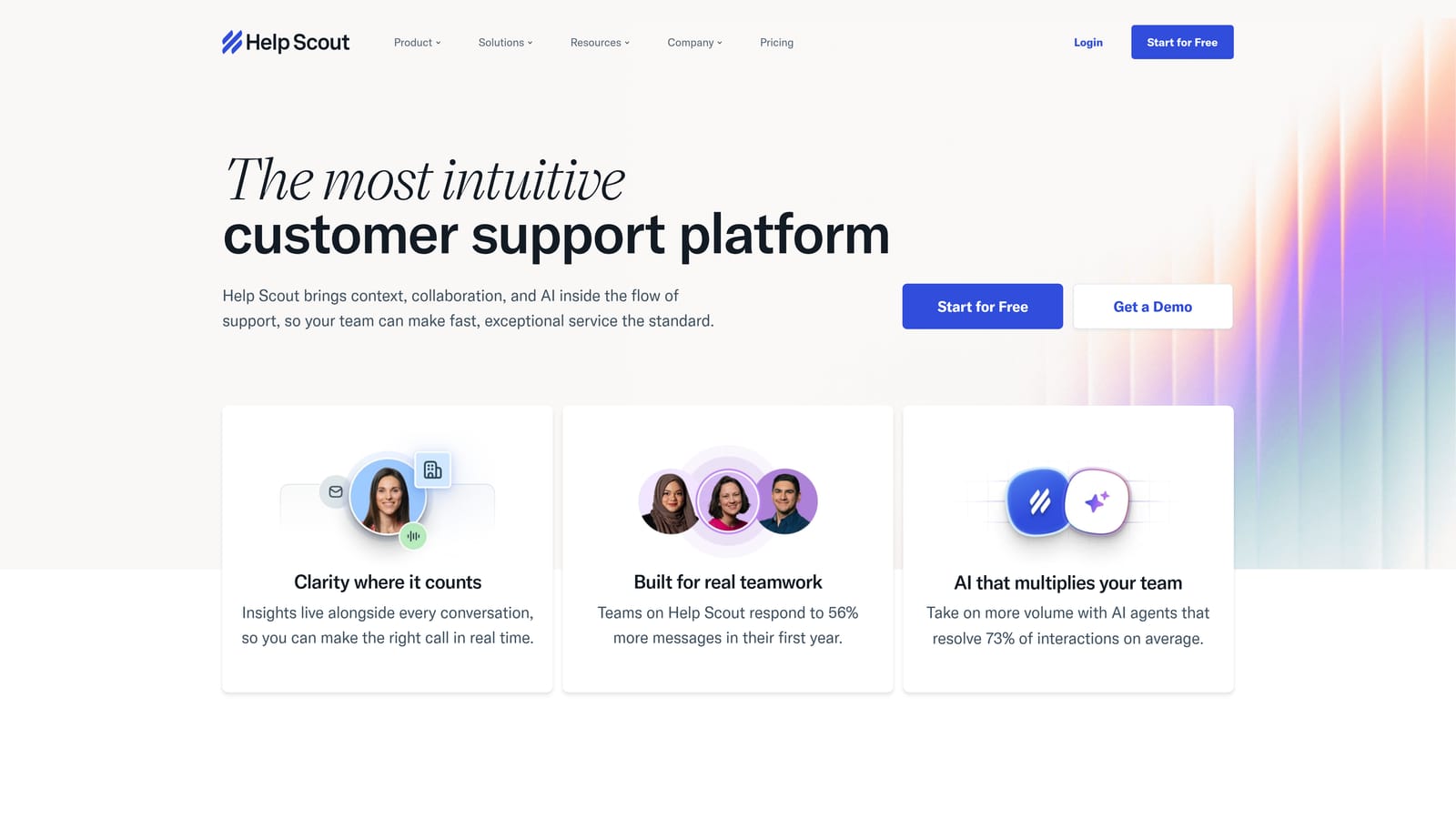
Help Scout is a customer support platform with AI features designed to augment human agents rather than replace them, with Summarize, Assist, and AI Drafts helping agents respond faster without removing the human element.
Where This Tool Shines
Help Scout occupies a deliberate position in the market: it's built for companies that believe human support is a brand differentiator, not a cost center to be automated away. The AI features are genuinely useful for agent efficiency without pushing toward autonomous resolution. Summarize gives agents instant context on long conversations; Assist helps with tone and phrasing in real time; AI Drafts suggests responses that agents review and send.
If your support philosophy centers on relationship quality, Help Scout's approach aligns well. It's worth being direct, though: if autonomous ticket resolution is your primary goal, this isn't the right tool. It's built to make human agents faster, not to replace them.
Key Features
AI Summarize: Instantly condenses long conversation threads so agents have full context without reading every message.
AI Assist: Provides real-time writing suggestions and tone adjustments as agents compose replies.
AI Drafts: Generates suggested replies based on conversation history for agents to review and send.
Docs Knowledge Base: Built-in knowledge base with AI-powered search to support both customers and agents.
Shared Inbox: Collaborative inbox with collision detection and internal notes to prevent duplicate responses.
Best For
Companies where support tone and relationship quality are core to the brand experience. Strong fit for teams that want AI to make agents more effective rather than operate autonomously. Not the right choice if deflection rate and autonomous resolution are the primary KPIs.
Pricing
Starts at approximately $22 per user per month. AI features are included on Standard and Plus plans. Verify current pricing on Help Scout's website.
7. Gorgias
Best for: Tech-enabled e-commerce companies managing high volumes of order-related support queries
Gorgias is an e-commerce-focused support automation platform with deep Shopify and commerce integrations, enabling automated resolution of order-related queries at scale.
Where This Tool Shines
Gorgias is the dominant tool in e-commerce support automation for a reason: its integrations with Shopify, Magento, and BigCommerce pull order data directly into every ticket, giving agents and AI agents full purchase context without switching tabs. For commerce companies, this eliminates a massive source of handle time and enables automated resolution of the most common query types: order status, tracking, and return requests.
The revenue statistics feature is genuinely useful for commerce teams that need to demonstrate support's impact on conversion and retention. For pure SaaS companies without a transactional commerce layer, Gorgias is less relevant. But for tech-enabled commerce businesses, it's hard to match.
Key Features
Deep Commerce Integrations: Native Shopify, Magento, and BigCommerce connections surface order data directly inside every support ticket.
Automated Ticket Closing: Handles repetitive order status and return queries without agent involvement.
AI Agent for First Response: Handles common commerce queries autonomously before escalating to human agents.
Revenue Statistics: Tracks support's impact on conversion rates and revenue, connecting support activity to business outcomes.
Macros and Rules Engine: High-volume ticket automation through configurable rules and templated responses.
Best For
Tech-enabled e-commerce companies and DTC brands with high order-related support volume. Less suited for pure SaaS companies where the support workload isn't tied to transactional commerce data.
Pricing
Starts at approximately $10 per month for low ticket volumes, scaling by ticket count rather than seat count. Verify current tier structure on Gorgias's website.
8. Guru
Best for: Teams where knowledge fragmentation is the primary bottleneck to faster support resolution
Guru is an AI-powered knowledge management platform that creates a single verified source of truth, feeding accurate answers into support tools and reducing resolution time caused by scattered or outdated information.
Where This Tool Shines
Guru addresses a problem that often goes undiagnosed: support teams that are slow not because of ticket volume, but because agents can't find accurate information quickly enough. The verified cards system ensures that knowledge has an owner, a review workflow, and an expiration process, so agents and AI tools are never pulling from outdated documentation.
The browser extension is particularly practical: it surfaces relevant knowledge inside whatever tool an agent is already using, whether that's Zendesk, Intercom, or Slack, without requiring a context switch. For organizations that have invested in AI support tools but are seeing poor resolution quality because the underlying knowledge is fragmented, Guru often fills the gap.
Key Features
AI-Powered Knowledge Search: Searches across internal docs, wikis, and connected tools to surface the most relevant answer quickly.
Verified Cards System: Ensures knowledge accuracy through structured review workflows and ownership assignment.
Browser Extension: Surfaces relevant knowledge inside any support tool without requiring agents to leave their current workflow.
Platform Integrations: Connects with Slack, Zendesk, Salesforce, and other common platforms to embed knowledge where work happens.
Knowledge Gap Analytics: Identifies the most frequently searched queries with no good answer, revealing where documentation needs to be built.
Best For
Support teams and operations leaders at mid-to-large tech companies where knowledge fragmentation is slowing resolution. Often used alongside a primary helpdesk or AI support platform rather than as a standalone tool.
Pricing
Free tier available. Paid plans start at approximately $10 per user per month. Verify current pricing on Guru's website.
9. Forethought
Best for: Enterprise teams wanting AI-driven efficiency on existing helpdesks without platform migration
Forethought is an enterprise AI platform for support teams that layers intelligent triage, routing, and agent assist onto existing helpdesks like Zendesk and Salesforce without requiring a platform change.
Where This Tool Shines
Forethought's value proposition is clear: if your organization has significant investment in an existing helpdesk and isn't ready to migrate, Forethought adds meaningful AI capability on top of what you already have. The Triage, Solve, and Assist modules address different parts of the support workflow, from classification and routing to autonomous first response to agent-facing knowledge surfacing.
The Discover module is particularly useful for operations teams: it analyzes ticket patterns to identify which query types are best suited for automation, giving you a data-driven roadmap for where to invest. For enterprises with complex approval processes around platform changes, this incremental approach has real organizational appeal.
Key Features
Triage AI: Automatically classifies and prioritizes incoming tickets based on content and historical patterns.
Solve AI: Handles autonomous first-response on common queries before routing to human agents.
Assist AI: Surfaces suggested replies and relevant knowledge to human agents in real time during live interactions.
Discover AI: Analyzes ticket patterns to identify the highest-value automation opportunities across your support queue.
Native Helpdesk Integrations: Built specifically for Zendesk, Salesforce Service Cloud, and ServiceNow environments.
Best For
Large enterprise support organizations with existing Zendesk, Salesforce, or ServiceNow deployments that want AI-driven efficiency gains without a platform migration. Less suited for smaller teams or companies evaluating their first support automation stack.
Pricing
Enterprise pricing. Contact Forethought directly for a quote.
Which Tool Is Right for Your Team?
The right automated support tool comes down to one fundamental question: do you want AI to augment your agents, or do you want it to own resolution entirely?
If autonomous resolution is the goal, Halo AI is built for exactly that. The page-aware context, continuous learning engine, and business intelligence layer make it the strongest fit for B2B SaaS teams that want AI to close tickets end-to-end, not just suggest replies. Forethought is the enterprise alternative for teams that need AI resolution capabilities without leaving their existing helpdesk.
If you're augmenting agents rather than replacing repetitive resolution, Help Scout and Guru are purpose-built for that model. For teams already deep in the Intercom ecosystem, Fin is the natural starting point. For cost-conscious mid-market teams, Freshdesk offers strong omnichannel coverage at a competitive price. And for tech-enabled commerce companies, Gorgias remains the clear category leader.
Your support team shouldn't scale linearly with your customer base. Let AI agents handle routine tickets, guide users through your product, and surface business intelligence while your team focuses on complex issues that need a human touch. See Halo in action and discover how continuous learning transforms every interaction into smarter, faster support.