9 Best AI for SaaS Support in 2026
Discover the best AI for SaaS support with this comprehensive breakdown of 9 top platforms evaluated for integration depth, learning capabilities, and escalation intelligence. As SaaS companies scale beyond sustainable headcount growth, these AI-powered tools offer context-aware, end-to-end ticket resolution specifically designed for SaaS workflows and user expectations.
 Matt PattoliFounder13 min read
SaaS companies face a support challenge that's genuinely different from other industries. Your users expect instant, context-aware help that understands their specific product experience, not a generic FAQ redirect. And as your user base grows, throwing more support headcount at the problem becomes financially unsustainable fast.
AI-powered support tools have matured significantly in the past few years. We've moved well beyond simple rule-based chatbots into intelligent agents capable of resolving complex tickets end-to-end, detecting product bugs, and even surfacing revenue signals from support conversations. But the market is crowded, and not every platform is built with SaaS workflows in mind.
We evaluated dozens of platforms to find the ones that genuinely understand SaaS support, factoring in integration depth, learning capabilities, escalation intelligence, and pricing transparency. Here are the top AI support tools available right now.
1. Halo AI
Best for: SaaS teams wanting an AI-first support platform with page-aware context and business intelligence
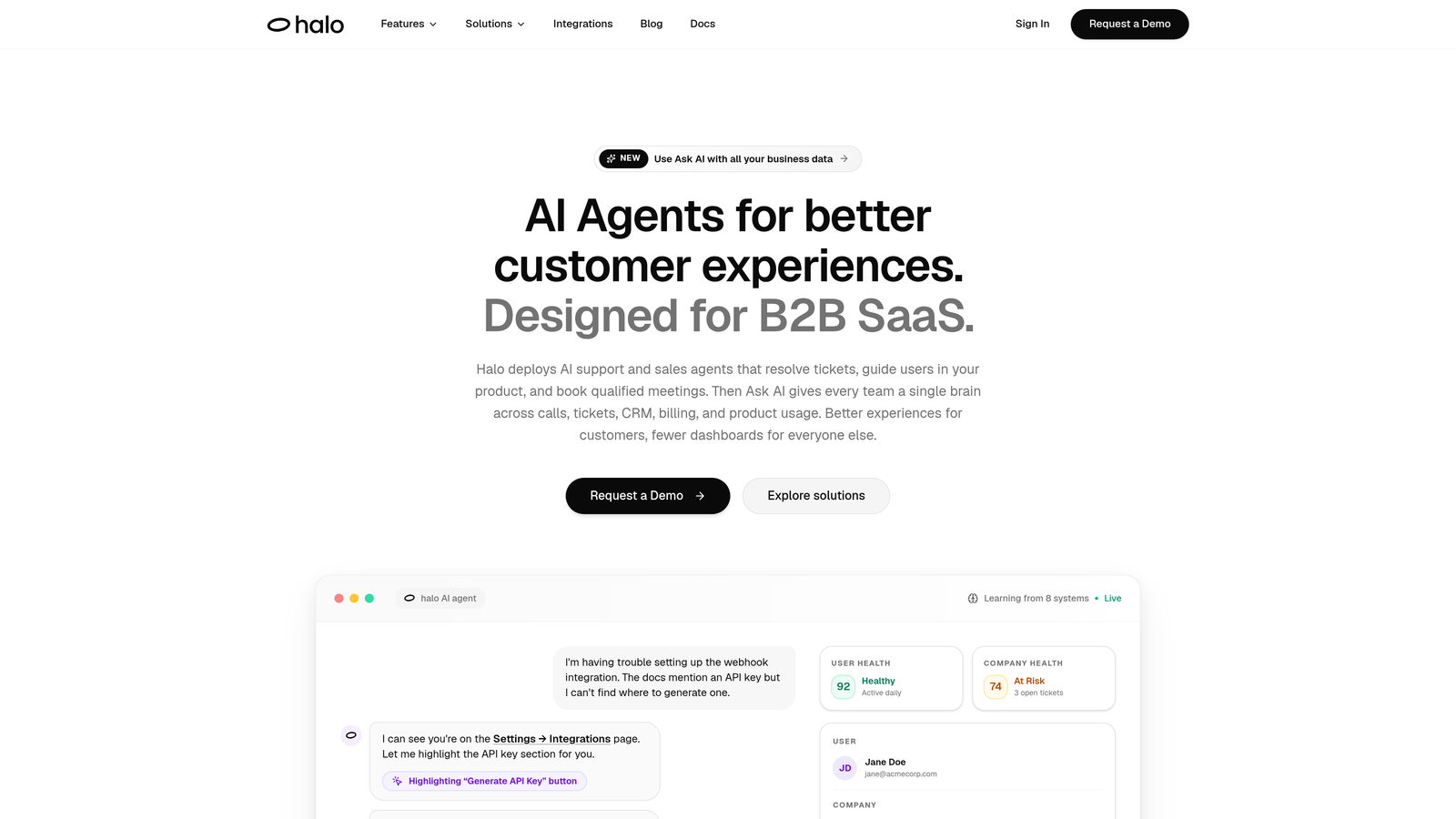
Halo AI is an AI-native customer support platform built specifically for SaaS, deploying intelligent agents that resolve tickets, guide users through your product, and surface business intelligence from every interaction.
Where This Tool Shines
What separates Halo from most competitors is the architecture. Rather than bolting AI onto a legacy helpdesk, Halo is built AI-first from the ground up. That means every feature, from ticket resolution to user guidance, is designed around intelligent automation rather than retrofitted into an existing workflow.
The page-aware chat widget is a standout capability. It sees what your users see inside the product and can provide visual UI guidance in context, which is a meaningful leap over keyword-matching chatbots that have no idea where a user is or what they're looking at. Combined with continuous learning from every interaction, the system gets measurably better over time rather than staying static.
Key Features
Page-Aware Chat Widget: Understands the user's current product context and delivers visual UI guidance specific to where they are in your application.
Continuous Learning: Every resolved interaction feeds back into the model, improving resolution quality and accuracy over time without manual retraining.
Auto Bug Ticket Creation: Automatically detects and routes product issues to engineering via Linear and Slack, closing the loop between support and development.
Smart Inbox with Business Intelligence: Goes beyond ticket management to surface customer health signals, revenue intelligence, and anomaly detection from support data.
Live Agent Handoff: Escalates complex issues to human agents with full conversation context preserved, so nothing gets repeated or lost in the transition.
Best For
SaaS product teams and B2B companies that want more than ticket deflection. Halo is particularly well-suited for teams where support data should inform product decisions, and where understanding user context inside the product is critical to delivering quality help.
Pricing
Contact for pricing. Plans are scaled for startups through enterprise, making it accessible at different stages of growth.
2. Intercom Fin
Best for: Teams already running Intercom who want native AI resolution without switching platforms
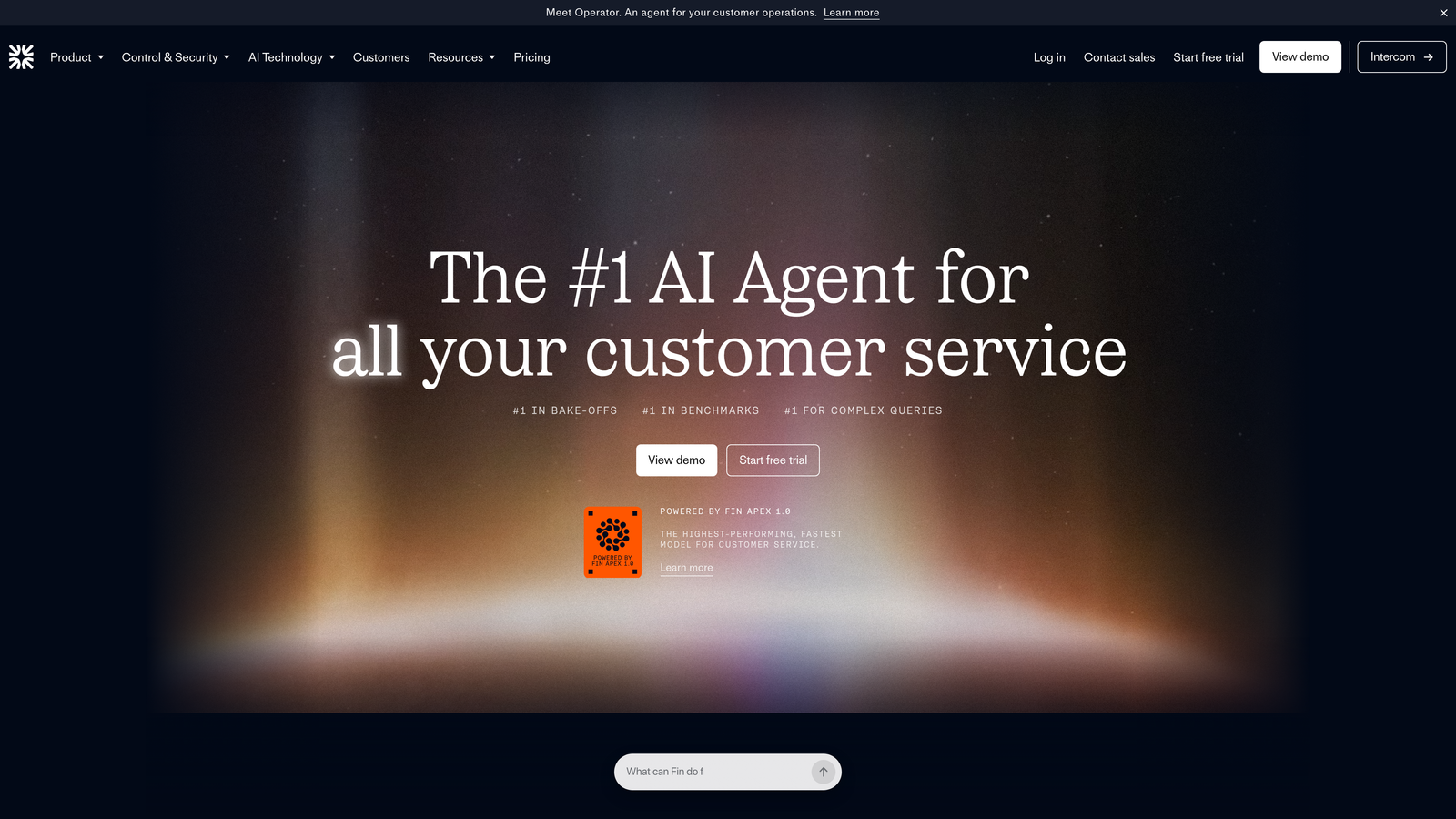
Intercom Fin is Intercom's native AI agent that resolves support queries using your existing help center content, conversation history, and custom data sources.
Where This Tool Shines
If your team is already invested in the Intercom ecosystem, Fin is the path of least resistance. It trains on your existing help center articles and past conversations, which means you're not starting from scratch. The multi-turn dialogue capability means it can handle more nuanced queries rather than just matching keywords to articles.
The seamless handoff to human agents within the same Intercom inbox is genuinely smooth. Agents get full context, and customers don't feel like they're starting over. For teams that have spent years building out their Intercom setup, Fin makes that investment work harder.
Key Features
Content Training: Trains on your Intercom help center, past conversations, and custom content sources for contextually relevant responses.
Multi-Turn Dialogue: Handles conversational back-and-forth rather than single-query resolution, supporting more complex support interactions.
Brand Voice Customization: Adjustable tone and persona settings to keep AI responses consistent with your brand.
Resolution Reporting: Built-in dashboards tracking resolution rates and AI performance metrics.
Native Inbox Handoff: Escalates to human agents within the Intercom inbox with full conversation context intact.
Best For
Companies with an established Intercom presence looking to extend their existing setup with AI resolution. Less compelling for teams not already using Intercom, since the value is closely tied to the ecosystem.
Pricing
Charged per resolution, which can add up at scale. Requires an active Intercom subscription as the foundation.
3. Zendesk AI
Best for: Enterprise support teams needing AI across a complex, multi-channel ticket operation
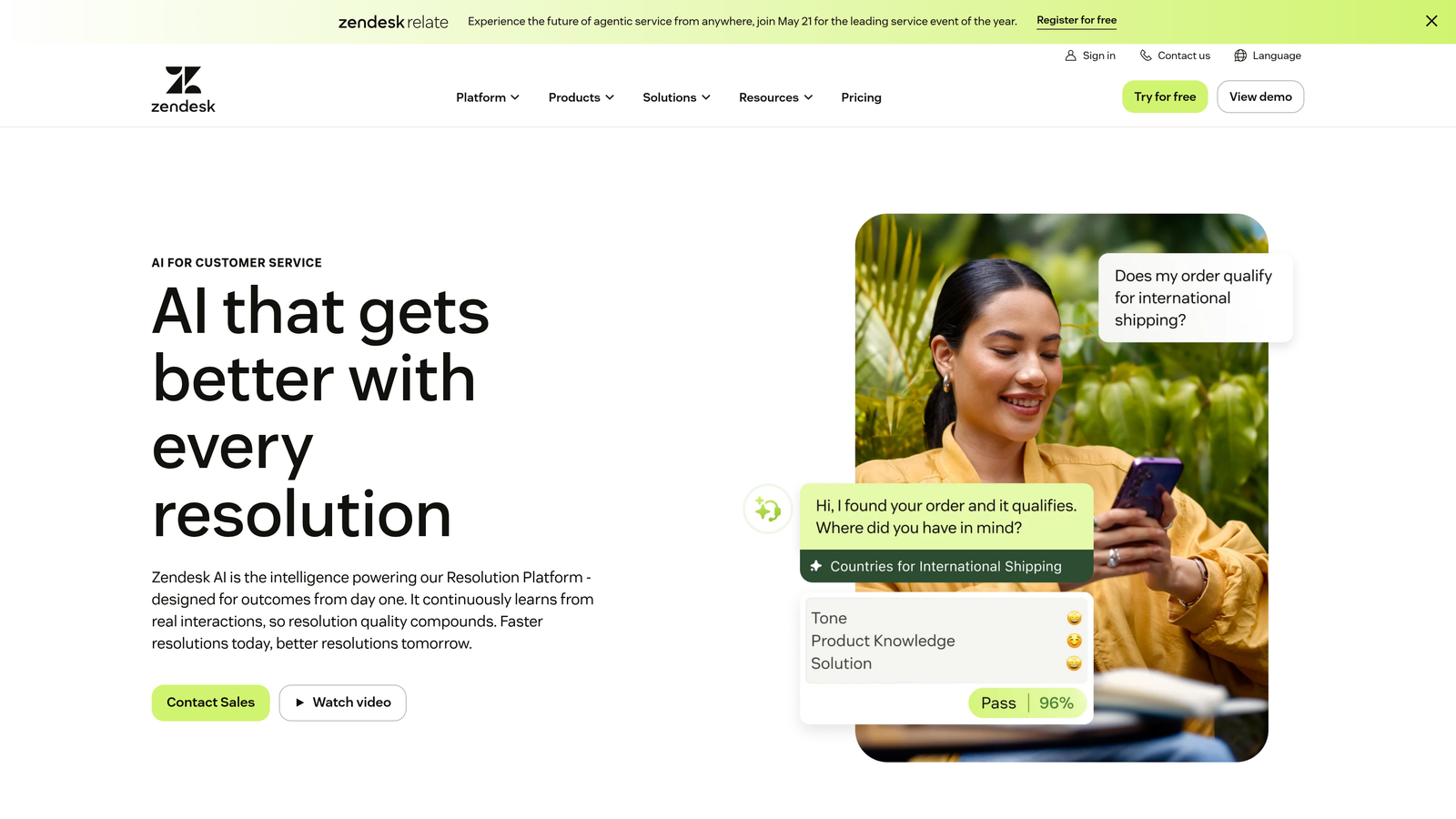
Zendesk AI is an enterprise-grade AI layer built into Zendesk's support suite, offering intelligent triage, AI agents, and agent assist tools trained on a large dataset of customer service interactions.
Where This Tool Shines
Zendesk AI benefits from the platform's massive scale. Its models are pre-trained on a substantial volume of customer service interactions, which gives it reasonable out-of-the-box accuracy without extensive customization. For enterprise teams managing high ticket volumes across email, chat, and social channels, the intent detection and intelligent routing capabilities handle complexity that smaller tools can't match.
The agent assist functionality is particularly useful for large teams: suggested replies and real-time knowledge base recommendations help human agents work faster without requiring them to search manually for answers.
Key Features
Intent Detection and Routing: Automatically categorizes and routes tickets across email, chat, and social based on detected intent.
Autonomous AI Agents: Resolves common queries without human involvement across multiple channels.
Agent Assist: Surfaces suggested replies and relevant knowledge base articles to human agents in real time.
Pre-Trained Models: Out-of-the-box accuracy from training on a broad dataset of customer service interactions.
AI Performance Dashboards: Advanced analytics tracking AI resolution rates, deflection, and agent productivity.
Best For
Enterprise SaaS companies with complex, multi-channel support operations already running on Zendesk. The AI layer adds meaningful value to existing Zendesk investments but comes with enterprise-level pricing to match.
Pricing
AI features included in Suite plans starting around $55 per agent per month; advanced AI capabilities available as a paid add-on.
4. Ada
Best for: High-volume, multilingual SaaS support requiring action-based resolution
Ada is an AI-powered customer service automation platform built for high-volume, multilingual support with a focus on actual resolution rather than deflection.
Where This Tool Shines
Ada's defining characteristic is its emphasis on taking real actions, not just providing answers. The platform connects to backend systems to execute tasks like processing refunds or making account changes, which is the difference between an AI that tells a user how to do something and one that actually does it for them.
The multilingual capability across 50-plus languages is genuinely strong, making Ada a practical choice for SaaS companies with global user bases who don't want to build separate support flows for each region.
Key Features
No-Code AI Agent Builder: Lets non-technical teams create resolution workflows without engineering involvement.
Multilingual Support: Handles customer interactions across 50-plus languages out of the box.
Action-Based Resolution: Connects to backend systems to execute real actions like refunds and account updates, not just provide instructions.
Helpdesk Integrations: Connects with Zendesk, Salesforce, and other major support platforms.
Containment Analytics: Detailed reporting on resolution rates and containment to measure actual AI impact.
Best For
SaaS companies with large international user bases or high-volume tier-1 ticket loads where action-based automation can meaningfully reduce human workload.
Pricing
Custom pricing based on resolution volume. Contact sales for specific quotes, as pricing scales with usage.
5. Freshdesk Freddy AI
Best for: Budget-conscious SaaS teams wanting AI support without premium pricing
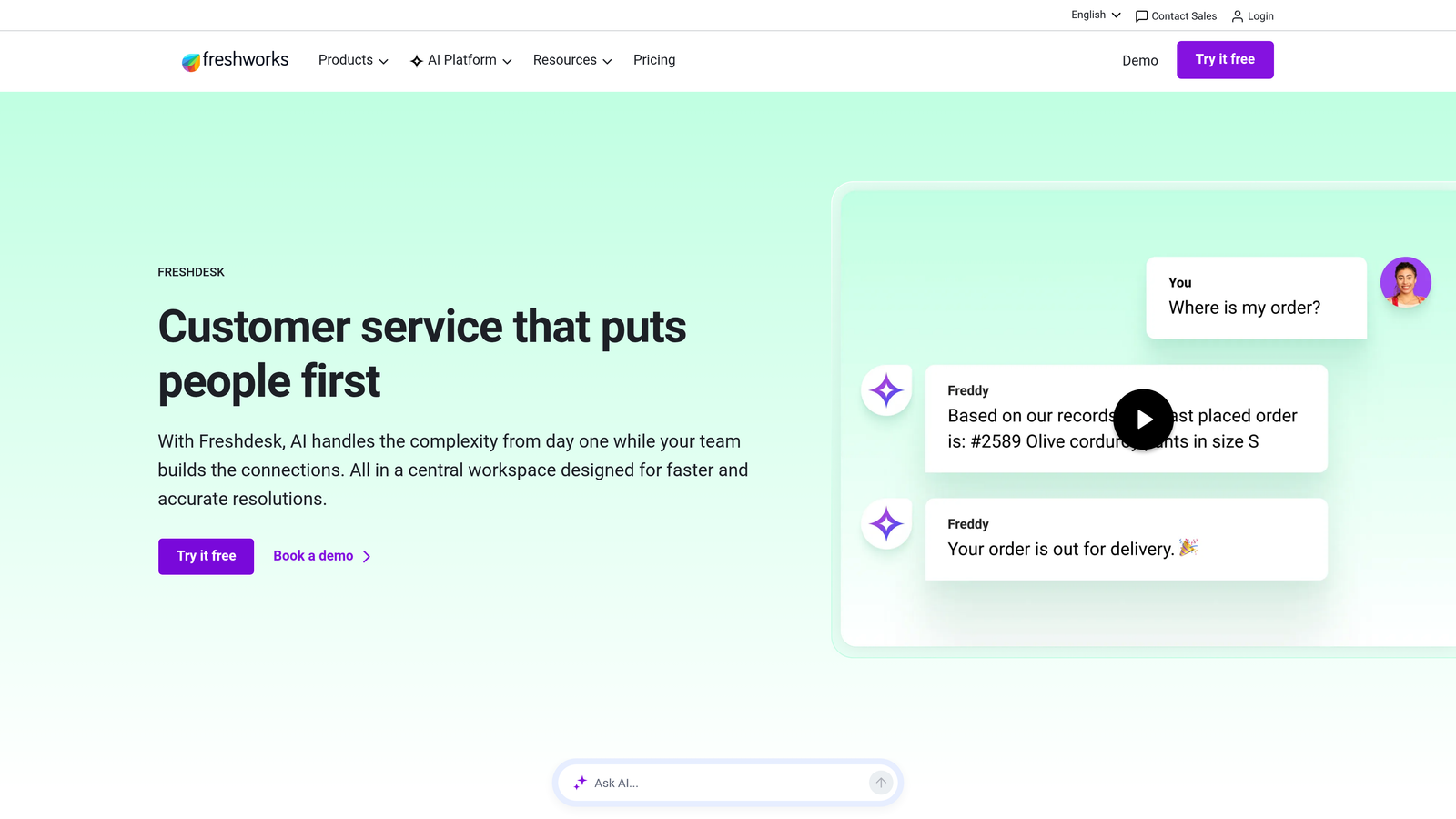
Freshdesk Freddy AI is Freshworks' AI assistant built into Freshdesk, providing auto-triage, AI-powered responses, and agent productivity tools at accessible price points.
Where This Tool Shines
Freddy AI's biggest advantage is value for money. AI features are available on mid-tier plans rather than locked behind enterprise add-ons, which makes it a realistic option for growing SaaS companies that want meaningful automation without committing to premium pricing.
The integration with Freshworks' broader suite, including their CRM and ITSM products, is useful for teams that want a unified platform rather than stitching together multiple tools. If your team is already in the Freshworks ecosystem, Freddy AI extends that investment naturally.
Key Features
Auto-Triage: Automatically categorizes and prioritizes incoming tickets using AI, reducing manual sorting workload.
Freddy AI Agent: Customer-facing resolution via chat and email for common queries.
Agent Assist: Canned response suggestions and knowledge base surfacing for human agents handling complex tickets.
Suite Integration: Built into Freshworks' broader platform including CRM and ITSM tools.
Accessible Pricing: AI features available on mid-tier plans, not reserved for enterprise tiers.
Best For
Early-stage to mid-size SaaS companies that need solid AI support capabilities without enterprise-level budgets, especially those already using or considering the Freshworks suite.
Pricing
Free tier available. AI features on Pro plan starting around $49 per agent per month, making it one of the more competitively priced options on this list.
6. Tidio
Best for: Startups and small SaaS teams wanting fast deployment with minimal technical overhead
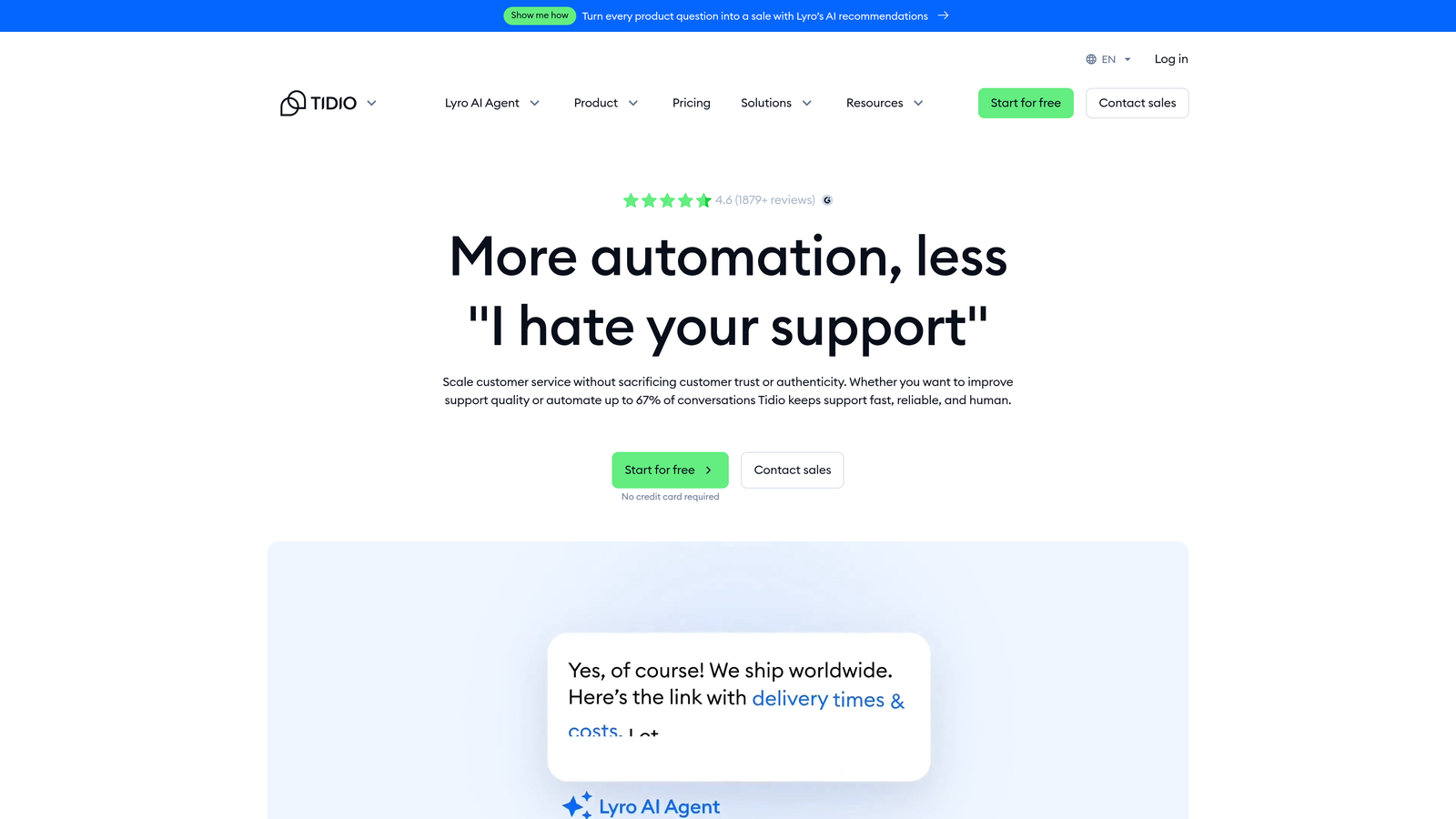
Tidio is a conversational AI platform combining its Lyro AI chatbot with live chat and a visual chatbot flow builder, designed for quick deployment with minimal technical setup.
Where This Tool Shines
Tidio's strength is speed to value. The platform can be operational in minutes without developer involvement, which is genuinely useful for small teams that need support automation without an engineering sprint to get there. Lyro AI trains on your existing content and handles conversational queries without requiring extensive configuration.
The combination of AI chatbot, live chat, and visual flow builder in a single widget keeps the toolstack simple. For early-stage SaaS companies that don't need enterprise complexity, this simplicity is a feature rather than a limitation.
Key Features
Lyro AI Chatbot: Trains on your content and resolves queries conversationally, handling common questions without human intervention.
Visual Flow Builder: Drag-and-drop interface for building custom chatbot automation sequences without code.
Unified Widget: Combines AI chatbot and live chat in a single embeddable widget.
Fast Setup: Operational in minutes without developer involvement.
Common Integrations: Connects with Shopify, WordPress, and a range of SaaS tools.
Best For
Startups and small SaaS teams that need to get support automation running quickly without technical resources. Less suited for complex enterprise workflows or teams needing deep product integrations.
Pricing
Free plan available. Lyro AI starts at $39 per month for 50 conversations, with pricing scaling based on conversation volume.
7. Forethought
Best for: Teams wanting AI capabilities without replacing their existing helpdesk
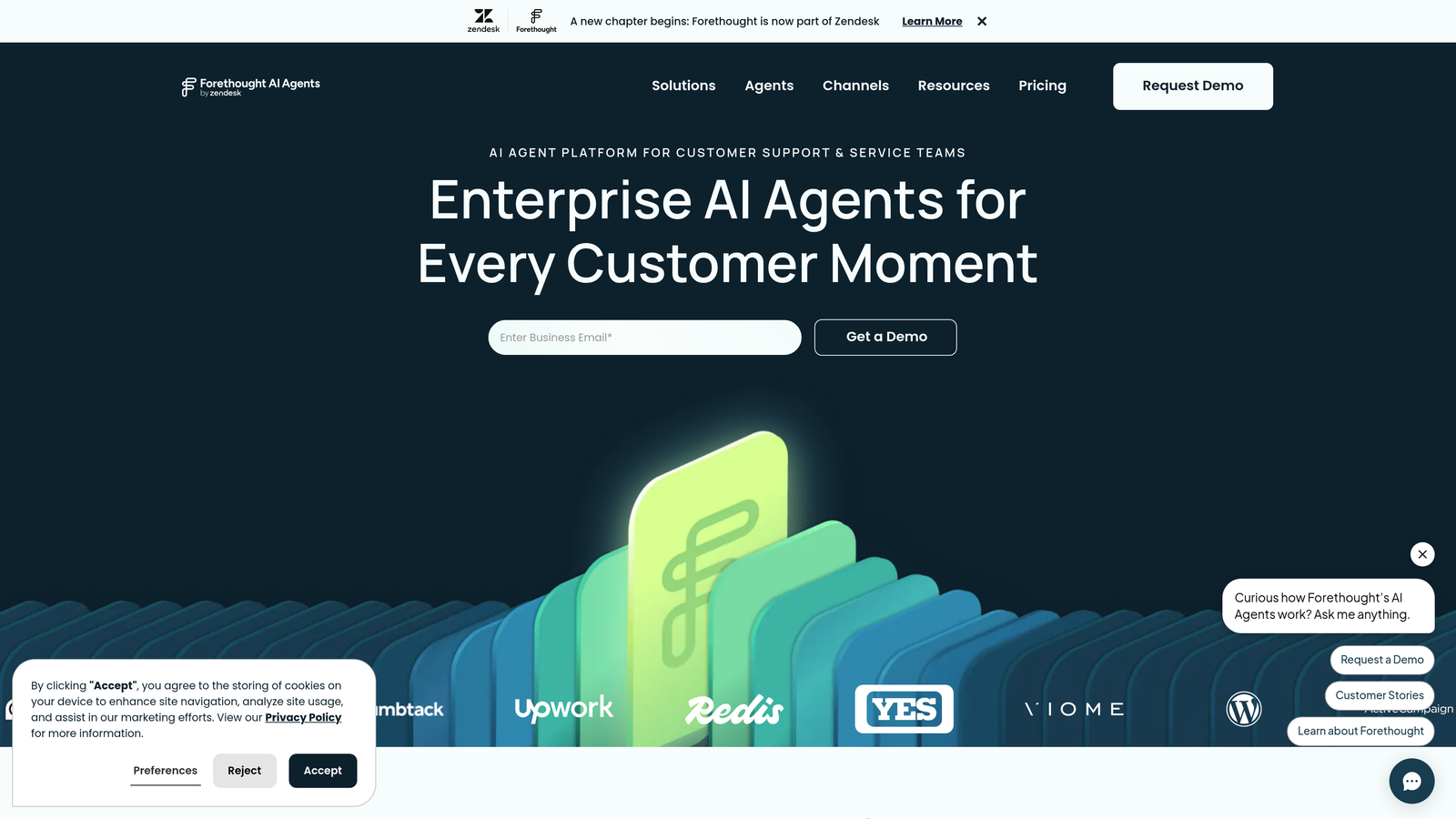
Forethought is an AI platform that layers on top of existing helpdesks to provide intelligent triage, autonomous ticket resolution, and real-time agent assist without replacing your current tools.
Where This Tool Shines
Forethought's overlay architecture is its defining feature. Rather than asking you to migrate away from Zendesk or Salesforce, it sits on top of your existing setup and makes it smarter. This is a meaningful advantage for teams with significant helpdesk investments they're not ready to abandon.
The three-module approach, covering autonomous resolution, intelligent triage, and agent assist, lets teams adopt the pieces that deliver the most immediate value rather than committing to a full platform replacement.
Key Features
Overlay Architecture: Works on top of Zendesk, Salesforce, and other helpdesks without requiring migration.
Solve AI: Autonomous ticket resolution via email and chat for common queries.
Triage AI: Categorizes, routes, and prioritizes tickets intelligently based on content and context.
Assist AI: Surfaces relevant knowledge for human agents in real time during active conversations.
Enterprise Security: Enterprise-grade security and compliance certifications for regulated industries.
Best For
Mid-market and enterprise SaaS teams with established helpdesk setups who want AI capabilities without a platform migration. Particularly strong for organizations with compliance requirements.
Pricing
Custom pricing based on ticket volume and modules selected. Contact Forethought directly for quotes tailored to your support operation.
8. Drift (Salesloft)
Best for: SaaS companies where support interactions should connect to revenue and expansion opportunities
Drift, now part of Salesloft, is a conversational AI platform that blends customer support with revenue intelligence, making it relevant for SaaS companies where support conversations signal sales opportunities.
Where This Tool Shines
Drift occupies a unique position on this list because it explicitly bridges support and revenue. For product-led growth SaaS companies, where users often upgrade based on hitting feature limits or experiencing pain points, support interactions are frequently expansion signals. Drift is built to recognize and act on those signals.
The intelligent routing between support and sales based on intent is a capability most pure-play support tools don't offer. If a user is asking about a feature that's only available on a higher plan, Drift can route that conversation appropriately rather than just resolving it as a support ticket.
Key Features
Revenue-Aware AI: Handles support queries while identifying sales-ready visitors based on behavioral signals.
Intent-Based Routing: Routes conversations between support and sales based on detected intent, not just ticket type.
CRM Integration: Connects with CRMs and revenue tools for unified customer context across support and sales.
PLG Playbooks: Pre-built workflows designed for product-led growth support-to-expansion scenarios.
Revenue Analytics: Dashboards connecting support interactions to pipeline and revenue outcomes.
Best For
Mid-market and enterprise SaaS companies with a product-led growth motion, where support conversations frequently represent expansion or upsell opportunities worth capturing.
Pricing
Custom pricing, typically positioned for mid-market and enterprise. Contact Salesloft for specific quotes.
9. Kastro
Best for: SaaS teams wanting a lightweight, purpose-built AI support widget with straightforward pricing
Kastro is a lightweight, AI-native support widget purpose-built for SaaS products, offering AI chat trained on your documentation with clean human handoff capabilities.
Where This Tool Shines
Kastro's appeal is focused simplicity. It's designed specifically for SaaS products rather than trying to be everything to everyone, and that focus shows in the clean implementation. The embeddable widget fits naturally into product interfaces without feeling like a generic support bolt-on.
For teams that don't need enterprise complexity, Kastro offers a refreshingly straightforward path: train it on your docs, embed the widget, and get useful AI support running without a lengthy implementation process.
Key Features
Documentation Training: AI chatbot trained on your docs, help center, and custom content for accurate, product-specific responses.
SaaS-Native Widget: Clean, embeddable widget designed specifically for SaaS product interfaces.
Smart Human Handoff: Recognizes when AI has reached its limits and escalates to human agents smoothly.
Conversation Analytics: Insights into common questions and conversation patterns to inform product and documentation improvements.
Straightforward Pricing: Transparent, usage-based pricing without enterprise sales complexity.
Best For
Small to mid-size SaaS teams that want a purpose-built, easy-to-implement AI support widget without the overhead of a full platform. Ideal when simplicity and speed of setup outweigh the need for advanced automation.
Pricing
Starts at $35 per month, scaling based on usage and features. One of the more accessible price points on this list for early-stage teams.
Which Tool Is Right for Your SaaS Team?
The right choice depends heavily on where your team is today and what problem you're actually trying to solve. Here's a quick breakdown to help you decide.
Best overall for SaaS: Halo AI. The AI-first architecture, page-aware context, and business intelligence layer make it the most purpose-built option for SaaS support teams that want more than ticket deflection.
Best for existing Intercom users: Intercom Fin. If you're already invested in the Intercom ecosystem, Fin extends that investment with minimal friction.
Best for enterprise: Zendesk AI. For large teams managing complex, multi-channel operations at scale, Zendesk's AI layer brings meaningful automation to an already robust platform.
Best for multilingual scale: Ada. Fifty-plus languages with action-based resolution makes Ada the standout choice for global SaaS companies with high-volume tier-1 tickets.
Best budget option: Freshdesk Freddy AI. Solid AI capabilities at mid-tier pricing, especially valuable for teams already in the Freshworks ecosystem.
Best for startups: Tidio. Fast setup, no developer required, and a free plan to start. Hard to beat for early-stage teams that need something running today.
Best overlay for existing helpdesks: Forethought. If migration isn't on the table, Forethought makes your current helpdesk significantly smarter without replacing it.
Best for PLG support-to-sales: Drift. For product-led growth companies where support conversations are revenue signals, Drift's intent-based routing is in a category of its own.
Best lightweight option: Kastro. Purpose-built simplicity for SaaS teams that want clean, focused AI support without enterprise overhead.
Your support team shouldn't scale linearly with your customer base. The best AI support tools handle routine tickets autonomously, guide users through your product in context, and surface intelligence that makes your whole business smarter. See Halo in action and discover how continuous learning transforms every interaction into faster, smarter support that gets better over time.