9 Best AI Support Agent Software Tools in 2026
This guide evaluates the 9 best AI support agent software platforms of 2026, covering both AI-first tools built for autonomous ticket resolution and AI-enhanced legacy helpdesks. B2B teams will find a clear breakdown of each platform's architecture, learning capabilities, integration depth, and pricing to make a confident buying decision.
 Matt PattoliFounder13 min read
Customer support has changed. The old model, where a team of agents manually triaged every incoming ticket, is giving way to something fundamentally different: AI agents that resolve issues autonomously, learn from every interaction, and surface business intelligence your team never had before.
For B2B teams evaluating these platforms, the choice isn't just about features. It's about architecture. There's now a meaningful split between AI-first platforms built from the ground up around autonomous agents, and legacy helpdesks that have layered AI onto existing ticketing infrastructure. Both have a place, but they serve different needs.
To build this list, we evaluated tools across six criteria: degree of autonomous ticket resolution, continuous learning capability, integration depth with common B2B stacks, quality of human escalation handling, pricing transparency, and fit for different company sizes. The result covers both purpose-built AI-first platforms and AI-enhanced helpdesks, so you can find the right fit regardless of where you're starting from.
1. Halo AI
Best for: B2B SaaS teams wanting AI-first autonomous support that learns and scales without adding headcount.
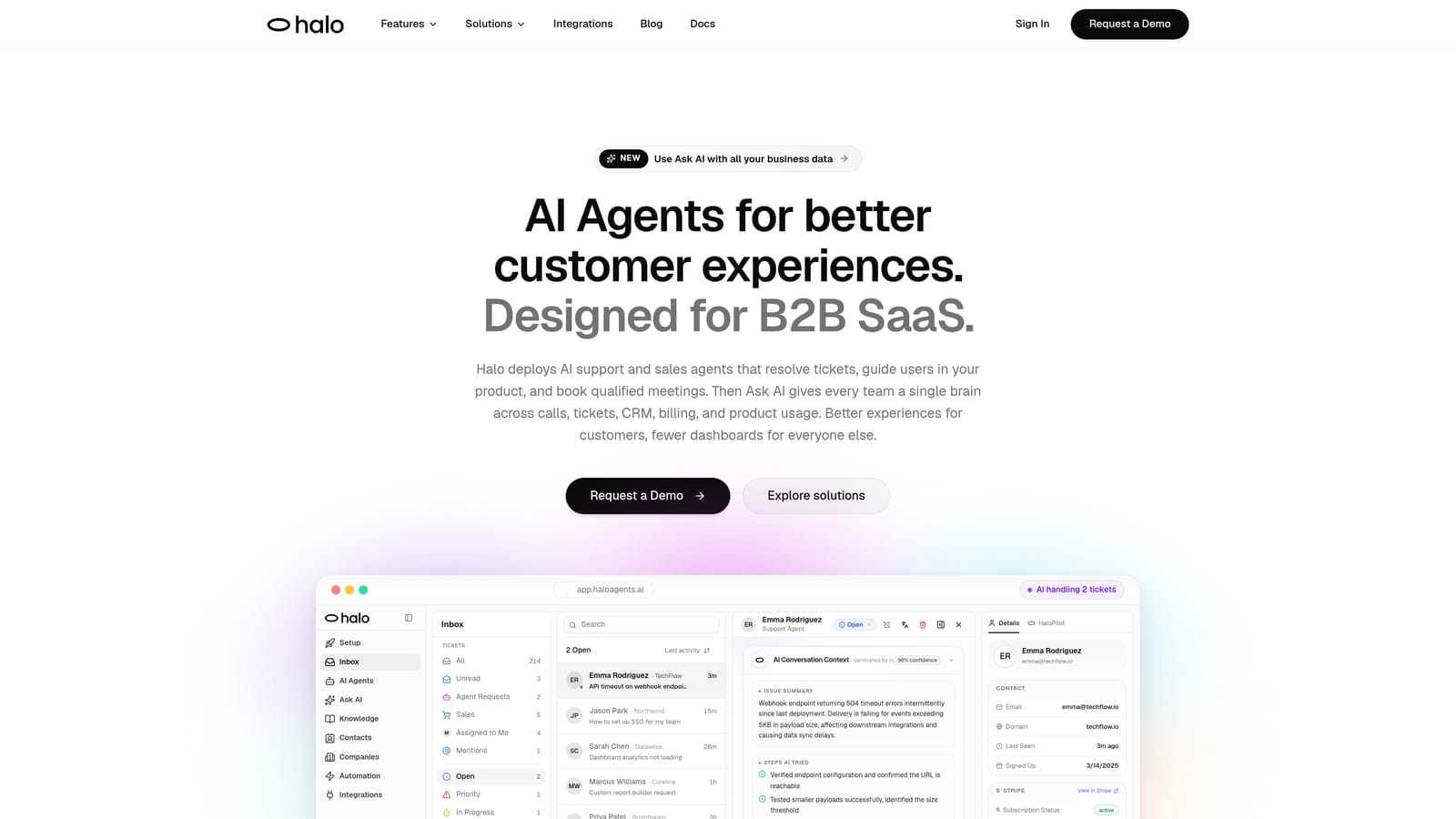
Halo AI is an AI-first customer support platform that deploys autonomous agents to resolve tickets, guide users through your product with real-time page context, and surface business intelligence across your entire support operation.
Where This Tool Shines
Most AI support tools are built on top of existing helpdesk infrastructure. Halo was designed from scratch around autonomous agents, which means the AI isn't a feature bolted onto a ticketing system. It's the foundation. This distinction matters when you're evaluating how deeply the AI can actually learn and act, rather than just suggest.
The page-aware chat widget is one of Halo's most distinctive capabilities. Instead of serving generic responses, it understands what the user is looking at in your product at that exact moment. That context changes everything: guidance becomes specific, resolution becomes faster, and users don't have to explain their situation from scratch.
Key Features
Page-Aware Chat Widget: Sees what the user sees inside your product, enabling contextually accurate guidance rather than generic FAQ responses.
Autonomous Ticket Resolution: AI agents handle and close tickets independently, with continuous learning from every resolved interaction to improve over time.
Auto Bug Ticket Creation: Automatically identifies and routes bug reports directly to Linear or connected project management tools, closing the loop between support and engineering.
Smart Inbox with Business Intelligence: Goes beyond ticket management to surface customer health signals, anomaly detection, and revenue intelligence that would otherwise stay buried in support data.
Deep Integrations: Connects natively with Linear, Slack, HubSpot, Intercom, Stripe, Zoom, PandaDoc, and Fathom, so your support operation talks to your entire business stack.
Intelligent Live Agent Handoff: Escalates to human agents smoothly when issues require judgment, with full conversation context preserved.
Best For
B2B SaaS companies that want to scale support without scaling headcount. Particularly well-suited for product teams that need their support layer to connect directly to engineering workflows, and for growth-stage companies that want business intelligence built into their support operation from day one.
Pricing
Visit haloagents.ai for current plan pricing. Plans are designed to scale with your support volume rather than your agent headcount.
2. Intercom
Best for: Mid-market SaaS teams wanting mature conversational support with strong autonomous resolution across channels.
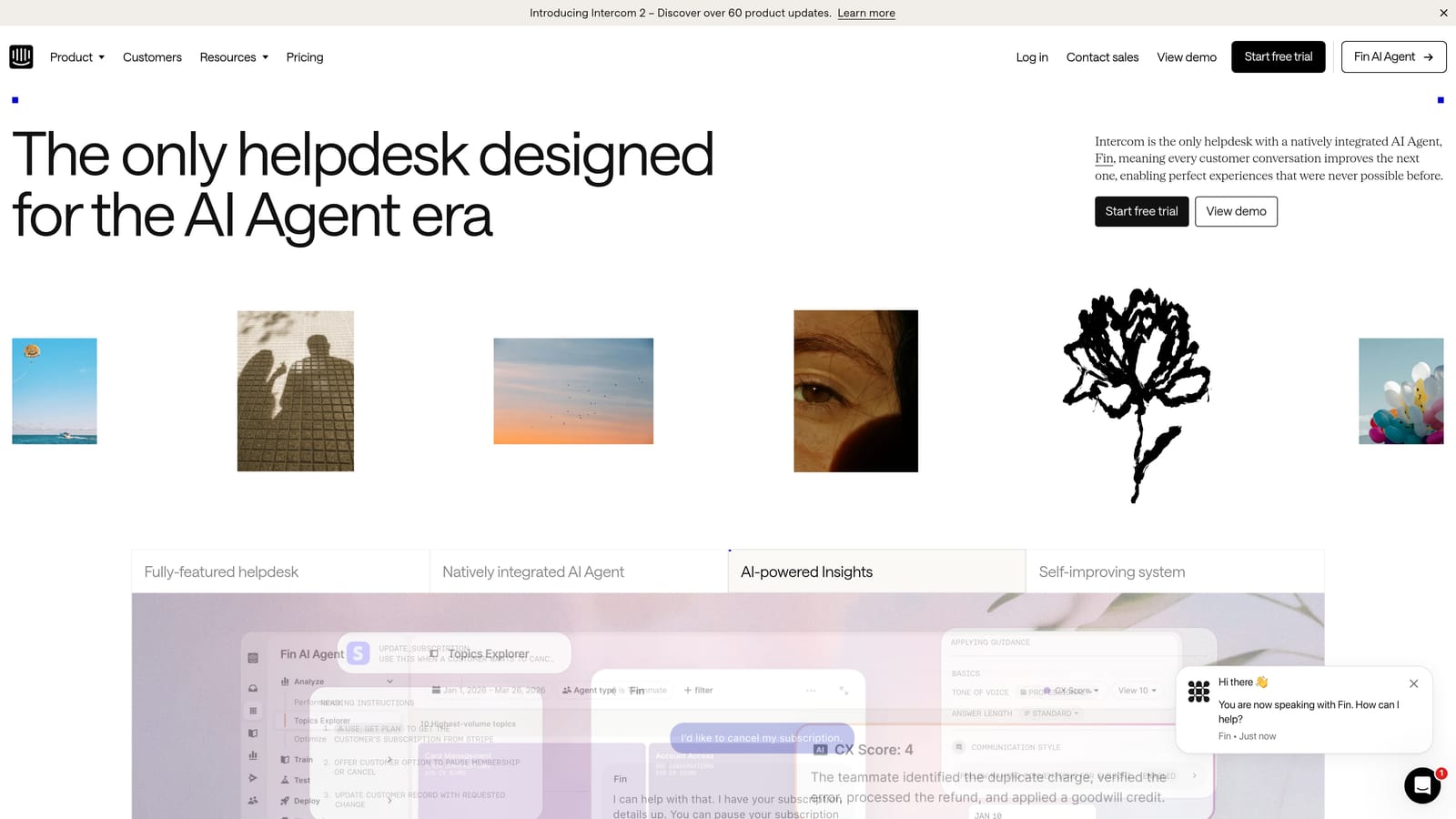
Intercom is a well-established conversational support platform whose Fin AI agent handles autonomous ticket resolution across chat, email, and messaging channels.
Where This Tool Shines
Intercom has been building toward AI-powered support for years, and Fin is the product of that investment. It handles high-volume, FAQ-style queries well, and its resolution rates on common support topics are genuinely strong. If your team is already using Intercom for customer messaging, adding Fin is a relatively low-friction upgrade.
The unified inbox is another strength. Conversations from chat, email, and social channels land in one place, and the AI Copilot helps human agents respond faster with suggested replies and conversation summaries. It's a cohesive experience for teams managing mixed support volume.
Key Features
Fin AI Agent: Handles autonomous ticket resolution across chat, email, and messaging without human involvement for common queries.
Unified Inbox: Consolidates conversations from multiple channels into a single workspace for agent efficiency.
AI Copilot: Assists human agents with suggested responses, conversation summaries, and next-step guidance.
Reporting and CSAT Tracking: Built-in analytics for tracking resolution rates, customer satisfaction, and team performance.
App Marketplace: Large ecosystem of third-party integrations and API access for custom workflows.
Best For
Mid-market SaaS companies already invested in the Intercom ecosystem, or teams that need strong omnichannel coverage with a polished agent experience. Less ideal for teams on tight budgets, as Fin's resolution fees add up at scale.
Pricing
Starts at approximately $39 per seat per month; Fin AI resolution fees apply separately. Check intercom.com for current pricing details.
3. Zendesk AI
Best for: Enterprise teams with complex support operations already built on Zendesk's ticketing infrastructure.
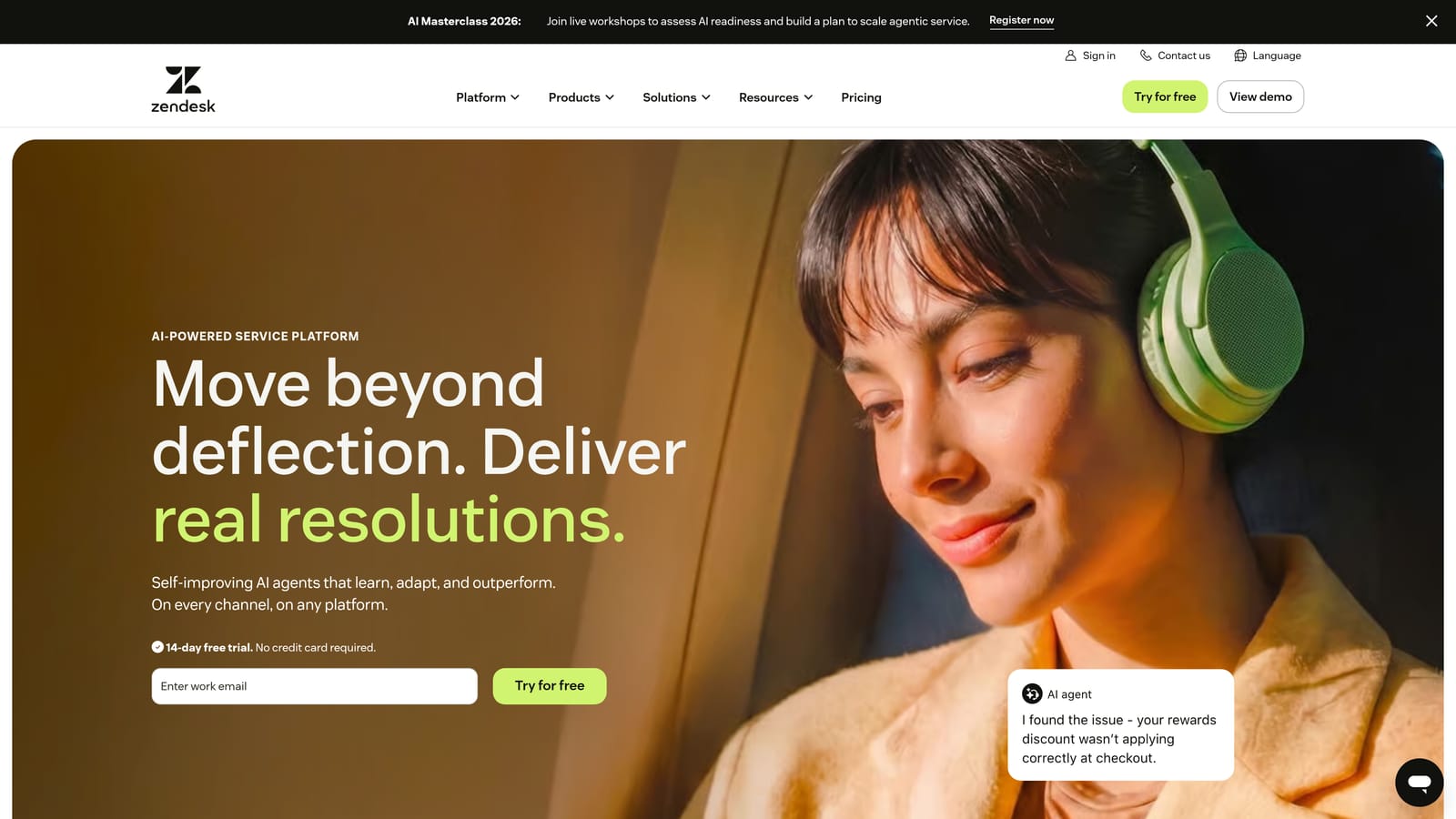
Zendesk AI is an enterprise-grade helpdesk platform with AI triage, agent copilot, and workflow automation layered onto its established ticketing system.
Where This Tool Shines
Zendesk's strength is its maturity. The platform handles complex enterprise support operations with deep compliance capabilities, robust reporting, and a marketplace of over 1,000 integrations. For teams that have built years of workflows and data inside Zendesk, the AI layer adds meaningful efficiency without requiring a platform migration.
The Agent Copilot is particularly useful for teams handling nuanced tickets. It surfaces suggested responses and next-best-action guidance in real time, which helps newer agents perform closer to senior-level quality. The AI is more augmentative than fully autonomous in most configurations, which suits enterprise teams that prefer human oversight on complex cases.
Key Features
Intelligent Triage: AI-powered routing based on ticket intent, priority, and agent skill, reducing manual sorting overhead.
Agent Copilot: Provides suggested responses and next-best-action guidance to human agents during live interactions.
Automated Workflows: Macros and automation rules handle repetitive ticket types without agent involvement.
App Marketplace: Access to 1,000+ third-party integrations covering CRM, billing, project management, and more.
Enterprise Compliance: Security certifications, data residency options, and reporting capabilities designed for regulated industries.
Best For
Large enterprise teams with complex support operations, compliance requirements, and existing Zendesk infrastructure. The AI features deliver the most value when you're already deeply embedded in the Zendesk ecosystem.
Pricing
Suite plans start at approximately $55 per agent per month; advanced AI features are available on higher tiers. Check zendesk.com for current pricing.
4. Freshdesk Freddy AI
Best for: SMBs wanting affordable AI-enhanced support without leaving the Freshworks ecosystem.
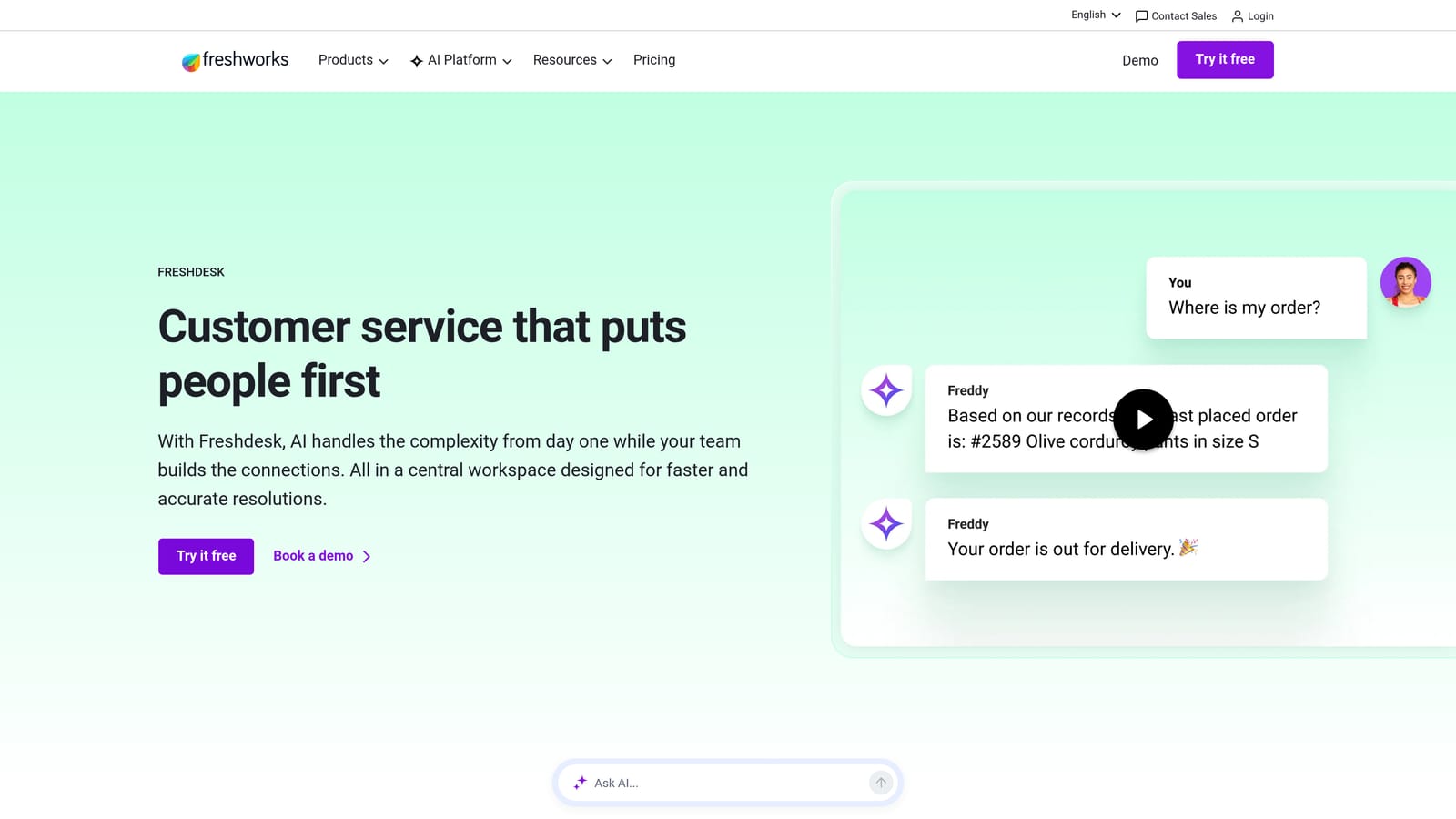
Freshdesk embeds Freddy AI across its support suite, offering predictive triage, sentiment detection, and response suggestions at pricing that's accessible for smaller teams.
Where This Tool Shines
Freshdesk's biggest advantage is its price-to-capability ratio. Teams that need AI-assisted support without enterprise-level budgets will find Freddy genuinely useful for reducing manual triage work, catching at-risk conversations early through sentiment analysis, and speeding up agent responses with intelligent suggestions.
Freddy also benefits from working across the broader Freshworks ecosystem, including Freshchat and Freshsales. If your team uses multiple Freshworks products, the AI layer connects them in ways that create a more unified customer view. Outside of Freshworks, however, the integration story is thinner.
Key Features
Predictive Triage: Freddy AI auto-tags and routes tickets based on content, reducing manual classification effort.
Suggested Responses: Recommends canned replies and response drafts to speed up agent handling time.
Sentiment Analysis: Flags conversations where customer frustration is escalating, allowing proactive intervention.
Freddy Self Service: Enables teams to build AI-powered chatbots for common support scenarios without engineering help.
Freshworks Ecosystem Integration: Works natively with Freshchat, Freshsales, and other Freshworks products for a connected experience.
Best For
SMBs and growing teams that want AI-assisted support at accessible pricing, especially those already using or considering the broader Freshworks product suite.
Pricing
Free plan available; paid plans start at approximately $15 per agent per month. Check freshdesk.com for current pricing and Freddy AI add-on details.
5. Tidio
Best for: E-commerce merchants and small businesses needing fast, low-overhead AI chat deployment.
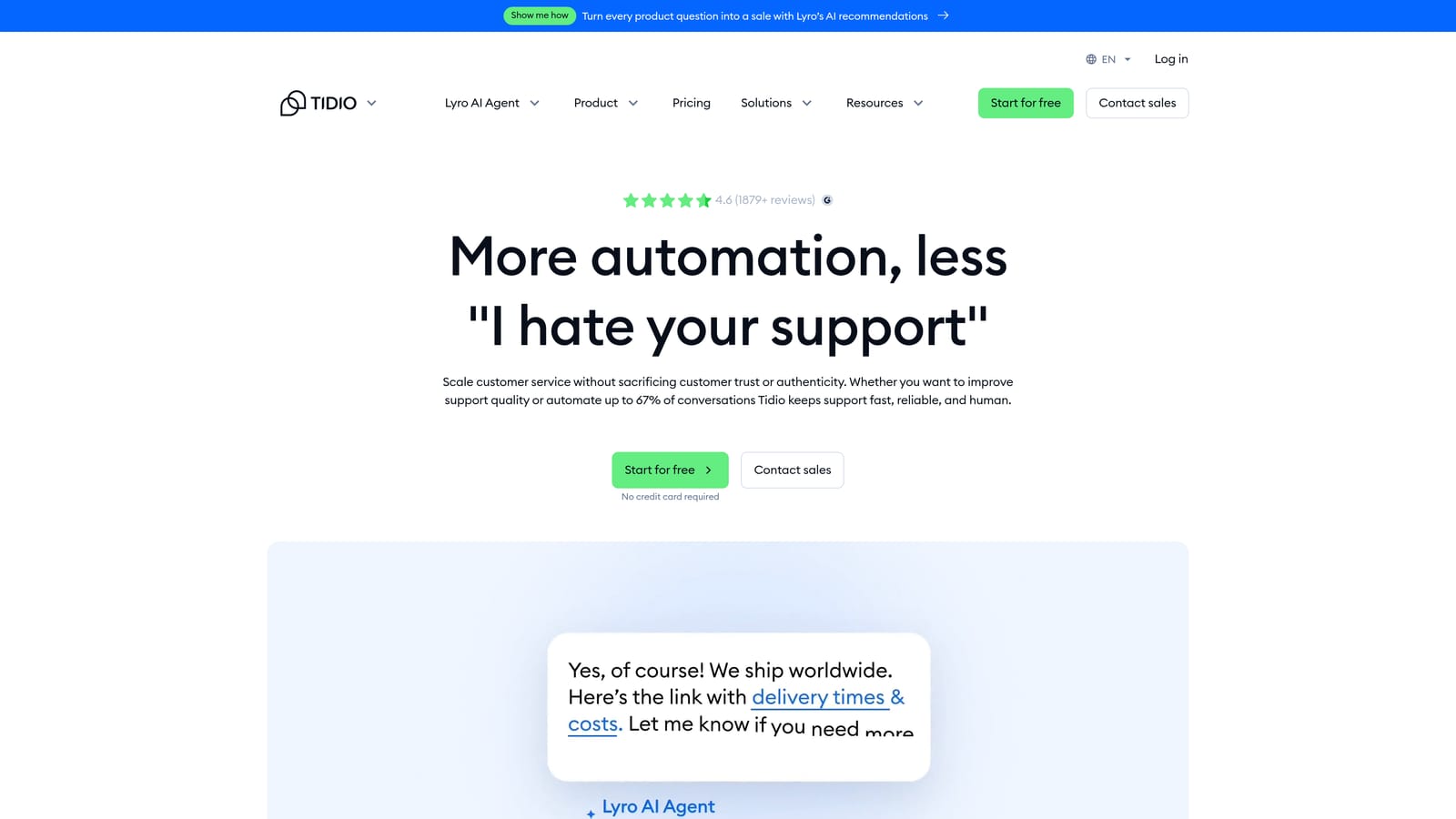
Tidio is a lightweight AI support tool featuring the Lyro AI chatbot, designed for rapid deployment without technical complexity.
Where This Tool Shines
Tidio's core value proposition is speed to value. Teams can get Lyro handling common support queries within hours, not weeks. The native Shopify and WooCommerce integrations make it particularly attractive for e-commerce teams that need AI support without a dedicated technical team to configure it.
The visual chatbot flow builder is accessible enough for non-technical users to customize without writing a single line of code. For simple support scenarios like order status, return policies, and product FAQs, Lyro handles the load well. It's less suited for the kind of complex, multi-step B2B support workflows that require deeper integrations.
Key Features
Lyro AI Chatbot: Autonomously handles common support queries using your existing content without manual training for each scenario.
E-Commerce Integrations: Native connections to Shopify and WooCommerce for order and product context in conversations.
Live Chat Fallback: Smooth handoff to human agents when Lyro reaches the limits of its resolution capability.
Visual Flow Builder: Drag-and-drop chatbot customization for non-technical users who want to control conversation paths.
Free Tier: Available with usage limits, making it accessible for teams testing AI support before committing to paid plans.
Best For
E-commerce merchants, small businesses, and early-stage teams that need AI chat support deployed quickly and affordably. Not the right fit for complex B2B SaaS support with deep integration requirements.
Pricing
Free plan available; Lyro AI plans start at approximately $29 per month. Check tidio.com for current pricing tiers.
6. Kustomer
Best for: High-volume support operations that need a full customer timeline built into their AI automation layer.
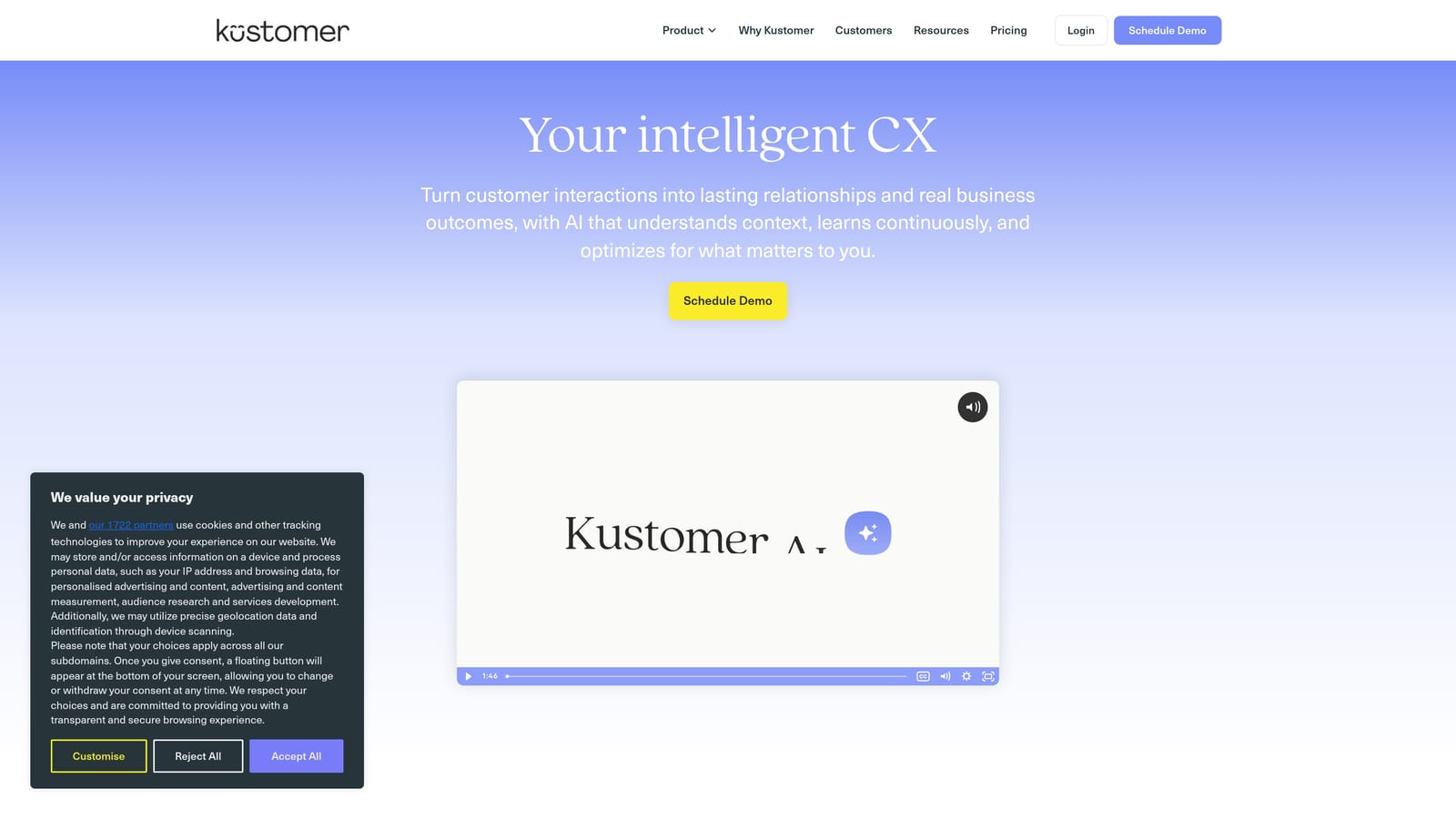
Kustomer is a CRM-native customer service platform that layers AI automation over a complete customer history, giving support teams rich context for every conversation.
Where This Tool Shines
Kustomer's differentiation is its built-in CRM. Rather than pulling customer data from a separate system, every support conversation sits alongside the full customer timeline: past purchases, previous interactions, subscription status, and more. The AI automation layer works on top of that context, which makes routing decisions and suggested responses more accurate than they would be with ticket data alone.
For high-volume operations, particularly D2C brands and companies managing large customer bases, this context-rich approach reduces the back-and-forth that slows down resolution. Agents spend less time looking up history and more time actually resolving issues.
Key Features
Full Customer Timeline: Every interaction across all channels is visible in a single chronological view, eliminating context-switching.
AI Automation: Handles routing, tagging, and suggested responses using the full customer data picture, not just ticket content.
Omnichannel Support: Covers chat, email, phone, SMS, and social channels from a unified workspace.
Built-In CRM: Eliminates the need for a separate customer data platform by embedding CRM functionality natively.
Customizable Workflows: Business rules and automation can be tailored to match complex support operations and escalation paths.
Best For
D2C brands, high-volume support teams, and companies that need CRM and support in one platform. The pricing puts it out of reach for smaller teams, but for the right use case it reduces tool sprawl significantly.
Pricing
Starts at approximately $89 per agent per month. Check kustomer.com for current pricing and plan details.
7. Ada
Best for: CX teams needing multilingual, multi-channel AI agents deployed without engineering resources.
Ada is a no-code AI agent builder that allows CX teams to deploy autonomous support agents across languages and channels without writing code or waiting on engineering.
Where This Tool Shines
Ada's no-code builder is genuinely accessible. CX teams can configure AI agents, define conversation flows, and deploy across web, mobile, and messaging apps without submitting a single engineering ticket. For organizations with large CX teams but limited technical resources, this independence is a significant operational advantage.
The multilingual capability is another standout. Ada supports conversations across many languages, which makes it a practical choice for companies with global customer bases that would otherwise need separate regional support setups. It integrates with major helpdesks like Zendesk and Salesforce, so it can layer on top of existing infrastructure rather than replacing it.
Key Features
No-Code Agent Builder: CX teams configure and deploy AI agents through a visual interface without engineering involvement.
Multilingual Support: Handles customer conversations across many languages from a single agent configuration.
Channel Flexibility: Deploys across web, mobile, SMS, and messaging apps from one central setup.
Helpdesk Integrations: Connects with Zendesk, Salesforce, and major CRM platforms to layer AI on top of existing workflows.
Analytics Dashboard: Tracks agent performance, containment rates, and conversation outcomes to guide ongoing optimization.
Best For
Mid-to-large enterprises with global customer bases that need fast, no-code AI deployment across multiple languages and channels. Also well-suited for CX teams that want autonomy from engineering for ongoing agent configuration.
Pricing
Custom pricing based on volume and use case. Contact Ada directly via ada.cx for a quote.
8. Forethought
Best for: Teams that want AI-powered triage and agent assist without replacing their existing helpdesk.
Forethought is an AI layer built to sit on top of existing helpdesks, using SupportGPT technology to handle intent detection, routing, and agent assist inside your current ticketing system.
Where This Tool Shines
Forethought's positioning is deliberately non-disruptive. It doesn't ask you to migrate away from Zendesk or Salesforce Service Cloud. Instead, it plugs in and immediately starts improving the quality of triage, routing, and agent responses. For teams with significant investment in their current helpdesk, this is a meaningful advantage.
SupportGPT handles intent detection with enough nuance to distinguish between similar-sounding tickets that require different routing paths. The Agent Assist feature surfaces relevant knowledge base articles and suggested responses in real time, which reduces the time agents spend searching for information mid-conversation.
Key Features
SupportGPT: Intent detection and intelligent ticket routing that goes beyond keyword matching to understand what a customer actually needs.
Agent Assist: Surfaces suggested responses and relevant knowledge base content to human agents during live ticket handling.
Triage AI: Auto-tags, prioritizes, and assigns tickets based on content and predicted resolution path.
Helpdesk Compatibility: Works inside Zendesk, Salesforce Service Cloud, and other major platforms without requiring migration.
Workflow Automation: Handles repetitive resolution paths end-to-end for common ticket types.
Best For
Support teams already invested in Zendesk or Salesforce that want AI improvements without platform disruption. A strong choice for teams where helpdesk migration isn't on the table but AI efficiency gains are.
Pricing
Custom pricing. Contact Forethought via forethought.ai for a quote tailored to your support volume.
9. Drift (Salesloft)
Best for: B2B revenue teams where support, sales, and renewal conversations regularly intersect.
Drift, now part of Salesloft, is a conversational AI platform built for B2B teams where the line between support and sales is intentionally blurred.
Where This Tool Shines
Drift's AI routing is built around intent: it distinguishes between a customer asking a support question, a prospect exploring a product, and a customer at renewal risk, then routes accordingly. For revenue teams managing post-sale relationships, this nuance prevents high-value conversations from landing in a generic support queue.
The integration with Salesloft's revenue workflow means that support interactions can trigger sales or renewal actions without manual handoffs. Conversational landing pages and built-in meeting scheduling make it practical for teams that want support and sales motions to coexist in the same platform rather than operating in separate silos.
Key Features
Intent-Based Routing: AI distinguishes between support, sales, and renewal intent to route conversations to the right team or workflow.
Conversational Landing Pages: Embeds AI-driven conversations directly into web pages, with meeting scheduling built in.
Salesloft Integration: Connects support interactions to revenue workflows, enabling post-sale actions without manual coordination.
Real-Time Notifications: Alerts teams when high-value accounts are active in a conversation, enabling timely human engagement.
Account-Based Targeting: Prioritizes and personalizes conversations based on account tier, status, or segment.
Best For
B2B companies where support and revenue teams share customer relationships, particularly those already using Salesloft for sales engagement. Less ideal for teams running a pure support operation with no sales overlap.
Pricing
Custom pricing. Contact Drift via drift.com for a quote based on your team size and use case.
Which Tool Is Right for Your Team
The best AI support agent software isn't the one with the longest feature list. It's the one that fits your existing stack, learns from real interactions, and escalates intelligently when a human is genuinely needed.
Here's a quick orientation by use case to help you narrow the field:
Enterprise teams with complex operations: Zendesk AI or Kustomer are the natural fits. Both handle scale, compliance, and omnichannel volume well, with Kustomer offering a built-in CRM advantage for data-rich support environments.
SMBs and growing teams on a budget: Freshdesk Freddy AI offers the best price-to-capability ratio, and Tidio is worth a look if your support scenarios are relatively straightforward and e-commerce-adjacent.
B2B SaaS teams scaling without adding headcount: Halo AI is built specifically for this. The AI-first architecture, page-aware context, continuous learning, and business intelligence layer make it the strongest choice for product-led companies that want support to connect directly to their engineering and revenue workflows.
No-code deployment across multiple languages: Ada gives CX teams genuine independence from engineering, with strong multilingual support for global operations.
Helpdesk augmentation without migration: Forethought slots in on top of Zendesk or Salesforce and improves triage and agent assist without disrupting existing infrastructure.
Sales and support in the same motion: Drift is purpose-built for B2B revenue teams where post-sale support and renewal conversations live in the same inbox.
Your support team shouldn't scale linearly with your customer base. Let AI agents handle routine tickets, guide users through your product, and surface business intelligence while your team focuses on complex issues that need a human touch. See Halo in action and discover how continuous learning transforms every interaction into smarter, faster support.