9 Best AI Support Automation Tools in 2026
Discover the best AI support automation tools that go beyond basic chatbots to autonomously resolve customer tickets, understand product context, and scale your support operations without expanding headcount. This evaluation covers platforms with genuine automation depth, advanced learning mechanisms, and seamless integration capabilities to help you choose solutions that deliver intelligent, scalable customer support in 2026.
 Matt PattoliFounder11 min read
Support tickets pile up faster than your team can answer them. Customers expect instant resolutions, not "we'll get back to you in 24 hours" auto-replies. And hiring more support agents just kicks the scaling problem down the road while burning through your budget.
AI support automation has evolved beyond basic chatbots that frustrate users with canned responses. The best tools now resolve tickets autonomously, understand product context, and continuously improve from every interaction. But the market is crowded with platforms that slap "AI-powered" on glorified FAQ matchers.
We evaluated AI support automation tools based on genuine automation depth, integration capabilities, learning mechanisms, and deployment complexity. Here are the top tools that actually deliver on the promise of intelligent, scalable support.
1. Halo AI
Best for: B2B SaaS companies needing autonomous ticket resolution with continuous learning capabilities
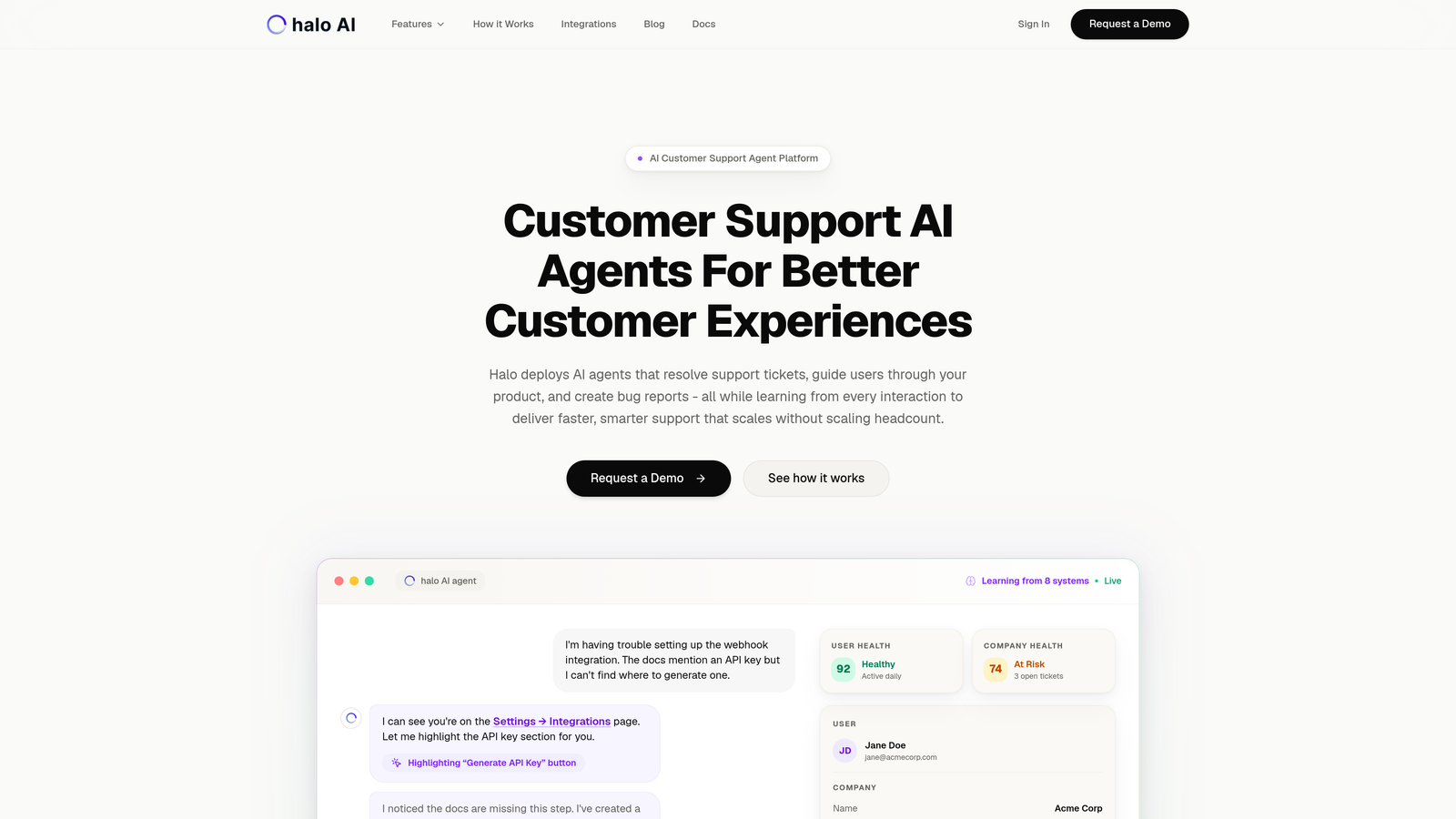
Halo AI is an AI-first customer support platform that deploys autonomous agents to resolve tickets, guide users through your product, and create bug reports without human intervention.
Where This Tool Shines
Unlike AI layers bolted onto existing helpdesks, Halo was built from the ground up for autonomous operation. The platform's page-aware context means it sees exactly what users see in your product—not just what they describe in a ticket. This visual understanding dramatically improves resolution accuracy.
The continuous learning architecture sets Halo apart from static AI models. Every interaction trains the system to handle similar issues better next time. Your AI agents get smarter with use, not stale.
Key Features
Autonomous AI Agents: Resolve tickets end-to-end without human intervention, escalating only when genuinely necessary.
Page-Aware Context: Visual UI understanding that sees what users see, eliminating "can you send a screenshot?" back-and-forth.
Auto Bug Ticket Creation: Automatically generates detailed bug reports in Linear when product issues are detected.
Smart Inbox with Business Intelligence: Surfaces customer health signals, revenue intelligence, and anomaly detection beyond basic support metrics.
Native Integrations: Connects across your entire business stack including Slack, HubSpot, Stripe, Intercom, Zoom, and PandaDoc.
Best For
B2B SaaS companies and product teams that need true automation, not just agent-assist features. Particularly valuable for teams using multiple systems (helpdesk, project management, CRM) who need unified intelligence across platforms.
Pricing
Contact for custom pricing based on ticket volume and integration requirements. Designed for scaling B2B teams that view support as a strategic function.
2. Intercom Fin
Best for: Existing Intercom users wanting native AI resolution without switching platforms
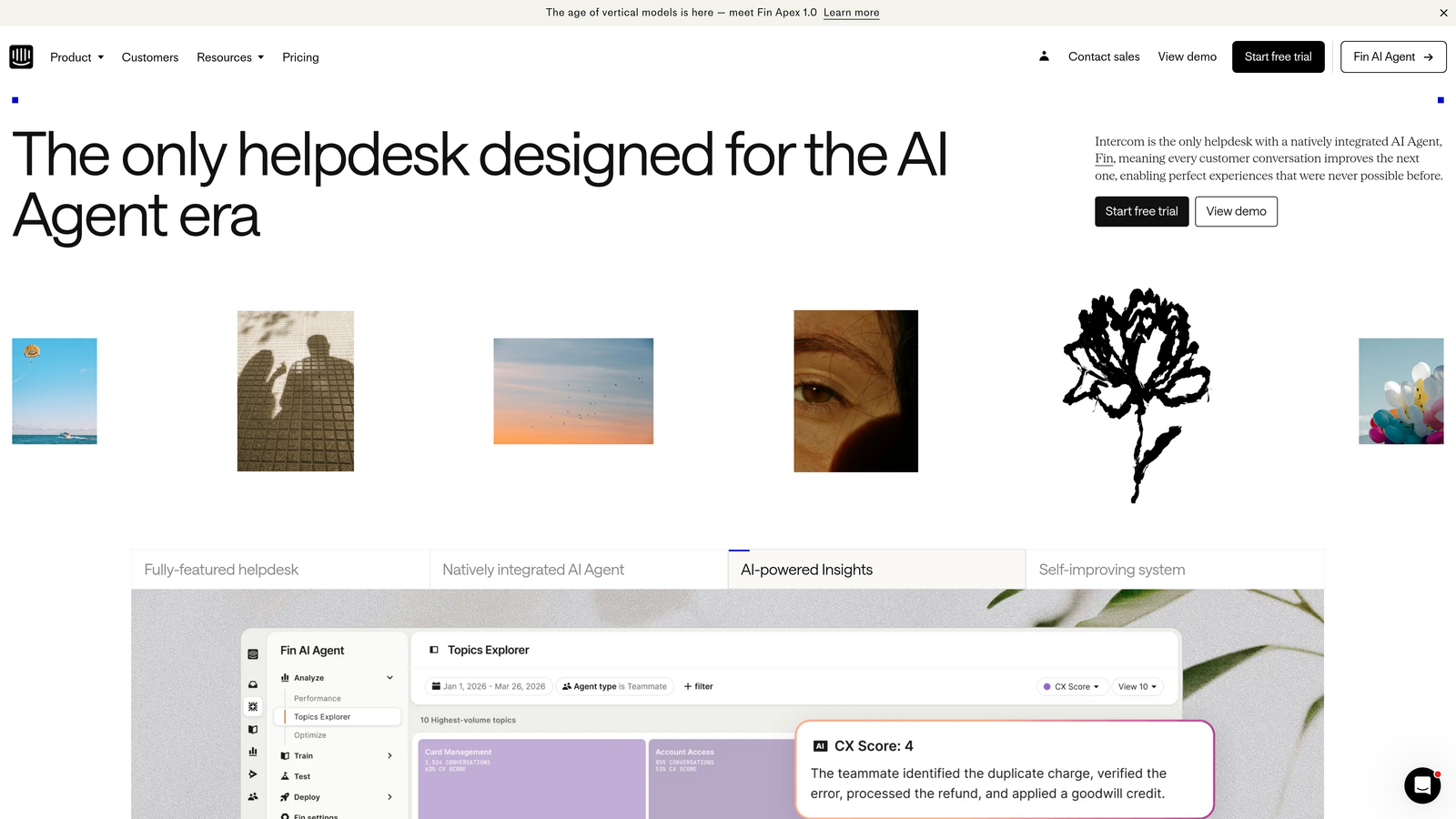
Intercom Fin is an AI-powered resolution bot built directly into the Intercom platform, trained on your help content and conversation history.
Where This Tool Shines
If you're already invested in the Intercom ecosystem, Fin offers the smoothest path to AI automation. It trains on your existing knowledge base and past conversations, so there's no need to rebuild content in a new format. The GPT-4 backbone provides strong natural language understanding.
The handoff experience is seamless. When Fin can't resolve an issue, it passes the full context to a human agent—no frustrating "let me start over" moments for customers.
Key Features
Knowledge Base Training: Automatically learns from your help center articles and historical conversations without manual configuration.
GPT-4 Language Understanding: Handles complex queries and understands intent beyond keyword matching.
Context-Preserved Handoff: Transfers conversations to human agents with complete history and customer data intact.
Custom Answers: Can provide responses for topics not explicitly documented by synthesizing information from multiple sources.
Resolution Analytics: Detailed reporting on what Fin resolves successfully and where it needs improvement.
Best For
Companies already using Intercom who want to add AI capabilities without platform migration. Works well for teams with robust help documentation that Fin can learn from.
Pricing
Starts at $0.99 per resolution, charged only when Fin successfully resolves a conversation. Requires an active Intercom subscription.
3. Zendesk AI
Best for: Enterprise teams deeply embedded in the Zendesk ecosystem needing AI across multiple touchpoints
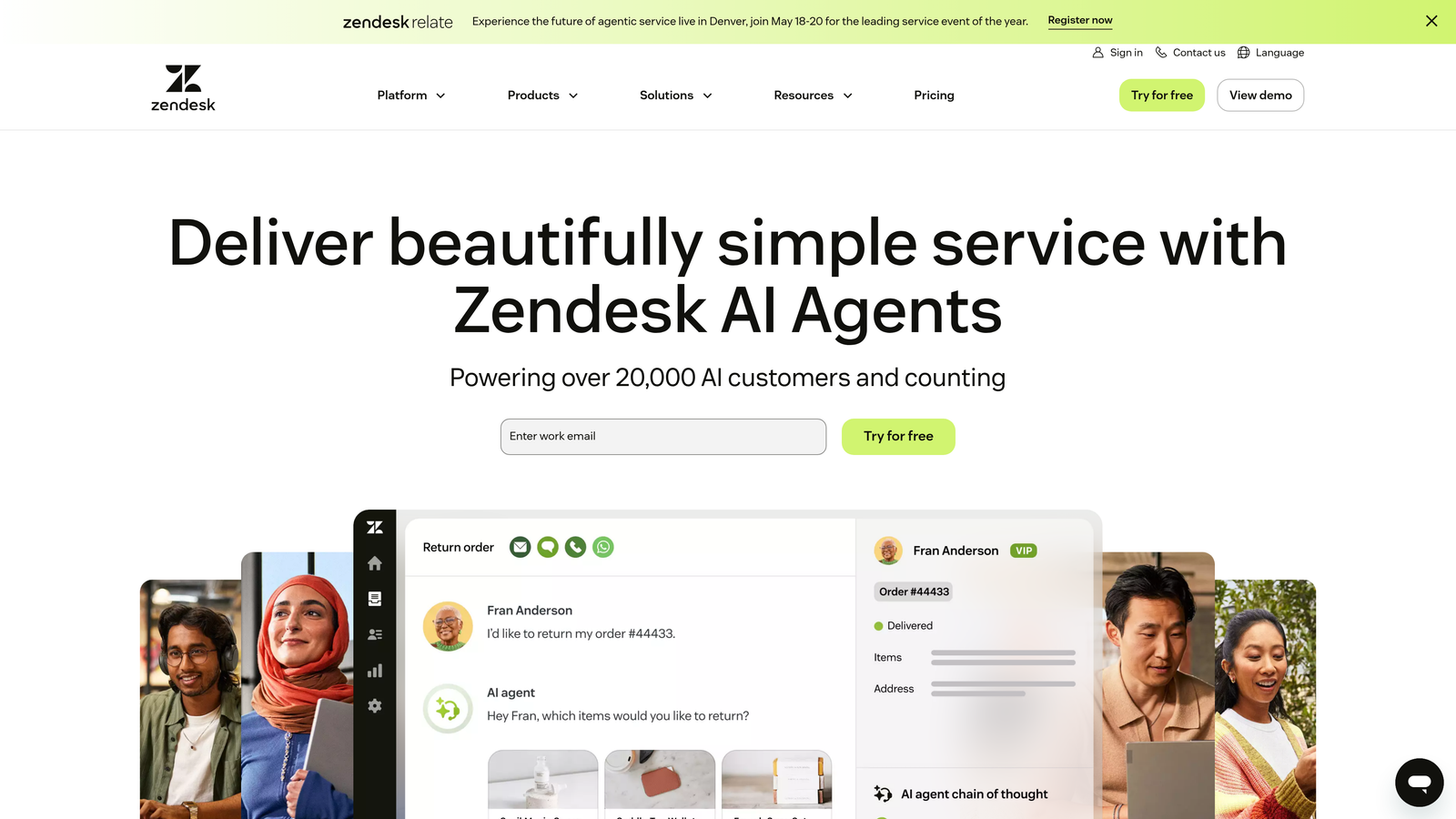
Zendesk AI is an enterprise-grade AI layer that adds intelligent routing, agent assist, and automated responses throughout the Zendesk Suite.
Where This Tool Shines
Zendesk AI's strength lies in its breadth across the entire Zendesk platform. It doesn't just automate customer-facing responses—it optimizes agent workflows, routing, and knowledge management. The intent detection accurately categorizes tickets even when customers describe problems vaguely.
For enterprises with complex support operations spanning multiple products and channels, the unified AI layer creates consistency. Agents get suggested responses and relevant macros regardless of which Zendesk product they're using.
Key Features
Intent Detection and Routing: Automatically categorizes tickets and routes them to the right team or agent based on content analysis.
Agent Assist: Suggests relevant responses, macros, and knowledge base articles while agents work tickets.
Generative AI Content: Drafts help articles and customer responses that agents can edit and approve.
Advanced Analytics: Tracks AI performance across resolution rates, deflection, and agent productivity impact.
Suite-Wide Integration: Works across Zendesk Support, Guide, Chat, and Talk with unified intelligence.
Best For
Large enterprises with established Zendesk deployments who need AI capabilities across their entire support infrastructure. Best suited for teams with complex routing needs and multiple support channels.
Pricing
AI add-on pricing varies by features and volume. Enterprise plans typically start around $115 per agent per month, with AI capabilities adding to base costs.
4. Ada
Best for: High-volume consumer brands and e-commerce companies needing multilingual automation at scale
Ada is an AI-powered customer service automation platform designed for brands handling thousands of daily customer interactions across multiple languages.
Where This Tool Shines
Ada excels at consumer-facing automation where volume matters more than complexity. The no-code builder lets marketing and support teams create automation flows without engineering resources. This democratization of AI setup means faster deployment and iteration.
The 50+ language support out of the box makes Ada particularly valuable for global brands. You're not paying extra or waiting for custom language models—multilingual support is baked in.
Key Features
No-Code Automation Builder: Visual interface for creating conversation flows without technical skills or developer involvement.
Native Multilingual Support: Handles 50+ languages without additional configuration or training per language.
Customer Data Personalization: Tailors responses based on purchase history, account status, and customer journey stage.
Proactive Messaging: Initiates conversations based on customer behavior triggers and campaign automation.
E-commerce and CRM Integrations: Connects with Shopify, Salesforce, and major commerce platforms for order status and account queries.
Best For
Consumer brands, e-commerce companies, and high-volume support operations where automation at scale matters more than deep product context. Ideal for teams without dedicated engineering support.
Pricing
Custom pricing based on conversation volume and resolution targets. Typically positioned for mid-market to enterprise budgets with significant support volume.
5. Freshdesk Freddy AI
Best for: Small to mid-sized teams using Freshworks products wanting affordable AI capabilities
Freshdesk Freddy AI is an AI assistant within the Freshworks ecosystem that handles ticket triage, suggests responses, and powers self-service chatbots.
Where This Tool Shines
Freddy AI delivers solid automation fundamentals at a price point accessible to growing companies. The auto-triage and categorization save agents from manually sorting tickets, while suggested responses speed up resolution without requiring full automation.
If you're using multiple Freshworks products, Freddy creates continuity across Freshdesk, Freshsales, and Freshchat. The AI understands customer context from sales and support interactions, not just support tickets in isolation.
Key Features
Auto-Triage and Categorization: Automatically sorts incoming tickets by type, priority, and required expertise.
AI-Suggested Responses: Recommends replies based on ticket content and historical resolution patterns.
Self-Service Chatbot: Deflects common queries by surfacing relevant knowledge base articles conversationally.
Canned Response Recommendations: Suggests which saved responses apply to current tickets, reducing search time.
Freshworks Suite Integration: Shares intelligence across Freshsales and Freshchat for unified customer understanding.
Best For
Growing companies that need AI assistance without enterprise pricing. Particularly valuable for teams already using Freshworks products who want to add intelligence across their stack.
Pricing
Included in the Pro plan at $49 per agent per month. Enterprise plan with advanced AI features runs $79 per agent per month.
6. Forethought
Best for: Mid-market and enterprise teams prioritizing ticket deflection and workflow automation
Forethought is an AI platform focused on preventing tickets from reaching agents through intelligent deflection and workflow automation powered by SupportGPT.
Where This Tool Shines
Forethought's SupportGPT generates contextually relevant responses that feel genuinely helpful, not robotic. The system understands nuance and can synthesize information from multiple sources to answer questions not explicitly documented.
The workflow automation extends beyond chat. Forethought can trigger backend actions, update systems, and orchestrate multi-step processes—not just answer questions. For companies with compliance requirements, the SOC 2 Type II and HIPAA certifications provide necessary assurance.
Key Features
SupportGPT Generative Responses: Creates context-aware answers that synthesize information rather than matching keywords.
Workflow Automation: Triggers backend processes and system updates beyond conversational responses.
Intelligent Ticket Classification: Routes tickets based on content analysis and urgency detection.
Security and Compliance: SOC 2 Type II and HIPAA certified for regulated industries.
Multi-Platform Integrations: Connects with Salesforce, Zendesk, Freshdesk, and major helpdesk systems.
Best For
Companies focused on deflection metrics and reducing ticket volume. Works well for teams with complex workflows that benefit from automation beyond simple Q&A.
Pricing
Custom enterprise pricing based on ticket volume and integration complexity. Typically suited for mid-market companies and above with substantial support operations.
7. Kustomer IQ
Best for: Teams wanting AI capabilities within a CRM-first customer service platform
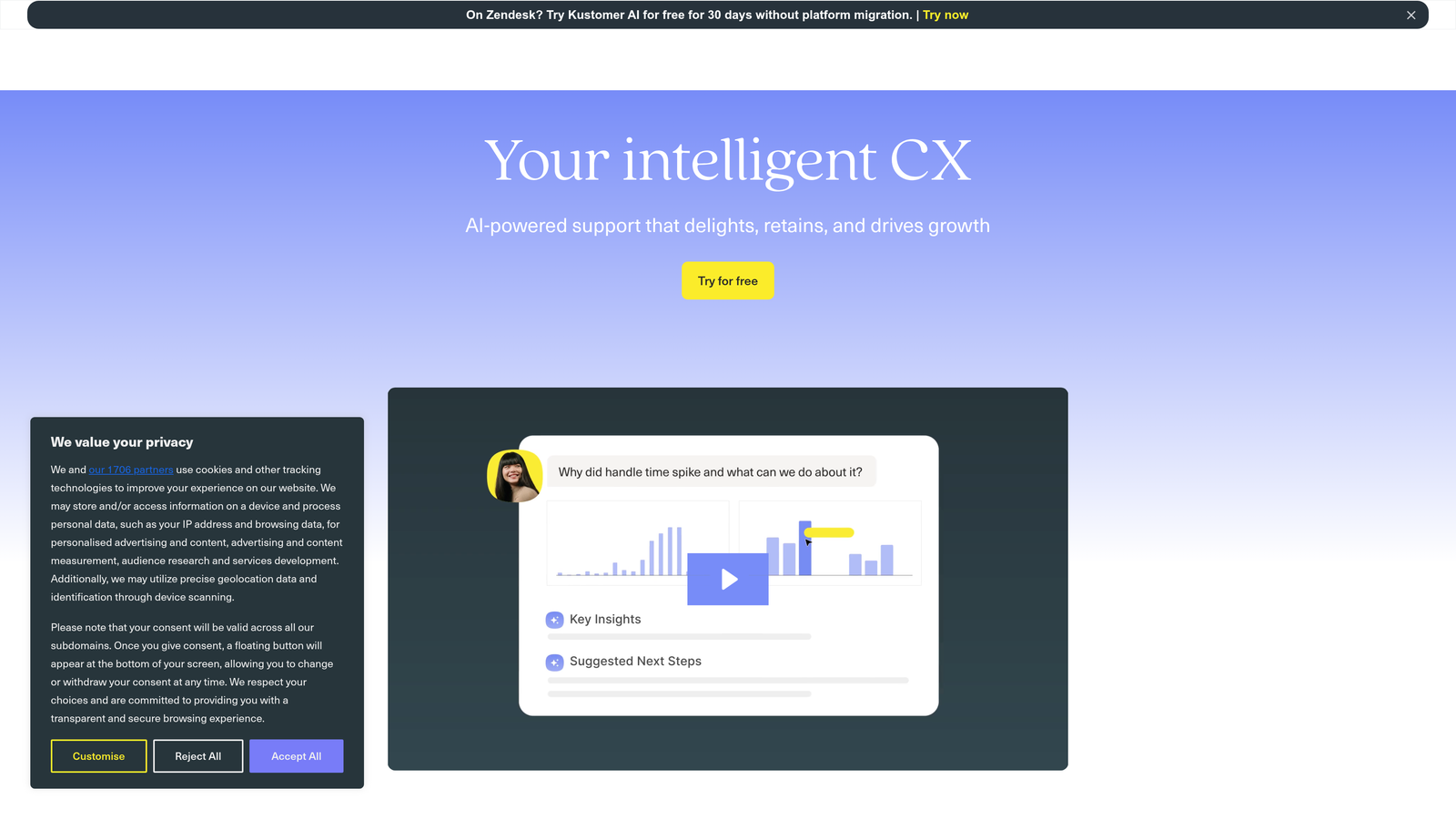
Kustomer IQ provides AI-powered sentiment analysis, intent detection, and automation within Kustomer's unified customer timeline platform.
Where This Tool Shines
Kustomer's CRM-first architecture means AI operates with full customer context—not just the current conversation. The unified timeline shows every interaction across email, chat, social media, and SMS, giving AI a complete picture before responding.
The sentiment analysis and intent detection help agents prioritize which conversations need immediate attention. AI flags frustrated customers or high-value accounts before situations escalate.
Key Features
AI Sentiment Analysis: Detects customer emotion and frustration levels to prioritize urgent conversations.
Unified Customer Timeline: Consolidates all interactions across channels into a single view for context-aware AI.
Automated Classification: Tags and categorizes conversations without manual agent input.
Proactive Outreach: Triggers customer contact based on behavior signals and account health indicators.
Omnichannel Support: Manages email, chat, social media, and SMS from unified inbox with consistent AI assistance.
Best For
Companies that view customer service as a CRM function, not just ticket resolution. Best for teams managing complex customer relationships across multiple touchpoints.
Pricing
Enterprise plan starts at $89 per user per month. Ultimate plan with advanced AI capabilities runs $139 per user per month.
8. Tidio AI
Best for: Small businesses and startups needing affordable AI chat with minimal setup complexity
Tidio AI is an accessible AI chatbot and live chat platform designed for businesses without dedicated technical teams or enterprise budgets.
Where This Tool Shines
Tidio removes the complexity barrier. The visual chatbot builder uses drag-and-drop flows that non-technical team members can configure in minutes. You're not waiting on developers or learning complex automation syntax.
The Lyro AI conversational engine handles natural language interactions beyond rigid chatbot scripts. For small e-commerce stores and service businesses, the Shopify and WordPress integrations mean you can deploy AI support the same day you decide you need it.
Key Features
Visual Chatbot Builder: Drag-and-drop interface for creating conversation flows without coding skills.
Lyro AI Conversations: Natural language understanding that goes beyond scripted responses.
Unified Inbox: Combines live chat and email into single agent interface.
E-commerce Integrations: Native connections with Shopify, WordPress, and WooCommerce for order status queries.
Quick Setup: Deploy functional AI chat in under an hour with minimal technical requirements.
Best For
Small businesses, solopreneurs, and early-stage startups that need basic AI automation without enterprise complexity or pricing. Ideal for e-commerce stores wanting to automate order status questions.
Pricing
Free tier available with basic features. Lyro AI add-on starts at $39 per month. Paid plans begin at $29 per month for additional live chat capabilities.
9. Ultimate.ai
Best for: Global enterprises requiring sophisticated multilingual support automation
Ultimate.ai is an enterprise AI platform specializing in multilingual support automation with custom model training, now part of the Zendesk family following their 2024 acquisition.
Where This Tool Shines
Ultimate.ai's deep language understanding across 100+ languages goes far beyond translation. The platform understands cultural context, idiomatic expressions, and regional variations—critical for brands operating across diverse markets.
The custom AI model training allows enterprises to fine-tune automation for their specific domain, products, and customer base. You're not stuck with generic models that work adequately for everyone but excellently for no one.
Key Features
100+ Language Support: Deep understanding of languages including cultural context and regional variations.
Custom Model Training: Tailored AI models trained on your specific use cases and customer interactions.
Backend System Integrations: Automates transactional processes beyond conversational responses.
Advanced Dialogue Builder: Creates complex conversation flows with conditional logic and multi-turn interactions.
Enterprise Security: Comprehensive compliance certifications for regulated industries and global operations.
Best For
Global enterprises with complex multilingual support requirements. Particularly valuable for companies in regulated industries needing custom AI models and extensive security compliance.
Pricing
Custom enterprise pricing based on language requirements, conversation volume, and integration scope. Positioned for large organizations with substantial international operations.
Finding Your Automation Match
The right AI support tool depends on where you are and where you're heading. If you need autonomous resolution that improves continuously, Halo AI's learning architecture and page-aware context deliver genuine automation. For teams already invested in major helpdesk platforms, native AI options like Intercom Fin or Zendesk AI provide the smoothest integration path.
Budget-conscious startups will find Tidio AI or Freshdesk Freddy accessible, while global enterprises need the multilingual sophistication of Ultimate.ai or the consumer-scale automation of Ada.
Think about what you're actually trying to solve. Are you deflecting simple questions, or do you need AI that resolves complex issues end-to-end? Do you want agent-assist features, or true autonomous operation? Can your AI see what users see in your product, or is it guessing based on text descriptions?
Your support team shouldn't scale linearly with your customer base. Let AI agents handle routine tickets, guide users through your product, and surface business intelligence while your team focuses on complex issues that need a human touch. See Halo in action and discover how continuous learning transforms every interaction into smarter, faster support.