10 Best Automated Customer Service Software in 2026
Discover the best automated customer service software of 2026, with in-depth evaluations of 10 leading platforms—from AI-native tools to automation-enhanced helpdesks—designed to help support teams resolve tickets faster, reduce agent workload, and deliver 24/7 customer assistance without scaling headcount.
 Matt PattoliFounder14 min read
Support teams are under more pressure than ever. Ticket volumes keep climbing, customers expect near-instant responses at any hour, and simply hiring more agents isn't a sustainable answer. Automated customer service software changes the equation by using AI and workflow automation to resolve common issues, route complex problems to the right humans, and keep support running around the clock.
This list covers tools across a range of approaches, from AI-native platforms built from the ground up around autonomous resolution to established helpdesks that have added meaningful automation layers. Each tool was evaluated on AI sophistication (not just rule-based bots), integration depth, ease of setup, scalability, analytics quality, and pricing transparency.
Whether you're a lean SaaS team looking to scale without headcount or an enterprise operation managing thousands of tickets daily, there's a solution here built for your situation. Here are the top automated customer service software platforms worth your attention in 2026.
1. Halo AI
Best for: B2B SaaS teams that want AI-native autonomous support, not a bolt-on chatbot.
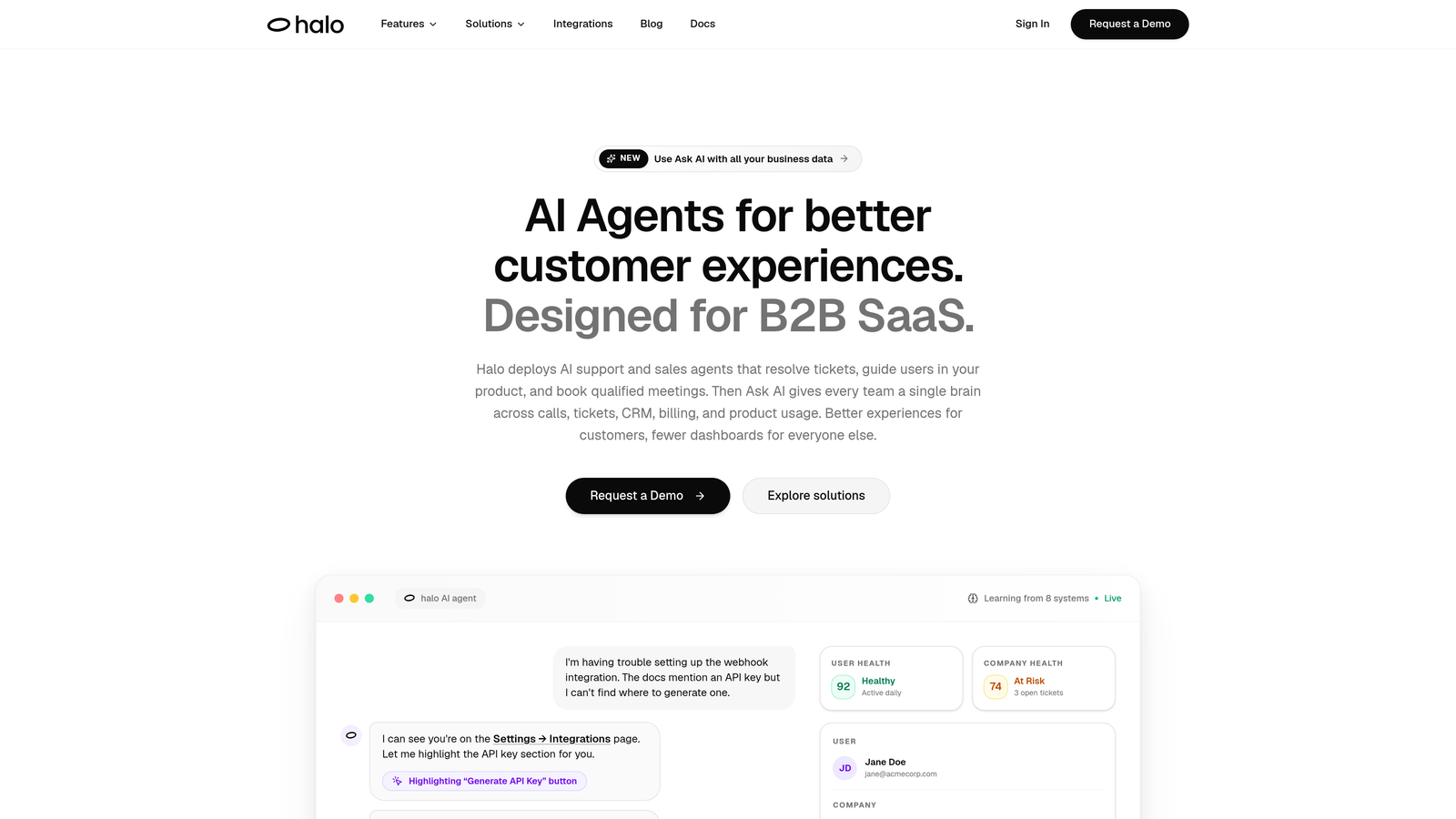
Halo AI is an AI-native customer support platform built from the ground up around autonomous resolution, not retrofitted onto a legacy helpdesk.
Where This Tool Shines
What separates Halo from most tools on this list is its architecture. Rather than adding AI features to an existing ticketing system, Halo was designed from day one around intelligent agents that learn continuously from every interaction. That means the system gets meaningfully smarter over time rather than staying static between manual updates.
The page-aware context is a particularly compelling differentiator. Halo's chat widget understands which page or feature a user is on and can provide visual UI guidance based on that context, essentially seeing what the user sees. For SaaS teams supporting complex products, this kind of contextual awareness dramatically improves resolution quality.
Key Features
Page-Aware Chat Widget: Detects the user's current page and product context to deliver relevant, visual guidance rather than generic responses.
Autonomous AI Agents: Resolve tickets end-to-end with continuous learning, improving with every conversation without manual retraining.
Auto Bug Ticket Creation: Automatically generates bug reports from support conversations and routes them to engineering via Linear or Slack.
Smart Inbox with Business Intelligence: Surfaces customer health signals, revenue intelligence, and anomaly detection beyond standard support metrics.
Deep Integrations: Connects natively with Linear, Slack, HubSpot, Intercom, Stripe, Zoom, PandaDoc, and Fathom for a fully connected support stack.
Best For
B2B SaaS companies and product teams that are hitting the limits of traditional helpdesks and need AI that genuinely resolves tickets rather than deflecting them. Particularly strong for teams where support insights need to flow into product, engineering, and revenue workflows.
Pricing
Contact for pricing. Halo is designed for B2B SaaS teams scaling support operations without scaling headcount proportionally.
2. Zendesk AI
Best for: Established support teams wanting AI layered onto a proven, enterprise-grade helpdesk.
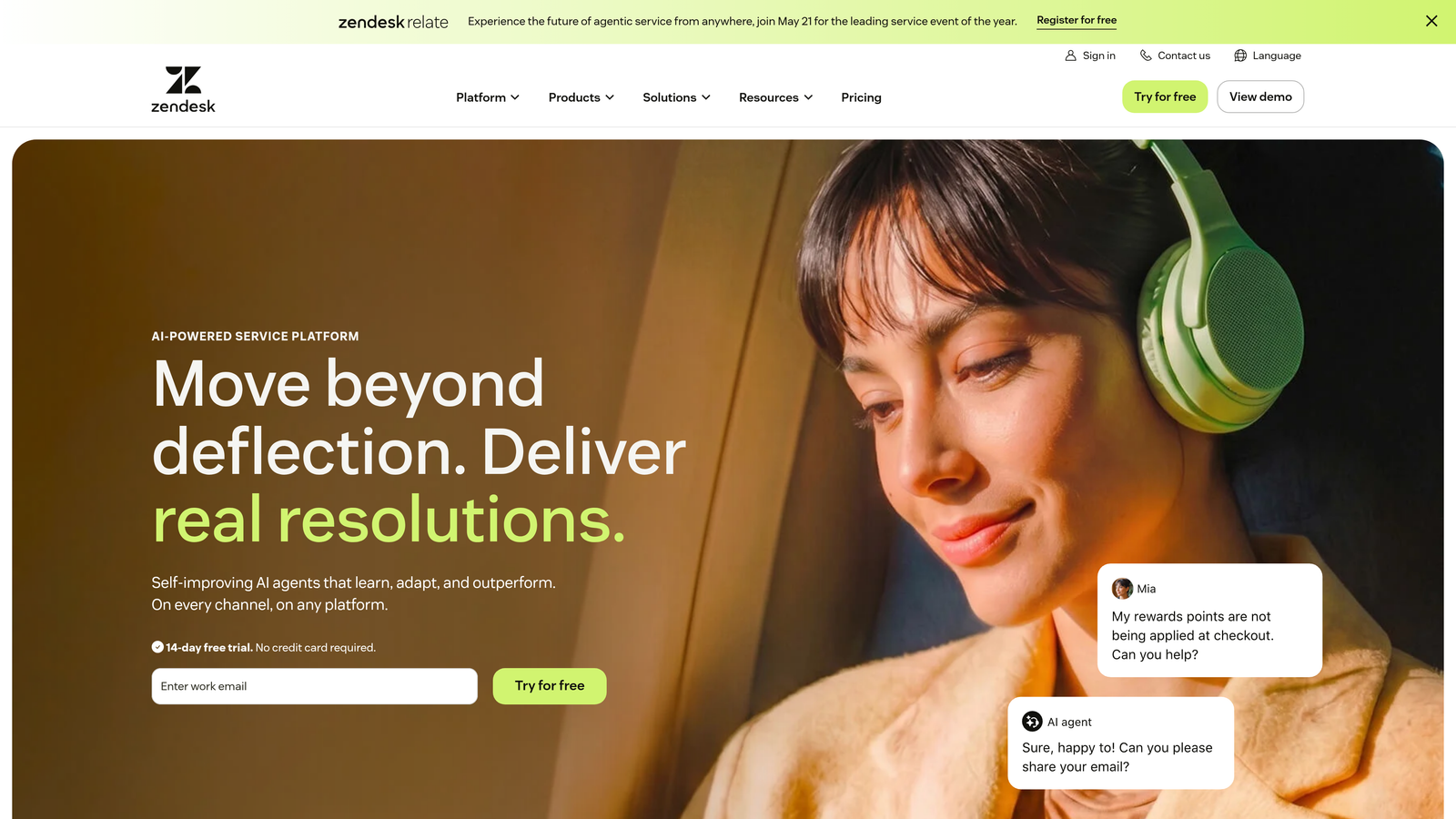
Zendesk AI is the industry's most recognized helpdesk platform, now with AI-powered triage, Answer Bot, and agent assist built into its mature ticketing engine.
Where This Tool Shines
Zendesk's biggest advantage is its maturity. The platform has been refined over many years, and its AI features benefit from that foundation: intelligent triage that classifies and routes tickets automatically, an Answer Bot that deflects common questions, and agent assist tools that surface relevant content mid-conversation.
The breadth of its ecosystem is unmatched. With over 1,500 marketplace integrations, Zendesk fits into virtually any existing tech stack. For teams that have already invested in Zendesk workflows, adding AI capabilities is a natural evolution rather than a disruptive change.
Key Features
Answer Bot and Intelligent Triage: Automatically classifies, tags, and routes incoming tickets while deflecting common questions before they reach an agent.
1,500+ Integrations: Connects to an extensive marketplace of CRMs, communication tools, and business applications.
Omnichannel Support: Manages tickets across email, chat, phone, social media, and messaging platforms from a single workspace.
Advanced Analytics: Custom reporting dashboards with deep visibility into team performance and customer satisfaction trends.
Enterprise Security: Robust compliance certifications and security controls suited for regulated industries.
Best For
Mid-market to enterprise teams with existing Zendesk investments, or organizations that need a proven, scalable helpdesk with AI features they can layer in gradually.
Pricing
Suite plans start at $55/agent/month. AI add-on features are available at additional cost depending on the plan tier.
3. Intercom Fin
Best for: Product-led SaaS companies wanting an AI agent embedded in their existing Intercom setup.
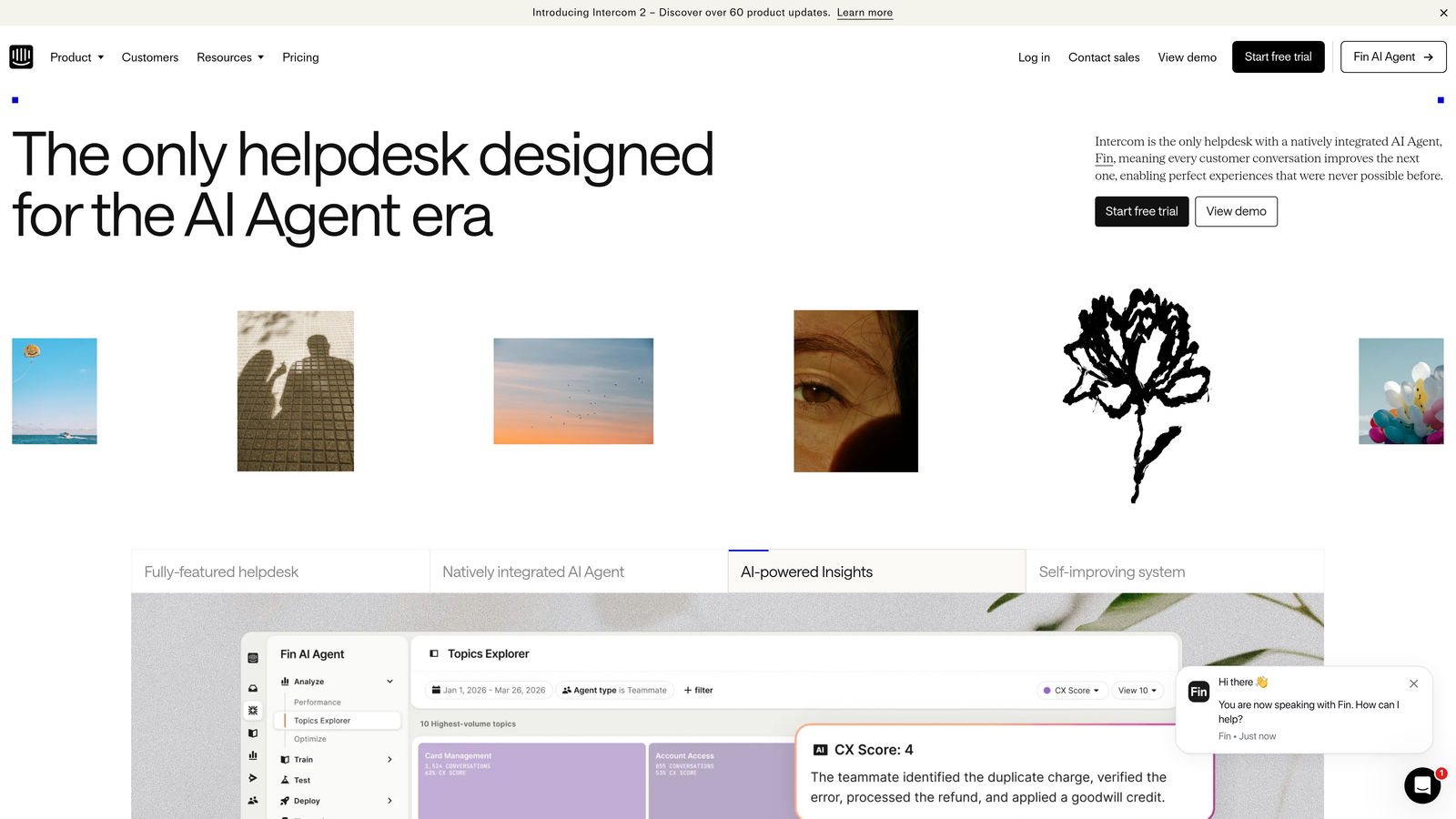
Intercom Fin is a conversational AI agent trained on your help center content to resolve support queries directly within chat, without human intervention for routine questions.
Where This Tool Shines
Fin sits naturally inside Intercom's broader messaging platform, which means teams already using Intercom for in-app communication get an AI resolution layer without switching tools. Fin is trained on your existing help center content, so setup is relatively fast compared to platforms requiring manual intent configuration.
The resolution-based pricing model is also worth noting. Rather than charging per seat for AI usage, Intercom charges per successful resolution, which aligns costs directly with value delivered. For teams with high deflection rates, this can be economically attractive.
Key Features
Fin AI Agent: Resolves support questions using help center articles and custom content, with natural conversational handling.
In-App Messaging and Product Tours: Proactive outreach and onboarding flows built into the same platform.
Customizable Workflows: Assignment rules and routing logic to manage escalation and team distribution.
AI Conversation Summaries: Auto-generated summaries and agent assist suggestions to speed up human handoffs.
Resolution-Based Pricing: Fin charges per successful resolution rather than per seat, aligning cost with outcomes.
Best For
SaaS companies already using Intercom for customer messaging that want to add AI resolution without migrating to a new platform. Also strong for teams with well-maintained help centers that can serve as Fin's training content.
Pricing
Essential plan starts at $29/seat/month. Fin AI is charged separately on a per-resolution basis.
4. Freshdesk
Best for: SMBs moving beyond shared inboxes that need affordable, full-featured helpdesk automation.
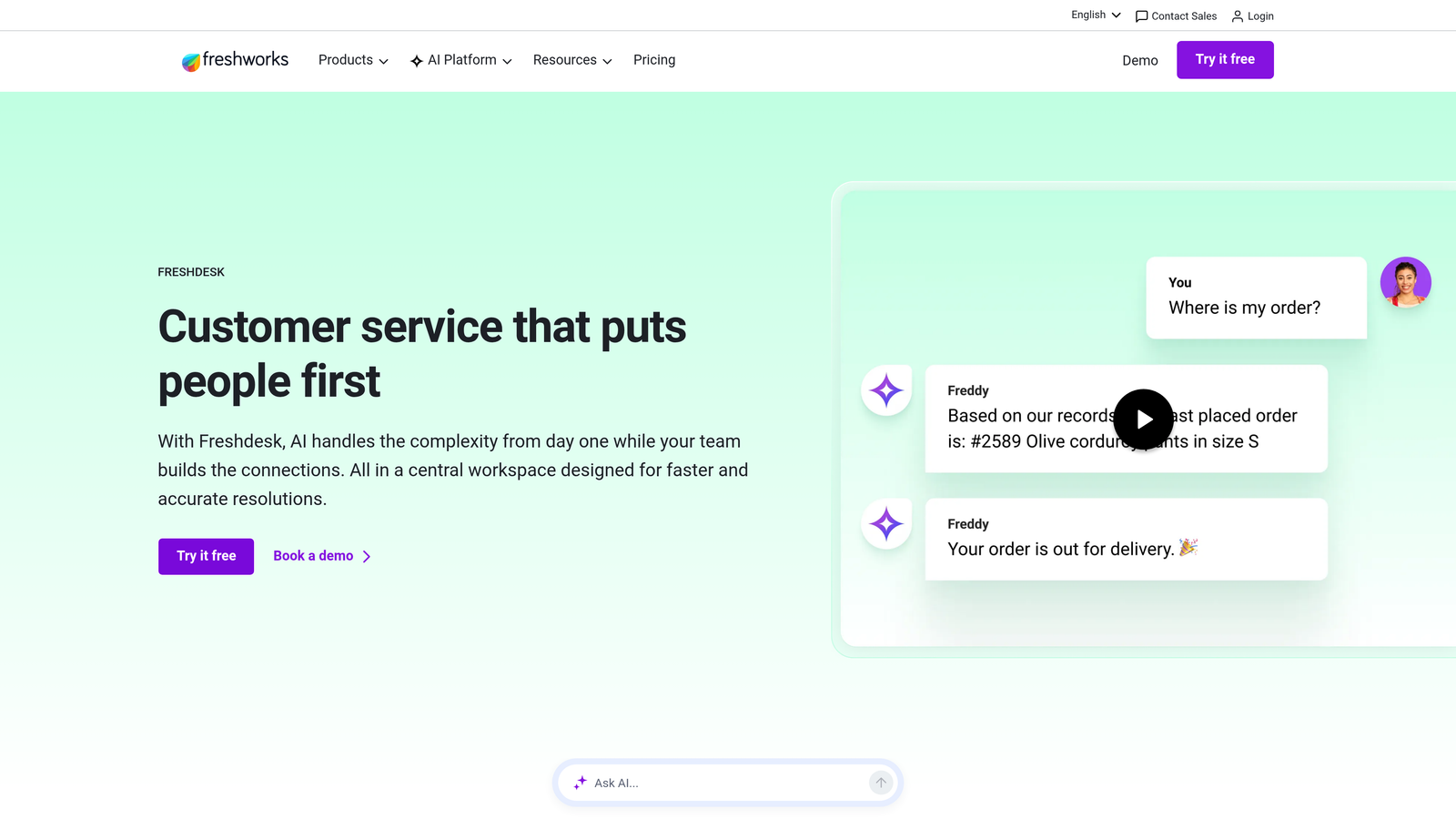
Freshdesk is a full-featured helpdesk from Freshworks with Freddy AI providing auto-triage, response suggestions, and ticket automation at an accessible price point.
Where This Tool Shines
Freshdesk hits a sweet spot between capability and affordability that few competitors match. Freddy AI handles the heavy lifting of triage and routing, while scenario automations let teams build multi-step workflows without developer involvement. The free tier makes it genuinely accessible for early-stage teams.
For SMBs that have outgrown a shared Gmail inbox but aren't ready for Zendesk-level complexity and cost, Freshdesk offers a logical upgrade path with room to grow as the team scales.
Key Features
Freddy AI: Handles auto-triage, canned response suggestions, and agent assist to reduce manual effort on repetitive tasks.
Omnichannel Ticketing: Consolidates email, chat, phone, and social media support into a single queue.
Scenario Automations: Multi-step automation rules and SLA management for consistent, timely responses.
Free Tier: Supports up to 2 agents at no cost, making it accessible for very small teams getting started.
1,000+ Integrations: Marketplace of apps covering CRMs, e-commerce, analytics, and communication tools.
Best For
Small to mid-sized businesses wanting a capable helpdesk with AI features without enterprise pricing. Also a strong choice for teams that want to start free and upgrade as they grow.
Pricing
Free plan available for up to 2 agents. Paid plans start at $15/agent/month.
5. Ada
Best for: Large enterprises in e-commerce, fintech, or telecom needing high-volume automated resolution at scale.
Ada is an enterprise-grade AI agent platform purpose-built for organizations that need to automate a significant portion of their support volume across multiple channels and languages.
Where This Tool Shines
Ada's focus is on resolution, not just deflection. The platform is designed to handle multi-step support issues end-to-end rather than simply pointing users toward articles and hoping they self-serve. For high-volume operations where even small improvements in resolution rate translate to significant cost savings, that distinction matters.
The no-code workflow builder and multilingual support across 50+ languages make Ada particularly compelling for global organizations managing diverse customer bases without building separate regional support setups.
Key Features
End-to-End AI Resolution: Handles complex, multi-step issues autonomously rather than deflecting to documentation.
No-Code Workflow Builder: Non-technical teams can build and manage AI workflows without engineering involvement.
Multilingual Support: Operates across 50+ languages for global customer bases.
Enterprise Integrations: Connects with major CRMs, helpdesks, and e-commerce platforms out of the box.
Enterprise Security: SOC 2 and HIPAA compliance for regulated industries handling sensitive data.
Best For
Large enterprises in high-volume industries like e-commerce, fintech, and telecom where automation at scale and compliance requirements are both non-negotiable.
Pricing
Custom enterprise pricing. Contact Ada directly for a quote tailored to your volume and use case.
6. Tidio
Best for: Small businesses and e-commerce stores wanting fast-to-deploy chat automation without heavy configuration.
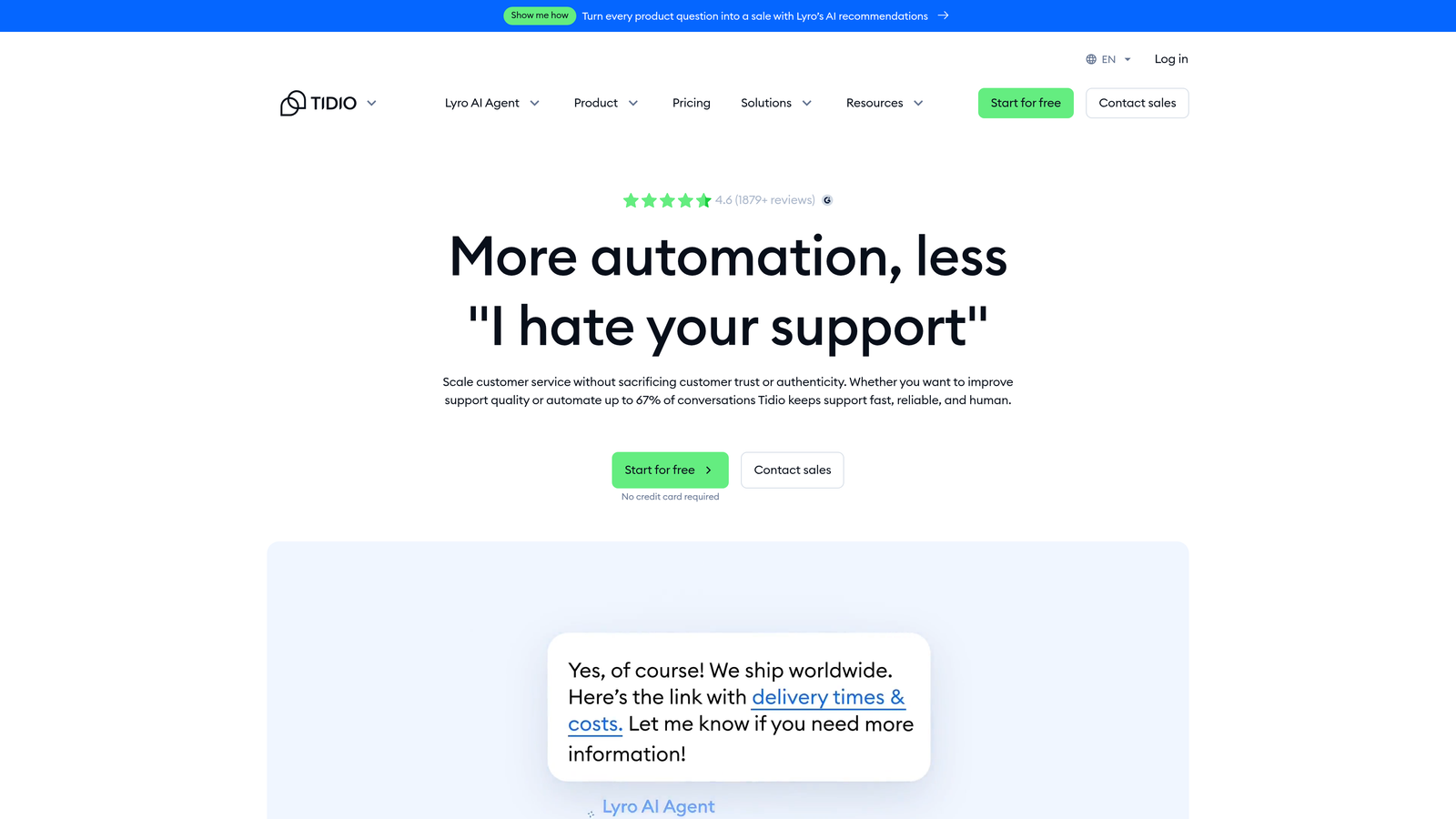
Tidio is a lightweight live chat and chatbot platform featuring Lyro AI, designed for quick deployment with minimal technical overhead.
Where This Tool Shines
Tidio's strength is simplicity and speed. The visual drag-and-drop chatbot builder with pre-built templates means a small business owner can have automation running in hours, not weeks. Lyro AI is trained on your existing content, reducing the manual effort required to get meaningful automation in place.
The native integrations with Shopify, WooCommerce, and WordPress make Tidio a natural fit for e-commerce operators who want to automate order status, return queries, and basic product questions without a dedicated support team.
Key Features
Lyro AI Chatbot: Conversational AI trained on your content to handle customer questions automatically.
Visual Chatbot Builder: Drag-and-drop interface with pre-built templates for fast setup without coding.
E-Commerce Integrations: Native connections to Shopify, WooCommerce, and WordPress for seamless store support.
Combined Live Chat and Chatbot: Both channels managed from a single widget and dashboard.
Visitor Tracking: Real-time analytics showing who's on your site and how conversations are performing.
Best For
Small businesses, e-commerce stores, and solopreneurs who need affordable, easy-to-configure automation without the complexity of enterprise platforms.
Pricing
Free plan available. Paid plans start at $29/month, making it one of the most accessible options on this list.
7. HubSpot Service Hub
Best for: Teams already in the HubSpot ecosystem that want support tightly integrated with CRM and marketing data.
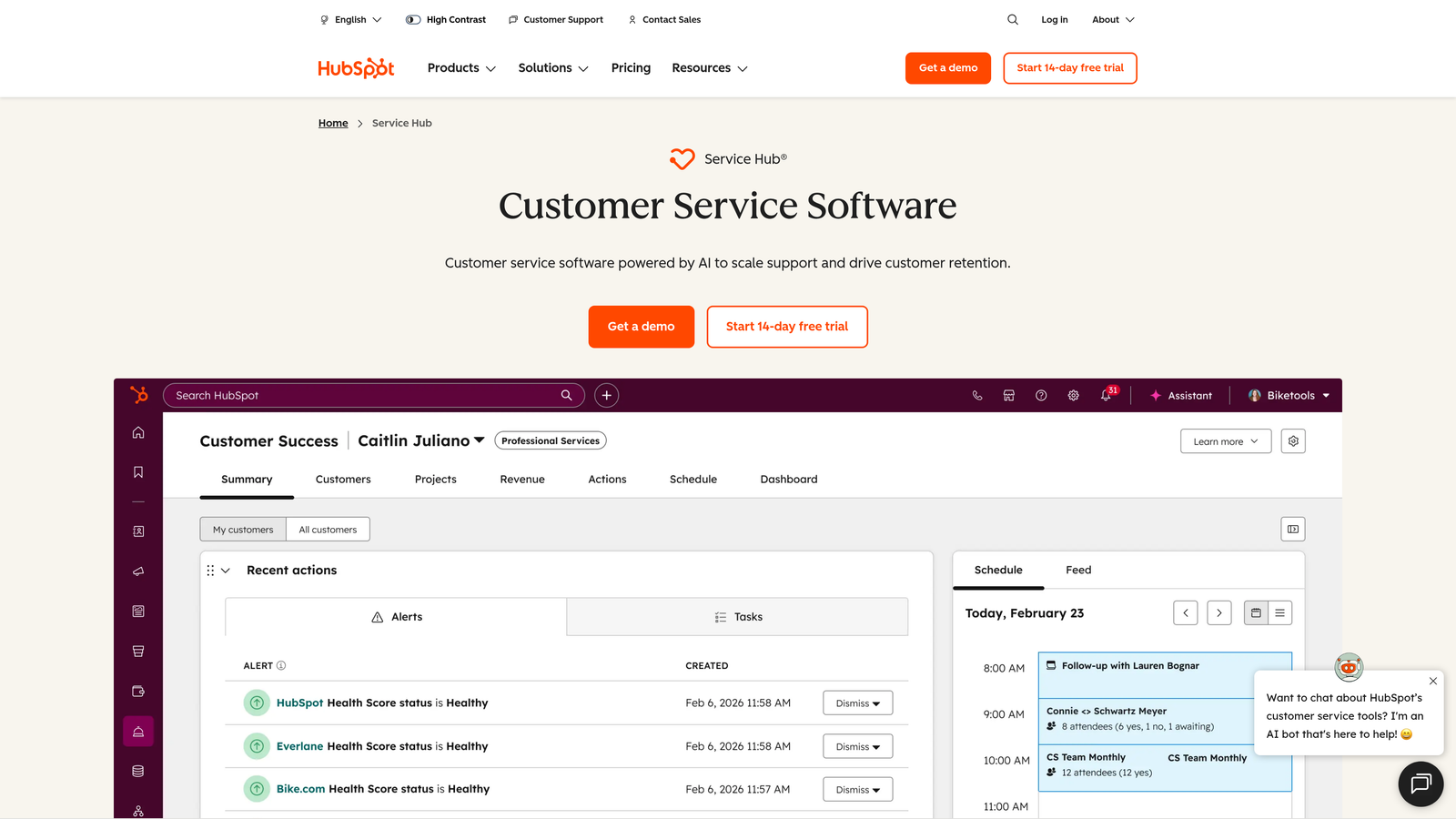
HubSpot Service Hub is a customer service platform natively connected to HubSpot CRM, giving support agents full visibility into a contact's marketing and sales history alongside their support tickets.
Where This Tool Shines
The core advantage of Service Hub is context. When a support agent opens a ticket, they can immediately see the customer's full journey: what marketing campaigns they've engaged with, where they are in the sales cycle, and what their account value looks like. That kind of visibility changes how teams prioritize and personalize support.
For companies using HubSpot across marketing, sales, and service, the unified reporting is a genuine differentiator. Rather than stitching together data from multiple platforms, leadership gets a single view of how support performance connects to retention and revenue.
Key Features
Native CRM Integration: Full customer journey visibility from first marketing touch through active support tickets.
Chatbot Builder: Branching logic and AI-powered responses for automated first-contact resolution.
Knowledge Base and Customer Portal: Self-service tools with feedback surveys to close the loop on customer experience.
Automated Ticket Routing: Rules-based assignment and SLA tracking to keep response times consistent.
Unified Reporting: Cross-functional dashboards connecting support data with marketing and sales performance.
Best For
Companies already running HubSpot for marketing and sales that want to extend that investment into customer service without managing a separate platform.
Pricing
Free tools available. Starter plan begins at $20/seat/month, with more advanced automation and reporting on higher tiers.
8. Salesforce Service Cloud
Best for: Large enterprises with complex support operations needing deep customization and Einstein AI.
Salesforce Service Cloud is a deeply customizable enterprise service platform with Einstein AI handling case classification, routing, and predictive recommendations at scale.
Where This Tool Shines
Service Cloud's power is its flexibility. Flow Builder allows organizations to construct highly specific workflows that reflect their exact support processes, not a vendor's generic template. For enterprises with complex escalation paths, regulatory requirements, or multi-department coordination, that customization headroom is essential.
Einstein AI brings predictive intelligence to case management: classifying incoming cases, recommending next-best actions, and routing tickets based on agent skill and availability. Combined with deep integration into Salesforce's broader platform, it creates a unified operational picture across sales, service, and field operations.
Key Features
Einstein AI: Case classification, auto-routing, and predictive next-best-action recommendations for agents.
Omnichannel Routing: Intelligent distribution across every support channel based on agent capacity and expertise.
Flow Builder: Highly customizable workflow automation without requiring heavy development resources.
Salesforce Ecosystem Integration: Deep connections with Sales Cloud, Marketing Cloud, and thousands of AppExchange apps.
Field Service and Self-Service: Extends support to field operations and customer-facing portals for comprehensive coverage.
Best For
Large enterprises already invested in the Salesforce ecosystem, or organizations with complex, multi-channel support operations that require extensive customization and enterprise-grade compliance.
Pricing
Starter plan at $25/user/month. Enterprise plan at $165/user/month. Implementation costs should be factored in for complex deployments.
9. Help Scout
Best for: Small-to-mid teams that want efficient automation without losing a personal, human feel in customer interactions.
Help Scout is a clean, human-centric helpdesk with smart automation features designed for teams that value both efficiency and genuine customer relationships.
Where This Tool Shines
Help Scout has built its reputation on making support feel personal even as it scales. The interface is intentionally simple, with a short onboarding curve that lets teams get productive quickly rather than spending weeks on configuration. AI drafts and summarization help agents respond faster without replacing the human voice in communications.
The Beacon widget is a standout feature for SaaS products: it surfaces relevant help docs directly inside your application, reducing ticket volume by helping users find answers before they reach out. Combined with collision detection that prevents two agents from replying to the same ticket, the collaboration features are thoughtfully designed for small team dynamics.
Key Features
AI Drafts and Summarization: Generates response drafts and conversation summaries to accelerate agent workflows.
Beacon Widget: In-app self-service tool that surfaces relevant documentation and support options contextually.
Workflow Automations: Rules for tagging, assignment, and follow-ups to keep queues organized without manual effort.
Collision Detection: Alerts agents when a colleague is already working on the same conversation.
Intuitive Interface: Minimal onboarding time with a clean design that agents can use effectively from day one.
Best For
Small to mid-sized teams, particularly in SaaS or services, that want automation to handle the operational overhead while keeping customer interactions warm and personal.
Pricing
Standard plan starts at $25/user/month, with higher tiers unlocking advanced reporting and more automation capacity.
10. Zoho Desk
Best for: Budget-conscious teams in the Zoho ecosystem wanting AI-enhanced support with strong all-in-one value.
Zoho Desk is an affordable helpdesk with Zia AI for sentiment analysis, anomaly detection, and auto-tagging, particularly strong for teams already using other Zoho products.
Where This Tool Shines
Zia, Zoho's AI assistant, brings capabilities to Zoho Desk that you'd expect to find only in more expensive platforms. Sentiment analysis flags emotionally charged tickets for priority handling, anomaly detection surfaces unusual spikes in ticket volume, and auto-tagging keeps queues organized without manual effort. For the price point, it's a genuinely capable AI layer.
The depth of Zoho ecosystem integration is the other major draw. Teams using Zoho CRM, Zoho Analytics, and other Zoho apps get native data flow between platforms, creating a connected operational picture without expensive third-party integrations or custom development.
Key Features
Zia AI: Sentiment analysis, auto-tagging, and anomaly detection to surface priority tickets and trends automatically.
Multi-Channel Support: Email, chat, phone, social media, and web forms managed from a unified interface.
Zoho Ecosystem Integration: Deep native connections with Zoho CRM, Analytics, and 40+ other Zoho applications.
Blueprint Process Automation: Guided ticket resolution workflows that enforce consistent handling across the team.
Free Plan: Supports up to 3 agents at no cost, making it accessible for very small teams.
Best For
Small to mid-sized teams already invested in the Zoho ecosystem, or budget-conscious organizations that want meaningful AI features without committing to premium pricing.
Pricing
Free plan available for up to 3 agents. Standard plan starts at $14/agent/month, making it one of the most cost-effective options in this category.
Which Tool Is Right for Your Team?
The right automated customer service software depends on three things: where your team is today, what your stack already looks like, and whether you need a bolt-on AI layer or a platform built around AI from the start.
Here's a quick breakdown by use case to help you narrow it down:
Best AI-native platform: Halo AI is the standout choice for B2B SaaS teams that want autonomous resolution, continuous learning, and business intelligence flowing out of support, not just ticket deflection.
Best for enterprise Zendesk users: Zendesk AI is the natural path for organizations already invested in the Zendesk ecosystem that want to layer in AI without platform disruption.
Best for product-led SaaS: Intercom Fin integrates seamlessly into existing Intercom setups and charges per resolution, making it a smart fit for teams with strong help center content.
Best budget options: Freshdesk and Tidio both offer free plans and affordable paid tiers, with Freshdesk better suited for growing SMBs and Tidio ideal for e-commerce operators.
Best for CRM-centric teams: HubSpot Service Hub wins for teams running HubSpot across marketing and sales, while Salesforce Service Cloud is the choice for large enterprises already in the Salesforce ecosystem.
One thing worth keeping in mind as you evaluate: focus on resolution rate, not just deflection. A tool that redirects customers to a knowledge base article isn't the same as one that actually resolves their issue. The gap between those two outcomes is where AI-native platforms are pulling ahead of traditional helpdesks.
Most tools on this list offer free trials or free tiers, so test with real ticket data before committing. Your support team shouldn't scale linearly with your customer base. Let AI agents handle routine tickets, guide users through your product, and surface business intelligence while your team focuses on complex issues that need a human touch. See Halo in action and discover how continuous learning transforms every interaction into smarter, faster support.