9 Best Automated Support Software Platforms in 2026
This guide evaluates the best automated support software platforms available in 2026, comparing AI-first solutions against traditional helpdesks with AI add-ons across key criteria including autonomous resolution capabilities, integrations, and deployment ease—helping B2B SaaS teams choose a platform that genuinely scales customer support without proportionally scaling headcount.
 Grant CooperFounder13 min read
Scaling customer support is one of the most persistent challenges in B2B SaaS. As your user base grows, the ticket volume grows with it, and hiring more agents to keep pace quickly becomes unsustainable. The good news is that automated support software has matured significantly: the best platforms in 2026 don't just deflect tickets, they resolve them autonomously, surface business intelligence, and improve with every interaction.
Choosing the right platform isn't straightforward, though. The market spans from AI-first architectures built around autonomous agents to traditional helpdesks with AI layered on top. That distinction matters more than most buyers realize, because it fundamentally shapes how well the automation performs and how much it improves over time.
To build this list, we evaluated each platform across five criteria: AI resolution capabilities (not just deflection), depth of integrations, ease of deployment, pricing transparency, and suitability for B2B product teams. Here are the top automated support software platforms worth considering in 2026.
1. Halo AI
Best for: B2B SaaS teams that want autonomous AI agents with page-aware context and business intelligence built in.
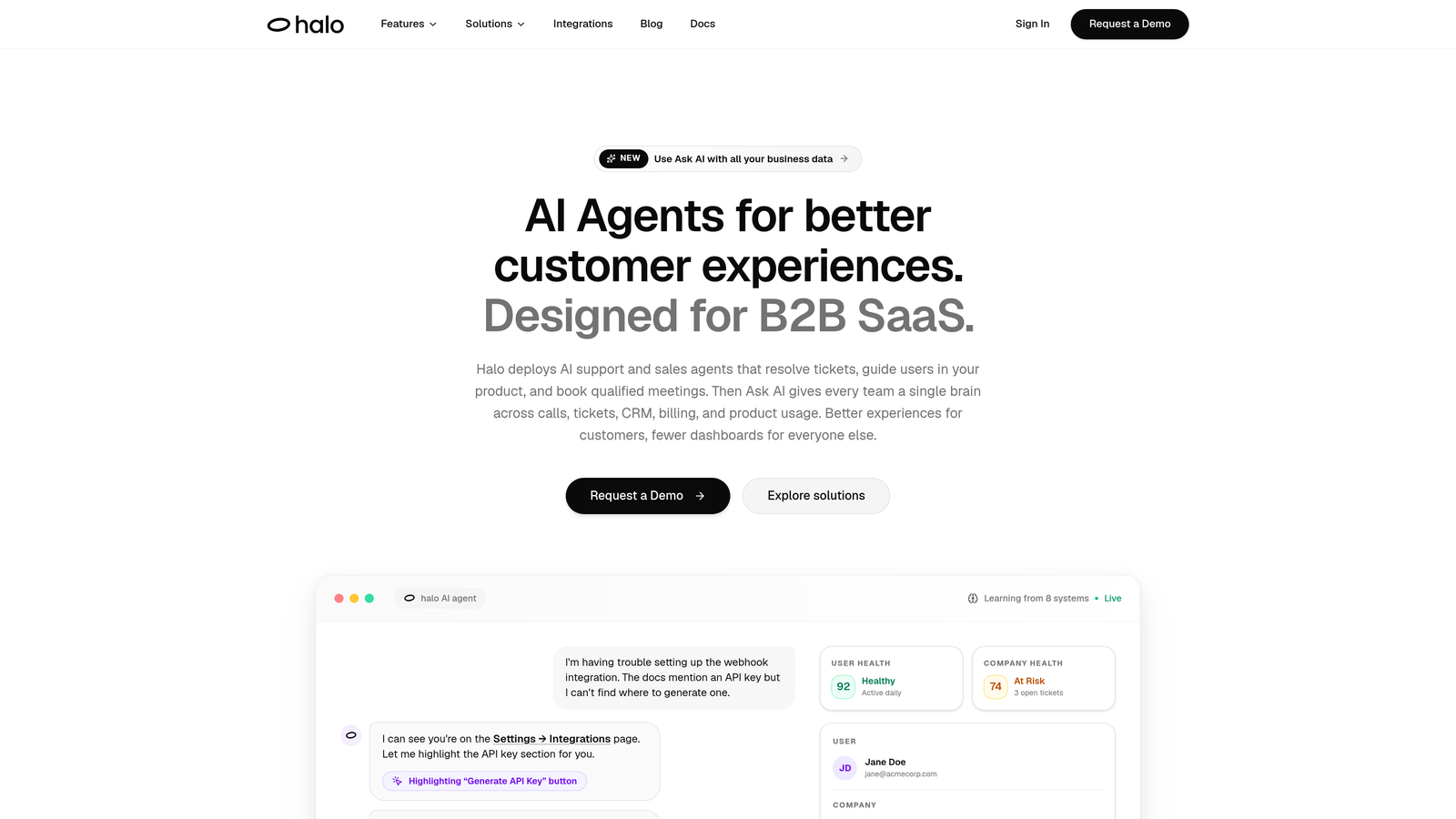
Halo AI is an AI-first customer support platform that deploys autonomous agents to resolve tickets, guide users visually through your product, and generate bug reports while continuously learning from every interaction.
Where This Tool Shines
What separates Halo from most support tools is its architecture. AI isn't a feature bolted onto a helpdesk here; it's the foundation. The platform's page-aware chat widget understands the context of where a user is in your product, which means the AI agent can provide visual UI guidance rather than generic answers. That's a meaningful difference when your users are stuck mid-workflow at 11pm and no human agent is available.
Beyond ticket resolution, Halo's smart inbox surfaces business intelligence that most support tools don't touch: customer health signals, revenue intelligence, and anomaly detection. Your support layer becomes a strategic data source, not just a cost center.
Key Features
Autonomous Ticket Resolution: AI agents handle support tickets end-to-end without requiring human intervention for routine issues.
Page-Aware Chat Widget: The widget sees what users see, enabling visual UI guidance that's contextually relevant to the user's current screen.
Smart Inbox with Business Intelligence: Goes beyond traditional metrics to surface customer health signals, anomaly detection, and revenue intelligence.
Auto Bug Ticket Creation: Automatically creates and routes bug tickets to Linear, Slack, and other dev tools when issues are detected.
Live Agent Handoff: Escalates complex issues to human agents with full conversation context preserved, so nothing gets repeated.
Best For
Halo is purpose-built for B2B SaaS product teams that want to scale support without scaling headcount. It's especially well-suited for teams already using tools like Linear, Slack, HubSpot, Intercom, Stripe, or Zoom, given its deep integration capabilities across the modern SaaS stack.
Pricing
Contact for pricing. Halo is designed for B2B SaaS teams at scale, so pricing is tailored to team size and resolution volume rather than per-seat.
2. Zendesk AI
Best for: Enterprise teams that need a mature, deeply integrated support ecosystem with AI layered throughout.
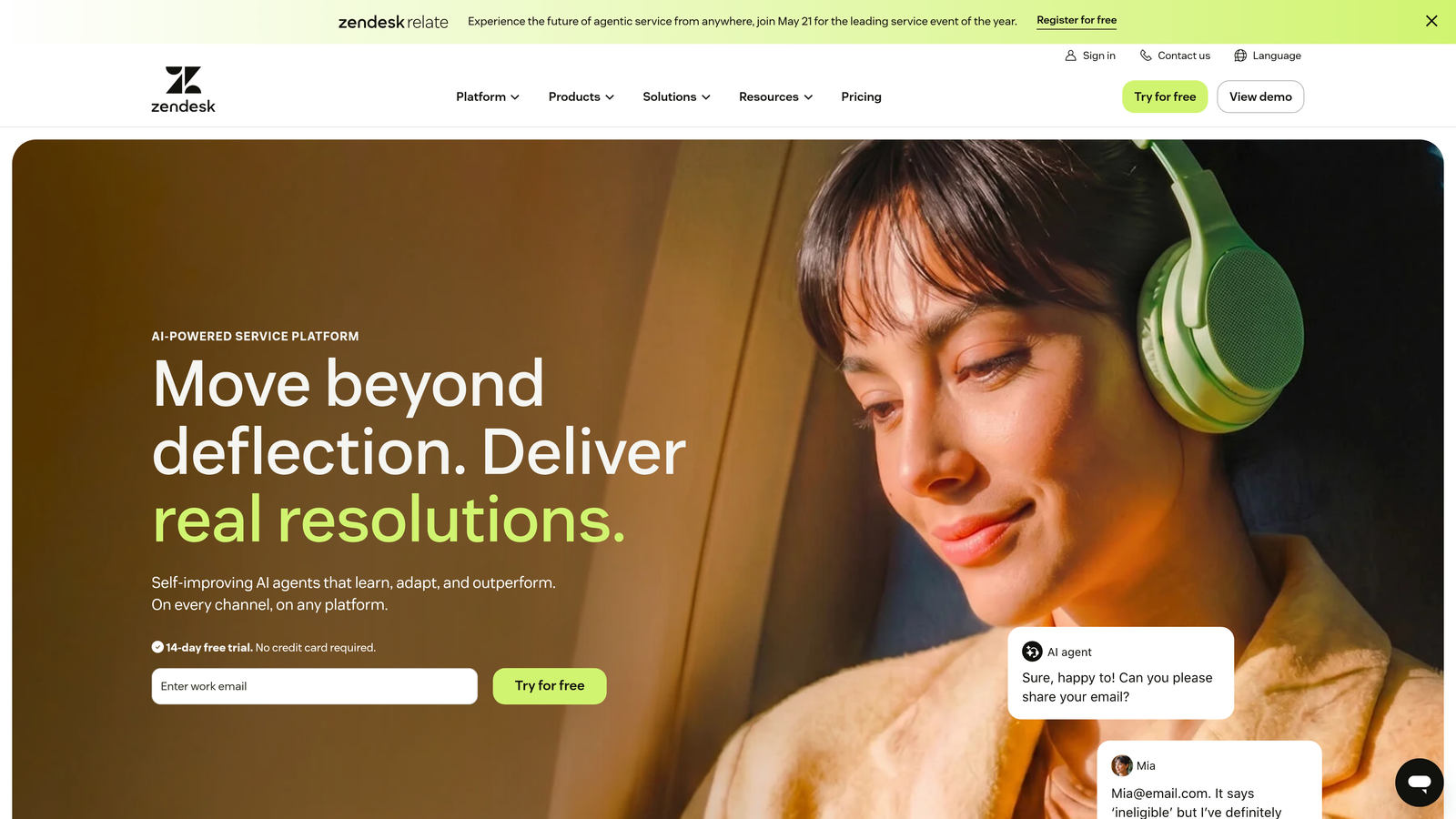
Zendesk AI is an enterprise helpdesk platform with AI-powered ticket routing, agent assist, and automated resolution capabilities built into the broader Zendesk Suite.
Where This Tool Shines
Zendesk's strength is its ecosystem. With over 1,500 marketplace integrations and years of enterprise adoption, it's the platform that most support teams have already touched in some form. The AI capabilities added in recent years, including intelligent triage, generative summarization, and agent assist, layer naturally on top of that foundation.
For teams that need sophisticated reporting, custom dashboards, and enterprise-grade SLA management, Zendesk delivers. The tradeoff is that AI feels like an enhancement to an existing system rather than a core architecture, which can affect how deeply it learns and adapts over time.
Key Features
Intelligent Ticket Routing: AI-powered triage automatically categorizes and routes tickets to the right team or agent.
Agent Assist: Surfaces suggested responses and relevant knowledge base articles to help agents respond faster.
Generative AI Tools: Ticket summarization and tone adjustment help agents communicate more effectively at scale.
1,500+ Integrations: Extensive marketplace connects Zendesk to virtually every tool in your stack.
Advanced Analytics: Custom reporting dashboards and SLA tracking built for enterprise operations.
Best For
Enterprise support organizations with large agent teams, complex workflows, and a need for deep customization. Also a strong choice for teams already invested in the Zendesk ecosystem who want to add AI without migrating platforms.
Pricing
Suite plans start at $55 per agent per month. AI add-on pricing varies depending on usage and plan tier.
3. Intercom Fin
Best for: Product-led growth companies that want conversational AI resolution embedded directly in their in-app messaging experience.
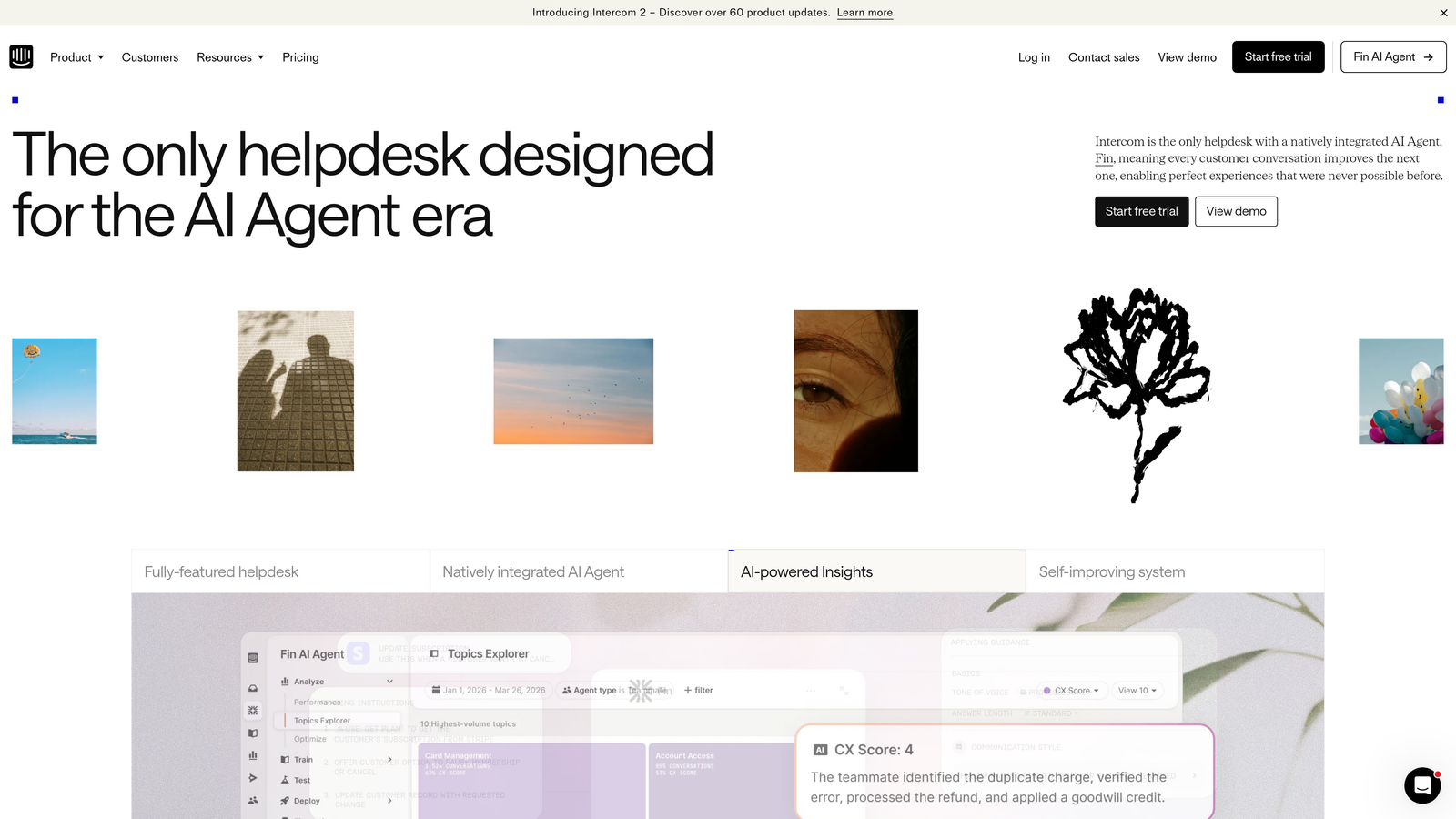
Intercom Fin is a conversational AI agent built into Intercom's messaging platform, trained on your help center content to resolve customer questions autonomously within the chat experience.
Where This Tool Shines
Fin works particularly well for PLG products where the chat widget is the primary support channel. It trains on your existing help center content and custom sources, which means setup is faster than building a custom knowledge base from scratch. The handoff to human agents is smooth, with full conversation context carried over so customers don't have to repeat themselves.
Intercom's broader platform also includes product tours, onboarding tools, and in-app messaging, which makes it a natural fit for teams that want support and activation to live in the same layer of their product.
Key Features
Fin AI Agent: Trained on help center content and custom sources to resolve questions autonomously within chat.
Seamless Human Handoff: Transfers to live agents with full conversation context when Fin reaches its limits.
Multi-Channel Support: Covers in-app messaging, email, and additional channels from a single platform.
Workflows Automation Builder: Custom automation for routing, tagging, and follow-up actions without code.
Product Tours and Onboarding: Activation and support tools integrated in the same platform, reducing tool sprawl.
Best For
PLG and SaaS companies where the chat widget is the dominant support channel and where support and onboarding workflows overlap significantly. Teams already using Intercom for messaging will find Fin a natural extension.
Pricing
Starts at $29 per seat per month. Fin AI is charged per resolution, so costs scale with actual usage rather than a flat fee.
4. Freshdesk (Freddy AI)
Best for: Growing teams that need a capable helpdesk with AI features at an accessible price point.
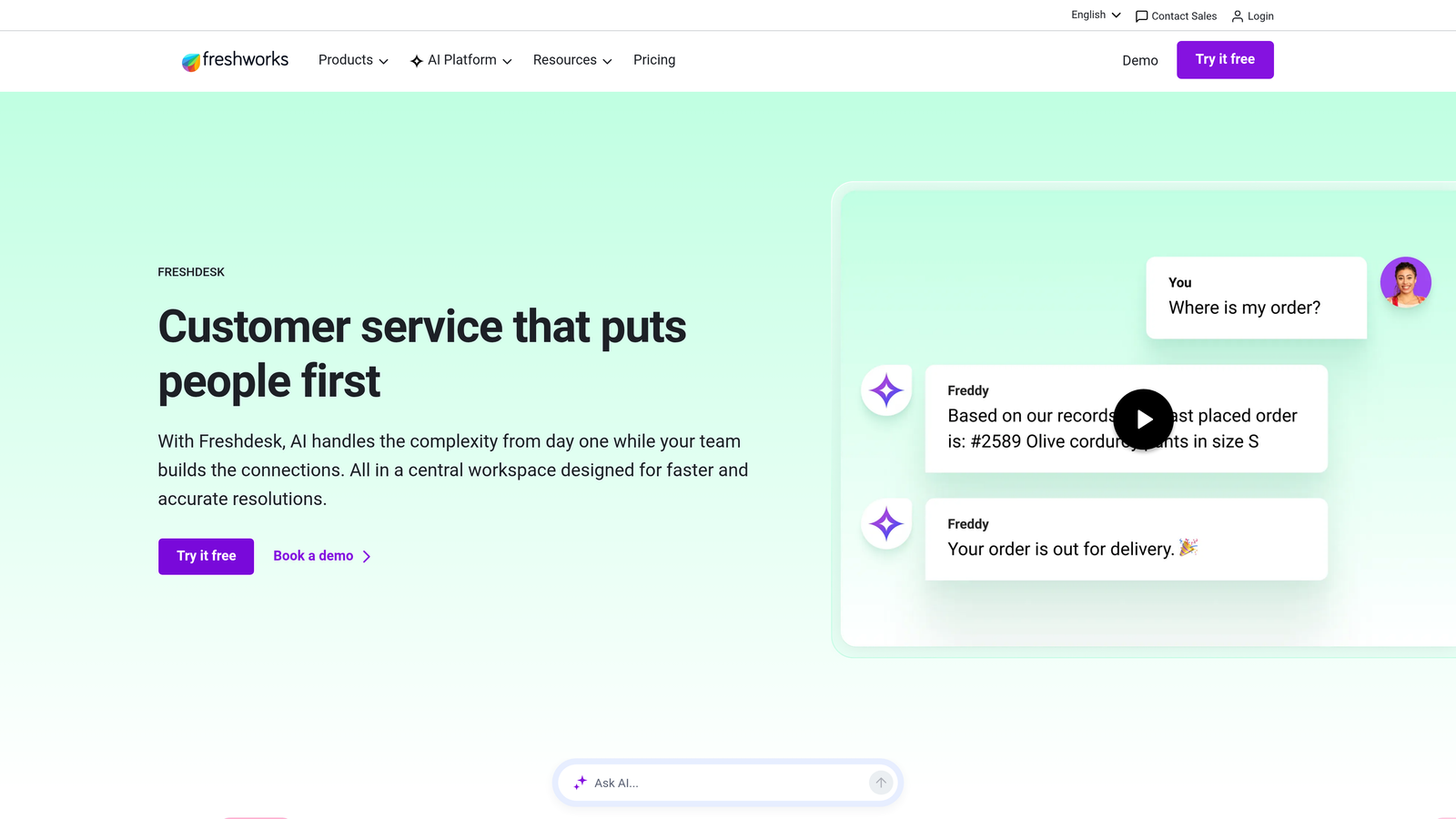
Freshdesk is a budget-friendly helpdesk with Freddy AI for ticket auto-triage, response suggestions, and self-service chatbots, well-suited for teams scaling their first real support operation.
Where This Tool Shines
Freshdesk hits a sweet spot between affordability and functionality. The free tier is genuinely useful for small teams, and the paid plans introduce Freddy AI capabilities that automate categorization, suggest responses, and power a no-code chatbot builder. For teams that don't have enterprise budgets but need more than a shared Gmail inbox, it's a strong starting point.
Omnichannel coverage across email, chat, phone, and social is included without the premium pricing that enterprise alternatives typically charge for the same breadth.
Key Features
Freddy AI Triage: Automatically categorizes and prioritizes incoming tickets based on content and history.
AI Response Suggestions: Recommends replies to agents based on similar resolved tickets and knowledge base content.
No-Code Chatbot Builder: Self-service bot setup without engineering involvement.
Omnichannel Support: Email, chat, phone, and social media managed from a single interface.
Free Tier: A functional free plan for small teams before committing to paid features.
Best For
Small to mid-sized teams looking for a cost-effective helpdesk with AI capabilities that don't require a large implementation project. Also useful as a stepping stone before migrating to a more AI-native platform as volume grows.
Pricing
Free plan available. Paid plans start at $15 per agent per month, making it one of the most accessible options on this list.
5. Ada
Best for: Enterprise and mid-market teams that want a dedicated, no-code AI agent platform built specifically for autonomous resolution across channels and languages.
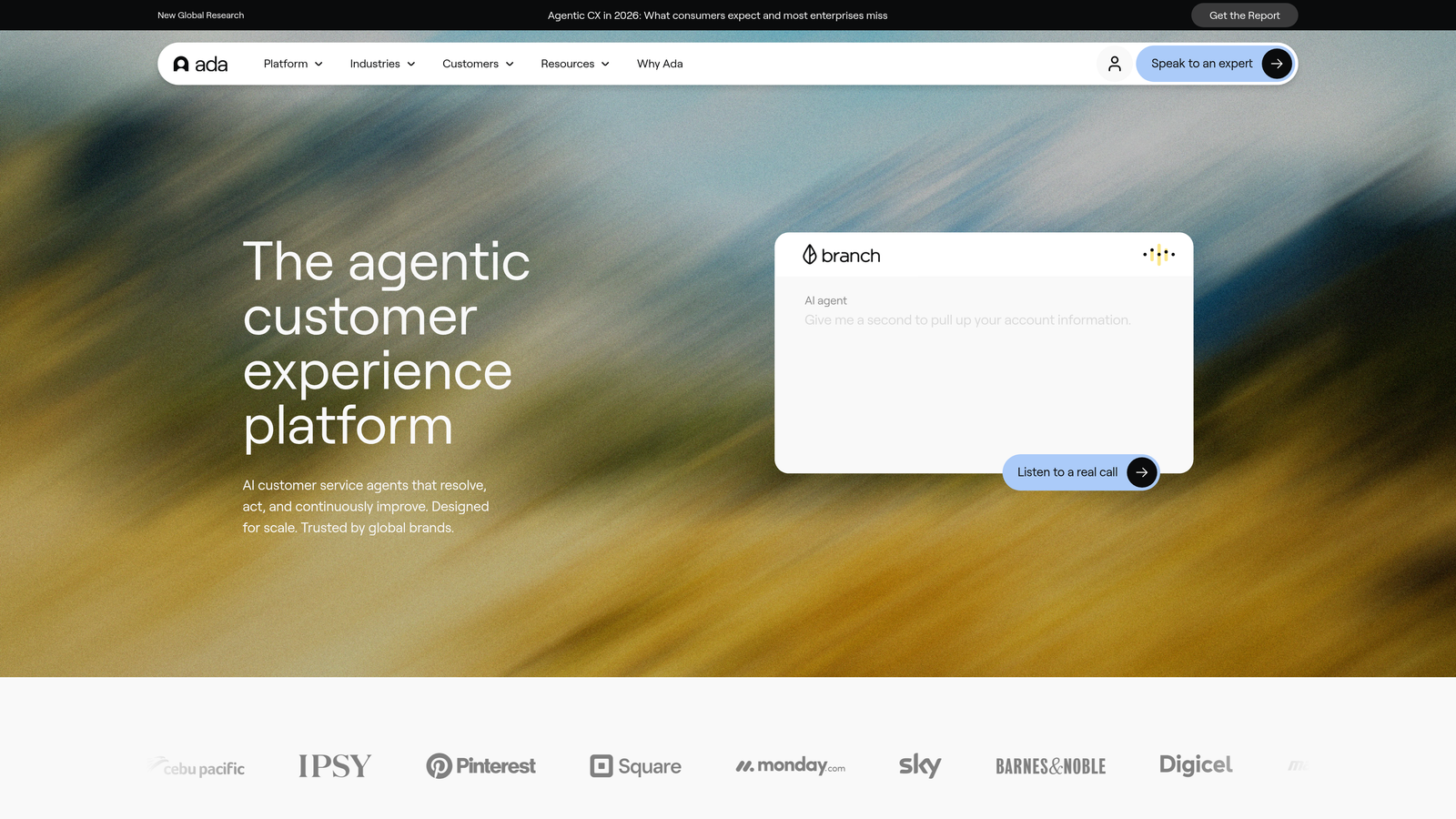
Ada is an AI-first customer service automation platform purpose-built for creating autonomous AI agents that handle support conversations across channels and languages without requiring code.
Where This Tool Shines
Ada's focus is narrow and intentional: autonomous resolution, not agent assist. The platform's reasoning engine allows AI agents to handle complex, multi-turn conversations without falling back to scripted flows. For companies with a global customer base, the multilingual support across 50+ languages is a genuine differentiator that removes a common barrier to international deployment.
Ada also connects to major CRMs and helpdesks, meaning it can sit on top of your existing support infrastructure rather than replacing it, which reduces deployment friction for teams with established workflows.
Key Features
No-Code AI Agent Builder: Build and deploy AI agents with a reasoning engine without engineering resources.
50+ Language Support: Multilingual resolution across a wide range of languages out of the box.
CRM and Helpdesk Integrations: Connects with Zendesk, Salesforce, and other major platforms.
Resolution Analytics: Tracks automated resolution rates and performance metrics to identify improvement areas.
Voice and Messaging Channels: Extends AI resolution beyond chat to voice and additional messaging channels.
Best For
Mid-market and enterprise companies with international customer bases or high conversation volumes across multiple channels. Particularly strong for teams that want autonomous resolution without replacing their existing helpdesk infrastructure.
Pricing
Custom pricing. Contact Ada directly for a quote based on your volume and use case.
6. Tidio
Best for: Small businesses and e-commerce teams that want accessible live chat and AI chatbot capabilities without complexity.
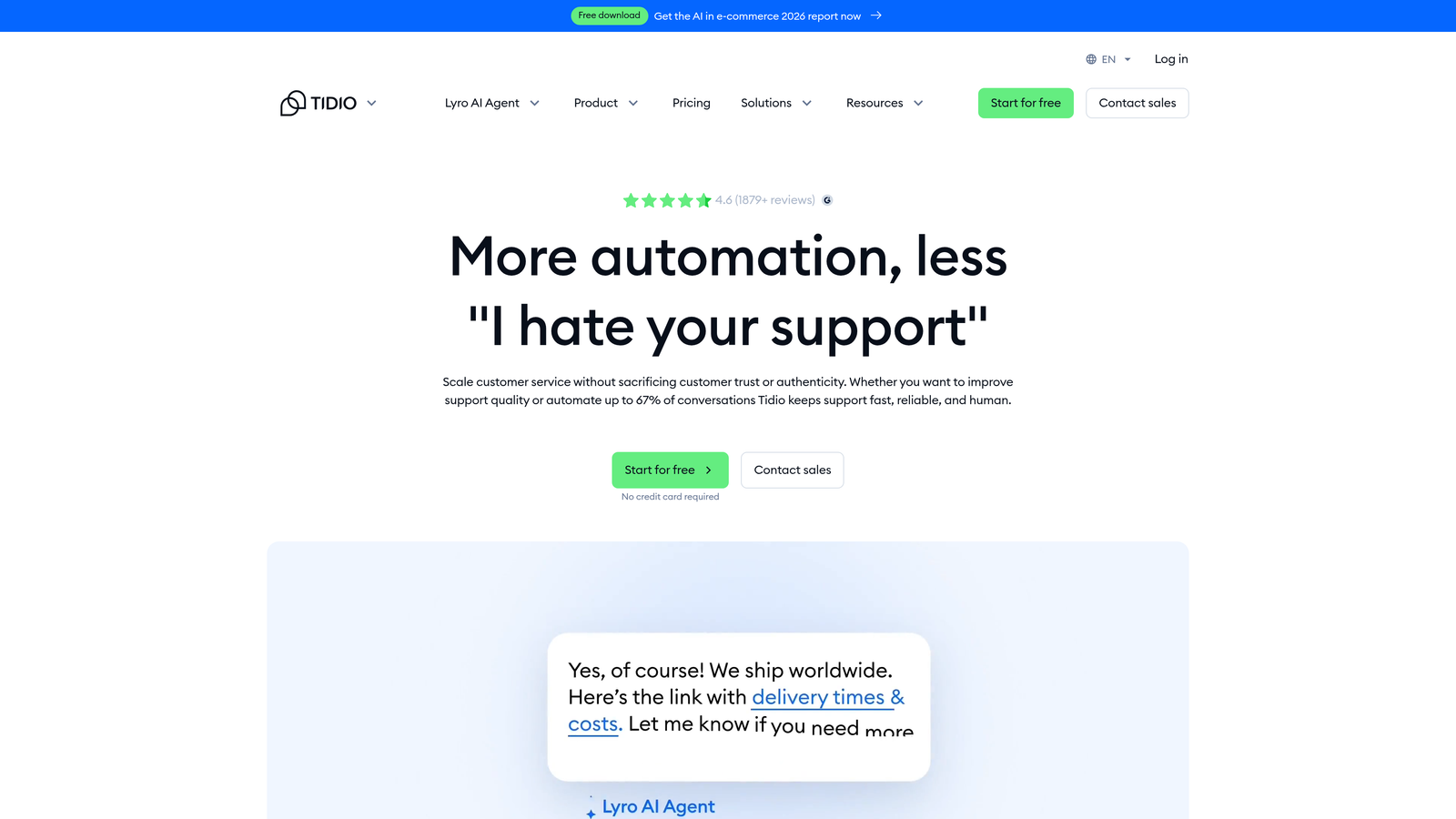
Tidio is an accessible live chat and chatbot platform combining AI-powered reply suggestions with a visual chatbot builder, designed for small businesses and e-commerce operations.
Where This Tool Shines
Tidio's appeal is its low barrier to entry. The visual drag-and-drop chatbot builder means you can have an automated support flow live without any technical background. Lyro, Tidio's AI chatbot, handles common customer questions automatically and hands off to a human agent when it can't resolve the issue.
For e-commerce teams in particular, the native integrations with Shopify, WooCommerce, and BigCommerce make it easy to connect support to order data, which is often the most common source of customer questions in that context.
Key Features
Lyro AI Chatbot: Automated customer conversations powered by AI, trained on your support content.
Visual Chatbot Builder: Drag-and-drop flow builder for creating automated sequences without code.
Live Chat with AI Suggestions: Real-time reply suggestions help human agents respond faster.
E-Commerce Integrations: Native connections to Shopify, WooCommerce, and BigCommerce.
Visitor Tracking: See who's on your site and what they're doing before they reach out.
Best For
Small businesses and e-commerce brands that need a simple, affordable live chat and chatbot solution. Not the right fit for complex B2B SaaS support workflows, but excellent for straightforward customer service at low volume.
Pricing
Free plan available. Paid plans start at $29 per month, making it one of the most affordable options with AI capabilities on this list.
7. HubSpot Service Hub
Best for: Revenue-focused teams that want support tightly integrated with CRM, marketing, and sales data in a single platform.
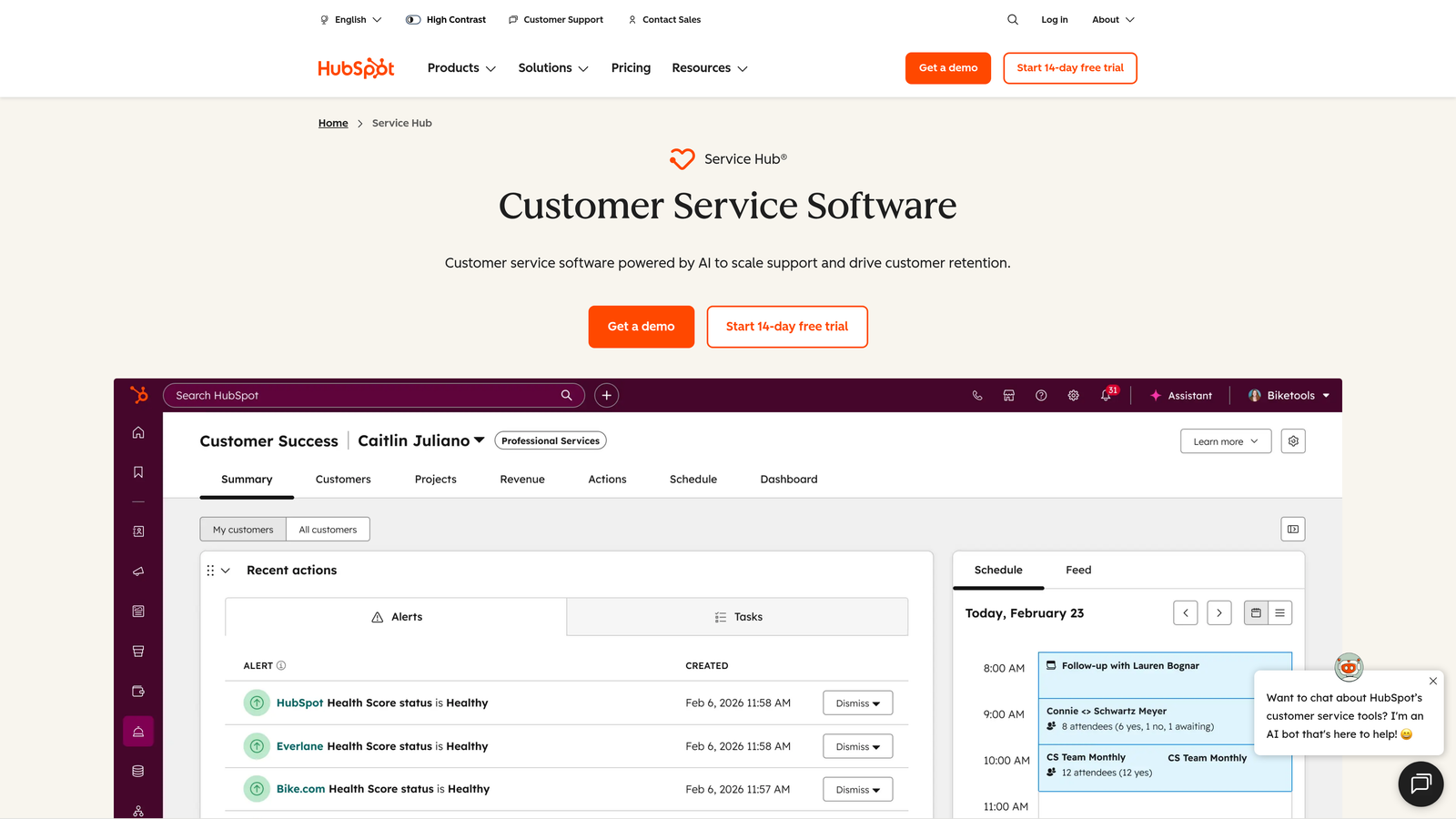
HubSpot Service Hub is a customer service platform tightly integrated with HubSpot CRM, offering ticketing, knowledge base, and AI-powered automation within a unified revenue operations stack.
Where This Tool Shines
If your team is already running on HubSpot for marketing and sales, Service Hub is a natural extension. Every support interaction carries full CRM context: deal stage, contact history, lifecycle stage, and more. That means your support agents aren't working blind, and the AI chatbot (Breeze) can be trained on your knowledge base to deflect common questions before they reach an agent.
The NPS and customer feedback tools built into the platform also make it easier to close the loop between support outcomes and customer health, a connection that many standalone support tools require third-party integrations to achieve.
Key Features
Full CRM Context: Every ticket surfaces complete contact and deal history from HubSpot CRM automatically.
Breeze AI Chatbot: AI-powered chatbot trained on your knowledge base for self-service resolution.
Shared Inbox with SLAs: Automated routing and SLA tracking across team inboxes.
Customer Feedback and NPS: Built-in survey and NPS tools to measure support impact on customer health.
Cross-Hub Integration: Seamless connection to HubSpot Marketing Hub and Sales Hub for unified revenue operations.
Best For
Teams already invested in the HubSpot ecosystem who want to unify support with CRM and revenue data. Also a strong choice for companies where support, sales, and marketing handoffs are frequent and context-sharing is critical.
Pricing
Free tools available. Starter plans begin at $20 per month; Professional plans at $100 per seat per month.
8. Kustomer
Best for: High-volume support teams that need a unified customer timeline across every channel with AI automation layered on top.
Kustomer is a CRM-powered customer service platform with a unified customer timeline view, offering AI automation layered on comprehensive interaction history across channels.
Where This Tool Shines
Kustomer's defining feature is the unified timeline: every interaction a customer has ever had with your company, across every channel, in a single chronological view. For support teams handling complex, multi-touch customer relationships, this context is invaluable. Agents aren't piecing together history from multiple tools; it's all in one place.
The AI layer handles classification, routing, and suggested responses, and the proactive support capabilities allow teams to reach out to customers based on behavioral signals before problems escalate into tickets.
Key Features
Unified Customer Timeline: Every interaction across all channels consolidated into a single chronological view per customer.
AI Classification and Routing: Automated ticket categorization and intelligent routing based on content and customer history.
Proactive Support: Trigger outreach based on customer behavior signals before issues become inbound tickets.
Custom Business Process Automation: Build complex workflow automations tailored to your specific support processes.
Multi-Channel Coverage: Chat, email, SMS, social, and voice managed from a single interface.
Best For
Enterprise and mid-market teams with high conversation volumes, complex customer relationships, and a need for deep historical context in every support interaction. Particularly strong for companies where customer lifetime value is high and relationship continuity matters.
Pricing
Enterprise pricing starts at $89 per user per month. Best suited for teams where the ROI of unified context justifies the per-seat investment.
9. Help Scout
Best for: Teams that want clean, simple shared inbox tooling with selective AI features and a human-first support philosophy.
Help Scout is a shared inbox platform that blends simplicity with selective AI features like draft generation and conversation summarization, built for teams that want automation without losing the human touch.
Where This Tool Shines
Help Scout has always prioritized the experience of both the support agent and the customer. The interface is clean, the setup is fast, and the tool doesn't overwhelm teams with features they don't need. The AI additions, including draft generation and conversation summarization, are practical and unobtrusive rather than central to the product identity.
The Beacon widget provides embedded help and chat directly in your product, and the Docs knowledge base includes AI-powered search that helps customers find answers before submitting a ticket. For teams that have found heavier platforms overcomplicated their workflows, Help Scout is a deliberate step back toward clarity.
Key Features
Clean Shared Inbox: Collision detection prevents multiple agents from responding to the same conversation simultaneously.
AI Drafts and Summarization: AI-generated reply drafts and conversation summaries to speed up agent workflows.
Beacon Widget: Embedded help and chat widget for in-product support without leaving the user's current screen.
Docs Knowledge Base: AI-powered search helps customers self-serve before reaching the support queue.
Simple Integrations: Straightforward API and connections to popular tools without complex setup requirements.
Best For
Small to mid-sized teams that prioritize simplicity and agent experience over deep AI automation. Also a good fit for companies where support volume is manageable and the primary goal is quality interactions rather than autonomous resolution at scale.
Pricing
Starts at $25 per user per month. Straightforward per-seat pricing with no complex add-on tiers.
Finding the Right Fit for Your Support Stack
The platforms on this list serve genuinely different needs, and the right choice depends less on which tool has the most features and more on where your team is today and where you're trying to go.
If autonomous AI resolution is the goal and you want a platform where AI is the architecture rather than an add-on, Halo AI is the strongest fit for B2B SaaS teams. The page-aware context, business intelligence layer, and continuous learning model make it more than a support tool; it becomes a strategic asset. For teams exploring what AI-native support looks like in practice, it's worth understanding how the technology works before committing to a platform built around older helpdesk assumptions.
For enterprise teams already embedded in an ecosystem: Zendesk AI is the safe, scalable choice with the deepest marketplace. Intercom Fin is the natural pick for PLG companies where the chat widget is the primary support surface. HubSpot Service Hub wins when revenue operations unification is the priority.
On the budget-conscious end, Freshdesk and Tidio offer real AI capabilities without enterprise pricing. Kustomer earns its higher price point for teams where unified customer history is non-negotiable. And Help Scout remains the go-to for teams that want simplicity and human-first support without the overhead of a complex platform.
Your support team shouldn't scale linearly with your customer base. Let AI agents handle routine tickets, guide users through your product, and surface business intelligence while your team focuses on complex issues that need a human touch. See Halo in action and discover how continuous learning transforms every interaction into smarter, faster support.