9 Best Intelligent Support Platforms for B2B Teams in 2026
Discover the 9 best intelligent support platforms built specifically for B2B teams in 2026, evaluated on AI capability, scalability, and analytics depth. This guide breaks down what separates truly AI-native platforms from basic helpdesks with bolt-on features, helping support leaders choose a solution that resolves tickets autonomously, learns continuously, and delivers actionable business intelligence beyond standard deflection metrics.
 Grant CooperFounder13 min read
Support teams used to be reactive by design: wait for a ticket, assign it, resolve it, repeat. But the expectations of B2B customers have shifted dramatically, and the platforms built to serve them have had to evolve just as fast. Today's intelligent support platforms don't just manage tickets — they resolve them autonomously, learn from every interaction, and surface business intelligence that goes far beyond deflection rates.
What separates a truly intelligent platform from a helpdesk with AI features bolted on? A few things: AI-native architecture built for autonomous resolution, contextual awareness that understands what users are actually doing, continuous learning that improves with every conversation, and analytics that connect support data to broader business signals.
To build this list, we evaluated platforms on AI capability depth, integration ecosystems, B2B scalability, analytics quality, and how quickly teams can get up and running. Whether you're a fast-growing SaaS company or an enterprise team modernizing a legacy stack, here are the top intelligent support platforms worth your attention in 2026.
1. Halo AI
Best for: B2B SaaS teams that want AI-native support with business intelligence built in.
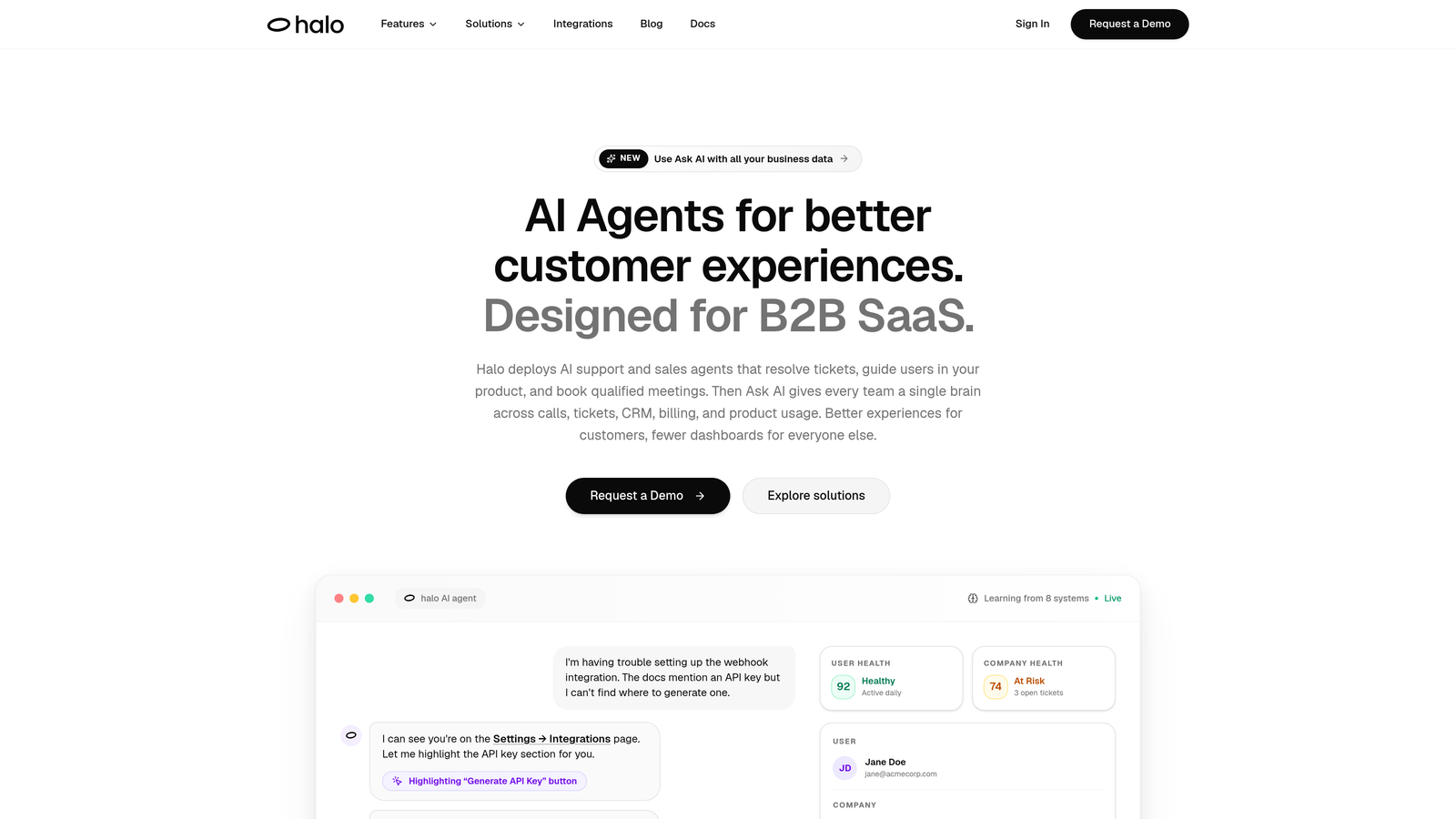
Halo AI is an AI-native intelligent support platform that deploys autonomous agents for ticket resolution, page-aware product guidance, and business intelligence — learning from every interaction to scale support without scaling headcount.
Where This Tool Shines
Halo is built from the ground up around intelligence, not retrofitted with AI features after the fact. The platform's page-aware chat widget is a standout capability: it understands the exact page a user is on and what they're seeing, enabling contextual visual guidance that feels more like a knowledgeable colleague than a generic chatbot.
Beyond resolution, Halo's smart inbox surfaces business intelligence that most support platforms don't touch — customer health signals, revenue insights, and anomaly detection. That means your support data becomes a strategic asset, not just an operational metric.
Key Features
Page-Aware Chat Widget: Sees what users see in real time, delivering contextual guidance tied to the specific product screen they're on.
Autonomous AI Agents: Resolve support tickets end-to-end and continuously learn from each interaction to improve accuracy over time.
Smart Inbox with Business Intelligence: Surfaces customer health signals, revenue intelligence, and anomaly detection directly from support conversations.
Automated Bug Ticket Creation: Converts support conversations into structured bug reports with integrations like Linear, removing manual steps from your engineering workflow.
Deep B2B Stack Integrations: Connects natively with Slack, HubSpot, Intercom, Stripe, Zoom, PandaDoc, and Fathom for a fully connected support operation.
Best For
B2B product and support teams that have outgrown traditional helpdesks and need an AI-first platform that resolves tickets, guides users through complex products, and generates business intelligence. Particularly well-suited for SaaS companies where product context and customer health data are critical to support quality.
Pricing
Contact for pricing. Halo is designed for B2B teams actively scaling support operations and offers custom packages based on team size and usage.
2. Intercom with Fin AI
Best for: Teams wanting a polished messaging-first experience with strong AI automation layered in.
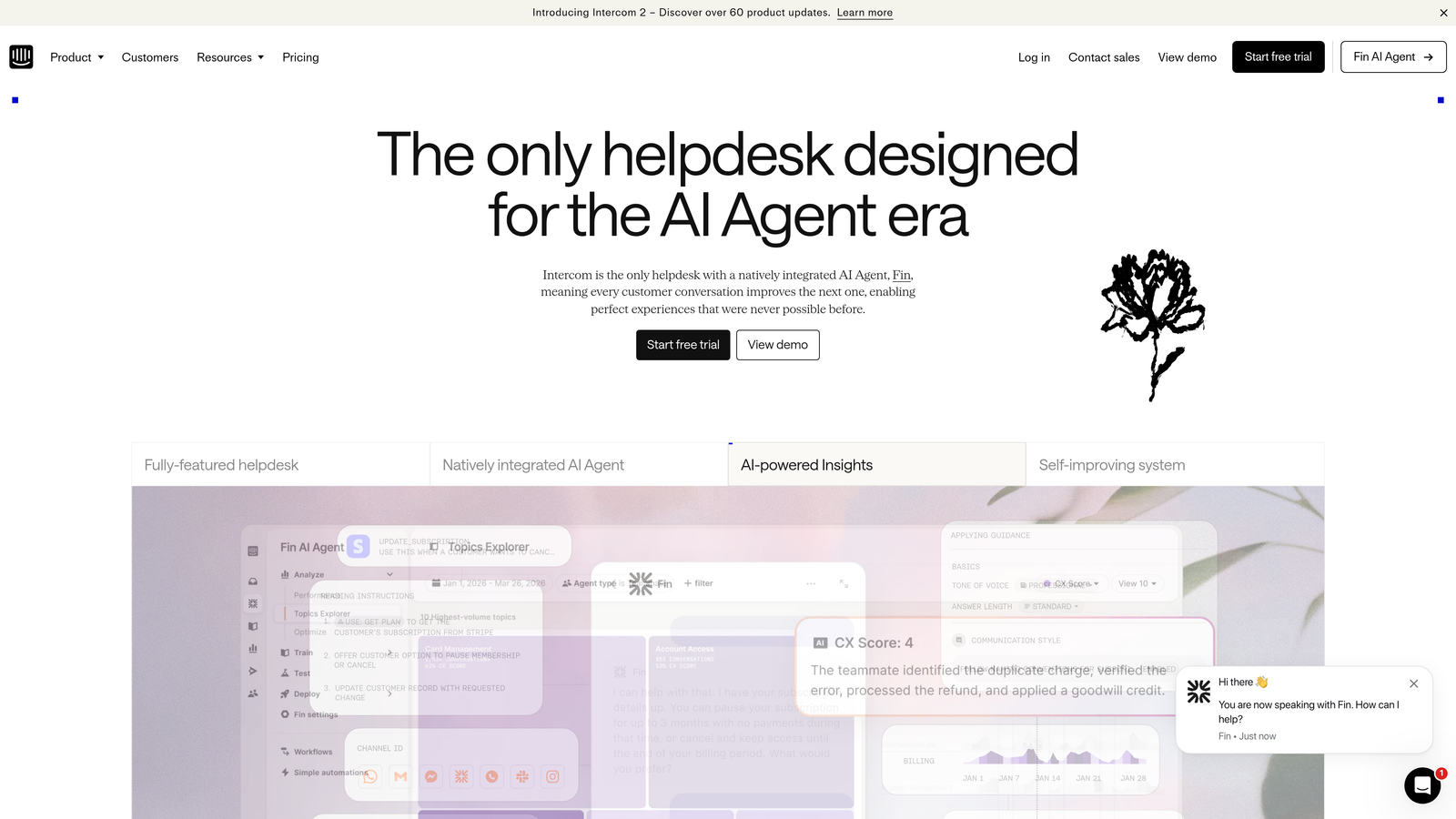
Intercom is a messaging-first customer platform with Fin AI, an AI agent that resolves support questions using your existing help center content and conversational AI.
Where This Tool Shines
Intercom's strength is its polished, conversational experience. Fin AI is trained on your help center articles and can handle a wide range of customer questions without human involvement. The platform's omnichannel messenger covers in-app, email, and web, making it a natural fit for product-led growth companies with high inbound volume.
The agent copilot features — including AI-generated conversation summaries and tone adjustments — help human agents work faster when escalations do occur. It's a mature platform with a large integration ecosystem to match.
Key Features
Fin AI Agent: Trained on your help center articles for automated, context-aware resolution without manual bot-building.
Omnichannel Messenger: Unified in-app, email, and web support with a consistent user experience across touchpoints.
Custom Workflows and Automation Builder: Visual builder for creating routing rules, escalation logic, and automated sequences.
Agent Copilot Features: AI-generated summaries, suggested replies, and tone-shift tools to accelerate human agent performance.
App Ecosystem: Robust marketplace with integrations across CRM, billing, analytics, and product tools.
Best For
SaaS and tech companies with established help centers looking to automate a significant portion of inbound volume without rebuilding their support infrastructure. Works well for teams already invested in the Intercom ecosystem.
Pricing
Starts at $39/seat/month. Fin AI usage is billed per resolution, so costs scale with automation volume rather than seat count.
3. Zendesk AI
Best for: Enterprise teams needing a comprehensive, battle-tested platform with deep AI capabilities across channels.
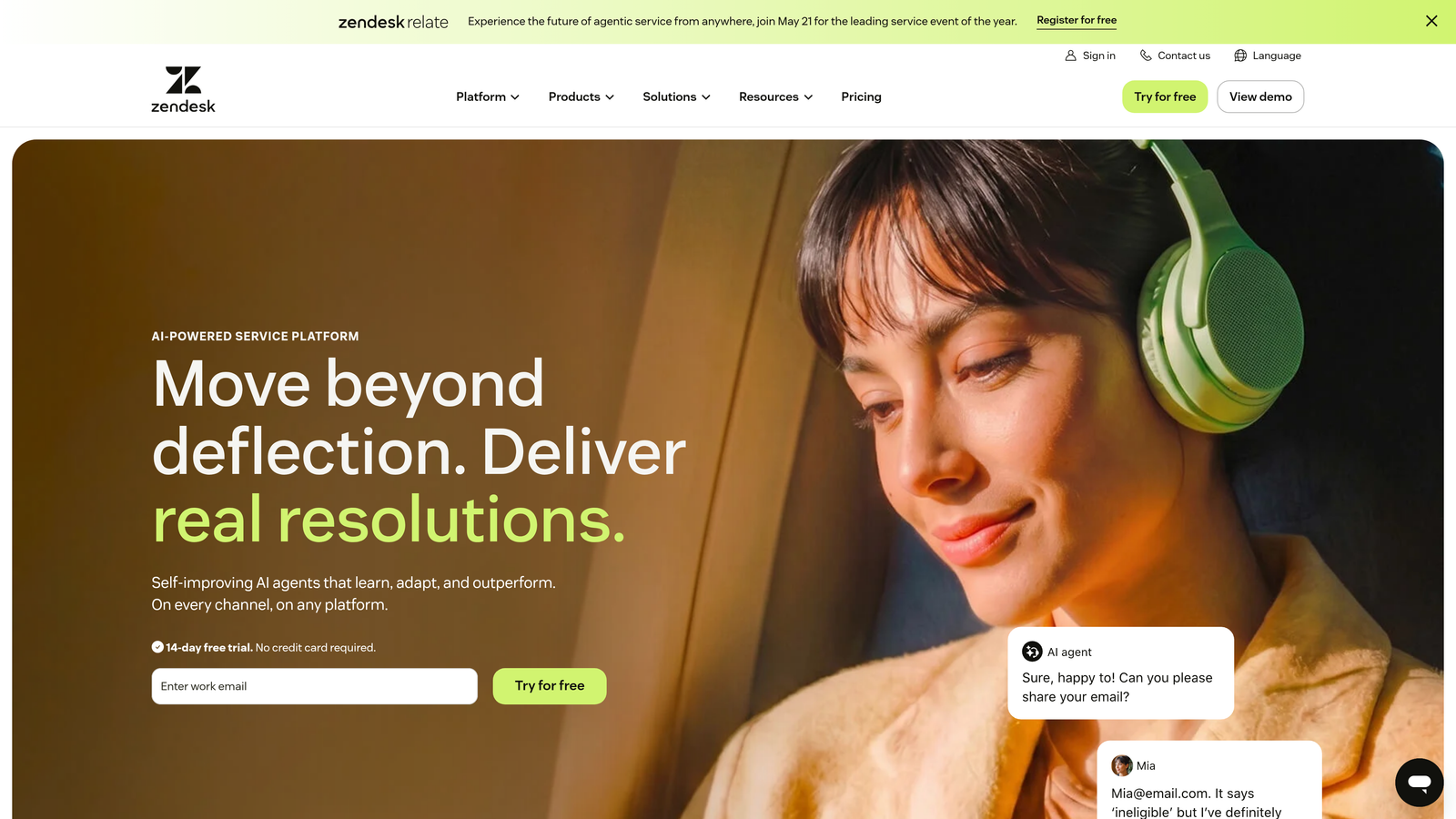
Zendesk is an enterprise-grade helpdesk platform with AI agents, intelligent triage, and generative AI tools built throughout the Zendesk Suite.
Where This Tool Shines
Zendesk has spent years building one of the most comprehensive support platforms available, and its AI investments reflect that scale. Intelligent triage automatically classifies intent, language, and sentiment before a ticket ever reaches a human, while AI agents handle autonomous resolution across channels.
The generative AI tools for agents — expand, summarize, tone shift — are practical productivity boosters rather than novelty features. For large teams managing high ticket volumes across multiple channels, Zendesk's depth is difficult to match.
Key Features
AI Agents: Autonomous ticket resolution across chat, email, and messaging channels with configurable escalation paths.
Intelligent Triage: Auto-classifies tickets by intent, language, and sentiment to route and prioritize accurately at scale.
Generative AI for Agents: Expand, summarize, and adjust tone of responses to improve agent speed and consistency.
Advanced Analytics: Comprehensive reporting dashboards covering team performance, ticket trends, and customer satisfaction.
Marketplace Integrations: Over 1,500 integrations covering virtually every tool in the modern B2B stack.
Best For
Mid-market and enterprise teams with complex support operations, multiple channels, and a need for deep customization. Less ideal for early-stage teams given the cost and configuration overhead.
Pricing
Suite plans start at $55/agent/month. AI capabilities are available as an add-on at additional cost, which can make total pricing significant for larger teams.
4. Freshdesk with Freddy AI
Best for: Growing teams that want intelligent automation at accessible, predictable pricing.
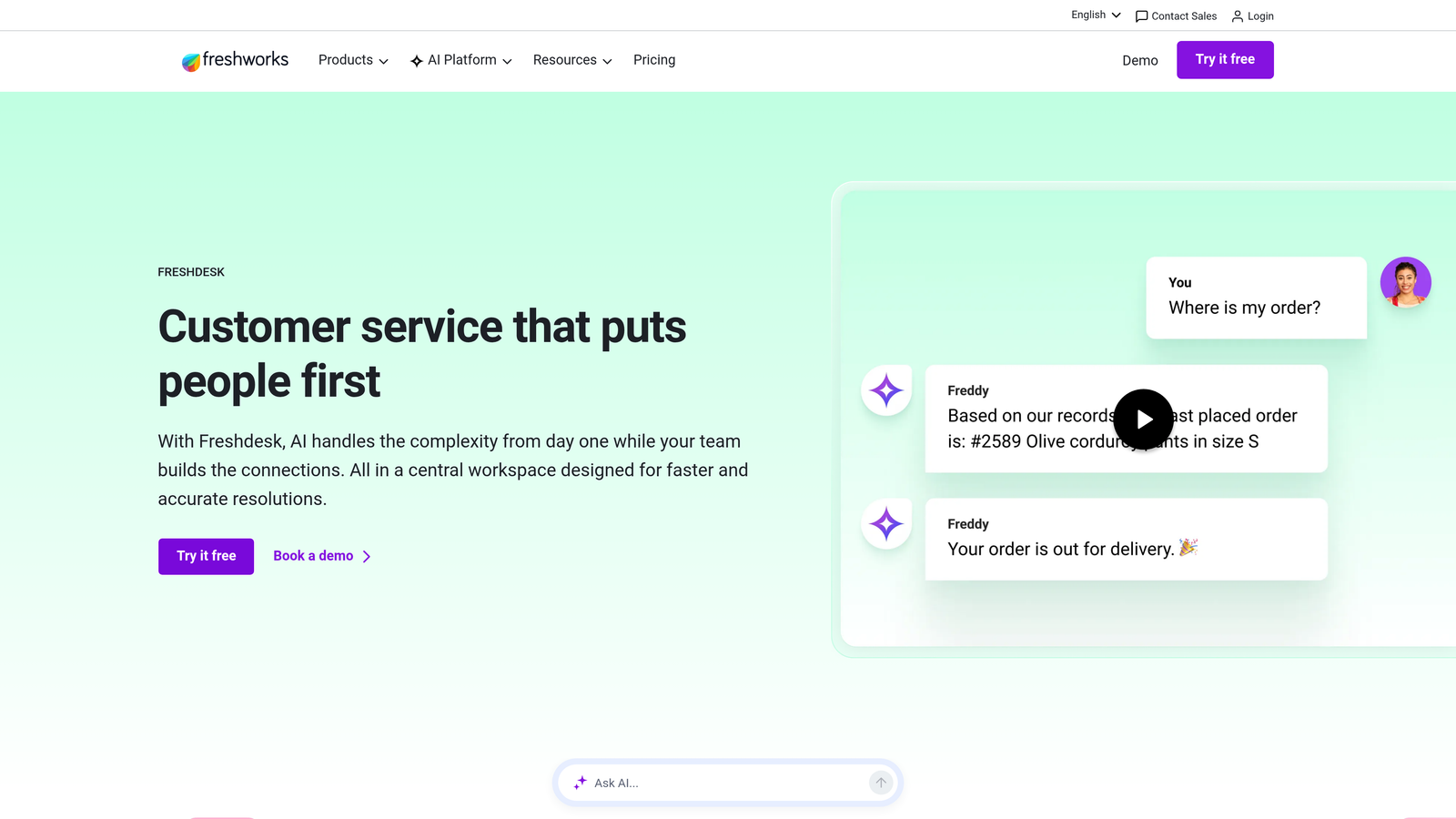
Freshdesk is a customer support platform from Freshworks with Freddy AI providing auto-triage, suggested responses, and AI-driven ticket resolution without the enterprise price tag.
Where This Tool Shines
Freshdesk hits a sweet spot for teams that need real AI capability without committing to enterprise-level spend. Freddy AI handles response suggestions and auto-triage out of the box, and the AI-powered chatbots cover self-service resolution for common queries across channels.
The unified ticketing across email, chat, phone, and social keeps everything in one place, and the free tier makes it genuinely accessible for smaller teams testing the waters before scaling up.
Key Features
Freddy AI Copilot: Suggests responses and handles auto-triage to reduce manual sorting and speed up agent workflows.
AI-Powered Chatbots: Self-service resolution for common queries across web, mobile, and messaging channels.
Unified Ticketing: Consolidates email, chat, phone, and social channels into a single, organized workspace.
Collaboration Tools: Shared inbox, team huddles, and internal notes for complex multi-agent resolutions.
Free Tier Available: Functional free plan for small teams, with clear upgrade paths as volume grows.
Best For
Small to mid-sized B2B teams looking for a cost-effective entry into AI-assisted support. Also a strong fit for companies already using other Freshworks products like Freshsales or Freshservice.
Pricing
Free plan available. Paid plans start at $15/agent/month. Freddy AI capabilities are available as an add-on at additional cost.
5. Ada
Best for: Teams prioritizing autonomous resolution rate over deflection metrics.
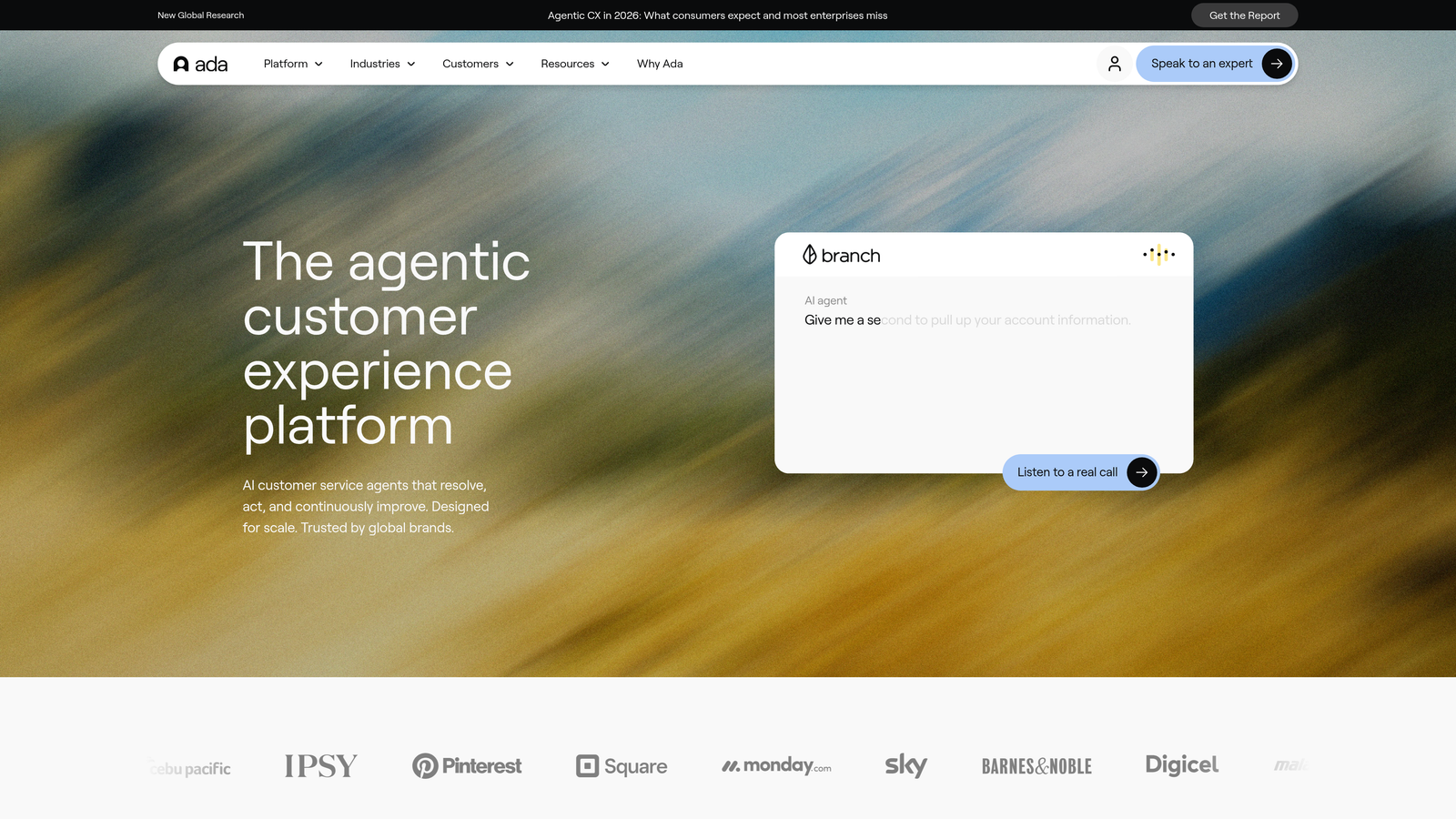
Ada is an AI-first customer service automation platform built around an AI agent that reasons through complex queries and resolves conversations end-to-end without human intervention.
Where This Tool Shines
Ada's core differentiator is its reasoning engine. Rather than matching keywords to pre-written answers, Ada's AI agent works through multi-step queries, connects to business systems to take real actions (like checking order status or updating account details), and measures success by resolution rate rather than deflection. That's a meaningful philosophical difference.
The no-code coaching interface makes it accessible to non-technical teams, and the omnichannel deployment covers web, mobile, social, SMS, and email without requiring separate configurations for each channel.
Key Features
Reasoning Engine: Handles multi-step, complex queries by reasoning through context rather than relying on static decision trees.
Action-Oriented Resolution: Connects to business systems to check orders, update accounts, and take real actions within conversations.
Resolution-First Measurement: Tracks actual resolution rate rather than deflection, providing a more honest performance metric.
Omnichannel Deployment: Single configuration that deploys across web, mobile, social, SMS, and email simultaneously.
No-Code Coaching Interface: Non-technical teams can train and adjust the AI agent without developer involvement.
Best For
Mid-market and enterprise B2B teams that want an AI agent focused on genuine resolution, especially where customers need to take actions (not just get answers) through the support channel.
Pricing
Custom pricing based on resolution volume. Contact Ada directly for quotes tailored to your expected interaction volume and use case.
6. Forethought
Best for: Teams wanting to layer advanced AI intelligence on top of an existing helpdesk investment.
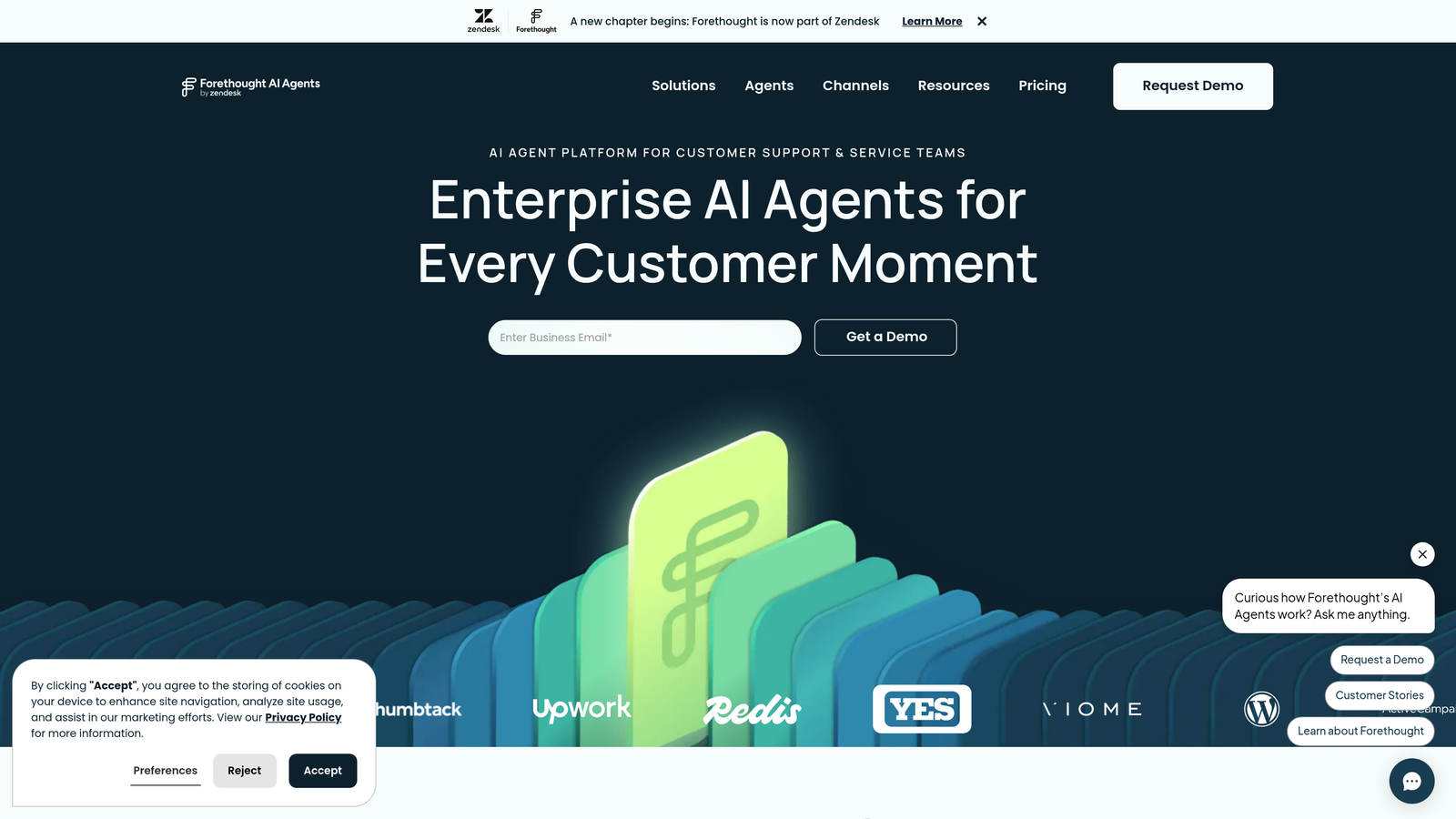
Forethought is an AI platform that adds intelligent automation on top of existing helpdesks like Zendesk and Salesforce, using SupportGPT for generative AI-powered resolution without replacing your current stack.
Where This Tool Shines
Forethought's key advantage is additive intelligence: it doesn't ask you to rip and replace your existing helpdesk. Instead, it layers generative AI resolution, intelligent routing, and agent productivity tools on top of whatever you're already running. For teams with significant existing investments in Zendesk or Salesforce, this approach reduces migration risk considerably.
The Discover AI component adds a layer of workflow optimization intelligence, identifying patterns in your support data to surface improvement opportunities your team might not otherwise see.
Key Features
Solve AI: Automated ticket resolution using generative AI trained on your knowledge base and historical ticket data.
Triage AI: Intelligent routing and prioritization that sends tickets to the right queue or agent automatically.
Assist AI Copilot: Real-time suggestions and context for human agents handling escalated or complex tickets.
Discover AI: Analyzes support patterns to surface workflow optimization insights and identify resolution gaps.
Helpdesk-Agnostic Layer: Works on top of Zendesk, Salesforce, and other major helpdesks without replacing them.
Best For
Mid-market to enterprise teams with existing helpdesk infrastructure who want to add AI intelligence without migration. Particularly valuable for Zendesk and Salesforce Service Cloud customers looking to extend their investment.
Pricing
Custom pricing at mid-market to enterprise tiers. Contact Forethought for a quote based on your helpdesk configuration and volume.
7. Tidio with Lyro AI
Best for: Small to mid-sized teams wanting intelligent automation without technical complexity or high cost.
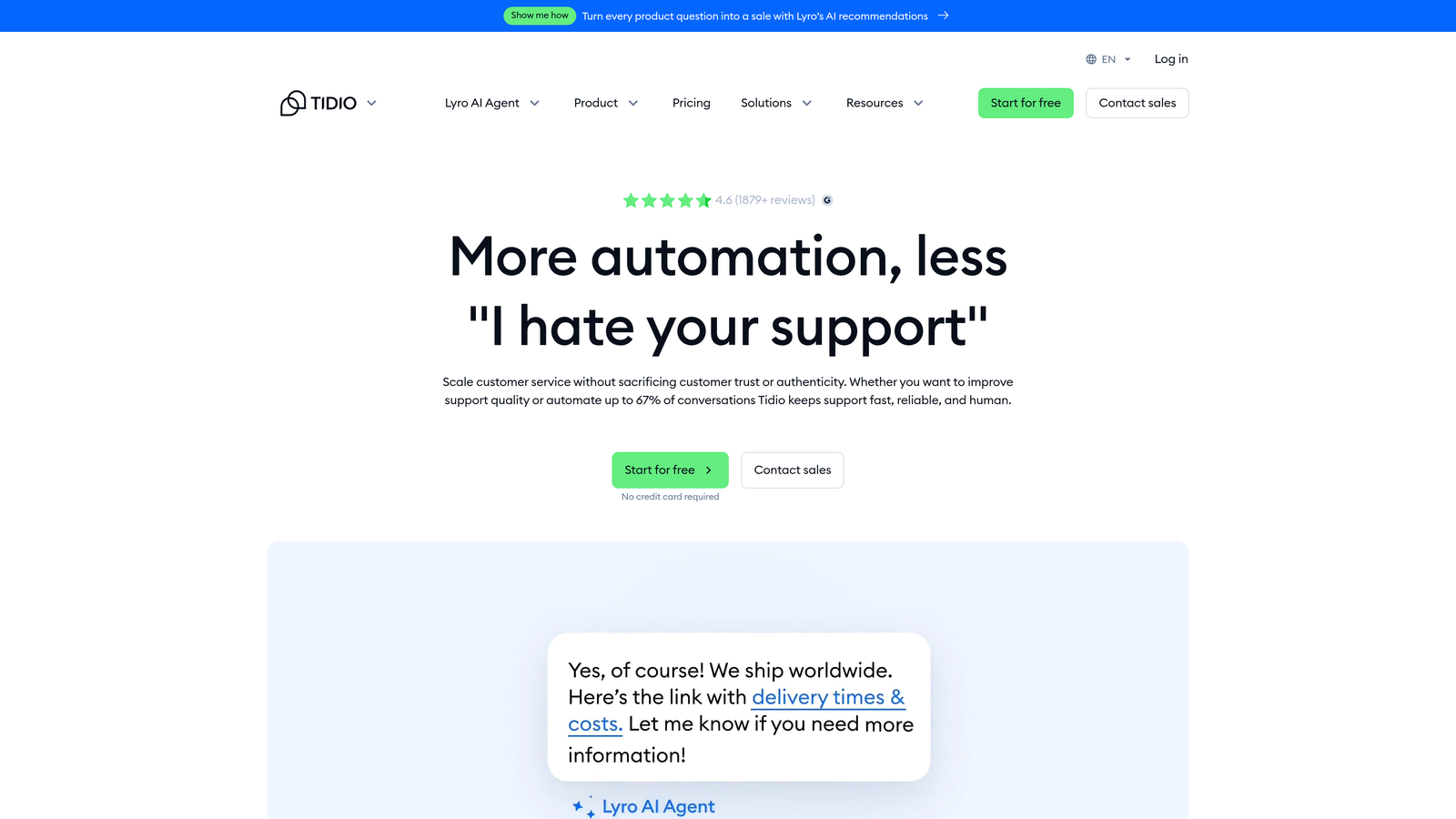
Tidio is an affordable customer support platform combining live chat, helpdesk, and Lyro AI chatbot for teams that want intelligent automation without an enterprise implementation project.
Where This Tool Shines
Tidio's appeal is in its simplicity and accessibility. Lyro AI learns from your FAQ and knowledge base content and starts handling conversations quickly, without requiring a dedicated implementation team. The combined live chat, chatbot, and helpdesk in a single platform removes the need to stitch together multiple tools at the early stages of building out a support function.
For e-commerce and SMB teams, the integrations with Shopify and WordPress make setup particularly fast, and the visual chatbot flow builder lets non-technical team members customize automations without writing a line of code.
Key Features
Lyro AI Chatbot: Learns from your FAQ and knowledge base to handle common customer questions autonomously.
All-in-One Platform: Combines live chat, AI chatbot, and helpdesk ticketing in a single, unified interface.
Visual Flow Builder: Drag-and-drop chatbot customization for teams without technical resources.
E-Commerce Integrations: Native connections to Shopify, WordPress, and other popular platforms for fast setup.
Minimal Technical Requirements: Designed for quick deployment without developer involvement.
Best For
Small businesses, e-commerce teams, and early-stage SaaS companies that want to add intelligent chat and automation without the cost or complexity of enterprise platforms.
Pricing
Free plan available. Paid plans start at $29/month. Lyro AI is available as an add-on, making it easy to scale intelligence as volume grows.
8. Salesforce Service Cloud with Einstein AI
Best for: Enterprise teams operating within the Salesforce ecosystem who need AI-powered service tied to CRM data.
Salesforce Service Cloud is an enterprise service platform with Einstein AI embedded across the Salesforce ecosystem for AI-powered case management, routing, and customer intelligence directly connected to CRM data.
Where This Tool Shines
The defining advantage of Service Cloud is its deep integration with the broader Salesforce platform. Support agents see a unified customer view that includes sales history, marketing interactions, and billing data in the same interface — context that fundamentally changes the quality of support interactions. Einstein AI adds classification, routing, and next-best-action recommendations on top of that rich data foundation.
Agentforce, Salesforce's AI agent capability, extends this further by enabling autonomous service interactions that draw on the full breadth of CRM data. For enterprise teams already running Salesforce, the depth of context available to every interaction is genuinely difficult to replicate elsewhere.
Key Features
Einstein AI: Case classification, intelligent routing, and next-best-action recommendations powered by your CRM data.
Agentforce AI Agents: Autonomous service interactions that leverage the full Salesforce data model for context-rich resolution.
Unified Customer View: Sales, service, and marketing data in a single record, giving agents complete customer context.
Omnichannel Routing: Intelligent routing across chat, email, phone, social, and messaging from a single platform.
Extensive Customization: Salesforce Flow and AppExchange provide deep configurability for complex enterprise requirements.
Best For
Enterprise B2B teams already operating within the Salesforce ecosystem where connecting support data to sales and account management is a strategic priority. Less practical for teams outside the Salesforce environment given cost and implementation complexity.
Pricing
Starts at $25/user/month on the Starter plan. Enterprise plans run $165/user/month. Einstein AI features are available as add-ons at additional cost.
9. Kustomer
Best for: Teams that need a CRM-powered support platform with rich customer context built into every conversation.
Kustomer is a CRM-powered customer service platform with AI classification, sentiment analysis, and a unified customer timeline that gives agents full context for every support interaction.
Where This Tool Shines
Kustomer's unified customer timeline is its signature feature. Rather than treating each ticket as an isolated event, Kustomer aggregates support history, order data, and interaction records into a single chronological view. Agents walk into every conversation with complete context, which meaningfully changes both resolution speed and customer experience quality.
The AI-powered classification, routing, and sentiment detection layer on top of that rich data model to automate the operational side of support, while the workflow automation engine handles complex routing logic without requiring custom development.
Key Features
Unified Customer Timeline: Aggregates support history, order data, and interaction records into a single chronological view per customer.
AI Classification and Routing: Automatically classifies incoming conversations and routes them based on intent, sentiment, and customer context.
Sentiment Detection: Identifies customer sentiment in real time to flag at-risk interactions for priority handling.
Omnichannel Support: Handles chat, email, social, SMS, and voice from a unified agent workspace.
Workflow Automation: Business rules engine for building complex routing, escalation, and automation logic without code.
Best For
B2B and B2C teams where customer context depth is a competitive differentiator — particularly companies handling high-value accounts where support history and order data need to be visible in every interaction.
Pricing
Enterprise pricing model. Contact Kustomer directly for custom quotes based on team size and interaction volume.
Choosing the Right Intelligent Support Platform
The right platform depends less on feature checklists and more on where your team is today and where you need to be in twelve months. Here's a practical way to think through the decision.
If you're a B2B SaaS team that wants an AI-native platform built for autonomous resolution, business intelligence, and deep product context from day one, Halo AI is purpose-built for exactly that. It's the only platform on this list that combines page-aware guidance, continuous learning agents, and business intelligence signals like customer health and revenue insights in a single architecture.
If you're already invested in Intercom or Zendesk and want to extend rather than replace, Fin AI and Zendesk AI are mature, well-supported options with strong automation capabilities. For teams on the Salesforce platform, Service Cloud with Einstein AI is the natural choice given the CRM data advantage.
For teams on a budget: Freshdesk and Tidio offer genuine AI capability at accessible price points, with free tiers that let you validate the approach before committing.
For teams focused on resolution quality: Ada's reasoning engine and resolution-rate measurement make it a strong contender when the goal is genuine problem-solving, not just deflection.
For teams with existing helpdesk infrastructure: Forethought's additive approach means you can layer intelligence without migration risk.
Your support team shouldn't scale linearly with your customer base. AI agents can handle routine tickets, guide users through your product, and surface business intelligence while your team focuses on complex issues that genuinely need a human touch. See Halo in action and discover how continuous learning transforms every interaction into smarter, faster support.