9 Best Support AI for SaaS Products in 2026
Discover the best support AI for SaaS products in 2026, with nine purpose-built platforms evaluated for AI autonomy, SaaS-specific integrations, and the ability to resolve tickets, guide users through workflows, and flag churn risks without scaling headcount proportionally.
 Matt PattoliFounder13 min read
SaaS companies face a support challenge that's genuinely different from traditional businesses. Your users expect instant, contextual help that understands their product experience, not a generic chatbot that points them to a FAQ page they've already read. And as your user base grows, ticket volume scales with it, but your headcount can't.
That's where AI-powered support tools built specifically for SaaS come in. The best ones resolve tickets autonomously, guide users through product workflows, surface bug reports, and even flag churn risks without requiring you to hire proportionally. The challenge is that the market is crowded, and not every tool is built with SaaS workflows in mind.
Some are retrofitted helpdesks with AI bolted on as an afterthought. Others are purpose-built for product-led teams. We evaluated dozens of platforms and narrowed it down to nine that genuinely deliver for SaaS companies in 2026. Our criteria: depth of AI autonomy, SaaS-specific integrations, product context awareness, analytics quality, and transparent pricing.
1. Halo AI
Best for: B2B SaaS teams that want AI-first support with deep product context and business intelligence
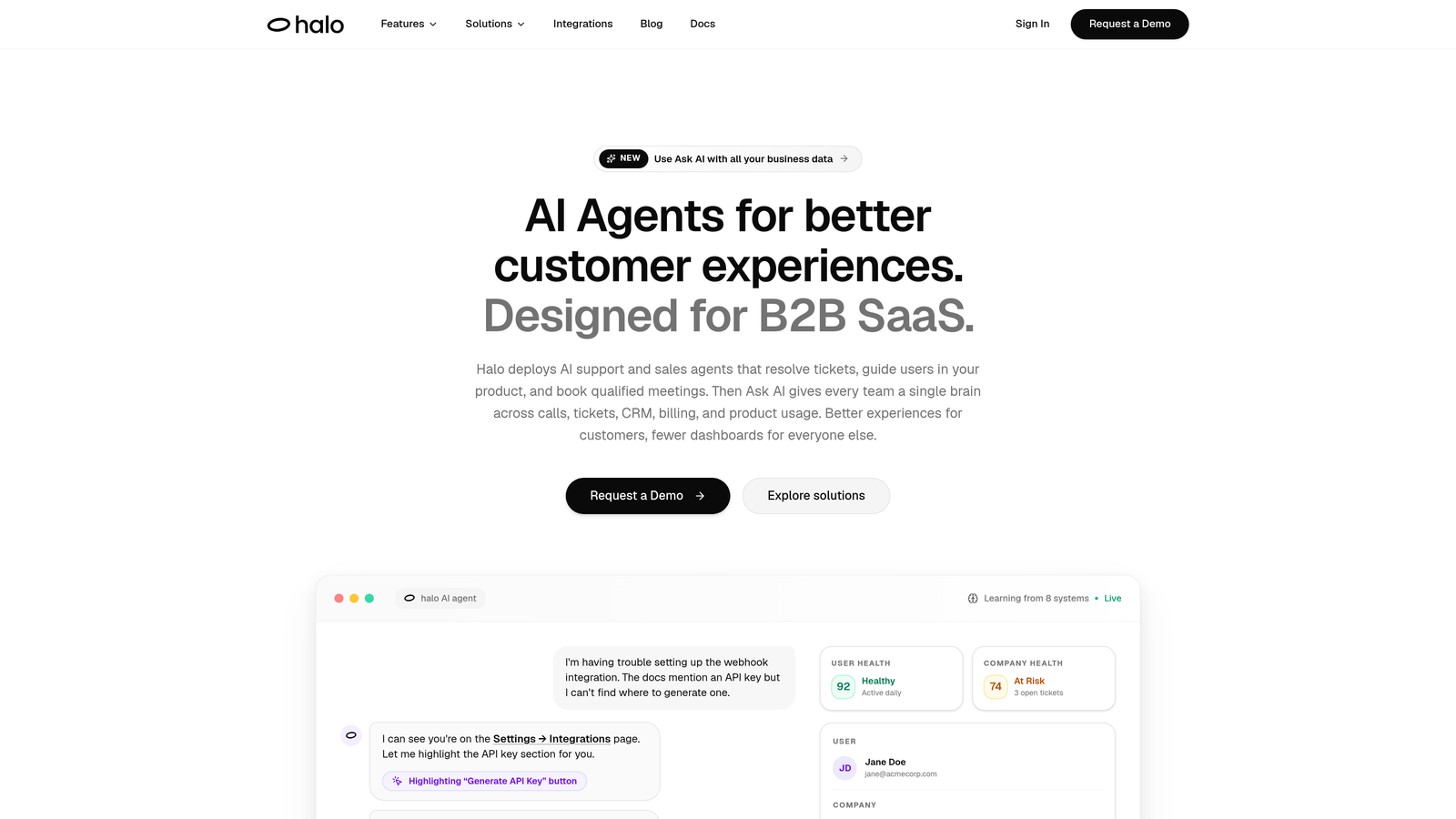
Halo AI is an AI-native customer support platform built specifically for SaaS products, not adapted from a traditional helpdesk.
Where This Tool Shines
What separates Halo from most tools on this list is its page-aware architecture. The AI agent doesn't just know your documentation, it knows what page a user is currently on and what they're looking at. That means it can provide visual UI guidance in context, rather than generic instructions that assume the user can figure out where to click.
Beyond resolving tickets, Halo's smart inbox functions as a business intelligence layer. It surfaces churn signals, revenue intelligence, and anomaly detection from support conversations, turning your support queue into a strategic data source. When a ticket reveals a bug, Halo automatically creates a bug ticket in Linear. When an issue needs a human, it hands off cleanly to a live agent.
Key Features
Page-Aware AI Chat Widget: Sees what users see in real time and delivers visual UI guidance specific to their current product context.
Autonomous Ticket Resolution: Resolves support tickets end-to-end with intelligent escalation to live agents when complexity warrants it.
Smart Inbox with Business Intelligence: Surfaces churn signals, revenue intelligence, and anomaly detection directly from support interactions.
Auto Bug Ticket Creation: Automatically creates bug tickets in Linear from support conversations, closing the loop between support and engineering.
Full SaaS Stack Integrations: Connects to Slack, HubSpot, Intercom, Stripe, Zoom, PandaDoc, and Fathom, covering the tools SaaS teams actually use.
Best For
B2B SaaS companies and product teams that want AI at the core of their support operation, not as a layer on top of an existing helpdesk. Particularly strong for teams that want support to feed directly into product development, customer success, and revenue workflows.
Pricing
Contact for pricing. Built for B2B SaaS teams of all sizes, with a focus on teams that want AI-first architecture rather than a helpdesk upgrade.
2. Intercom Fin
Best for: Teams already on Intercom who want AI resolution without switching platforms
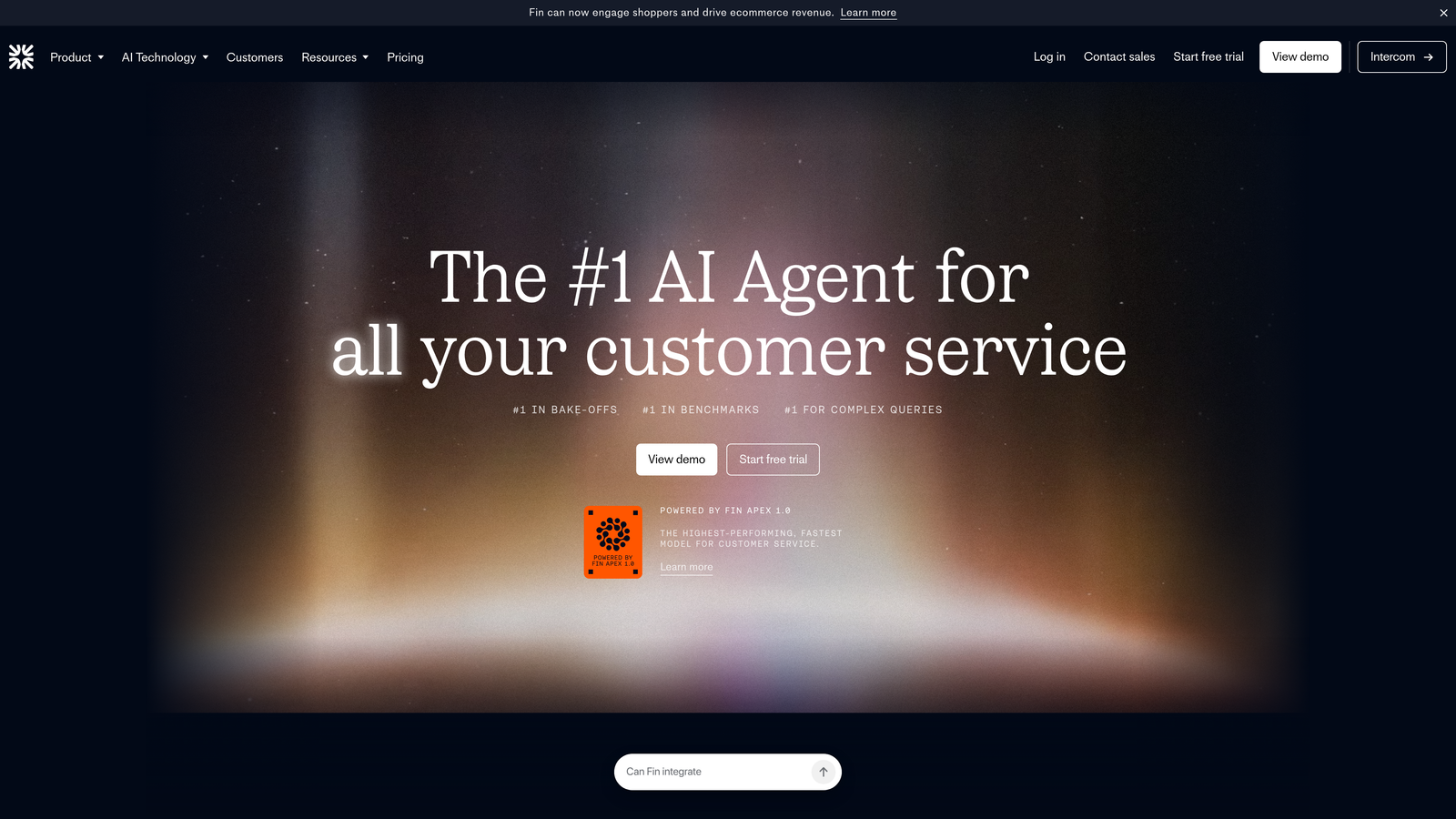
Intercom Fin is Intercom's native AI agent that resolves support questions using your existing help center content and conversation history.
Where This Tool Shines
If your team is already invested in Intercom, Fin is the path of least resistance to AI-powered resolution. It plugs directly into your existing messenger, inbox, and help center without requiring any migration or new infrastructure. The setup experience is genuinely smooth for existing Intercom customers.
Fin pulls answers from help articles, past conversations, and custom data sources, which means it gets smarter as your help center matures. The built-in reporting gives you clear visibility into resolution rates and AI performance without needing a separate analytics tool.
Key Features
Native Intercom Integration: Works directly within your existing Intercom messenger, inbox, and help center setup.
Multi-Source Knowledge Retrieval: Pulls answers from help articles, conversation history, and custom data sources simultaneously.
Brand Voice Customization: Adjustable tone and persona settings so the AI matches your company's voice.
AI Performance Reporting: Built-in dashboards tracking resolution rates and AI effectiveness.
Multilingual Support: Handles conversations in multiple languages without additional configuration.
Best For
SaaS teams already using Intercom as their primary support and messaging platform who want to add AI resolution without platform switching. Less compelling if you're not already in the Intercom ecosystem.
Pricing
Per-resolution pricing model. Requires an active Intercom subscription, so total cost depends on your existing plan plus Fin usage volume.
3. Zendesk AI
Best for: Enterprise SaaS teams with complex, multi-channel support operations
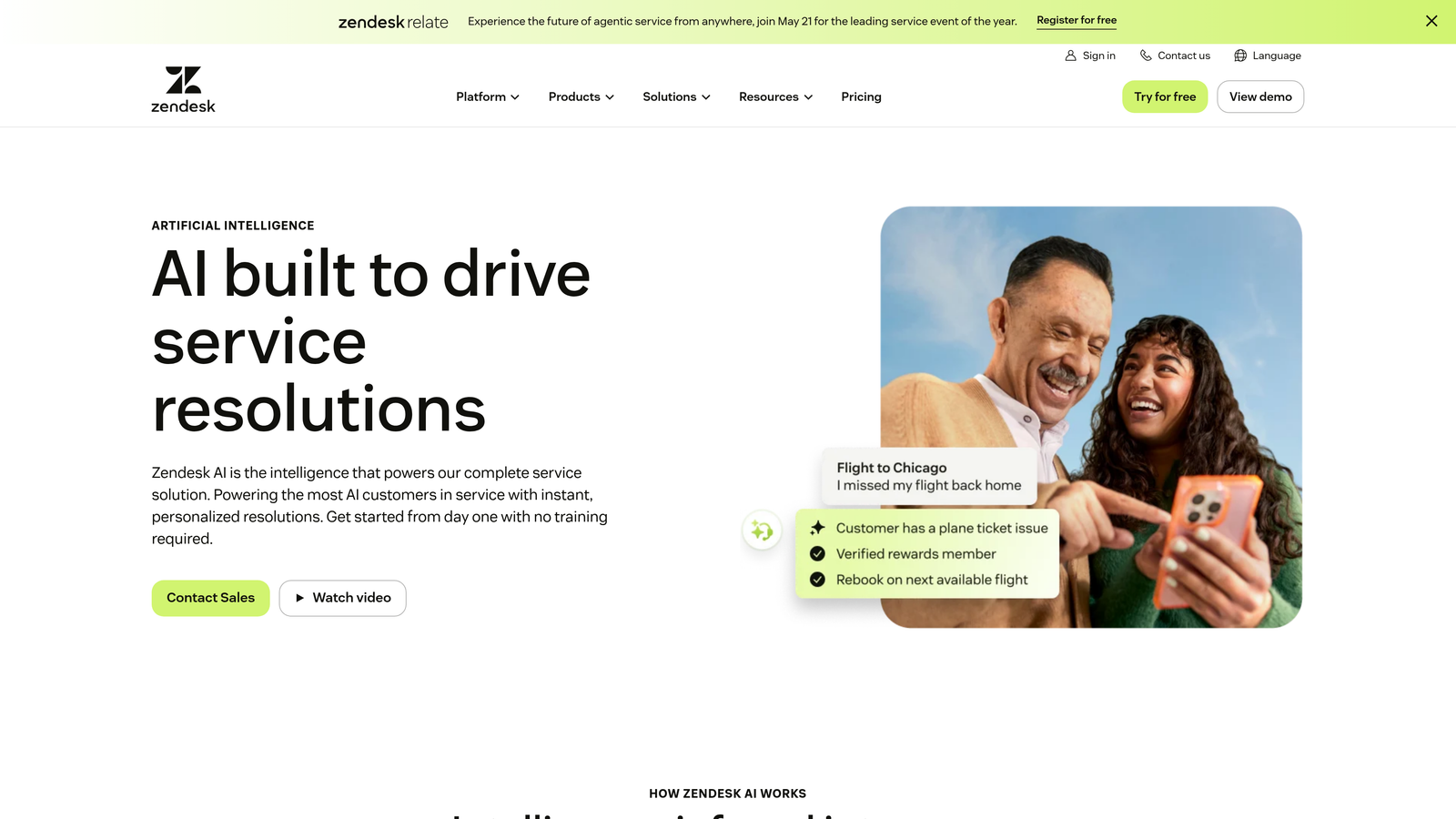
Zendesk AI is an enterprise-grade AI layer built into Zendesk's support suite, offering AI agents, intelligent triage, and agent assist across the full Zendesk ecosystem.
Where This Tool Shines
Zendesk AI benefits from the platform's massive install base and years of support data. The intelligent triage capabilities are particularly strong, automatically classifying intent, sentiment, and language across high volumes of incoming tickets. For enterprise teams managing thousands of tickets across multiple channels, this kind of automated routing is genuinely valuable.
The 1,500+ integration marketplace means Zendesk AI can fit into almost any existing tech stack. If you're already a Zendesk shop, the AI features layer on without disruption. The tradeoff is that AI capabilities feel like additions to a helpdesk rather than the core architecture.
Key Features
AI Agents for Autonomous Resolution: Handles tickets across email, chat, and messaging channels without human intervention.
Intelligent Triage: Automatically classifies intent, sentiment, and language to route tickets accurately.
Agent Assist: Provides live agents with AI-suggested replies and knowledge base recommendations in real time.
Extensive Integration Marketplace: Over 1,500 integrations covering virtually every enterprise tool category.
Advanced Analytics: Custom reporting dashboards with deep operational visibility.
Best For
Enterprise SaaS companies with established Zendesk deployments and complex multi-channel support needs. Teams evaluating Zendesk from scratch should weigh whether AI-native alternatives offer better long-term architecture.
Pricing
AI features available on Suite Professional and above. An AI add-on applies, making total cost higher than entry-level Zendesk plans. Contact Zendesk for current pricing details.
4. Ada
Best for: SaaS companies that need multi-step, action-oriented AI resolution without rigid conversation scripts
Ada is an AI-powered customer service automation platform with a reasoning engine designed for complex, multi-step resolutions.
Where This Tool Shines
Ada's core differentiator is its reasoning engine. Rather than following scripted decision trees, it reasons through multi-step issues in a way that handles the kind of nuanced, context-dependent questions SaaS users actually ask. This makes it particularly effective for support scenarios that don't fit neatly into predefined flows.
The no-code builder is genuinely accessible for non-technical teams, and Ada's ability to connect to CRMs, billing systems, and order management tools means it can take action, not just provide information. That distinction matters as the industry moves toward AI agents that do things rather than simply answer questions.
Key Features
Reasoning Engine: Handles complex, multi-step resolutions without rigid decision trees or scripted flows.
No-Code Agent Builder: Deploy and manage AI agents without engineering resources.
Action-Taking Integrations: Connects to CRMs, billing systems, and order management tools to execute tasks, not just retrieve information.
Omnichannel Deployment: Works across web, mobile, social, and messaging channels from a single platform.
Conversation Intelligence: AI-powered insights on conversation trends and automation opportunities.
Best For
Mid-market to enterprise SaaS companies with complex support workflows that require AI to take actions across connected systems. Strong fit for teams that have outgrown simple FAQ deflection tools.
Pricing
Custom pricing based on resolution volume. Contact Ada's sales team for quotes tailored to your scale and use case.
5. Freshdesk Freddy AI
Best for: Growing SaaS startups that want AI-powered support at an accessible price point
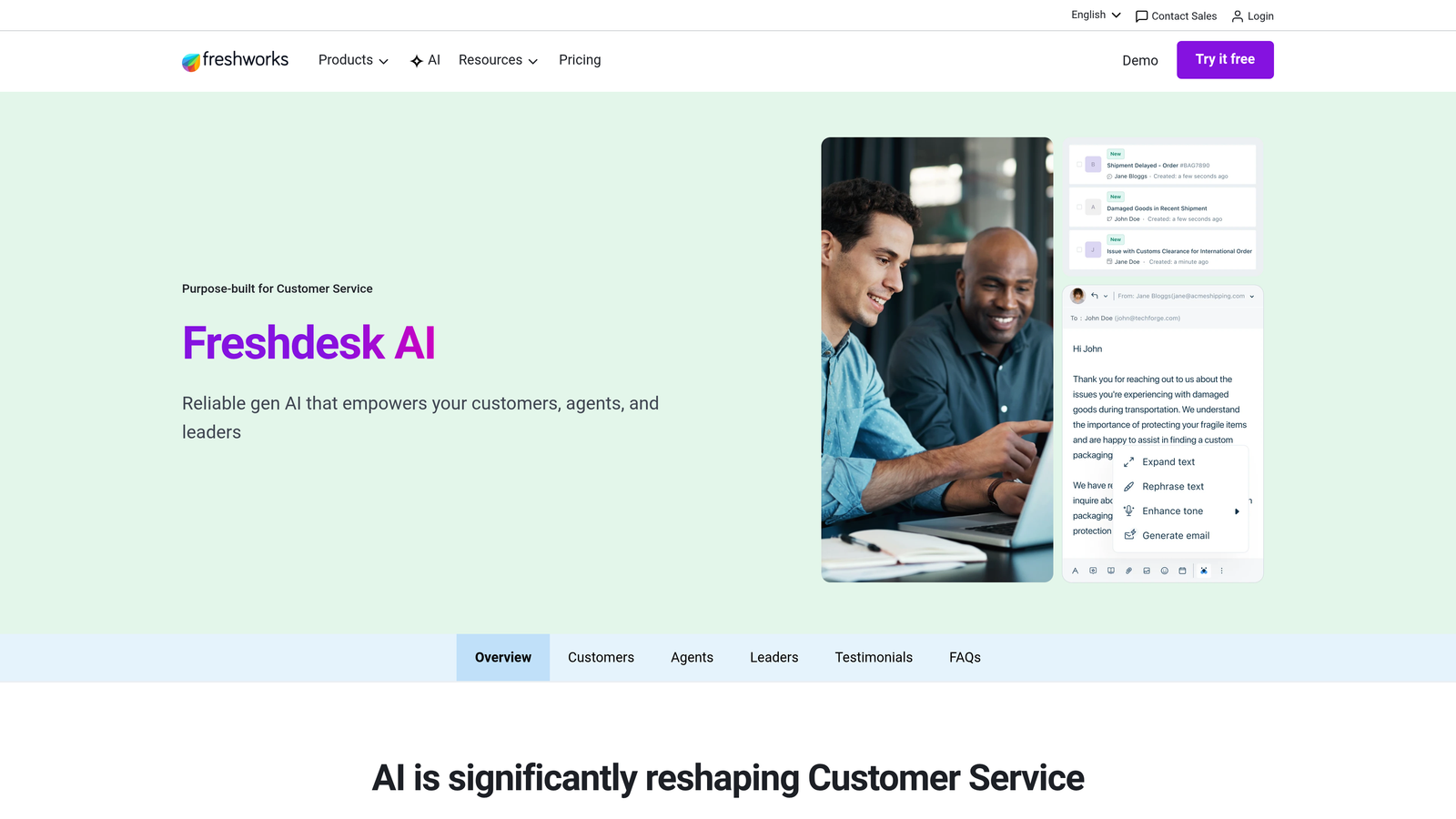
Freshdesk Freddy AI is the AI capability layer within the Freshworks ecosystem, offering ticket resolution, agent assist, and auto-triage for teams watching their budget.
Where This Tool Shines
Freshdesk's biggest advantage for early-stage SaaS teams is its pricing accessibility. The free tier gets small teams started without commitment, and Freddy AI's core features become available at a price point that doesn't require an enterprise budget. For a startup still finding product-market fit, that matters.
The broader Freshworks suite also means that as you grow and add CRM, ITSM, or marketing automation, everything connects. Freddy AI's ticket summarization and suggested responses help agents work faster, which is valuable when your team is small and handling a wide variety of issues.
Key Features
Freddy AI Agent: Self-service resolution across channels without human intervention for common support requests.
Ticket Summarization and Suggested Responses: Helps live agents respond faster with AI-generated summaries and reply recommendations.
Auto-Triage: Intent detection and priority assignment that routes tickets to the right queue automatically.
Freshworks Suite Integration: Connects with Freshworks CRM, ITSM, and marketing tools as your stack grows.
Accessible Pricing: Free tier available for small teams, with AI features unlocking at competitive per-agent pricing.
Best For
Early-stage and growth-stage SaaS companies that need functional AI support without enterprise-level investment. Also works well for teams already in the Freshworks ecosystem.
Pricing
Free tier available. AI features on the Growth plan start at $15/agent/month, making it one of the most accessible options on this list.
6. Tidio
Best for: Small SaaS teams that want fast AI deployment with minimal setup complexity
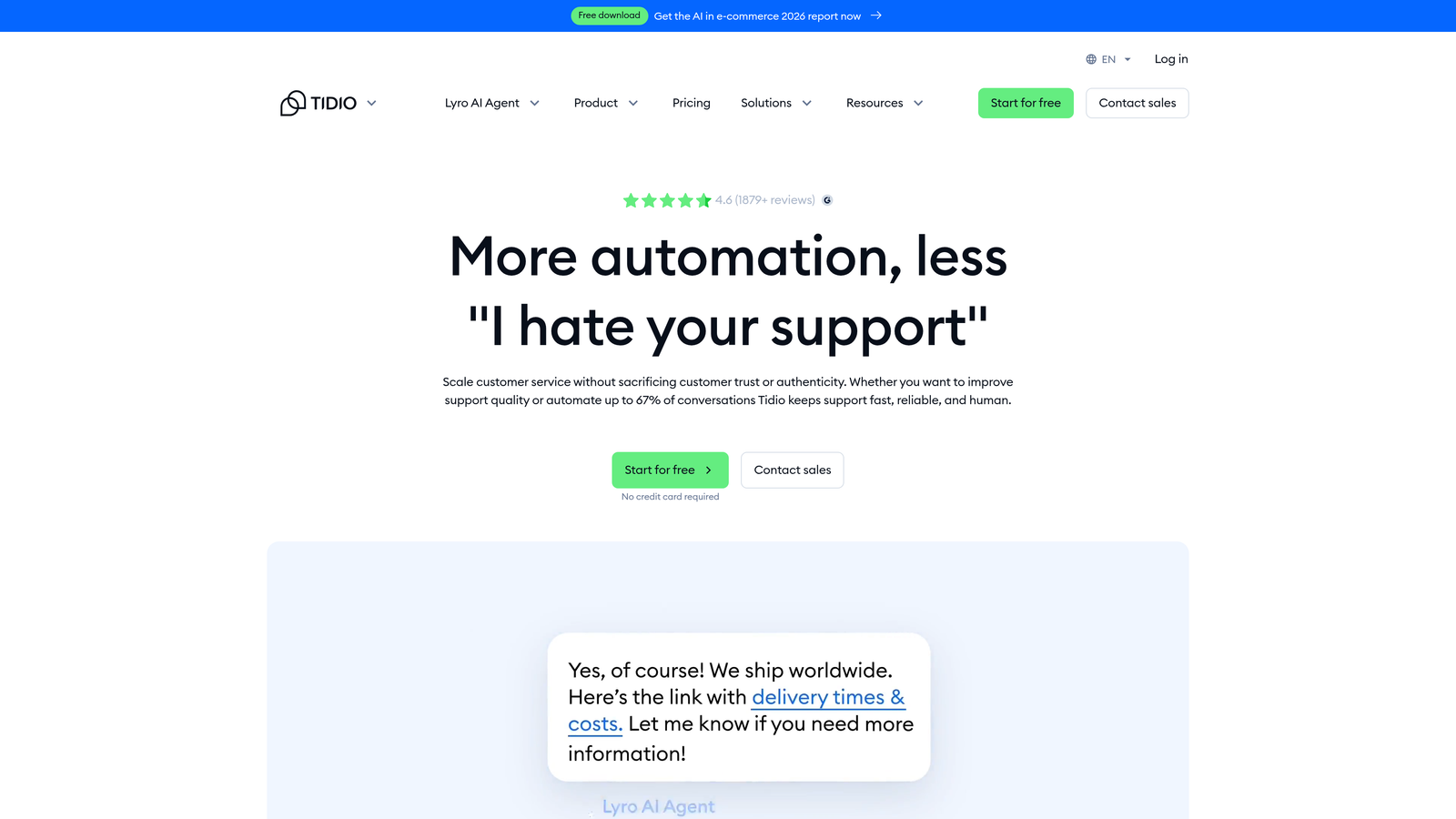
Tidio is a lightweight AI chat platform featuring Lyro AI, designed for teams that need to get AI-powered support live quickly without enterprise overhead.
Where This Tool Shines
Tidio's appeal is speed and simplicity. Lyro AI trains on your FAQ and help content in minutes, not weeks. For a small SaaS team that needs something working today rather than after a lengthy implementation, that's a meaningful advantage. The visual chatbot builder also makes it accessible for non-technical team members to customize conversation flows.
The tradeoff is depth. Tidio works well for straightforward support scenarios but doesn't offer the kind of product context awareness or business intelligence that more purpose-built SaaS tools provide. It's a strong starting point, but fast-growing teams may find themselves outgrowing it.
Key Features
Lyro AI Chatbot: Trains on your FAQ and help content quickly, with no lengthy setup process required.
Visual Chatbot Builder: Drag-and-drop interface for creating custom conversation flows without code.
AI-Assisted Live Chat: Provides reply suggestions to live agents during active conversations.
Common Tool Integrations: Connects with Shopify, WordPress, and various SaaS tools.
Simple Analytics Dashboard: Tracks AI performance and conversation outcomes without overwhelming complexity.
Best For
Small SaaS teams and early-stage startups that want AI chat live quickly with minimal technical investment. Also useful for teams whose support volume doesn't yet justify enterprise tooling.
Pricing
Free plan available. Lyro AI starts at $39/month for 50 conversations, with higher tiers for greater volume.
7. Forethought
Best for: SaaS teams that want AI layered on top of their existing helpdesk without replacing it
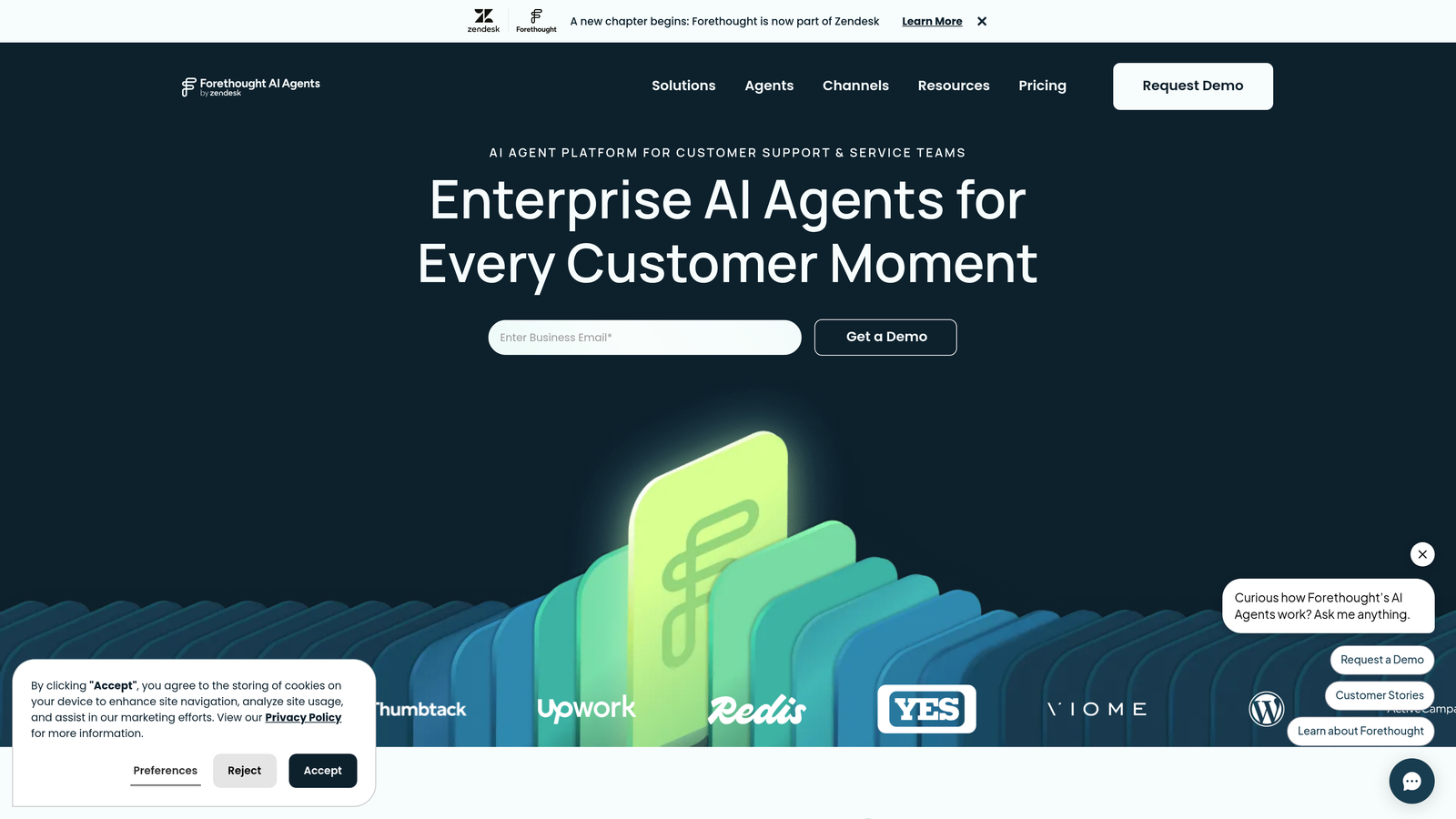
Forethought is an AI platform focused on intelligent triage, routing, and resolution that works as an overlay on existing helpdesks like Zendesk, Salesforce, and Freshdesk.
Where This Tool Shines
Forethought's modular product structure is its key advantage. You can deploy its Triage product for intelligent classification and routing, its Solve product for autonomous resolution, and its Assist product for real-time agent suggestions, independently or together. That flexibility means you can start with the piece that solves your most pressing problem and expand from there.
Because it overlays on existing helpdesks rather than replacing them, Forethought is particularly well-suited for teams that have significant investment in their current platform and aren't ready for a full migration. It's an additive layer rather than a rip-and-replace.
Key Features
Triage Product: AI-powered ticket classification and priority routing that improves queue management at scale.
Solve Product: Autonomous resolution of common support requests without agent involvement.
Assist Product: Real-time AI suggestions and recommendations delivered to live agents during active tickets.
Helpdesk Overlay Architecture: Works on top of Zendesk, Salesforce, Freshdesk, and others without requiring platform migration.
Workflow Customization: SaaS and enterprise-focused configuration options for complex support operations.
Best For
Mid-market and enterprise SaaS teams with existing helpdesk investments who want to add AI capabilities without switching platforms. Strong fit for organizations with complex routing and triage requirements.
Pricing
Custom pricing. Contact Forethought's sales team for details based on your helpdesk platform and resolution volume.
8. Kastro
Best for: Developer-focused SaaS products with rich documentation and technical user bases
Kastro is a lightweight, docs-first AI support widget that trains on your knowledge base and documentation to provide instant answers for technical users.
Where This Tool Shines
Kastro is built for a specific use case: developer tools and technical SaaS products where users are sophisticated, documentation is detailed, and questions tend to be specific and precise. The setup is intentionally minimal. Import your docs, configure the widget, and go live. For developer-focused teams that don't want to manage a complex support platform, that simplicity is the point.
The ChatGPT-powered engine means it handles technical language and nuanced documentation well, which generic chatbots often struggle with. When the AI can't resolve an issue, it hands off cleanly to a human agent.
Key Features
Docs-First AI Engine: ChatGPT-powered widget trained directly on your documentation and help center content.
Minimal Setup: Import documentation and go live quickly without lengthy implementation or configuration.
Human Handoff: Smooth escalation to human agents when the AI reaches the limits of its knowledge.
Widget Customization: Adjustable appearance to match your product's visual design.
Developer Product Focus: Designed specifically for technical and developer-oriented SaaS products and their users.
Best For
Developer tools, API platforms, and technical SaaS products with well-maintained documentation and a user base that prefers self-service over guided support flows.
Pricing
Free tier available. Paid plans start at accessible monthly rates. Check Kastro's website for current pricing tiers.
9. Decagon
Best for: Enterprise SaaS teams that need AI agents to take actions, not just answer questions
Decagon is an enterprise-grade generative AI agent platform that goes beyond answering support questions to executing actions directly in your connected systems.
Where This Tool Shines
Decagon represents where the AI support market is heading: agents that do things. Processing refunds, updating account details, triggering workflows, looking up data across systems. This is a meaningful step beyond FAQ deflection or even intelligent routing. For enterprise SaaS companies with complex, action-heavy support workflows, Decagon's approach is genuinely differentiated.
The platform is trained on your company's specific data and policies, which means the AI operates within your defined parameters rather than improvising. Enterprise security and compliance features make it viable for organizations with strict data governance requirements.
Key Features
Action-Executing AI Agents: Processes refunds, updates accounts, and performs data lookups directly in connected systems.
Company-Specific Training: Generative AI trained on your organization's data, policies, and workflows.
Enterprise Security and Compliance: Built-in features for organizations with strict governance and data requirements.
Resolution Quality Analytics: Tracks resolution quality, customer satisfaction, and agent performance in detail.
Custom Integrations: Connects to internal tools and databases beyond standard third-party integrations.
Best For
Enterprise SaaS companies with high-volume, action-oriented support workflows where AI needs to execute tasks across multiple systems, not just surface information.
Pricing
Enterprise pricing. Contact Decagon's sales team for custom quotes based on your scale, integration requirements, and use case.
Which Tool Is Right for Your SaaS Team?
The right choice depends heavily on where you are as a company and what you need AI to actually do for you.
If you want AI at the core of your support operation, with page-aware context, business intelligence, and deep SaaS integrations built in from the start, Halo AI is the strongest purpose-built option on this list. It's particularly compelling for B2B SaaS teams that want support to feed directly into product, customer success, and revenue workflows rather than sitting in a silo.
For teams already deeply invested in Intercom or Zendesk, Fin and Zendesk AI offer the smoothest path to AI resolution without platform disruption. If budget is the primary constraint, Freshdesk Freddy AI and Tidio both offer accessible entry points with functional AI capabilities. Ada and Decagon are the standout choices when your support workflows require AI to take actions across connected systems, not just answer questions. Forethought is the right call if you want to add AI intelligence to an existing helpdesk without replacing it. And Kastro is purpose-built for developer-focused products where documentation depth is your primary support asset.
The broader trend is clear: SaaS buyers in 2026 are moving away from AI-washed helpdesks toward platforms where intelligence is the architecture, not the add-on. Your support team shouldn't scale linearly with your customer base. Let AI agents handle routine tickets, guide users through your product, and surface business intelligence while your team focuses on complex issues that need a human touch. See Halo in action and discover how continuous learning transforms every interaction into smarter, faster support.