9 Best AI Customer Service Platforms to Buy in 2026
If you're ready to buy an AI customer service platform, this guide evaluates nine leading solutions across resolution quality, integrations, analytics, scalability, and total cost of ownership—helping B2B teams cut through a crowded market to find the right fit, whether they're replacing a legacy helpdesk, augmenting existing tools like Zendesk or Intercom, or building a fully AI-first support operation from scratch.
 Matt PattoliFounder13 min read
B2B teams are actively shopping for AI customer service platforms right now, and the market has never been more crowded or more confusing. You're no longer choosing between a basic chatbot and a human agent team. You're evaluating fully autonomous AI agent systems, bolt-on AI layers for existing helpdesks, and everything in between.
This guide cuts through the noise. We evaluated platforms on five core criteria: AI resolution quality, integration depth, analytics capabilities, scalability, and total cost of ownership. Whether you're replacing a legacy helpdesk, augmenting an existing Zendesk or Intercom setup, or building an AI-first support operation from scratch, these platforms represent the strongest options available today.
One distinction worth keeping in mind as you read: there's a meaningful difference between platforms built AI-first from the ground up and platforms where AI was added onto legacy helpdesk infrastructure. That architectural difference shapes everything from resolution quality to integration flexibility to how the system improves over time. We'll call that out for each tool.
1. Halo AI
Best for: B2B SaaS teams building an AI-first support operation that scales without adding headcount
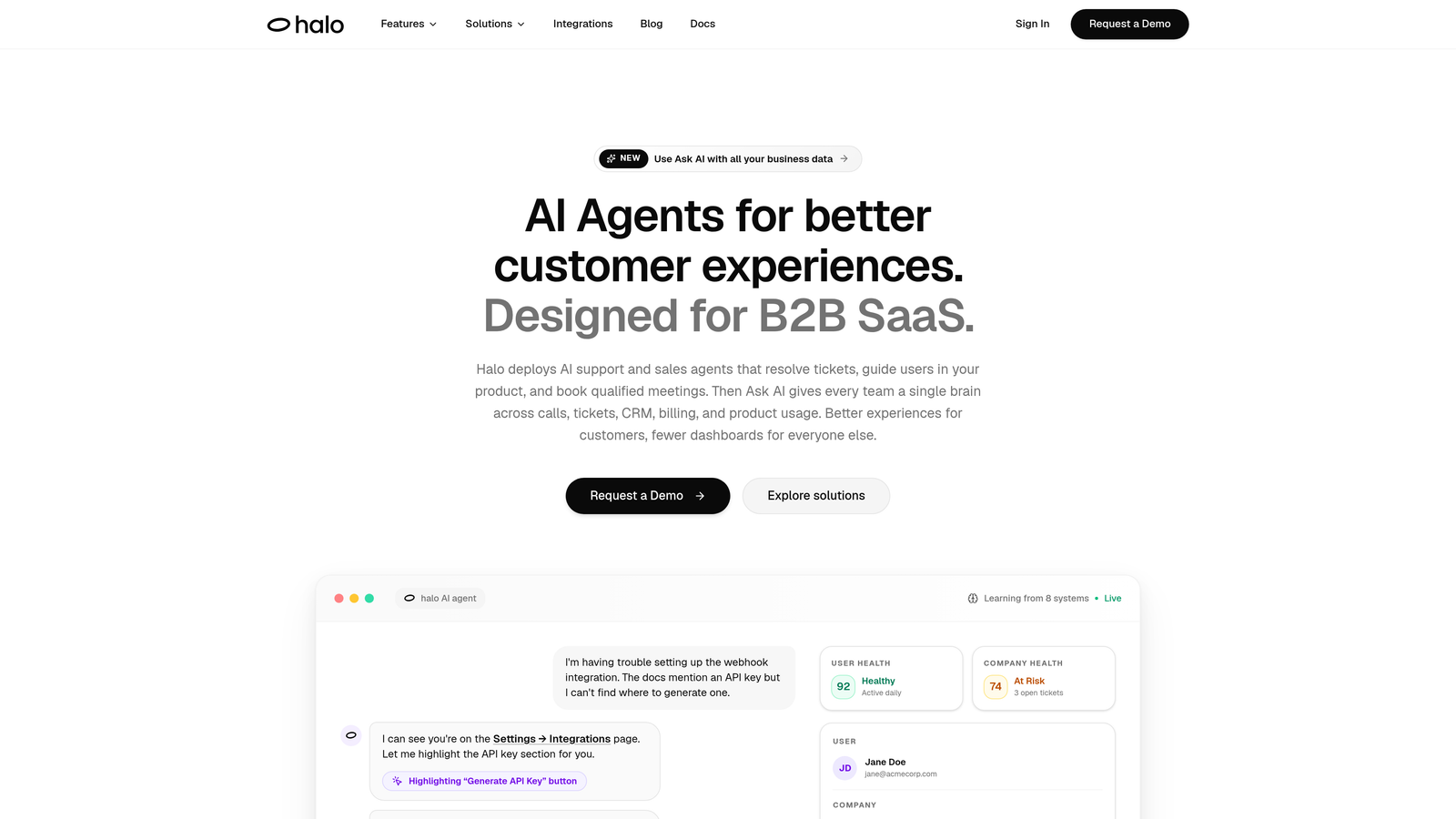
Halo AI is an AI-first customer support platform where autonomous agents resolve tickets, guide users through your product visually, and surface business intelligence from every interaction.
Where This Tool Shines
Halo was built AI-first, not retrofitted onto a legacy helpdesk. That architectural decision matters in practice: the AI agents aren't constrained by workflows designed for human agents, so they can operate autonomously across ticket resolution, in-product guidance, and bug escalation without friction.
The standout capability is page-aware context. Halo's chat widget sees what the user sees, which means the AI agent can provide guidance specific to the exact screen a user is on, not just generic help center content. Combined with continuous learning from every resolved interaction, the system gets meaningfully smarter over time rather than staying static.
Key Features
Page-Aware AI Agents: The AI sees the user's current page and UI state, enabling contextual visual guidance that's specific to where the user is in your product.
Continuous Learning: Every resolved interaction feeds back into the model, improving resolution accuracy and response quality without manual retraining.
Smart Inbox with Business Intelligence: Goes beyond ticket management to surface customer health signals, revenue intelligence, and anomaly detection from support data.
Auto Bug Ticket Creation: Automatically creates and routes bug reports to Linear, Slack, and other dev tools when issues are detected in support conversations.
Live Agent Handoff: Escalates complex issues to human agents with full conversation context intact, so agents never start cold.
Best For
B2B SaaS companies that want an AI-first support layer, not a chatbot bolted onto an existing helpdesk. Particularly strong for product-led growth teams where in-product guidance and support are closely tied, and for teams that want support data to feed business intelligence rather than just track ticket volume.
Pricing
Contact for pricing. Designed for B2B SaaS teams at scale, with pricing structured around the team's support volume and automation goals.
2. Intercom Fin
Best for: Teams already on Intercom who want AI resolution without switching platforms
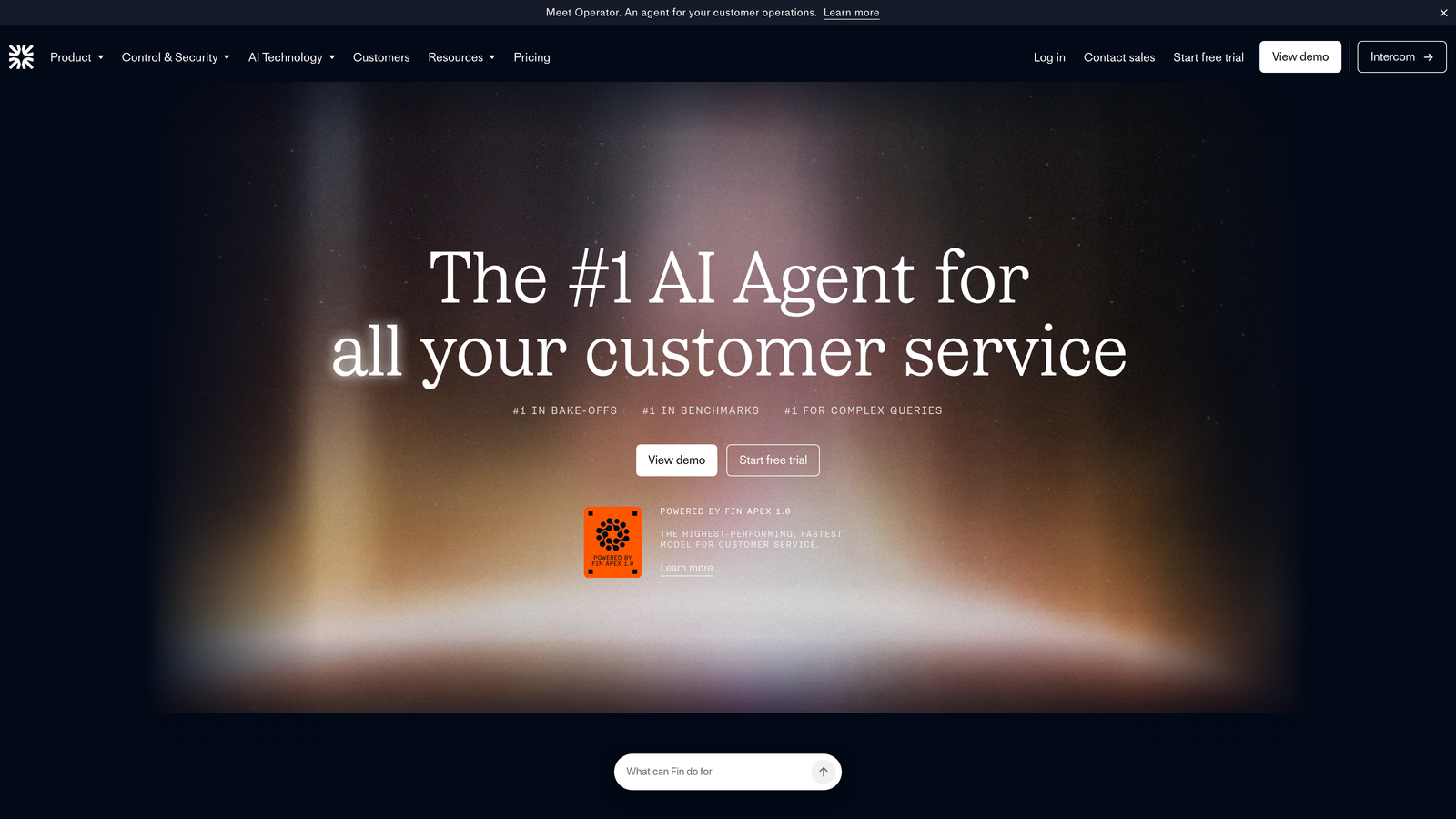
Intercom Fin is Intercom's native AI agent, built directly into its established messenger and help center ecosystem.
Where This Tool Shines
If your team is already running Intercom for customer messaging, Fin is the lowest-friction path to AI-powered resolution. It draws on your existing knowledge base content and Intercom help center articles without requiring significant setup work, which means time-to-value can be fast for teams with mature content libraries.
The per-resolution pricing model is worth understanding carefully. You pay for conversations that Fin resolves, not a flat seat fee. That structure can be cost-effective for teams with high deflection rates, but it can also create unpredictable costs as volume scales.
Key Features
Native Intercom Integration: Works directly within Intercom's messenger, inbox, and help center without additional connectors or setup complexity.
Knowledge Base Resolution: Uses your existing Intercom help center content to generate AI responses, reducing the need to rebuild a separate knowledge base.
Customizable AI Tone: Allows teams to configure the AI's personality and communication style to match brand voice.
Per-Resolution Pricing: Charges only for conversations Fin successfully resolves, aligning cost with actual deflection value.
Human Handoff with Context: Escalates to human agents with full conversation history when the AI cannot resolve an issue.
Best For
Companies already invested in the Intercom ecosystem who want to add AI resolution without migrating platforms. Less compelling for teams evaluating from scratch or those who want AI capabilities that extend beyond the Intercom environment.
Pricing
Per-resolution pricing model layered on top of an existing Intercom subscription. Total cost depends heavily on conversation volume and resolution rates.
3. Zendesk AI
Best for: Enterprise teams with existing Zendesk infrastructure who want AI layered into their current workflows
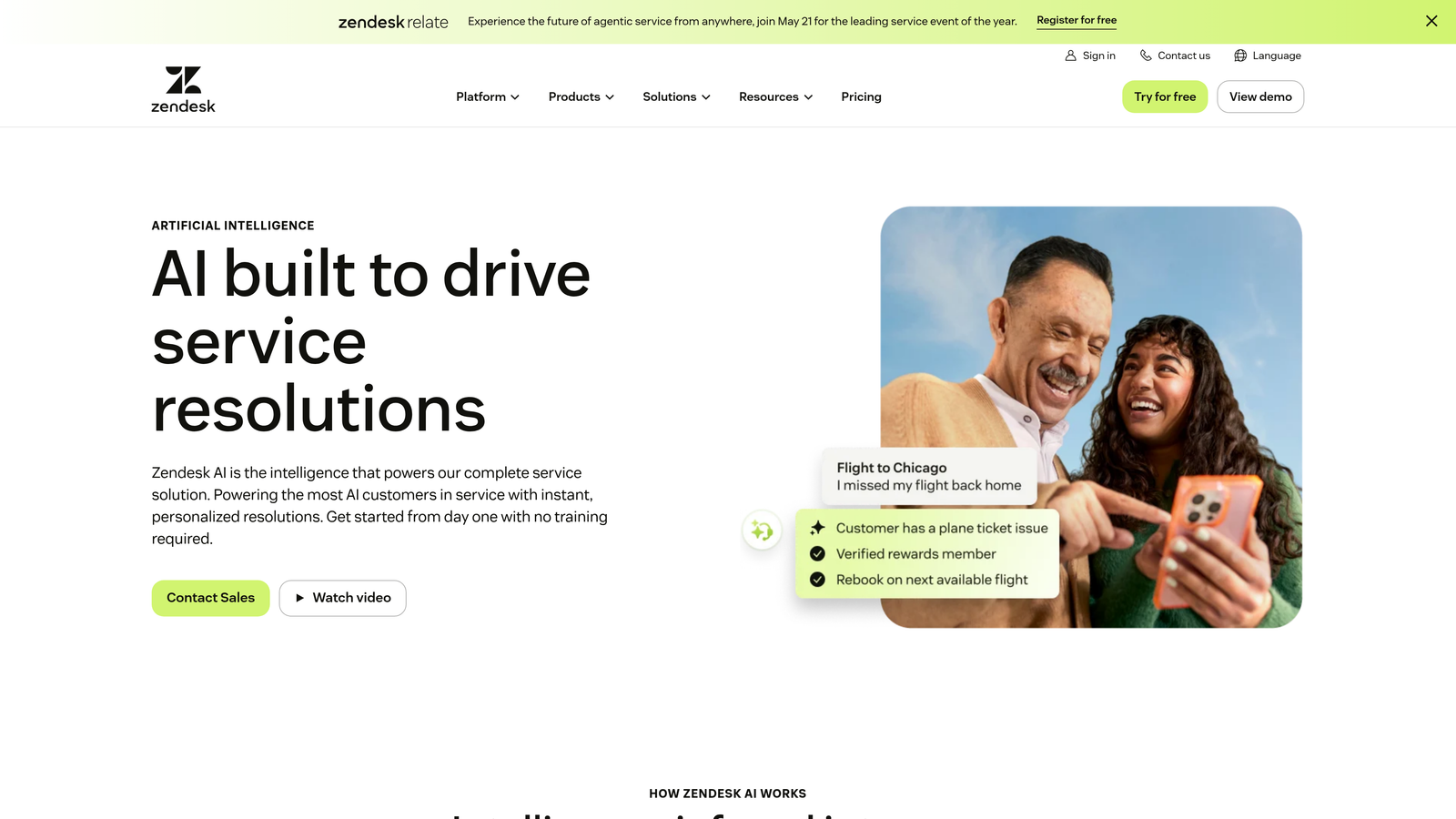
Zendesk AI brings AI agents, intelligent triage, and agent-assist capabilities into Zendesk's enterprise ticketing suite as an add-on layer.
Where This Tool Shines
Zendesk's strength has always been enterprise-grade ticketing infrastructure, and the AI additions extend that rather than replace it. For large support operations already standardized on Zendesk, the AI features integrate cleanly into existing agent workflows, reporting, and compliance structures.
The intelligent triage capabilities are particularly useful for high-volume teams. Automatic intent detection, language identification, and sentiment analysis help route tickets to the right queue or agent without manual sorting, which has real operational impact at scale.
Key Features
AI Agents: Automated resolution across email, chat, and messaging channels using AI trained on your help center content.
Intelligent Triage: Automatic intent detection, language detection, and sentiment analysis to route and prioritize incoming tickets.
Agent Assist: AI-suggested replies and ticket summaries to help human agents respond faster and more consistently.
Native Suite Integration: All AI features connect directly to Zendesk's existing ticketing, reporting, and workflow infrastructure.
Enterprise Compliance: Enterprise-grade security, data residency, and compliance controls consistent with Zendesk's existing certifications.
Best For
Large enterprises already running Zendesk Suite who want to add AI capabilities without platform migration. The add-on model means you're extending an existing investment rather than replacing it, which suits organizations with complex change management requirements.
Pricing
AI features are priced as add-ons to existing Zendesk Suite plans. Automated resolution carries per-resolution pricing in addition to base plan costs. Contact Zendesk for current enterprise pricing.
4. Ada
Best for: Global enterprises needing omnichannel, multilingual AI automation at scale
Ada is an enterprise conversational AI platform built for large-scale, multilingual customer service automation across multiple channels and geographies.
Where This Tool Shines
Ada's multilingual capabilities are genuinely broad, with support for over 50 languages out of the box. For companies operating across multiple regions, this removes a significant barrier that often forces teams to maintain separate support workflows per language or market.
The no-code automation builder is also worth noting. Non-technical teams can build and modify conversation flows without engineering involvement, which reduces the operational overhead of keeping automations current as products and policies change.
Key Features
No-Code Automation Builder: Visual interface for building conversation flows without requiring developer resources for ongoing maintenance.
50+ Language Support: Native multilingual capabilities covering a wide range of languages without additional configuration.
Omnichannel Deployment: Single platform for web, mobile, social, and SMS channels with consistent AI behavior across touchpoints.
AI Reasoning Engine: Handles complex, multi-step queries that go beyond simple FAQ-style responses.
CRM and Helpdesk Integrations: Connects to major platforms including Salesforce, Zendesk, and Freshdesk for data sharing and escalation.
Best For
Enterprise companies with global customer bases requiring multilingual support across multiple channels. Ada's scale and language capabilities make it particularly strong for companies where geographic diversity is a core support challenge.
Pricing
Custom enterprise pricing. Contact Ada's sales team for quotes based on volume and channel requirements.
5. Freshdesk Freddy AI
Best for: Growing mid-market teams who want AI-assisted support at accessible price points
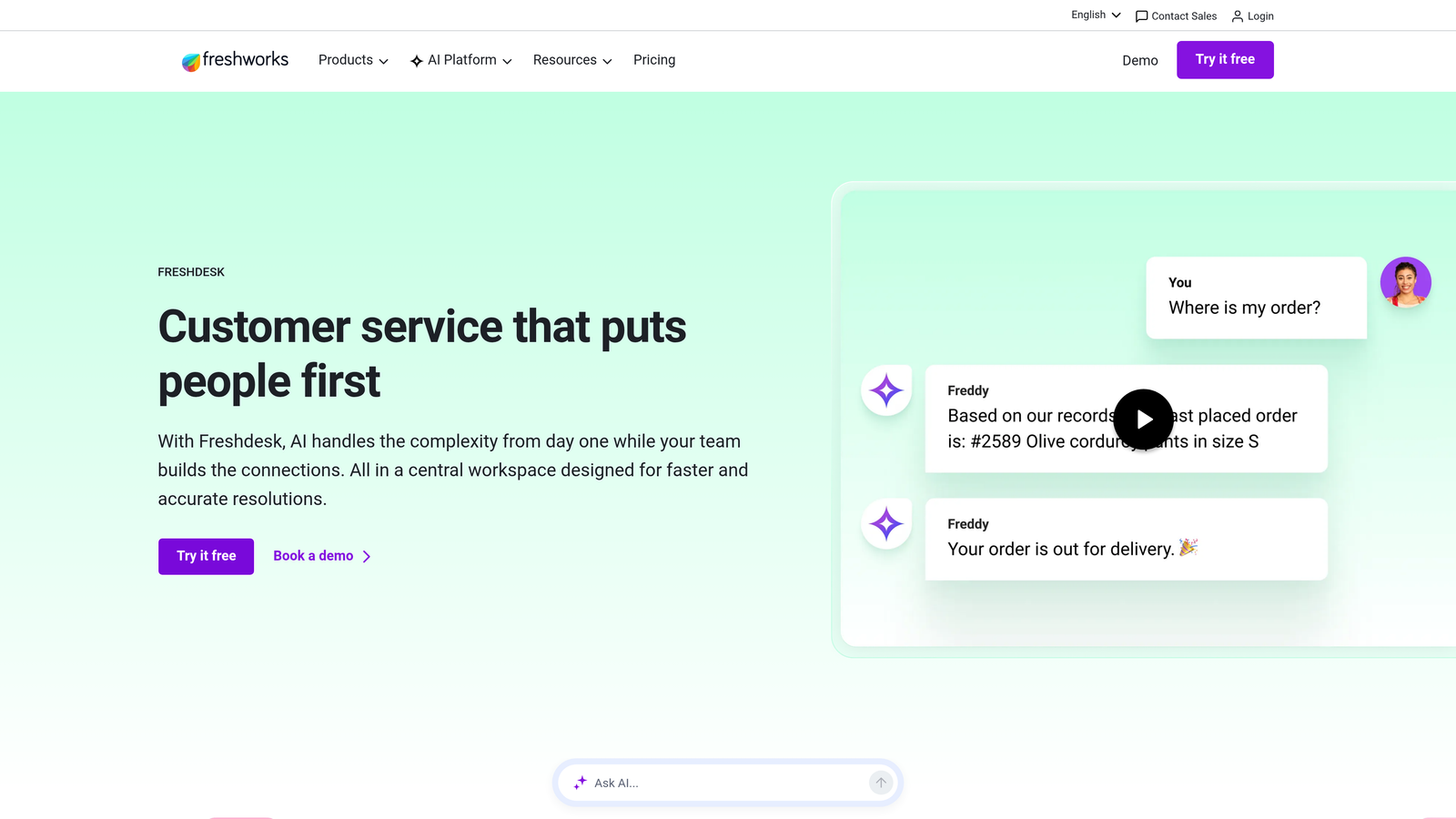
Freshdesk Freddy AI embeds AI capabilities into Freshworks' Freshdesk helpdesk suite, offering both customer-facing automation and agent-assist features across accessible pricing tiers.
Where This Tool Shines
Freshdesk's value proposition has always been strong functionality at a price point that doesn't require an enterprise budget. Freddy AI extends that positioning into AI-powered support, making it one of the more accessible options for mid-market teams that need real automation without a six-figure contract.
The dual-mode approach works well: Freddy AI Agent handles customer-facing resolution while Freddy Copilot assists human agents with suggestions and summaries. Teams can deploy both simultaneously or phase them in as confidence in the AI grows.
Key Features
Freddy AI Agent: Customer-facing AI for automated resolution using your knowledge base and ticket history.
Freddy Copilot: Agent-assist features including AI-suggested responses, ticket summaries, and next-action recommendations for human agents.
Built-In Helpdesk Suite: Ticketing, knowledge base, and reporting all within a single platform without requiring additional tools.
Accessible Pricing Tiers: AI features available at price points suitable for growing teams, not just enterprise budgets.
Marketplace Integrations: Connects to common business tools through Freshworks' integration marketplace.
Best For
Mid-market B2B teams that want AI-powered support without the cost or complexity of enterprise platforms. Also a strong option for teams currently on Freshdesk who want to add AI without switching their core helpdesk.
Pricing
Free tier available for basic use. Paid plans start around $15 per agent per month, with AI features available on higher tiers. Pricing is competitive relative to enterprise alternatives.
6. Tidio
Best for: SMBs and e-commerce teams wanting fast setup and conversational AI without complexity
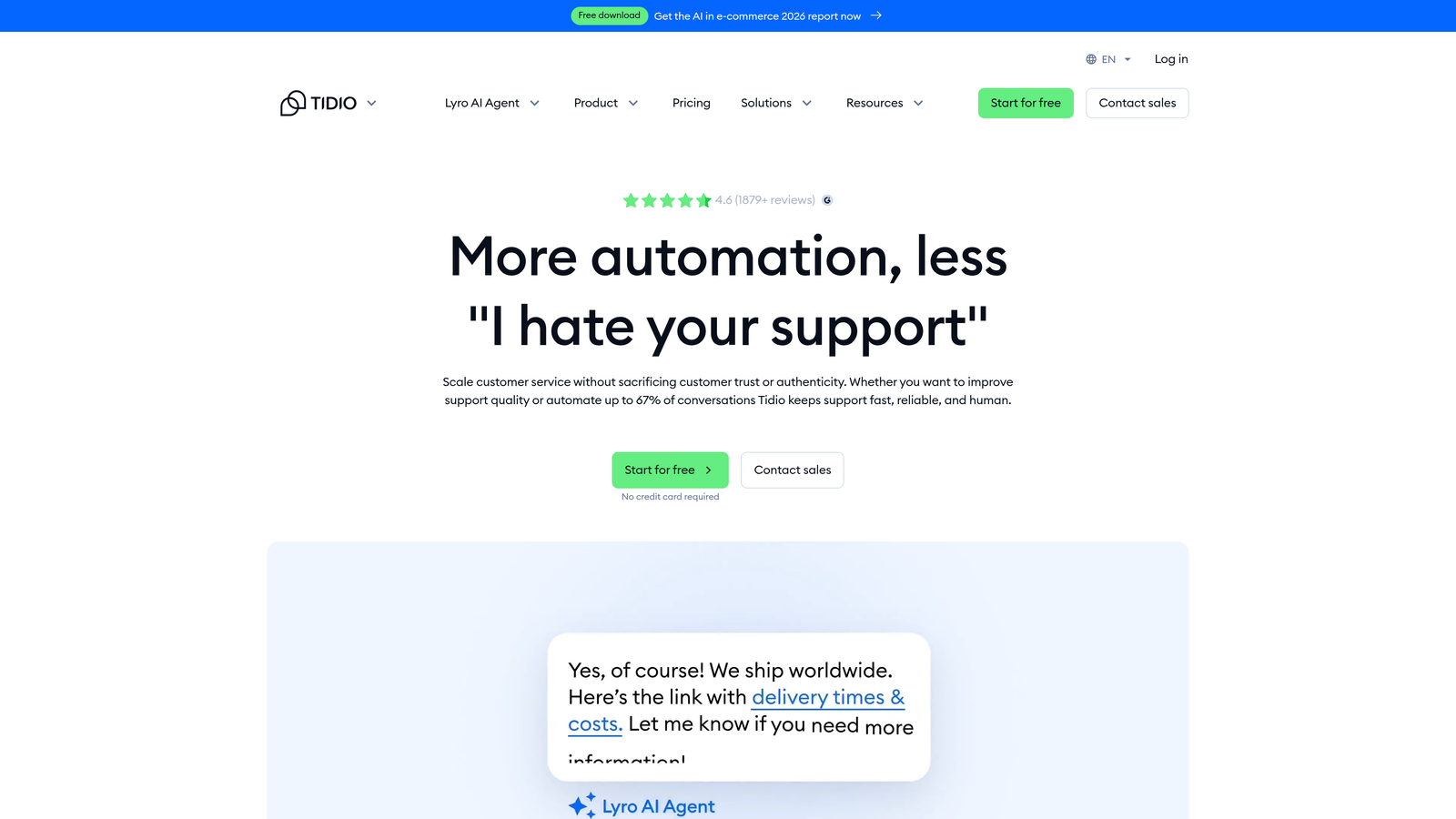
Tidio is a user-friendly AI chatbot and live chat platform featuring Lyro AI, designed for small to mid-size businesses that need conversational support without heavy implementation requirements.
Where This Tool Shines
Tidio's strongest suit is accessibility. The platform is designed to be operational quickly, with minimal technical requirements and a visual flow builder that non-technical teams can use without training. For small businesses that don't have a dedicated support ops function, that simplicity has real value.
The e-commerce integrations with Shopify and WooCommerce make Tidio particularly relevant for online retail teams, where order status, return policies, and product questions make up a large share of support volume.
Key Features
Lyro AI Chatbot: Conversational AI that handles common customer questions using your existing FAQ and knowledge content.
Visual Flow Builder: Drag-and-drop interface for building chatbot conversation flows without coding.
Live Chat with Visitor Monitoring: Real-time visibility into active visitors with the ability to proactively engage high-intent users.
E-Commerce Integrations: Native connections to Shopify and WooCommerce for order-aware support conversations.
Quick Setup: Designed for fast deployment with minimal technical configuration required.
Best For
Small businesses and e-commerce teams that want a simple, affordable AI chat solution without the complexity or cost of enterprise platforms. Not designed for large B2B SaaS operations with complex ticket workflows or deep integration requirements.
Pricing
Free plan available. Paid plans start around $29 per month. Lyro AI conversations are priced separately based on volume, so total cost scales with usage.
7. Forethought
Best for: Support teams focused on intelligent triage, prioritization, and agent augmentation
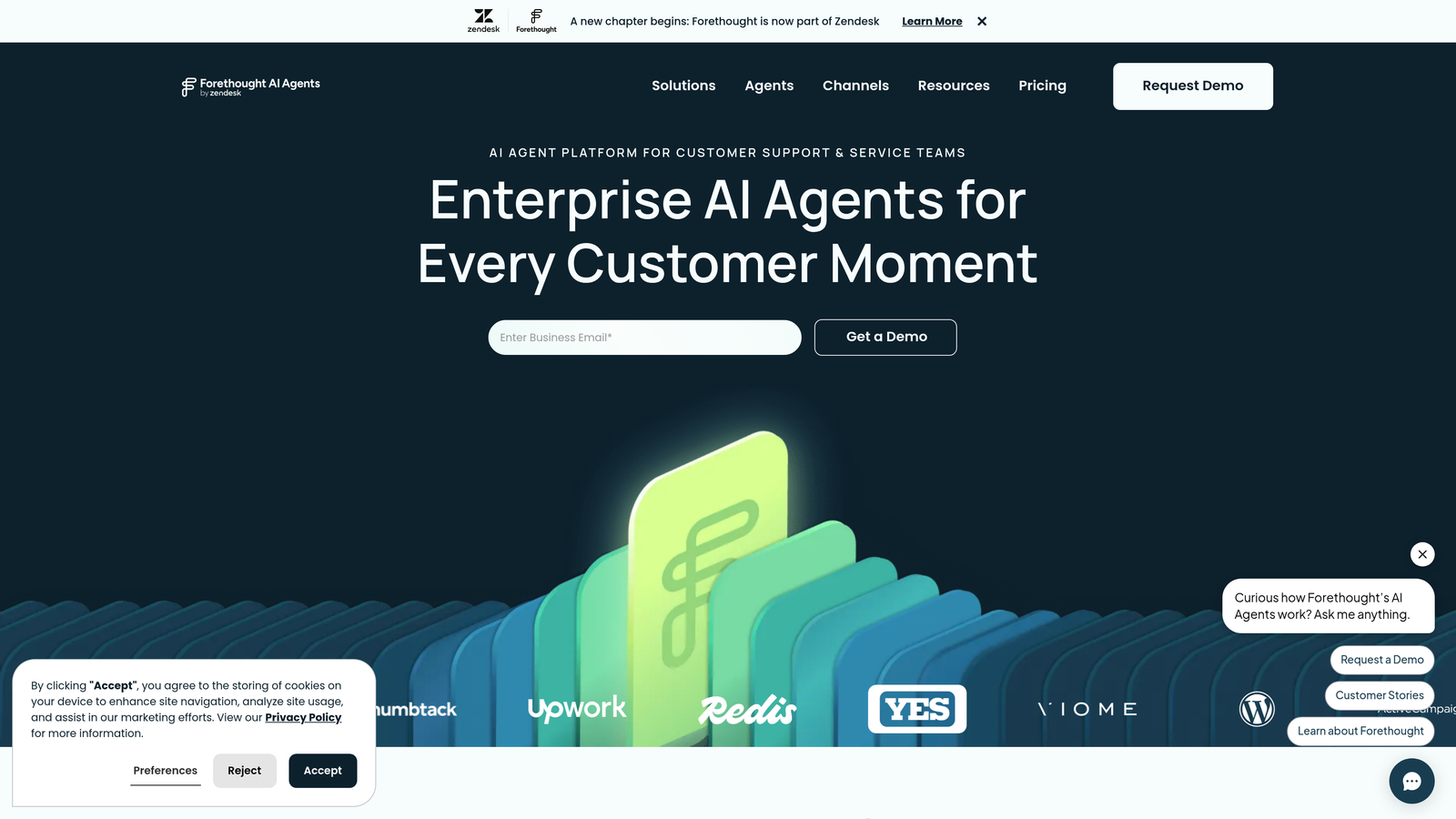
Forethought is an AI platform built around intelligent ticket triage, prioritization, and agent assist, designed to augment human support teams rather than replace them entirely.
Where This Tool Shines
Forethought takes a different philosophical position than fully autonomous AI agent platforms. Rather than aiming for maximum ticket deflection, it focuses on making human agents dramatically more effective through AI-powered routing, knowledge surfacing, and real-time response suggestions.
For teams where a significant portion of tickets genuinely require human judgment, that's a meaningful distinction. The triage capabilities are particularly strong, using AI to classify and route tickets with a level of nuance that reduces misrouting and queue backlogs.
Key Features
AI Triage: Automatic ticket classification and intelligent routing based on intent, urgency, and topic.
Solve for Self-Service: Automated resolution module for tickets that don't require human involvement.
Agent Assist: Real-time suggested responses and relevant knowledge article surfacing during live agent interactions.
Workflow Automation: Automated actions for repetitive ticket operations like tagging, status updates, and assignments.
Helpdesk Integrations: Deep integrations with Zendesk, Salesforce Service Cloud, and other major platforms.
Best For
Support operations where human agents handle a significant share of tickets and the priority is improving agent efficiency and accuracy rather than maximizing deflection. Strong fit for teams already on Zendesk or Salesforce who want AI augmentation without platform replacement.
Pricing
Custom pricing based on ticket volume and which modules are deployed. Contact Forethought for a quote based on your specific use case.
8. Kustomer
Best for: CRM-centric teams that need unified customer context across every support interaction
Kustomer is a CRM-powered customer service platform that combines a unified customer timeline with AI-driven classification and omnichannel support in a single workspace.
Where This Tool Shines
Kustomer's defining feature is its customer-centric data model. Rather than organizing work around tickets, it organizes around customers, presenting every interaction, order, and support touchpoint in a unified timeline. For businesses where customer history deeply informs how support issues should be handled, that context is genuinely valuable.
The AI capabilities build on that foundation, using customer history and intent signals to classify conversations and route them appropriately. This makes the AI smarter in context-heavy scenarios where ticket-centric platforms might miss important signals.
Key Features
Unified Customer Timeline: Single view combining support history, order data, and all customer interactions across channels.
AI Intent Detection: Automatic conversation classification based on customer intent, sentiment, and historical patterns.
Omnichannel Support: Unified inbox for email, chat, social media, and phone interactions.
CRM-Centric Context: Deep customer data available to agents and AI during every interaction without switching tools.
Business Rules Engine: Flexible workflow automation for routing, escalation, and ticket management.
Best For
Direct-to-consumer brands and companies where customer lifetime value and purchase history are central to support decisions. Less suited for pure B2B SaaS teams whose primary need is ticket deflection rather than customer data unification.
Pricing
Enterprise pricing starting around $89 per user per month. Designed for mid-market to enterprise operations rather than early-stage teams.
9. Cognigy
Best for: Enterprises needing highly customizable voice and chat AI with on-premise deployment options
Cognigy is an enterprise conversational AI platform specializing in complex, customizable voice and chat automation, with deployment flexibility that includes on-premise and private cloud options for regulated industries.
Where This Tool Shines
Cognigy is built for enterprises that need maximum control over their AI deployments. The on-premise and private cloud options address a genuine blocker for regulated industries like financial services, healthcare, and government, where data residency and sovereignty requirements make cloud-only platforms non-starters.
The voice capabilities are also notably mature compared to most platforms on this list. Cognigy handles both voice and text channels with equal sophistication, making it relevant for contact center operations where phone remains a primary channel alongside digital messaging.
Key Features
Voice and Text AI: Advanced conversational AI across both voice and digital text channels with consistent capability.
Visual Flow Editor: Sophisticated conversation design interface for building complex, branching interaction flows.
On-Premise Deployment: Full on-premise and private cloud deployment options for data sovereignty and compliance requirements.
Enterprise NLU: Multilingual natural language understanding with support for complex, domain-specific language.
Contact Center Integrations: Deep integrations with enterprise contact center infrastructure including Genesys and Avaya.
Best For
Large enterprises in regulated industries where data residency is a hard requirement, or contact center operations where voice AI is as important as chat automation. Not suited for teams looking for a quick-to-deploy, cloud-native solution.
Pricing
Custom enterprise pricing. Contact Cognigy's sales team for quotes based on deployment model, channel requirements, and scale.
Which Platform Fits Your Situation
The right AI customer service platform depends almost entirely on three things: your existing stack, your resolution goals, and where you expect to be in 18 months. Here's a quick map to help you decide.
Building AI-first from the ground up: Halo AI is the strongest choice for B2B SaaS teams that want autonomous agents, in-product guidance, and business intelligence from support data without being constrained by legacy helpdesk architecture.
Already on Intercom: Fin is the lowest-friction path to AI resolution if you're already in the Intercom ecosystem and don't want to manage a separate platform.
Enterprise Zendesk shop: Zendesk AI extends your existing investment without migration, which matters when you have complex workflows, compliance requirements, and change management constraints.
Global multilingual operation: Ada's language breadth and omnichannel coverage make it the strongest option for companies supporting customers across multiple regions and languages.
Budget-conscious mid-market: Freshdesk Freddy AI delivers real AI capability at price points that don't require an enterprise procurement process.
SMB or e-commerce: Tidio gets you operational quickly with minimal setup, especially if Shopify or WooCommerce is part of your stack.
Agent augmentation focus: Forethought is purpose-built for teams where human agents remain central and the goal is making them more effective, not replacing them.
CRM-centric D2C brand: Kustomer's unified customer timeline makes it the right fit when purchase history and customer context are core to how support issues get resolved.
Enterprise voice and chat with compliance requirements: Cognigy's deployment flexibility and mature voice capabilities make it the right call for regulated industries and large contact center operations.
Whatever platform you choose, the underlying principle holds: your support team shouldn't scale linearly with your customer base. The best AI platforms resolve routine tickets autonomously, guide users through your product in real time, and surface business intelligence that goes far beyond ticket counts. See Halo in action and discover how continuous learning transforms every interaction into smarter, faster support.