Customer Health Scoring Automation: How AI Turns Support Data Into Retention Intelligence
Customer Health Scoring Automation bridges the gap between reactive support and proactive retention by using AI to aggregate behavioral, support, and product data into real-time composite signals. This article explains how modern B2B teams can move beyond manual spreadsheets to identify at-risk customers before a cancellation request ever hits the inbox.
 Matt PattoliFounder14 min read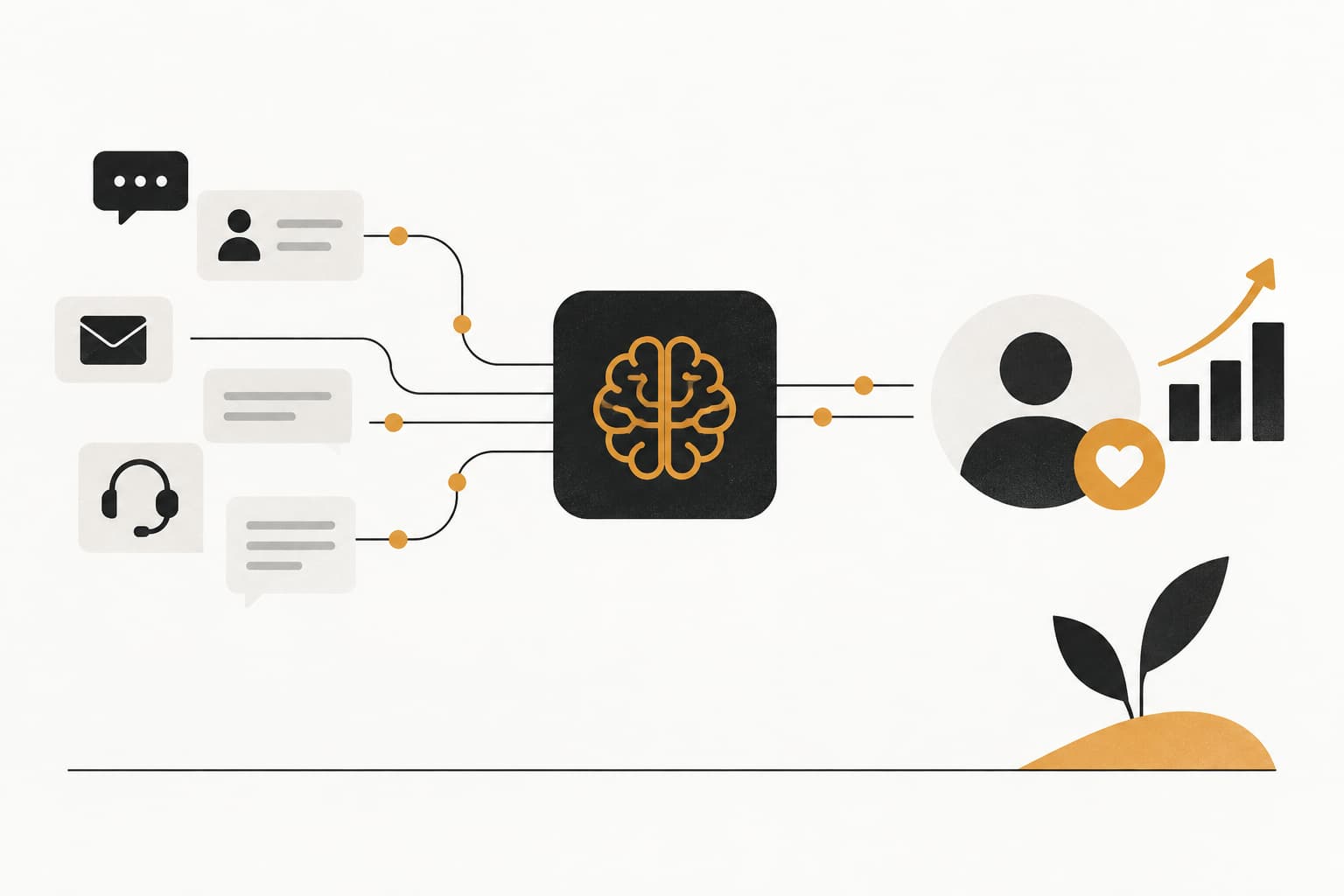
Your support team closes tickets all day. They troubleshoot, explain, reassure, and resolve. But somewhere in that daily grind, a customer who seemed perfectly fine three months ago quietly decides not to renew. No warning. No escalation. Just a cancellation request that lands in the inbox like a surprise.
This is the central frustration of modern customer success: by the time you notice a customer is struggling, the damage is often already done. The signals were there. They were just scattered across your helpdesk, your CRM, your product analytics, and your billing system, with no one connecting the dots fast enough to act.
Customer health scoring is the bridge between reactive support and proactive retention. Instead of waiting for a customer to raise their hand, health scoring aggregates behavioral, support, and product data into a single composite signal that tells you, in real time, which customers are thriving and which ones are quietly heading for the exit. The challenge is that doing this manually falls apart almost immediately at scale. Modern B2B products generate thousands of micro-signals every day, far too many for any spreadsheet or weekly check-in to process meaningfully.
That's where automation changes the game entirely. By the end of this article, you'll understand what customer health scoring automation actually is, which signals matter most, how the automation pipeline works, and how modern AI support platforms are making this level of intelligence accessible without a dedicated data science team.
The Hidden Cost of Not Knowing Your Customer's Health
Let's start with a clear definition. A customer health score is a composite signal, typically a number or a color-coded tier, that aggregates data from multiple sources to indicate how likely a customer is to renew, expand, or churn. Think of it as a vital signs monitor for each account. Just as a doctor doesn't rely on a single reading to assess a patient's health, a meaningful health score pulls from behavioral patterns, support interactions, product engagement, and financial history to form a complete picture.
The concept itself has been around in customer success circles for years, championed by platforms like Gainsight, Totango, and ChurnZero. What's changed dramatically is the volume and velocity of signals that modern SaaS products generate, and the expectation that teams can act on those signals quickly enough to make a difference.
Manual tracking simply cannot keep up. The classic approach involves a customer success manager maintaining a spreadsheet, updating account notes after quarterly business reviews, and relying on gut instinct to flag accounts that feel risky. This works reasonably well when you have twenty accounts. It breaks down entirely when you have two hundred, and it becomes almost meaningless at two thousand.
The problem isn't effort. It's physics. A human being can only process so many signals in a day. They can't simultaneously monitor ticket sentiment trends, notice that a key user hasn't logged in for three weeks, catch a failed payment that hasn't been followed up on, and cross-reference all of that against the customer's NPS score from last quarter. Not for every account. Not in real time.
Automation solves this by doing exactly that kind of continuous, multi-signal monitoring at scale. Every ticket submitted, every login event, every billing change, every feature interaction becomes a data point that feeds into a living score. The system doesn't sleep, doesn't forget, and doesn't have a backlog. When a customer's behavior shifts in a way that historically precedes churn, the score moves and the right people get notified before the cancellation request arrives.
This shift from reactive to proactive customer support isn't just operationally cleaner. It fundamentally changes the economics of retention. Intervening early, when a customer is showing early warning signs, is far more effective than trying to win back an account that has already mentally checked out.
The Signals That Actually Predict Customer Health
Not all data is equally predictive. One of the most important decisions in building a health scoring model is deciding which signals to weight most heavily. Industry practitioners generally organize health signals into four categories, each capturing a different dimension of the customer relationship.
Support signals include ticket volume trends, resolution time, sentiment within ticket conversations, and escalation rate. These are often the richest and most underutilized source of health data available to B2B companies. A customer who suddenly submits three times their normal ticket volume, with increasingly frustrated language, is sending a clear signal. The problem is that this signal typically lives in the helpdesk and never makes it into the CRM or the health score. It gets resolved and filed away, disconnected from the broader account picture.
Product signals capture how customers actually use what they're paying for. Login frequency, session duration, feature adoption depth, and API usage volume all tell a story. A customer who is deeply embedded across multiple features is far less likely to churn than one who logs in occasionally and only uses the most basic functionality. Conversely, a customer who was previously highly engaged but whose session frequency has dropped sharply over the past few weeks deserves attention.
Financial signals include payment history, plan tier changes, billing disputes, and expansion or contraction events. A customer who has upgraded their plan twice in the past year is a very different health profile than one who recently downgraded or disputed an invoice. These signals are often available in billing systems like Stripe but rarely connected to the health scoring layer in a meaningful way.
Relationship signals cover the qualitative side of the customer relationship: NPS responses, survey completion rates, QBR attendance, and stakeholder engagement. A customer who actively participates in quarterly reviews and responds to surveys is demonstrating investment in the relationship. One who has gone silent on all communication channels is not.
Here's where the concept of leading versus lagging indicators becomes critical. Lagging indicators describe what has already happened. A churned customer is a lagging indicator. A downgraded account is a lagging indicator. These are useful for understanding patterns in retrospect, but they don't give you time to act.
Leading indicators are predictive. A spike in frustrated support tickets, a drop in login frequency, a key stakeholder who stops attending calls, these signal what is likely to happen if nothing changes. The entire value of health scoring automation is its ability to surface leading indicators in time to intervene. Manual processes, by their nature, tend to catch lagging indicators. Automation is specifically designed to catch the leading ones. Understanding how to track customer health from support data is the first step toward building this kind of predictive capability.
How Automation Builds and Maintains Health Scores
Understanding what signals matter is one thing. Building the infrastructure to collect, weight, and act on them continuously is another. Let's walk through how an automated health scoring pipeline actually works.
The foundation is data ingestion. Your health scoring system needs to pull data from every system that touches the customer relationship. That typically means your CRM (like HubSpot), your helpdesk or support platform, your product analytics tool, your billing system (like Stripe), and your communication tools. Each of these systems holds a piece of the customer story. The automation layer's job is to connect them into a unified view of each account.
This is where integration depth matters enormously. A health scoring system that only reads from your CRM is missing most of the signal. A system that pulls from your helpdesk, your product database, your billing platform, and your communication tools is working with a much more complete picture. The quality of your health scores is directly proportional to the breadth and freshness of your data inputs.
Once data is flowing in, signal weighting determines how much each input contributes to the overall score. In a rule-based system, you might manually define that ticket sentiment accounts for twenty percent of the score, feature adoption for thirty percent, and so on. This works as a starting point but requires ongoing manual adjustment as your product and customer base evolve.
This is where AI and machine learning introduce a meaningful upgrade. Instead of static weights defined by human assumption, an adaptive model learns which signals most reliably predict outcomes for your specific customer base. It identifies patterns that humans wouldn't necessarily think to look for, such as the combination of a particular feature not being used alongside a drop in a specific support category that reliably precedes churn in your environment. Over time, as the model sees more outcomes, its predictions become more accurate and its weights become more reflective of reality.
Real-time score recalculation is what makes this operationally useful. A health score that updates monthly is better than no health score. A score that recalculates every time a new event occurs, a ticket submitted, a login recorded, a payment processed, is genuinely actionable. When a customer's score drops sharply overnight because of a surge in frustrated tickets and a failed payment, the system knows immediately. The right people can be notified before the next business day begins.
The practical infrastructure for this requires a connected tech stack. Platforms like Halo AI, which integrate natively with HubSpot, Stripe customer support automation, Slack, Intercom, and Linear, are positioned to serve as the connective tissue between these systems. The AI agents that handle support interactions also generate structured data about sentiment, resolution complexity, and escalation patterns, data that can feed directly into health scoring logic without manual data entry. The support layer becomes an intelligence layer.
From Score to Action: Triggering the Right Response Automatically
A health score that sits in a dashboard and waits for someone to check it is only marginally better than no score at all. The real value of automation is in what happens when a score changes, specifically, the workflows that trigger automatically based on score thresholds.
Think of score thresholds as decision points. You define tiers: healthy, neutral, at-risk, and critical. When a customer's score crosses from neutral into at-risk territory, the system doesn't wait for a human to notice. It acts. That might mean sending an alert to the assigned CSM in Slack, creating a follow-up task in HubSpot, flagging the account in the support inbox for priority attention, or triggering an automated outreach sequence. The specific action depends on the threshold and the playbook you've defined for that customer tier. Building effective support workflow automation tools into this process ensures the right actions fire at the right moments without manual intervention.
This is where AI support agents become a meaningful part of the retention story. When a customer's health score is declining and they open a chat session, the AI agent isn't just resolving a ticket in isolation. It has context. It knows this account is at risk. It can proactively surface relevant help content, offer a guided walkthrough of a feature the customer hasn't adopted, or recognize that the conversation is escalating emotionally and hand off to a live agent before the customer reaches the point of frustration where they start researching alternatives.
That kind of contextually aware, proactive engagement is very different from a standard chatbot that simply pattern-matches to a knowledge base article. The AI agent is functioning as part of a larger retention system, not just a ticket-closing machine. Teams exploring support automation with human handoff will find this blend of AI context-awareness and live escalation is central to making at-risk interventions actually work.
The expansion side of health scoring is equally important and often overlooked. High-health customers who are deeply engaged with specific features, logging in frequently, and growing their usage represent expansion opportunities. Automated workflows can flag these accounts to the sales team with relevant context, triggering an outreach about a higher-tier plan or a complementary product. Instead of relying on a sales rep to manually identify expansion candidates, the system surfaces them automatically when the signals align.
The result is a support and success motion that is simultaneously more proactive on the churn side and more opportunistic on the expansion side, all driven by the same underlying health scoring infrastructure.
Building Your Health Scoring Model: A Practical Framework
Knowing the theory is one thing. Building a model that actually works for your business requires a structured approach, especially if you're starting from scratch.
The most reliable starting point is your churn history. Look at the customers who left in the past twelve to eighteen months and ask a simple question: what did they have in common thirty to sixty days before they churned? Were they submitting more tickets than average? Had their product engagement dropped? Did they miss a QBR? Did they have a billing dispute that wasn't fully resolved? The patterns you find in churned accounts are your first set of predictive signals, and they're grounded in your actual customer data rather than industry assumptions.
From there, assign initial weights to each signal category based on how strongly it correlated with churn in your historical analysis. Define your score tiers: healthy, neutral, at-risk, and critical. Set the thresholds for each tier, and map out the automated workflows that should trigger at each level. This doesn't need to be perfect on day one. It needs to be good enough to start generating signal and informing action.
One of the most important best practices in health scoring is segmenting your model by customer type. A startup on a free trial has fundamentally different health signals than an enterprise customer on a multi-year contract. The enterprise customer's health might be best predicted by stakeholder engagement and feature adoption depth. The startup's health might be more closely tied to time-to-value and initial onboarding completion. Applying a single model to both will produce scores that are accurate for neither.
Segment by customer tier, product line, or use case, and build scoring logic that reflects the reality of each segment. This requires more upfront work but produces significantly more actionable scores.
There are three common pitfalls worth naming explicitly. The first is over-indexing on a single signal. Ticket volume alone doesn't tell you much. A customer who submits many tickets but gets them resolved quickly and leaves positive feedback is very different from one who submits the same volume with escalating frustration. Context and combination matter.
The second pitfall is failing to refresh your model as your product evolves. If you launch a major new feature and don't update your health scoring logic to account for its adoption, your scores will gradually become less predictive. Health models require ongoing maintenance. Reviewing your support automation success metrics on a regular cadence is one of the most effective ways to catch model drift before it erodes score accuracy.
The third pitfall is not closing the loop. If your model flags an at-risk account and a CSM intervenes, did the score recover? Did the customer renew? Tracking intervention outcomes is what allows you to refine your model over time and understand which playbooks actually work.
Health Scoring as a Company-Wide Intelligence Layer
It's tempting to think of customer health scoring as a customer success tool. It's more accurate to think of it as business intelligence infrastructure that every team in your company benefits from.
Your support team uses health scores to prioritize which tickets need urgent attention and which accounts need proactive outreach. Your sales team uses them to identify expansion candidates and flag accounts that might be vulnerable to competitive displacement. Your product team uses aggregate health signal data to understand which features drive retention and which ones correlate with disengagement. Leadership uses the overall health distribution of the customer base as a leading indicator of revenue performance.
When everyone is working from the same shared view of customer health, the organization stops operating in silos. A product manager who sees that a specific feature has low adoption among at-risk accounts has a very different set of priorities than one flying blind. A sales leader who can see which accounts are deeply healthy and primed for expansion can direct their team's energy far more effectively. Teams that struggle with support team health visibility gaps often find that this shared intelligence layer is the single most impactful structural change they can make.
The compounding value of this system grows over time. As the AI learns from more interactions and more outcomes, its predictions become more accurate. Interventions become more targeted. The cost of churn prevention decreases as the system gets better at identifying the right moment and the right action for each account.
Halo AI's smart inbox, AI agents, and native integrations with HubSpot, Stripe, Slack, and Intercom are built to serve as exactly this kind of foundation. Instead of assembling a custom data pipeline from scratch or purchasing a dedicated CS platform that requires months of implementation, teams can leverage Halo's existing intelligence layer as the starting point for automated health scoring. The support interactions your AI agents handle every day aren't just tickets being closed. They're signals being captured, patterns being learned, and scores being updated in real time.
Your support team shouldn't scale linearly with your customer base. Let AI agents handle routine tickets, guide users through your product, and surface business intelligence while your team focuses on complex issues that need a human touch. See Halo in action and discover how continuous learning transforms every interaction into smarter, faster support.
The Bottom Line
Customer health scoring automation is no longer a capability reserved for companies with dedicated data science teams and enterprise CS platforms. The tools and integrations that make it possible are increasingly accessible to any B2B team willing to connect their systems and act on the signals those systems generate.
The core insight is straightforward: your customers are already telling you how they feel through their behavior. Every ticket they submit, every feature they use or ignore, every login they make or skip, every payment they process or dispute, all of it is signal. The question is whether your infrastructure is built to listen to all of it simultaneously, in real time, and translate it into action before it's too late.
Start with your churn history. Build a model that reflects your actual customer base. Segment it by customer type. Connect the systems that hold your signal data. Define the workflows that trigger when scores change. And then let the system do what humans cannot: monitor every account, every day, without missing anything.
That's what customer health scoring automation actually delivers. Not just better data, but the operational capacity to act on it at the speed your customers require. See Halo in action and explore how the platform's business intelligence capabilities, smart inbox, and AI agents can serve as the foundation for building this intelligence layer without starting from scratch.
How Halo helps
Halo gives customer success teams one AI brain across tickets, calls, CRM, and product usage — so churn signals surface before renewal conversations, not after. Learn more about how Halo catches churn early.