8 Best Customer Service AI Agent Platforms in 2026
This guide evaluates the 8 best customer service AI agent platform options available in 2026, comparing AI-first architectures against legacy helpdesk add-ons across autonomy, integration depth, and learning capabilities. It is designed to help B2B SaaS support teams identify the solution that best fits their scale, workflow, and business intelligence needs.
 Matt PattoliFounder12 min read
Customer support teams are under more pressure than ever: resolve tickets faster, scale without adding headcount, and deliver personalized experiences across every channel. AI agent platforms have moved well beyond simple chatbots. Today's solutions can autonomously resolve complex tickets, guide users through products in real time, detect bugs, and surface business intelligence that goes far beyond basic support metrics.
But not all platforms are built the same. Some are AI layers bolted onto legacy helpdesks. Others are AI-first from the ground up. That architectural difference matters more than most buyers realize — it affects how well the AI learns, how autonomously it can act, and how much ongoing maintenance your team will carry.
Here are the top customer service AI agent platforms available in 2026, evaluated on autonomy, integration depth, learning capabilities, and real-world fit for B2B SaaS teams.
1. Halo AI
Best for: B2B SaaS teams wanting AI-first support with business intelligence built in
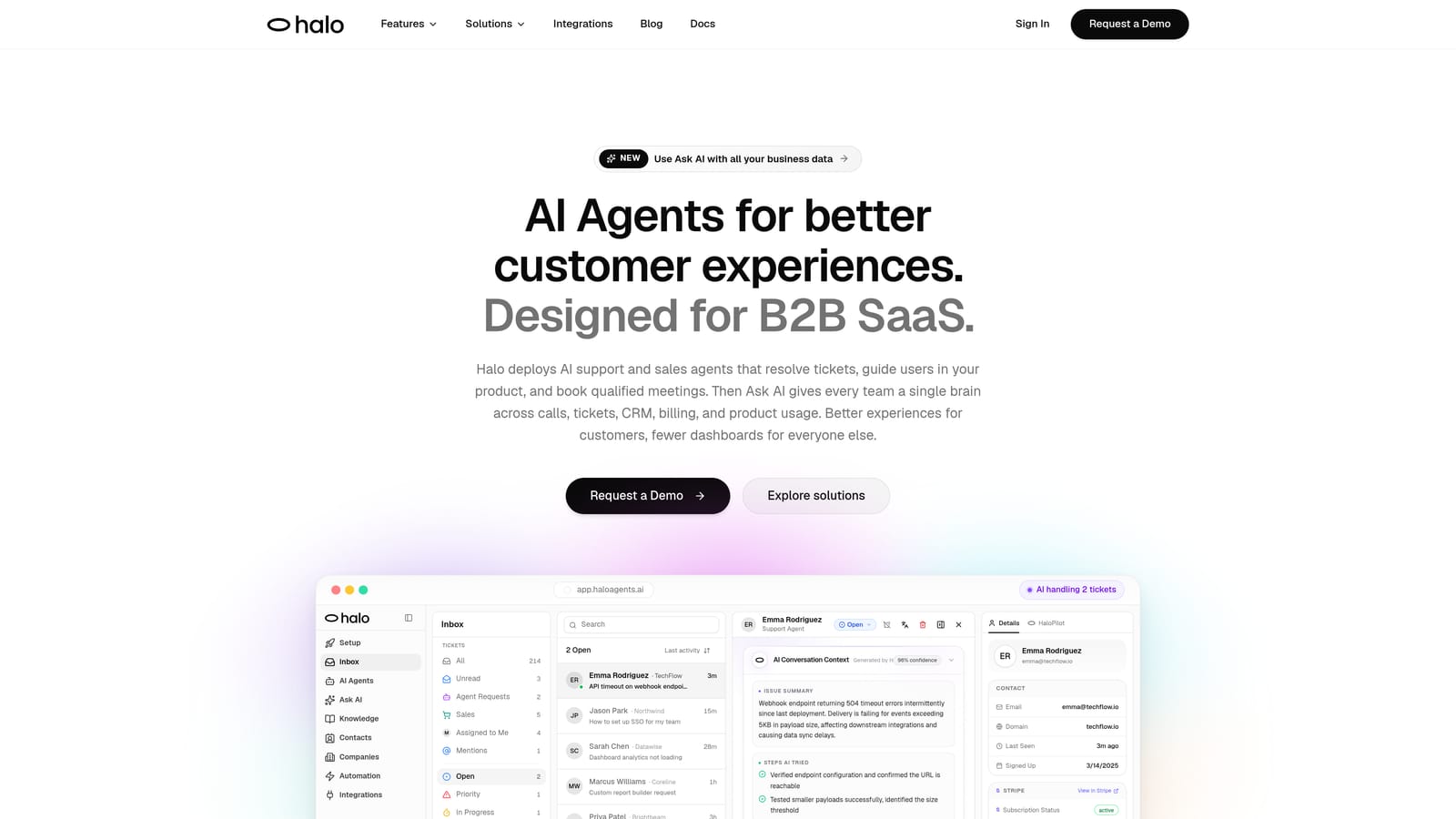
Halo AI is an AI-first customer support platform built specifically for B2B SaaS teams, deploying intelligent agents that resolve tickets, guide users visually through your product, and surface business signals — all while continuously learning from every interaction.
Where This Tool Shines
What separates Halo from most platforms on this list is its architecture. It was built as an AI-native system, not a feature added on top of an existing helpdesk. That means the AI isn't working around legacy rule-based logic — it's the foundation everything else runs on.
The page-aware chat widget is a standout capability: the AI understands exactly which page or product state a user is on and provides contextual, visual UI guidance in response. Combined with a smart inbox that surfaces customer health signals, revenue anomalies, and churn indicators, Halo functions less like a support tool and more like an intelligence layer across your entire customer relationship.
Key Features
Page-Aware Chat Widget: The AI sees what your users see, enabling contextual UI guidance that's specific to their current product state — not generic help center links.
Autonomous Ticket Resolution: AI agents resolve support tickets end-to-end and continuously learn from every interaction to improve over time.
Auto Bug Ticket Creation: When users report issues, Halo automatically creates and routes bug tickets directly to Linear, reducing manual triage work for engineering teams.
Smart Inbox with Business Intelligence: Goes beyond support metrics to surface customer health signals, revenue anomalies, and churn indicators from support interactions.
Live Agent Handoff: Complex escalations transfer seamlessly to human agents with full conversation context preserved.
Deep Integration Stack: Connects natively with Linear, Slack, HubSpot, Intercom, Stripe, Zoom, PandaDoc, and Fathom — covering the full B2B SaaS business stack. Explore the full integrations page for details.
Best For
B2B SaaS companies that want more than ticket deflection. If your team needs an AI that learns continuously, integrates across your entire stack, and surfaces business intelligence beyond support, Halo is purpose-built for that use case. Particularly well-suited for product-led growth teams where support and product experience overlap.
Pricing
Contact for pricing. Halo is positioned for B2B SaaS teams and scales with your customer base rather than per-seat or per-resolution models.
2. Intercom (Fin AI Agent)
Best for: Teams already on Intercom who want autonomous AI without switching platforms
Intercom Fin is an autonomous AI resolution layer built natively into the Intercom messenger, designed to handle customer queries using your existing knowledge base without requiring a platform migration.
Where This Tool Shines
Fin's biggest advantage is zero switching cost for existing Intercom customers. It sits directly inside the messenger and inbox your team already uses, pulling from your existing help center content to answer queries autonomously. For teams with a well-structured knowledge base, Fin can deflect a significant volume of repetitive, FAQ-style questions without any additional infrastructure.
The usage-based pricing model is also worth noting. You pay per resolution rather than a flat seat fee, which makes cost predictable for teams with variable support volumes.
Key Features
Native Messenger Integration: Fin operates inside Intercom's existing messenger and inbox, requiring no workflow changes for support teams.
Knowledge Base-Driven Resolution: Works directly from your existing help center content, making deployment fast for teams with documented support material.
Usage-Based Pricing: Pay per resolution rather than per seat, giving teams flexibility based on actual AI usage.
Seamless Human Handoff: Escalations transfer to human agents within the same conversation thread, preserving context.
Multi-Language Support: Handles queries across multiple languages, useful for international customer bases.
Best For
Companies already invested in Intercom who want to add autonomous resolution without changing their support stack. Less ideal for teams seeking deep business intelligence or AI that learns beyond static knowledge base content.
Pricing
Usage-based pricing per resolution, charged on top of existing Intercom subscription plans. Costs scale with resolution volume rather than team size.
3. Zendesk AI (Agents and Copilot)
Best for: Large organizations deeply committed to Zendesk infrastructure
Zendesk AI includes both autonomous AI agents for self-service resolution and an AI Copilot that assists human agents with real-time suggestions and next-best actions, all built into the Zendesk Suite.
Where This Tool Shines
If your organization has years of Zendesk data, macros, triggers, and workflows, Zendesk AI is the path of least resistance to adding AI capabilities. The Copilot feature is particularly useful for teams that aren't ready to go fully autonomous — it augments human agents rather than replacing them, suggesting responses and guiding next steps in real time.
The intent detection and intelligent triage capabilities also help large teams manage high ticket volumes by routing issues to the right queue or agent automatically. For organizations with complex support workflows already built in Zendesk, this is a meaningful upgrade rather than a platform replacement. You can explore how this compares to modern AI-first approaches in this Zendesk vs AI support platform breakdown.
Key Features
Autonomous AI Agents: Handle defined ticket types without human involvement, drawing on your existing Zendesk content and workflows.
AI Copilot: Provides real-time response suggestions and next-step guidance to human agents during live conversations.
Intent Detection and Triage: Automatically identifies ticket intent and routes to the appropriate team or workflow.
Deep Workflow Integration: Works natively with Zendesk macros, triggers, and automation rules already in place.
Suite-Wide Availability: AI capabilities are available across Zendesk Suite plans, with full autonomous features on higher tiers.
Best For
Enterprises with significant Zendesk investment and complex existing workflows. Less suited for teams starting fresh or looking for AI-first architecture rather than AI layered onto a legacy system. See also: Zendesk automation tools comparison.
Pricing
AI features are included on higher Zendesk Suite plans. Full autonomous agent capabilities require enterprise-tier licensing. Contact Zendesk for specific pricing.
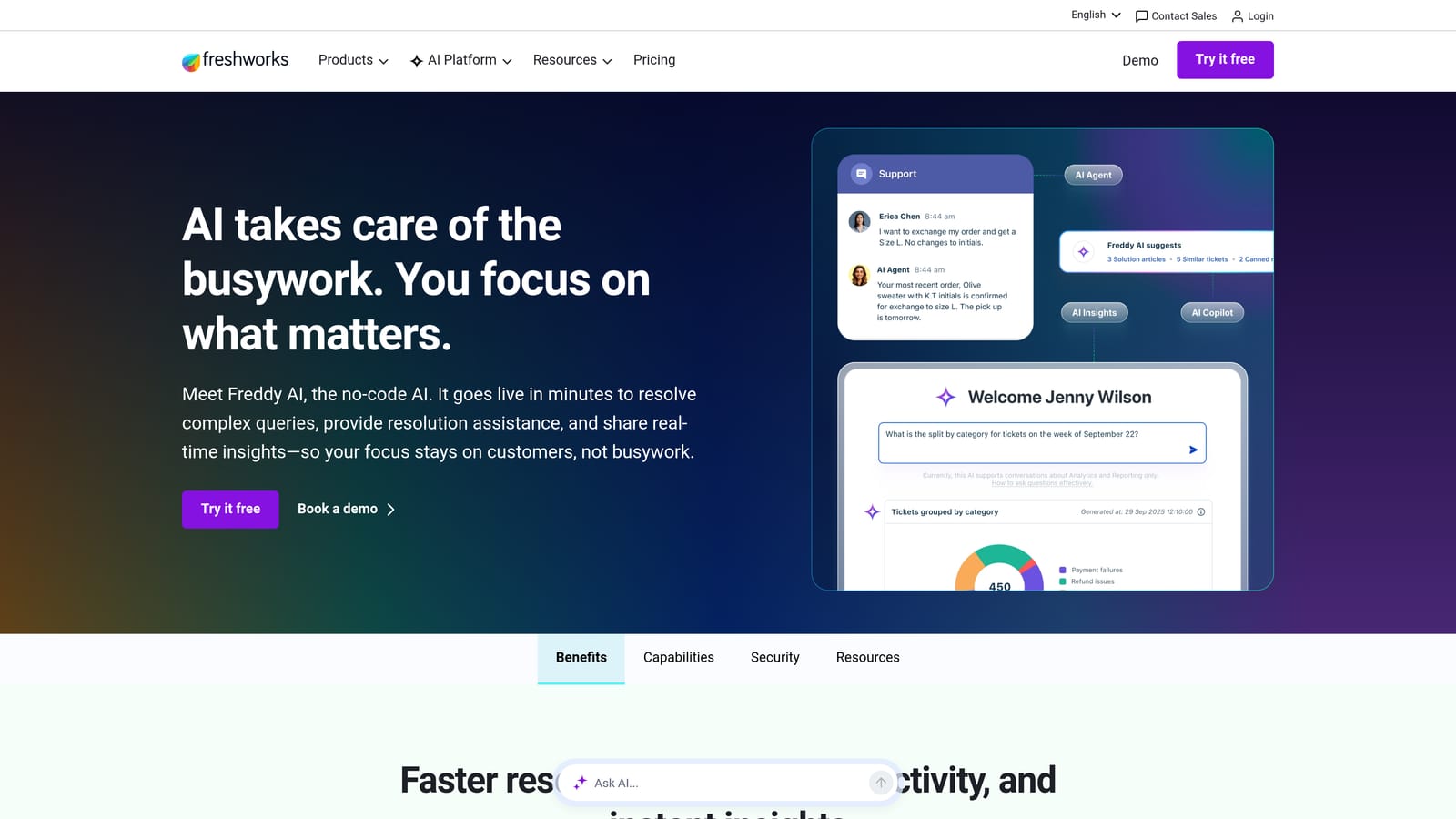
4. Freshdesk Freddy AI
Best for: Teams using the Freshworks ecosystem who want AI across support, CRM, and ITSM
Freshdesk Freddy AI is Freshworks' unified AI layer spanning customer support, CRM, and IT service management — offering self-service, agent assistance, and analytics in a single ecosystem.
Where This Tool Shines
Freddy's strength is breadth. Unlike platforms focused solely on support, Freddy AI spans Freshdesk, Freshsales, and Freshservice — which means your AI capabilities carry across support, sales, and IT functions without needing separate tools for each. For organizations already running on Freshworks products, this creates a unified AI layer rather than fragmented point solutions.
The three-module structure (Self Service, Copilot, and Insights) also gives teams flexibility to adopt AI incrementally. You can start with customer-facing deflection and layer in agent assistance and analytics as your team matures.
Key Features
Freddy Self Service: Customer-facing AI deflection and autonomous resolution drawing from your knowledge base and support history.
Freddy Copilot: Real-time agent assistance with suggested replies, summarization, and next-step guidance during live tickets.
Freddy Insights: AI-powered analytics that surface support trends, anomalies, and performance signals for team leads.
Cross-Platform Coverage: Spans Freshdesk, Freshsales, and Freshservice for consistent AI across business functions.
Competitive Pricing: Generally more affordable than Zendesk and Salesforce equivalents, particularly for growing teams.
Best For
Teams already on Freshworks products, or organizations looking for a more affordable alternative to Zendesk or Salesforce with solid cross-functional AI coverage. Less suited for teams needing deep B2B-specific intelligence or AI-first architecture.
Pricing
Freddy AI is available as add-ons across Freshdesk plans. Pricing varies by module and tier. Contact Freshworks for current rates.
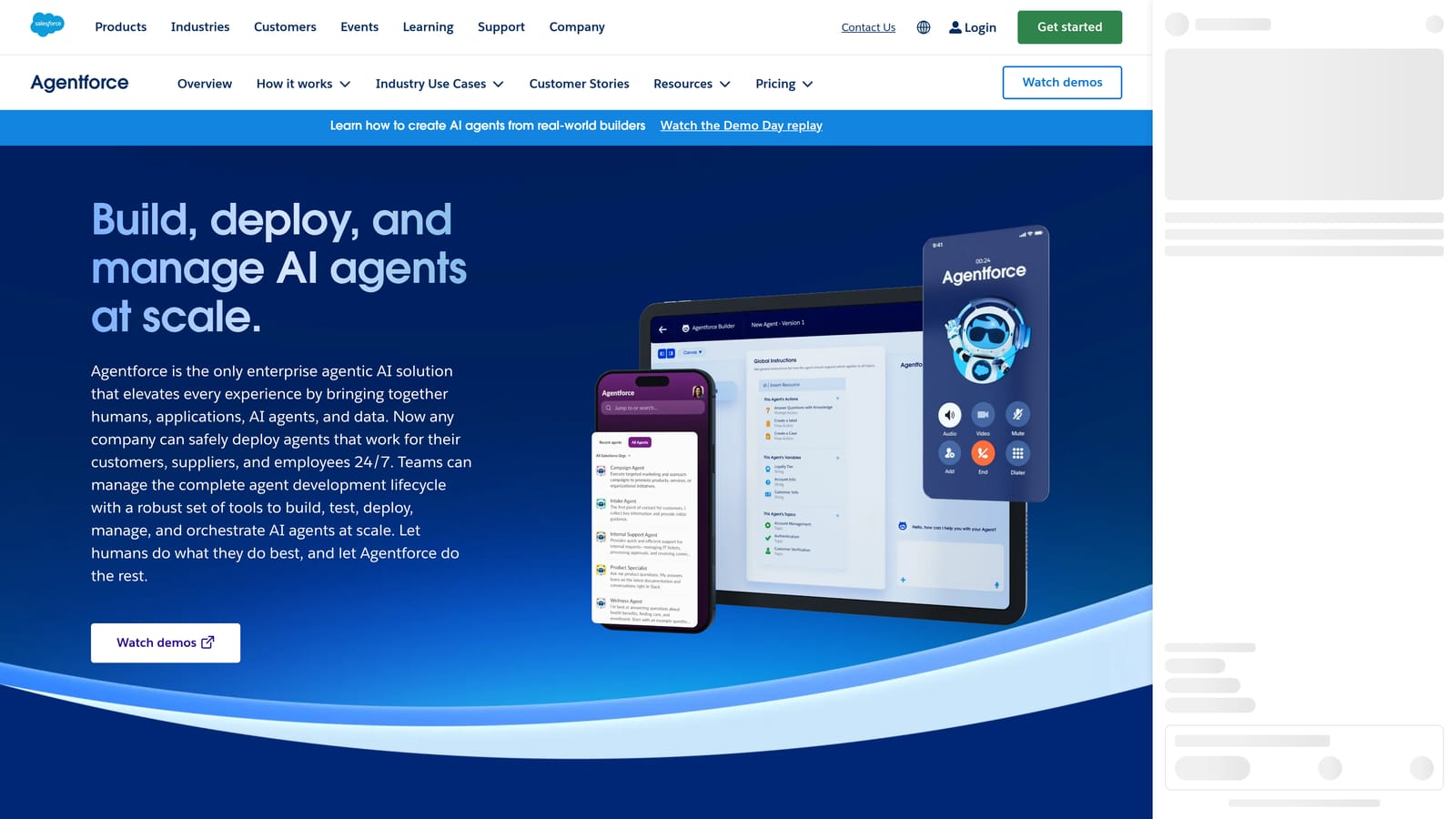
5. Salesforce Agentforce
Best for: Enterprise organizations with deep Salesforce CRM investment
Salesforce Agentforce is Salesforce's autonomous AI agent platform, deeply connected to Salesforce Data Cloud and CRM, enabling AI-driven actions across service, sales, and marketing from a single platform.
Where This Tool Shines
Agentforce's core advantage is data access. When your customer data, history, and CRM context all live in Salesforce, an AI agent built natively on that data can make more informed, personalized decisions than a standalone support tool with limited CRM visibility. The Atlas Reasoning Engine enables multi-step decision making that goes beyond simple query-response patterns.
For enterprises where service, sales, and marketing teams all operate within Salesforce, Agentforce offers a unified AI layer that can act across all three functions. That's a meaningful advantage if your organization is already standardized on Salesforce infrastructure.
Key Features
CRM-Connected Autonomy: AI agents operate with full Salesforce CRM and Data Cloud context, enabling personalized, data-informed resolutions.
Atlas Reasoning Engine: Powers multi-step decision making for complex service scenarios that require more than a single-turn response.
Cross-Functional Scope: Spans service, sales, and marketing use cases within a single platform and data model.
Pre-Built Agent Templates: Accelerates deployment with templates for common service scenarios, reducing custom build time.
Deep Salesforce Integration: Works natively with Salesforce Flow, Einstein, and third-party connected systems.
Best For
Large enterprises where Salesforce is the system of record for customer data. Organizations without significant Salesforce investment will find limited value — the platform's power comes directly from its CRM connectivity.
Pricing
Enterprise pricing. Requires existing Salesforce licensing. Contact Salesforce for current Agentforce pricing details.
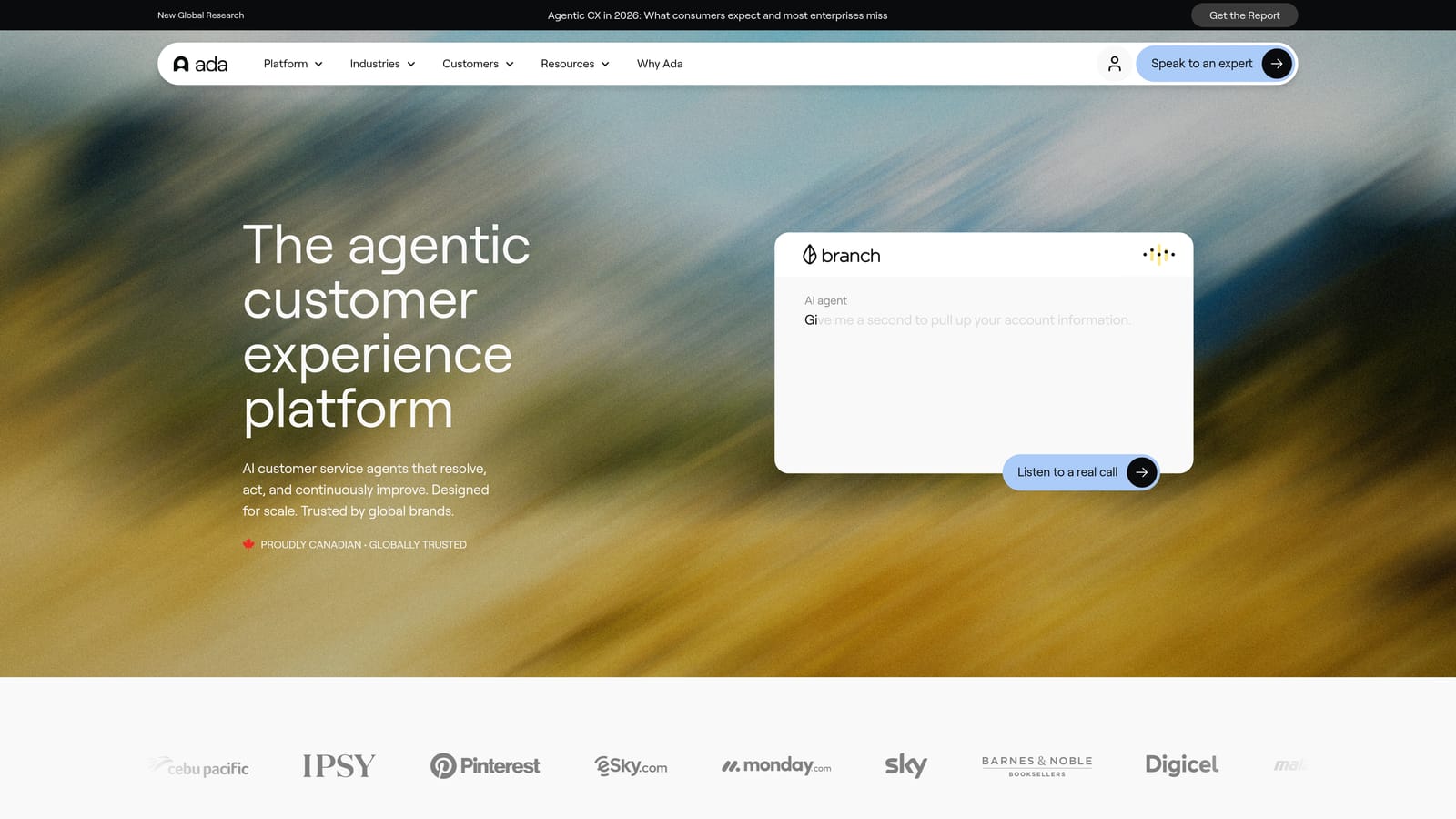
6. Ada
Best for: Enterprise brands needing no-code AI agent deployment with strong governance controls
Ada is an enterprise-focused, no-code AI agent platform that lets CX teams build, deploy, and govern AI agents across web, mobile, SMS, and social messaging channels without requiring engineering resources.
Where This Tool Shines
Ada's no-code builder is genuinely designed for CX teams, not developers. Brand voice controls, tone settings, and governance features mean enterprise teams can deploy AI agents that stay on-message across every channel without constant engineering involvement. This is particularly valuable for regulated industries where consistency and auditability matter.
Multi-channel deployment is another strength. Ada can operate across web, mobile, SMS, and social messaging from a single configuration, which reduces the complexity of managing separate AI setups per channel.
Key Features
No-Code Agent Builder: CX teams can build and modify AI agents without engineering dependency, using visual tools with brand and tone controls.
Multi-Channel Deployment: Single configuration deploys across web, mobile, SMS, and social messaging channels simultaneously.
Enterprise Governance: Compliance and auditability features designed for regulated industries that need oversight of AI behavior.
Backend Integrations: Connects to backend systems to enable personalized, action-oriented resolutions rather than generic responses.
Conversation Analytics: AI-powered measurement tools that track resolution quality and surface optimization opportunities.
Best For
Enterprise brands in regulated industries, or large CX teams that need governance and brand control across multi-channel AI deployments. Less suited for B2B SaaS teams needing deep product-level context or business intelligence.
Pricing
Enterprise pricing. Contact Ada for a quote tailored to your deployment scope and channel requirements.
7. Kustomer
Best for: High-volume consumer brands with strong social and messaging support needs
Kustomer is a CRM-native customer service platform, owned by Meta, with built-in AI capabilities that give agents and AI systems access to full customer history across all channels — with particular strength in social and messaging support.
Where This Tool Shines
Kustomer's CRM-native architecture means AI agents aren't working with fragmented ticket data — they have the full customer timeline, purchase history, and prior interaction context available in every conversation. That depth of context enables more personalized resolutions than platforms that treat each ticket as isolated.
Meta's ownership gives Kustomer a natural advantage in social and messaging channels. For brands with significant customer interaction volume on Meta platforms, the integration depth is difficult to replicate with other tools.
Key Features
CRM-Native Architecture: AI agents operate with full customer history and timeline context, not just the current ticket thread.
Social and Messaging Strength: Deep integration with Meta messaging platforms gives Kustomer an edge for brands with high social support volume.
AI-Powered Routing and Sentiment Detection: Automatically routes tickets and detects customer sentiment to prioritize urgent or at-risk conversations.
Unified Customer Timeline: Both human agents and AI work from the same complete customer view, reducing context-switching and repeated questions.
Workflow Automation Builder: Complex workflow orchestration for teams with sophisticated routing and escalation requirements.
Best For
High-volume consumer brands, particularly those with significant presence on Meta platforms. Less suited for B2B SaaS teams, where the CRM-native strengths are less relevant and social channel depth is less of a priority.
Pricing
Enterprise pricing. Contact Kustomer for a quote based on your team size and channel requirements.
8. Tidio (Lyro AI)
Best for: Small businesses and early-stage SaaS teams needing fast, affordable AI deployment
Tidio Lyro is an accessible AI agent solution built for small businesses and early-stage teams, offering fast deployment and autonomous query resolution without requiring large knowledge bases or complex setup.
Where This Tool Shines
Lyro's defining characteristic is its low barrier to entry. Most enterprise AI platforms require substantial knowledge base content, engineering involvement, and onboarding time before the AI can handle real queries. Lyro is designed to work with minimal training data, which means small teams can go live quickly without months of preparation.
For early-stage SaaS teams that need basic AI deflection without the overhead of an enterprise platform, Lyro offers a practical starting point. It handles common queries, escalates to human agents when needed, and covers live chat, email, and Messenger without requiring separate configurations.
Key Features
Fast Deployment: Minimal training data required to get Lyro handling real customer queries, reducing time-to-value significantly.
Autonomous Query Handling: Resolves common customer questions with natural conversation flow, without human intervention for routine issues.
Seamless Human Escalation: Transfers to human agents when queries exceed the AI's confidence threshold, with context preserved.
Multi-Channel Coverage: Supports live chat, email, and Messenger from a single Tidio configuration.
SMB-Accessible Pricing: Significantly more affordable than enterprise alternatives, making AI support accessible for teams with limited budgets.
Best For
Small businesses, e-commerce teams, and early-stage SaaS companies that want AI deflection without enterprise complexity or cost. Teams that outgrow Lyro's capabilities will eventually need a platform with deeper integration and learning capabilities.
Pricing
Lyro AI is available on paid Tidio plans at pricing accessible to SMBs. More affordable than any enterprise option on this list. See Tidio's website for current plan details.
Which Platform Is Right for Your Team?
The honest answer depends less on feature checklists and more on one fundamental question: do you need AI bolted onto an existing system, or do you need AI as the foundation?
If you're a large enterprise already running on Zendesk or Salesforce, adding their native AI capabilities is the pragmatic choice. You'll get meaningful automation without a platform migration, and your existing data and workflows carry forward. The same logic applies to Freshdesk Freddy AI for Freshworks customers and Intercom Fin for Intercom users.
For high-volume consumer brands with strong social and messaging presence, Kustomer's CRM-native architecture and Meta integration depth are difficult to match. Ada is the strongest choice for enterprise CX teams that need no-code governance across regulated industries or multi-channel deployments.
Early-stage teams and small businesses will find Tidio Lyro the most practical entry point: fast to deploy, affordable, and capable enough for common query deflection without enterprise overhead.
For B2B SaaS teams that want more than ticket deflection, Halo AI is built for exactly that scenario. The combination of page-aware context, continuous learning, auto bug reporting, and business intelligence signals means your support function becomes a source of product and revenue insight — not just a cost center. You can explore the full customer support agent capabilities to see how it maps to your use case.
Your support team shouldn't scale linearly with your customer base. AI agents should handle routine tickets, guide users through your product, and surface business intelligence while your team focuses on complex issues that need a human touch. See Halo in action and discover how continuous learning transforms every interaction into smarter, faster support.