9 Best Customer Service AI Subscriptions for Scaling Support in 2026
A curated breakdown of the 9 top customer service AI subscription platforms for 2026, evaluated on autonomous resolution, integrations, and pricing to help B2B teams scale support without proportionally scaling headcount. Whether you're building a new support stack or enhancing an existing helpdesk, this guide covers AI-native and traditional platforms to match your specific growth needs.
 Grant CooperFounder13 min read
Subscription-based AI customer service platforms have become a genuine competitive differentiator for B2B teams in 2026. The pressure is real: customer bases grow, ticket volumes climb, and hiring support staff at the same rate simply isn't sustainable. The right AI subscription doesn't just deflect tickets — it resolves them, learns from them, and feeds intelligence back to your product and leadership teams.
To build this list, we evaluated tools across five criteria: autonomous resolution capabilities, integration depth with existing stacks, pricing transparency, whether the AI genuinely improves over time, and the quality of handoff when a human agent needs to step in.
The list covers both ends of the spectrum: AI-native platforms built from the ground up around autonomous agents, and established helpdesks that have added AI capabilities to familiar workflows. Whether you're starting fresh or enhancing an existing stack, there's a fit here for you.
Here are the top customer service AI subscriptions worth considering in 2026.
1. Halo AI
Best for: B2B product teams wanting an AI-first support architecture with deep integrations and continuous learning.
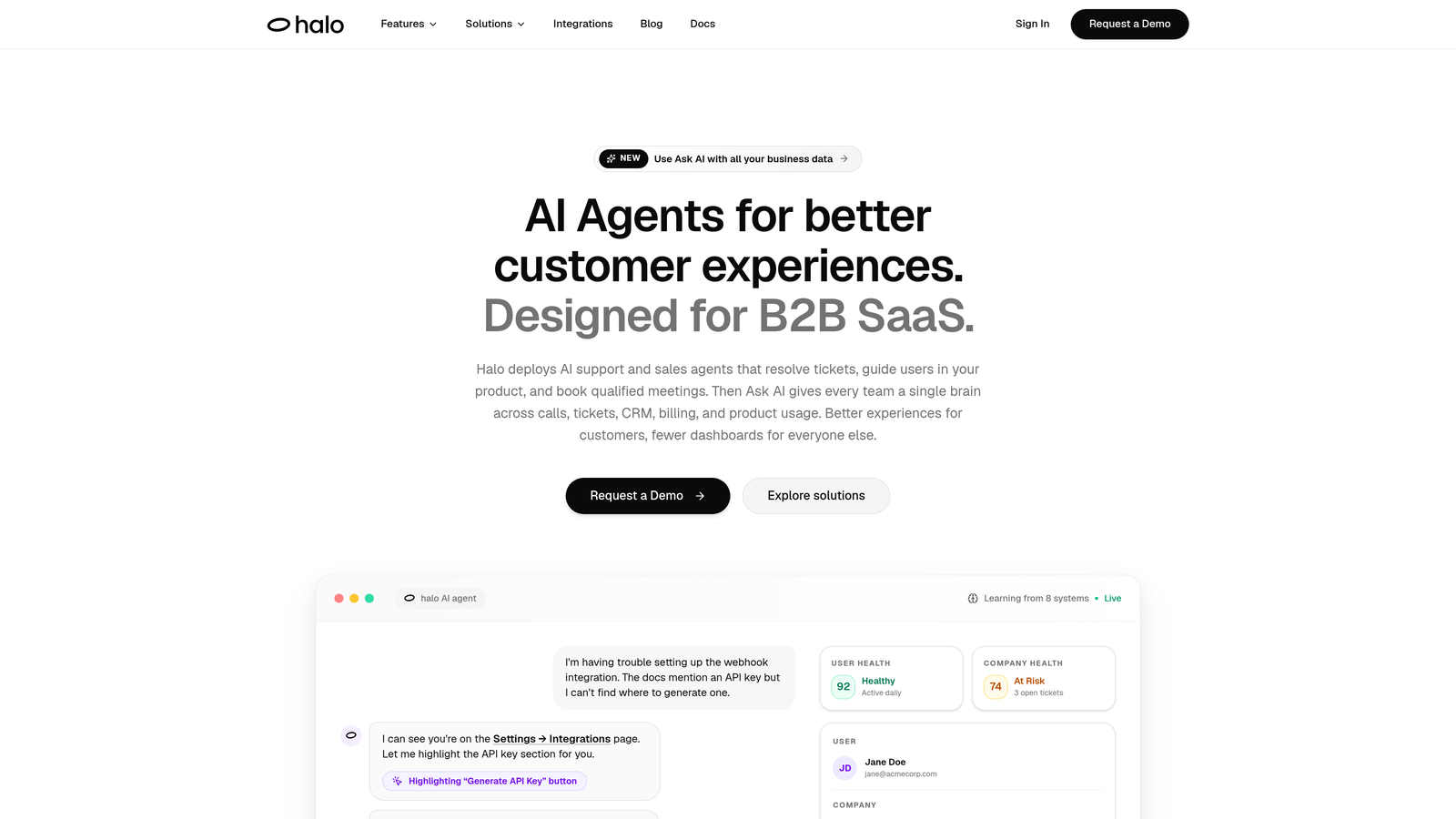
Halo AI is an AI-native customer support platform that deploys autonomous agents to resolve tickets, guide users with page-aware context, and surface business intelligence across your entire support operation.
Where This Tool Shines
What separates Halo from most tools on this list is the architecture. It wasn't built as a chatbot layer on top of an existing helpdesk — it was designed from the start around autonomous AI agents. That means every interaction feeds a continuous learning loop, so the system genuinely gets smarter with each ticket it handles.
The page-aware chat widget is a standout capability. Instead of offering generic guidance, Halo's agent sees exactly what a user is looking at in your product and can provide visual, contextual UI guidance in real time. For product teams dealing with complex SaaS interfaces, this is a meaningful step beyond standard FAQ deflection.
Key Features
Page-Aware Chat Widget: The AI agent detects which page a user is on and delivers contextually relevant guidance, not just generic answers.
Autonomous Ticket Resolution: AI agents handle multi-step support workflows independently, with continuous learning from every resolved interaction.
Auto Bug Ticket Creation: Automatically generates bug reports and routes them to Linear, Jira, or other engineering tools when issues are detected.
Smart Inbox with Business Intelligence: Goes beyond support metrics to surface customer health signals, revenue intelligence, and anomaly detection for leadership teams.
Deep Integration Stack: Native connections to Slack, HubSpot, Intercom, Stripe, Zoom, PandaDoc, Fathom, and more — so your support data flows across your entire business stack.
Best For
B2B SaaS companies and product teams that want AI as the core of their support architecture, not a bolt-on. Particularly well-suited for teams whose support tickets frequently surface product issues that need engineering visibility, or for organizations that want support data to inform product and revenue decisions.
Pricing
Subscription-based model; contact Halo AI directly for pricing details tailored to your team size and ticket volume.
2. Intercom Fin
Best for: Teams already using Intercom who want native AI resolution without switching platforms.
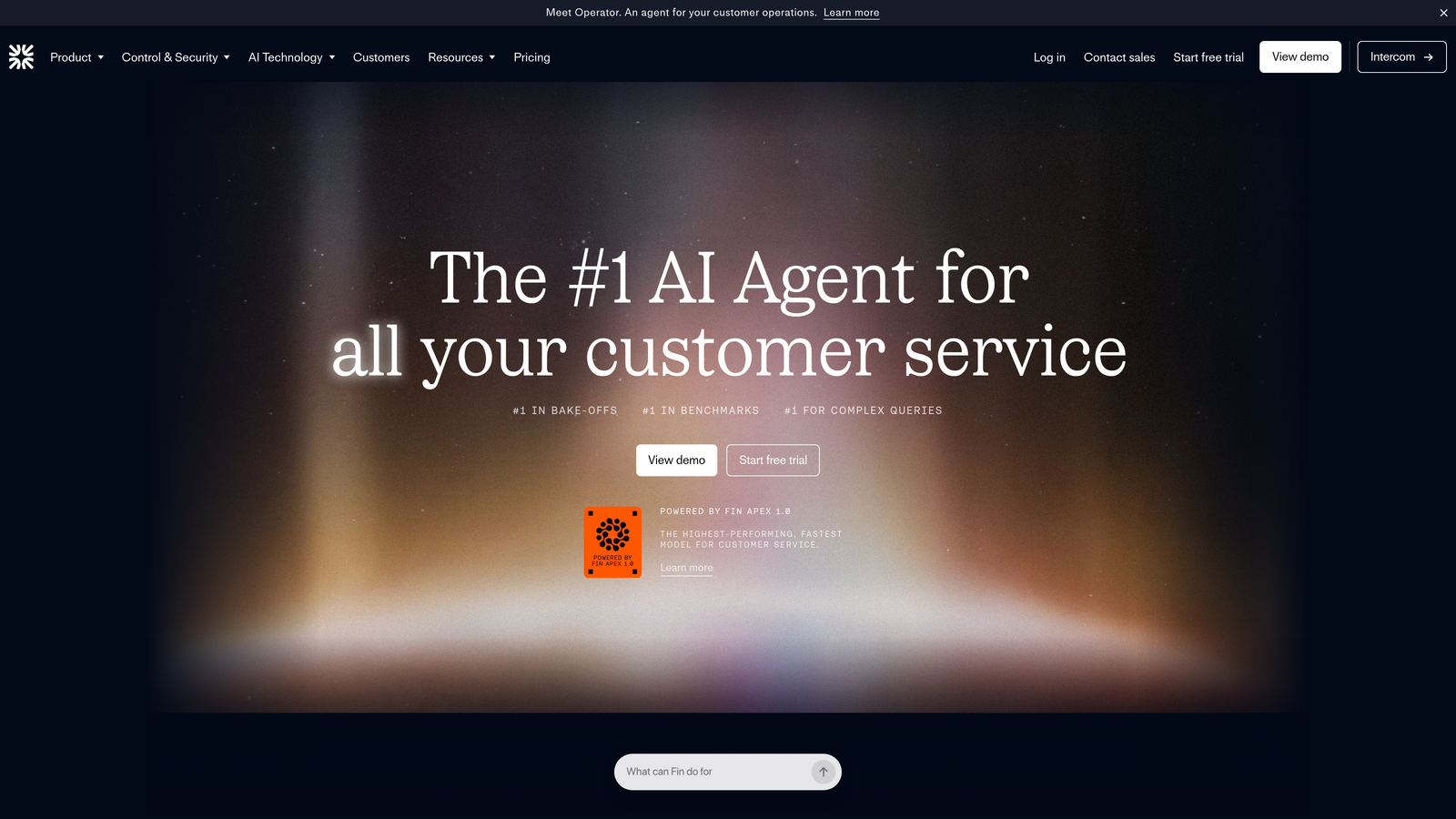
Intercom Fin is Intercom's AI agent built directly into its customer messaging platform, using your existing help center content to resolve conversations autonomously.
Where This Tool Shines
Fin's biggest strength is how naturally it fits into the Intercom ecosystem. If your team is already living in Intercom's inbox and using its help center, Fin requires minimal setup to start deflecting and resolving conversations. The AI draws from your existing articles and snippets, which means you're not starting from scratch with a new knowledge base.
The handoff experience is notably clean. When Fin can't resolve something, it passes the conversation to a human agent with full context intact, so customers don't have to repeat themselves. That continuity matters a lot in B2B support where conversations can be nuanced and ongoing.
Key Features
Native Messenger Integration: Works directly within Intercom's existing inbox and messaging workflows without additional configuration layers.
Content-Sourced Answers: Pulls responses from help center articles, snippets, and custom content you've already created.
Customizable AI Personality: Allows teams to adjust tone, language, and persona to match their brand voice.
Seamless Human Handoff: Transfers conversations to live agents with full context and conversation history preserved.
Multi-Language Support: Handles customer conversations across multiple languages without separate configuration.
Best For
Companies already invested in the Intercom ecosystem who want to add autonomous resolution without migrating to a new platform. Less ideal for teams looking for an AI-first architecture independent of Intercom's broader subscription costs.
Pricing
Per-resolution pricing model; requires an active Intercom subscription as the underlying platform.
3. Zendesk AI
Best for: Enterprise support teams using Zendesk Suite who want AI layered across their existing workflows.
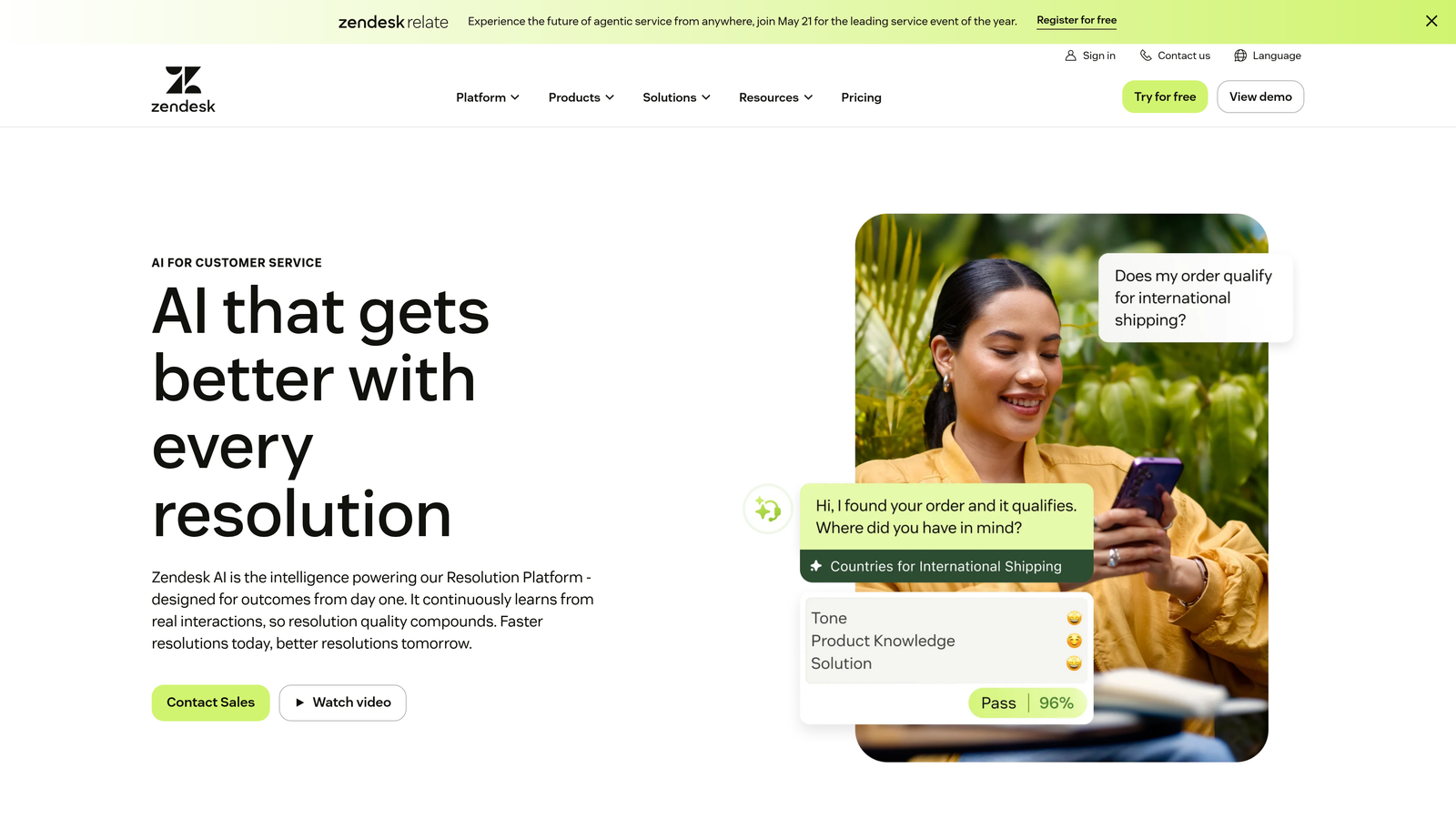
Zendesk AI embeds AI capabilities across the full Zendesk Suite, covering both customer-facing resolution and internal agent-assist tools.
Where This Tool Shines
Zendesk's AI benefits from years of training on a massive volume of real customer service interactions. The intent detection and triage capabilities are mature, which means out-of-the-box classification accuracy tends to be solid even before you've done extensive customization. For large support teams handling high ticket volumes across multiple channels, this matters.
The agent-assist features are genuinely useful for human teams. Suggested replies, ticket summaries, and macro suggestions reduce the cognitive load on agents handling complex or high-stakes conversations, which helps maintain quality even during volume spikes.
Key Features
Pre-Trained Intent Detection: AI trained on billions of customer service interactions for accurate ticket classification from day one.
AI Agents for Automated Resolution: Customer-facing bots that handle common queries across messaging and email channels.
Agent Assist: Suggests replies, generates ticket summaries, and recommends macros to speed up human agent responses.
Intelligent Triage: Automatically classifies, prioritizes, and routes incoming tickets based on content and intent.
Suite-Wide Coverage: Works across Zendesk Support, Chat, and Talk for unified AI across channels.
Best For
Established enterprise teams already on Zendesk Suite who want to add AI capabilities incrementally without platform migration. Not the best fit for teams wanting AI as their primary architecture rather than an enhancement layer.
Pricing
Core AI features included in Suite plans; advanced AI available as an add-on starting at $50 per agent per month.
4. Ada
Best for: Enterprise teams needing high-volume automated resolution across chat, email, voice, and social simultaneously.
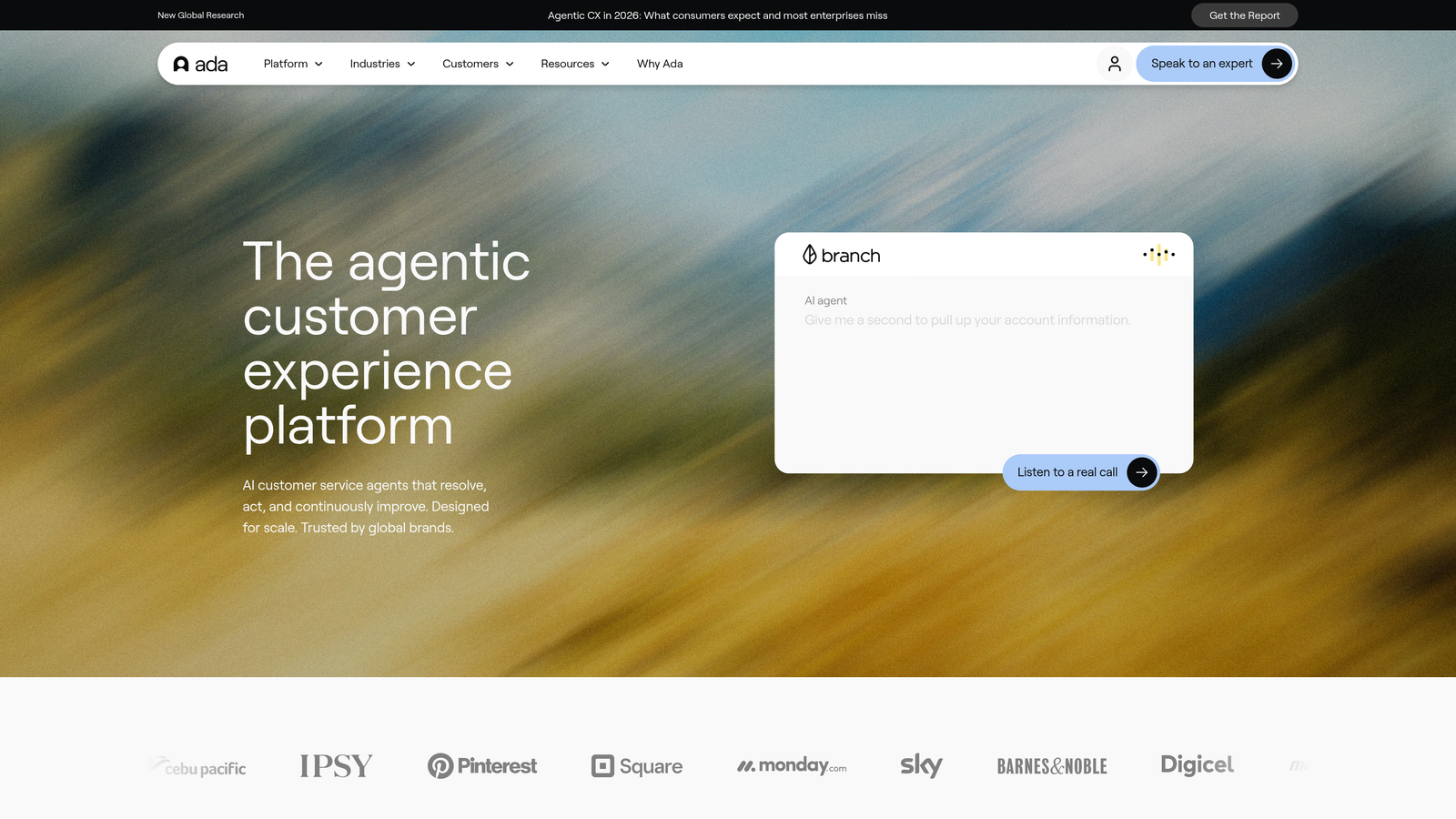
Ada is an enterprise-grade AI agent platform designed for organizations that need autonomous resolution at scale across multiple channels and complex support workflows.
Where This Tool Shines
Ada's reasoning engine is built for multi-step problem solving, not just single-turn FAQ responses. That means it can handle support scenarios that require gathering information, checking account status, and executing actions across integrated systems before delivering a resolution. For high-complexity B2B support environments, this is a meaningful capability.
The no-code builder gives non-technical teams the ability to customize AI agent behavior and build workflows without depending on engineering resources. Combined with Ada's multi-channel coverage, this makes it practical to deploy consistent AI experiences across touchpoints without a large implementation team.
Key Features
Reasoning Engine: Handles multi-step problem solving rather than simple pattern-matching, enabling more complex autonomous resolutions.
Multi-Channel Coverage: Deploys across chat, email, voice, SMS, and social from a single platform.
No-Code Workflow Builder: Lets support teams customize AI behavior and conversation flows without engineering involvement.
CRM Integrations: Connects with Salesforce, Zendesk, and major CRM platforms for personalized, data-informed responses.
Resolution Analytics: Dashboard tracking resolution rates, CSAT scores, and automation performance over time.
Best For
Large enterprises with high support volumes across multiple channels who need proven autonomous resolution at scale. Custom pricing makes it less accessible for smaller teams or those evaluating on a tight budget.
Pricing
Custom enterprise pricing; contact Ada directly for subscription details based on volume and channel requirements.
5. Freshdesk Freddy AI
Best for: Growing teams wanting an affordable all-in-one helpdesk with AI capabilities built in.
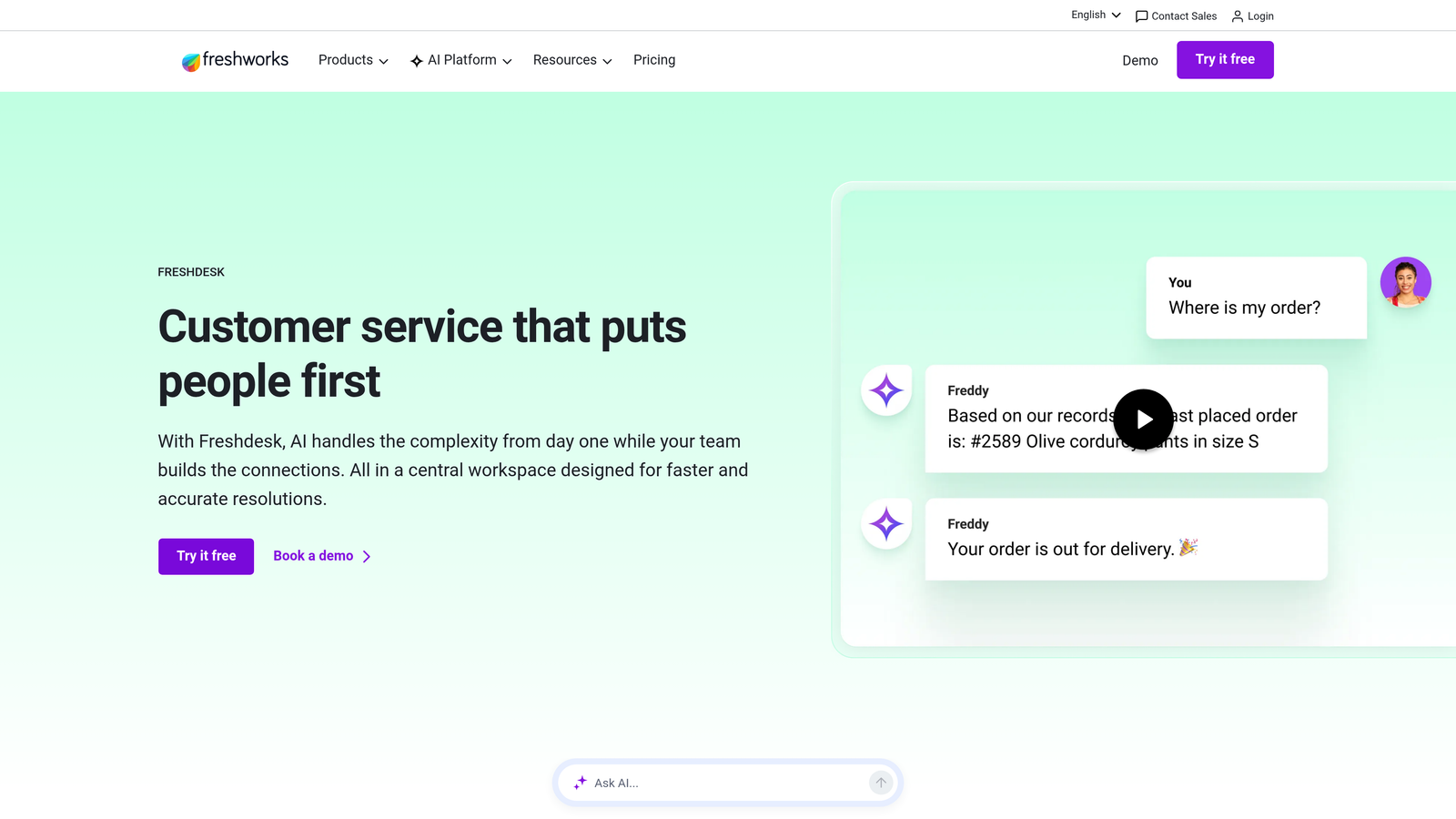
Freshdesk Freddy AI is Freshworks' AI layer within Freshdesk, offering AI chatbots, agent assist, and auto-triage as part of a cost-efficient helpdesk platform.
Where This Tool Shines
Freshdesk's value proposition has always been accessibility, and Freddy AI extends that. The AI features are bundled into existing plan tiers rather than sold as expensive add-ons, which makes the total cost of ownership more predictable for teams watching their budget. For companies that don't need enterprise-level customization, this is a practical advantage.
Freddy Copilot, the agent-facing component, is well-integrated into the helpdesk workflow. Agents get reply suggestions, ticket summaries, and draft assistance without switching tools or learning a separate interface, which shortens the adoption curve considerably.
Key Features
Freddy AI Agent: Self-service resolution via chat, drawing from your knowledge base to handle common customer queries autonomously.
Freddy Copilot: Agent-facing assistant that provides reply suggestions, conversation summaries, and draft responses in real time.
Auto-Triage: Automatic ticket classification and priority assignment to route incoming tickets efficiently.
Omnichannel Support: Covers email, chat, phone, and social from within a single helpdesk interface.
Cost-Efficient Bundling: AI features included in Pro and Enterprise plan tiers rather than priced separately.
Best For
Small to mid-sized teams that want solid AI functionality without paying a premium for a standalone AI platform. A strong choice for teams migrating off basic ticketing tools who want AI included from the start.
Pricing
Free tier available; AI features included in Pro plan at $49 per agent per month and Enterprise plan.
6. Tidio
Best for: Small businesses and e-commerce teams wanting fast deployment and affordable AI chat automation.
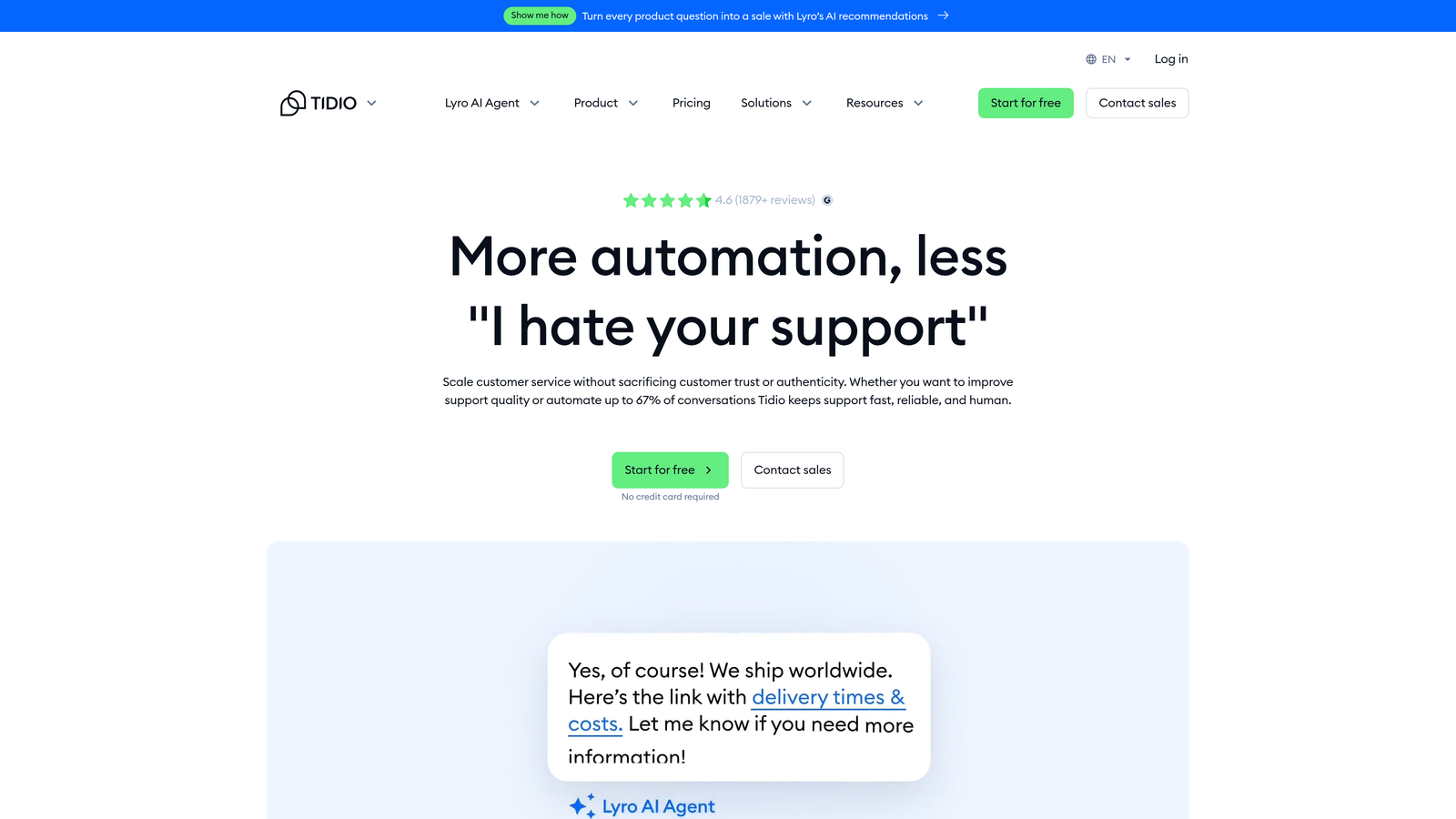
Tidio is an accessible AI chat platform featuring the Lyro AI chatbot, designed for teams that need to get up and running quickly without extensive technical setup.
Where This Tool Shines
Tidio's Lyro AI chatbot learns from your existing FAQ content and knowledge base, which means you're not building a training dataset from scratch. For small teams with limited resources, this dramatically reduces time-to-value. Most deployments can be live within hours rather than weeks.
The e-commerce integrations are genuinely strong. Native connections to Shopify, WooCommerce, and BigCommerce mean Tidio can pull order data, track shipments, and handle common post-purchase queries automatically, which is where a large portion of e-commerce support volume tends to concentrate.
Key Features
Lyro AI Chatbot: Learns from your FAQ and knowledge base content to answer customer questions without manual rule-building.
Visual Flow Builder: Drag-and-drop interface for creating custom conversation paths and escalation logic.
E-Commerce Integrations: Deep connections with Shopify, WooCommerce, and BigCommerce for order-aware support.
Live Chat Hybrid: Smooth handoff between AI and human agents with clear escalation triggers.
Visitor Analytics: Tracks visitor behavior and engagement patterns to inform proactive chat triggers.
Best For
Small businesses, e-commerce brands, and early-stage teams that prioritize speed of deployment and affordability over enterprise-grade customization. Less suited for complex B2B support environments with multi-step workflows.
Pricing
Free plan available; Lyro AI starts at $39 per month with pricing that scales based on conversation volume.
7. Forethought
Best for: Support teams with complex routing needs who want AI-powered triage, assist, and resolution in one platform.
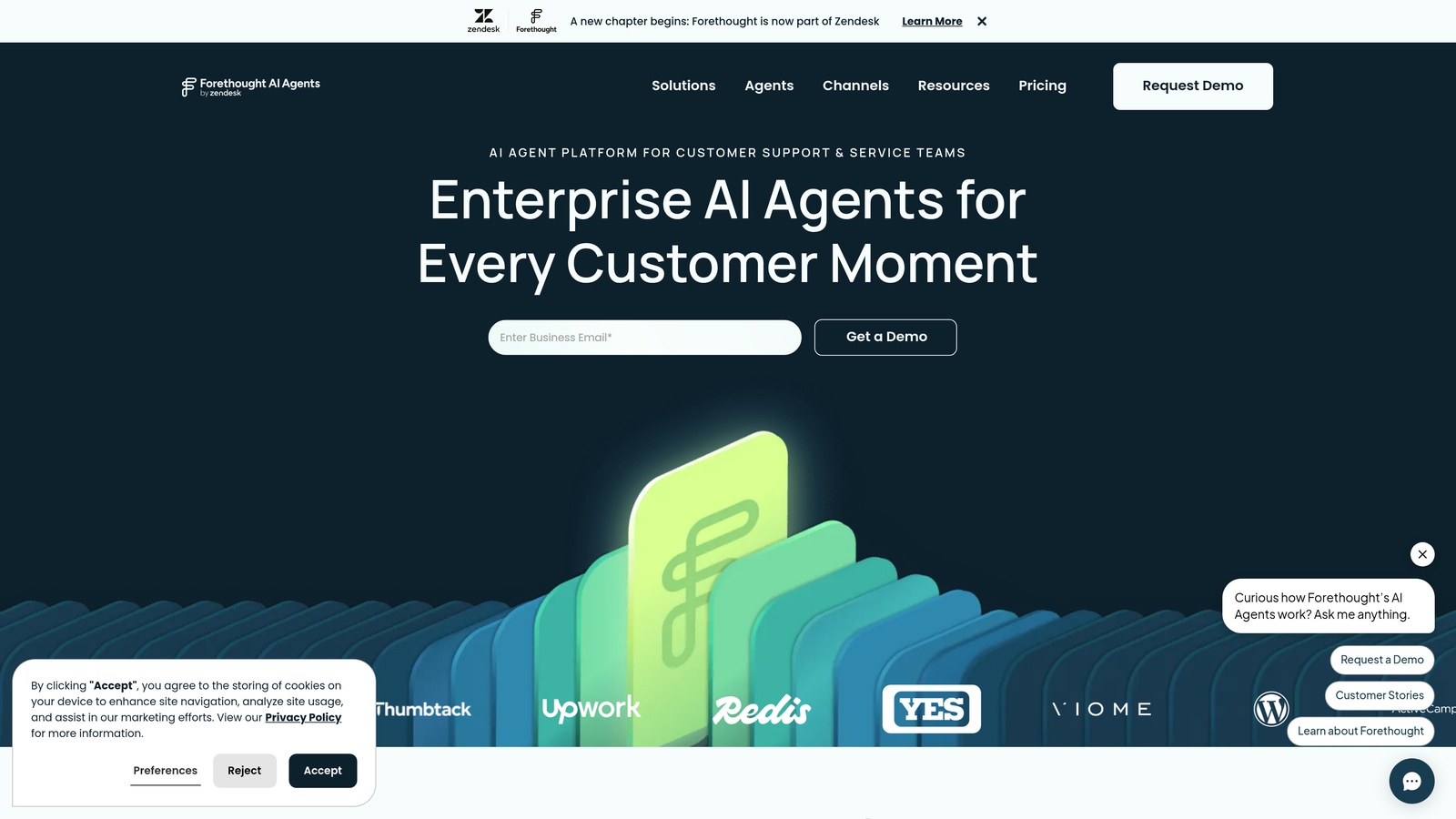
Forethought is an AI platform built specifically around intelligent ticket triage, agent assist, and autonomous resolution for support operations that deal with high complexity and nuanced prioritization.
Where This Tool Shines
Forethought's modular structure is a genuine differentiator. Rather than offering a single AI layer, it breaks functionality into distinct components — Solve for autonomous resolution, Triage for classification and routing, Assist for agent support, and Discover for insights. Teams can adopt the modules that address their most pressing gaps without paying for capabilities they don't need.
The Discover module stands out for teams that want AI to do more than handle tickets. It surfaces trends, identifies knowledge gaps, and highlights recurring issues that should be addressed upstream in the product or documentation, which makes it useful for support leaders making strategic decisions.
Key Features
Solve: AI agent for autonomous customer-facing resolution of common support queries.
Triage: Automatic ticket classification with sentiment analysis and intelligent routing based on content and urgency.
Assist: Real-time knowledge suggestions surfaced to human agents as they work through tickets.
Discover: AI-powered analysis of support trends, knowledge gaps, and recurring issue patterns.
Platform Integrations: Connects with Zendesk, Salesforce, and ServiceNow for teams using established helpdesk infrastructure.
Best For
Mid-market and enterprise support teams that need sophisticated triage and routing alongside autonomous resolution. Particularly strong for operations teams who want visibility into what's driving ticket volume, not just tools to handle it.
Pricing
Custom pricing based on ticket volume and the specific modules selected; contact Forethought for a tailored quote.
8. Cognigy
Best for: Enterprise contact centers needing voice-first AI agents with advanced LLM orchestration and deep customization.
Cognigy is an enterprise conversational AI platform with particularly strong voice capabilities, LLM orchestration, and the compliance infrastructure that large organizations require.
Where This Tool Shines
Most AI customer service tools are chat-first, with voice as an afterthought. Cognigy inverts that. Its voice AI agents are built for phone-based customer service at enterprise scale, which makes it the right fit for contact centers where a significant portion of volume comes through voice channels rather than digital messaging.
The LLM orchestration layer is technically sophisticated. Cognigy can combine multiple AI models within a single conversation flow, routing to the most appropriate model based on the task at hand. For organizations with complex compliance requirements or specialized knowledge domains, this flexibility is valuable.
Key Features
Voice-First AI Agents: Purpose-built for phone-based customer service with natural conversation handling at scale.
LLM Orchestration: Combines and routes across multiple large language models within unified conversation flows.
Low-Code Conversation Designer: Advanced logic builder that doesn't require deep engineering expertise for most configurations.
Enterprise Security and Compliance: SOC 2 and GDPR compliance built into the platform architecture.
CCaaS Integrations: Native connections to Genesys, NICE, Avaya, and other major contact center platforms.
Best For
Large enterprises and contact centers with significant voice support volume, strict compliance requirements, or the need to orchestrate multiple AI models within complex conversation flows. Not the right fit for small teams or digital-first support environments.
Pricing
Enterprise subscription pricing; contact Cognigy directly for quotes based on deployment scale and channel requirements.
9. Kustomer
Best for: Teams that want a CRM-native support platform with AI layered onto a unified customer timeline.
Kustomer is a CRM-powered customer service platform that brings AI capabilities to a unified customer timeline, giving support teams a single view of every interaction across channels.
Where This Tool Shines
Kustomer's core differentiator is the data model. Rather than treating each support ticket as an isolated event, it builds a continuous timeline of every customer interaction across email, chat, social, SMS, and voice. When AI-powered suggestions surface in this context, they're informed by the full relationship history, not just the current conversation.
For B2B teams managing complex accounts with multiple stakeholders, this unified view is genuinely useful. Agents and AI alike can see the full picture before responding, which reduces the friction of customers having to re-explain their situation across multiple touchpoints.
Key Features
Unified Customer Timeline: Single-view history of all customer interactions across every channel, informing both AI and human responses.
AI-Powered Suggested Responses: Surfaces relevant reply suggestions based on conversation content and historical interaction data.
CRM-Native Data Model: Built-in customer data structure enables personalized support without a separate CRM integration.
Multi-Channel Inbox: Manages email, chat, social, SMS, and voice from a single unified interface.
Custom Objects and Attributes: Flexible data model for capturing complex B2B account structures and custom business logic.
Best For
B2B teams managing complex customer relationships where historical context is critical to support quality. Also well-suited for organizations that want to consolidate their CRM and helpdesk into a single platform rather than maintaining separate systems.
Pricing
Starts at $89 per user per month for the Enterprise plan; AI features available in higher tiers.
Which Platform Is Right for Your Team?
The customer service AI subscription landscape in 2026 has matured into two distinct camps, and understanding which one fits your situation is the most important decision you'll make before committing to a platform.
AI-native platforms like Halo AI, Ada, and Forethought are built from the ground up around autonomous agents and continuous learning. They tend to offer deeper resolution capabilities, more flexible integration architectures, and the ability to surface intelligence beyond just support metrics. If you want AI as the foundation of your support operation rather than a feature on top of something else, this category is where to look.
Established helpdesks with AI layers — Zendesk, Freshdesk, and Intercom — offer a different value proposition. If your team is already embedded in these platforms, adding AI capabilities incrementally is lower risk and often faster to deploy. The trade-off is that you're working within the constraints of an existing product architecture rather than one designed for AI from day one.
For voice-heavy contact centers, Cognigy stands apart. For small businesses and e-commerce teams prioritizing speed and affordability, Tidio is hard to beat. For complex B2B accounts where relationship context drives support quality, Kustomer's unified timeline approach has real merit.
Your support team shouldn't scale linearly with your customer base. Let AI agents handle routine tickets, guide users through your product, and surface business intelligence while your team focuses on complex issues that need a human touch. See Halo in action and discover how continuous learning transforms every interaction into smarter, faster support.