9 Best Customer Service AI Vendors Compared for 2026
This customer service AI vendor comparison evaluates nine purpose-built platforms across six key dimensions—including resolution quality, integration depth, and pricing transparency—to help B2B teams identify the right solution for their support operations. Whether you're new to AI customer service or conducting a formal vendor review, this guide provides a clear, structured breakdown of what each platform does best and which business needs it serves.
 Matt PattoliFounder12 min read
Choosing the right AI customer service vendor is one of the highest-impact decisions a B2B team can make. The wrong pick means months of integration headaches, disappointing resolution rates, and a support team that's still drowning in tickets. The right one transforms how your entire operation scales.
This comparison focuses on purpose-built AI support platforms, not generic chatbot builders. We evaluated each vendor across six dimensions: AI resolution quality, integration depth, analytics capabilities, ease of deployment, scalability, and pricing transparency. Whether you're exploring AI customer service for the first time or doing a formal chatbot software comparison, this guide gives you a clear picture of what each platform actually does well and who it's built for.
The market has shifted decisively toward autonomous AI agents that resolve tickets end-to-end, not just deflect them. Here are the top vendors worth evaluating in 2026.
1. Halo AI
Best for: B2B SaaS teams that need autonomous AI support with deep product and business-stack context
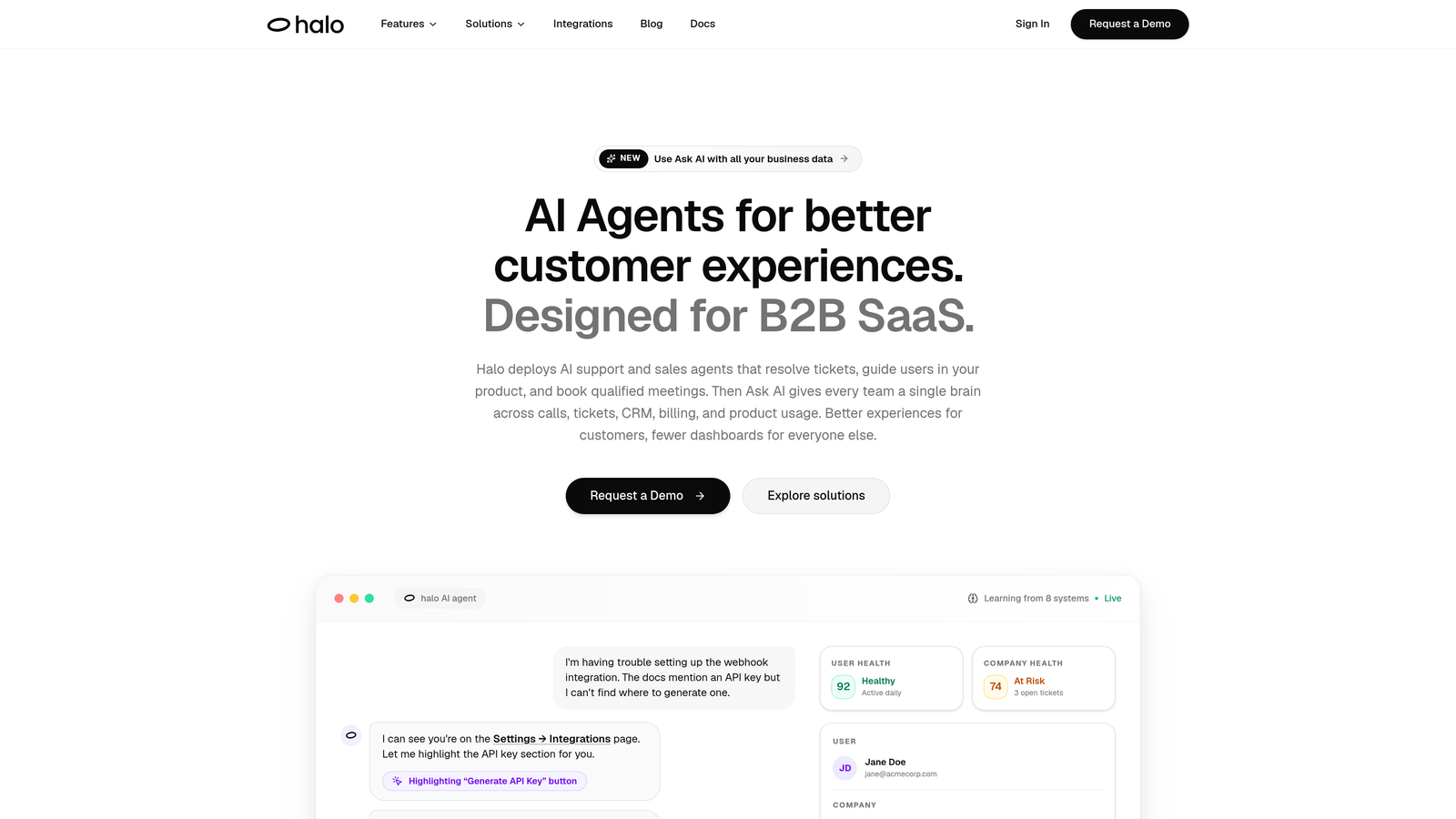
Halo AI is an AI-first customer support platform that deploys autonomous agents to resolve tickets, guide users visually through your product, and surface business intelligence across your entire stack.
Where This Tool Shines
What separates Halo from most vendors on this list is its page-aware architecture. The AI agent doesn't just answer questions in a vacuum; it sees what the user is looking at inside your product and can provide contextual, visual guidance specific to that moment. That's a fundamentally different support experience than a generic help center chatbot.
Halo also thinks beyond the ticket queue. Its smart inbox surfaces customer health signals, revenue intelligence, and anomaly detection, turning your support channel into a source of business intelligence rather than a cost center. And because it learns continuously from every interaction, resolution quality improves over time without manual retraining.
Key Features
Page-Aware Chat Widget: The AI sees what users see in your product, enabling visual UI guidance that's contextually relevant rather than generic.
Autonomous Bug Ticket Creation: Automatically creates and routes bug reports to Linear and other dev tools without requiring a human to triage first.
Smart Inbox with Business Intelligence: Surfaces customer health signals, revenue intelligence, and anomaly detection alongside standard ticket metrics.
Continuous Learning: Every resolved interaction feeds back into the model, improving resolution quality and coverage without manual updates.
Deep Integration Stack: Connects natively with Slack, HubSpot, Intercom, Stripe, Zoom, PandaDoc, and Fathom, bridging support with the full business stack.
Best For
Product-led SaaS companies and B2B teams that want their support layer to do more than deflect tickets. Halo is particularly strong for teams that need autonomous actions (bug creation, handoffs, escalations) and want support intelligence to flow into product and revenue conversations.
Pricing
Contact for pricing. Designed for B2B SaaS teams scaling support operations, with a focus on teams moving away from headcount-linear support models.
2. Intercom Fin
Best for: Teams already on Intercom who want native AI resolution without adding another vendor
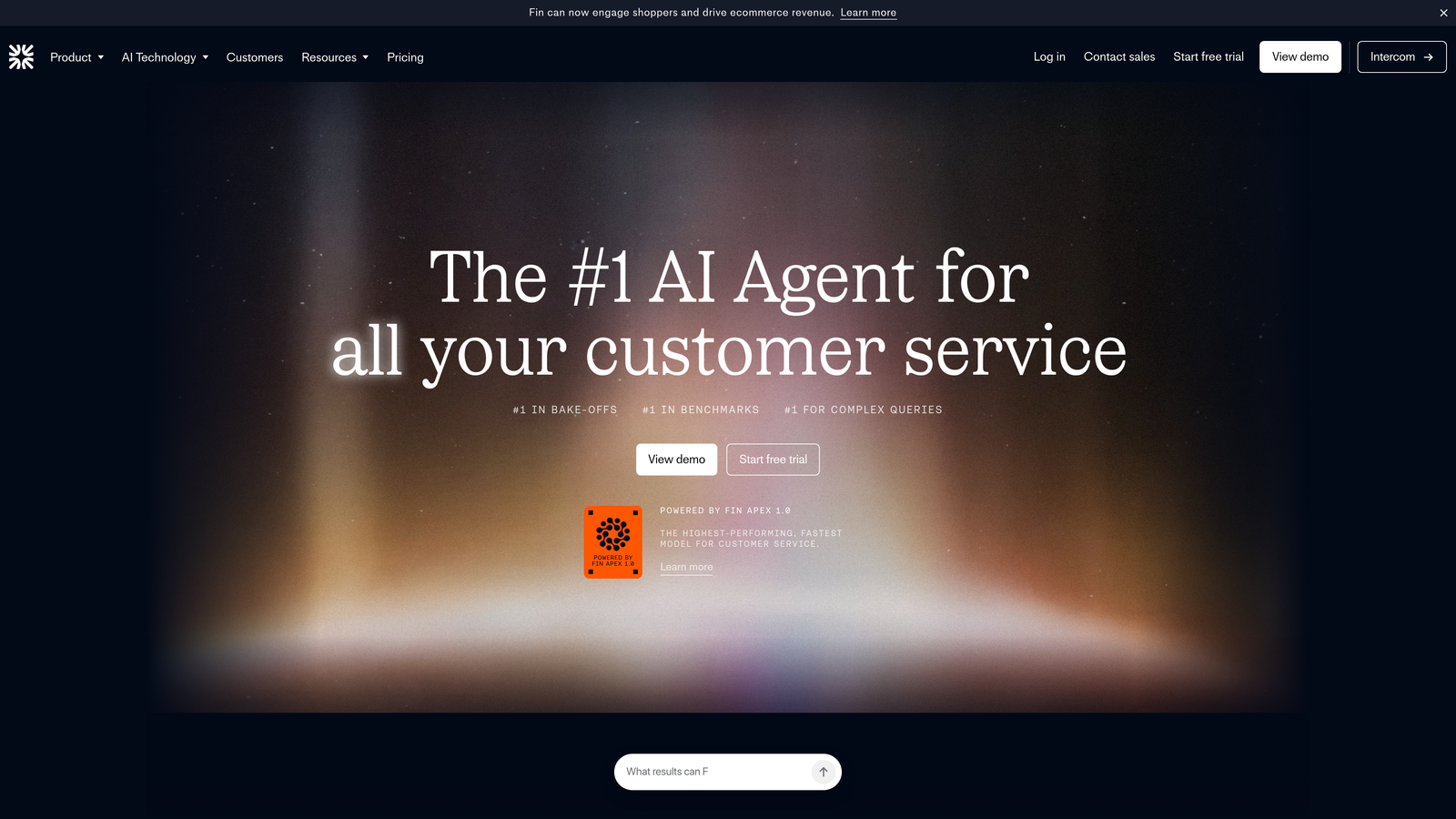
Intercom Fin is Intercom's native AI agent, resolving customer questions using existing help center content, conversation history, and custom knowledge sources.
Where This Tool Shines
If your team lives in Intercom, Fin is the path of least resistance. It draws directly from your existing help center articles and past conversations, which means deployment can be genuinely fast for teams with a well-maintained knowledge base. The handoff to human agents is smooth, with full conversation context preserved.
Fin's strength is its deep native integration with the Intercom messenger experience. You get consistent branding, familiar workflows, and no context-switching between tools. The tradeoff is that Fin is purpose-built for Intercom environments, so if you use multiple support systems, its value diminishes.
Key Features
Knowledge-Grounded Answers: Sources responses from Intercom help center articles, past conversations, and custom content you define.
Native Messenger Integration: Fully embedded in the Intercom inbox and workflow experience with no additional setup.
Customizable Tone and Persona: Adjust the AI's communication style to match your brand voice.
Seamless Human Handoff: Escalates to live agents with complete conversation context intact.
Best For
Mid-market SaaS teams already invested in the Intercom ecosystem who want to add AI resolution without introducing a new vendor relationship or integration layer.
Pricing
Usage-based pricing per resolution. Requires an active Intercom subscription, so total cost depends on your existing plan tier and resolution volume.
3. Zendesk AI
Best for: Enterprise teams on Zendesk Suite wanting AI embedded across every support channel
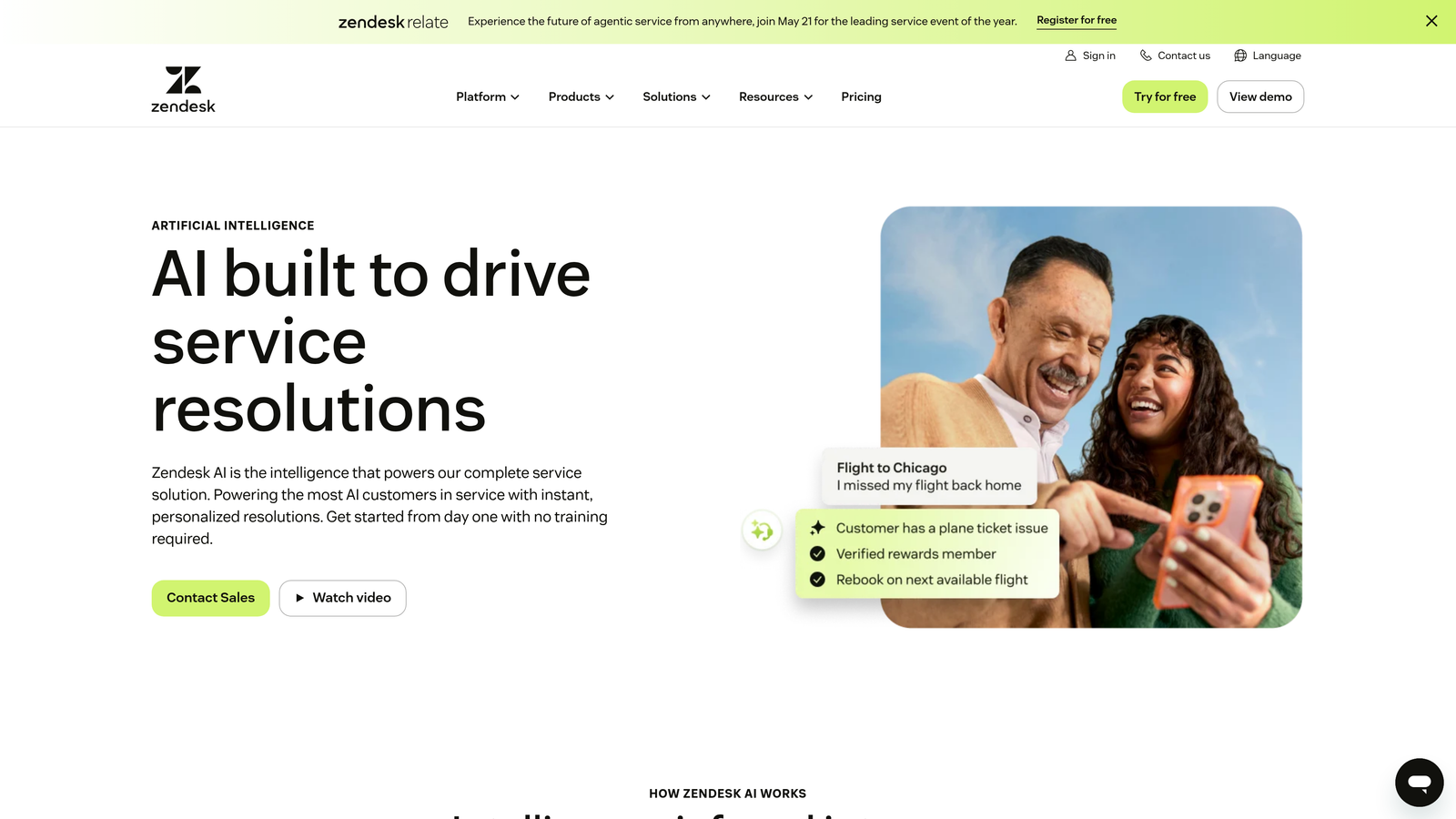
Zendesk AI is Zendesk's suite of built-in AI capabilities covering automated resolution, intelligent triage, agent assist, and generative AI features across chat, email, and forms.
Where This Tool Shines
Zendesk AI benefits from one of the largest support data sets in the industry, which informs its intent detection, sentiment analysis, and triage accuracy. For teams already running Zendesk at scale, the AI features layer in without requiring a separate deployment project. The breadth of coverage is notable: the same AI layer touches the customer-facing bot, the agent's inbox, and the admin's reporting view.
Agent assist is a standout capability. AI-generated reply suggestions and ticket summaries help human agents work faster on the tickets that do require intervention, which compounds the value of the automation layer.
Key Features
AI Agents: Automated resolution across chat, email, and web forms without human intervention for routine queries.
Intelligent Triage: Automatic intent, language, and sentiment detection for accurate routing and prioritization.
Agent Assist: Real-time AI-generated reply suggestions and ticket summaries to accelerate human agent responses.
Knowledge Gap Identification: Surfaces areas where help content is missing or underperforming.
Macro Suggestions: Recommends automation shortcuts based on ticket patterns.
Best For
Enterprise support teams with high ticket volumes already standardized on Zendesk Suite, particularly those wanting AI across both customer-facing and agent-facing workflows without introducing a new vendor.
Pricing
Core AI features are included in Zendesk Suite plans. Advanced AI capabilities are available as a paid add-on. Pricing scales with agent seats and plan tier.
4. Ada
Best for: Companies needing multilingual, action-oriented AI resolution across multiple channels
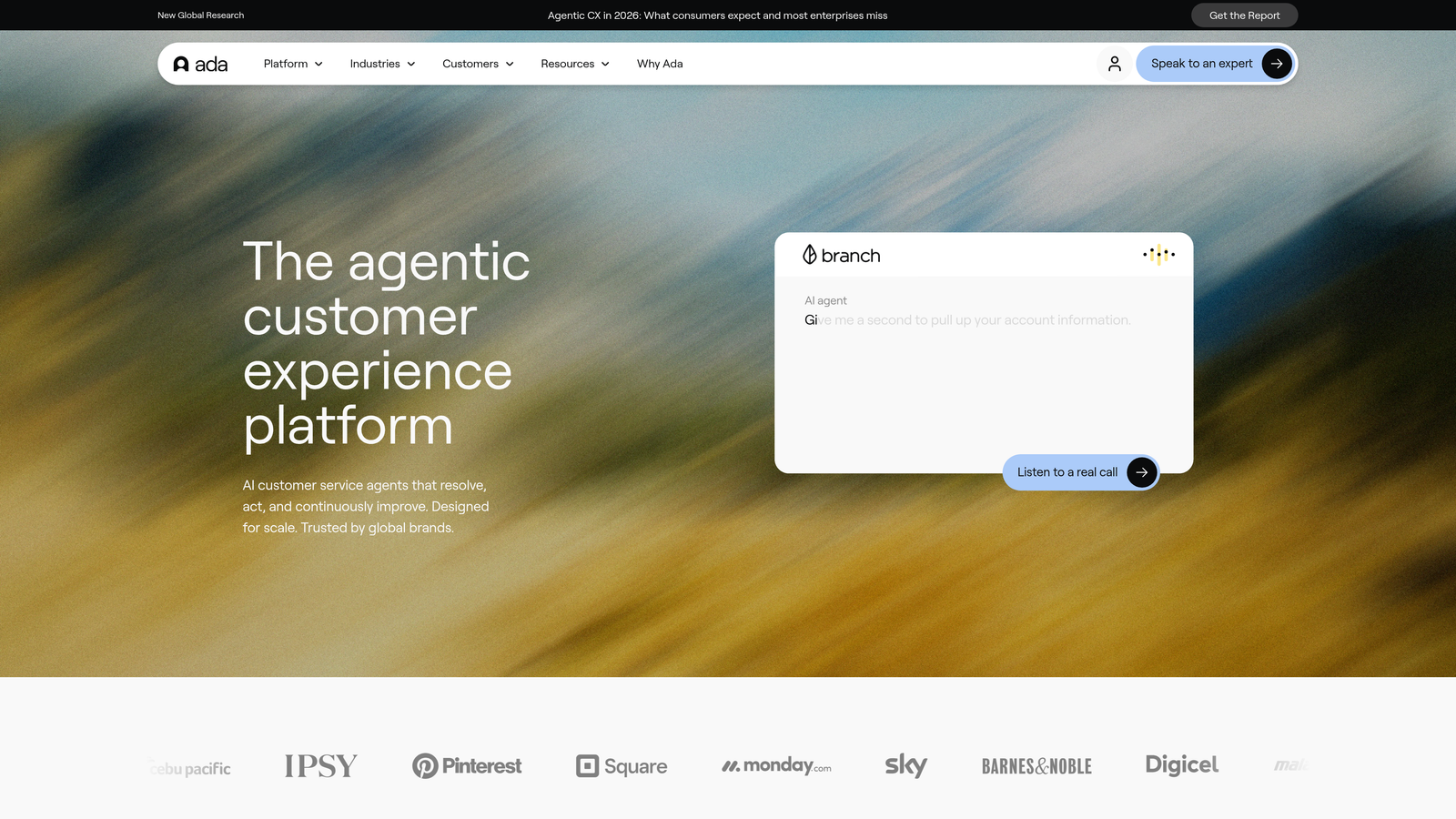
Ada is an AI-powered customer service automation platform built to deliver high-resolution-rate experiences across chat, email, voice, and social channels in over 50 languages.
Where This Tool Shines
Ada's differentiator is its action orientation. Rather than just answering questions, Ada's AI can look up order statuses, process account changes, and execute tasks inside connected systems. That moves it from an FAQ bot into genuine self-serve automation, which is where meaningful deflection actually happens.
Its multilingual capabilities are also a genuine strength, not a checkbox feature. For companies with a global customer base, Ada handles language complexity at a level that most platforms treat as an afterthought.
Key Features
No-Code Automation Builder: Non-technical teams can build and update resolution flows without engineering support.
Multilingual Support: Handles customer interactions across 50-plus languages with consistent resolution quality.
Action-Oriented AI: Executes tasks like order lookups, account changes, and data updates inside connected systems.
Omnichannel Coverage: Operates across web chat, social messaging, email, and SMS from a single platform.
Best For
Mid-market and enterprise teams with a global customer base or complex self-serve action requirements, particularly in e-commerce, fintech, and subscription businesses where customers frequently need to execute transactions through support.
Pricing
Custom pricing based on resolution volume and the number of channels deployed. Typically positions at mid-market to enterprise price points.
5. Forethought
Best for: Teams that want AI trained specifically on their own support ticket history
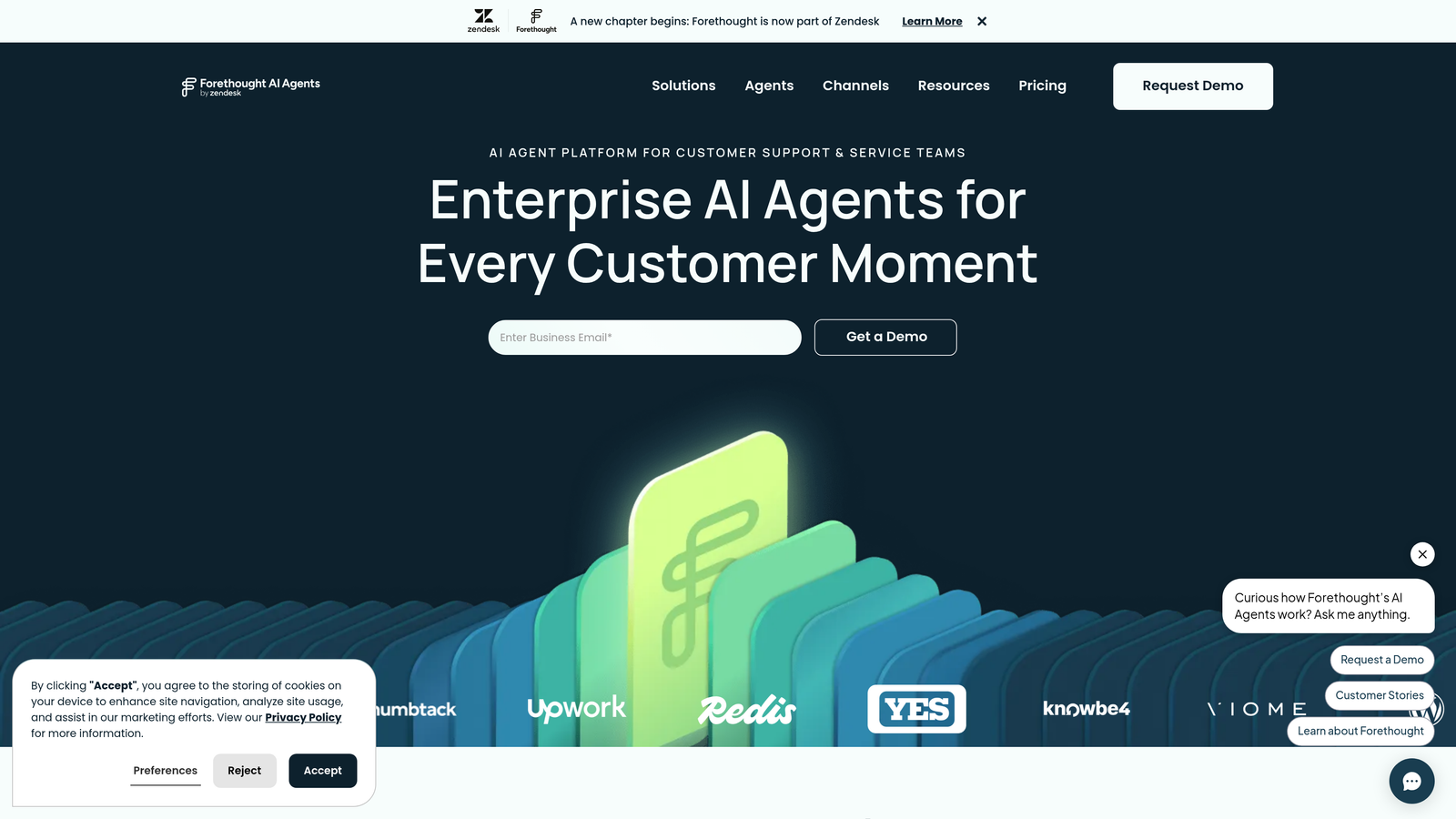
Forethought is an AI platform for customer support that uses SupportGPT models fine-tuned on company-specific ticket data to power triage, self-serve resolution, and agent assist.
Where This Tool Shines
Forethought's approach to model training is its clearest differentiator. Rather than relying solely on generic LLM knowledge or your help center articles, it fine-tunes on your actual historical support tickets. The result is an AI that understands the specific language, issues, and resolution patterns of your customer base, not a generic approximation.
The platform is modular: Triage handles routing and prioritization, Solve handles customer-facing resolution, and Assist supports human agents in real time. Teams can deploy all three or start with one.
Key Features
SupportGPT Fine-Tuning: Models trained on your company's specific ticket data for higher accuracy on your actual support topics.
Triage Product: Intelligent ticket routing and prioritization based on intent, urgency, and historical patterns.
Solve Product: Customer-facing AI agent for self-serve resolution before a ticket is created.
Assist Product: Real-time knowledge suggestions and next-best-action recommendations for live agents.
Best For
Mid-market to enterprise teams with a substantial ticket history who want an AI that reflects their specific support context, and who value modular deployment over an all-in-one approach.
Pricing
Custom pricing. Generally positions at mid-market to enterprise tiers. Contact sales for a quote based on volume and product modules needed.
6. Freshdesk Freddy AI
Best for: SMB and mid-market teams on Freshdesk wanting AI capabilities at accessible price points
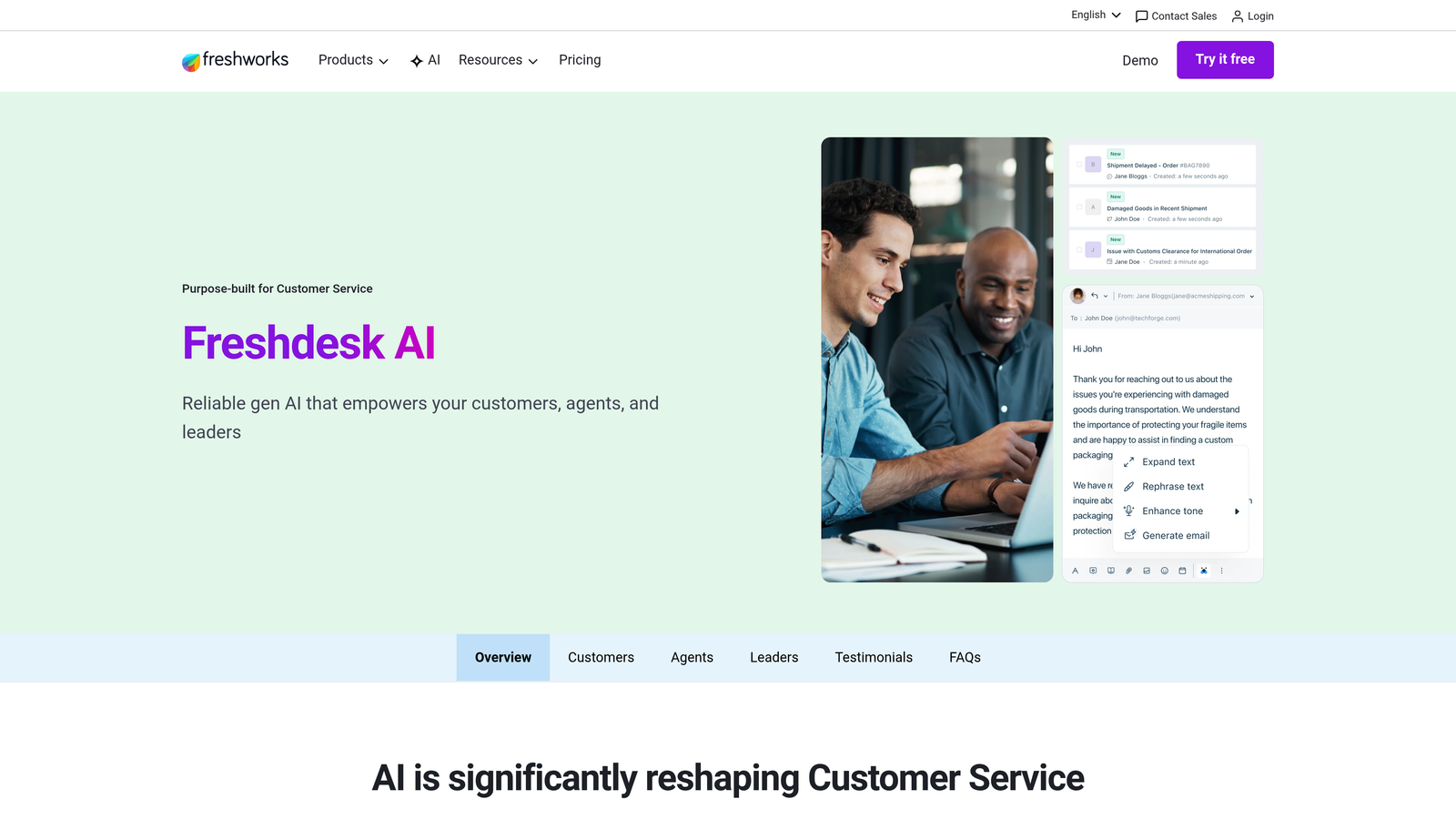
Freshdesk Freddy AI is Freshworks' embedded AI layer for Freshdesk, offering automated ticket resolution, auto-triage, and agent assist without requiring a separate AI vendor relationship.
Where This Tool Shines
Freddy AI's primary advantage is accessibility. For teams already on Freshdesk, meaningful AI capabilities are bundled into existing plans at price points that SMBs can actually absorb. The barrier to getting started is low, which matters for teams that don't have dedicated AI implementation resources.
Auto-triage is particularly useful for teams dealing with high inbound volume across multiple product lines or customer segments, automatically categorizing and routing tickets so agents start with context rather than having to read and sort first.
Key Features
Freddy AI Agent: Automated ticket resolution for common customer questions without human intervention.
Auto-Triage: Automatic ticket categorization, prioritization, and routing based on content and intent.
AI-Suggested Responses: Recommended replies and canned response suggestions for agents to speed up resolution.
Bundled Pricing: Core AI features included in Pro and Enterprise Freshdesk plans without a separate AI subscription.
Best For
Small to mid-market teams on Freshdesk who want to add AI resolution and agent assist without switching platforms or adding vendor complexity to their stack.
Pricing
Included in Freshdesk Pro and Enterprise plans. Additional AI add-ons are available for teams needing expanded capabilities beyond what's bundled.
7. Tidio
Best for: Small businesses and e-commerce teams wanting fast AI deployment with minimal setup
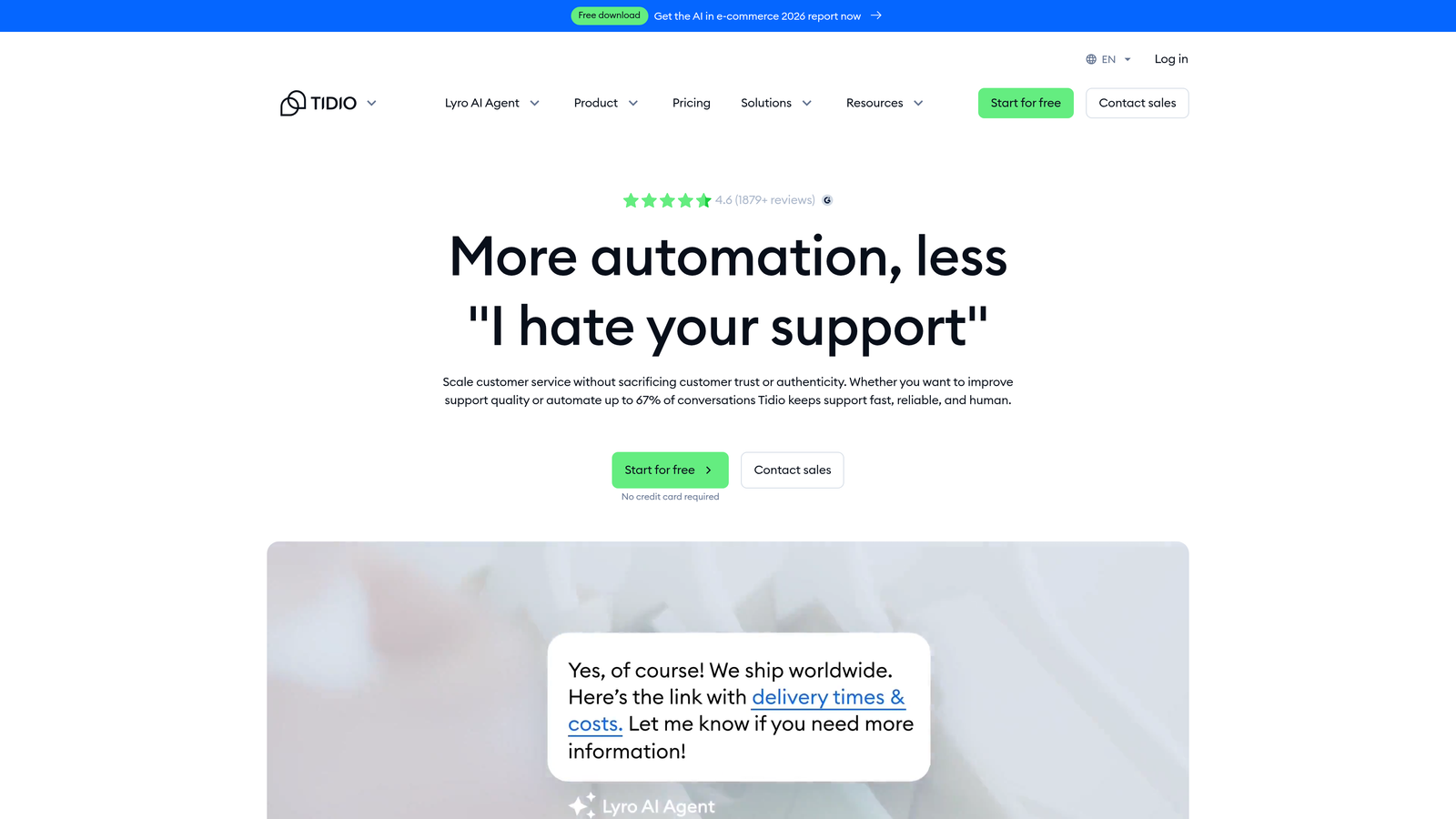
Tidio is a conversational AI platform combining its Lyro AI chatbot with live chat and helpdesk features, built for teams that need to be up and running quickly without a lengthy implementation project.
Where This Tool Shines
Tidio's speed-to-value is its headline strength. The Lyro AI chatbot learns from your existing FAQ and knowledge base content, which means a small team can deploy a functional AI support experience in a matter of hours rather than weeks. For businesses that don't have a dedicated IT or support ops function, this matters enormously.
The combination of AI chatbot and live chat in a single widget also simplifies the customer experience. Rather than bouncing between a bot interface and a separate live chat tool, customers get one consistent interaction point with smooth escalation when needed.
Key Features
Lyro AI Chatbot: Learns from FAQ and knowledge base content to handle common customer questions automatically.
Visual Flow Builder: Drag-and-drop builder for creating custom conversation paths without coding.
E-Commerce Integrations: Native connections to Shopify, WooCommerce, and WordPress for order and product context.
Combined Live Chat and AI: Single widget handles both automated and human conversations for a consistent customer experience.
Best For
Small businesses, e-commerce stores, and early-stage teams that prioritize fast deployment and low cost over enterprise-grade customization or deep CRM integrations.
Pricing
Free tier available with limited conversations. Paid plans start at approximately $29 per month, making it one of the most accessible options on this list.
8. Cognigy
Best for: Large enterprise contact centers needing voice AI and strict compliance requirements
Cognigy is an enterprise conversational AI platform specializing in voice and chat automation for large contact centers with complex compliance, security, and workflow requirements.
Where This Tool Shines
Cognigy is built for environments where a chatbot isn't enough: large contact centers handling thousands of voice calls daily, regulated industries with strict data residency requirements, and organizations that need on-premise deployment options. Its voice AI capabilities are genuinely enterprise-grade, not a lightweight add-on.
The low-code conversation design environment allows contact center operations teams to build and manage complex dialogue flows without full engineering dependency, while still supporting the advanced NLU that enterprise call volumes demand.
Key Features
Voice AI Bots: Phone-based customer support automation for contact centers handling high call volumes.
Low-Code Conversation Design: Visual builder with advanced NLU for creating complex, branching dialogue flows.
Enterprise Security and Compliance: On-premise deployment options, data residency controls, and enterprise-grade security certifications.
Contact Center Platform Integrations: Deep connections to Genesys, Avaya, NICE, and other major contact center infrastructure providers.
Best For
Large enterprises in regulated industries (financial services, healthcare, telecommunications) running traditional contact center infrastructure who need voice AI automation at scale with compliance guarantees.
Pricing
Enterprise custom pricing. Contact sales for a quote. Implementation typically involves a professional services engagement given the complexity of contact center integrations.
9. Ultimate (now part of Zendesk)
Best for: Teams wanting platform-agnostic AI agents that connect across multiple helpdesk systems
Ultimate, now integrated into Zendesk's AI offerings, is a virtual agent platform with strong platform-agnostic roots, capable of connecting to multiple CRMs and helpdesks rather than being locked to a single ecosystem.
Where This Tool Shines
Before its Zendesk acquisition, Ultimate built its reputation on flexibility: AI agents that could connect to Salesforce, Freshdesk, Zendesk, and other helpdesks simultaneously. That architecture makes it particularly relevant for enterprise teams running complex, multi-system support environments where a single-platform native AI wouldn't cover the full scope.
Its analytics dashboard is notably strong, tracking automation rate and resolution quality in ways that help teams understand not just what's happening, but where to improve. The dialogue builder's intent recognition and entity extraction capabilities also give it depth for handling nuanced customer requests.
Key Features
Platform-Agnostic AI Agents: Connects to multiple CRMs and helpdesk systems without being locked to one ecosystem.
Dialogue Builder: Intent recognition and entity extraction for handling complex, multi-turn customer conversations.
Backend Action Integrations: Executes tasks like order lookups and account changes inside connected systems.
Analytics Dashboard: Tracks automation rate, resolution quality, and performance trends to guide continuous improvement.
Best For
Enterprise teams running multi-system support environments or those already in the Zendesk ecosystem who want a more sophisticated AI agent layer with strong analytics and action capabilities.
Pricing
Custom pricing. Now integrated into Zendesk's broader AI product offerings, so evaluation typically happens as part of a Zendesk Suite conversation.
Choosing the Right Vendor for Your Team
The right AI customer service vendor depends less on which platform has the longest feature list and more on where your team actually is today and where you need to go.
For SMBs and early-stage teams: Tidio offers the fastest path to a working AI support experience at a price point that doesn't require a business case. Freshdesk Freddy AI is a strong second if you're already on Freshdesk.
For mid-market SaaS teams: Intercom Fin is the obvious choice if you're Intercom-native. If you want more resolution depth or cross-platform flexibility, Forethought and Ada both earn serious consideration. For teams that want AI to do more than answer questions, connecting to engineering tools, surfacing customer health signals, and learning continuously, Halo AI is purpose-built for exactly that use case.
For enterprise contact centers: Cognigy leads for voice-heavy, compliance-sensitive environments. Zendesk AI and Ultimate are strong for teams running at scale on Zendesk infrastructure.
For product-led SaaS companies: Halo AI's page-aware context and business intelligence layer make it the standout. The ability to see what users see, create bug tickets autonomously, and surface revenue signals from support data is a fundamentally different value proposition than ticket deflection alone.
Your support team shouldn't scale linearly with your customer base. AI agents should handle routine tickets, guide users through your product, and surface business intelligence while your team focuses on the complex issues that genuinely need a human touch. See Halo in action and discover how continuous learning transforms every interaction into smarter, faster support.