9 Best Customer Service Automation Tools for B2B in 2026
B2B customer support demands faster, smarter solutions that scale without sacrificing quality. This guide reviews the 9 best customer service automation for B2B tools in 2026, evaluated on AI capability, integration depth, and how well they handle complex B2B workflows like multi-seat accounts, technical queues, and escalation paths.
 Matt PattoliFounder13 min read
B2B customer support is a different beast than B2C. Your customers are paying for software, managing teams, and expecting answers fast, often outside business hours. A missed ticket or slow response doesn't just frustrate a user; it risks a renewal. That's why more B2B companies are turning to customer service automation: not to replace their support teams, but to help them scale intelligently.
This list covers the best tools built for B2B customer service automation in 2026. We evaluated each on AI capability, integration depth, ease of deployment, and how well they handle the complexity of B2B workflows, things like multi-seat accounts, technical support queues, and escalation paths. Whether you're running a lean support team at a startup or managing enterprise helpdesk operations, there's a tool here that fits.
1. Halo AI
Best for: AI-first B2B SaaS teams wanting deep integrations, business intelligence, and continuous learning.
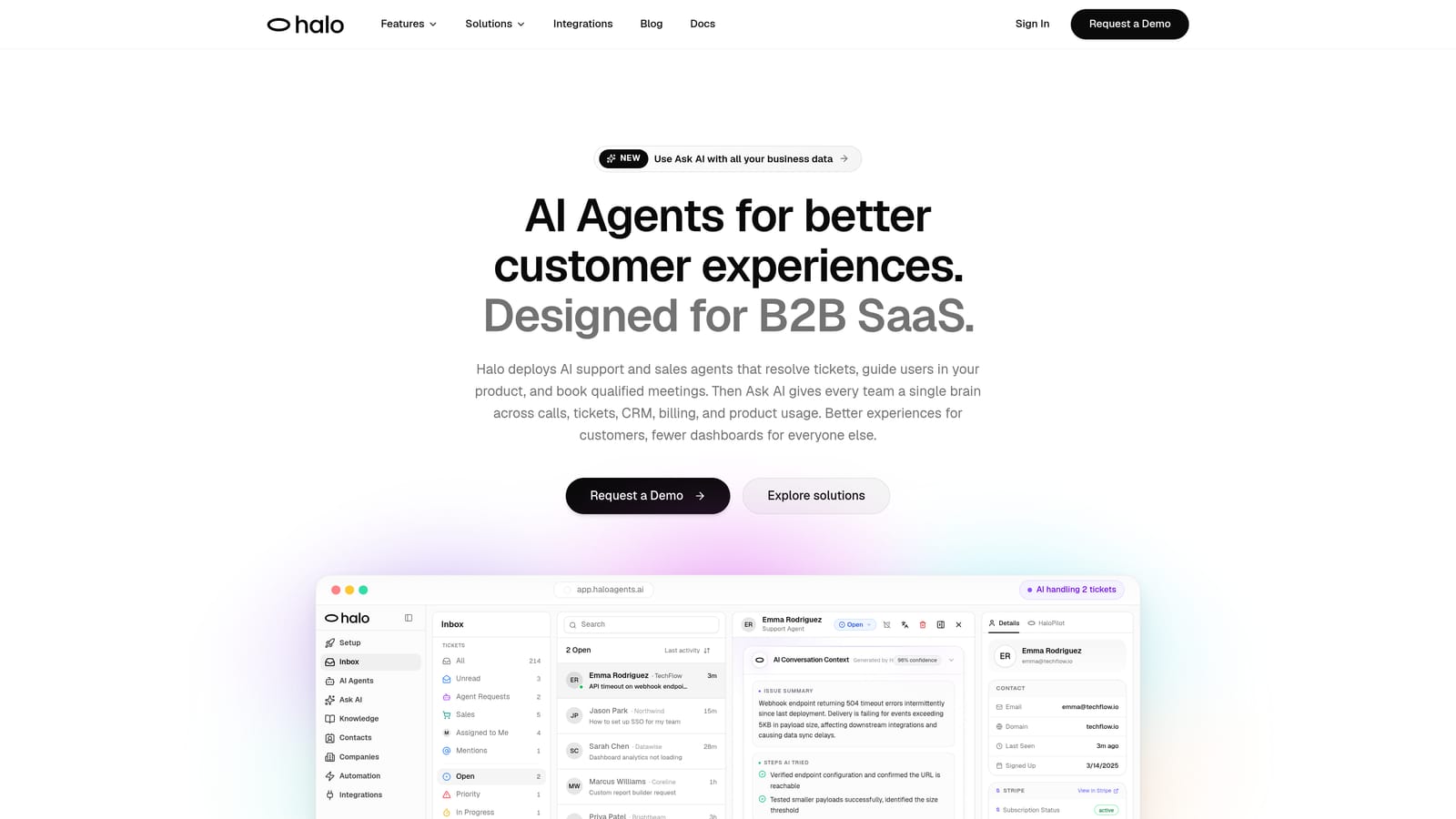
Halo AI is an AI-first customer support platform purpose-built for B2B SaaS teams, deploying intelligent agents that resolve tickets, guide users, and surface business signals.
Where This Tool Shines
What separates Halo from most tools on this list is its architecture. Rather than layering AI onto an existing ticketing system, Halo is built AI-first from the ground up. That distinction matters in practice: the system learns continuously from every resolved interaction, getting smarter the longer you use it rather than plateauing after initial setup.
The standout capability is page-aware context. Halo's agents can see what the user sees inside your product UI, which means they're not guessing at context based on a typed description. They can guide users through the exact screen they're stuck on. For SaaS teams where "I can't figure out how to do X" is a top ticket category, this is genuinely useful.
Key Features
Page-Aware AI Agents: The agent sees the user's current product view, enabling precise UI guidance rather than generic instructions.
Auto Bug Ticket Creation: Automatically generates and routes bug reports directly to Linear or your existing dev workflow, closing the loop between support and engineering without manual handoff.
Smart Inbox with Business Intelligence: Goes beyond ticket management to surface customer health signals, revenue intelligence, and anomaly detection, giving support teams visibility that typically lives in a separate analytics tool.
Live Agent Handoff: Escalates to human agents with full conversation context preserved, so customers never have to repeat themselves.
Integration Ecosystem: Connects natively with Linear, Slack, HubSpot, Intercom, Stripe, Zoom, PandaDoc, and Fathom, covering the full B2B SaaS stack.
Best For
B2B SaaS teams that want more than ticket deflection. If your support operation intersects with product, engineering, and revenue workflows, and you want a platform that learns and improves over time rather than requiring constant manual tuning, Halo is worth a serious look.
Pricing
Contact for pricing. Halo offers tailored plans based on B2B SaaS team size and usage volume, so you'll need to reach out for a quote specific to your setup.
2. Intercom
Best for: Established SaaS companies wanting a mature, omnichannel messaging platform with a capable AI agent.
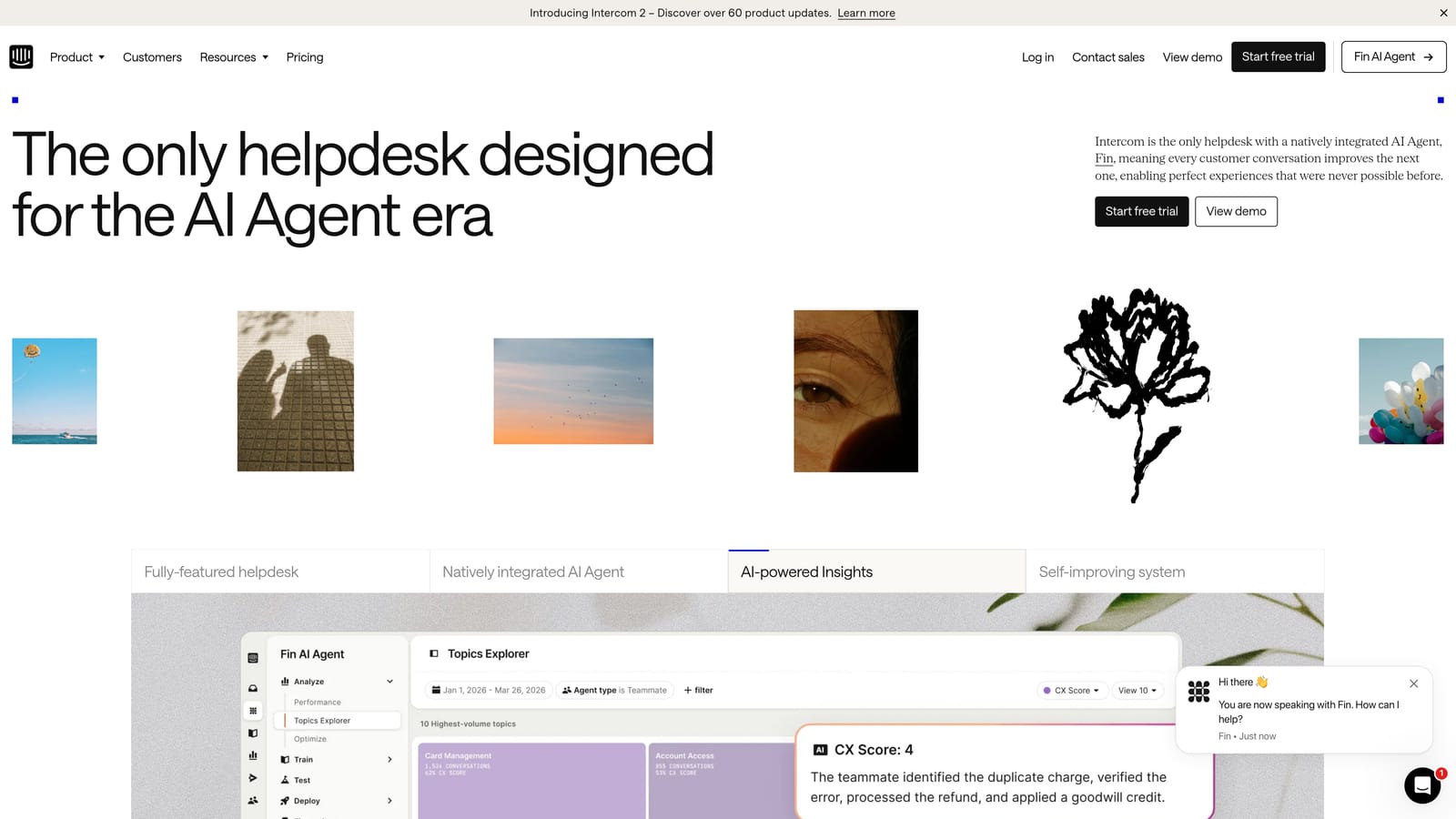
Intercom is a mature all-in-one customer messaging platform with Fin, its LLM-powered AI agent built for support conversations across chat, email, and in-product surfaces.
Where This Tool Shines
Fin is one of the more capable AI agents in this category. It's built on large language models and designed to handle nuanced support conversations, not just pattern-matched FAQ responses. For teams with well-documented help content, Fin can resolve a meaningful portion of inbound volume without agent involvement.
Intercom's broader platform is also genuinely mature. The omnichannel inbox, workflow automation, and reporting capabilities have been refined over years of B2B adoption. If your team already lives in Intercom, the AI layer is a natural extension rather than a separate tool to manage.
Key Features
Fin AI Agent: LLM-powered agent that handles full support conversations across channels with contextual understanding.
Omnichannel Inbox: Unified view across chat, email, and social channels with consistent routing and assignment rules.
Workflow Automation: Robust rules engine for routing, tagging, escalation, and follow-up automation.
Integration Ecosystem: Large library of third-party integrations covering CRM, billing, analytics, and communication tools.
Conversation Analytics: In-depth reporting on resolution rates, response times, and AI performance metrics.
Best For
SaaS companies already in the Intercom ecosystem, or teams looking for a single platform that handles both customer communication and AI-powered support automation. Worth noting: pricing has increased substantially in recent years, so budget-conscious teams should evaluate total cost carefully.
Pricing
Starts at approximately $39/seat/month. Fin AI usage is billed per resolution, so total cost scales with automation volume. Verify current pricing directly with Intercom.
3. Zendesk
Best for: Enterprise support teams needing structured ticket management with strong SLA compliance and reporting.
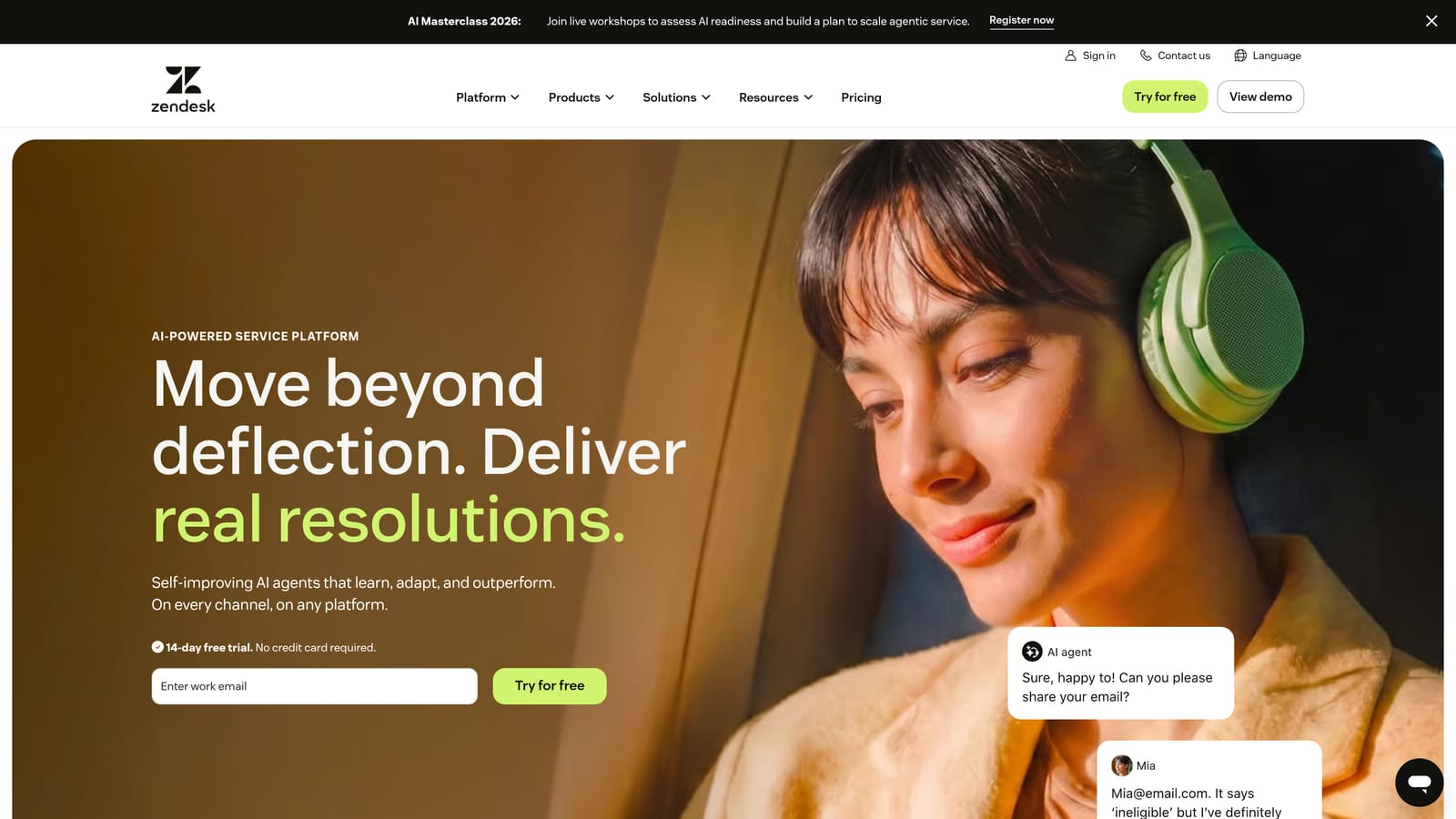
Zendesk is the enterprise standard for structured ticket management, now with AI-powered triage, suggested replies, and intelligent summarization built into its Support Suite.
Where This Tool Shines
Zendesk's strength is operational depth. SLA management, compliance reporting, skills-based routing, and a marketplace of over 1,500 integrations make it the go-to for enterprise support operations that need structure and auditability. It's not the most agile tool to configure, but it handles complex ticket workflows at scale better than almost anything else on this list.
The AI features, including Agent Copilot for suggested replies and ticket summarization, are genuinely useful additions to an already capable platform. They don't transform the experience, but they reduce agent effort on repetitive tasks in a measurable way.
Key Features
AI-Powered Triage: Automatically classifies, tags, and routes incoming tickets based on content and intent.
Agent Copilot: Surfaces suggested replies and ticket summaries to help agents resolve issues faster.
SLA Management: Granular SLA policies with escalation rules and compliance reporting built in.
1,500+ Integrations: Extensive marketplace covering virtually every tool in a modern B2B tech stack.
Custom Dashboards: Flexible analytics with pre-built and custom reporting for support operations.
Best For
Enterprise B2B teams with high ticket volume, complex routing requirements, and strict SLA obligations. Can feel heavyweight for smaller teams, but for organizations that need structure and scale, Zendesk delivers.
Pricing
Suite Team starts at $55/agent/month. AI features are available on higher tiers. Verify current pricing at zendesk.com before committing.
4. Freshdesk
Best for: Cost-conscious SMB and mid-market B2B teams scaling support without enterprise-level budgets.
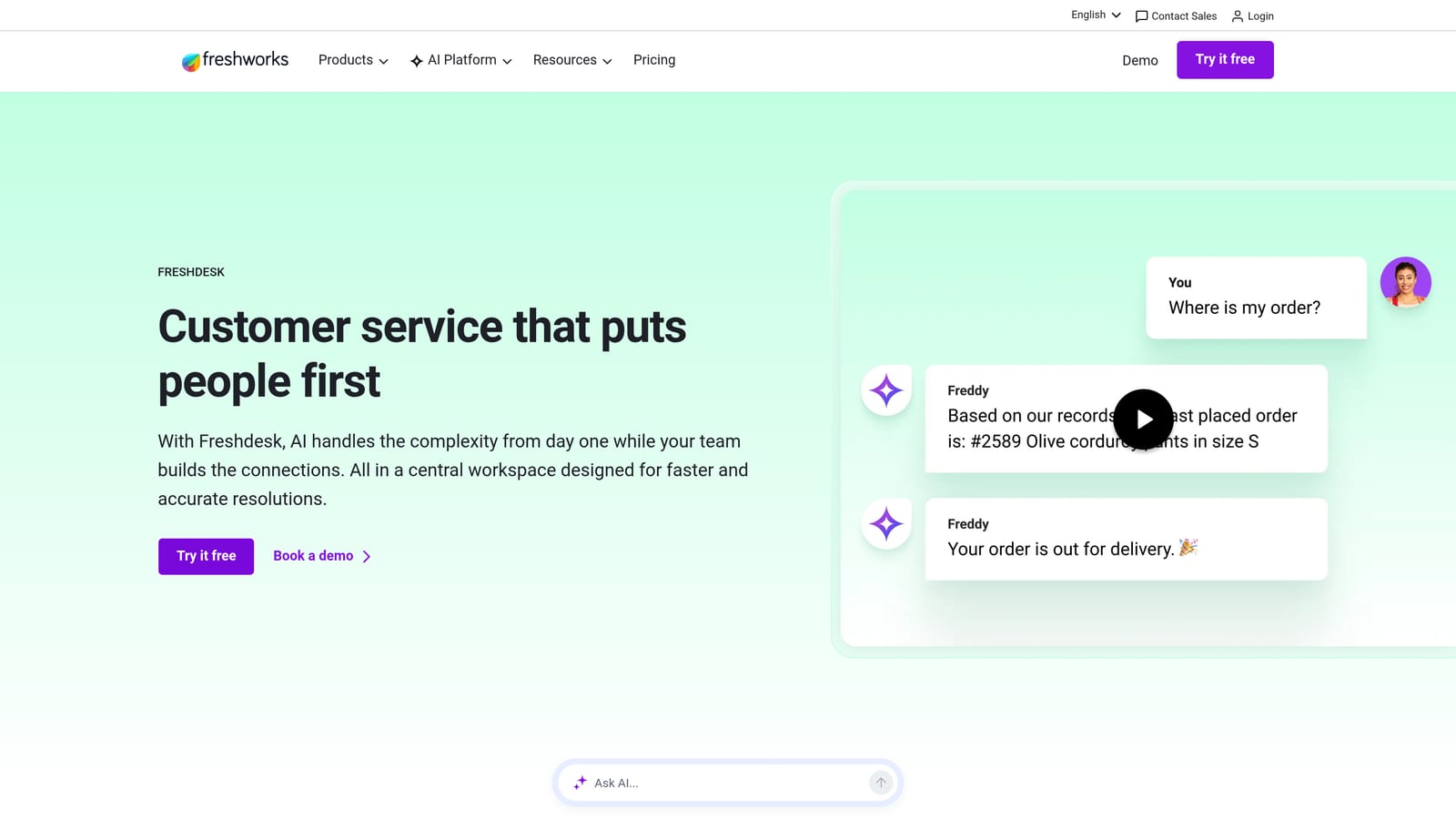
Freshdesk is a feature-rich helpdesk platform with Freddy AI built in, offering automation, sentiment analysis, and chatbot capabilities at accessible price points.
Where This Tool Shines
Freshdesk delivers a strong feature set at a price point that makes it genuinely competitive with Zendesk for teams that don't need the full enterprise tier. Freddy AI covers ticket summarization, sentiment analysis, and agent assist, which are the features most teams actually use day-to-day.
The Freddy Self Service chatbot handles deflection reasonably well for teams with documented knowledge bases. It's not the most sophisticated AI agent on this list, but it's capable enough for many B2B support scenarios and significantly easier to configure than enterprise alternatives.
Key Features
Freddy AI: Covers ticket summarization, suggested responses, and sentiment analysis to reduce agent effort.
Agent Assist: Real-time suggestions and next-best-action recommendations during live conversations.
Automated Routing: Workflow rules for ticket assignment, escalation, and SLA tracking.
Multi-Channel Support: Handles email, chat, phone, and social channels from a unified inbox.
Freddy Self Service: No-code chatbot builder for FAQ deflection and self-service flows.
Best For
Growing B2B teams that want solid AI-assisted support without the cost and complexity of enterprise platforms. A natural step up from basic email-based support for SMB SaaS companies.
Pricing
Free plan available. Growth tier starts at $15/agent/month. AI features unlock on Pro and Enterprise tiers. Pricing is among the most accessible on this list.
5. Salesforce Service Cloud
Best for: Enterprise B2B organizations already on Salesforce CRM where account-level context is critical for support.
Salesforce Service Cloud is enterprise-grade customer service built natively on the Salesforce platform, with Einstein AI providing account-level context, case deflection, and next-best-action recommendations.
Where This Tool Shines
If your organization runs on Salesforce, Service Cloud is the most natural support solution available. Every case is tied directly to account and opportunity data, which means support agents have full CRM context without switching tools. For B2B companies where account health and support history need to be unified, this native integration is a genuine differentiator.
Einstein AI handles case classification, routing, and summarization competently. The real value, though, is the data model: support interactions feeding directly into account records, informing renewal conversations, and surfacing risk signals for customer success teams.
Key Features
Einstein AI: Case classification, routing recommendations, and conversation summarization powered by Salesforce's AI layer.
Native CRM Integration: Every support case connected to account, contact, and opportunity records automatically.
Omni-Channel Routing: Skills-based assignment across channels with workload balancing.
Einstein Bots: Self-service automation for common case types with CRM-aware context.
Salesforce Analytics: Deep reporting tied to the full Salesforce data model for cross-functional visibility.
Best For
Enterprise B2B organizations already invested in the Salesforce ecosystem. Implementation complexity and cost are real considerations, but for Salesforce-centric orgs, the native data unification is hard to replicate elsewhere.
Pricing
Starter Suite from $25/user/month. Enterprise tier from $165/user/month. Implementation costs can be significant depending on configuration requirements.
6. HubSpot Service Hub
Best for: Inbound-focused B2B teams already on HubSpot who want support tickets connected to CRM data without a separate platform.
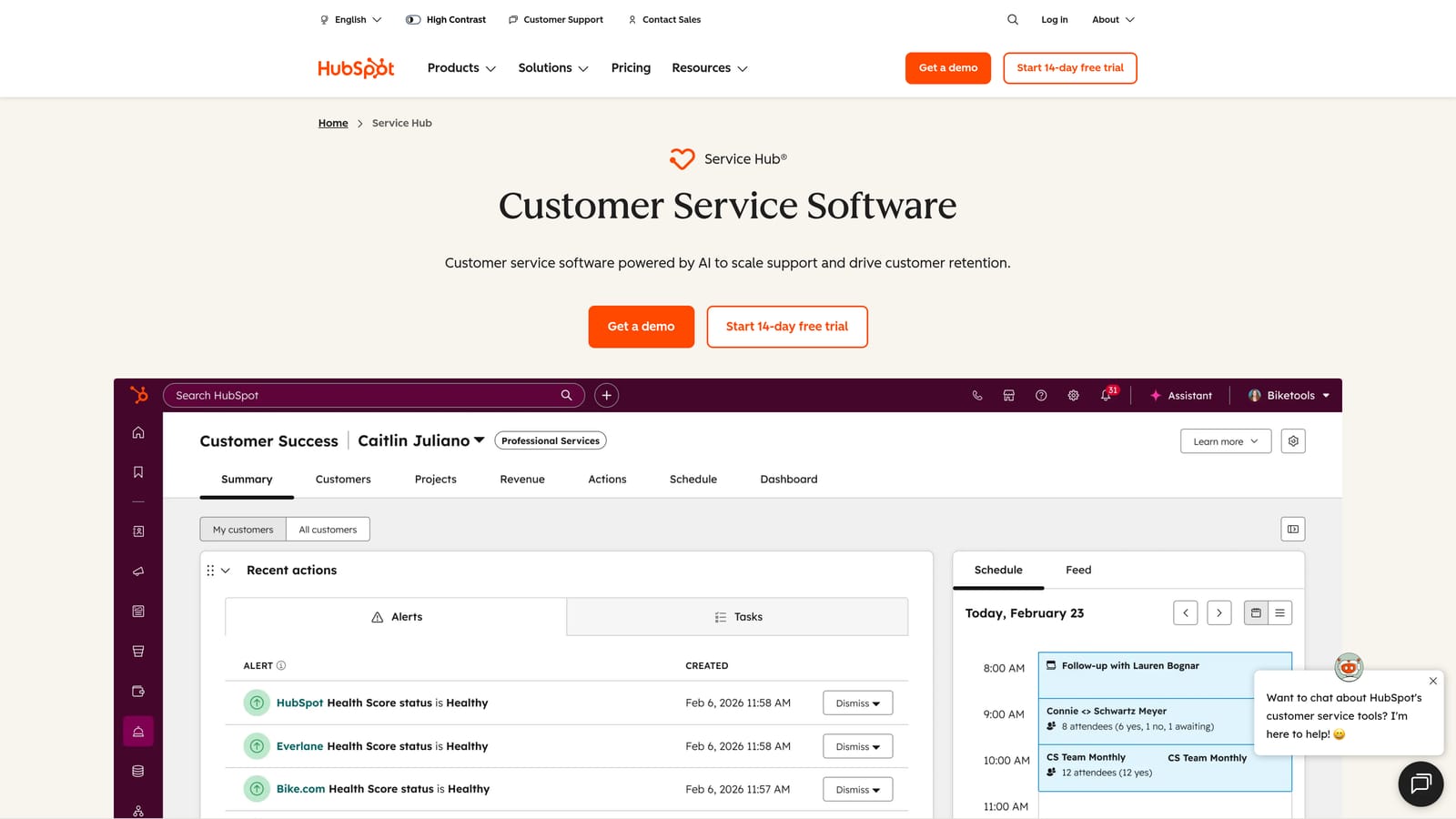
HubSpot Service Hub is HubSpot's customer service product that connects support tickets directly to CRM contact and deal records, with growing AI features for teams already in the HubSpot ecosystem.
Where This Tool Shines
The core value proposition is simplicity for HubSpot users. Tickets link automatically to contact and deal records, which means support conversations are visible to sales and customer success teams without any integration work. For teams that have built their go-to-market motion on HubSpot, avoiding a separate support platform is a meaningful operational win.
The AI features, including ticket summarization and reply suggestions, are functional but not as mature as Intercom or Zendesk's equivalents. HubSpot is actively developing this area, so the gap may narrow, but teams with sophisticated AI automation needs may find it limiting today.
Key Features
Native CRM Integration: Support tickets automatically linked to HubSpot contact, company, and deal records.
AI Ticket Summarization: Automatically summarizes ticket context to speed up agent response.
Knowledge Base Builder: Create and manage self-service content with AI writing assistance.
Customer Portal: Self-service ticket tracking for customers without requiring agent involvement.
SLA Management: Built-in SLA tracking and shared inbox tools for team coordination.
Best For
B2B teams already using HubSpot for marketing and sales who want to unify their customer data in one platform. Less compelling as a standalone support tool if you're not already in the HubSpot ecosystem.
Pricing
Free tools available. Starter from $15/seat/month. Professional tier from $90/seat/month with more advanced automation and reporting.
7. Tidio
Best for: Small B2B teams and agencies needing fast, affordable automation without complex configuration.
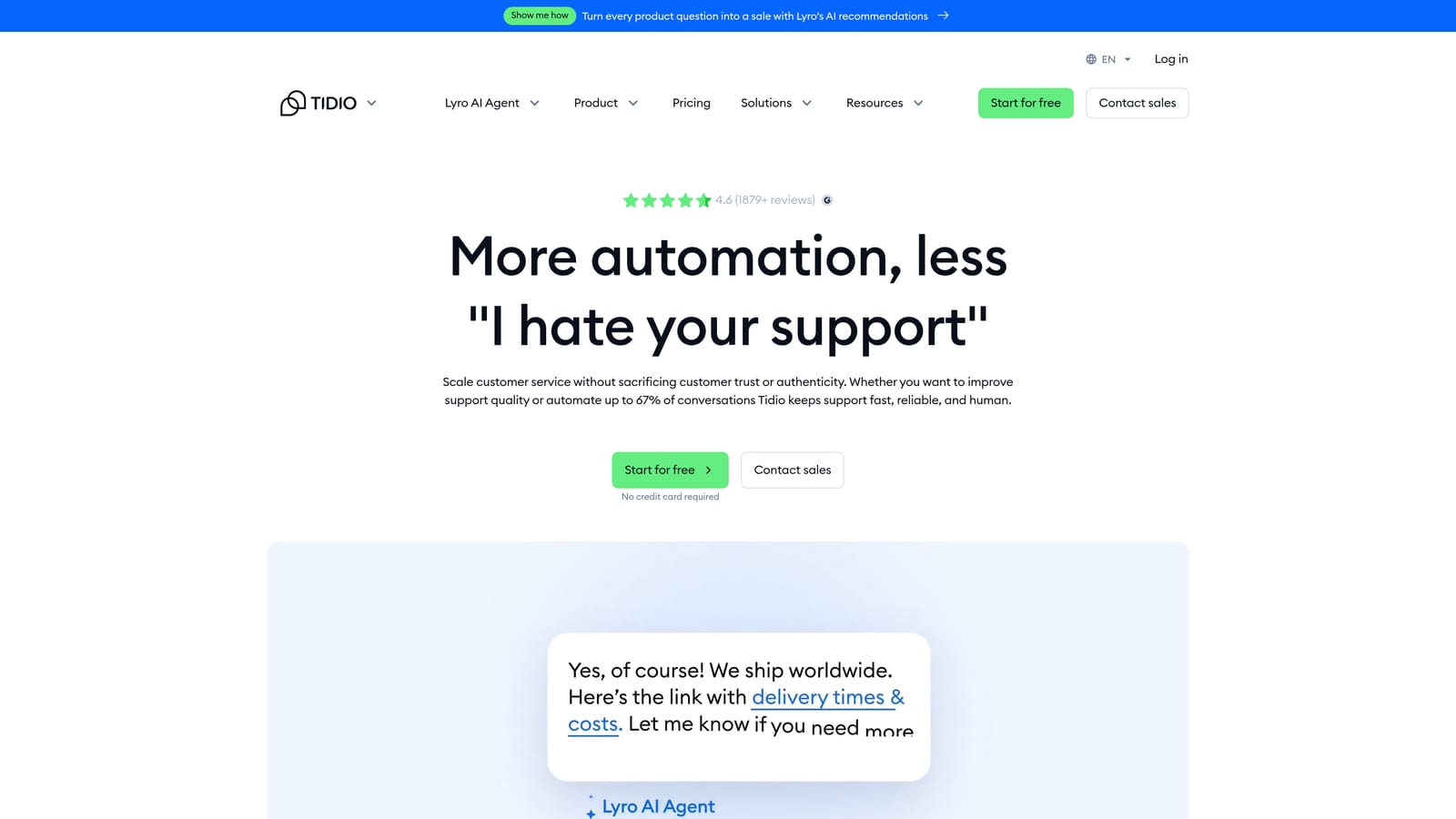
Tidio is an accessible live chat and AI chatbot platform featuring Lyro, its conversational AI agent, designed for teams that need fast deployment and solid automation without enterprise complexity.
Where This Tool Shines
Tidio's main advantage is speed to value. Setup is genuinely fast, configuration is no-code, and Lyro handles conversational automation without requiring a technical implementation project. For small B2B teams that need something working this week rather than next quarter, that matters.
Lyro performs well for common support scenarios and the human handoff experience is smooth. It's not the most sophisticated AI agent available, but for teams with straightforward support workflows, it covers the basics effectively at a price point that's hard to argue with.
Key Features
Lyro AI Chatbot: Conversational AI agent that handles automated support interactions with natural language understanding.
No-Code Configuration: Fast setup with pre-built flows and templates that don't require technical resources.
Live Chat with Handoff: Smooth escalation from AI to human agents when conversations require it.
Multichannel Support: Covers email, live chat, and Messenger from a single interface.
Pre-Built Automation Flows: Templates for common support scenarios to accelerate deployment.
Best For
Small B2B teams, agencies, or early-stage SaaS companies that need functional automation quickly and without a large budget. Less suited to enterprise teams with complex routing requirements or multi-seat account management needs.
Pricing
Free plan available. Lyro AI starts at $29/month, with pricing scaling based on conversation volume. One of the most accessible options on this list for small teams.
8. Drift (by Salesloft)
Best for: Revenue-focused B2B teams where support conversations frequently connect to pipeline, renewal, and expansion activity.
Drift is a conversational AI platform positioned at the intersection of B2B sales and support, designed for teams where customer conversations have direct revenue implications.
Where This Tool Shines
Drift occupies a distinct position in this category. It's less a traditional helpdesk and more a revenue-aware conversation platform. Since its acquisition by Salesloft, the integration between conversational AI and sales workflow has deepened, making it interesting for B2B teams where the line between support and renewal management is blurry.
Account-based targeting lets teams personalize conversations based on company segment, contract tier, or renewal date, which is genuinely useful for enterprise B2B support where a customer's context determines how urgently their issue needs to be handled.
Key Features
AI Conversational Bots: Handles qualification, routing, and support conversations with account-aware context.
Account-Based Targeting: Personalizes chat experiences based on company segment, tier, or custom attributes.
Meeting Scheduling: Embeds calendar booking directly into chat flows for seamless escalation to human conversations.
Salesloft Integration: Native alignment with Salesloft for revenue workflow continuity across sales and support.
Real-Time Visitor Intelligence: Identifies and routes known accounts based on real-time behavior data.
Best For
B2B teams where customer support and revenue workflows genuinely overlap, particularly those already using Salesloft for sales engagement. Less suited to teams looking for a pure support ticketing solution.
Pricing
Contact for pricing. Drift is enterprise-focused with custom quotes. Expect pricing to reflect that positioning.
9. Kustomer
Best for: High-volume B2B support teams needing a CRM-native platform with unified customer history across all channels.
Kustomer is a CRM-native customer service platform (owned by Meta) that unifies customer history across all channels into a single timeline, with AI-powered routing and resolution for high-volume support teams.
Where This Tool Shines
Kustomer's defining characteristic is the unified customer timeline. Rather than viewing support as a series of disconnected tickets, Kustomer presents every interaction across every channel as a single continuous view of the customer relationship. For teams managing complex accounts with long histories, this context is genuinely valuable.
The built-in CRM means you're not stitching together a separate customer database with your support platform. AI-powered routing and automated resolution handle volume efficiently, and the workflow automation engine is capable enough for sophisticated business rules.
Key Features
Unified Customer Timeline: Every interaction across email, chat, SMS, social, and voice in a single chronological view.
AI-Powered Routing: Automated conversation classification and routing based on content, customer attributes, and business rules.
Built-In CRM: Native customer data model eliminates the need for a separate CRM integration.
Omnichannel Inbox: Unified handling of email, chat, SMS, social, and voice from one interface.
Workflow Automation Engine: Business rules engine for complex routing, escalation, and follow-up automation.
Best For
B2B companies with high-volume, multi-channel support needs and a preference for CRM-native architecture. Kustomer's strength is in omnichannel unification; teams with simpler, single-channel workflows may find the platform more than they need.
Pricing
Enterprise tier from $89/user/month. Ultimate tier from $139/user/month. Pricing reflects the platform's enterprise positioning.
Which Tool Is Right for Your Team
The right tool depends almost entirely on where your team is today and what complexity you're trying to solve. Here's how to think about it:
Halo AI is the strongest fit for B2B SaaS teams that want AI-first architecture with deep integrations, continuous learning, and business intelligence built in. If your support operation touches product, engineering, and revenue workflows, it's purpose-built for exactly that.
Intercom suits established SaaS companies already in its ecosystem. Fin is a capable AI agent and the platform is mature, though pricing has climbed and should be evaluated carefully.
Zendesk remains the enterprise standard for structured, high-volume ticket operations where SLA compliance and routing complexity are the primary concerns.
Freshdesk is the pragmatic choice for cost-conscious SMB and mid-market teams that want solid AI features without enterprise pricing.
Salesforce Service Cloud is the natural fit for enterprise orgs running on Salesforce CRM, where native account context integration outweighs the implementation overhead.
HubSpot Service Hub makes the most sense for inbound-focused teams already on HubSpot who want support data unified with their CRM without adding another platform.
Tidio is the fastest path to functional automation for small teams and agencies working with limited budgets and timelines.
Drift is worth exploring for revenue-focused teams where support conversations regularly intersect with renewal and expansion activity, particularly Salesloft users.
Kustomer fits high-volume B2B teams that want a CRM-native platform with omnichannel unification as the core design principle.
Your support team shouldn't scale linearly with your customer base. Let AI agents handle routine tickets, guide users through your product, and surface business intelligence while your team focuses on complex issues that need a human touch. See Halo in action and discover how continuous learning transforms every interaction into smarter, faster support.