9 Best Customer Success AI Tools in 2026
Discover the 9 best customer success AI tools in 2026, from autonomous support agents to churn-predicting health-score platforms, selected for their depth of AI capability and real impact on customer outcomes. Whether you manage a lean SaaS startup or enterprise accounts, this guide helps CS teams scale personalized engagement, reduce churn risk, and stay proactive without adding headcount.
 Grant CooperFounder14 min read
Customer success teams are under more pressure than ever: larger books of business, higher churn risk, and the expectation to be proactive rather than reactive. AI tools built specifically for customer success are changing how teams identify at-risk accounts, resolve issues faster, and scale personalized engagement without adding headcount.
This list covers nine tools that stand out in 2026, ranging from AI agents that autonomously resolve support tickets to health-scoring platforms that surface churn signals before they become problems. Whether you're running a lean CS team at a growing SaaS startup or managing enterprise accounts at scale, there's a solution here built for your workflow.
Selection criteria: depth of AI capability (not just automation), integration ecosystem, ease of deployment, and genuine impact on customer outcomes, not just ticket volume.
1. Halo AI
Best for: B2B SaaS teams that want autonomous ticket resolution and business intelligence from every support interaction.
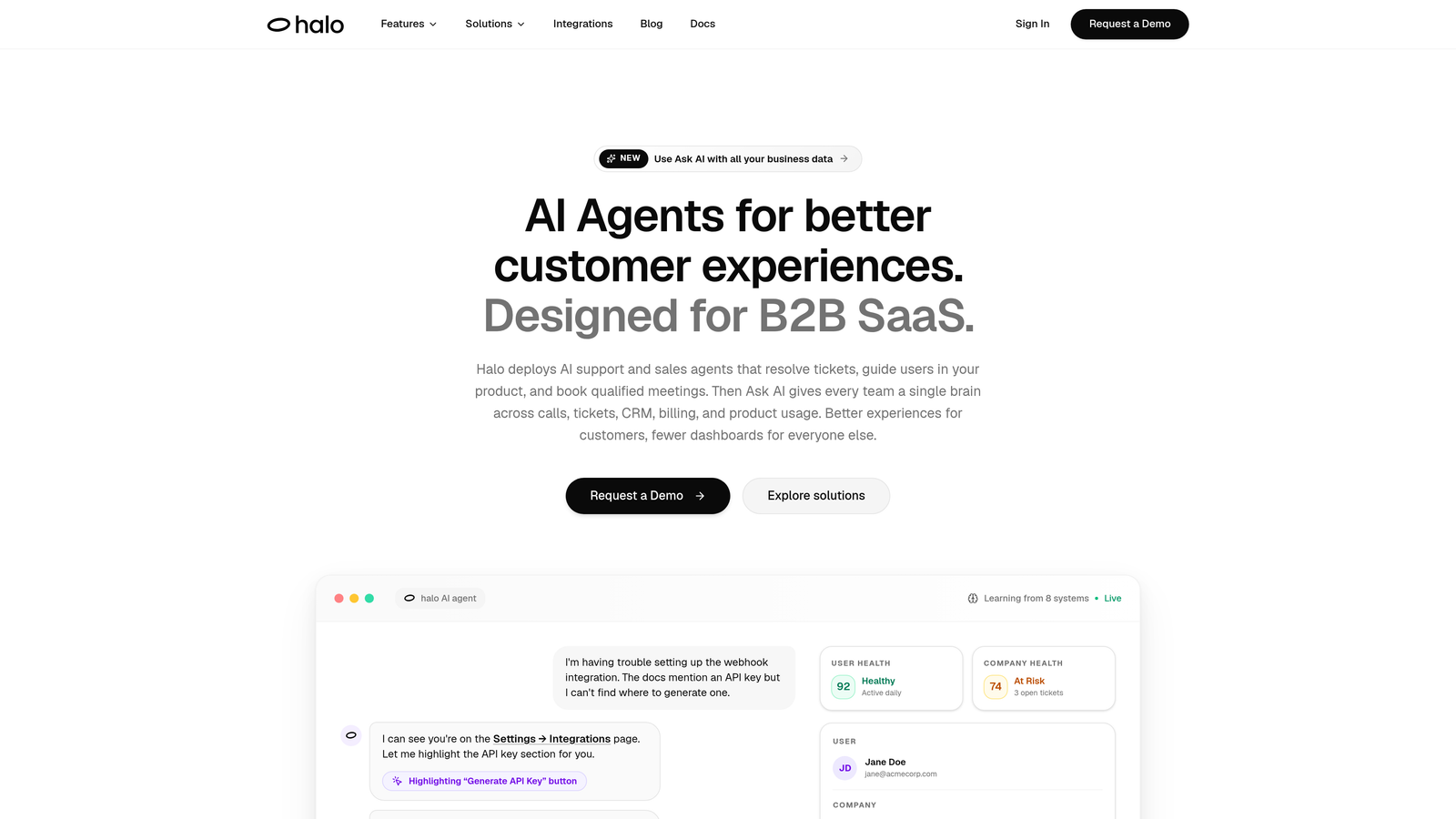
Halo AI is an AI-first customer support platform that deploys autonomous agents to resolve tickets, guide users contextually, and surface business intelligence without human triage.
Where This Tool Shines
What separates Halo from most tools on this list is the architecture. It wasn't built as a feature layer on top of an existing helpdesk. It was designed from the ground up around autonomous AI agents, which means the intelligence runs deeper and learns continuously from every interaction rather than relying on static rule sets.
The page-aware chat widget is a standout capability: it sees what your user is currently viewing and delivers contextual UI guidance based on that exact screen state. Pair that with a smart inbox that surfaces customer health signals, anomaly detection, and revenue intelligence, and you have a support tool that doubles as a business intelligence layer for your CS team.
Key Features
Autonomous AI Agents: Resolve support tickets end-to-end without human intervention, learning from every resolved case to improve over time.
Page-Aware Chat Widget: Detects what page a user is on and delivers contextually relevant guidance, reducing confusion without requiring a human to explain the UI.
Smart Inbox with Business Intelligence: Surfaces customer health signals, revenue intelligence, and anomaly detection directly from support interactions, giving CS teams proactive visibility.
Auto Bug Ticket Creation: Automatically identifies product issues from support conversations and routes them to Linear or equivalent tools without manual triage.
Live Agent Handoff: Escalates complex issues to human agents with full conversation context preserved, so nothing gets repeated or lost.
Deep Integration Ecosystem: Connects natively with Linear, Slack, HubSpot, Intercom, Stripe, Zoom, PandaDoc, and Fathom, fitting into the full B2B SaaS stack.
Best For
Product-led SaaS companies and B2B teams that want support automation with genuine intelligence behind it. Particularly well-suited for teams that need their support layer to feed CS health data upstream rather than operating in a silo. Ideal if you're evaluating AI-first platforms rather than adding AI features to a legacy helpdesk.
Pricing
Contact for pricing. See full details and request a demo at haloagents.ai.
2. Gainsight
Best for: Enterprise CS teams that need deep health scoring, renewal forecasting, and AI-assisted playbook management at scale.
Gainsight is the most established enterprise customer success platform, with AI layered across health scoring, risk alerts, and renewal forecasting.
Where This Tool Shines
Gainsight has been the reference point for enterprise CS platforms for years, and its AI capabilities have matured significantly. Predictive health scoring pulls from CRM data, product usage signals, and support history to give CSMs a consolidated view of account risk. The AI-assisted playbook recommendations help large teams stay consistent without micromanagement.
The tradeoff is complexity. Gainsight is enterprise-grade in both capability and implementation effort. Teams that get the most out of it tend to have dedicated CS operations resources and significant configuration time available. It's not a quick-start platform, but for large, complex customer bases, the depth is hard to match.
Key Features
AI-Powered Predictive Health Scoring: Aggregates signals across the customer base to surface risk and opportunity before they become visible in lagging indicators.
Automated Risk Alerts and Renewal Forecasting: Flags at-risk renewals early and gives CS leaders pipeline visibility comparable to sales forecasting.
AI-Assisted Playbook Recommendations: Suggests the right CS motion for each account based on health data and historical outcomes.
360-Degree Customer View: Combines CRM, product usage, and support data into a single account profile.
Enterprise-Grade Configurability: Highly adaptable to complex account structures, business models, and reporting requirements.
Best For
Large enterprise CS teams with dedicated CS operations resources and complex account portfolios. Best suited for organizations where Salesforce or another major CRM is already the system of record and where implementation investment is feasible.
Pricing
Enterprise pricing. Contact Gainsight directly for a quote. Implementation costs can be significant, so factor those into the total cost of ownership.
3. Totango
Best for: CS teams that want modular, fast-to-deploy workflows without committing to a full platform overhaul upfront.
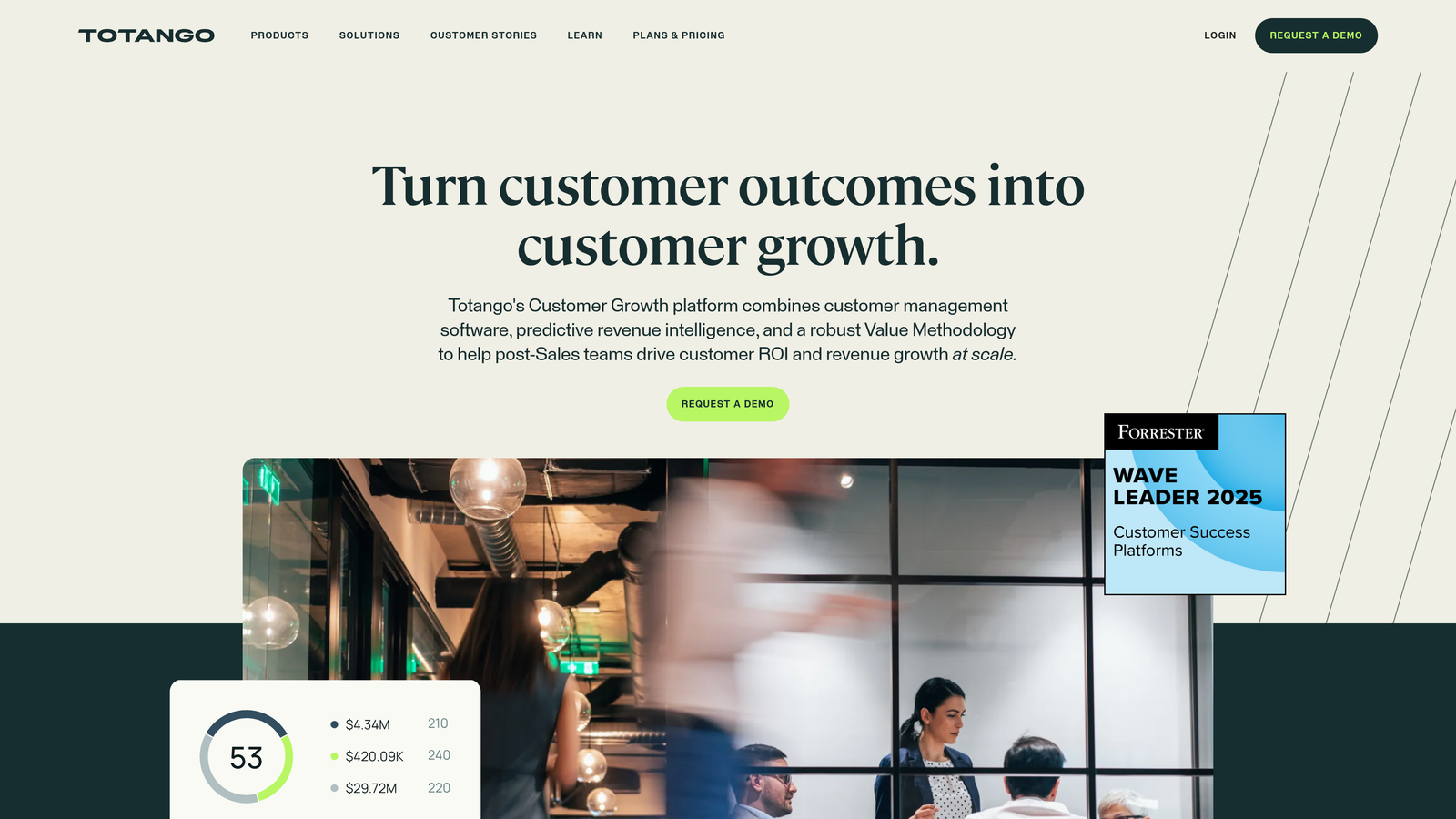
Totango is a modular customer success platform built around SuccessBLOCs, which are pre-built CS workflows that teams can deploy incrementally alongside AI health signals.
Where This Tool Shines
The SuccessBLOCs framework is genuinely differentiated. Rather than requiring teams to build their entire CS motion from scratch inside the platform, Totango ships pre-built workflows for common use cases: onboarding, adoption, renewal, expansion. Teams can activate what they need and add more as they scale, which dramatically reduces time-to-value compared to platforms that require full configuration before anything runs.
AI signals surface account health changes in real time and can trigger automated CS plays without manual intervention. The flexible data model also makes it easier to adapt to different business models, whether you're running a usage-based pricing motion or a traditional seat-based SaaS product.
Key Features
SuccessBLOCs: Modular, pre-built CS workflows that can be deployed incrementally, reducing implementation time and complexity.
AI Health Signals: Detect account health changes and trigger automated CS plays based on behavioral and usage data.
Flexible Data Model: Adapts to different business models and pricing structures without requiring custom development.
In-App Engagement Tools: Supports product-led CS motions with in-app messaging and guidance capabilities.
Revenue and Expansion Tracking: Tracks renewal and upsell pipeline alongside health metrics for a complete CS view.
Best For
Growth-stage SaaS companies scaling from startup to mid-market that need a CS platform they can grow into rather than one they need to grow out of. Also a strong option for teams that have struggled with slow implementations on larger platforms.
Pricing
Free tier available. Paid plans scale with customer count. Contact Totango for enterprise pricing.
4. ChurnZero
Best for: SaaS CS teams that want real-time product usage data driving health scores and automated retention playbooks.
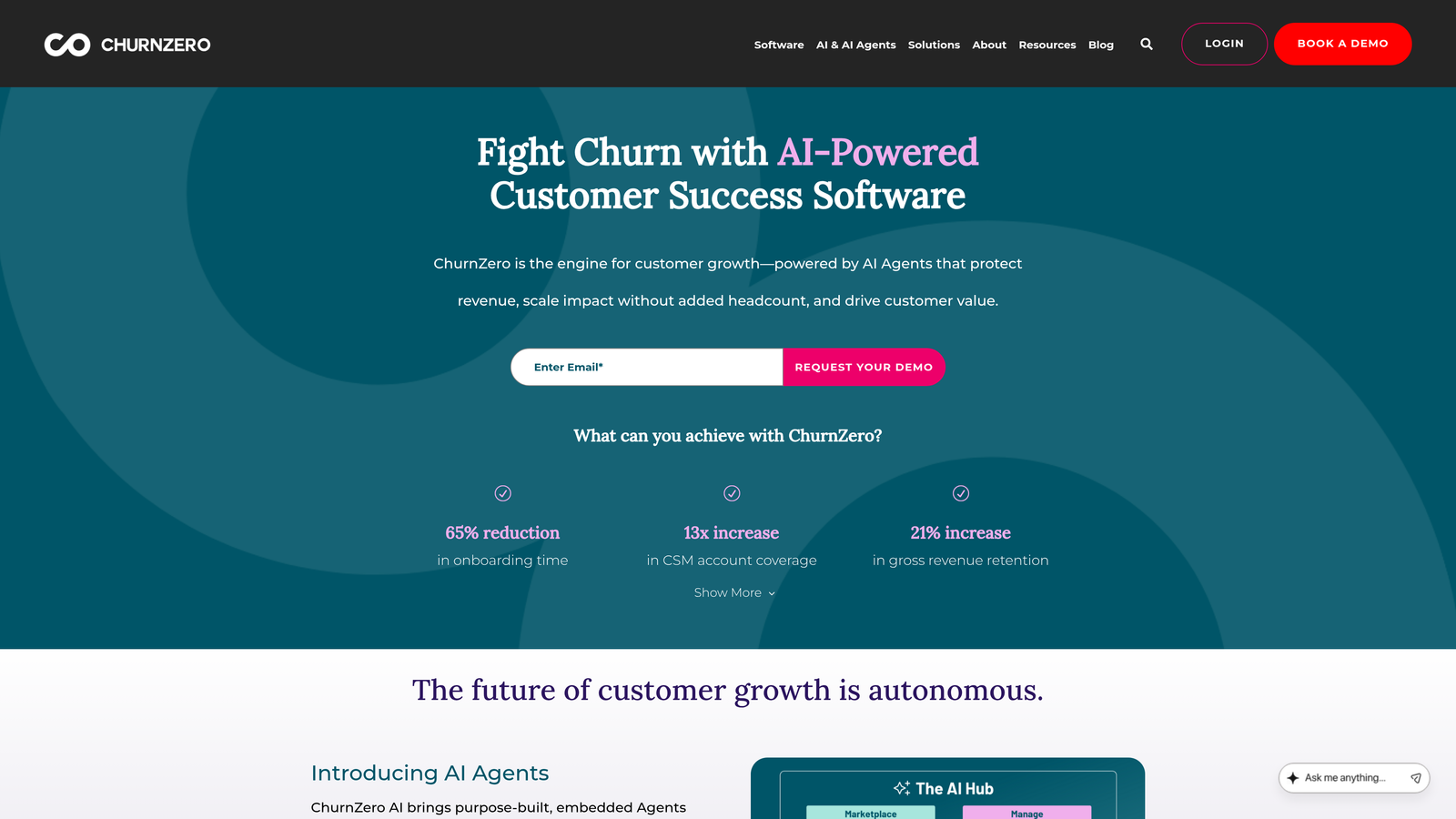
ChurnZero is a SaaS-focused customer success platform that ties real-time product usage data directly to health scores and automated retention workflows.
Where This Tool Shines
ChurnZero's core strength is the tightness of the loop between product behavior and CS action. When a user's login frequency drops or a key feature goes unused, ChurnZero can trigger an automated CS play immediately rather than waiting for a quarterly business review to surface the risk. That real-time responsiveness is what makes it particularly effective for retention-focused teams.
The ChurnZero AI layer adds summarization and playbook suggestions on top of the behavioral data, helping CSMs prioritize their outreach and understand account context quickly without digging through raw data.
Key Features
Real-Time Product Usage Health Scoring: Feeds live behavioral signals directly into health score calculations, not just periodic data syncs.
Automated CS Plays: Triggers retention and engagement workflows based on specific behavioral signals like feature abandonment or login decline.
In-App Communication Tools: Enables proactive outreach directly within the product experience.
Renewal and Expansion Pipeline Tracking: Gives CS leaders visibility into upcoming renewals and upsell opportunities.
ChurnZero AI: Provides summarization, playbook suggestions, and account context to help CSMs work more efficiently.
Best For
SaaS companies with a strong focus on retention and expansion, particularly those where product usage data is the most reliable indicator of account health. Well-suited for mid-market CS teams that need automation without enterprise-level implementation overhead.
Pricing
Contact ChurnZero for pricing. Scales with number of customers.
5. Intercom (Fin AI)
Best for: SaaS teams already using Intercom for in-app messaging who want autonomous AI resolution layered on top of their existing help content.
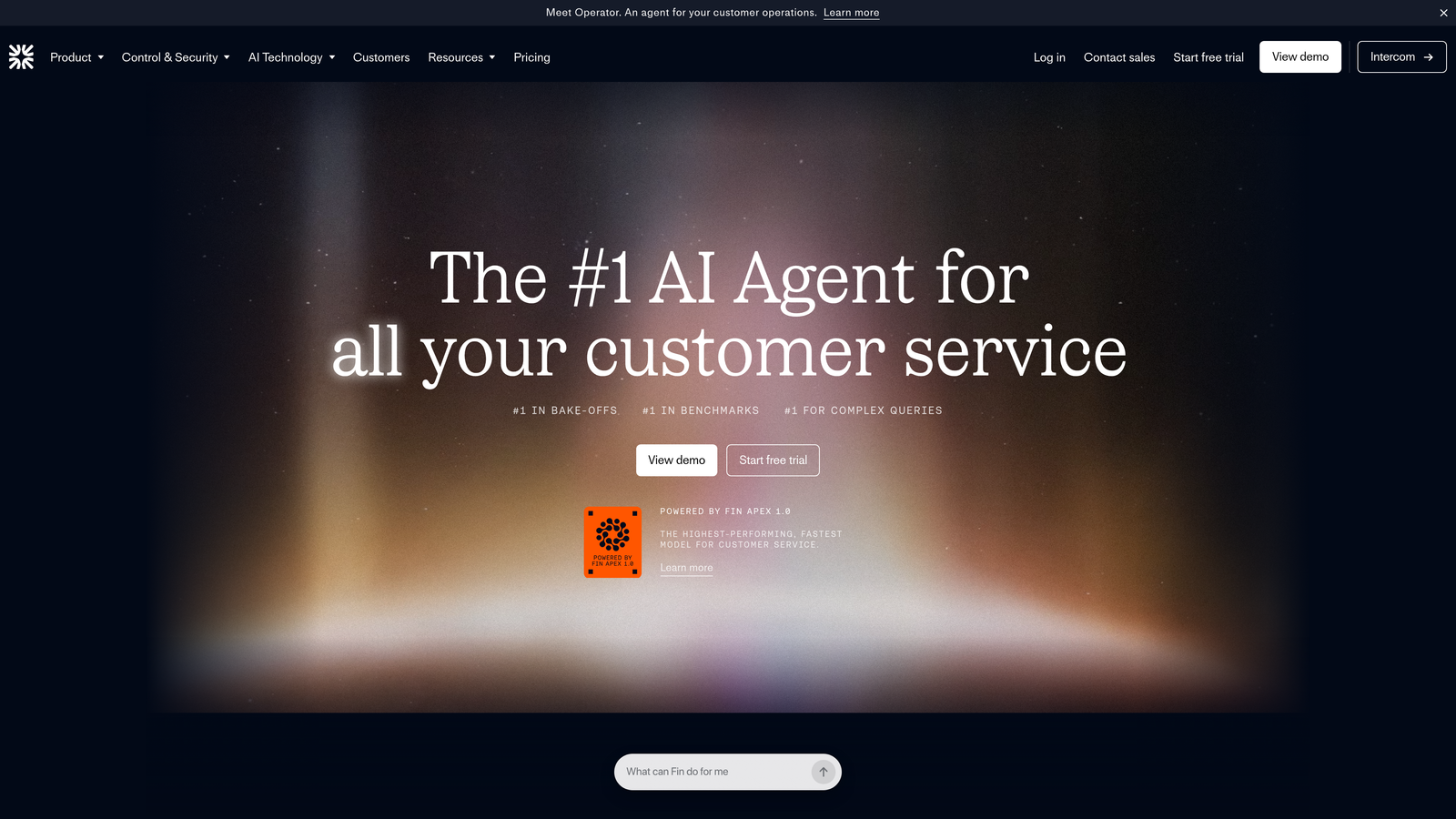
Intercom's Fin is an AI agent that autonomously resolves customer support conversations using your existing help center content, with seamless handoff to human agents when needed.
Where This Tool Shines
Fin's biggest advantage is the deployment path. If your team is already using Intercom, Fin can start resolving conversations using your existing help center content without a lengthy setup process. It reads your documentation, handles common questions autonomously, and passes complex conversations to human agents with full context intact.
The AI Copilot feature also helps agents on complex queries by surfacing relevant answers and suggested replies in real time. Fin is primarily a support automation tool rather than a proactive CS health platform, so teams looking for churn prediction or health scoring will need to pair it with a dedicated CS platform.
Key Features
Fin AI Agent: Resolves customer conversations autonomously by drawing on your help center content without requiring manual rule configuration.
Seamless Human Handoff: Escalates to human agents with full conversation context preserved, so customers don't have to repeat themselves.
Multi-Channel Support: Handles conversations across in-app, web, and email channels from a single interface.
AI Copilot for Agents: Assists human agents on complex queries with suggested replies and relevant knowledge article recommendations.
Deep Intercom Platform Integration: Works natively within the broader Intercom ecosystem, including CRM data and customer attributes.
Best For
Product teams and SaaS companies already invested in the Intercom platform who want to add autonomous resolution without switching tools. Less suited for teams starting from scratch or needing proactive CS health scoring alongside support automation.
Pricing
Available on Intercom plans starting at approximately $74/month. Per-resolution pricing is also available for Fin. Check Intercom's website for current plan details.
6. Zendesk AI
Best for: Support teams running high ticket volumes inside the Zendesk ecosystem who want AI-powered triage, routing, and autonomous resolution.
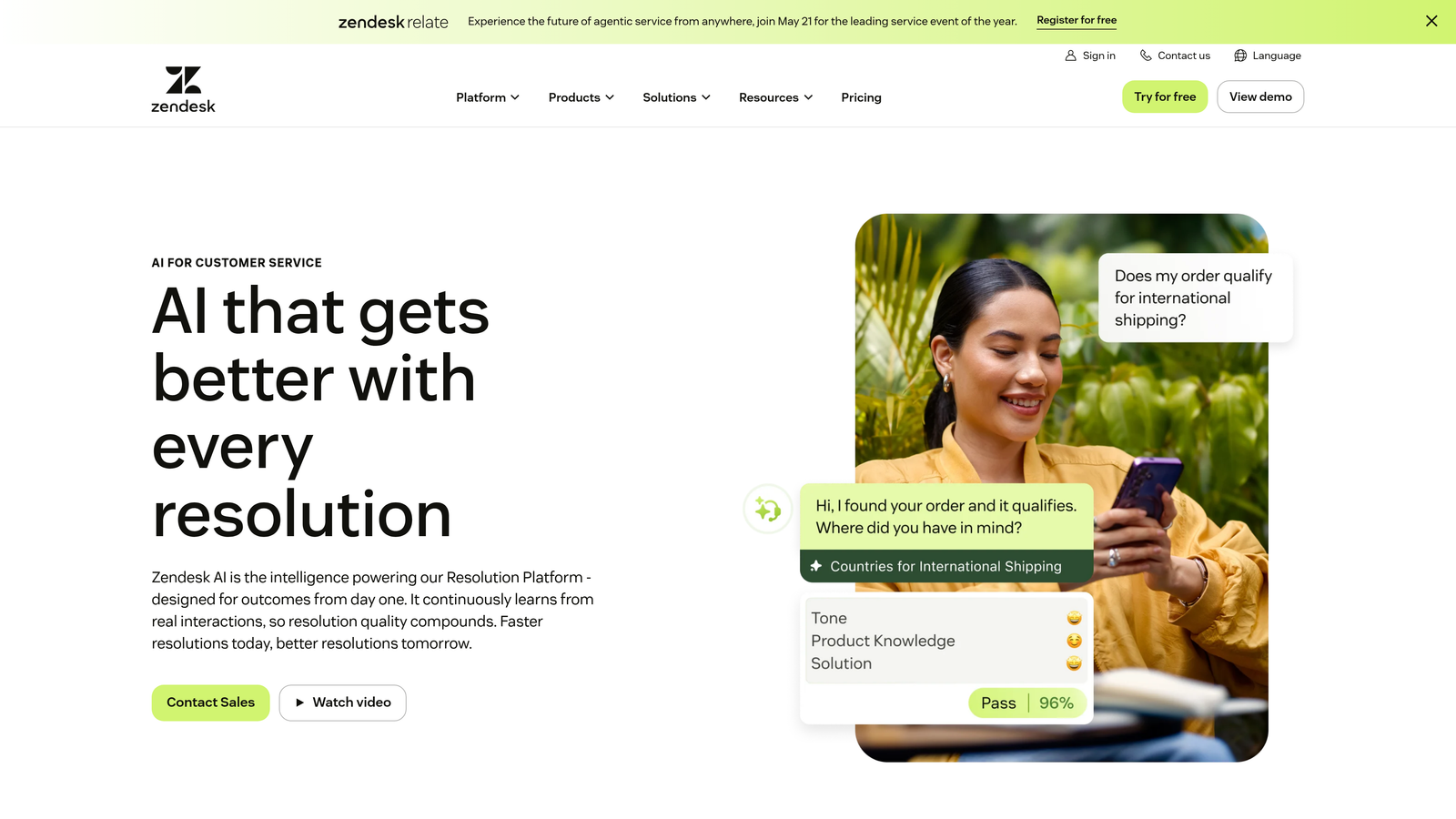
Zendesk AI delivers intelligent triage, intent detection, auto-routing, and autonomous ticket resolution natively across the Zendesk Suite.
Where This Tool Shines
Zendesk AI is most powerful for teams already running their support operations inside Zendesk. The AI capabilities are embedded natively across the suite rather than bolted on, which means intent detection, sentiment analysis, and auto-routing work in context with the tickets and agents already in the system. For high-volume support operations, the intelligent triage alone can significantly reduce the manual sorting burden on agents.
AI agents handle common tickets without human involvement, and the Agent Copilot surfaces suggested replies and next best actions for the cases that do reach a human. The limitation is that Zendesk AI is optimized for reactive support rather than proactive CS health management.
Key Features
AI Agents for Autonomous Resolution: Handles common support tickets end-to-end without human involvement.
Intelligent Triage: Detects intent, sentiment, and language to classify and route tickets accurately from the moment they arrive.
Agent Copilot: Provides suggested replies and next best action recommendations to help agents resolve cases faster.
Automated Routing: Routes tickets based on content, priority, and agent skill sets without manual queue management.
Native Suite Integration: Works across the full Zendesk platform, including ticketing, messaging, and analytics.
Best For
Mid-market and enterprise support teams already invested in the Zendesk ecosystem. Strong fit for high-volume support operations where triage efficiency and consistent routing are primary pain points.
Pricing
AI features are available on Zendesk Suite plans. AI agent add-ons are available separately. Contact Zendesk for current pricing details.
7. Salesforce Einstein for Service
Best for: Enterprise organizations where Salesforce is the central system of record and support needs to integrate deeply with sales, CRM, and data infrastructure.
Salesforce Einstein for Service embeds AI across Service Cloud for case classification, next best action recommendations, CSAT prediction, and knowledge management.
Where This Tool Shines
Einstein's primary strength is depth of Salesforce integration. For enterprises where every customer interaction, sales touchpoint, and service case lives in Salesforce, Einstein for Service connects support intelligence directly to the broader CRM and Data Cloud infrastructure. CSAT prediction and churn risk signals feed into the same account record that sales and CS teams are already working from, creating genuine cross-functional visibility.
The tradeoff is that Einstein for Service is built for Salesforce-native environments. Implementation complexity and cost are high, and teams without dedicated Salesforce administration resources will find it difficult to extract full value. It's not a tool for lean or early-stage teams.
Key Features
AI Case Classification and Auto-Routing: Automatically categorizes and routes incoming cases based on content and priority.
Next Best Action Recommendations: Guides service agents through the most effective resolution path for each case type.
CSAT and Churn Risk Prediction: Surfaces satisfaction and risk signals from service interactions directly within the customer record.
Knowledge Article Recommendations: Suggests relevant knowledge content to agents during case resolution, reducing handle time.
Full Salesforce Ecosystem Integration: Connects natively with Service Cloud, Sales Cloud, CRM, and Data Cloud for unified customer intelligence.
Best For
Large enterprises where Salesforce is already the system of record across sales, service, and CS. Not recommended for companies without existing Salesforce infrastructure or the implementation resources to configure it properly.
Pricing
Included in select Salesforce Service Cloud editions. Einstein add-ons are available for additional capabilities. Contact Salesforce for current pricing.
8. Planhat
Best for: Growth-stage SaaS companies building their first serious CS platform and wanting clean UX with strong revenue tracking alongside health data.
Planhat is a modern customer success platform with AI-assisted health scoring, revenue and expansion tracking, and a clean interface that CS teams can actually navigate without training.
Where This Tool Shines
Planhat has built a reputation among growth-stage SaaS companies for delivering a clean, intuitive experience without sacrificing depth. The AI-assisted health scoring is configurable to the metrics that matter most to each business, and the revenue and expansion tracking gives CS teams visibility into upsell and renewal pipeline alongside traditional health data.
The API-first architecture makes it relatively straightforward to connect Planhat to existing data sources, which is valuable for companies that don't want to rebuild their data model around a new platform. It's less feature-dense than Gainsight, but for many growth-stage teams, that's a feature rather than a limitation.
Key Features
AI-Assisted Health Scoring: Configurable health metrics with AI assistance to weight and interpret signals based on your specific business model.
Revenue and Expansion Tracking: Tracks upsell and renewal pipeline alongside CS health data in a unified view.
Customer Journey Analytics: Provides lifecycle management and journey tracking to understand where customers are in their relationship with your product.
Collaborative CS Workspaces: Shared workspaces help CS teams stay aligned on account strategy without switching between tools.
API-First Architecture: Flexible data integration that connects to existing data infrastructure without requiring a full migration.
Best For
Growth-stage SaaS companies building a CS function for the first time, or teams migrating away from spreadsheet-based CS management. A strong alternative to heavier enterprise platforms for companies that don't yet need that level of complexity.
Pricing
Contact Planhat for pricing. Typically scales with the number of end customers.
9. Freshdesk Freddy AI
Best for: SMB and growth-stage teams that need accessible AI-powered support automation without enterprise pricing or complex implementation.
Freshdesk Freddy AI is Freshworks' AI layer across Freshdesk, offering ticket auto-resolution, agent assist, sentiment detection, and self-service chatbot capabilities at an accessible price point.
Where This Tool Shines
Freddy AI's strongest selling point is accessibility. Most of the AI features are configured without code, which means smaller teams without dedicated technical resources can get meaningful automation running quickly. The three-layer structure of Freddy Self Service, Freddy Copilot, and Freddy Insights maps well to different stages of AI adoption: start with self-service deflection, add agent assist, then layer in analytics.
Freddy Insights brings AI-powered analytics and anomaly detection to the Freshdesk environment, which gives support leaders visibility into trends and outliers without manual reporting. For teams evaluating their first AI-powered helpdesk, Freshdesk Freddy is a low-risk starting point with a clear upgrade path.
Key Features
Freddy Self Service: AI chatbot that deflects common support queries before they reach a human agent, drawing on your existing knowledge base.
Freddy Copilot: Provides agents with suggested replies, conversation summaries, and next step recommendations on active tickets.
Freddy Insights: AI-powered analytics that surface trends, anomalies, and performance signals across the support operation.
Sentiment Detection: Analyzes incoming tickets for tone and urgency to help agents prioritize their queue.
No-Code Setup: Most AI features are configurable without technical resources, reducing time-to-value for smaller teams.
Best For
SMB and growth-stage companies looking for accessible AI-powered support automation without enterprise-level pricing or implementation complexity. A natural fit for teams already using Freshdesk who want to activate AI capabilities without switching platforms.
Pricing
Freddy AI features are available on Freshdesk Growth plan and above. Freddy Copilot is available as an add-on. Pricing is accessible for SMB budgets. Check Freshworks' website for current plan details.
Which Tool Is Right for Your Team?
The honest answer is that the best tool depends on what problem you're actually trying to solve. These nine tools fall into two overlapping categories, and many teams will use one from each.
If your primary need is autonomous ticket resolution and support intelligence, Halo AI stands out for its AI-first architecture, page-aware contextual guidance, and the business intelligence it surfaces from every support interaction. Intercom Fin and Zendesk AI are strong alternatives for teams already embedded in those ecosystems. Freshdesk Freddy is the most accessible entry point for smaller teams.
If your primary need is proactive churn prevention and CS health management, Gainsight is the enterprise standard, ChurnZero excels at real-time product usage signals, Totango offers the fastest deployment through its modular SuccessBLOCs framework, and Planhat is the cleanest option for growth-stage teams building their CS function for the first time.
For enterprise organizations where Salesforce is already the system of record, Einstein for Service provides the deepest CRM integration but comes with corresponding implementation complexity.
The clearest differentiator to evaluate is whether you need a platform that reacts to support volume or one that learns from it. The best AI tools in 2026 don't just close tickets faster. They surface the signals inside those tickets that tell you which accounts are at risk, which features are broken, and where your product is falling short.
Your support team shouldn't scale linearly with your customer base. Let AI agents handle routine tickets, guide users through your product, and surface business intelligence while your team focuses on complex issues that need a human touch. See Halo in action and discover how continuous learning transforms every interaction into smarter, faster support.