Customer Success Ops: The Practical 2026 Playbook
Customer success ops explained: KPIs, processes, org design, AI tooling, and a roadmap for building or scaling a CS Ops function in B2B SaaS.
 Grant CooperFounder15 min read
Customer success ops has moved from a back-office reporting function to a core operating layer for subscription revenue. The share of companies with a dedicated Customer Success Operations organization more than doubled, from 20% in 2022 to 41% in 2024, according to industry benchmark data on Customer Success Operations adoption. That shift reflects a practical reality: retention, expansion, onboarding, support, and product usage now depend on signals moving cleanly across systems and triggering the right action at the right time.
The best CS Ops teams don't produce more dashboards. They build the decision architecture that tells a CSM which account needs attention, why it needs attention, what action should happen next, and when automation should handle the work. This playbook is for first-time CS Ops leads, CS VPs scaling the function, RevOps partners, and founders deciding whether CS Ops deserves dedicated headcount.
You'll get a way to assign KPI ownership, choose an org model, design the data and technology layers, introduce AI agents safely, and build a practical 90-day roadmap. The standard is simple: every process should connect to a measurable customer or revenue outcome.
Why Customer Success Ops Is Now a Board-Level Function
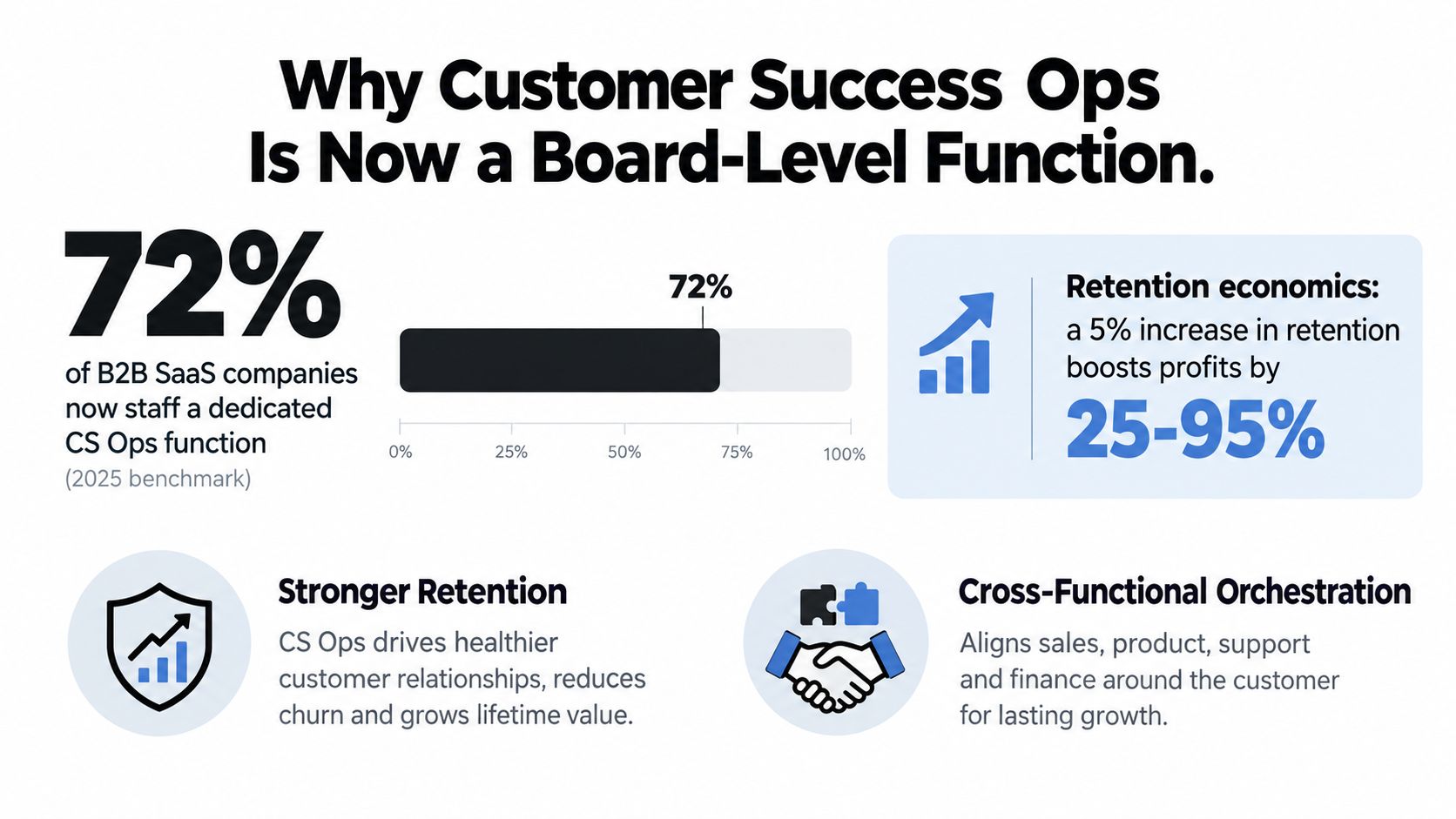
Dedicated CS Ops organizations rose from 20% of companies in 2022 to 41% in 2024, more than doubling in two years, according to Customer Success industry benchmarks. The shift reflects a change in how SaaS leaders manage recurring revenue. Retention, expansion, onboarding, support, and product adoption now depend on signals crossing systems and producing consistent decisions.
The board-level case rests on operating control. A CSM may spot risk in a conversation, yet the company still needs to combine that signal with product usage, support activity, contract terms, billing status, and executive engagement. CS Ops designs the rules, ownership, and workflows that turn those inputs into a renewal intervention, an expansion motion, or an automated task.
That work also exposes a real staffing trade-off. A small team can govern definitions, integrations, and decision rules, but it cannot manually inspect every account or maintain every workflow without clear priorities. The first KPI should therefore connect operational coverage to an outcome, such as renewal readiness, risk-response time, or expansion pipeline influenced. A dashboard without an assigned decision owner is reporting overhead.
What changes for leadership
Organizations with dedicated Customer Success teams were reported to see 89% higher retention, while teams reported reducing churn by 22% to 30% in the first year, according to Customer Success Collective's CS Ops coverage. Those figures do not prove that CS Ops alone creates the result. They explain why executives expect the function to connect process quality with revenue protection.
Leadership should judge CS Ops by the decisions it makes reliable: which accounts require attention, why they are at risk, what action comes next, and when an AI agent can execute safely. That requires ownership of health, adoption, renewal readiness, escalation, and expansion definitions, plus a cadence for reviewing exceptions.
Practical rule: If a dashboard does not trigger a named action, it is decoration, not an operating mechanism.
Teams redesigning the customer journey can consult this customer experience optimization guide alongside their operating model. The reporting line matters less than authority over data, workflows, cross-functional handoffs, and the KPI attached to each decision.
What Customer Success Ops Actually Does
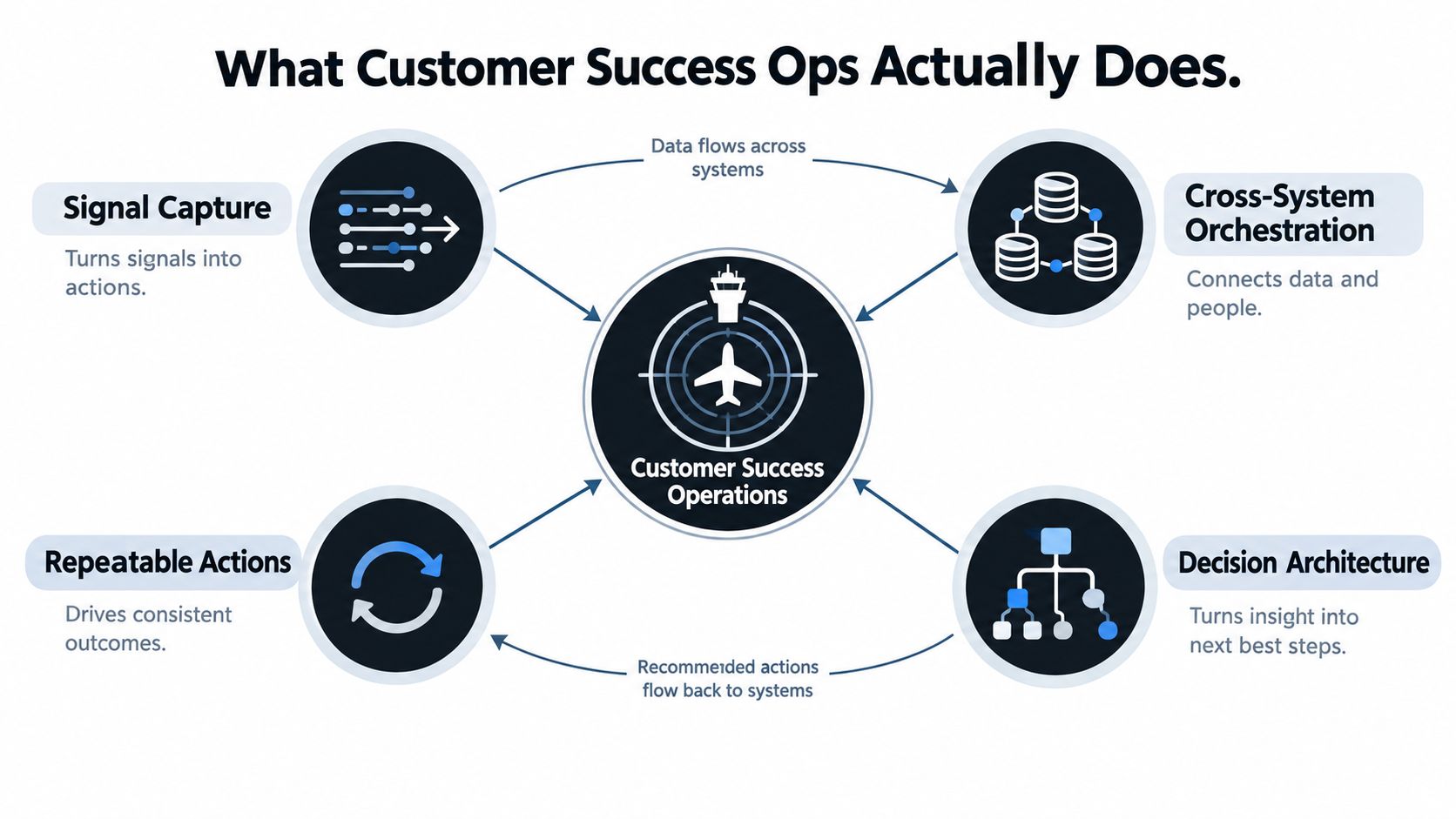
Customer Success Operations is the orchestration and decision-architecture layer between raw customer signals and personalized CSM action. Product analytics, billing, CRM, support, survey, and conversation data arrive in different shapes. CS Ops defines how those signals become a health state, a priority, a playbook, an alert, or an automated action.
The air traffic control analogy is useful. CSMs are the pilots. Customers and their journeys are the airspace. CS Ops runs the control room, coordinating routes, sequencing handoffs, managing exceptions, and preventing collisions between Sales, Support, Finance, Product, and Customer Success.
The actual boundary of the function
CS Ops starts where raw data meets the customer journey and stops when a CSM takes a personalized action. Everything in between belongs in its remit:
- Signal definition: Decide what counts as adoption, risk, engagement, escalation, or expansion intent.
- Segmentation logic: Determine which customers receive high-touch, low-touch, digital-led, or automated treatment.
- Routing: Send the right alert, task, or recommendation to the right owner.
- Workflow design: Build the playbook, timing, escalation path, and system updates.
- Quality assurance: Check whether the signal is accurate and whether the resulting action worked.
- Integration governance: Maintain the connections among CRM, CS platform, product analytics, support, billing, and data warehouse.
CS Ops isn't CSM management. It doesn't own the quality of every customer conversation, and it shouldn't become a layer of approval between CSMs and customers. It also isn't RevOps with a new label. RevOps may govern shared infrastructure across the go-to-market organization, while CS Ops owns the post-sale decision system, including health models, renewal workflows, success-plan structure, and CSM execution support.
The function also shouldn't become a reporting factory. A health score with no action path is incomplete. A renewal report that doesn't expose missing stakeholders, adoption gaps, or unresolved escalations is just a list.
Teams looking for practical ways to connect automation with retention can review reduce churn with AI tactics, especially when evaluating whether an AI workflow should advise a human or execute a bounded action.
The Core KPIs Every CS Ops Team Owns
CS Ops should separate board outcomes from weekly operating controls. The board needs a clear view of retained and expanded revenue. The CS Ops lead needs evidence that the systems, signals, and workflows are creating the conditions for those results.
GRR measures recurring revenue retained before expansion. NRR includes retention, contraction, and expansion, showing whether the installed base is shrinking, holding, or growing. A commonly cited Series B SaaS benchmark sets NRR at 115% or higher, GRR at 93% or higher, and top-quartile NRR at around 125%, according to the CS Ops dashboard benchmark. These belong in the executive view, but CS Ops still needs the operating controls that influence them.
Review leading indicators weekly:
- Time-to-first-value: Measure how quickly a customer reaches a meaningful outcome. The cited benchmark places TTFV at 12 days or less.
- Adoption quality: Track a Product Adoption Index or PQL-to-active conversion, defining active behavior around customer outcomes rather than logins.
- Health-score coverage: Measure the share of accounts with enough current data to produce a trustworthy score.
- Next-best-action coverage: Track accounts with a current recommendation, named owner, and due date. A health model is useful only when it routes work or informs an AI agent's bounded recommendation.
- Escalation rate: Monitor how often normal workflows need intervention. A rising rate usually signals weak routing, unclear ownership, or product friction.
- Renewal forecast accuracy: Set a target of being within 5% only after Finance, Sales, and CS agree on the definitions of committed, likely, and at-risk revenue.
Each KPI needs a decision and an owner. If adoption drops, specify whether the response is a CSM play, product intervention, support outreach, or automated task. If next-best-action coverage falls, inspect data freshness and routing before adding another dashboard. Staffing matters: a small CS Ops team can maintain a limited set of reliable controls, while broader orchestration requires data, systems, and workflow capacity.
Support efficiency belongs in the same operating view. First-response time, CSAT, first-contact resolution, and QBR completion should connect to defined journeys, not stand alone as activity counts. Customer success teams commonly track 11 core KPIs, including health score, NPS, qualitative feedback, churn, recurring revenue, lifetime value, retention cost, effort, first-contact resolution, CSAT, and renewal rate, as listed in HubSpot's customer success metrics guide.
| KPI | What It Measures | Target Benchmark |
|---|---|---|
| NRR | Retention plus expansion | 115% or higher for the cited Series B benchmark |
| GRR | Revenue retained before expansion | 93% or higher for the cited Series B benchmark |
| TTFV | Speed to meaningful value | 12 days or less for the cited Series B benchmark |
| FRT | Speed of first support response | Review by segment and risk |
| Escalation rate | Workflow or product friction | Downward trend with clear reason codes |
| QBR completion rate | Delivery of planned strategic reviews | Track against eligible accounts |
| Renewal forecast accuracy | Reliability of renewal prediction | Within 5% |
A useful customer health scoring framework can structure the signals, but the model is not the deliverable. Review five to seven controls weekly, investigate movement, and assign an action. Keep GRR, NRR, renewal rate, and expansion visible to executives. The board should see the outcome and its drivers, not every operational fluctuation.
Core Processes That Run Every Quarter
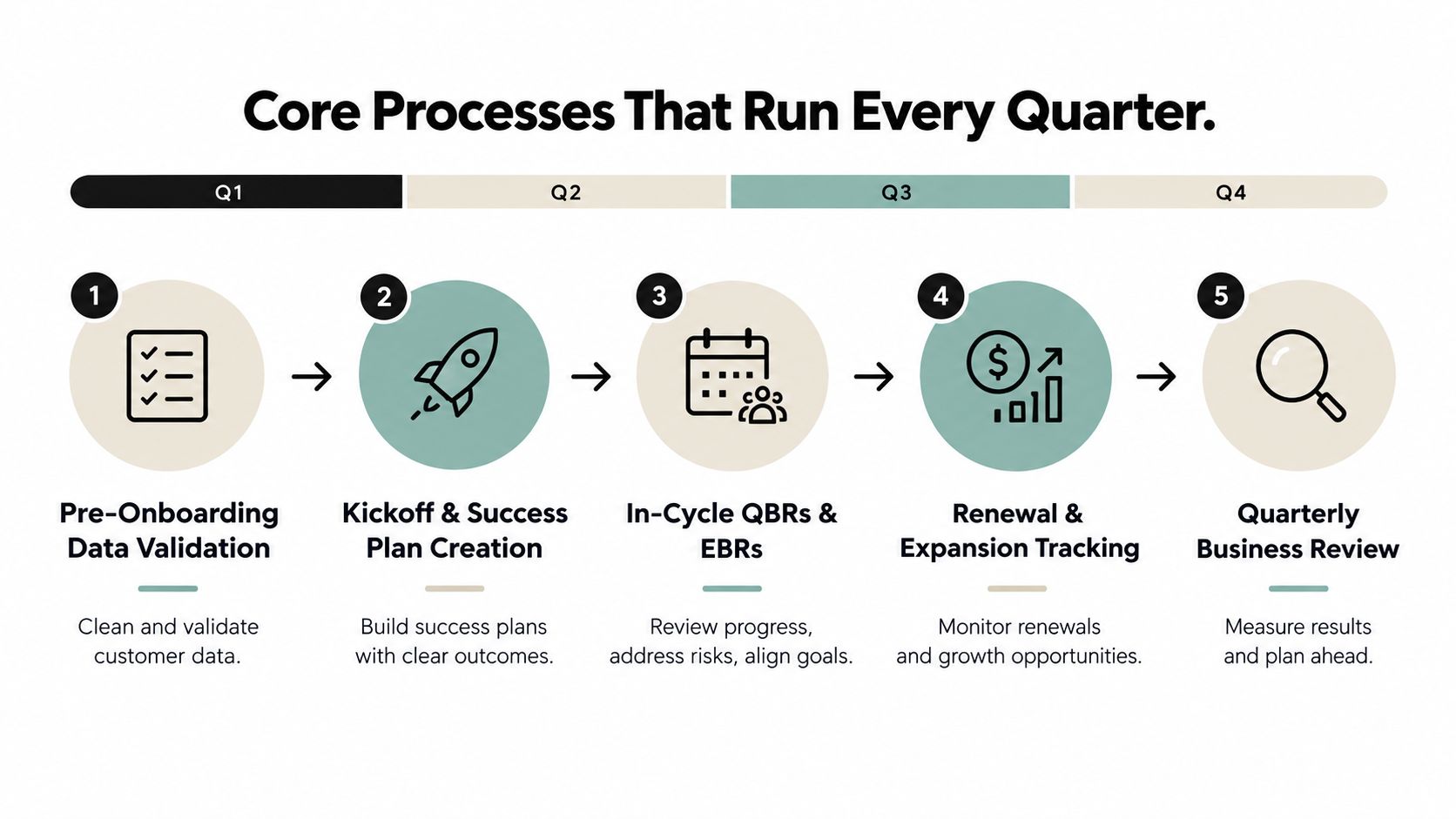
The quarter should run as a connected lifecycle, not as separate onboarding, QBR, renewal, and escalation projects. Each motion needs an input, an owner, a system of record, and a defined handoff into the next motion.
Start with clean inputs
Before onboarding begins, CS Ops validates the account hierarchy, contract details, renewal date, sold products, implementation commitments, primary users, and executive stakeholders. The CRM should be the commercial record, while the CS platform or warehouse can carry journey and usage context. The output is a customer record a CSM can trust.
Kickoff and success-plan creation then turn those inputs into shared outcomes. CS Ops owns the template, required fields, milestone logic, and reminder cadence. The CSM owns the customer conversation and the judgment behind the goals. The handoff occurs when the plan has named outcomes, owners, dates, and a measurable definition of value.
Keep the cycle active
During the quarter, QBRs and EBRs should draw from the same success plan and current usage evidence. CS Ops prepares the data pull, flags missing stakeholders, checks whether risks remain open, and records completion. The CSM leads the meeting. A completed review should produce updated priorities, not just a presentation archive.
Renewal tracking begins before the commercial deadline. Build the workflow backward from the renewal date, with checkpoints for adoption evidence, decision-maker alignment, open escalations, procurement requirements, and expansion eligibility. The exact customer-facing motion varies by segment, but the operational sequence should remain visible.
Expansion triggers should come from evidence such as broader team adoption, increased workflow depth, or interest in a capability that maps to a known customer goal. Route the signal to the CSM and account owner with context, not a vague “upsell opportunity” task.
Escalations complete the loop. Define severity, owner, response expectation, customer communication responsibility, and closure criteria. Support can own technical resolution, Product can own defect prioritization, and CS can own relationship management. CS Ops owns the routing rules and the audit trail.
The failure mode that derails most builds is treating each process as an independent play. Onboarding data should inform the success plan. The success plan should feed QBRs. QBR evidence should support renewal readiness and expansion decisions. Escalation outcomes should update health and future playbooks.
How to Structure the CS Ops Team at Each Stage
Org design should follow operational complexity, not the ambition of a software vendor's org chart. A small team usually needs someone who can instrument the basics and stay close to CSM behavior. A larger team needs specialization because data engineering, systems administration, analytics, and automation compete for attention.
| Stage | Headcount | Owns | Common Mistake |
|---|---|---|---|
| Under 20 CSMs | One embedded analyst or CS Ops generalist reporting to the VP CS | Definitions, basic reporting, lifecycle workflows, data hygiene | Hiring for dashboards before agreeing on the data model |
| 40 to 80 CSMs | 2 to 4 CS Ops FTEs with a lead | Analytics, systems, enablement, renewal operations, workflow governance | Splitting ownership without a single decision-maker |
| 100 or more CSMs | Manager plus analysts, data engineers, and an AI or automation specialist | Operating model, data layer, forecasting, automation governance, cross-functional architecture | Building specialist teams that don't share a common account model |
The embedded model is fast and practical. It works when the main problem is inconsistent execution, missing renewal fields, spreadsheet dependence, or weak onboarding cadence. Its trade-off is limited capacity. One person can't simultaneously rebuild the warehouse, administer a CS platform, and design advanced AI workflows.
The dedicated pod adds value. A lead can set priorities while an analyst owns reporting and a systems or automation specialist maintains workflows. The cost is coordination. Without clear decision rights, the pod becomes a ticket queue for CSM requests.
The full function earns its complexity when multiple segments, products, geographies, or revenue motions create competing data and workflow needs. It can support governance and experimentation, but it also creates a risk of over-specialization.
Staffing reality check: Keep CS Ops to roughly 10% to 12% of total CS headcount until the company passes 200 customers. Those thresholds are operating heuristics, not universal laws, so adjust for implementation complexity and data maturity.
The most common copy-paste mistake is importing a large vendor-recommended org chart into a 15-person CS organization. Start with the constraint that is blocking retention or execution today. Add capacity when a measurable bottleneck persists, not when a category on the tech roadmap looks unfinished.
The CS Ops Tech Stack and Data Layer
A useful stack has three concentric layers. The system-of-record layer contains the CRM, CS platform, billing system, product analytics, and support platform. The integration fabric moves data through a warehouse, reverse ETL, identity resolution, and event pipelines. The decision layer contains workflows, alerts, playbooks, AI agents, and human approvals.
Don't begin with a vendor comparison. Begin with the five data relationships that make decisions possible:
- Account-product mapping: Know which products, workspaces, environments, and users belong to each commercial account.
- Contract and renewal dates: Preserve start dates, end dates, term details, owners, and renewal status in a governed location.
- Ticket and sentiment signals: Connect support volume, topic, severity, sentiment, and unresolved issues to the correct account.
- Executive sponsor tracking: Record the sponsor, champion, economic buyer, last meaningful interaction, and relationship status.
- Expansion eligibility flags: Identify evidence-based opportunities without confusing product usage with purchase intent.
The warehouse should become the spine because it gives you a place to reconcile conflicting systems, preserve history, and calculate metrics consistently. A no-code workflow is fine for a straightforward notification or task assignment. Engineering becomes necessary when identity resolution, account hierarchies, event quality, historical backfills, permissions, or write-back reliability matter.
Fix the model before the workflow
Account hierarchy is usually the first hard decision. Define the relationship among parent company, business unit, workspace, contract, and end user before creating more custom objects in Salesforce. Custom-object sprawl makes reporting harder when teams use different objects for the same customer concept.
Treat the CS platform as an execution surface, not the canonical home for every raw signal. Put durable definitions in the warehouse or governed data model, then send the fields and events each workflow needs to the systems where people work.
A knowledge base also needs durable context. Teams designing retrieval and memory patterns can consult this resource on canonical memory for knowledge bases. For the broader integration architecture, customer data integration guidance is relevant when product, CRM, support, and billing records need to resolve to one account identity.
Where AI and Autonomous Agents Fit In
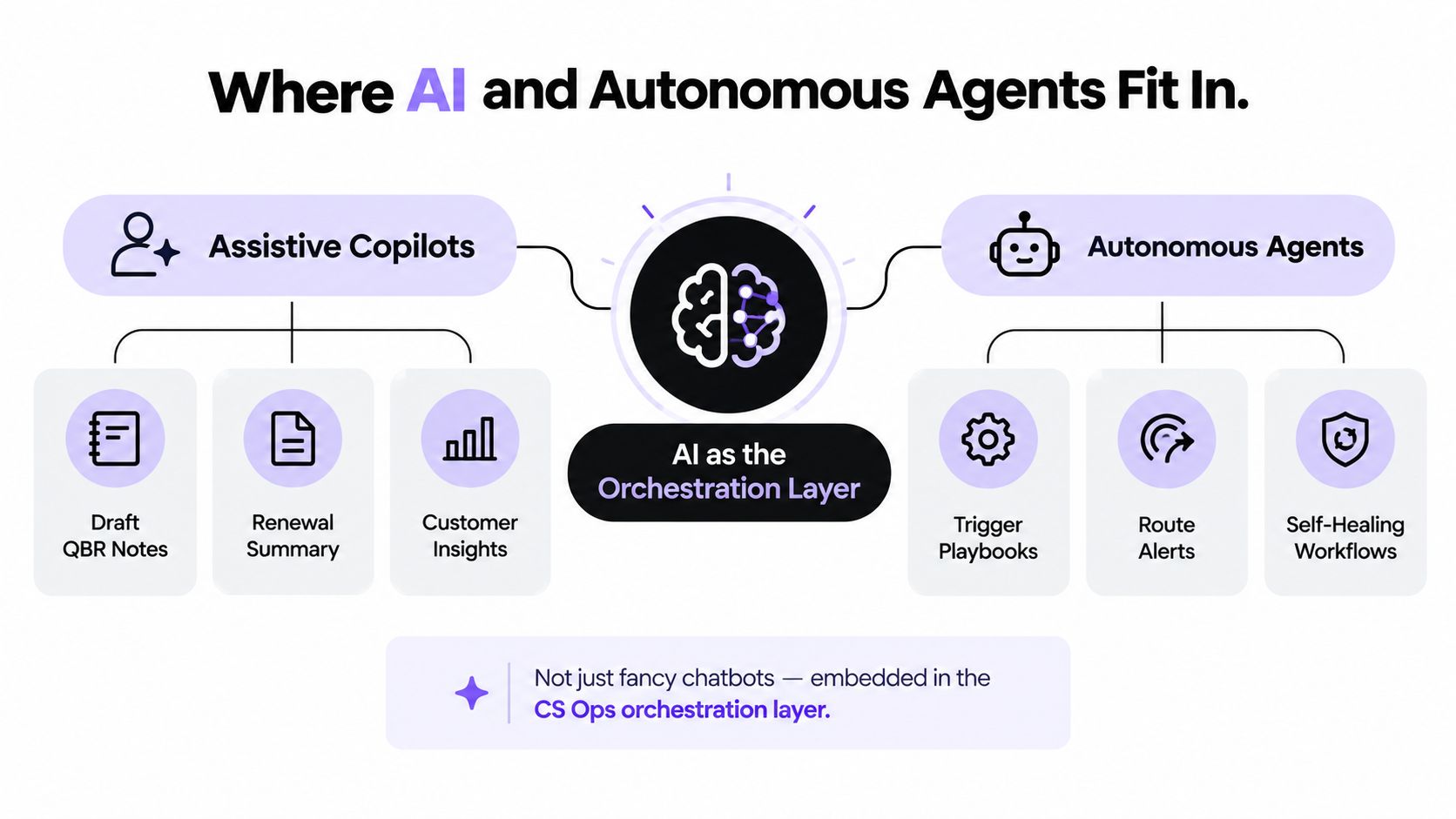
AI should sit inside the CS Ops orchestration layer, not beside it as a chatbot bolted onto a help center. An assistive copilot drafts QBR notes, summarizes renewal history, or prepares a stakeholder brief. An autonomous agent watches signals, selects an approved action, executes it in a system, and records the result within defined guardrails.
That distinction matters because the operational benchmark is moving beyond deflection. Mature AI deployments have been reported to resolve roughly 60% to 76% of conversations without human intervention, while well-instrumented transactional queues can reach the mid-80% range, according to AI customer support benchmark summaries. The same benchmark set reports a median first response time of 8 seconds, compared with a human baseline of 2.4 minutes, and average handle time of 3.2 minutes compared with 8.7 minutes for humans.
Match the agent to a KPI
A signal-watching agent can detect declining adoption, unresolved support friction, or stakeholder disengagement and create an intervention task. Its KPI is not the number of alerts. Measure whether earlier action improves risk coverage and supports NRR.
A triage agent can classify incoming requests, identify account context, apply urgency rules, and route the case. Measure FRT, escalation rate, repeat contacts, and resolution quality. Full resolution still takes longer than first response. Blended average resolution has been reported near 3 to 4 days, while top-quartile teams close in under a day, according to support benchmark reporting.
A renewal-preparation agent can assemble usage evidence, open risks, stakeholder history, contract context, and unresolved issues. Measure forecast accuracy and preparation time, not the volume of summaries generated.
Context preservation is the differentiator. AI escalation handoffs have reached 78% median context preservation and 94% at the top quartile in the cited benchmark set, which shows why an agent should pass evidence and prior actions to a human instead of merely announcing that escalation is required.
Before an agent gets write access, require a stable account hierarchy, a consistent product-event taxonomy, permission rules, a written runbook, human approval points, and a kill switch. The staffing question is more important than the license question. Budget for AI Ops capability, including someone who can test prompts, inspect failures, govern actions, and improve data quality.
For a deeper conceptual view, Contesimal's explanation of agentic orchestration is useful when separating agents that recommend from agents that act. Teams building a predictive signal layer can also reference predictive customer analytics.
The practical rule is to start with one narrow workflow where the input is observable, the action is reversible, and the KPI is already measured. Don't automate an ambiguous judgment because the workflow appears repetitive.
Your 90-Day Roadmap to Build or Scale CS Ops
A 90-day build should produce operating efficiency, not a new collection of reports. Sequence the work so the data model comes before automation and the manual process comes before autonomous execution.
Days 1 to 30 build the instrumentation
Lock the account hierarchy first. Define how parent accounts, subsidiaries, workspaces, contracts, users, and products relate. Then document the product-event taxonomy, including which actions represent activation, meaningful adoption, stalled usage, and expansion evidence.
Stand up the core KPIs in one source of truth. Start with NRR, GRR, TTFV, health coverage, next-best-action coverage, escalation rate, FRT, and renewal forecast accuracy. Audit every spreadsheet used by CSMs, managers, Finance, Sales, or Support, then decide which fields should be migrated, retired, or governed.
The failure mode is buying a CS platform before the model is stable. Software can expose bad data faster, but it can't decide what an account means or which event represents value.
Days 31 to 60 establish the cadence
Run a weekly health review, a monthly renewal pipeline review, and a quarterly QBR review. Give each meeting a fixed input, decision owner, and follow-up record. Choose one leading-indicator play, such as a meaningful adoption drop or unresolved high-severity issue, and run it manually from detection through resolution.
Don't automate a process the team hasn't completed end to end. Manual execution reveals missing fields, ambiguous ownership, and customer exceptions that a workflow diagram usually hides.
Teams improving onboarding can pair this work with user onboarding automation, but the automation should follow a documented journey with explicit milestones and handoffs.
Days 61 to 90 deploy narrowly
Deploy the first agent with a narrow scope, read-only access where possible, explicit approval rules, and a kill switch. Compare its output with the manual baseline. Review false positives, missed context, bad routing, and actions that created extra work.
Write the CS Ops charter before day 90 ends. It should state what the function owns, what it influences, which systems it governs, how priorities are chosen, and which KPIs determine success.
By day 90, name one KPI you moved, one process you retired, and one agent in production. If you can't, the function is still a reporting team.
Halo AI gives CS Ops teams an AI-first layer for resolving support tickets, guiding users through products, creating detailed bug reports, and querying CRM, billing, call, ticket, and product context. Visit Halo AI to evaluate how autonomous support and cross-system customer intelligence could fit into your retention and orchestration model.