9 Best Enterprise AI Support Platforms and What They Actually Cost in 2026
Enterprise AI support pricing lacks transparency, making it difficult to compare platforms without extensive vendor negotiations. This guide breaks down the actual costs, pricing models, and scalability of nine leading enterprise AI support platforms to help organizations make informed decisions and avoid overpaying as support volume grows.
 Matt PattoliFounder13 min read
Enterprise AI support pricing is notoriously opaque. Most vendors hide behind "contact sales" buttons, making it nearly impossible to compare options without sitting through a dozen demos. Whether you're evaluating your first AI support deployment or looking to replace a legacy system that's straining your budget, understanding the real cost landscape is critical.
Pricing models vary wildly across the market. You'll encounter per-resolution structures, per-ticket charges, seat-based licensing, flat-rate plans, and hybrid combinations of all of the above. The wrong choice can mean overpaying significantly year over year, especially as your support volume scales.
We evaluated nine leading enterprise AI support platforms based on pricing transparency, cost structure, scalability, feature depth, and total cost of ownership. Here's what each platform actually charges, how their pricing scales, and which model fits different enterprise needs.
1. Halo AI
Best for: B2B SaaS teams wanting AI-native support with business intelligence built in
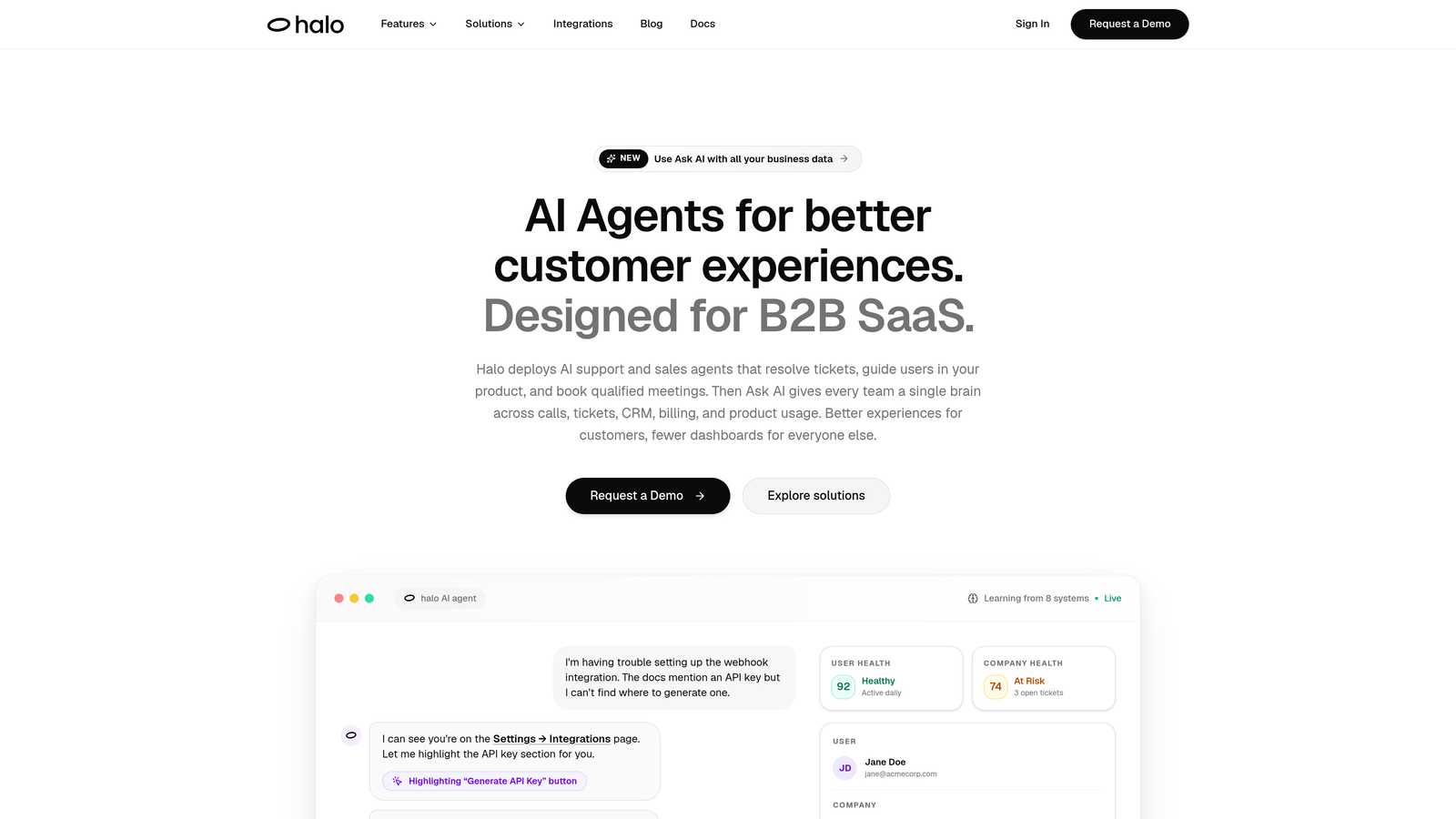
Halo AI is an AI-native customer support platform built from the ground up for intelligent, autonomous support rather than bolting AI features onto a legacy helpdesk.
Where This Tool Shines
What separates Halo from most platforms on this list is its architecture. Rather than layering AI on top of a ticketing system designed in a different era, Halo was built AI-first. That distinction matters for enterprise buyers because it means the intelligence runs deeper: agents learn continuously from every interaction rather than relying on static decision trees.
The page-aware chat widget is a genuinely differentiated feature. It sees what the user sees in your product, enabling contextual guidance that generic chatbots simply cannot provide. Combine that with the smart inbox's business intelligence capabilities, including customer health signals and anomaly detection, and Halo starts functioning less like a support tool and more like an operational intelligence layer.
Key Features
Autonomous AI Agents: Resolve tickets end-to-end and learn from every interaction to improve over time.
Page-Aware Chat Widget: Understands which product page a user is on and delivers contextual, visual guidance accordingly.
Smart Inbox with Business Intelligence: Surfaces customer health signals, revenue intelligence, and anomaly detection beyond standard support metrics.
Auto Bug Ticket Creation: Automatically generates bug reports and routes them to the right team when issues are detected.
Live Agent Handoff: Escalates complex issues to human agents with full conversation context preserved.
Deep Integrations: Connects with Linear, Slack, HubSpot, Intercom, Stripe, Zoom, PandaDoc, and Fathom across the business stack.
Best For
B2B SaaS companies and product teams that want AI support to do more than deflect tickets. If you need support tooling that also surfaces customer health signals, feeds bug reports into engineering workflows, and connects across your entire business stack, Halo is built for that use case.
Pricing
Halo offers transparent tiered pricing designed to scale without per-ticket cost surprises. Visit haloagents.ai/pricing for current plan details.
2. Zendesk AI (Advanced AI Add-on)
Best for: Enterprises already invested in the Zendesk ecosystem
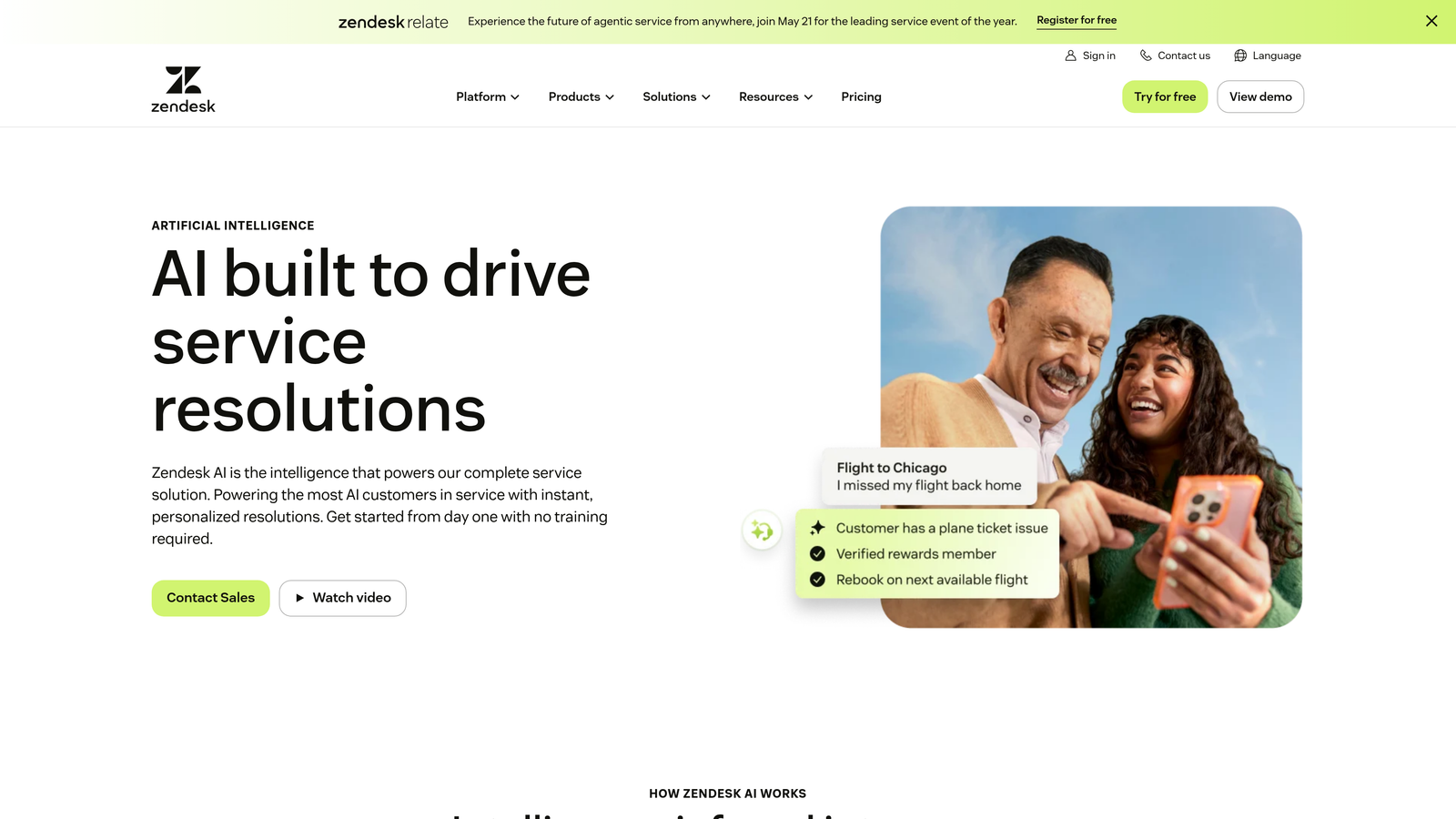
Zendesk AI is a set of AI capabilities layered on top of Zendesk Suite, including autonomous AI agents, intelligent triage, and an agent copilot for human-assisted workflows.
Where This Tool Shines
If your team is already running on Zendesk Suite, the AI add-on is the path of least resistance to adding automation. The ecosystem integration is genuinely strong: AI agents pull from your existing knowledge base, triage connects to your existing routing rules, and the agent copilot works inside the familiar Zendesk interface your team already knows.
The content gap identification feature is particularly useful for knowledge-driven support operations. It surfaces where your documentation is failing customers, which helps reduce resolution costs over time by fixing root causes rather than just deflecting symptoms.
Key Features
AI Agents: Autonomously resolve tickets across channels using your existing knowledge base.
Intelligent Triage: Automatically classifies, prioritizes, and routes incoming tickets.
Agent Copilot: Provides AI-generated response suggestions to human agents in real time.
Content Gap Identification: Flags knowledge base gaps where AI agents are failing to resolve queries.
Native Suite Integration: Works directly within existing Zendesk workflows without additional configuration overhead.
Best For
Organizations already on Zendesk Suite that want to add AI capabilities without migrating platforms. Less compelling as a greenfield choice when AI-native alternatives exist.
Pricing
Suite plans are priced per agent per month. AI agents are charged per automated resolution on top of base Suite pricing. Enterprise agreements are available and typically negotiated directly with Zendesk. Check zendesk.com for current rates.
3. Intercom Fin
Best for: Teams that want transparent, outcome-based pricing tied directly to AI resolutions
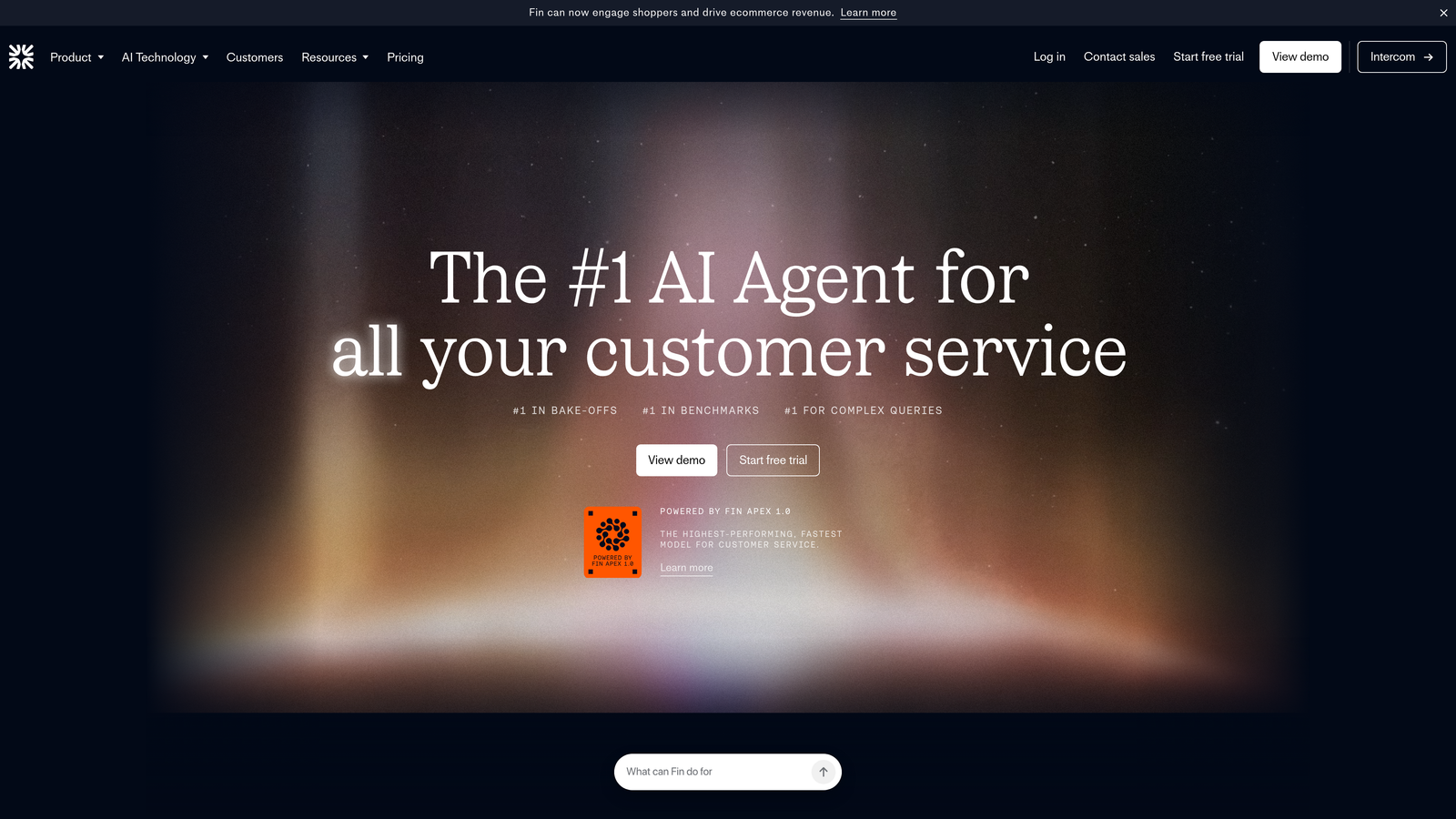
Intercom Fin is an AI support agent built into the Intercom platform that resolves customer questions autonomously using your help center content and custom knowledge sources.
Where This Tool Shines
Fin's biggest differentiator in the enterprise market is pricing transparency. While most vendors on this list require a sales call to get numbers, Intercom publishes a per-resolution rate publicly. That makes budget forecasting significantly easier, especially for teams with predictable support volumes.
The quality of handoffs is also worth noting. When Fin cannot resolve a query, it passes the full conversation context to a human agent, reducing the frustrating experience of customers having to repeat themselves. For teams prioritizing customer experience continuity, that matters.
Key Features
Autonomous AI Agent: Resolves customer queries from help center content and custom knowledge sources without human involvement.
Per-Resolution Pricing: Charges only for successful resolutions, aligning cost directly with value delivered.
Multilingual Support: Handles conversations across multiple languages and channels.
Tone and Behavior Controls: Customizable AI personality and escalation thresholds to match your brand.
Contextual Handoff: Transfers full conversation history to human agents when escalation is needed.
Best For
Teams already using Intercom for customer communications, or those who want outcome-based pricing they can model in a spreadsheet before committing. Less suitable if you need deep integrations outside the Intercom ecosystem.
Pricing
Base Intercom platform pricing is per seat per month. Fin AI resolutions are charged additionally per resolution (published as $0.99 per resolution at time of writing, though you should verify current rates at intercom.com/pricing).
4. Ada
Best for: Large enterprises needing omnichannel AI agents with measurable resolution metrics
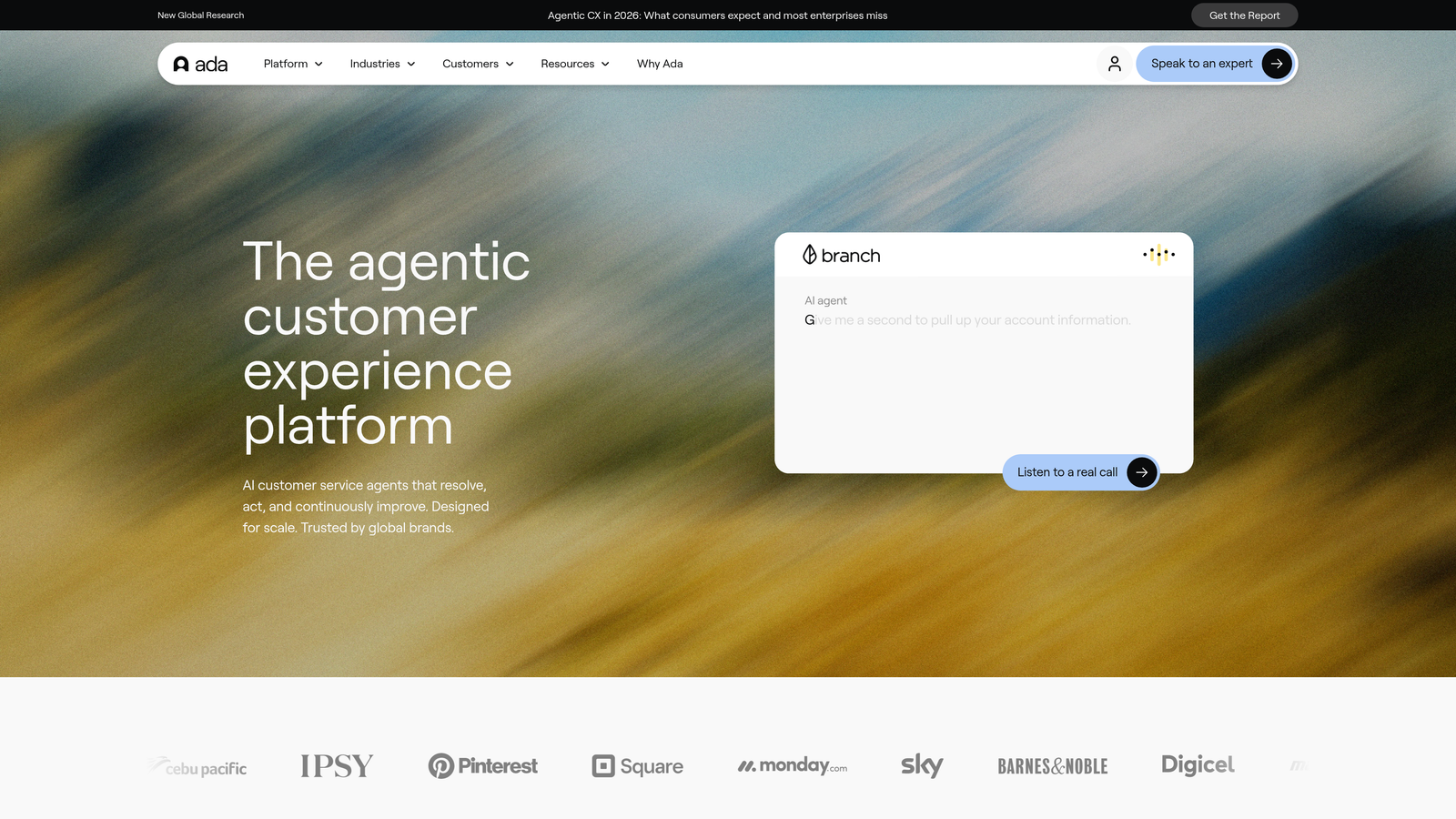
Ada is an enterprise AI agent platform designed for large-scale automated support across chat, email, voice, and social channels, with a focus on measurable automated resolution rates.
Where This Tool Shines
Ada's strength is breadth of channel coverage. Most AI support tools handle chat well but struggle with voice and social. Ada's omnichannel approach means a single AI agent configuration can handle customer interactions across chat, SMS, email, voice, and social simultaneously, which reduces the operational complexity of managing separate tools per channel.
The AI coaching engine is a meaningful differentiator for teams focused on continuous improvement. Rather than requiring manual retraining, the system identifies where AI agents are underperforming and suggests improvements, which compounds over time into measurably better resolution rates.
Key Features
Omnichannel AI Agents: Covers chat, email, SMS, voice, and social from a single platform configuration.
Automated Resolution Measurement: Built-in analytics track resolution rates to demonstrate ROI.
Multilingual Support: Handles conversations in 50+ languages out of the box.
AI Coaching Engine: Continuously identifies improvement opportunities and refines agent behavior.
Enterprise Security and Compliance: Meets enterprise-grade security requirements including SOC 2 and data residency options.
Best For
Enterprise contact centers with high volumes across multiple channels, particularly those needing voice AI alongside chat. Not the right fit for teams wanting self-serve setup or transparent public pricing.
Pricing
Custom enterprise pricing based on resolution volume and channel configuration. No public pricing page. Budget accordingly for a sales consultation process before getting numbers.
5. Freshdesk Freddy AI
Best for: Teams wanting competitive entry-level pricing with a path to AI automation
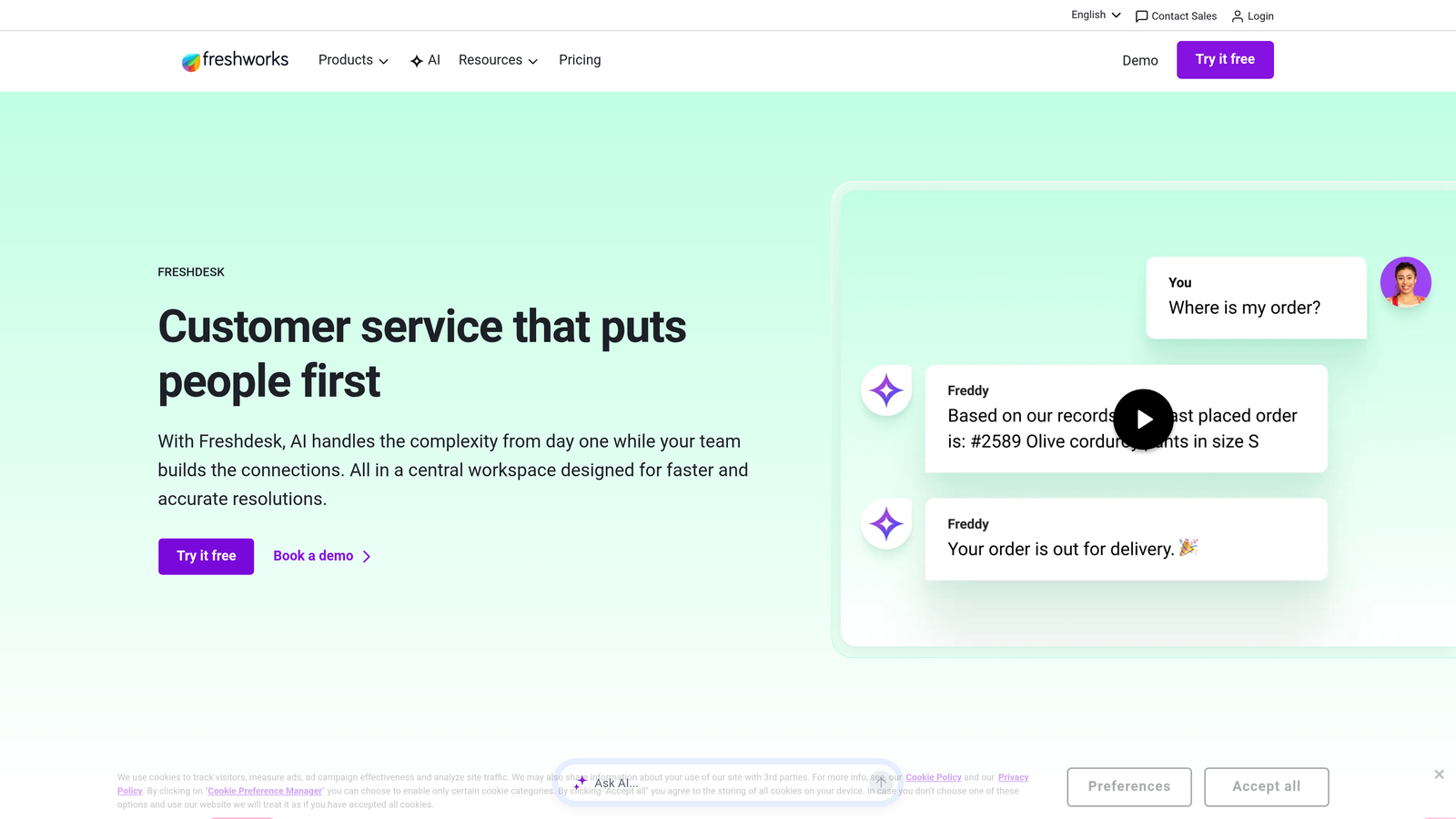
Freshdesk Freddy AI delivers AI-powered support capabilities built into the Freshworks helpdesk platform, with both agent assist and autonomous resolution features available across pricing tiers.
Where This Tool Shines
Freshdesk's free tier is a genuine differentiator in the enterprise comparison context. For teams evaluating AI support for the first time, being able to start with a functioning helpdesk at no cost and upgrade into AI features as confidence grows is a lower-risk path than committing to a large enterprise contract upfront.
Freddy AI covers both sides of the support equation: Freddy Copilot assists human agents with response suggestions and summaries, while Freddy Agent handles customer-facing autonomous resolution. Having both capabilities in one platform at accessible price points makes Freshdesk a strong option for mid-market teams with enterprise ambitions.
Key Features
Freddy AI Copilot: Provides real-time response suggestions, ticket summaries, and next-step recommendations to human agents.
Freddy AI Agent: Autonomously resolves customer-facing queries without agent involvement.
Free Tier: Basic helpdesk functionality available at no cost, with AI features in higher tiers.
Built-in Ticketing and Knowledge Base: Full helpdesk infrastructure included without additional licensing.
Marketplace Integrations: Extensive app marketplace for extending functionality across business tools.
Best For
Growing teams that want to start lean and scale into AI automation, or mid-market companies looking for competitive pricing without sacrificing core helpdesk functionality.
Pricing
Free tier available. Paid plans start at competitive per-agent per-month rates with AI features bundled into higher tiers. Check freshworks.com for current pricing details.
6. Salesforce Einstein for Service
Best for: Enterprises running their entire customer lifecycle on the Salesforce platform
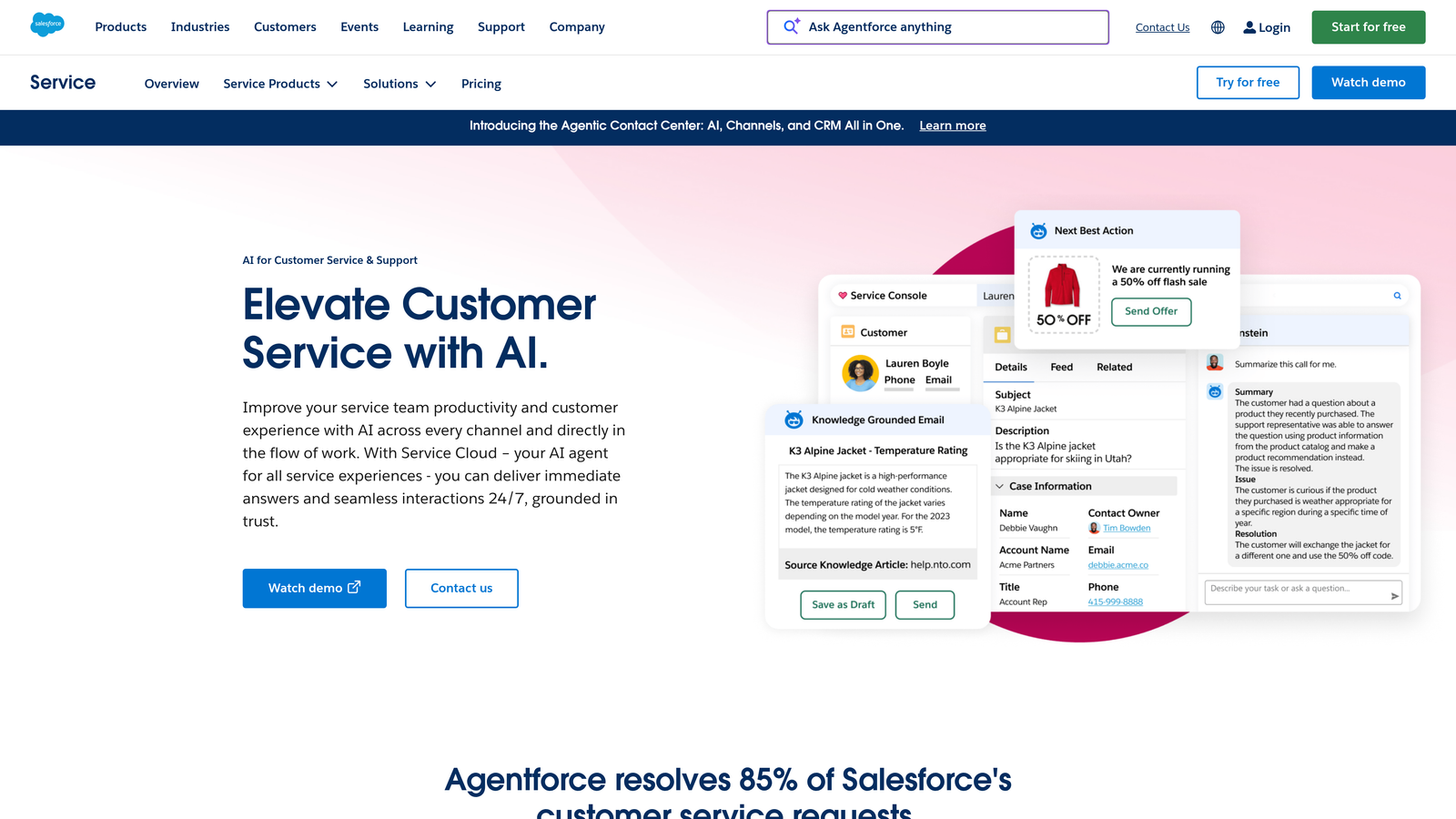
Salesforce Einstein for Service brings AI-powered service automation into Service Cloud, leveraging the full depth of Salesforce CRM data to deliver contextual AI agent responses and agent assist capabilities.
Where This Tool Shines
The CRM context advantage is real. When an AI agent has access to a customer's full history across sales, marketing, and service touchpoints, the quality of responses and routing decisions improves meaningfully. For enterprises where support is tightly connected to account management and renewal workflows, that unified data layer is difficult to replicate outside the Salesforce ecosystem.
Agentforce, Salesforce's autonomous AI agent offering, extends this further by enabling AI agents to take actions within Salesforce workflows, not just answer questions. That capability is particularly valuable for complex service scenarios involving order management, case escalation, or account updates.
Key Features
Full CRM Context: AI agents draw on sales, marketing, and service data for contextually informed responses.
Agentforce Autonomous Agents: AI agents that take actions within Salesforce workflows, not just answer questions.
Case Classification and Routing: Automatically categorizes and routes incoming cases based on content and priority.
Knowledge Article Recommendations: Surfaces relevant knowledge articles to agents during live interactions.
Salesforce Ecosystem Integration: Deep connectivity with Sales Cloud, Marketing Cloud, and the broader platform.
Best For
Large enterprises already running on Salesforce where support is deeply connected to CRM workflows. The value proposition weakens significantly if you're not already a Salesforce customer.
Pricing
Service Cloud is licensed per user per month. Einstein AI capabilities are available as add-ons. Agentforce is charged per conversation. Enterprise agreements vary considerably. Contact Salesforce directly for quotes.
7. Forethought
Best for: Enterprises wanting AI capabilities on top of existing helpdesks without a platform migration
Forethought is an AI support layer that sits on top of existing helpdesk platforms like Zendesk and Salesforce, providing triage, autonomous resolution, and agent assist capabilities without requiring teams to change their core tooling.
Where This Tool Shines
Forethought's positioning is clever for enterprises that have significant investment in existing helpdesk infrastructure. Rather than asking you to migrate, it adds an AI intelligence layer on top of what you already have. For organizations where a platform migration would involve months of change management, that's a meaningful value proposition.
The modular structure, with separate Triage, Solve, Assist, and Discover modules, also allows enterprises to adopt AI incrementally. You can start with triage and agent assist before committing to autonomous resolution, which reduces organizational risk during rollout.
Key Features
Helpdesk-Agnostic Layer: Works on top of Zendesk, Salesforce Service Cloud, and other major platforms.
Triage Module: Intelligent ticket classification and routing based on content and intent.
Solve Module: Autonomous customer-facing resolution for deflecting tickets before agent involvement.
Assist Module: AI-powered response suggestions and knowledge surfacing for human agents.
Discover Module: Identifies workflow inefficiencies and knowledge gaps to improve resolution rates over time.
Best For
Enterprises with established Zendesk or Salesforce deployments that want AI capabilities without a rip-and-replace migration. Less compelling for greenfield deployments where an AI-native platform would serve better.
Pricing
Custom pricing based on ticket volume and selected modules. No public pricing. Expect a demo and sales conversation before receiving a quote.
8. Tidio Lyro AI
Best for: Smaller teams and e-commerce businesses wanting quick AI deployment with accessible pricing
Tidio Lyro AI is an accessible AI chatbot solution with transparent per-conversation pricing, designed for quick deployment without engineering resources.
Where This Tool Shines
Tidio's setup speed is genuinely impressive compared to enterprise-tier alternatives. Where many platforms on this list require weeks of implementation, knowledge base preparation, and integration work, Lyro can be deployed quickly without developer involvement. For teams that need AI support running fast, that time-to-value advantage is significant.
The e-commerce integrations, particularly with Shopify, also make Tidio a natural fit for direct-to-consumer brands where order status, returns, and product questions dominate support volume. It's less suited to complex B2B SaaS support scenarios but excels in its target market.
Key Features
Lyro AI Chatbot: Natural language understanding for autonomous customer query resolution.
No-Code Setup: Deploy without engineering or developer resources involved.
Bundled AI Conversations: Transparent pricing with AI conversations included in plan tiers.
Live Chat Included: Full live chat and basic helpdesk features bundled into the platform.
E-Commerce Integrations: Native Shopify integration and connections to other e-commerce platforms.
Best For
Small-to-mid-market e-commerce and direct-to-consumer teams that need fast deployment and accessible pricing. Not designed for complex enterprise support workflows or deep B2B integrations.
Pricing
Free tier available with limited Lyro AI conversations. Paid plans include bundled AI conversation volumes at accessible monthly rates. Check tidio.com for current pricing tiers.
9. Cognigy
Best for: Large contact centers needing voice AI alongside chat with complex workflow automation
Cognigy is an enterprise conversational AI platform supporting both voice and chat AI agents, built for large contact center operations with sophisticated workflow automation requirements.
Where This Tool Shines
Cognigy is the most contact-center-native platform on this list. If your support operation runs through Genesys, NICE, or Avaya and you need voice AI agents handling inbound calls alongside chat, Cognigy's integration depth with these platforms is difficult to match. Most AI support tools treat voice as an afterthought; Cognigy treats it as a primary channel.
The on-premise deployment option is also notable for regulated industries. Financial services, healthcare, and government organizations that cannot route customer data through cloud-only infrastructure have very few enterprise AI support options. Cognigy's ability to deploy on-premise addresses that requirement directly.
Key Features
Voice AI Agents: Full voice channel support alongside chat for complete contact center coverage.
Low-Code Flow Builder: Visual conversation design tools for building complex, branching AI workflows.
On-Premise Deployment: Available for regulated industries requiring data sovereignty or private infrastructure.
Contact Center Platform Integrations: Deep integrations with Genesys, NICE, Avaya, and other CCaaS platforms.
Advanced Conversation Analytics: Detailed conversation intelligence and performance reporting.
Best For
Large enterprise contact centers with significant voice volume, complex workflow requirements, or regulated industry data requirements. Overkill for standard SaaS support teams without voice channel needs.
Pricing
Custom enterprise pricing based on session volume and deployment complexity. Requires direct sales engagement for quotes. Budget for a longer procurement cycle than most tools on this list.
Picking the Right Pricing Model for Your Team
The shift toward outcome-based pricing is the defining trend in enterprise AI support right now. Buyers increasingly want to pay for resolutions, not seats, because it aligns vendor incentives with actual value delivered. Per-resolution models like Intercom Fin's published pricing make that math transparent. Custom enterprise pricing from Ada, Forethought, and Cognigy requires more work upfront but often yields better unit economics at scale.
A few standouts depending on your situation. If you're an enterprise Zendesk shop and migration isn't on the table, the Zendesk AI add-on is the lowest-friction path forward. If you're running a large contact center with voice requirements, Cognigy is in a category of its own. If you want AI support that goes beyond deflection and into business intelligence, customer health signals, and cross-functional integrations, Halo AI is built specifically for that use case.
One cost consideration that doesn't appear on any pricing page: total cost of ownership. Implementation, knowledge base preparation, ongoing optimization, and integration development add real cost to any platform. Platforms that require less professional services to get running, and that learn continuously without manual retraining cycles, tend to deliver better economics over a two-to-three year horizon.
Also worth modeling: overage costs. Per-resolution pricing is elegant until your volume spikes unexpectedly. Understand your support volume patterns before committing to a model that charges per outcome.
Your support team shouldn't scale linearly with your customer base. AI agents that handle routine tickets, guide users through your product, and surface business intelligence let your team focus on the complex issues that actually need human judgment. See Halo in action and discover how continuous learning transforms every interaction into smarter, faster support.