9 Best Enterprise Support Automation Platforms in 2026
Enterprise support automation platforms have evolved far beyond rule-based chatbots — in 2026, the best solutions autonomously resolve tickets, route complex issues intelligently, and deliver actionable business intelligence. This guide ranks the top nine platforms for enterprise B2B teams, evaluated on AI capability, integration depth, and the ability to scale without burning out your support staff.
 Matt PattoliFounder14 min read
Enterprise support teams face a compounding problem: ticket volumes scale with growth, but headcount can't keep pace. The result is slower response times, agent burnout, and customers who churn before they ever reach a human.
Enterprise support automation platforms solve this by handling routine tickets autonomously, routing complex issues intelligently, and surfacing business intelligence that goes far beyond a resolved ticket count. The shift from rule-based chatbots to genuinely intelligent AI agents has accelerated significantly, and the key differentiator in 2026 is no longer "do you have AI?" but "how deeply is AI embedded in your resolution workflow?"
This list covers the top platforms best suited for enterprise B2B teams in 2026, evaluated on AI capability, integration depth, scalability, and the ability to handle real-world complexity. Whether you're running a lean support team at a fast-scaling SaaS company or managing a multi-tier support operation across regions, there's a platform here built for your context.
1. Halo AI
Best for: AI-first B2B SaaS teams that need autonomous resolution, product guidance, and business intelligence in one platform.
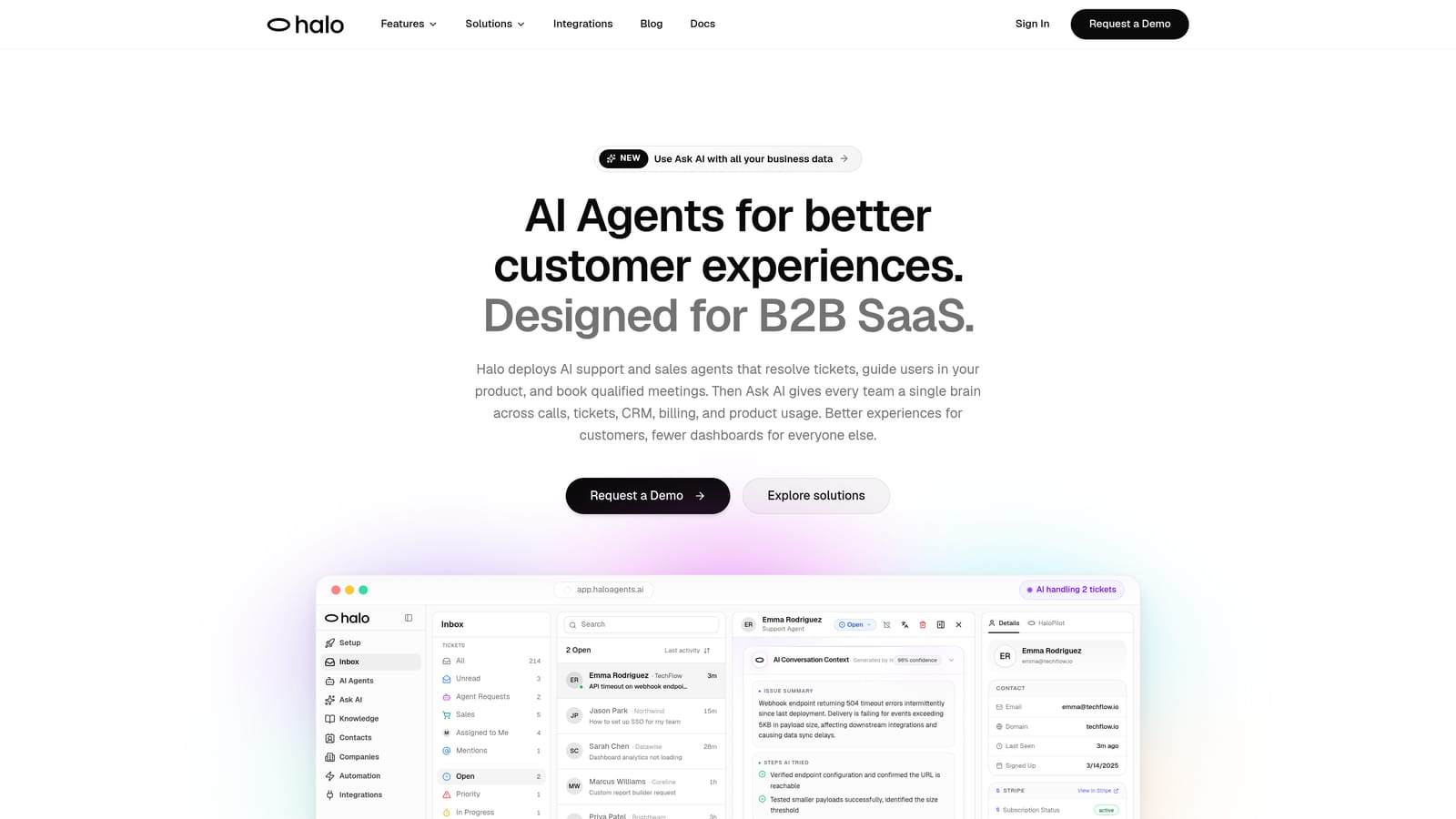
Halo AI is an AI-first customer support platform purpose-built for B2B SaaS teams that need more than ticket deflection.
Where This Tool Shines
Most support platforms bolt AI onto an existing ticketing architecture. Halo was built AI-first, which means the intelligence isn't a layer on top — it's the foundation. Every ticket resolved, every conversation handled, every user guided through a product feature feeds back into the system to make the next interaction smarter.
The standout capability is Halo's page-aware chat widget. The AI sees exactly what the user sees on screen, which means it can offer contextual, visual guidance rather than generic knowledge base responses. For SaaS products with complex interfaces, this is a meaningful difference in resolution quality.
Key Features
Page-Aware Chat Widget: The AI understands the user's current screen context, enabling precise, step-by-step product guidance without requiring users to describe where they are.
Autonomous Ticket Resolution: AI agents handle routine tickets end-to-end with continuous learning — each resolved interaction improves future performance.
Auto Bug Ticket Creation: Support conversations that surface product issues automatically generate bug tickets routed to Linear or your preferred issue tracker.
Smart Inbox with Business Intelligence: The inbox surfaces customer health signals, churn risk indicators, and revenue anomalies — turning support data into strategic intelligence.
Live Agent Handoff: Complex issues escalate to human agents with full conversation context preserved, so nothing gets repeated or lost in the transition.
Deep Integration Stack: Native integrations with Linear, Slack, HubSpot, Intercom, Stripe, Zoom, PandaDoc, and Fathom connect support to the full business stack.
Best For
Halo AI is the strongest fit for B2B SaaS companies that want an AI-first architecture rather than an AI add-on. It's particularly well-suited for product-led growth teams where customer support and product feedback loops need to be tightly connected, and for support leaders who want business intelligence signals alongside resolution metrics.
Pricing
Pricing is not publicly listed. Contact the team directly or book a demo at haloagents.ai to discuss enterprise pricing for your team size and use case.
2. Intercom
Best for: Teams that want a mature omnichannel messaging platform with a capable autonomous AI agent at its core.
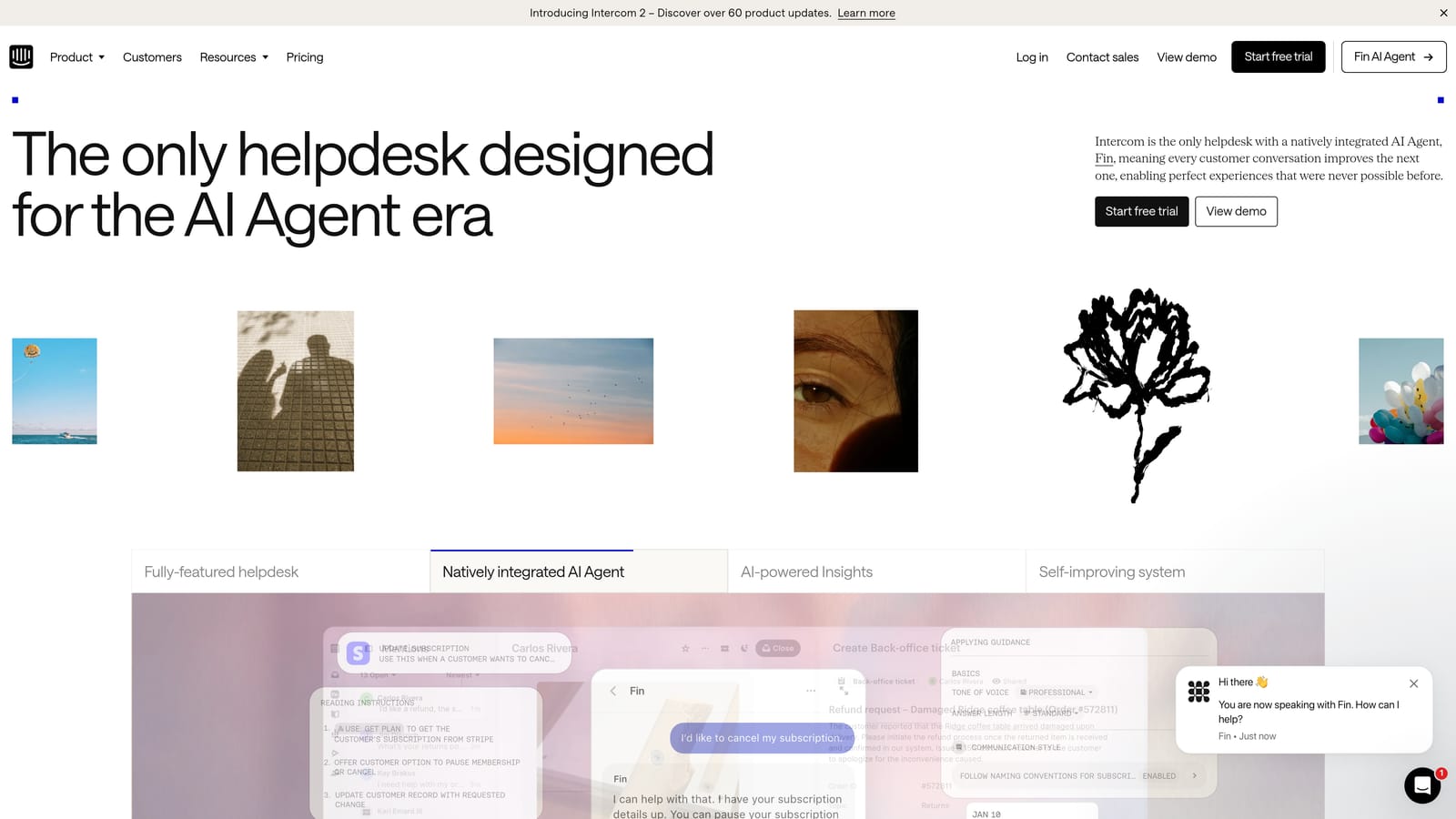
Intercom is a leading customer communications platform with Fin AI Agent handling autonomous conversation resolution across the full messaging suite.
Where This Tool Shines
Intercom's Fin AI Agent has become one of the more capable autonomous resolution tools in the market. It draws on your knowledge base to handle conversations end-to-end, and the underlying messaging infrastructure it sits on is genuinely mature — omnichannel, reliable, and deeply integrated with third-party tools.
The combination of Fin for autonomous resolution and the AI Copilot for human agent assistance gives teams a layered approach: AI handles what it can, and when a human steps in, they're equipped with suggested replies and surfaced context to resolve faster.
Key Features
Fin AI Agent: Autonomous AI that resolves support conversations using your knowledge base, with minimal configuration overhead.
AI Copilot: Real-time assistance for human agents, including suggested replies and relevant context surfacing during live conversations.
Omnichannel Messaging: Covers chat, email, in-app messaging, and phone across a unified platform.
Workflow Automation Builder: Visual builder for creating complex, multi-step automation flows without engineering involvement.
Integration Ecosystem: Extensive third-party integrations covering CRM, analytics, billing, and productivity tools.
Best For
Intercom works well for mid-market to enterprise teams that want a proven omnichannel messaging foundation with strong AI layered in. It's a particularly good fit for product-led companies that already rely on Intercom for in-app messaging and want to extend that infrastructure into automated support.
Pricing
Mid-market plans are publicly listed on the Intercom website. Enterprise pricing is available on request. Fin AI Agent pricing is typically usage-based on top of base plan costs.
3. Zendesk
Best for: Large enterprises that need a battle-tested ticketing platform with broad AI capabilities and an extensive integration marketplace.
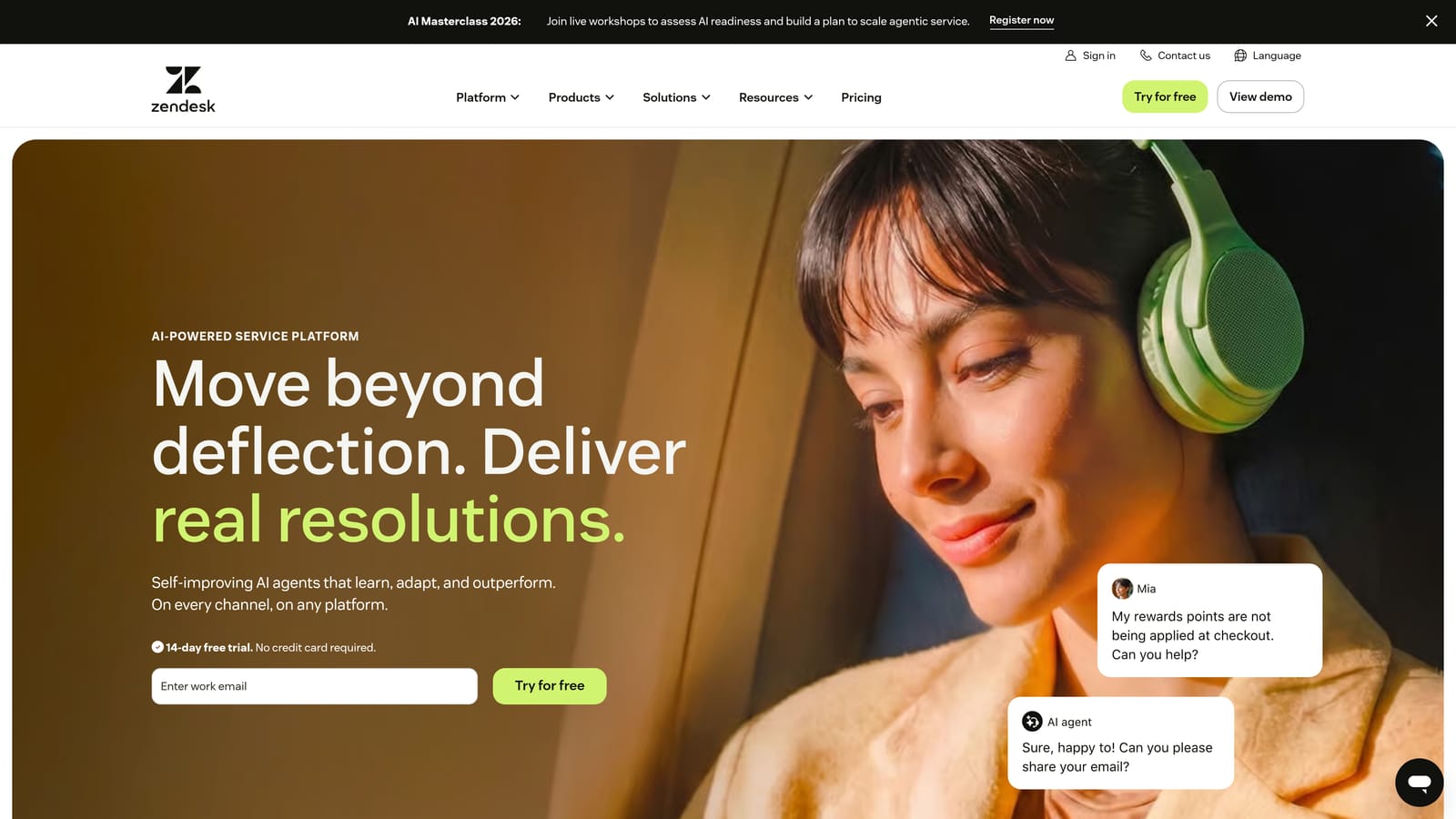
Zendesk is the most widely deployed enterprise ticketing platform, now with AI layered across triage, routing, agent assist, and self-service.
Where This Tool Shines
Zendesk's core strength is scale and ecosystem maturity. With over 1,000 marketplace integrations and a platform that has been refined across thousands of enterprise deployments, it handles operational complexity well. The AI capabilities added through Zendesk AI cover the full ticket lifecycle: intelligent triage at intake, agent copilot during resolution, and self-service deflection before a ticket is ever created.
For enterprises with established support operations, Zendesk's reporting and SLA management infrastructure is particularly strong. It's built to handle multi-tier support operations, regional teams, and complex escalation logic.
Key Features
Intelligent Triage: AI-powered intent detection and sentiment analysis that routes tickets accurately from the moment they arrive.
Agent Copilot: Real-time suggested responses and next-best-action recommendations for human agents during live ticket handling.
Omnichannel Coverage: Email, chat, voice, social, and messaging channels unified in a single workspace.
Marketplace Integrations: 1,000+ integrations covering virtually every tool in the enterprise stack.
Enterprise SLA Management: Advanced reporting, SLA tracking, and compliance tooling designed for multi-tier support operations.
Best For
Zendesk is best suited for larger enterprises with established support operations that need proven infrastructure, broad integration coverage, and AI that enhances an existing ticketing workflow rather than replacing it. Teams already invested in the Zendesk ecosystem will find the AI additions integrate naturally.
Pricing
Suite plans start at approximately $55 per agent per month. Enterprise pricing is available on request and varies based on configuration, add-ons, and contract terms.
4. Freshdesk (Freddy AI)
Best for: Teams that want comprehensive AI automation across self-service, agent assist, and analytics at a competitive price point.
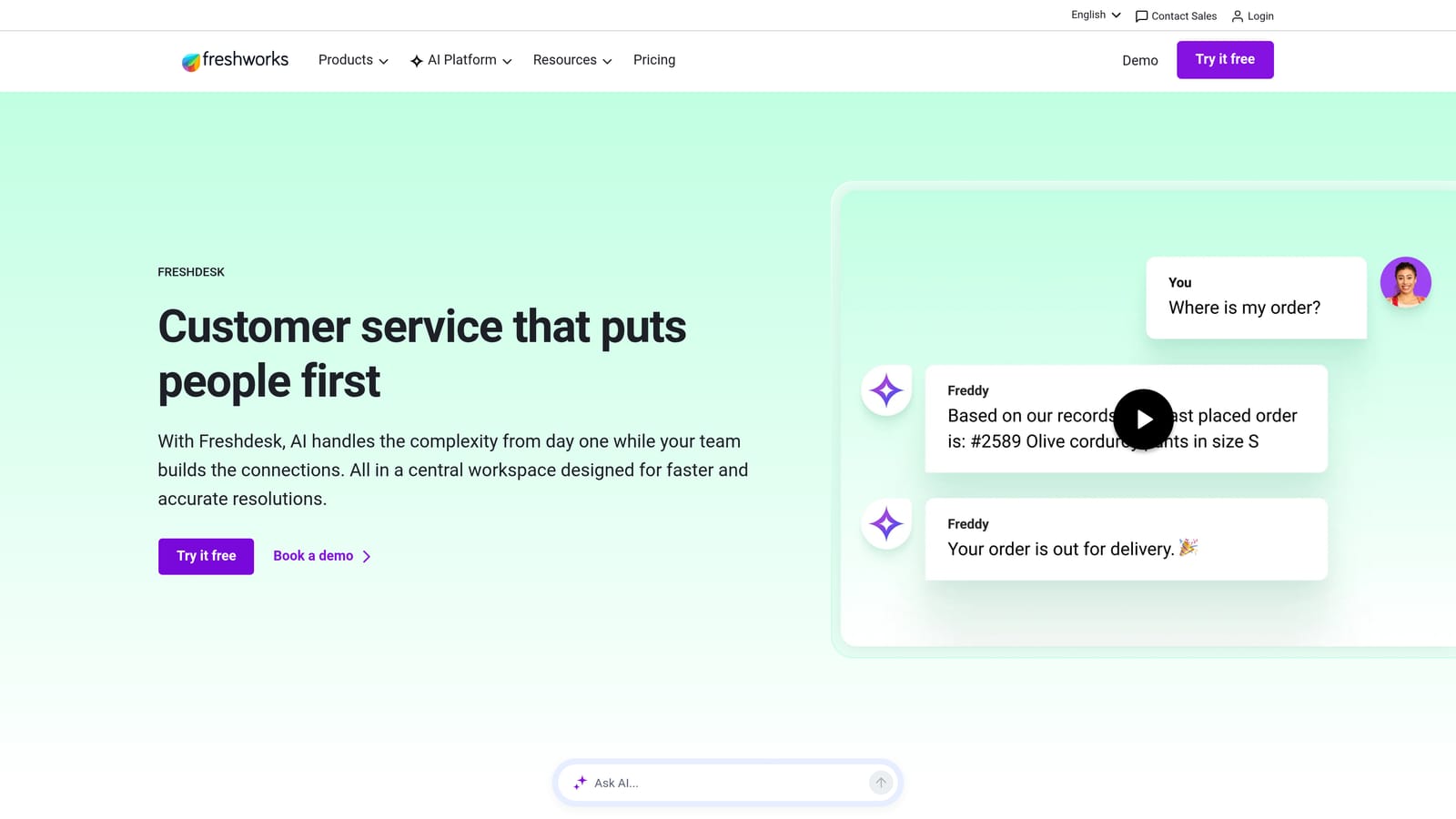
Freshdesk is Freshworks' flagship support platform with Freddy AI built across three distinct layers: self-service automation, agent copilot, and analytics intelligence.
Where This Tool Shines
Freshdesk positions itself as the feature-rich alternative to Zendesk at a more accessible price point, and the Freddy AI architecture reflects that positioning. Rather than a single AI capability, Freddy spans the full support workflow: autonomous self-service at the front, agent assistance in the middle, and anomaly detection in reporting at the back.
The Freshworks suite context is also worth noting. For teams that want support, CRM, and IT service management on a connected platform, Freshdesk's place within the broader Freshworks ecosystem creates integration opportunities that standalone support tools can't match.
Key Features
Freddy Self Service: AI bot for autonomous customer resolution, drawing on your knowledge base and conversation history.
Freddy Copilot: Agent assist with suggested replies, ticket summarization, and contextual recommendations during live handling.
Freddy Insights: AI-driven analytics that surfaces trends, anomalies, and performance signals across your support operation.
Omnichannel Ticketing: Email, chat, phone, and social channels managed from a single unified inbox.
Freshworks Suite Integration: Native alignment with Freshworks CRM and IT service products for teams that want a connected business platform.
Best For
Freshdesk is a strong fit for growing enterprises that want broad AI coverage without the implementation complexity or price premium of larger platforms. It's particularly well-suited for teams already using other Freshworks products or those evaluating Zendesk alternatives on cost-to-feature grounds.
Pricing
Tiered plans start at approximately $15 per agent per month. Freddy AI features are available on higher tiers, with specific capabilities and add-on costs varying by plan level.
5. Salesforce Service Cloud
Best for: Enterprises where customer support must be tightly unified with CRM, sales data, and account management workflows.
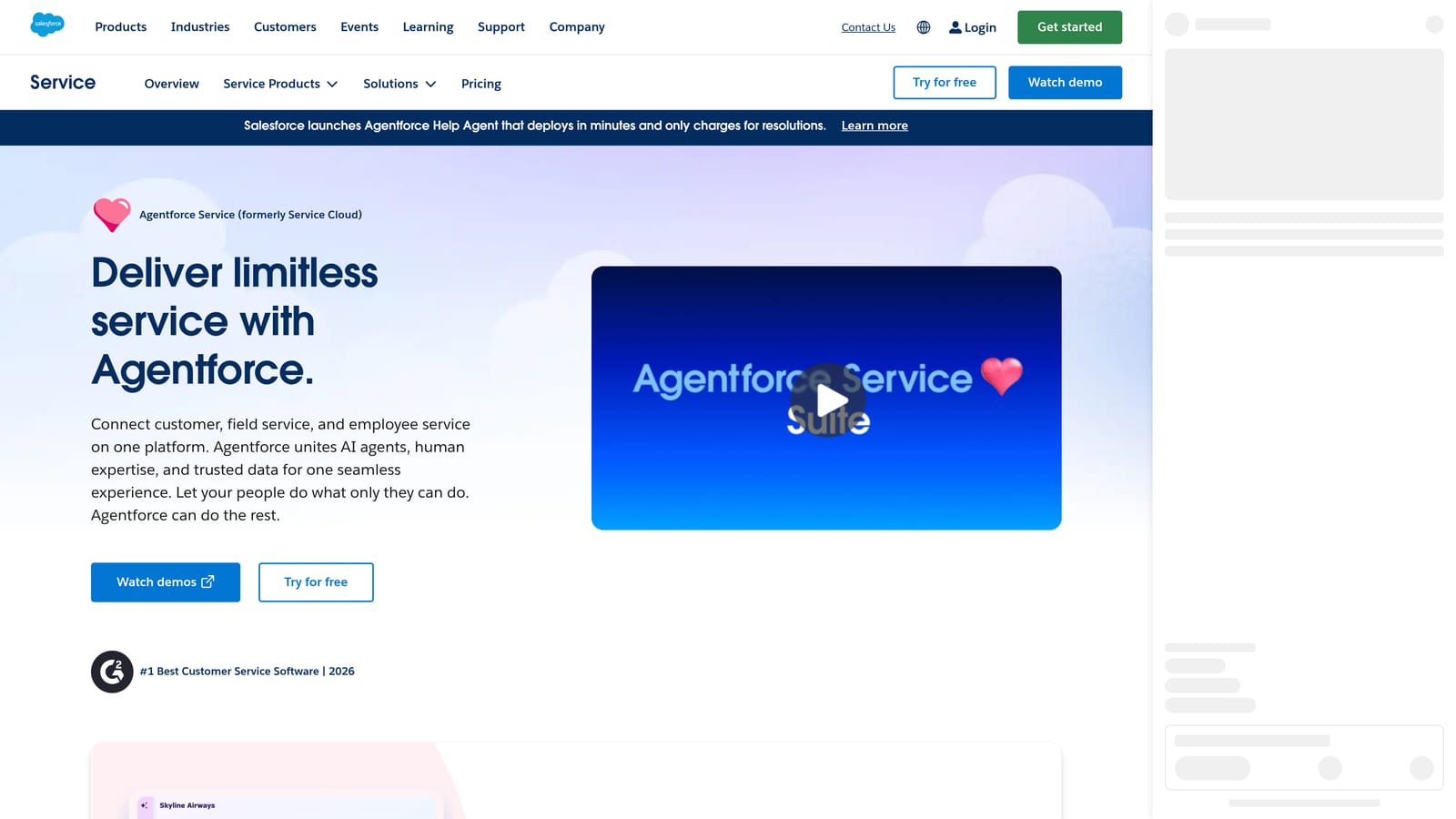
Salesforce Service Cloud is Salesforce's enterprise support platform with Einstein AI and Agentforce built in for autonomous and assisted resolution.
Where This Tool Shines
The primary differentiator for Service Cloud isn't the AI itself — it's the CRM integration. Support agents working in Service Cloud see the full Salesforce account record: opportunity history, contract details, account health, and relationship context. For enterprise B2B teams where a single support interaction can involve a seven-figure account, that context changes how agents handle every conversation.
Agentforce, Salesforce's autonomous AI agent product, extends this by enabling self-service resolution that's informed by account data — not just a generic knowledge base. That's a meaningful capability for enterprises with complex customer relationships.
Key Features
Einstein AI: Case classification, intelligent routing, and next-best-action recommendations powered by machine learning across your customer data.
Agentforce: Autonomous AI agents for self-service resolution, with access to full CRM context during interactions.
Native CRM Integration: Support agents see complete account and opportunity history embedded in every case view.
Omnichannel Routing: Unified routing across voice, digital channels, and field service for complex enterprise support structures.
Advanced Analytics: Deep reporting with Tableau integration for enterprise-grade performance analysis.
Best For
Service Cloud is the right choice for enterprises already invested in the Salesforce ecosystem, particularly those where support outcomes directly affect account retention and expansion revenue. It requires Salesforce admin resources for implementation and ongoing management, so it's best suited for organizations with that capacity.
Pricing
Enterprise plans start at approximately $165 per user per month. True cost depends heavily on configuration, additional cloud licenses, and implementation scope.
6. ServiceNow Customer Service Management
Best for: Large enterprises where resolving customer issues requires coordination across IT, operations, and back-office teams.
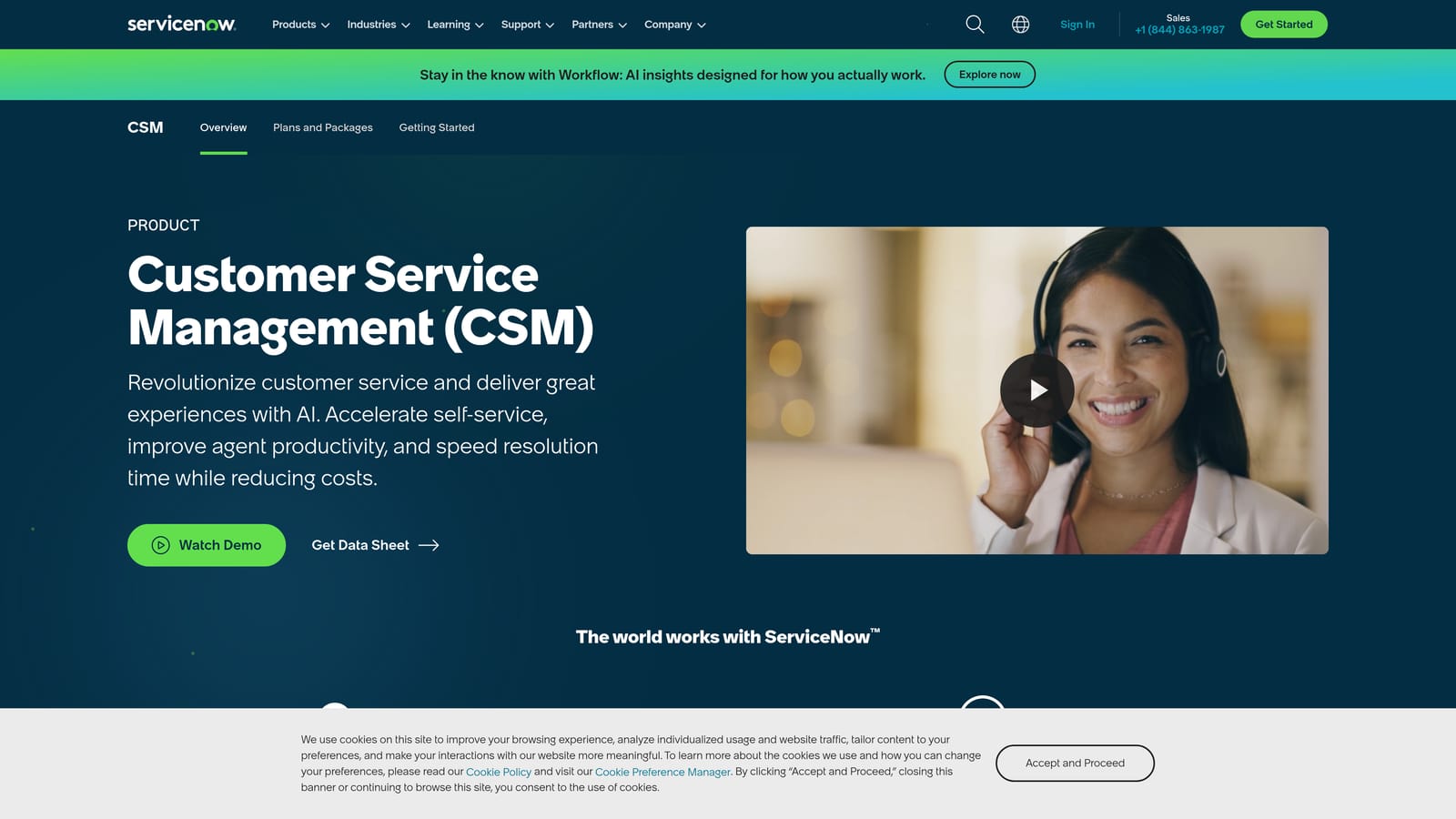
ServiceNow Customer Service Management brings ITSM-grade workflow automation to customer-facing support, with AI layered across agent productivity and self-service deflection.
Where This Tool Shines
ServiceNow CSM's core strength is cross-departmental workflow automation. When a customer issue requires action from IT, operations, finance, or a field team, ServiceNow connects those workflows in a way that pure support platforms can't. The customer-facing ticket and the internal resolution workflow are part of the same system, which eliminates the handoff friction that slows enterprise support down.
Now Assist, ServiceNow's AI capability, focuses on agent productivity and self-service deflection within this workflow context. For enterprises where the complexity isn't the conversation — it's the back-office coordination — ServiceNow CSM is purpose-built for that problem.
Key Features
Cross-Departmental Workflow Automation: Connects customer-facing cases directly to back-office resolution workflows across IT, operations, and other departments.
Now Assist AI: Agent productivity tools and self-service deflection capabilities built into the ServiceNow platform.
Proactive Case Management: Predictive intelligence surfaces issues before they escalate, enabling proactive outreach.
ITSM Integration: Deep alignment with ServiceNow's IT service management products for technical support use cases.
Enterprise Compliance Tooling: SLA management, audit capabilities, and compliance reporting built for regulated enterprise environments.
Best For
ServiceNow CSM is the right fit for large enterprises where customer support is operationally complex: issues that span departments, require back-office coordination, or exist in regulated industries where audit trails and compliance matter. It's not the right choice for teams that need fast deployment or straightforward AI-first resolution.
Pricing
Enterprise only. Pricing is not publicly listed. Contact ServiceNow directly for a quote based on your organization's scope and configuration requirements.
7. Kustomer
Best for: High-volume enterprises that want CRM-native support with unified customer timelines and AI-powered routing.
Kustomer is a CRM-native support platform that organizes every customer interaction on a unified timeline, with AI automation across routing, intent classification, and agent assistance.
Where This Tool Shines
Kustomer's model is fundamentally different from ticket-centric platforms. Every conversation, regardless of channel, lives on a single customer timeline. Agents don't work a queue of tickets — they work with customers, with full historical context from every previous interaction visible in one place. For high-volume environments where customers contact support repeatedly, this eliminates the frustration of repeating context.
The AI automation layer handles the volume problem: routing, intent detection, and auto-response keep throughput high while the CRM-native model keeps quality high for the conversations that reach human agents.
Key Features
Unified Customer Timeline: Every channel and every interaction consolidated in a single chronological view per customer.
AI-Powered Routing and Intent Detection: Automated classification and routing that directs conversations to the right agent or queue without manual triage.
CRM-Native Architecture: Customer and order data is embedded in every conversation view, not pulled from a separate system.
Multi-Step Workflow Automation: Complex support processes automated across multiple steps and conditions.
Omnichannel Coverage: Email, chat, SMS, social, and voice channels managed within the unified timeline model.
Best For
Kustomer fits high-volume enterprise environments where customer relationship context is as important as resolution speed. It's well-suited for B2B and B2C enterprises with repeat customer contact patterns and teams that want CRM data embedded in support workflows rather than accessed separately.
Pricing
Enterprise pricing only. Pricing is not publicly listed. Contact Kustomer directly for a quote tailored to your team size and channel requirements.
8. Gladly
Best for: Enterprises that prioritize relationship quality and want AI self-service alongside human agents with complete cross-channel context.
Gladly is a people-centric support platform that replaces the ticket model with a continuous customer conversation thread, with AI handling self-service while human agents maintain full context.
Where This Tool Shines
Gladly's defining principle is that customers, not tickets, are the unit of work. There are no ticket numbers, no case IDs, no fragmented interactions across channels. Every conversation a customer has ever had with your team is visible in a single thread, and agents pick up exactly where the last interaction left off regardless of channel. This model significantly reduces the friction that erodes CSAT in high-volume environments.
Sidekick, Gladly's AI self-service capability, handles deflection and guided resolution before conversations reach human agents. When escalation happens, agents inherit the full thread — no context is lost, no customer has to repeat themselves.
Key Features
Conversation-Centric Model: Customers are the organizing unit, not tickets — every channel interaction lives in a single continuous thread.
Sidekick AI: Self-service AI agent for deflection and guided resolution before human escalation.
Full Cross-Channel History: Human agents see the complete conversation history across every channel in a single view.
Task Automation and Intelligent Routing: Automated workflows and routing that direct conversations to the right agent based on context and availability.
Relationship Quality Metrics: CSAT and relationship-focused analytics that measure outcomes beyond resolution speed.
Best For
Gladly is a strong fit for enterprises where relationship quality is a strategic differentiator — particularly those in retail, consumer, and service-oriented industries where repeat customer interactions are common and agent context matters as much as resolution speed.
Pricing
Enterprise pricing only. Pricing is not publicly listed. Contact Gladly directly for a quote based on team size and channel requirements.
9. Tidio (Lyro AI)
Best for: Teams that need conversational AI automation deployed quickly with minimal training data or configuration overhead.
Tidio offers Lyro AI, a conversational agent that resolves queries using existing help content and deploys faster than most enterprise platforms require.
Where This Tool Shines
Tidio's Lyro AI stands out for its time-to-value. Most enterprise automation platforms require substantial configuration, training data, and implementation work before they deliver results. Lyro is designed to deploy with minimal overhead, drawing on your existing help content to start resolving conversations quickly.
For teams that need automation running fast — whether that's a lean support team at a scaling company or a specific use-case deployment within a larger organization — Tidio offers a lower barrier to entry than the platforms above it on this list. It's not the deepest enterprise platform, but it's one of the most accessible.
Key Features
Lyro AI Agent: Conversational AI that resolves customer queries using your existing help content with minimal training requirements.
Fast Deployment: Designed for rapid time-to-value with low configuration overhead compared to enterprise-grade alternatives.
Multi-Channel Support: Live chat, email, and Messenger channel coverage from a single platform.
Flow Builder: Visual rule-based automation builder that works alongside Lyro AI for structured conversation paths.
Analytics Dashboard: Conversation and resolution tracking to monitor Lyro's performance and identify gaps in coverage.
Best For
Tidio is best suited for smaller enterprise teams, fast-scaling companies that need automation running before a full platform implementation is feasible, or larger organizations deploying AI for a specific channel or use case. It's a strong starting point for teams new to support automation.
Pricing
Tiered plans are publicly listed on the Tidio website. Lyro AI is available from mid-tier plans upward, with usage-based pricing for higher conversation volumes.
Choosing the Right Platform for Your Team
The right enterprise support automation platform depends less on feature lists and more on where your complexity actually lives. Here's a quick framework for thinking through your decision.
AI-first for B2B SaaS: If you want autonomous resolution, page-aware product guidance, and business intelligence signals from a platform built AI-first rather than AI-bolted-on, Halo AI is the strongest fit. It's purpose-built for the SaaS support context, with integrations that connect support to the full business stack.
Enterprise-scale ticketing: For large organizations with established support operations, complex SLA requirements, and a need for broad integration coverage, Zendesk and Salesforce Service Cloud are the mature choices. Salesforce wins when CRM unification is the priority; Zendesk wins when operational flexibility and marketplace depth matter more.
Cross-departmental complexity: If your support issues routinely require coordination across IT, operations, or back-office teams, ServiceNow CSM is built for exactly that problem. No other platform on this list handles that workflow coordination as well.
CRM-native and relationship-focused: Kustomer and Gladly both prioritize customer context over ticket throughput. Kustomer is the stronger fit for high-volume environments with repeat contact patterns; Gladly is better when relationship quality and CSAT are the primary success metrics.
Fast deployment: If you need automation running quickly without a lengthy implementation cycle, Tidio's Lyro AI offers the fastest time-to-value on this list.
Your support team shouldn't scale linearly with your customer base. Let AI agents handle routine tickets, guide users through your product, and surface business intelligence while your team focuses on complex issues that need a human touch. See Halo in action and discover how continuous learning transforms every interaction into smarter, faster support.