9 Best Help Desk Software with AI Capabilities in 2026
This guide ranks the 9 best help desk software with AI capabilities in 2026, evaluating each platform on autonomous resolution depth, integration breadth, continuous learning, and business intelligence — helping B2B support teams move beyond reactive ticketing and scale without adding headcount.
 Matt PattoliFounder13 min read
The era of ticket queues and copy-paste responses is over. Modern B2B support teams are replacing reactive workflows with AI-powered platforms that resolve issues autonomously, surface customer health signals, and scale without adding headcount.
But not all "AI-powered" help desks are created equal. Some bolt AI onto legacy ticketing systems as an afterthought. Others are built AI-first from the ground up, with autonomous resolution, continuous learning, and business intelligence baked into the architecture from day one.
This guide covers the top help desk software options with genuine AI capabilities in 2026, evaluated on autonomous resolution depth, integration breadth, learning ability, and business intelligence beyond basic ticketing. Whether you're running a lean support team at a fast-growing SaaS company or managing enterprise-scale volume, there's a platform here built for your needs.
1. Halo AI
Best for: AI-first SaaS teams that need autonomous resolution, product guidance, and business intelligence in one platform.
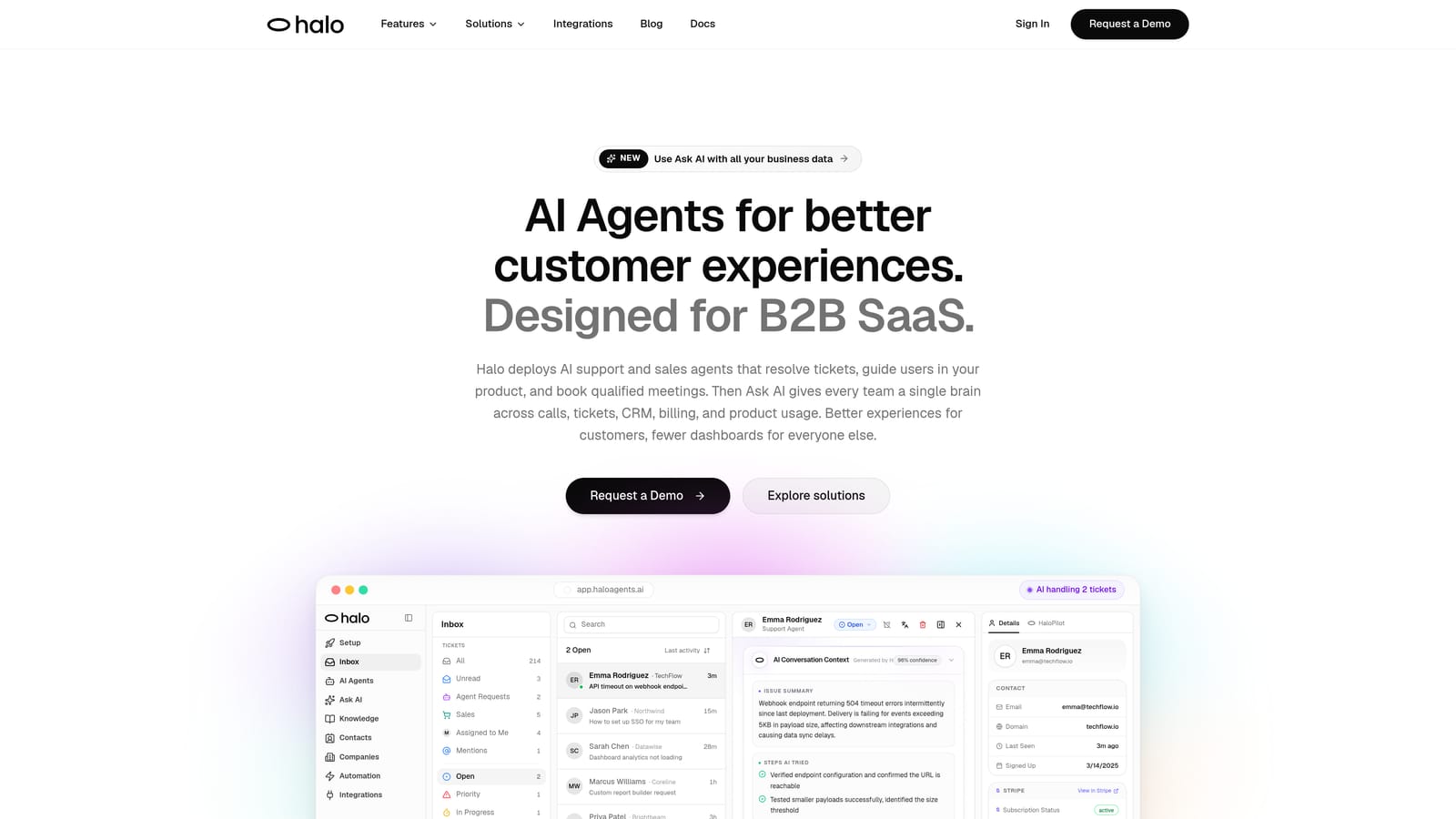
Halo AI is an AI-first customer support platform that deploys intelligent agents to resolve tickets, guide users through your product with page-aware context, and surface business intelligence — all while continuously learning from every interaction.
Where This Tool Shines
What separates Halo from most platforms on this list is the architecture. AI isn't a feature layer added on top of a legacy ticketing system — it's the foundation. The page-aware agents understand what a user is actually looking at in your product when they reach out, which means responses are contextually relevant rather than generic.
The business intelligence layer is a genuine differentiator for SaaS product and support teams. Beyond ticket counts and CSAT scores, Halo surfaces customer health signals, revenue anomalies, and churn indicators from your support interactions. It also auto-creates bug tickets routed to Linear or your issue tracker, which closes the loop between support and engineering without manual handoffs.
Key Features
Page-Aware AI Agents: Agents understand what users are seeing in real time, enabling context-specific guidance rather than generic responses.
Autonomous Ticket Resolution: AI resolves tickets independently and escalates complex issues to human agents with full context preserved.
Auto Bug Ticket Creation: Automatically generates and routes bug reports to Linear or your preferred issue tracker when support interactions reveal product issues.
Smart Inbox with Business Intelligence: Surfaces customer health signals, revenue anomalies, and churn indicators from support data — insights most help desks don't offer.
Deep Integration Stack: Connects to Linear, Slack, HubSpot, Intercom, Stripe, Zoom, PandaDoc, and Fathom, giving AI agents context from across your business stack.
Continuous Learning Loop: Every resolved interaction improves future resolution quality, so the platform gets smarter over time without manual retraining.
Best For
SaaS companies and B2B product teams that want AI as the core of their support operation, not a bolt-on. Particularly well-suited for teams that need support, product, and engineering workflows connected in one intelligent loop. If you're evaluating a move away from legacy help desks, Halo is worth a close look — you can explore how it compares to traditional platforms in this Zendesk vs AI support platform comparison.
Pricing
Contact for pricing or book a demo directly at haloagents.ai. Pricing is tailored to team size and usage requirements.
2. Zendesk
Best for: Established enterprise teams that need a mature, highly extensible help desk with growing AI capabilities.
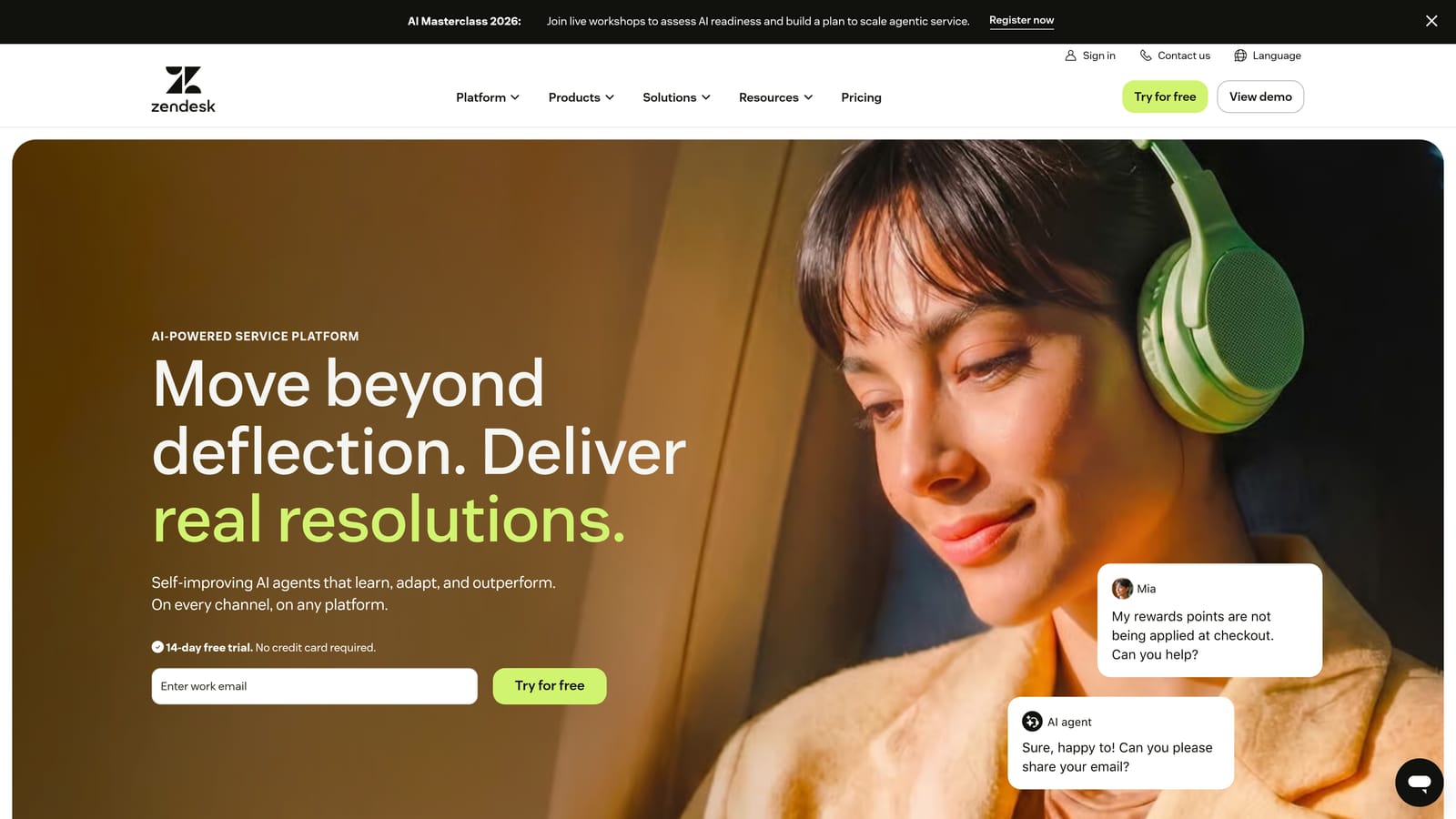
Zendesk is one of the most established help desk platforms available, now with an expanding suite of AI features including intelligent triage, an agent copilot, and AI-powered self-service.
Where This Tool Shines
Zendesk's strength is its maturity. The platform has a massive ecosystem of third-party integrations, a well-documented API, and years of enterprise-grade reliability behind it. For teams that have already built workflows around Zendesk, the AI additions — particularly Zendesk Copilot — provide meaningful productivity gains without requiring a platform migration.
That said, Zendesk's AI capabilities are layered onto a legacy ticketing architecture rather than built from the ground up as AI-native. This means the autonomous resolution depth is more limited compared to AI-first platforms, and AI features often come as add-ons on higher pricing tiers.
Key Features
Zendesk Copilot: Provides AI-assisted agent suggestions, macro recommendations, and reply drafting during live ticket handling.
Intelligent Triage and Routing: Automatically categorizes and routes tickets based on detected intent and sentiment.
AI-Powered Knowledge Base Suggestions: Surfaces relevant help center articles to agents during ticket resolution.
Robust Reporting Dashboard: Comprehensive analytics covering ticket volume, resolution time, agent performance, and customer satisfaction.
Extensive Marketplace: Hundreds of third-party app integrations available through the Zendesk marketplace.
Best For
Mid-market and enterprise teams with existing Zendesk infrastructure who want to add AI capabilities incrementally. Also a strong choice for organizations that need a large integration ecosystem and don't want to rebuild their support stack from scratch.
Pricing
Per-agent monthly pricing; AI features are available as add-ons on higher tiers. Check zendesk.com for current plans and pricing details.
3. Intercom
Best for: SaaS companies with rich knowledge bases that want conversational in-product support powered by a capable AI agent.
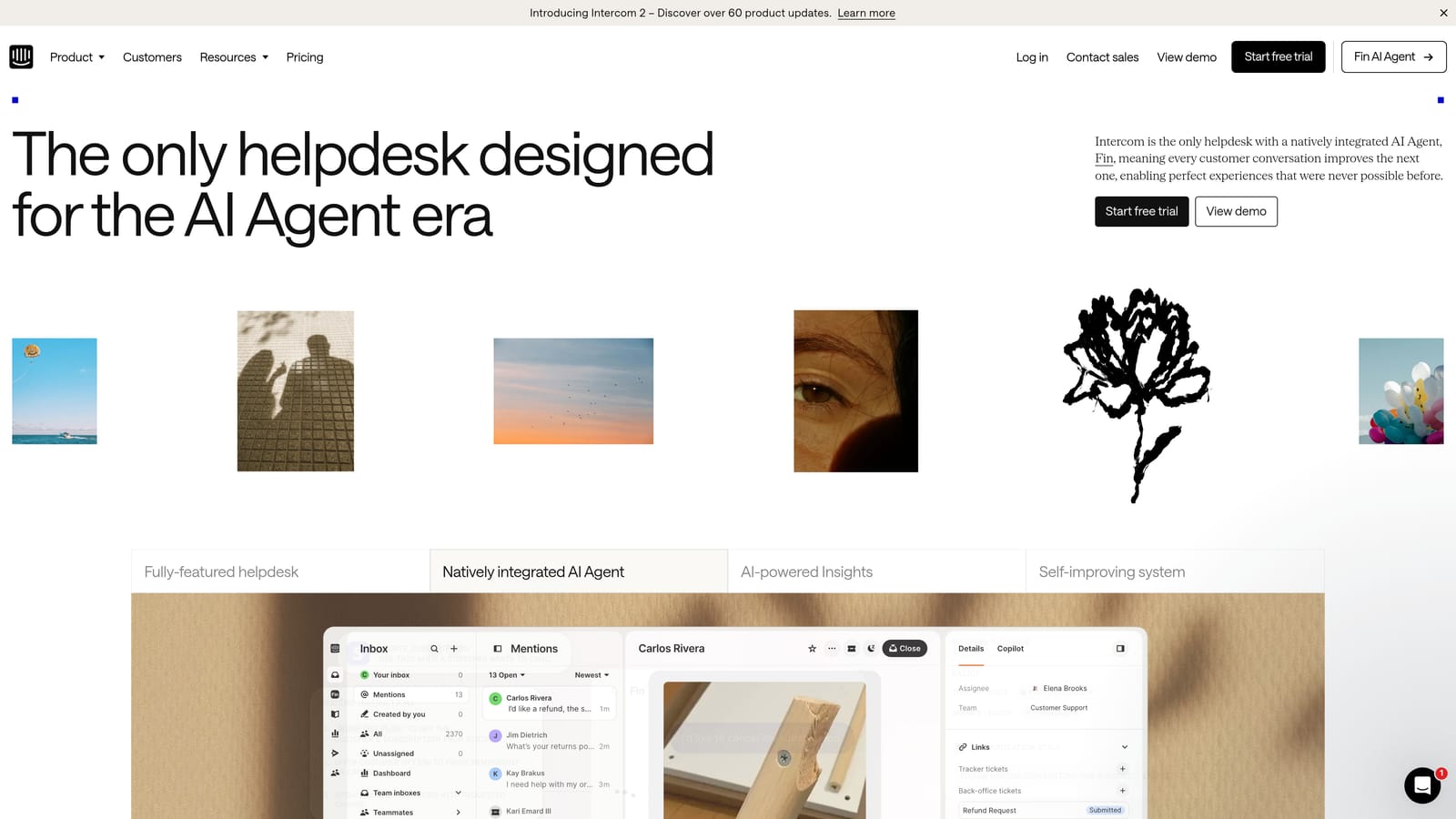
Intercom is a conversational support platform with Fin, its GPT-powered AI agent, designed to resolve queries from your help center content and hand off to human agents when needed.
Where This Tool Shines
Intercom's in-product messenger experience is one of the best in the category. Fin AI can handle a meaningful portion of incoming queries autonomously, drawing on your existing help center content to generate accurate, conversational responses. The quality of Fin's resolution rate scales with the quality of your knowledge base, which gives teams an incentive to maintain thorough documentation.
Beyond AI resolution, Intercom's proactive messaging and product tours make it a strong choice for SaaS teams that want to combine support with onboarding and user education in a single platform.
Key Features
Fin AI Agent: Resolves customer queries autonomously using help center content, with natural language understanding powered by large language models.
In-Product Messenger: Embeds directly in your product with proactive messaging, product tours, and contextual support.
AI-Powered Inbox: Provides conversation summaries and suggested replies to speed up agent handling of escalated tickets.
Customer Data Platform: Supports behavioral targeting and segmentation for proactive outreach and personalized support.
Workflows Builder: No-code automation builder for creating support flows across the full customer lifecycle.
Best For
SaaS companies that want conversational, in-product support with a strong AI resolution layer. Best results come from teams with well-maintained help centers that give Fin the content it needs to resolve queries accurately.
Pricing
Tiered pricing based on seats and usage; Fin AI is billed per resolution. Check intercom.com for current plans.
4. Freshdesk
Best for: SMBs and growing teams that need solid AI capabilities at competitive price points within a broader business software ecosystem.
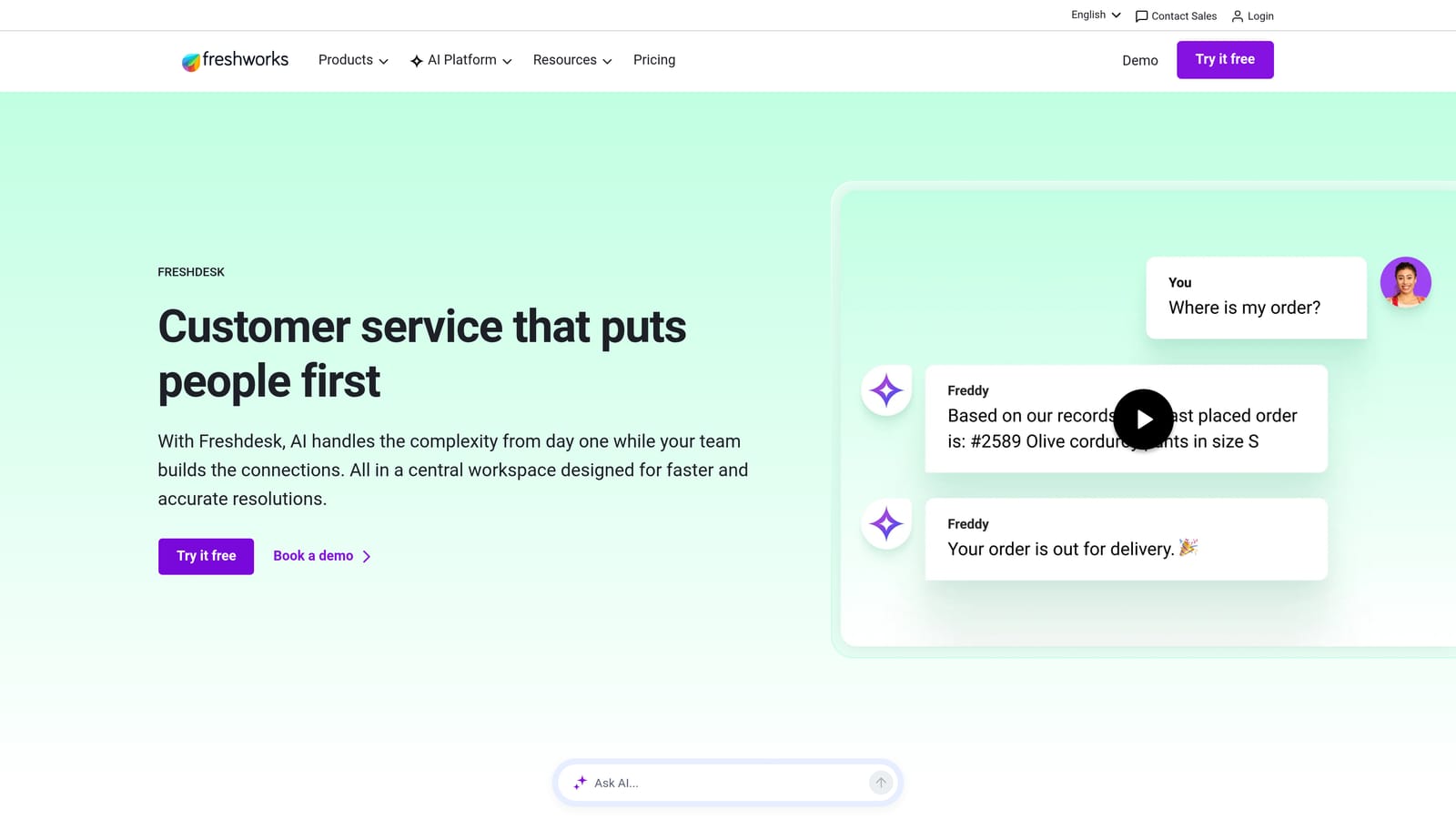
Freshdesk is a widely used help desk platform with Freddy AI built in, covering auto-triage, sentiment detection, suggested responses, and a self-service bot at accessible price points.
Where This Tool Shines
Freshdesk's value proposition is breadth at an accessible price. The Freddy AI suite covers the core use cases most support teams need: automatic categorization, priority routing, sentiment-based flagging, and agent-assist features for drafting replies. It's not the deepest AI implementation on this list, but it covers the fundamentals well without requiring a significant budget.
The Freshworks ecosystem integration is also worth noting. Teams using Freshsales or Freshservice alongside Freshdesk get native data sharing across CRM, support, and ITSM, which gives Freddy AI more context to work with.
Key Features
Freddy AI Triage: Automatically categorizes, prioritizes, and routes incoming tickets based on content and intent.
Freddy Self Service Bot: Deflects common queries before they reach agents, reducing ticket volume for straightforward issues.
Freddy Copilot: Agent-assist features including suggested replies, conversation summarization, and tone adjustment.
Sentiment Analysis: Flags frustrated or high-priority customers for immediate agent attention.
Freshworks Ecosystem Integration: Native connections to Freshsales CRM and Freshservice ITSM for cross-platform data sharing.
Best For
SMBs, growing startups, and teams already in the Freshworks ecosystem. A strong choice for organizations that want capable AI features without enterprise-level pricing, particularly if they're also using Freshsales or Freshservice.
Pricing
Free tier available for small teams; paid plans scale by agent count and feature set. Check freshdesk.com for current pricing.
5. Help Scout
Best for: Teams that prioritize human-quality support relationships and want AI to assist agents rather than fully automate resolution.
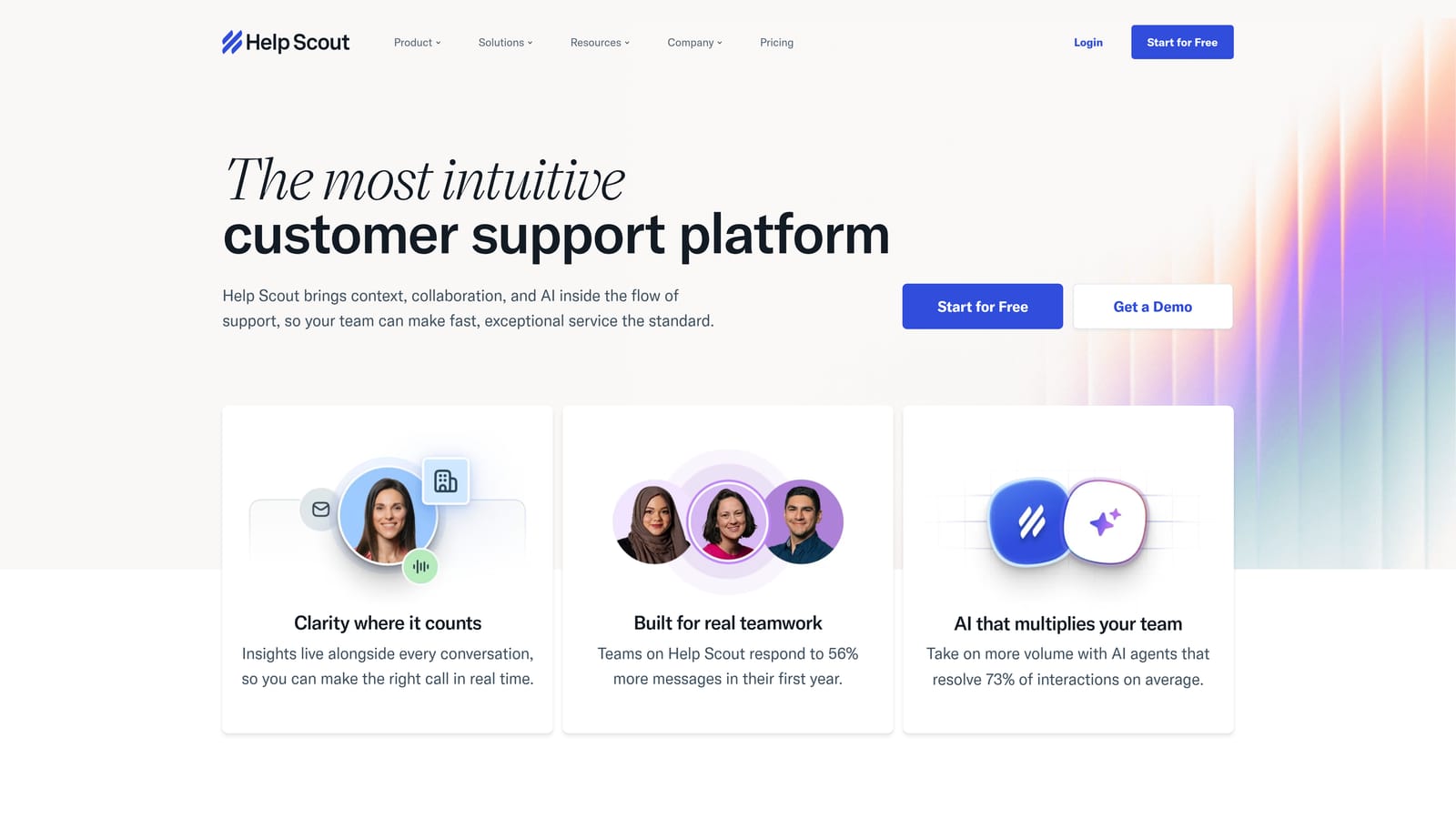
Help Scout is a human-first support platform that has added AI assist features to help agents work faster, without pushing toward full automation.
Where This Tool Shines
Help Scout occupies a distinct position in this list: it's deliberately not trying to be an autonomous AI platform. Instead, it uses AI to make human agents faster and more consistent. AI Summarize gives agents instant context on long conversation threads, and AI Assist helps draft replies, adjust tone, and expand bullet points into full responses.
For teams where the quality of human interaction is a brand differentiator, this approach makes sense. Help Scout's clean, minimal UI also means there's very little configuration overhead — teams can be productive quickly without extensive setup.
Key Features
AI Summarize: Instantly condenses long conversation threads so agents can get up to speed without reading every message.
AI Assist: Helps agents draft replies, adjust tone, and expand rough notes into polished responses.
Shared Inbox with Collision Detection: Prevents two agents from responding to the same conversation simultaneously.
Docs Knowledge Base: Built-in knowledge base with AI-powered search for both agents and customers.
Simple, Clean UI: Minimal configuration overhead with an interface that most agents can learn quickly.
Best For
Teams that want AI to accelerate human agents rather than replace them. Particularly well-suited for companies where relationship quality and personalized support are central to the customer experience.
Pricing
Per-user monthly pricing with a free trial available. Check helpscout.com for current plans.
6. Zoho Desk
Best for: Teams in the Zoho ecosystem that need solid AI capabilities with strong cross-platform data sharing at mid-market pricing.
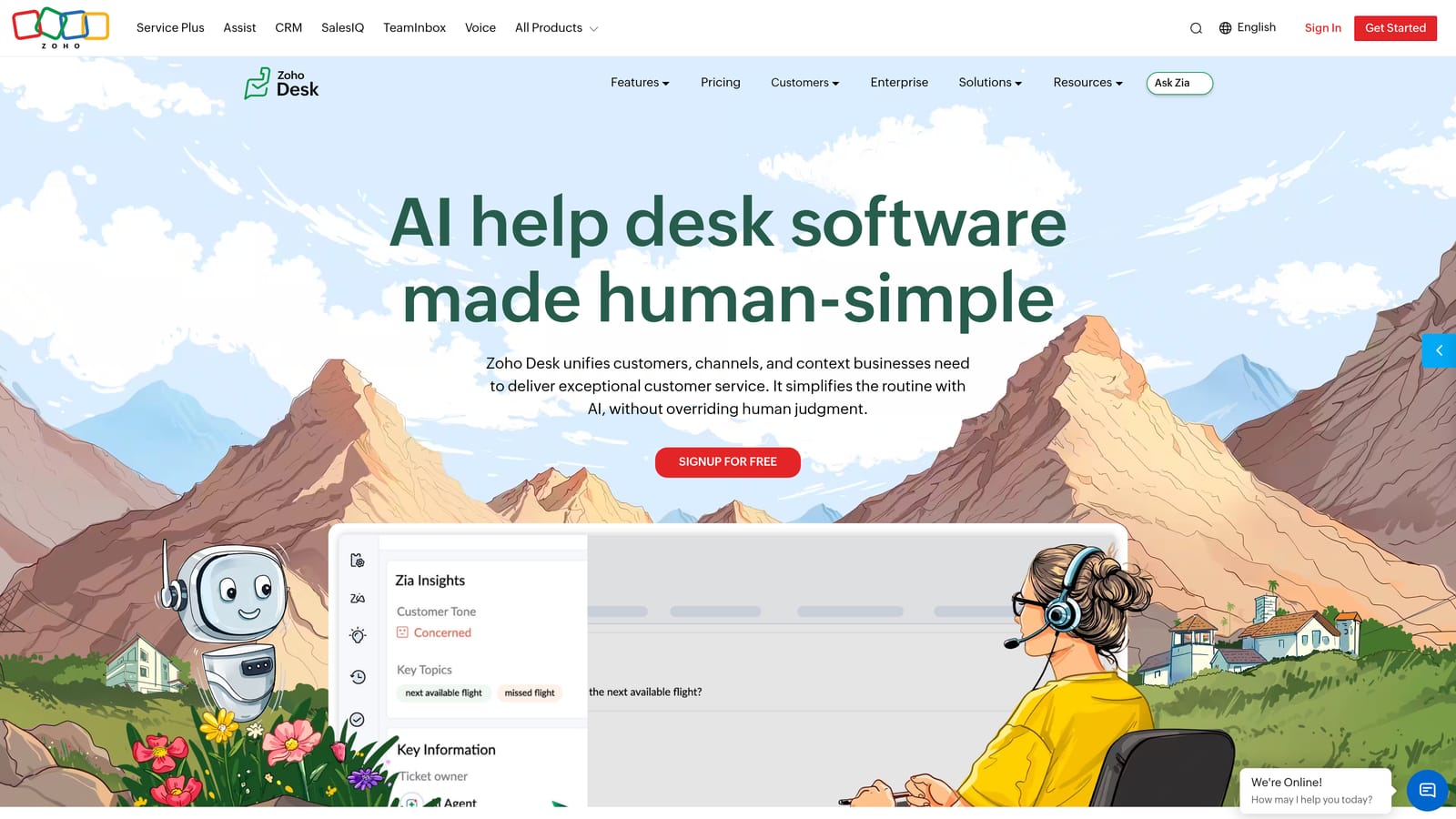
Zoho Desk is a feature-rich help desk with Zia AI for sentiment analysis, anomaly detection, and cross-platform intelligence — particularly strong for teams already using Zoho CRM or Analytics.
Where This Tool Shines
Zia AI's anomaly detection is a genuinely useful capability that goes slightly beyond what most mid-market help desks offer. Rather than just analyzing individual tickets, Zia can identify unusual patterns in ticket volume or topic clusters, which can signal product issues or emerging customer pain points before they escalate.
The Zoho ecosystem advantage is real: native data sharing between Zoho Desk, Zoho CRM, Zoho Analytics, and Zoho SalesIQ means Zia has richer context than it would in an isolated help desk deployment.
Key Features
Zia AI: Covers sentiment analysis, ticket anomaly detection, and response suggestions across incoming support volume.
Native Zoho Integrations: Deep connections to Zoho CRM, Zoho Analytics, and Zoho SalesIQ for cross-platform intelligence.
Guided Conversations and Self-Service Bot: No-code bot builder for deflecting common queries before they reach agents.
Multi-Channel Support: Handles email, chat, phone, and social channels from a unified interface.
Blueprint Workflow Automation: Structured automation for complex ticket handling processes with defined approval and escalation paths.
Best For
Teams already invested in the Zoho ecosystem. Also a solid choice for mid-market companies that want anomaly detection and cross-platform intelligence without the complexity or cost of enterprise platforms.
Pricing
Tiered pricing with a free plan for small teams. Check zoho.com/desk for current plans.
7. Salesforce Service Cloud
Best for: Enterprise organizations already on the Salesforce platform that need deeply integrated AI across their entire customer service operation.
Salesforce Service Cloud is the enterprise-grade service platform from Salesforce, with Einstein AI deeply embedded for case intelligence, next-best-action recommendations, and autonomous bots.
Where This Tool Shines
Service Cloud's primary advantage is depth of CRM integration. When your support agents are working cases, Einstein AI has access to the full Salesforce data model: purchase history, open opportunities, marketing interactions, account health scores, and more. That context makes next-best-action recommendations and intelligent routing genuinely more useful than they would be in a standalone help desk.
The tradeoff is complexity and cost. Service Cloud is a significant investment, and realizing its full value typically requires dedicated Salesforce administration and implementation resources. For teams not already on Salesforce, the overhead of building on this platform can be prohibitive.
Key Features
Einstein AI Case Classification: Automatically classifies incoming cases and predicts field values to speed up triage and routing.
Einstein Bots: Self-service automation bots with full access to CRM data for context-rich automated responses.
Next-Best-Action Recommendations: Surfaces real-time guidance to agents during live interactions based on CRM and case data.
Omni-Channel Routing: AI-driven workload balancing across channels and agent queues based on capacity and skill matching.
Deep Salesforce Ecosystem Integration: Native connections to Salesforce CRM, Marketing Cloud, and Commerce Cloud.
Best For
Enterprise organizations already operating on the Salesforce platform. The value proposition is strongest when support, sales, and marketing data are all in Salesforce, giving Einstein AI the broadest possible context to work with.
Pricing
Enterprise pricing per agent per month; represents a significant investment relative to most alternatives. Check salesforce.com for current plans.
8. Tidio
Best for: SMBs and e-commerce teams that need fast AI chatbot deployment without technical resources or complex setup.
Tidio is an accessible live chat and AI chatbot platform with Lyro, its conversational AI agent, designed for fast deployment without requiring technical expertise.
Where This Tool Shines
Tidio's standout quality is speed to value. Lyro can be deployed in minutes with no-code setup, making it genuinely accessible for small teams that don't have a dedicated support engineer or technical implementation resources. For e-commerce businesses in particular, the Shopify and WooCommerce integrations mean Lyro can answer order-related queries with relevant context from the start.
The live chat handoff is smooth when Lyro reaches the limits of what it can resolve autonomously, which matters for customer experience. The platform is less suited for complex B2B support workflows or teams that need deep business intelligence, but for its target use case it delivers well.
Key Features
Lyro AI Chatbot: Conversational AI with intent recognition and natural language understanding for autonomous query resolution.
No-Code Setup: Deployable in minutes without technical resources or developer involvement.
Live Chat with Human Handoff: Smooth escalation to live agents when AI reaches the limits of its resolution capability.
E-Commerce Integrations: Native connections to Shopify and WooCommerce for order-aware support responses.
Visitor Tracking and Proactive Triggers: Behavior-based chat triggers that initiate conversations based on visitor activity on your site.
Best For
SMBs, e-commerce brands, and teams that need a quick-to-deploy AI chatbot without technical overhead. Less suitable for complex B2B environments that require deep integrations or advanced business intelligence.
Pricing
Free plan available; Lyro AI is included on paid tiers. Check tidio.com for current pricing.
9. Kustomer
Best for: High-volume consumer brands that need omnichannel AI-powered support with a unified customer timeline for context-rich interactions.
Kustomer is an omnichannel customer service CRM with AI-powered automation across email, chat, SMS, and social, built around a unified customer timeline that gives agents and AI agents full context on every interaction.
Where This Tool Shines
Kustomer's unified customer timeline is the core differentiator. Rather than treating each ticket as an isolated event, Kustomer aggregates purchase history, prior interactions, CRM data, and channel history into a single view. This gives AI-powered routing and automation much richer context to work with than a standard help desk, which translates to more accurate triage and more relevant automated responses.
The platform is particularly well-suited for high-volume consumer brands managing support across multiple channels simultaneously. It's less commonly used in pure B2B SaaS contexts, where the omnichannel breadth may be more than necessary.
Key Features
Unified Customer Timeline: Aggregates purchase history, prior interactions, and CRM data into a single contextual view per customer.
AI-Powered Routing and Automation: Intelligent case routing and workflow automation across all supported channels.
Intelligent Deflection with Conversational AI Bots: Handles common queries autonomously before routing to human agents.
Sentiment Analysis and Proactive Issue Detection: Identifies at-risk customers and flags high-priority interactions for immediate attention.
Flexible Omnichannel Workflow Builder: No-code automation builder for complex cross-channel support flows.
Best For
High-volume consumer brands managing support across email, chat, SMS, and social simultaneously. Teams that need a unified customer data layer to give AI automation meaningful context across the full interaction history.
Pricing
Per-agent monthly pricing. Check kustomer.com for current plans.
Which Platform Is Right for Your Team?
The most important decision in this category isn't which feature list looks best on paper — it's whether you need AI as a layer on top of a legacy system or as the foundation of your support operation. That distinction shapes everything from resolution quality to how the platform scales.
Here's a quick breakdown by use case to help you orient:
AI-first SaaS teams: Halo AI is the strongest fit if you want autonomous resolution, page-aware context, and business intelligence beyond ticket counts — with a continuous learning loop built into the architecture.
Enterprise teams already on Salesforce: Salesforce Service Cloud delivers the deepest value when support, sales, and marketing data are all in the same ecosystem for Einstein AI to draw on.
Conversational in-product support: Intercom's Fin AI and in-product messenger are well-suited for SaaS companies with rich knowledge bases and a focus on proactive user engagement.
Budget-conscious SMBs: Freshdesk and Tidio both offer capable AI features at accessible price points, with Freshdesk better suited for B2B workflows and Tidio for e-commerce and fast deployment.
Zoho ecosystem teams: Zoho Desk's native data sharing with Zoho CRM and Analytics makes it the logical choice if you're already invested in that stack.
Your support team shouldn't scale linearly with your customer base. Let AI agents handle routine tickets, guide users through your product, and surface business intelligence while your team focuses on complex issues that need a human touch. See Halo in action and discover how continuous learning transforms every interaction into smarter, faster support.
For a broader look at modern customer support solutions, explore how AI-first platforms are redefining what's possible at every stage of the support lifecycle.