9 Best Intelligent Support Platforms Compared in 2026
This guide evaluates nine intelligent support platforms compared across AI autonomy, integration ecosystems, contextual awareness, and analytics — giving B2B SaaS teams a clear, practical view of what each platform actually does and which one fits their support stack in 2026.
 Grant CooperFounder14 min read
The support software landscape has shifted dramatically. Customers now expect instant, accurate answers at any hour, and traditional helpdesks built around ticket queues and manual routing simply weren't designed for that reality. The new category of intelligent support platforms combines AI-powered resolution, contextual awareness, and business analytics to handle volume without headcount growth.
But "intelligent" means different things to different vendors. Some bolt AI onto legacy ticketing systems. Others are built AI-first from the ground up. Some excel at chat deflection; others shine at deep integrations and business intelligence.
This comparison covers nine platforms evaluated on depth of AI autonomy, integration ecosystem, contextual awareness, analytics beyond basic reporting, and suitability for B2B SaaS teams. Whether you're migrating off a legacy helpdesk or choosing your first serious support stack, here's a clear view of what each platform actually does and who it's built for.
1. Halo AI
Best for: B2B SaaS teams that want AI as the core architecture, not a feature add-on.
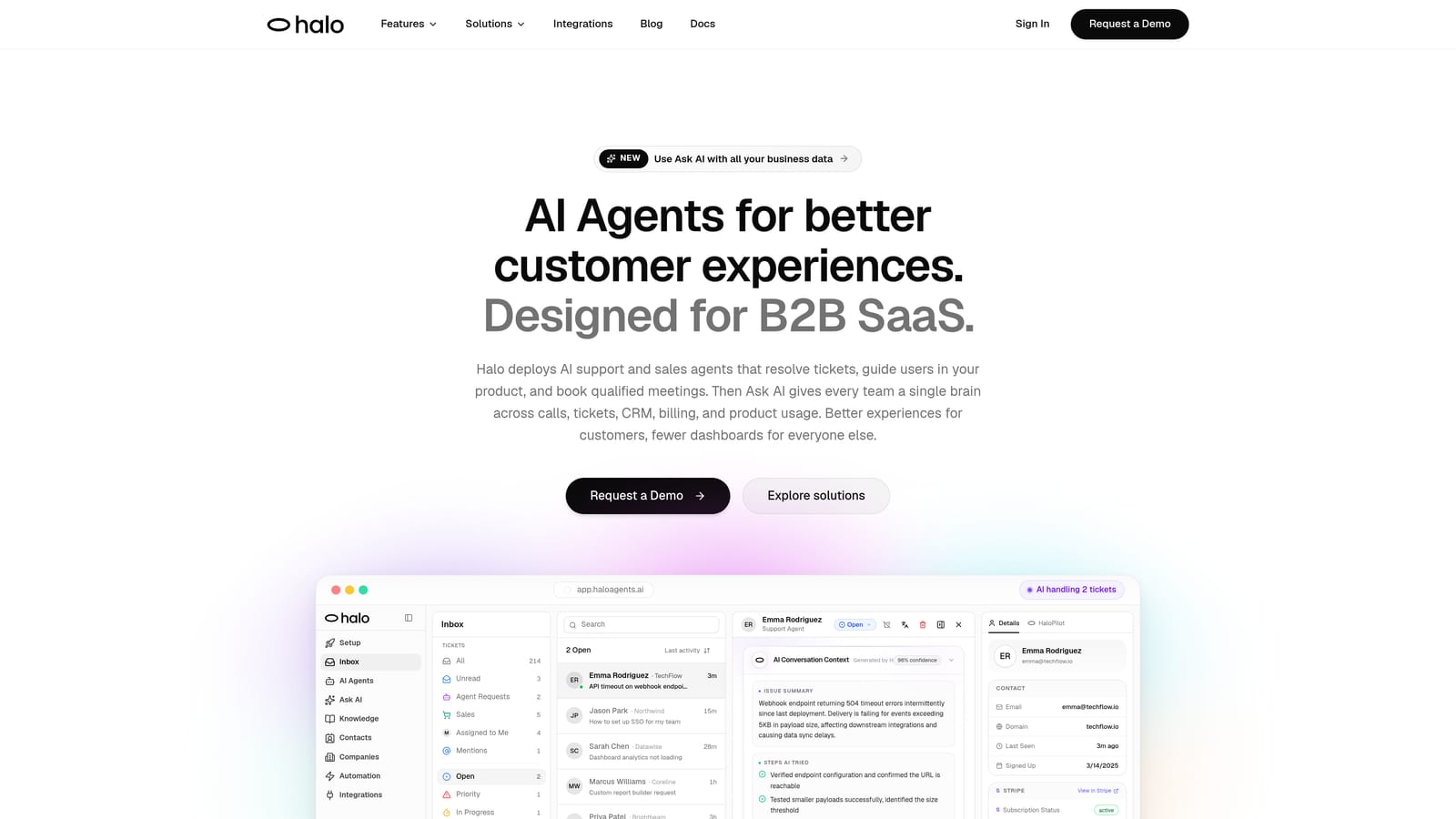
Halo AI is an AI-first customer support platform built specifically for B2B SaaS, deploying intelligent agents that resolve tickets, guide users visually through your product, and surface business intelligence — all while learning from every interaction.
Where This Tool Shines
What separates Halo from most platforms on this list is architectural intent. It wasn't built as a ticketing system with AI added later. The resolution logic, contextual awareness, and learning mechanisms are the platform. That distinction matters when you're evaluating how deeply AI can actually operate versus how often it still hands off to a human for routine tasks.
The page-aware chat widget is particularly notable for SaaS teams. Rather than offering generic help content, Halo sees what the user is currently looking at inside your product and can provide visual UI guidance tied to that specific context. For complex B2B software where user confusion is often highly contextual, this kind of situational awareness changes the quality of support dramatically.
Key Features
Page-Aware Chat Widget: Understands the user's current location within your product and delivers visual, context-specific guidance rather than generic knowledge base links.
Autonomous Ticket Resolution: AI agents handle tickets end-to-end, with smart live agent handoff reserved for genuinely complex issues that require human judgment.
Auto Bug Ticket Creation: Automatically identifies and routes bug reports directly to Linear, closing the loop between support and engineering without manual triage.
Smart Inbox with Business Intelligence: Goes beyond ticket metrics to surface customer health signals, revenue intelligence, and anomaly detection — turning support data into strategic insight.
Broad Integration Stack: Connects natively to Linear, Slack, HubSpot, Intercom, Stripe, Zoom, PandaDoc, and Fathom, meaning it fits into the full SaaS business stack rather than operating in isolation.
Continuous Learning: Every resolved interaction improves the AI's future performance, so the platform gets meaningfully smarter over time rather than staying static.
Best For
B2B SaaS companies that are scaling customer volume without wanting to scale headcount proportionally. Particularly strong for product-led growth teams where users need contextual, in-product guidance, and for organizations that want support data to feed into broader business intelligence rather than sitting in a separate silo.
Pricing
Available on request. Book a demo at haloagents.ai to get pricing tailored to your team's volume and use case.
2. Intercom
Best for: Mid-market teams wanting a polished all-in-one messenger with strong AI conversation handling.
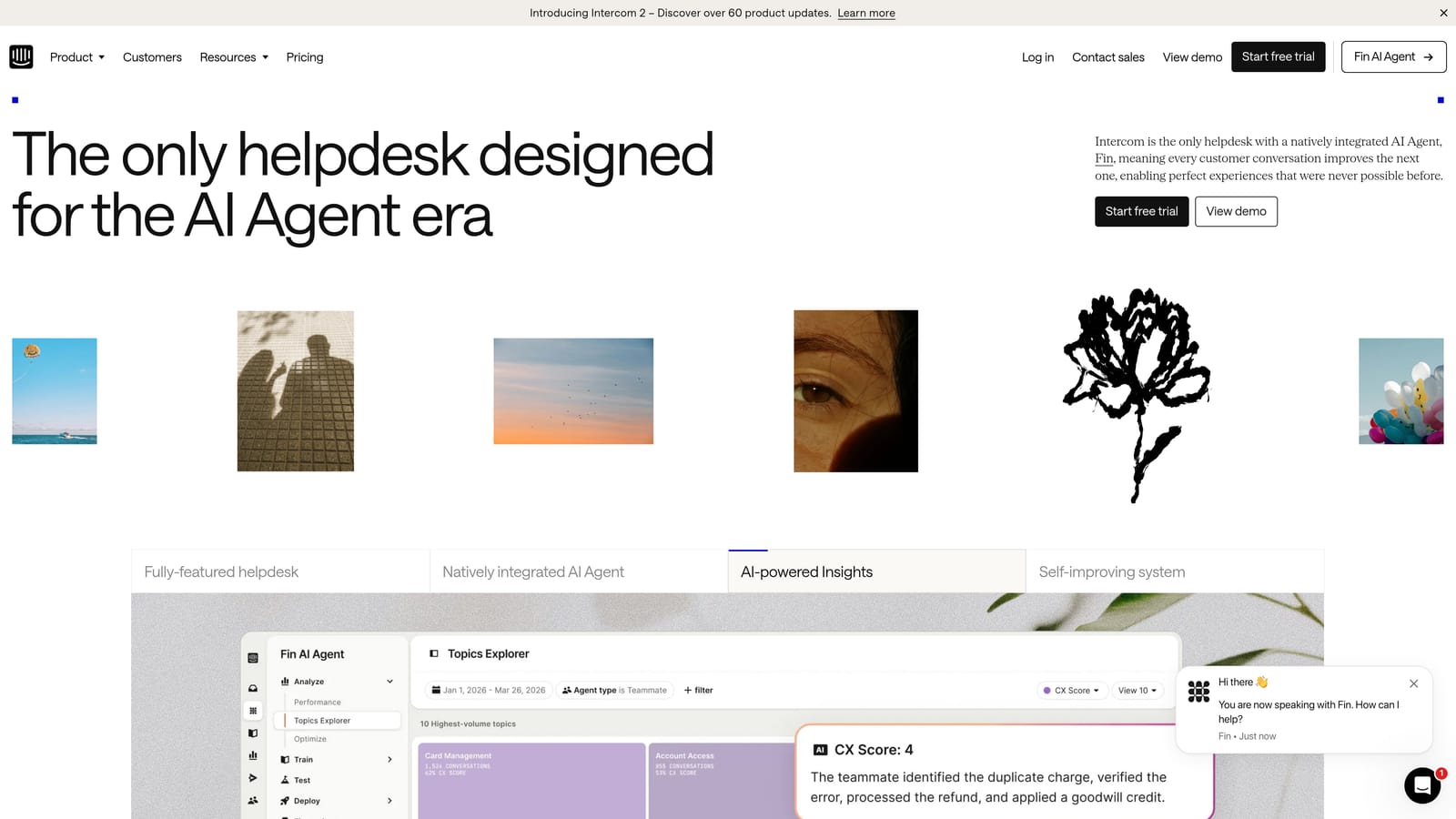
Intercom is a mature customer messaging platform featuring Fin, an AI agent built on large language models that handles conversational support queries autonomously.
Where This Tool Shines
Intercom has one of the most refined in-app messenger experiences on the market. The UX is polished, the customization options are extensive, and Fin represents a serious investment in AI-powered resolution rather than just agent assistance. For teams that want conversational AI with a proven track record, Fin handles a meaningful portion of common queries without human involvement.
The app marketplace is also a genuine strength. With hundreds of integrations available, Intercom connects to most of the tools in a typical SaaS stack. That said, the platform was originally designed around human-led conversations, and the AI layer, while capable, reflects that heritage in how it's structured.
Key Features
Fin AI Agent: Handles autonomous query resolution via natural conversation, drawing on your knowledge base and configured content.
AI Copilot: Assists human agents with suggested replies, ticket summarization, and next-step guidance during live conversations.
In-App Messenger: Highly customizable messenger with strong UX, widely regarded as one of the best in the category.
Proactive Messaging and Product Tours: Supports outbound messaging campaigns and guided product walkthroughs alongside reactive support.
Large App Marketplace: Hundreds of integrations covering CRM, billing, analytics, and more.
Best For
Mid-market SaaS and tech companies that want a well-rounded messaging platform with solid AI capabilities and don't need deep business intelligence beyond support metrics. Teams already invested in the Intercom ecosystem will find the AI additions genuinely useful.
Pricing
Starts at approximately $39/month; AI features and usage-based pricing add meaningful cost at scale. Check intercom.com for current plans.
3. Zendesk
Best for: Enterprise teams with complex routing logic and large agent operations needing AI-assisted workflows.
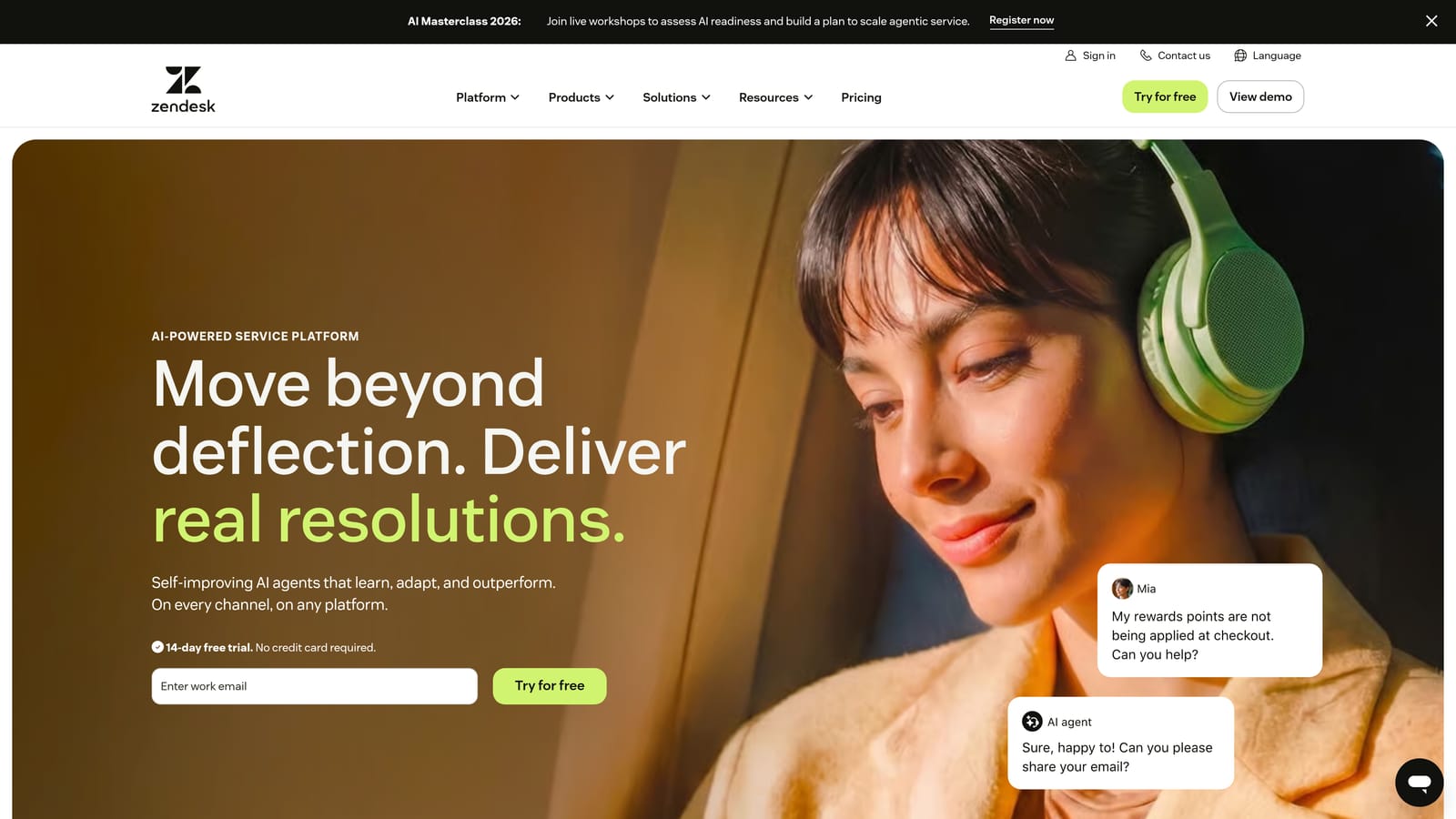
Zendesk is the dominant enterprise ticketing platform, now layering AI Copilot and intelligent triage onto its established ticketing backbone.
Where This Tool Shines
Zendesk's core strength is operational depth. The workflow customization, SLA management, and routing logic available here are unmatched for large support operations with complex rules. The marketplace of over 1,000 integrations means it connects to virtually anything. For enterprises that have built significant processes around Zendesk, the AI additions provide real productivity gains for agents.
Where it's more limited is in autonomous resolution. Zendesk AI is fundamentally agent-assist oriented: it helps humans work faster rather than replacing human involvement for routine tickets. The underlying architecture remains ticket-queue-first, which shapes what the AI can realistically do without human oversight.
Key Features
AI Copilot: Provides agents with suggested replies, ticket summarization, and next-step guidance to speed up resolution.
Intelligent Triage: Automatically classifies and routes incoming tickets based on intent, sentiment, and content.
Macro Suggestions: AI recommends relevant macros based on ticket context, reducing manual lookup time.
Enterprise-Grade Reporting: Detailed SLA tracking, custom dashboards, and team performance analytics.
Vast Integration Marketplace: Over 1,000 apps covering virtually every tool category in enterprise software.
Best For
Large enterprises with established support operations, complex routing requirements, and significant agent teams. Organizations that need deep customization and compliance-grade reporting will find Zendesk's maturity valuable. Less suited to teams prioritizing autonomous AI resolution over agent productivity.
Pricing
Suite plans from approximately $55/agent/month; AI add-ons are priced separately. Enterprise plans vary significantly. Check zendesk.com for current pricing.
4. Freshdesk
Best for: SMBs and growing teams wanting AI-assisted support at competitive price points with a free entry tier.
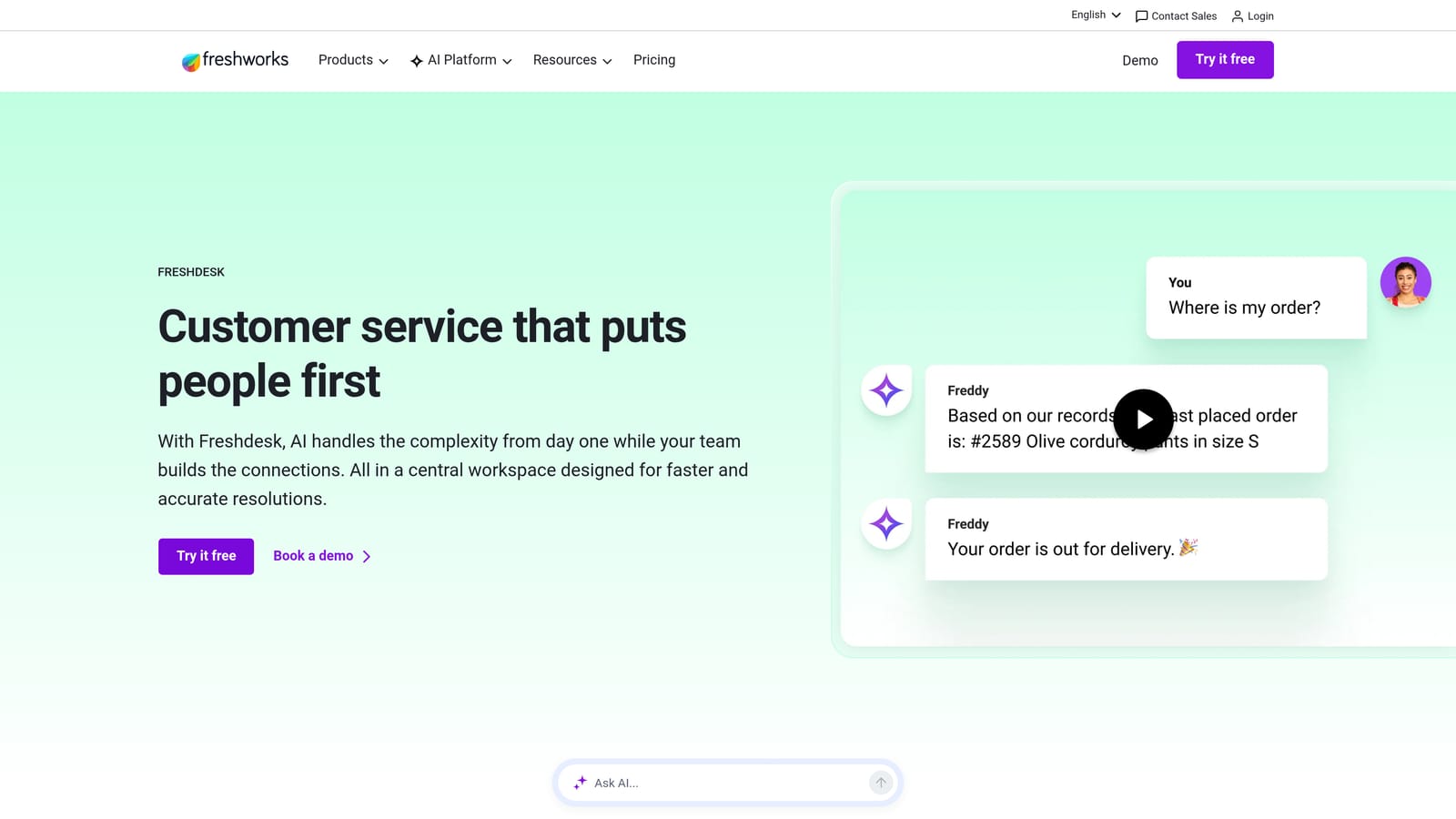
Freshdesk is an SMB-friendly helpdesk platform where Freddy AI provides ticket classification, suggested responses, and chatbot functionality at accessible price points.
Where This Tool Shines
Freshdesk punches above its price point for teams that don't need enterprise-level complexity. Freddy AI covers the practical bases well: classifying incoming tickets, suggesting relevant responses to agents, and powering a self-service chatbot that handles common queries. The setup experience is generally smoother than Zendesk, making it accessible to teams without dedicated IT resources.
Freddy Insights adds a layer of analytics and trend detection that helps support managers spot patterns without building custom reports. It won't match the depth of enterprise platforms, but for SMBs managing growing ticket volume, it covers the essentials effectively.
Key Features
Freddy AI: Handles ticket classification and suggests relevant responses to agents based on ticket content and historical data.
Freddy Copilot: Agent productivity tools including response drafting and summarization for faster resolution.
Freddy Self Service: Built-in chatbot builder for creating automated self-service flows without code.
Freddy Insights: Analytics layer that surfaces support trends and performance anomalies for managers.
Free Tier: Available for teams getting started, with paid AI features unlocking at higher tiers.
Best For
SMBs and mid-market teams that want AI capabilities without enterprise pricing or implementation complexity. A strong fit for teams migrating off basic email-based support who want structured ticketing with AI assistance built in from day one.
Pricing
Free tier available; paid plans from approximately $15/agent/month; AI tiers priced higher. Check freshworks.com for current plan details.
5. Salesforce Service Cloud
Best for: Large enterprises where support is tightly coupled to CRM data and sales workflows.
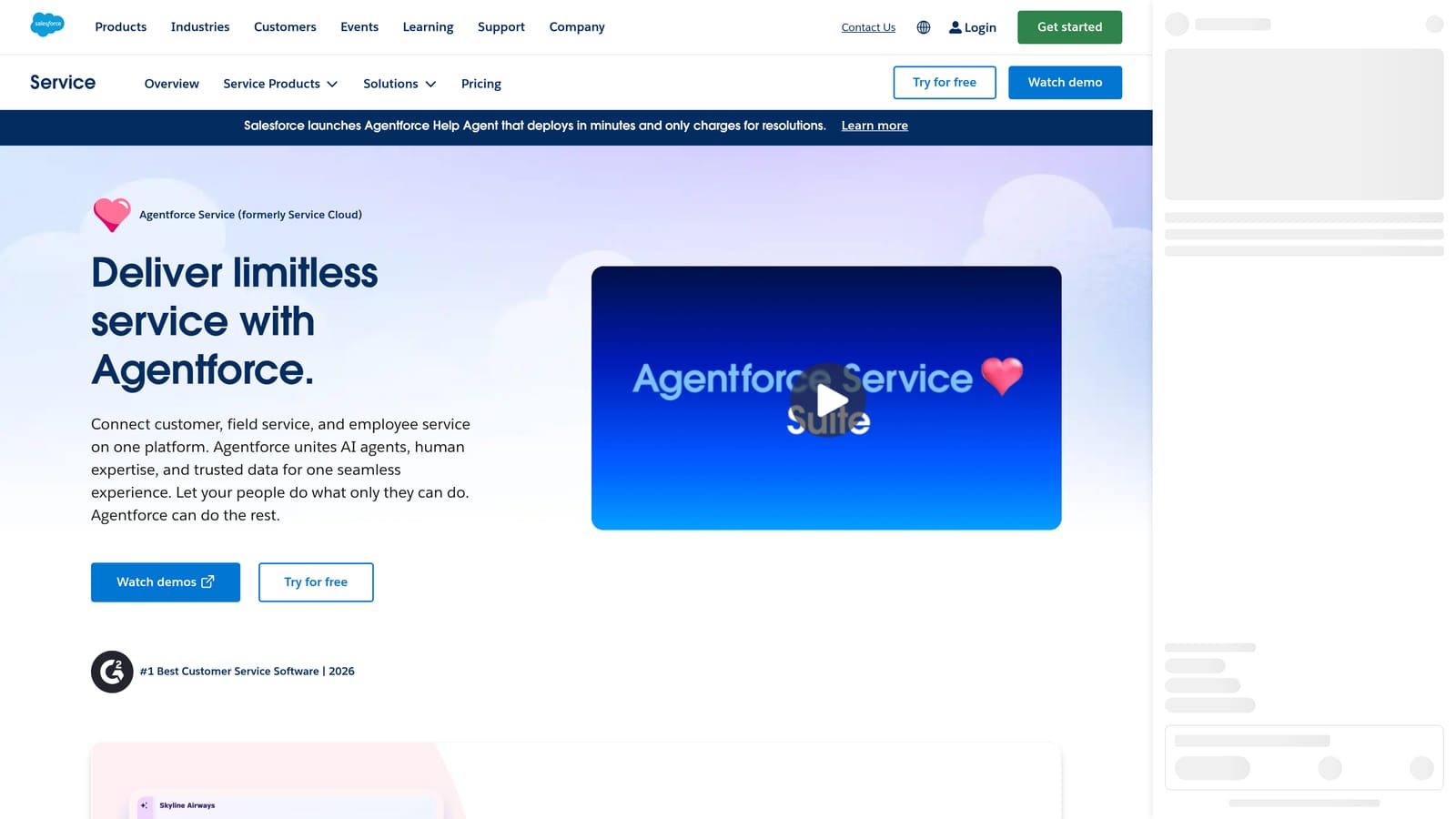
Salesforce Service Cloud is enterprise support software deeply integrated with Salesforce CRM, using Einstein AI to personalize support with full customer data context.
Where This Tool Shines
The defining advantage of Service Cloud is the Salesforce data model. When support agents can see a customer's full sales history, contract status, and account health alongside their support ticket, the quality of contextual support is genuinely different. Einstein AI leverages that CRM data to personalize responses and predict customer needs in ways that standalone support platforms can't replicate without custom integrations.
Agentforce, Salesforce's AI agent framework, is pushing the platform toward more autonomous action. For organizations already running their business on Salesforce, Service Cloud offers a unified view that's hard to match. The trade-off is significant implementation complexity and cost.
Key Features
Einstein AI: Uses CRM data to personalize support interactions, predict customer needs, and recommend next best actions for agents.
Agentforce: AI-assisted and increasingly autonomous agent actions built on the Salesforce platform.
Customer 360 View: Unified customer profile combining sales, service, and marketing data in a single interface.
Omnichannel Routing: Mature routing across phone, chat, email, and social channels with intelligent prioritization.
Enterprise Customization: Deep workflow automation and configuration options for complex operational requirements.
Best For
Large enterprises already invested in the Salesforce ecosystem where support and sales processes are closely interconnected. Organizations without existing Salesforce infrastructure should weigh implementation costs carefully before committing.
Pricing
Enterprise plans from approximately $165/user/month; implementation and customization costs vary significantly. Check salesforce.com for current enterprise pricing.
6. Help Scout
Best for: Teams that prioritize a human, personal support experience with clean email-native workflows.
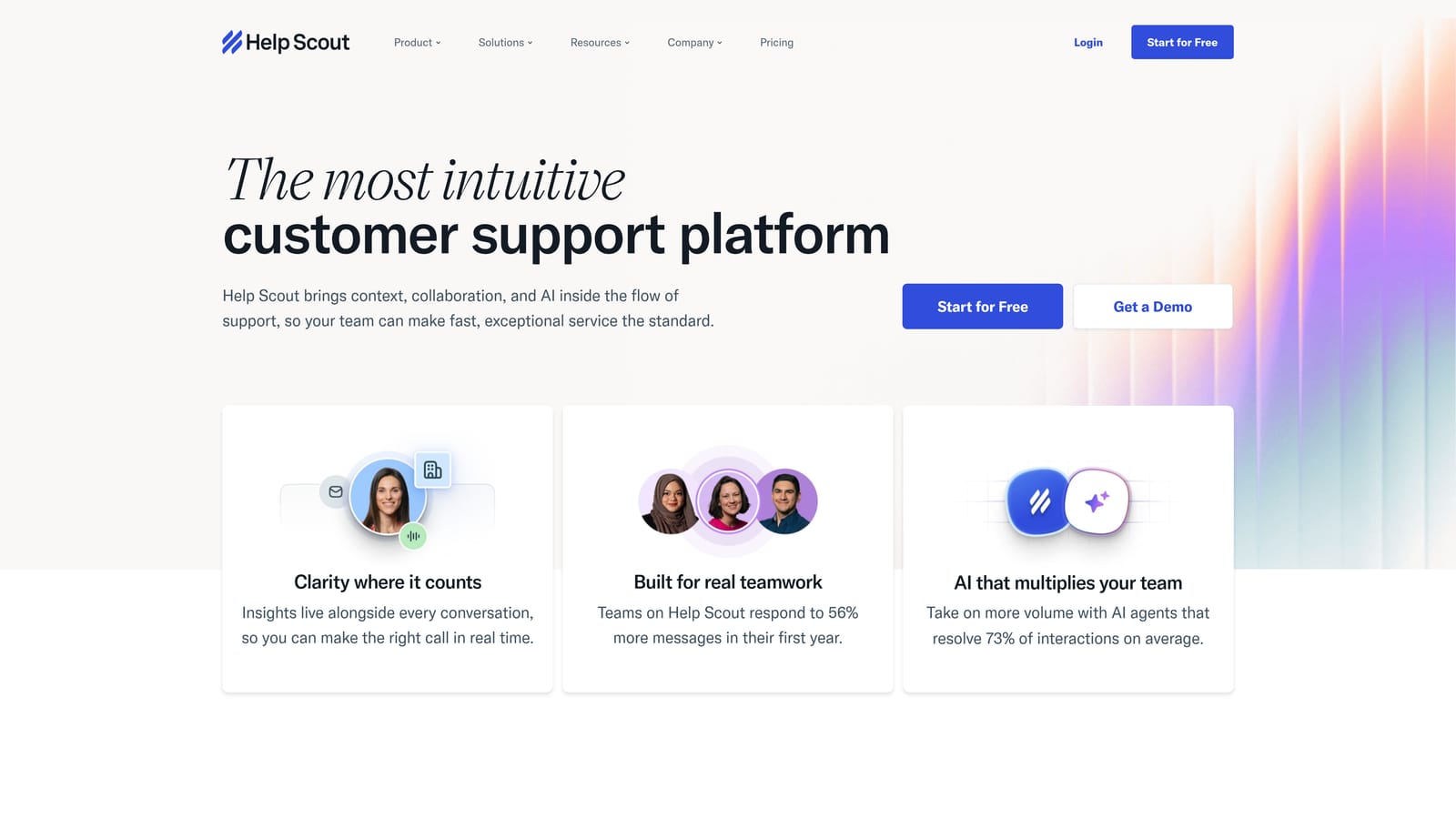
Help Scout is an email-first support platform that prioritizes a human feel, with AI tools focused on agent productivity rather than autonomous resolution.
Where This Tool Shines
Help Scout is deliberately not trying to be everything. The shared inbox is clean, the email-native UX is intuitive, and the platform gets out of the way so agents can focus on actually helping customers. For teams that believe human connection is a competitive differentiator in their support experience, Help Scout's philosophy aligns well with that approach.
The AI features — Summarize, Drafts, and AI Answers — are genuinely useful for agent productivity without pushing toward full automation. Beacon, the in-app widget, provides contextual self-service options without requiring a complex setup. It's a straightforward, well-executed platform that knows its audience.
Key Features
AI Summarize and AI Drafts: Helps agents quickly understand long conversation threads and draft replies faster without replacing their judgment.
AI Answers: Surfaces relevant knowledge base content to agents during conversations to reduce lookup time.
Beacon Widget: In-app help widget for contextual self-service, embedded directly in your product or website.
Shared Inbox: Clean, email-native collaborative inbox with collision detection and conversation assignment.
CSAT Reporting: Built-in customer satisfaction tracking with straightforward reporting dashboards.
Best For
Small to mid-sized teams that handle moderate ticket volumes and prioritize quality of interaction over automation depth. Strong fit for companies where brand voice and human warmth are core to the customer experience, and where high-volume autonomous resolution isn't the primary goal.
Pricing
Plans from approximately $22/user/month with straightforward per-seat pricing. Check helpscout.com for current plan details.
7. Kustomer
Best for: Consumer brands managing complex, multi-channel customer histories that need a unified timeline view.
Kustomer is a CRM-native support platform that presents a unified customer timeline, with AI handling intent detection and routing across all communication channels.
Where This Tool Shines
Kustomer's core differentiator is its data model. Rather than organizing support around individual tickets, it organizes everything around the customer: every email, chat, order, and interaction appears in a single chronological timeline. For consumer brands dealing with customers who have long, complex interaction histories, this view dramatically reduces the time agents spend piecing together context.
The AI layer handles intent detection and intelligent routing, ensuring conversations reach the right team or workflow based on what the customer actually needs. The omnichannel coverage is broad, spanning chat, email, SMS, social, and voice. It's more naturally suited to consumer support operations than to B2B SaaS environments.
Key Features
Unified Customer Timeline: Every interaction across all channels presented chronologically in a single customer-centric view.
AI Intent Detection: Automatically identifies customer intent from incoming messages to route conversations appropriately.
Omnichannel Coverage: Handles chat, email, SMS, social, and voice from a single platform.
Business Process Automation: Workflow automation for repetitive operational tasks without manual agent involvement.
Native CRM Data Model: Customer-centric rather than ticket-centric architecture, enabling richer context for every interaction.
Best For
Consumer brands and DTC companies with complex customer histories and high omnichannel volume. Less suited to B2B SaaS teams whose support needs center on product guidance, technical troubleshooting, and business intelligence rather than order and interaction history management.
Pricing
Enterprise pricing from approximately $89/user/month; contact kustomer.com for a full quote.
8. Tidio
Best for: Small businesses and e-commerce sites wanting affordable AI chatbot resolution with minimal setup time.
Tidio is an SMB-focused live chat and AI chatbot platform featuring Lyro, a conversational AI that resolves common queries with minimal configuration required.
Where This Tool Shines
Tidio's appeal is simplicity and speed. Lyro, the AI chatbot, can handle a meaningful share of common queries through natural conversation without requiring extensive training data or complex setup. For small businesses that need to get something working quickly without a dedicated implementation team, the barrier to entry is genuinely low.
The visual chatbot flow builder makes it easy to create custom automation paths for specific scenarios. E-commerce integrations with Shopify and WooCommerce add practical value for online retail teams. The trade-off is limited depth for complex B2B SaaS use cases, enterprise integrations, or sophisticated business intelligence needs.
Key Features
Lyro AI Chatbot: Conversational AI that resolves common queries autonomously through natural dialogue with minimal training required.
Live Chat: Easy website embed with a clean chat interface for human agent fallback when needed.
Visual Flow Builder: Drag-and-drop chatbot builder for creating custom automation sequences without coding.
E-Commerce Integrations: Native connections to Shopify and WooCommerce for order-related query handling.
Low-Cost Entry: Free plan available with paid AI tiers accessible to small business budgets.
Best For
Small businesses, e-commerce stores, and early-stage companies that need functional AI chatbot support without enterprise-level complexity or cost. Not designed for the integration depth or business intelligence requirements of B2B SaaS teams at scale.
Pricing
Free plan available; Lyro AI from approximately $29/month, scaling with conversation volume. Check tidio.com for current plan details.
9. Gorgias
Best for: E-commerce brands, particularly Shopify merchants, needing AI that handles order and shipping queries automatically.
Gorgias is a support platform purpose-built for e-commerce, with deep Shopify integration and AI that auto-closes routine order and shipping queries without agent involvement.
Where This Tool Shines
Gorgias does one thing exceptionally well: e-commerce support. The depth of Shopify integration means agents can see order details, process refunds, and update shipping information without leaving the support interface. The AI auto-close feature handles the high-volume, low-complexity queries that dominate e-commerce support queues: "Where's my order?" and "How do I return this?" get resolved automatically, freeing agents for more nuanced situations.
The revenue-per-ticket analytics are a genuinely useful differentiator for e-commerce teams, connecting support activity to sales outcomes in a way that most helpdesks don't attempt. It's a highly specialized tool that excels in its domain and would be the wrong fit outside of it.
Key Features
Deep Shopify Integration: Native connection to Shopify, Magento, and BigCommerce with order data surfaced directly in the support interface.
AI Auto-Close: Automatically resolves and closes routine order, shipping, and return queries without agent review.
Revenue-Per-Ticket Analytics: Connects support interactions to sales outcomes, showing which support activities drive or protect revenue.
Dynamic Macros: Response templates that pull live order data from Shopify, enabling personalized automated replies at scale.
Omnichannel Inbox: Unified inbox covering email, chat, social, and SMS for e-commerce customer communication.
Best For
DTC e-commerce brands and Shopify merchants with high volumes of order-related queries. Highly specialized for retail support workflows. Not designed for B2B SaaS, technical product support, or teams needing business intelligence beyond e-commerce metrics.
Pricing
Plans from approximately $10/month, scaling with monthly ticket volume. Check gorgias.com for current pricing tiers.
Which Platform Is Right for Your Team?
The most important question when evaluating these platforms isn't which one has the most features. It's whether AI is a layer added on top of existing workflows or the core architecture the platform was designed around. That distinction shapes everything from how deeply the AI can operate to how much it improves over time.
Here's a quick guide organized by use case to help you narrow the field:
AI-First B2B SaaS: Halo AI is purpose-built for this. Page-aware context, autonomous resolution, business intelligence, and continuous learning make it the strongest fit for SaaS teams that want AI doing real work, not just assisting agents.
Enterprise Ticketing Backbone: Zendesk or Salesforce Service Cloud, depending on whether complex routing logic or CRM integration is the primary driver. Both are mature, powerful, and expensive to implement fully.
Mid-Market All-in-One Messenger: Intercom offers the most polished messaging experience with capable AI in Fin, particularly for teams already invested in the Intercom ecosystem.
Budget-Conscious SMB: Freshdesk delivers solid AI capabilities at competitive pricing with a free entry tier. Tidio is an even lighter option for very small teams or e-commerce businesses just getting started.
E-Commerce and Shopify: Gorgias is the clear choice for DTC brands. The Shopify depth and AI auto-close for order queries are genuinely specialized and hard to replicate with a general-purpose platform.
Human-Feel Simplicity: Help Scout is the right answer for teams that want clean, email-native workflows with AI assistance rather than automation. It's deliberately simple and well-executed for that audience.
If you're leading a B2B SaaS team and you're still running support on a legacy helpdesk with AI bolted on as an afterthought, the gap between what you have and what's possible has grown significantly. Your support team shouldn't scale linearly with your customer base. Let AI agents handle routine tickets, guide users through your product, and surface business intelligence while your team focuses on complex issues that need a human touch. See Halo in action and discover how continuous learning transforms every interaction into smarter, faster support.