10 Best Machine Learning Customer Service Tools in 2026
Explore the 10 best machine learning customer service tools of 2026, evaluated for ML sophistication, integration depth, and B2B value. This guide covers AI-native platforms and ML-enhanced helpdesks that go beyond rule-based chatbots to deliver context-aware, continuously learning support solutions that help growing teams resolve issues autonomously without scaling headcount proportionally.
 Matt PattoliFounder15 min read
Customer service has undergone a quiet revolution. The rule-based chatbots of five years ago — the ones that sent users in circles until they rage-quit — have given way to machine learning systems that actually understand context, learn from past interactions, and resolve issues autonomously. The difference isn't cosmetic. It's architectural.
ML-powered customer service tools bring pattern recognition, continuous learning, and predictive capabilities that static decision trees simply cannot replicate. For B2B teams managing growing support volumes without proportional headcount growth, choosing the right tool has become a strategic decision, not just an operational one.
The tools below were evaluated on ML sophistication, integration depth, ease of deployment, and overall value for B2B teams. The list spans AI-native platforms built from the ground up around machine learning, and ML layers added to established helpdesk ecosystems. Both approaches have merit — the right choice depends on where you're starting from and where you need to go.
Here are the top machine learning customer service tools worth your attention in 2026.
1. Halo AI
Best for: B2B SaaS teams that want an AI-native support platform with continuous learning and deep product context.
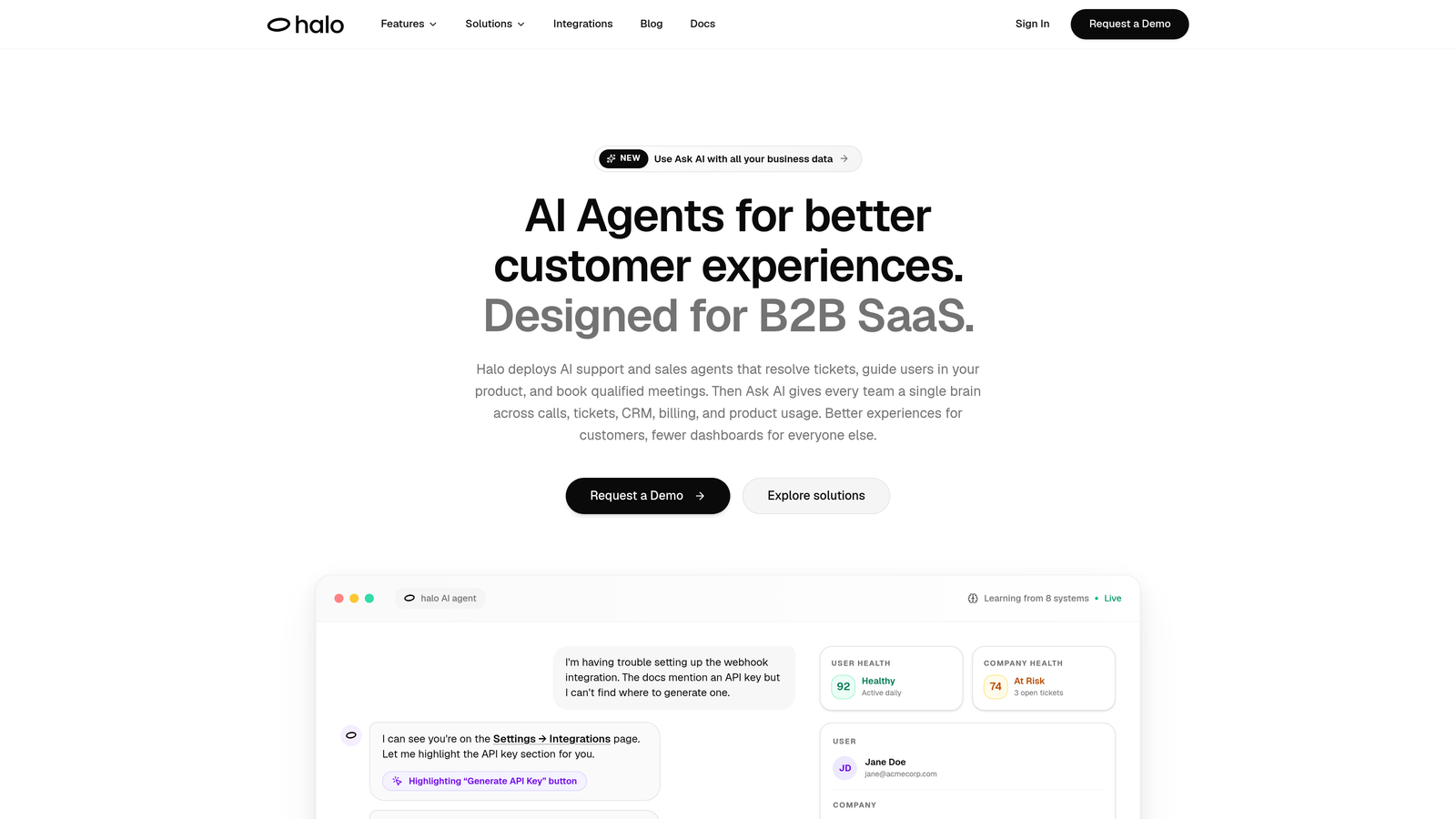
Halo AI is an AI-native customer support platform that deploys intelligent agents to resolve tickets, guide users through your product, and auto-create bug reports — learning from every interaction.
Where This Tool Shines
What separates Halo from ML features bolted onto legacy helpdesks is the architecture. The platform was built AI-first, which means the learning loop is central to how it operates rather than an add-on layer. Every resolved ticket, every user session, every escalation feeds back into the system to improve future resolution accuracy.
The page-aware context capability is genuinely distinctive. Halo's chat widget can see what a user sees — their current page, their UI state — and deliver guidance that's specific to where they are in your product. That level of contextual awareness is rare, and it meaningfully changes the quality of automated support interactions.
Key Features
Page-Aware Chat Widget: Understands the user's current product context to deliver precise, visual UI guidance rather than generic help content.
Continuous ML Learning: Improves resolution accuracy over time by learning from every ticket interaction, agent correction, and user session.
Auto Bug Ticket Creation: Detects issues from user sessions and automatically creates structured bug reports with relevant context, routing them to the right team.
Smart Inbox with Business Intelligence: Goes beyond ticket management to surface customer health signals, revenue intelligence, and anomaly detection across your support data.
Deep Integration Stack: Connects natively with Linear, Slack, HubSpot, Intercom, Stripe, Zoom, PandaDoc, and Fathom, making it a hub for your entire customer-facing operation.
Best For
B2B SaaS companies that need more than ticket deflection. Halo is particularly well-suited for product-led growth teams, support leaders who want business intelligence alongside resolution metrics, and organizations where the support stack needs to connect tightly with engineering, sales, and customer success workflows.
Pricing
Contact for pricing. Halo is designed for B2B SaaS teams and pricing is tailored to team size and integration requirements.
2. Zendesk AI
Best for: Teams already on the Zendesk Suite who want ML-powered triage, agent assist, and automated resolution without switching platforms.
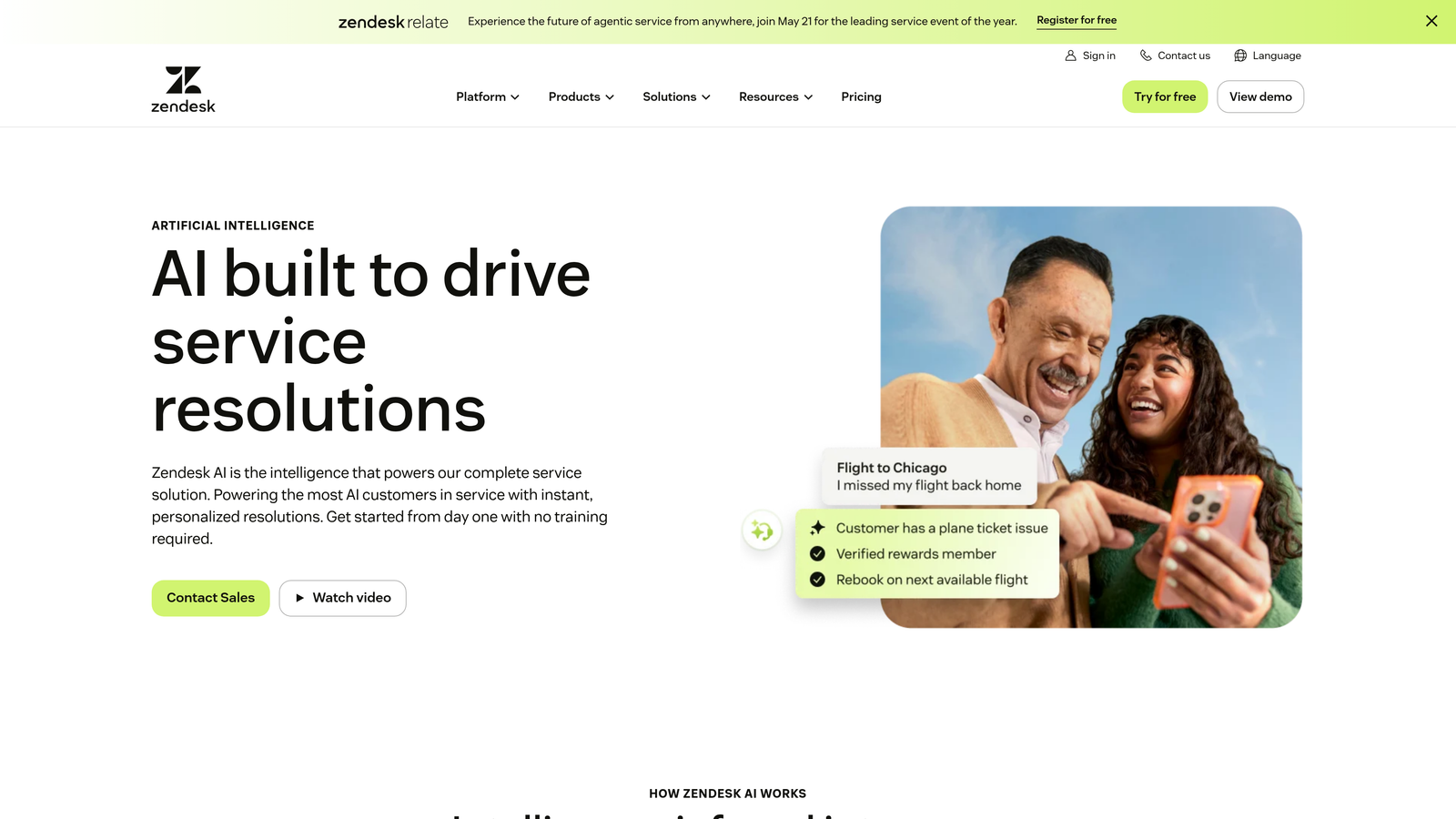
Zendesk AI is an ML-powered intelligence layer built directly into the Zendesk Suite, offering intent detection, intelligent triage, generative AI for agents, and AI-powered bots for automated resolution.
Where This Tool Shines
Zendesk AI's biggest advantage is zero migration friction. If your team is already working inside Zendesk, the AI features activate within your existing workflows rather than requiring a platform change. The intent detection and sentiment analysis work across your historical ticket data, which means the models start with meaningful context from day one.
The generative AI agent assist is genuinely useful for reducing handle time. Agents get reply drafts, tone adjustments, and ticket summaries without leaving their workspace, which keeps the human-in-the-loop experience smooth even as automation takes on more volume.
Key Features
Intelligent Triage: Automatically detects intent, language, and sentiment to route tickets to the right team or trigger automated resolution flows.
Generative AI Agent Assist: Drafts replies, adjusts tone, and summarizes tickets in real time to accelerate agent response.
AI-Powered Bots: Trained on your help center content to handle common queries before they reach a human agent.
Macro Suggestions: ML-driven recommendations for canned responses based on ticket context and historical patterns.
Native Ecosystem Integration: Works across the full Zendesk product suite without additional connectors or configuration overhead.
Best For
Mid-market and enterprise teams already invested in the Zendesk ecosystem who want to layer ML capabilities onto existing workflows without a rip-and-replace approach to their support stack.
Pricing
AI features are included in Suite plans starting around $55 per agent per month. An Advanced AI add-on is available for teams needing deeper automation capabilities.
3. Intercom Fin
Best for: Product-led SaaS companies that want an LLM-powered AI agent with high conversational accuracy and seamless human handoff.
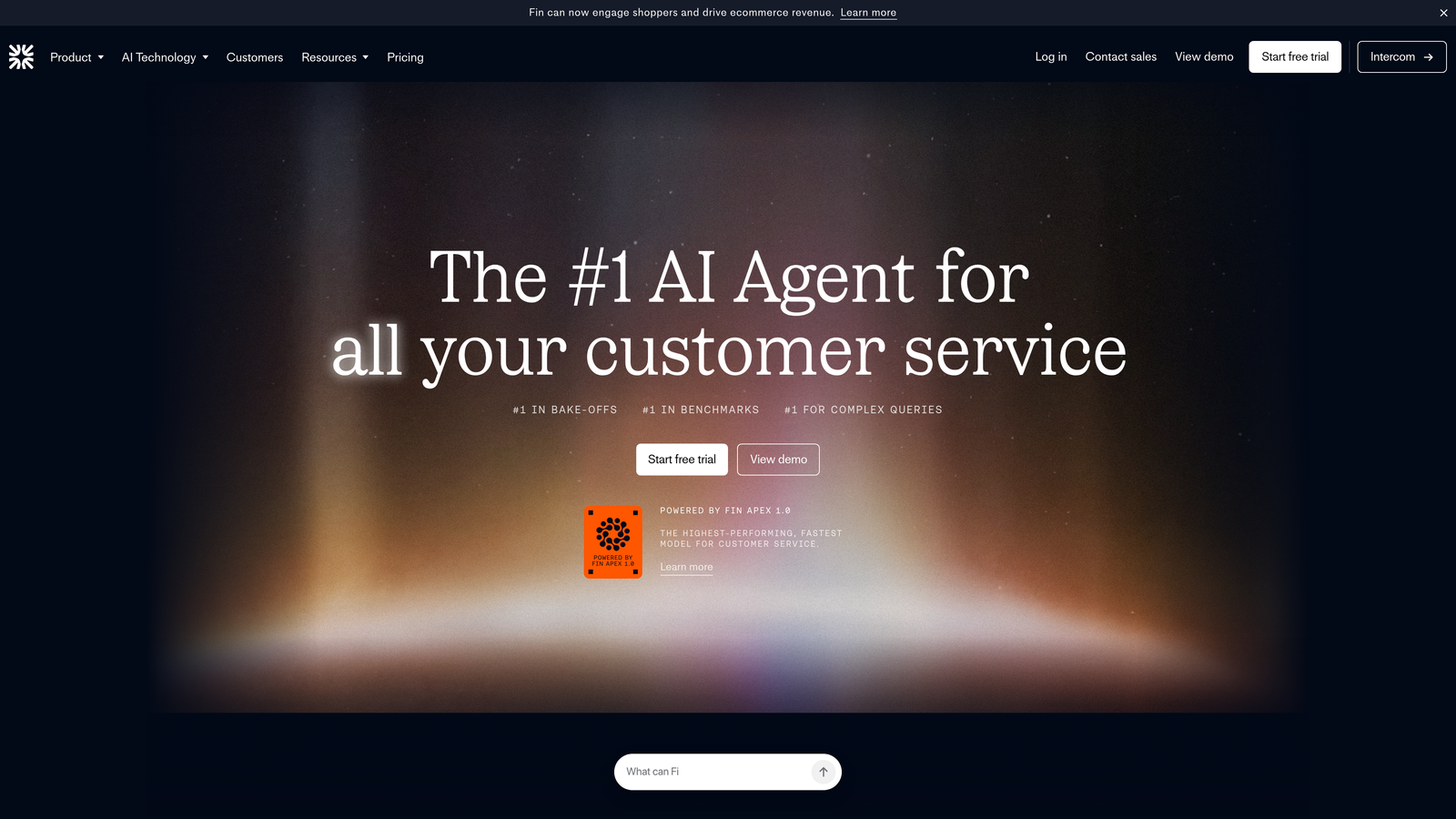
Intercom Fin is an AI agent built on large language models that resolves customer questions by reasoning over your help center, past conversations, and custom data sources.
Where This Tool Shines
Fin's resolution engine doesn't just pattern-match against FAQ content. It reasons over multiple sources simultaneously — help articles, PDFs, past conversations, custom URLs — to construct accurate, conversational responses. That multi-source approach means it handles nuanced questions that would trip up simpler keyword-matching bots.
The per-resolution pricing model is worth noting. It aligns Intercom's incentives with yours: you pay for outcomes, not seat licenses or chat volumes. For teams with variable support demand, that structure can be more predictable than per-agent pricing.
Key Features
LLM-Powered Resolution Engine: Reasons across your knowledge base and support content to generate accurate, context-aware responses rather than retrieving static answers.
Multi-Source Ingestion: Pulls from help articles, PDFs, URLs, and past conversations to build a comprehensive knowledge foundation.
Resolution Rate Analytics: Built-in tracking shows exactly what Fin resolved, what it escalated, and where knowledge gaps exist.
Custom Answers: Allows teams to define brand-specific or nuanced responses for scenarios where LLM reasoning alone isn't sufficient.
Human Handoff with Context: Escalates to live agents with full conversation history preserved, so customers never have to repeat themselves.
Best For
SaaS companies already using Intercom for customer communications who want to add high-accuracy AI resolution without introducing a separate platform. Also well-suited for teams that prefer outcome-based pricing.
Pricing
Fin charges per resolution. Intercom plans start at $39 per seat per month, with Fin's per-resolution cost layered on top depending on automation volume.
4. Freshdesk Freddy AI
Best for: Growing teams on a budget who want solid ML-powered triage, agent assist, and self-service without enterprise price tags.
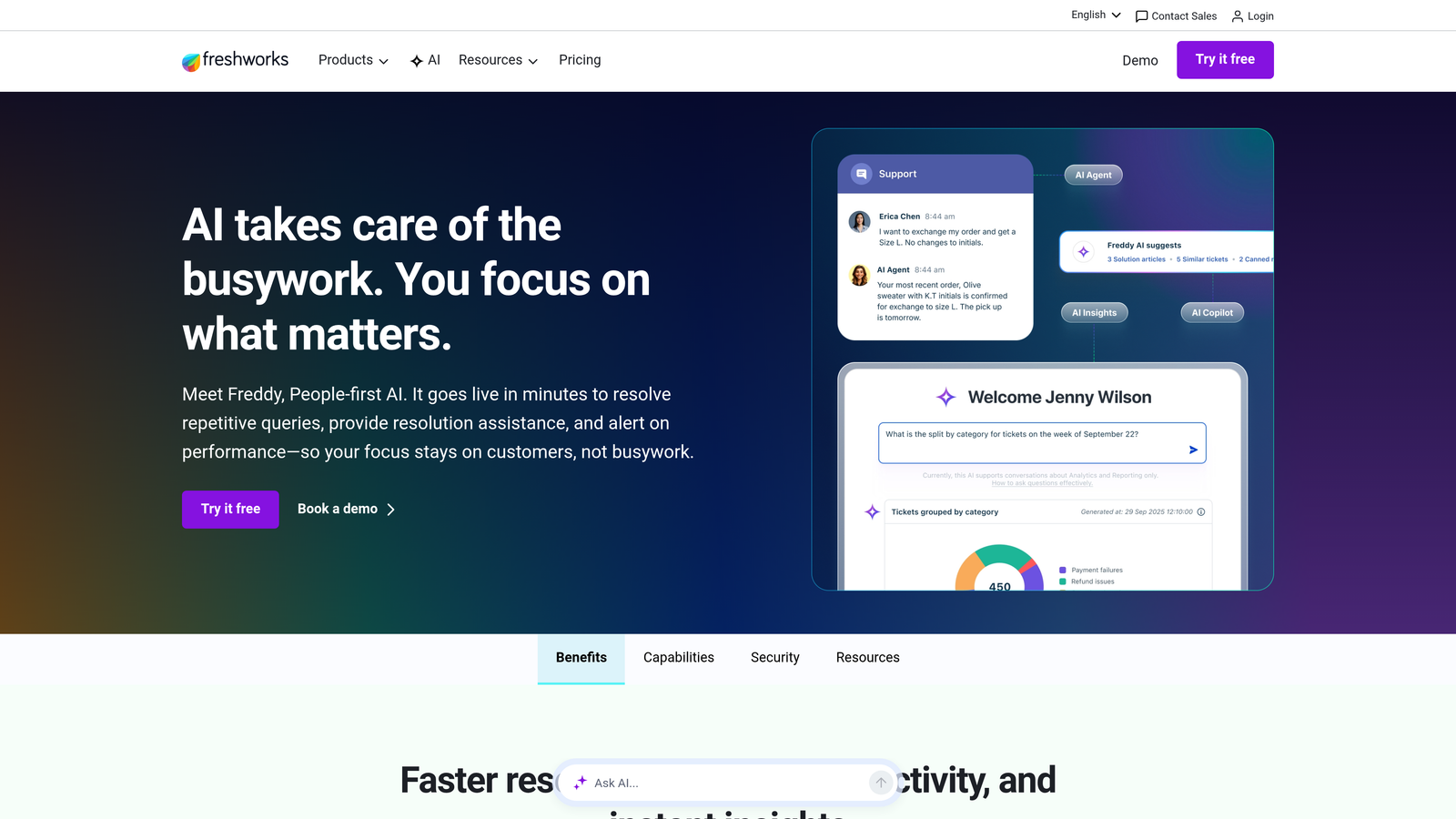
Freshdesk Freddy AI is Freshworks' AI engine embedded across Freshdesk, providing auto-categorization, predictive ticket fields, agent assist, and AI-powered chatbot capabilities at accessible price points.
Where This Tool Shines
Freddy AI punches above its price point. The predictive ticket fields and auto-categorization work reliably for teams with moderate ticket volumes, and the article suggester actively reduces resolution time by surfacing relevant help content to both agents and customers. It's not the most sophisticated ML engine on this list, but it's well-integrated and consistently useful.
The thank you detector is a small but impactful feature. It prevents tickets from being reopened when customers send a simple acknowledgment reply, which keeps resolution metrics clean and reduces noise in the queue.
Key Features
Predictive Ticket Fields: Automatically categorizes, prioritizes, and tags incoming tickets based on historical patterns and content analysis.
Freddy AI Agent: Handles self-service resolution via chat, trained on your help center content.
Canned Response Suggestions: Recommends contextually relevant canned responses to agents based on ticket content.
Thank You Detector: Identifies and filters closing replies so they don't incorrectly reopen resolved tickets.
Article Suggester: Proactively recommends relevant help documentation to both agents and customers during interactions.
Best For
Small to mid-sized teams on Freshdesk who want meaningful ML automation without enterprise pricing. Particularly useful for support teams managing high ticket volumes with limited agent headcount.
Pricing
A free tier is available. AI features are included in the Pro plan starting around $49 per agent per month, making it one of the more accessible options on this list.
5. Ada
Best for: Enterprise teams that need multilingual AI automation with complex workflow support and no-code configurability.
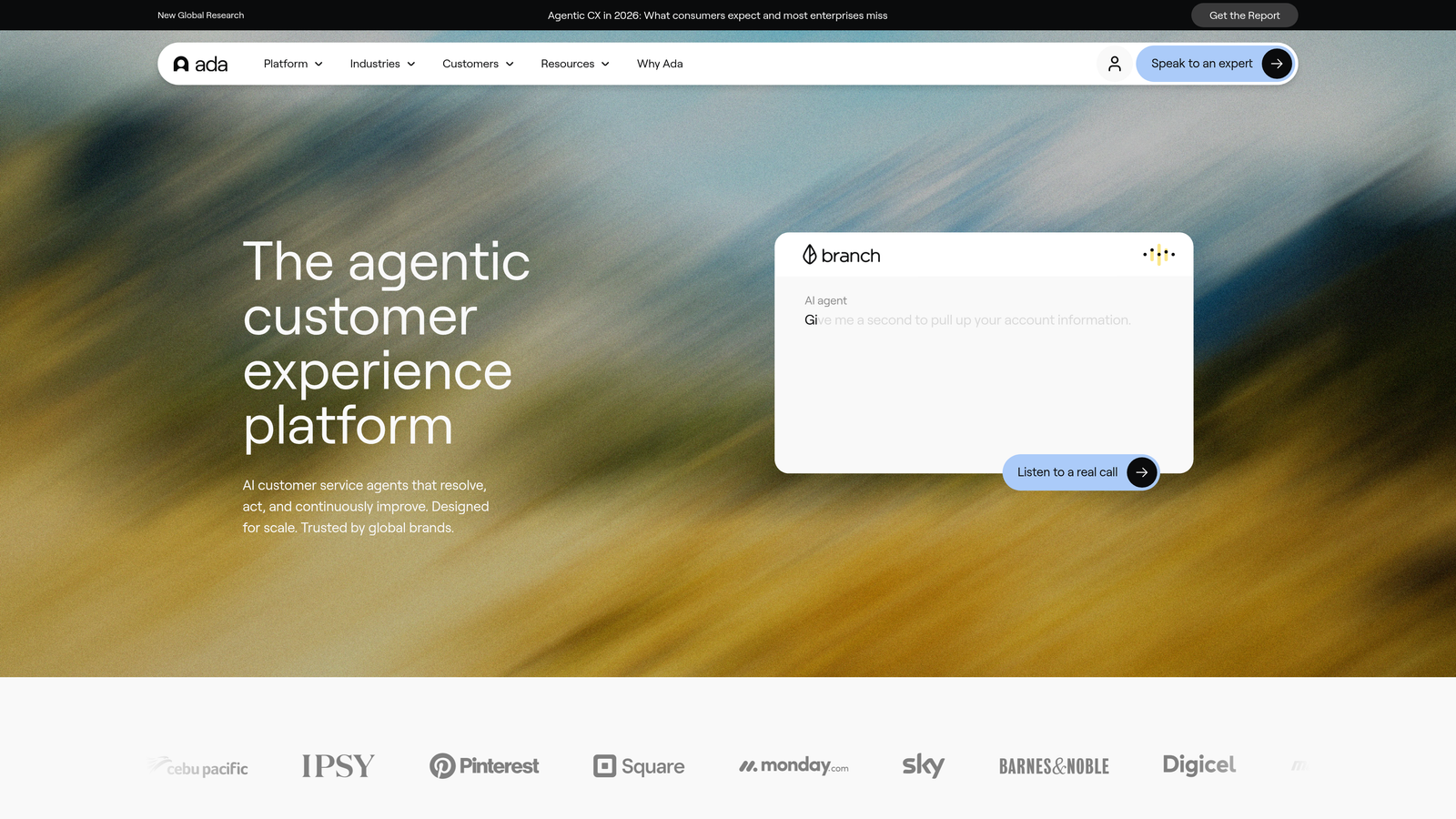
Ada is an enterprise-grade AI agent platform purpose-built for customer service automation, featuring a reasoning engine, multilingual support across 50+ languages, and no-code configuration for complex workflows.
Where This Tool Shines
Ada's reasoning engine is built for complexity. It handles multi-step inquiries that require the AI to gather information, make decisions, and take actions — not just retrieve answers. That action-oriented capability, covering things like processing returns, updating account details, and checking order status, moves it from a Q&A bot into genuine autonomous agent territory.
The multilingual capability is enterprise-grade rather than a checkbox feature. Ada handles 50+ languages without requiring teams to manually translate content or maintain separate conversation flows for each language, which matters significantly for global support operations.
Key Features
AI Reasoning Engine: Handles multi-step, complex customer inquiries that require decision-making rather than simple information retrieval.
Multilingual Support: Operates across 50+ languages without manual translation workflows, enabling consistent global support quality.
No-Code Platform: Business teams can build and manage AI agent workflows without engineering involvement.
Action-Oriented AI: Can process returns, update account information, and check order status autonomously within defined guardrails.
Analytics Dashboard: Tracks resolution rates, conversation quality, and identifies gaps in AI coverage.
Best For
Enterprise organizations with global customer bases, complex support workflows, and the need for AI that can take autonomous actions rather than just answer questions. Strong fit for e-commerce, fintech, and telecom sectors.
Pricing
Custom enterprise pricing. Contact Ada directly for a quote based on conversation volume and integration requirements.
6. Forethought
Best for: Support operations teams that want ML-driven triage, intelligent routing, and knowledge gap discovery before tickets reach agents.
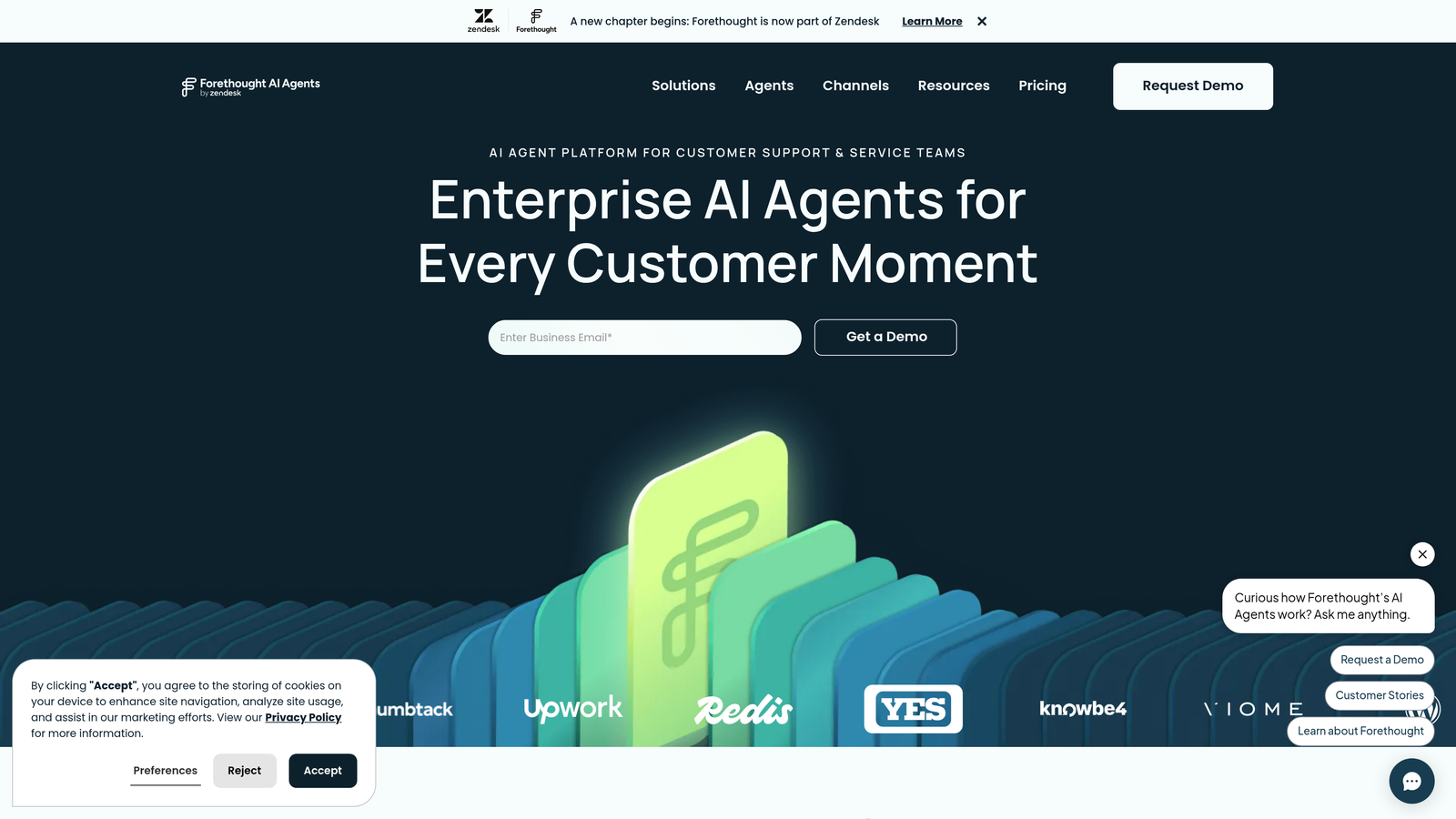
Forethought is an AI platform focused on intelligent ticket triage, routing, and agent assist, using ML to predict urgency, sentiment, and optimal resolution paths before a human agent ever engages.
Where This Tool Shines
Forethought's approach is to intervene earlier in the ticket lifecycle than most tools. Its triage model assesses intent, urgency, and sentiment at the moment a ticket arrives, which means routing decisions are made with ML-derived context rather than simple keyword rules. The result is more accurate queue prioritization and fewer misrouted tickets consuming agent time.
The Discover module adds a layer of operational intelligence that support leaders find valuable: it surfaces trending issues, knowledge gaps, and resolution patterns across your ticket data, turning support operations into a source of product and process insight.
Key Features
Triage Model: Predicts ticket intent, urgency, and sentiment automatically at the point of submission.
Intelligent Routing: Directs tickets to the best-qualified agent or team based on ML-derived context rather than static rules.
Solve: AI agent module for automated Tier 1 ticket resolution before human escalation.
Assist: Delivers real-time knowledge suggestions to agents during live conversations to reduce handle time.
Discover: ML-driven analysis of support trends, knowledge gaps, and resolution patterns across your ticket history.
Best For
Mid-market and enterprise support teams with high ticket volumes where intelligent triage and routing have a meaningful impact on efficiency. Particularly well-suited for operations-focused support leaders who want ML-derived insight, not just automation.
Pricing
Custom pricing based on ticket volume. Contact Forethought directly for a quote.
7. Tidio
Best for: Small businesses and e-commerce teams that want accessible ML-powered chat automation without enterprise complexity or pricing.
Tidio is a live chat and chatbot platform featuring Lyro AI, an ML-powered conversational agent designed to automate common support interactions for smaller teams and e-commerce operations.
Where This Tool Shines
Tidio fills an important gap in the market: genuinely capable ML automation at a price point that works for small businesses. Lyro AI learns from your FAQ and support content to handle routine questions autonomously, which for many small teams represents a meaningful reduction in repetitive ticket volume.
The visual drag-and-drop builder means non-technical teams can design and adjust conversation flows without developer involvement. Combined with native e-commerce integrations, it's a practical choice for Shopify or WooCommerce businesses that need automation but don't have a dedicated support operations function.
Key Features
Lyro AI Chatbot: Learns from your FAQ and support content to handle common customer questions conversationally.
Visual Flow Builder: Drag-and-drop interface for designing custom chatbot conversation flows without coding.
AI Reply Suggestions: Recommends contextually relevant responses to live agents during conversations.
E-Commerce Integrations: Native connections with Shopify, WooCommerce, and other e-commerce platforms.
Visitor Tracking: Monitors visitor behavior to trigger proactive chat engagements at the right moment.
Best For
Small businesses, e-commerce teams, and early-stage startups that want functional ML-powered chat automation without the complexity or cost of enterprise platforms.
Pricing
A free plan is available. Lyro AI is available as an add-on from $39 per month. Paid plans start at $29 per month, making this one of the most accessible options on the list.
8. Cognigy
Best for: Regulated industries and enterprise organizations that need omnichannel conversational AI with advanced NLU and compliance controls.
Cognigy is an enterprise conversational AI platform supporting voice and chat channels with advanced NLU, low-code design tools, and compliance controls built for complex, regulated environments.
Where This Tool Shines
Cognigy is built for organizations where compliance isn't optional. Its enterprise-grade security controls, GDPR compliance, and SOC 2 certification make it a viable choice for financial services, healthcare, and telecommunications companies that need conversational AI without compromising on data governance requirements.
The voice channel support is a meaningful differentiator. Many ML customer service tools focus exclusively on chat and messaging. Cognigy handles voice interactions with real-time transcription and NLU, which matters for support operations that still handle significant call volume alongside digital channels.
Key Features
Advanced NLU Engine: Intent recognition and entity extraction with high accuracy across complex, multi-turn conversations.
Omnichannel Deployment: Operates across voice, chat, messaging apps, and email from a single platform.
Low-Code Flow Editor: Enables complex conversational experience design without deep technical expertise.
Enterprise Compliance Controls: GDPR compliance, SOC 2 certification, and enterprise-grade data security built in.
Agent Assist Mode: Real-time transcription and next-best-action suggestions for human agents handling escalated interactions.
Best For
Large enterprises in regulated industries — financial services, healthcare, telecom — that need omnichannel conversational AI with serious compliance credentials and voice channel support.
Pricing
Enterprise pricing. Contact Cognigy for a custom quote based on channel volume and deployment requirements.
9. Ultimate (now part of Zendesk)
Best for: Teams that want fast time-to-value from pre-trained, industry-specific ML models, now within the Zendesk ecosystem.
Ultimate is an AI automation platform with pre-trained, industry-specific intent models for rapid deployment, now integrated into the Zendesk ecosystem following its acquisition.
Where This Tool Shines
Ultimate's core differentiation has always been speed to value. Rather than requiring teams to train ML models from scratch on their ticket data, Ultimate ships with pre-trained models for specific industry verticals — e-commerce, fintech, travel, SaaS — that arrive with meaningful intent recognition out of the box. That reduces the ramp time significantly compared to platforms that start from a blank slate.
Post-acquisition by Zendesk, Ultimate's capabilities are increasingly woven into the broader Zendesk AI story. For existing Zendesk customers, this means the intent models and multi-channel automation become available within a familiar ecosystem rather than as a standalone integration.
Key Features
Pre-Trained Industry Models: ML models trained on vertical-specific data for faster deployment and higher out-of-the-box accuracy.
CS-Specific NLU: Natural language understanding tuned for customer service contexts rather than general-purpose language tasks.
Multi-Channel Automation: Handles chat, email, and social interactions from a unified automation layer.
Dialogue Builder: Visual tool for designing custom conversation flows layered on top of pre-trained intent models.
Backend Integrations: Connects to order management, CRM, and account systems for action-oriented automation like order lookups and account updates.
Best For
Zendesk customers who want rapid deployment of industry-tuned ML automation without extensive model training. Also strong for teams in verticals like e-commerce, travel, or fintech where pre-trained intent coverage is particularly relevant.
Pricing
Now part of Zendesk; pricing varies based on your Zendesk plan and automation volume. Contact Zendesk for specifics.
10. Salesforce Einstein for Service
Best for: Salesforce Service Cloud users who want ML-powered case routing, generative AI replies, and native CRM intelligence in one platform.
Salesforce Einstein for Service is the ML-powered intelligence layer within Salesforce Service Cloud, offering predictive case routing, next-best-action recommendations, and generative AI for service replies.
Where This Tool Shines
Einstein's primary advantage is depth of CRM integration. Because it operates natively within Salesforce, the ML models have access to the full customer record: purchase history, account status, prior case history, contract details. That context produces routing and recommendation quality that standalone tools can't replicate without significant integration work.
The generative AI capabilities for case wrap-up and knowledge article creation reduce post-interaction administrative work meaningfully. For service teams managing complex B2B accounts, automating case documentation frees agents to focus on relationship quality rather than record-keeping.
Key Features
Predictive Case Classification: Routes cases based on ML analysis of historical patterns, case content, and customer attributes.
Einstein GPT for Service: Generates reply drafts and knowledge articles from case context to accelerate agent response.
Next-Best-Action Recommendations: Suggests the most relevant action for agents based on case context and customer history.
Automated Case Wrap-Up: Generates case summaries automatically at resolution to reduce post-interaction documentation time.
Native CRM Context: Full access to customer account history, purchase data, and relationship records within the service workflow.
Best For
Organizations already running Salesforce Service Cloud as their primary CRM and service platform. The native integration depth makes Einstein substantially more capable within the Salesforce ecosystem than it would be as a standalone tool.
Pricing
Included in Service Cloud Enterprise and above. Einstein add-ons start from $50 per user per month for advanced AI capabilities.
Which Tool Is Right for Your Team
The right ML customer service tool depends less on feature checklists and more on where your team is starting from and what kind of intelligence you actually need.
Here's a quick orientation by use case:
AI-native platform with continuous learning: Halo AI is the strongest choice for B2B SaaS teams that want ML built into the foundation, not bolted on, with the added advantage of page-aware context and business intelligence beyond ticket resolution.
Already on Zendesk: Zendesk AI or Ultimate (now part of Zendesk) give you ML capabilities without migration. Ultimate is particularly strong if you want rapid deployment via pre-trained industry models.
Product-led SaaS: Intercom Fin's LLM reasoning engine and per-resolution pricing model align well with product-led teams managing variable support demand.
Budget-conscious teams: Freshdesk Freddy AI and Tidio both deliver meaningful ML automation at accessible price points. Tidio skews toward e-commerce; Freddy works well for broader B2B support contexts.
Enterprise multilingual or regulated industries: Ada handles complex, multi-step workflows across 50+ languages. Cognigy adds omnichannel voice support with enterprise compliance credentials for regulated sectors.
Salesforce-first organizations: Einstein for Service provides the deepest CRM integration available, and the native context it draws on is difficult to replicate with any other tool in a Salesforce environment.
Intelligent triage and routing: Forethought focuses specifically on the pre-agent moment — triage, routing, and knowledge gap discovery — which makes it a strong complement to any existing helpdesk.
One final consideration worth flagging: there's a meaningful difference between tools that apply ML as a layer on top of rule-based logic and platforms where ML is the underlying architecture. As your support volume scales and your AI needs to handle more complex, context-dependent interactions, that architectural distinction becomes increasingly important to get right from the start.
Your support team shouldn't scale linearly with your customer base. AI agents can handle routine tickets, guide users through your product, and surface business intelligence while your team focuses on the complex issues that genuinely need a human touch. See Halo in action and discover how continuous learning transforms every interaction into smarter, faster support.