9 Best Support Automation Software with Free Trials in 2026
Finding the right support automation software is easier when you can test before you commit — this guide ranks nine of the strongest platforms offering a free trial or meaningful free tier in 2026, evaluated on automation depth, integration ecosystem, onboarding ease, and fit for B2B SaaS teams of every size.
 Grant CooperFounder13 min read
If you're evaluating support automation software, a free trial is the fastest way to separate real-world performance from marketing claims. The right tool should reduce ticket volume, speed up resolution times, and scale without adding headcount — but every team's stack, workflow, and complexity level is different. That's why hands-on testing matters before you commit.
This list covers nine of the strongest support automation platforms offering free trials or meaningful free tiers in 2026. Each has been selected based on automation depth, integration ecosystem, ease of onboarding, and fit for B2B SaaS teams. Whether you're running a lean support operation or managing thousands of tickets a month, you'll find options here worth testing.
For teams already using tools like Zendesk, Freshdesk, or Intercom — or looking to move beyond them — this guide will help you identify which platform deserves your trial window.
1. Halo AI
Best for: B2B SaaS teams wanting AI-first support with business intelligence built in
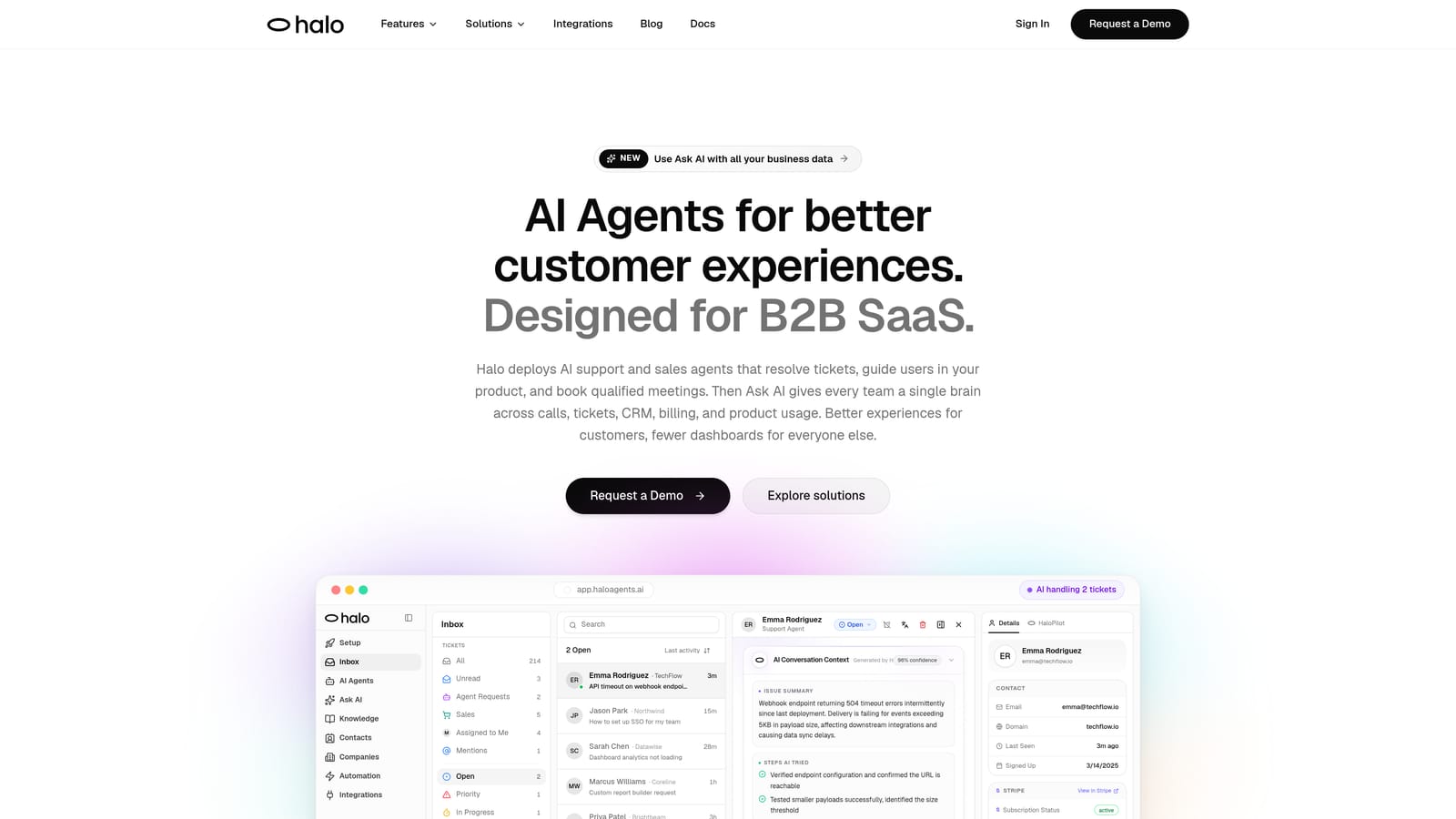
Halo AI is an AI-native customer support platform that resolves tickets, guides users through your product, and surfaces business intelligence signals — all from a single system.
Where This Tool Shines
Most support tools treat AI as a feature layered on top of an existing helpdesk. Halo is built AI-first from the ground up, which means automation isn't an add-on — it's the core architecture. The platform's intelligent agents don't just match keywords; they reason through context, resolve tickets autonomously, and hand off to live agents when complexity warrants it.
What genuinely sets Halo apart is the page-aware chat widget. The AI agent sees exactly what the user sees on screen, enabling contextual UI guidance that feels less like a chatbot and more like a knowledgeable colleague. Pair that with a smart inbox that surfaces churn indicators, revenue anomalies, and customer health signals, and you have a platform that makes your support operation a source of business intelligence — not just a cost center.
Key Features
Intelligent AI Agents: Resolve tickets autonomously and escalate to live agents when the situation requires a human touch.
Page-Aware Chat Widget: The AI sees what the user sees, enabling precise, contextual guidance through your product's UI.
Smart Inbox with Business Intelligence: Surfaces customer health signals, revenue anomalies, and churn indicators directly in your support workflow.
Auto Bug Ticket Creation: Automatically generates and routes bug reports to Linear or your preferred project management tool without manual intervention.
Deep Integration Ecosystem: Connects natively with HubSpot, Slack, Stripe, Intercom, Zoom, PandaDoc, and Fathom for a fully connected support stack.
Best For
B2B SaaS product teams and support leaders who want more than ticket deflection. Halo is particularly well-suited to teams that need their support layer to inform product decisions, flag revenue risks, and operate intelligently without constant configuration tweaking.
Pricing
Trial available via demo. Visit haloagents.ai/demo to book your session and see the platform in action with your own use cases.
2. Intercom
Best for: Chat-first support teams wanting a mature AI agent with strong LLM reasoning
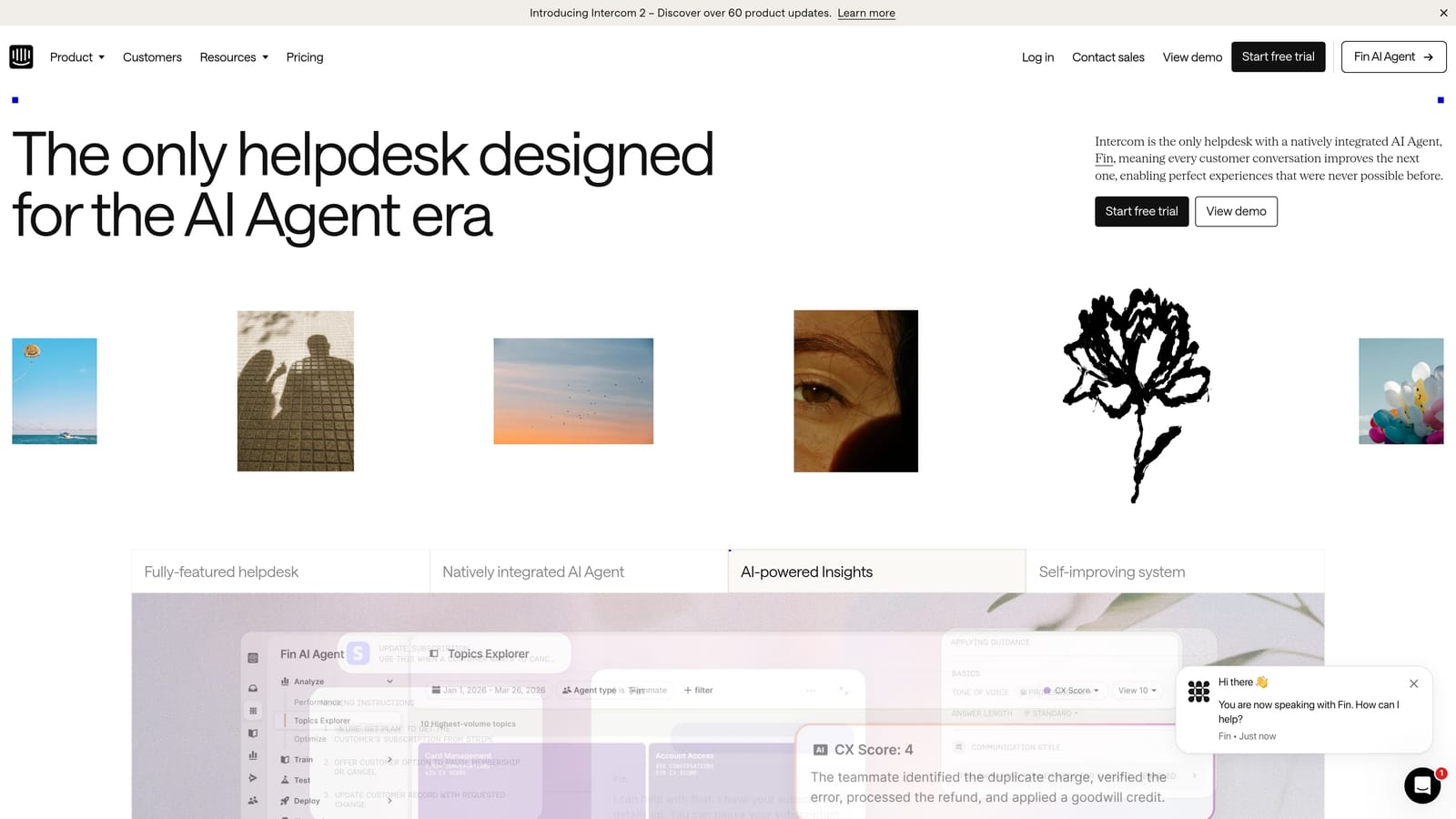
Intercom is a well-established customer messaging platform whose Fin AI agent resolves queries directly from your help content using large language model reasoning.
Where This Tool Shines
Intercom has been building in this space long enough that the rough edges are mostly gone. The unified inbox combining chat, email, and in-app messaging is genuinely polished, and Fin's ability to reason over your help documentation rather than just pattern-match makes it one of the more capable AI agents on this list.
The workflow automation builder is flexible enough to handle complex routing logic without requiring developer involvement. For teams with a strong chat-first support motion, Intercom's depth of tooling across proactive messaging, product tours, and outbound sequences gives it a range that few competitors match.
Key Features
Fin AI Agent: Built on advanced LLM reasoning to resolve queries autonomously from your existing help content.
Unified Inbox: Combines chat, email, and in-app messaging in a single, organized workspace.
Workflow Automation Builder: Visual builder for routing, tagging, escalation, and SLA management without code.
Proactive Support: Outbound messaging and product tours to deflect tickets before they're created.
Customer Data Layer: CRM-lite profile data enriches every conversation with context about the user.
Best For
Mid-market and growth-stage SaaS teams with a chat-heavy support motion. Teams that also use Intercom for sales or marketing messaging will get the most leverage from the platform's breadth.
Pricing
14-day free trial available. Pricing is usage-based and scales with resolution volume, so high-volume teams should model costs carefully. Check intercom.com for current rates.
3. Freshdesk
Best for: Multi-channel support teams wanting a free tier with a path to AI automation
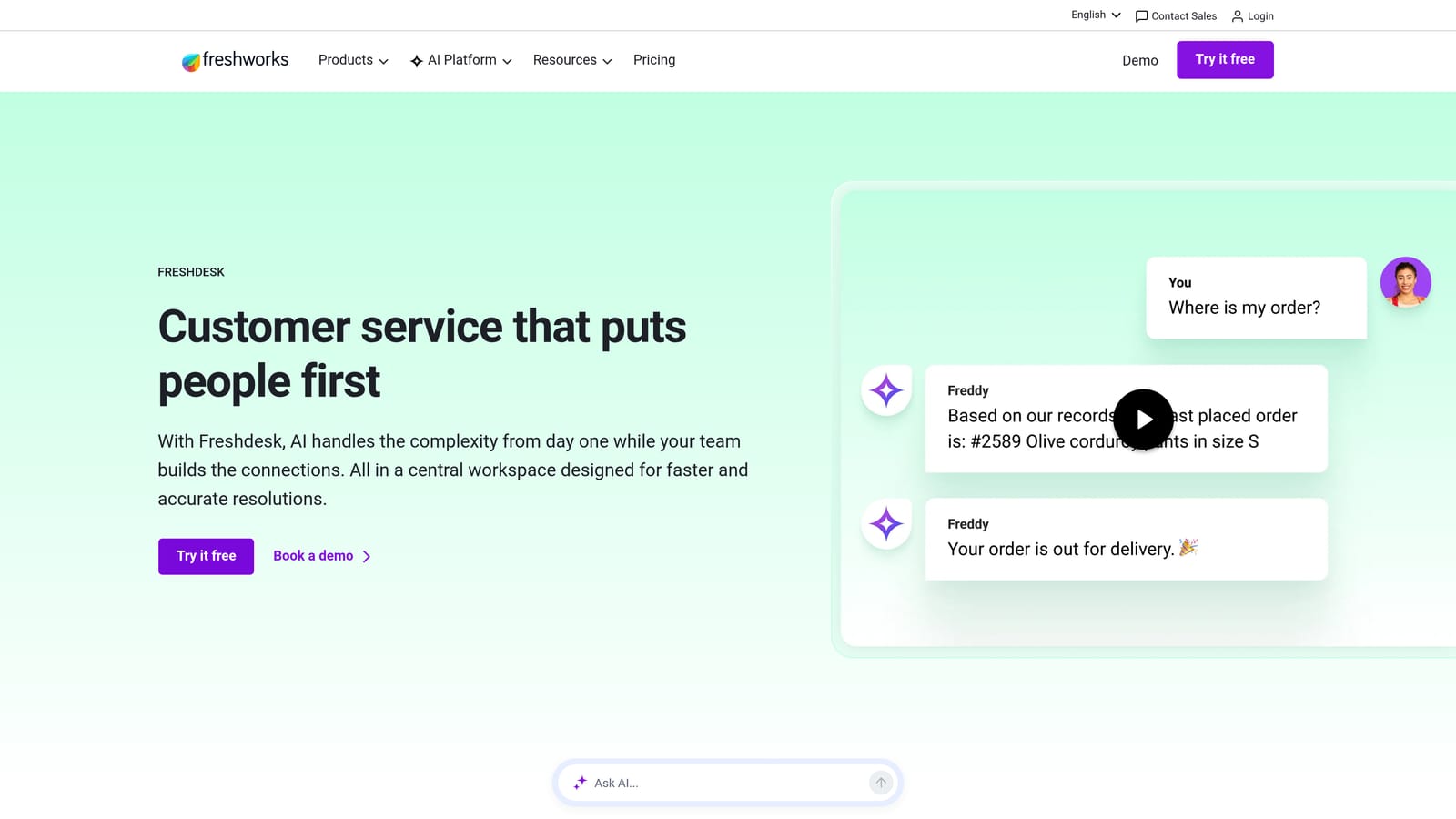
Freshdesk is Freshworks' flagship helpdesk platform with Freddy AI layered across ticketing, self-service, and agent assist for teams handling support across multiple channels.
Where This Tool Shines
Freshdesk's free plan is one of the more generous in this category, making it a practical starting point for small teams that need core helpdesk functionality without an immediate financial commitment. The platform handles email, chat, phone, and social channels from a single interface, which reduces context-switching for agents working across multiple touchpoints.
Freddy AI adds meaningful automation on paid tiers: automated ticket classification, response suggestions, and self-service deflection through a knowledge base. The marketplace of over 1,000 integrations means Freshdesk can slot into most existing tech stacks without custom development work.
Key Features
Freddy AI: Automated ticket classification, agent response suggestions, and self-service deflection built into the helpdesk workflow.
Multi-Channel Support: Handles email, chat, phone, and social media from a unified agent interface.
Automation Rules: Ticket routing, SLA management, and escalation logic configured through a visual rule builder.
Free Plan: Supports up to 10 agents with core helpdesk features, no trial expiration.
Marketplace: Over 1,000 integrations covering CRM, billing, project management, and communication tools.
Best For
Small to mid-sized teams that need multi-channel helpdesk functionality and want to grow into AI automation over time. Also a strong fit for teams already using other Freshworks products like Freshsales or Freshchat.
Pricing
Free plan available for up to 10 agents with limited features. 21-day free trial on paid plans, which unlock Freddy AI capabilities. See freshworks.com/freshdesk for current plan details.
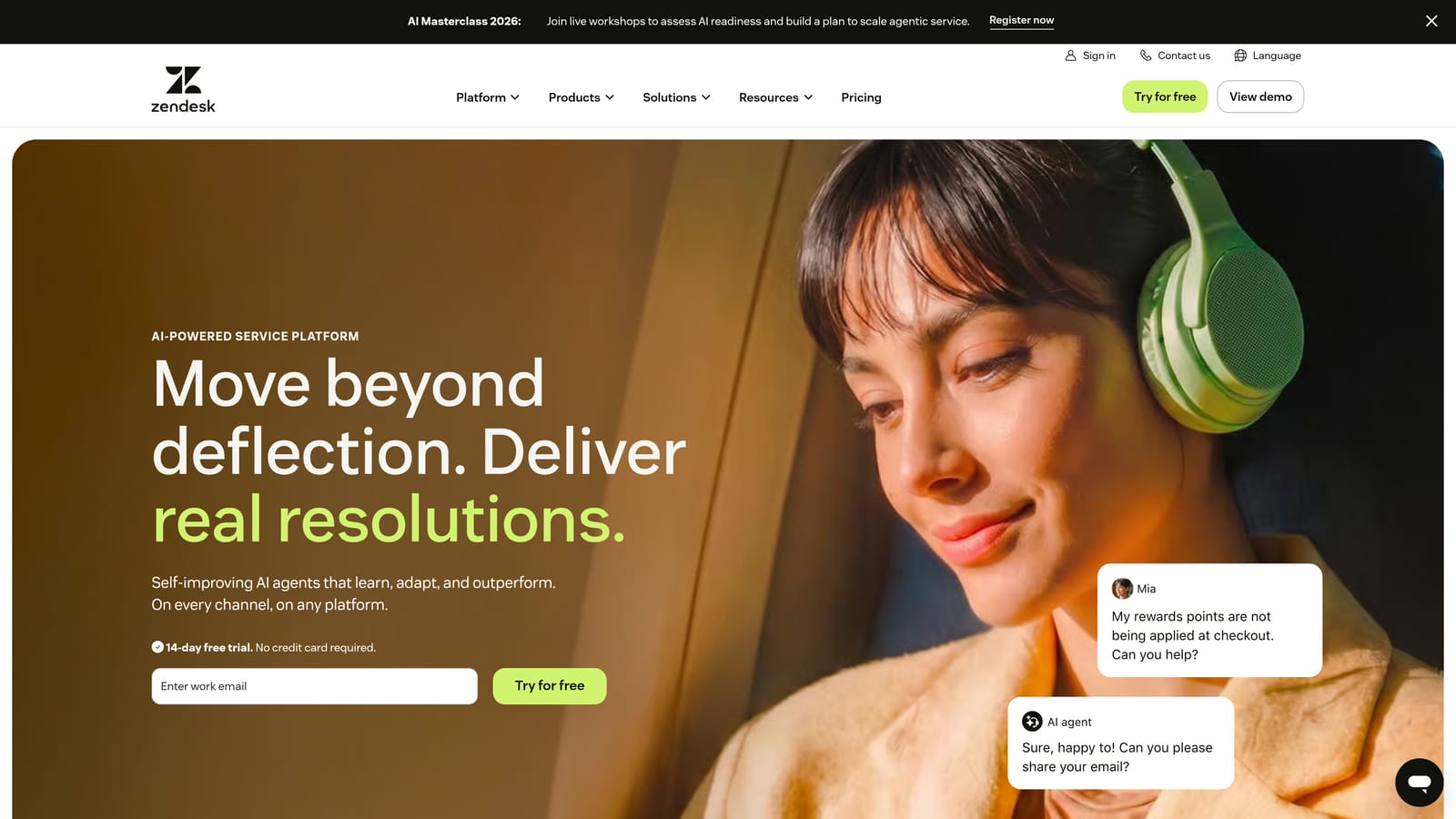
4. Zendesk
Best for: Enterprise teams needing mature workflow automation and a vast integration marketplace
Zendesk is the established enterprise helpdesk with sophisticated workflow automation, hundreds of marketplace integrations, and AI features for intelligent triage and agent assistance.
Where This Tool Shines
Zendesk's automation tooling — triggers, macros, and multi-step flows — is among the most mature in the market. Teams with complex routing logic, strict SLA requirements, or enterprise compliance needs will find it handles edge cases that simpler platforms struggle with. The breadth of the app marketplace means almost any integration scenario has a pre-built solution.
The AI layer adds intent detection, intelligent triage, and auto-tagging that can meaningfully reduce manual classification work at scale. For large support organizations already embedded in the Zendesk ecosystem, the switching cost is high enough that the AI add-ons often make more sense than migrating to a newer platform.
Key Features
Mature Workflow Automation: Triggers, macros, and multi-step automation flows with fine-grained conditional logic.
Zendesk AI: Intent detection, intelligent triage, and auto-tagging to reduce manual classification at volume.
Extensive Marketplace: Hundreds of pre-built integrations across CRM, e-commerce, analytics, and communication tools.
Advanced SLA Management: Configurable SLA policies with escalation rules and reporting for enterprise accountability.
Omnichannel Support: Email, chat, voice, and social channels unified in a single agent workspace.
Best For
Larger support organizations with complex workflows, enterprise compliance requirements, or deep existing investment in the Zendesk ecosystem. Less ideal for lean teams that want quick deployment and minimal configuration overhead.
Pricing
14-day free trial available. AI features are available as add-ons on select plans, which can affect total cost significantly. Verify current pricing at zendesk.com.
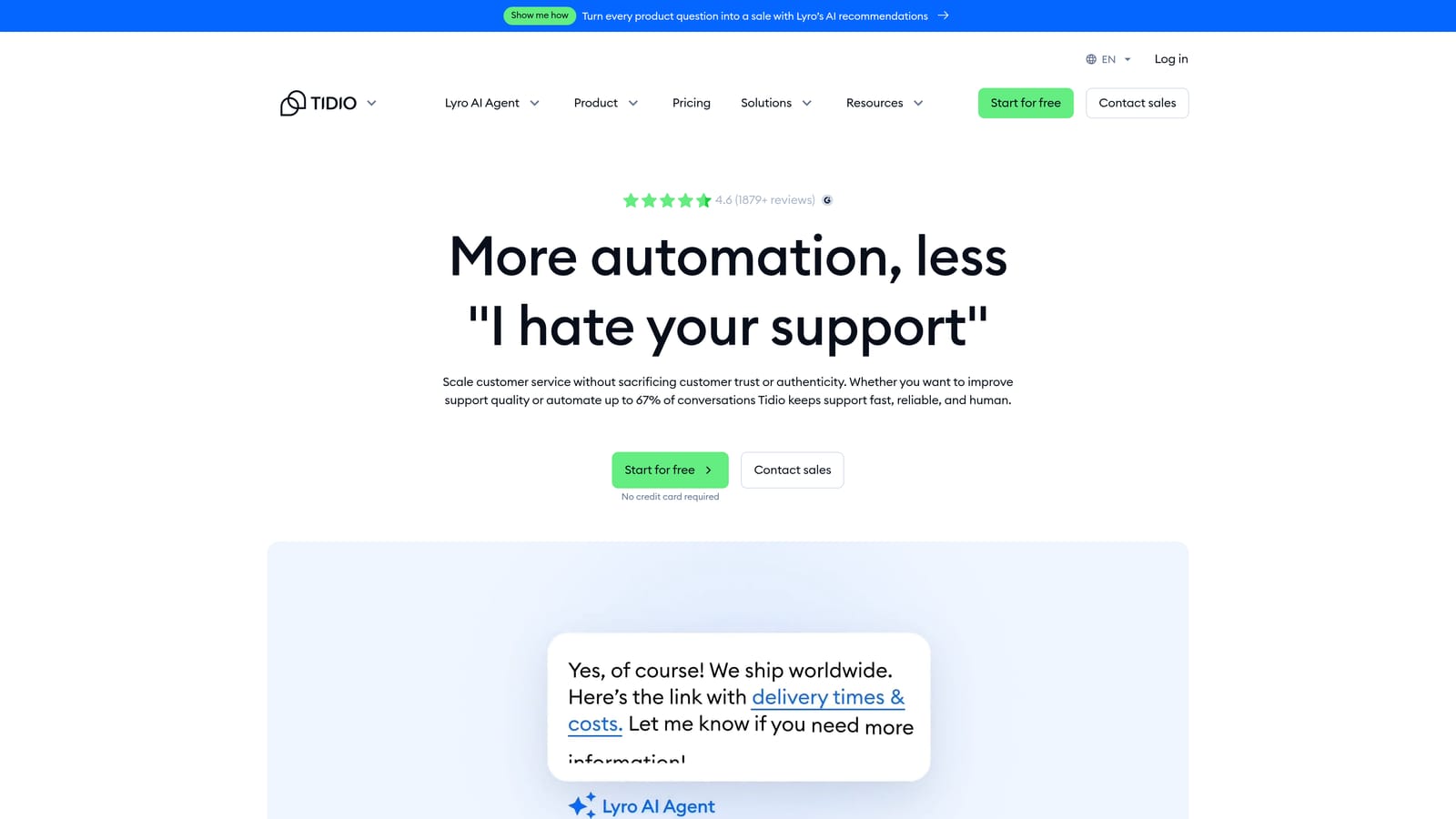
5. Tidio
Best for: Smaller B2B teams and e-commerce businesses wanting fast deployment and a free tier
Tidio is a live chat and AI chatbot platform known for its fast setup, generous free tier, and Lyro AI chatbot for handling FAQ-style queries automatically.
Where This Tool Shines
If time-to-value is your primary concern, Tidio is hard to beat. The platform can be live on your site in under an hour, and the visual chatbot flow builder requires no coding knowledge. For teams that have been putting off automation because it felt too technically complex, Tidio removes most of those barriers.
Lyro AI handles conversational FAQ resolution reasonably well for lower-complexity support scenarios. The free tier includes a limited number of Lyro AI conversations per month, which gives you a real sense of the automation quality before committing to a paid plan. Real-time visitor tracking and proactive messaging add a layer of engagement that goes beyond reactive support.
Key Features
Lyro AI Chatbot: Handles FAQ-style automated query resolution using conversational AI without requiring flow configuration for every scenario.
Visual Flow Builder: No-code chatbot builder for creating custom conversation paths and escalation logic.
Live Chat with Visitor Tracking: Real-time visitor monitoring and proactive messaging to engage users before they submit a ticket.
Generous Free Tier: Core live chat and limited Lyro AI conversations available without a paid subscription.
Broad Integrations: Native connections with Shopify, WordPress, Wix, and major CRM platforms.
Best For
Small B2B teams, early-stage SaaS products, and e-commerce businesses that want automation up and running quickly without a lengthy implementation process. Less suited to complex enterprise support workflows.
Pricing
Free plan available; 7-day Lyro AI trial included on the free plan. Paid plans start at accessible price points. Check tidio.com for current plan details.
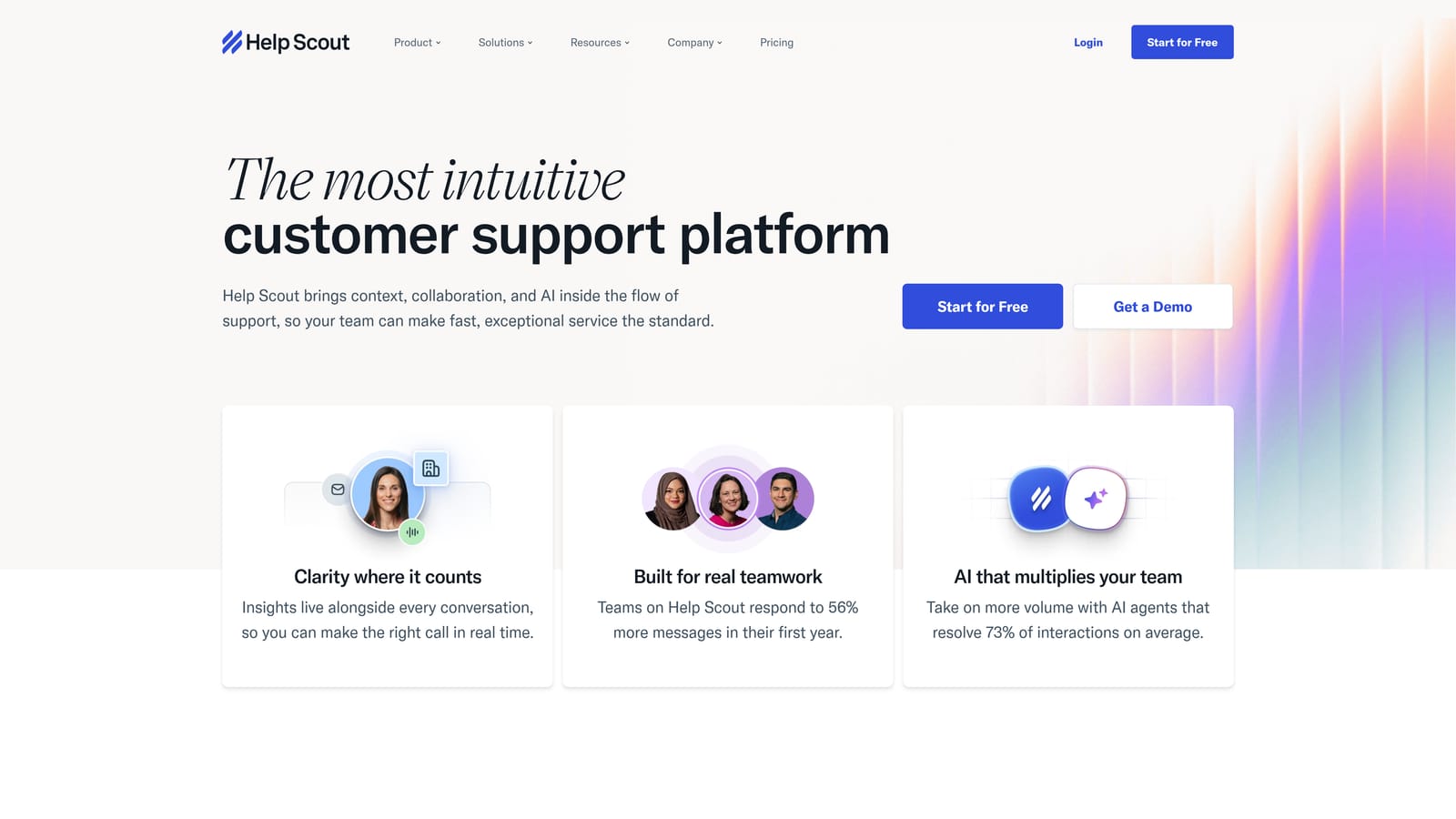
6. Help Scout
Best for: Teams prioritizing relationship quality and response quality alongside automation efficiency
Help Scout is a shared inbox platform with AI-powered drafting, summarization, and automated workflows, designed for support teams that care as much about conversation quality as ticket throughput.
Where This Tool Shines
Help Scout has built a strong reputation for being genuinely intuitive. Agents get up to speed quickly, and the shared inbox with collision detection prevents the embarrassing scenario of two agents sending different responses to the same customer. The platform feels designed for humans first, automation second — which is either a strength or a limitation depending on your priorities.
The AI features (Summarize, Drafts, and AI Answers) focus on helping agents work faster and write better rather than replacing them entirely. For teams where response quality and customer relationship health are primary metrics, this approach fits well. The built-in Docs knowledge base also enables self-service deflection without requiring a separate tool.
Key Features
AI Drafts and Summarize: AI-assisted response drafting and conversation summarization to speed up agent workflows.
Collision Detection: Prevents duplicate replies by alerting agents when a colleague is already working on a conversation.
Workflow Automation: Rule-based automation for tagging, routing, and follow-up sequencing.
Built-in Knowledge Base (Docs): Self-service deflection without needing a separate documentation tool.
Customer Data Sidebar: Full conversation history and customer context visible in every interaction.
Best For
Support teams at growth-stage companies where agent experience and response quality matter as much as deflection rates. Particularly well-suited to teams transitioning from email-based support to a structured helpdesk environment.
Pricing
15-day free trial available. Pricing is per user. See helpscout.com for current plan options.
7. Zoho Desk
Best for: Teams in the Zoho ecosystem wanting affordable AI-assisted helpdesk capabilities
Zoho Desk is an AI-assisted helpdesk tightly integrated with the broader Zoho suite, featuring Zia AI for sentiment analysis, anomaly detection, and smart response suggestions.
Where This Tool Shines
For teams already using Zoho CRM, Zoho Analytics, or other Zoho products, Desk offers an integration depth that's difficult to replicate with third-party connections. Customer data flows naturally between systems, which means agents have CRM context in every ticket without manual data lookups.
Zia AI is a genuinely useful differentiator: sentiment analysis helps agents prioritize frustrated customers, anomaly detection flags unusual ticket volume spikes before they become crises, and response suggestions reduce the time spent composing routine replies. The free plan for up to three agents makes it a low-risk starting point for small teams evaluating the platform.
Key Features
Zia AI: Sentiment analysis, response suggestions, ticket tagging recommendations, and anomaly detection in a single AI layer.
Anomaly Detection: Automatically flags unusual spikes in ticket volume so teams can respond proactively.
Zoho Ecosystem Integration: Deep native connections with Zoho CRM, Zoho Analytics, and the broader Zoho suite.
Free Plan: Core helpdesk features available for up to three agents with no trial expiration.
Multi-Channel Support: Email, chat, phone, and social channels managed from a unified workspace.
Best For
Small to mid-sized teams already invested in the Zoho ecosystem, or budget-conscious teams that want AI-assisted helpdesk functionality without enterprise pricing. Less compelling for teams with no existing Zoho footprint.
Pricing
Free plan for up to 3 agents; 15-day free trial on paid plans. See zoho.com/desk for current pricing tiers.
8. Gorgias
Best for: E-commerce brands needing support automation tied directly to live order data
Gorgias is a support automation platform purpose-built for e-commerce, with deep Shopify, WooCommerce, and Magento integrations that let automation rules act on live order and customer data.
Where This Tool Shines
Gorgias solves a problem that generic helpdesks handle awkwardly: support queries that require live order context. When a customer asks "where is my order?", Gorgias can pull the order status directly into the ticket view and trigger an automated response without agent involvement. Automation rules can be conditioned on order status, customer lifetime value, and product type — which opens up genuinely intelligent routing logic for e-commerce scenarios.
The ticket-volume-based pricing model is also worth noting. For e-commerce teams with seasonal volume spikes, paying per ticket rather than per seat can be more predictable and cost-effective than traditional helpdesk pricing.
Key Features
Native Commerce Integrations: Deep connections with Shopify, WooCommerce, and Magento with live order data surfaced in the ticket view.
Order-Triggered Automation: Automation rules that fire based on order status, customer LTV, and product type.
Macros and Templates: Pre-built response templates for high-volume queries like WISMO, returns, and refunds.
AI Intent Detection: Automatic ticket categorization based on query intent to route and prioritize efficiently.
Ticket-Volume Pricing: Pricing based on ticket volume rather than agent seats, suited to e-commerce demand patterns.
Best For
E-commerce brands on Shopify, WooCommerce, or Magento with significant support volume around orders, returns, and shipping inquiries. Less relevant for B2B SaaS teams without a commerce component.
Pricing
7-day free trial available. Pricing is based on ticket volume rather than seats. See gorgias.com for current tiers.
9. Drift (Salesloft)
Best for: B2B teams where support and sales qualification overlap in the same conversation flow
Drift, now part of Salesloft, is a conversational platform that blends support automation with sales engagement, using AI-powered routing to handle both prospects and customers in a unified interface.
Where This Tool Shines
Drift occupies an interesting position: it's not a pure support tool, but for B2B teams where the line between a support conversation and a sales opportunity is blurry, that's actually useful. AI-powered playbooks can qualify a visitor, route a support question, and schedule a meeting — all within the same conversation thread. For companies with a product-led growth motion, this overlap can be genuinely valuable.
The integration depth with Salesforce, HubSpot, and marketing automation tools means Drift fits naturally into enterprise GTM stacks. Meeting scheduling automation built directly into the conversation flow removes friction from the handoff between automated engagement and human follow-up.
Key Features
AI-Powered Conversation Routing: Handles both support queries and sales qualification in a single automated flow.
Playbooks: Automated, personalized engagement sequences triggered by visitor behavior and intent signals.
Meeting Scheduling: Built-in calendar scheduling within the conversation to reduce handoff friction.
Real-Time Handoff Notifications: Alerts sales and support teams when a conversation requires live intervention.
CRM and Marketing Integrations: Native connections with Salesforce, HubSpot, and major marketing automation platforms.
Best For
B2B companies with a strong inbound sales motion alongside customer support, particularly those using Salesforce or HubSpot as their CRM. Teams looking for a pure support automation tool may find Drift's sales focus adds unnecessary complexity.
Pricing
Trial availability varies following the Salesloft acquisition. Check drift.com or salesloft.com for current trial and pricing options.
Which Platform Deserves Your Trial Window
Nine platforms, nine different approaches to support automation. The right choice depends less on feature checklists and more on where your team is today and where you need to be six months from now.
If you're a B2B SaaS team that wants AI-first architecture, business intelligence signals, and deep integration with your product and revenue stack, Halo AI is the strongest starting point. The page-aware context, continuous learning, and smart inbox capabilities make it a platform that gets smarter with every interaction rather than requiring constant reconfiguration.
For teams with a strong chat-first motion and mature messaging needs, Intercom's Fin AI and unified inbox are hard to argue with. Freshdesk and Zoho Desk are solid choices for teams that want multi-channel helpdesk functionality with a free tier to start. Help Scout suits teams where relationship quality is a primary metric. Zendesk remains the default for large enterprise organizations with complex workflow requirements. Tidio is the fastest path to live automation for smaller teams. Gorgias is the clear choice for e-commerce. And Drift makes sense when support and sales qualification happen in the same conversation.
Most of these platforms offer between 7 and 21 days to test with real tickets and real workflows. Use that time well: run your most common support scenarios, test escalation paths, and check how the reporting surfaces actionable data rather than just activity metrics.
Your support team shouldn't scale linearly with your customer base. Let AI agents handle routine tickets, guide users through your product, and surface business intelligence while your team focuses on complex issues that need a human touch. See Halo in action and discover how continuous learning transforms every interaction into smarter, faster support.