9 Best Support Automation Solutions for Enterprises in 2026
Enterprise support teams need more than basic helpdesk tools — they need support automation solutions for enterprises that resolve tickets autonomously, scale with growth, and integrate across complex tech stacks. This guide evaluates nine leading platforms in 2026 on AI capability, enterprise integrations, and the ability to handle real support complexity beyond simple FAQ deflection.
 Grant CooperFounder14 min read
Enterprise support teams face a distinct challenge: ticket volumes that scale with growth, complex multi-product environments, and customers who expect fast, accurate answers around the clock. Generic helpdesk tools weren't built for this reality.
The best support automation solutions for enterprises go beyond simple rule-based routing. They resolve tickets autonomously, surface business intelligence, and integrate deeply with the tools your teams already use. This guide covers nine platforms worth serious consideration in 2026, evaluated on AI capability, enterprise integrations, scalability, and the ability to handle real support complexity — not just FAQ deflection.
Whether you're running a lean support team at a scaling SaaS company or managing a large operation across multiple products, there's a solution here that fits. We've included Halo AI at the top because it's built specifically for this use case, but every tool on this list has genuine strengths worth understanding.
1. Halo AI
Best for: B2B SaaS teams that want autonomous AI agents, not just agent-assist tooling.
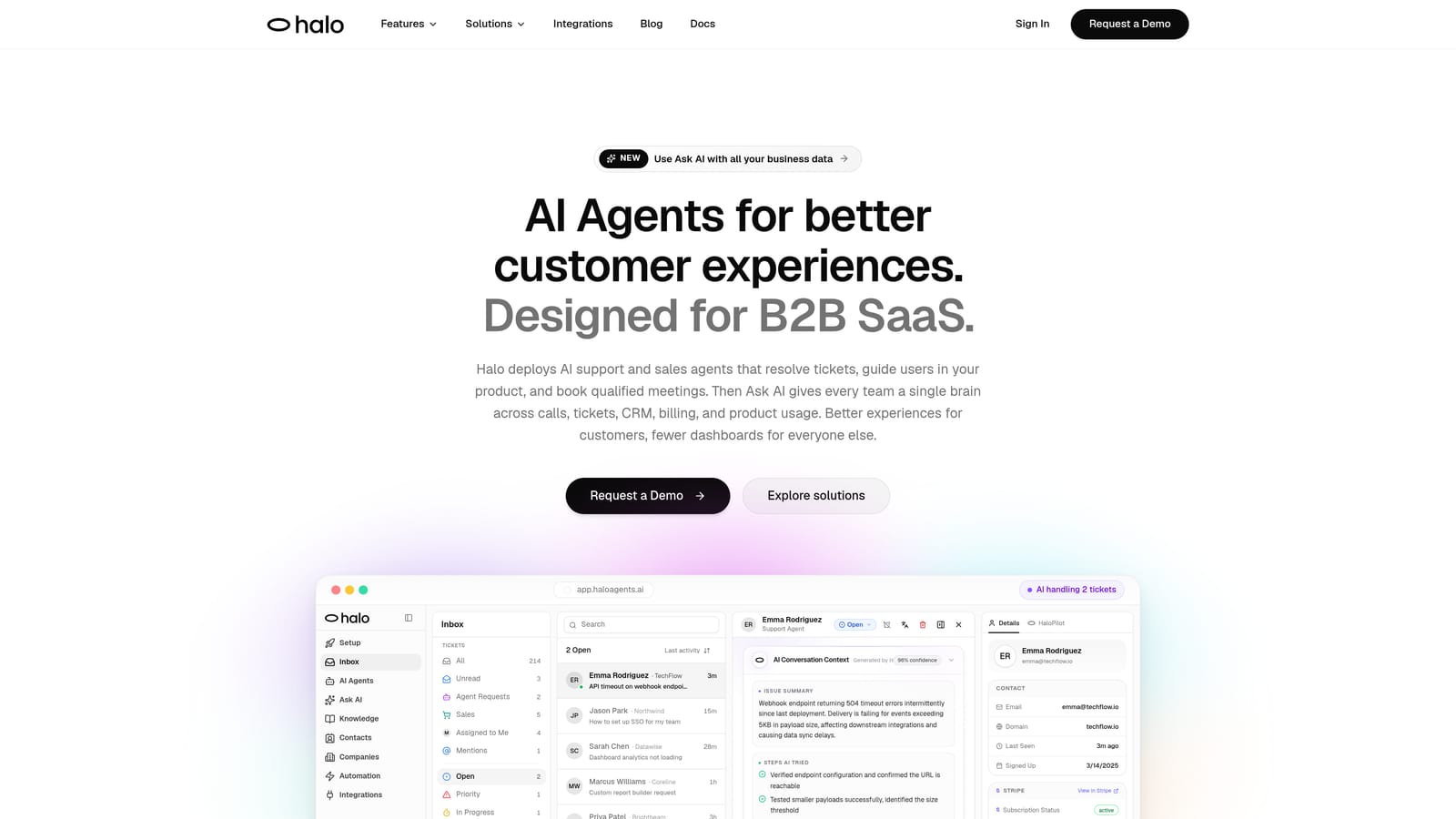
Halo AI is an AI-first customer support platform built specifically for B2B SaaS teams who need agents that resolve tickets end-to-end, not just suggest responses for a human to approve.
Where This Tool Shines
What separates Halo from most support tools is the architecture. This isn't AI bolted onto an existing helpdesk. The platform is built from the ground up around autonomous agents that learn from every interaction, meaning resolution quality improves continuously without manual retraining or rule updates.
The page-aware chat widget is a genuinely differentiated feature. The AI agent can see what the user is looking at in your product, enabling contextual, visual guidance rather than generic answers. For SaaS products with complex UIs or multi-step workflows, this is the difference between a deflected ticket and a resolved one.
Key Features
Autonomous Ticket Resolution: AI agents handle support tickets end-to-end, from understanding intent to delivering resolution, without requiring human approval on routine issues.
Page-Aware Chat Widget: The agent sees what the user sees in your product, enabling context-specific guidance that generic chatbots simply can't provide.
Smart Inbox with Business Intelligence: The inbox surfaces customer health signals, revenue anomalies, and churn indicators alongside support data, giving your team intelligence that goes well beyond ticket counts.
Auto Bug Ticket Creation: When a user reports a bug, Halo automatically creates a structured ticket and routes it directly to Linear or your preferred issue tracker, closing the loop between support and engineering.
Live Agent Handoff: Complex issues escalate to human agents with full conversation context preserved, so customers never have to repeat themselves.
Deep Integration Stack: Native connections to HubSpot, Slack, Intercom, Stripe, Zoom, PandaDoc, Fathom, and Linear mean the AI operates with context from your entire business stack.
Best For
Halo is best suited for B2B SaaS companies at growth or scale stage, particularly those with product-led or sales-assisted motions where support context overlaps with customer success and revenue. Teams that want AI to handle the routine workload autonomously while surfacing intelligence for their human team will find the most value here.
Pricing
Custom enterprise pricing. A demo is available at haloagents.ai to explore fit for your specific support environment.
2. Zendesk
Best for: Enterprises wanting a proven, deeply configurable helpdesk with a broad AI layer.
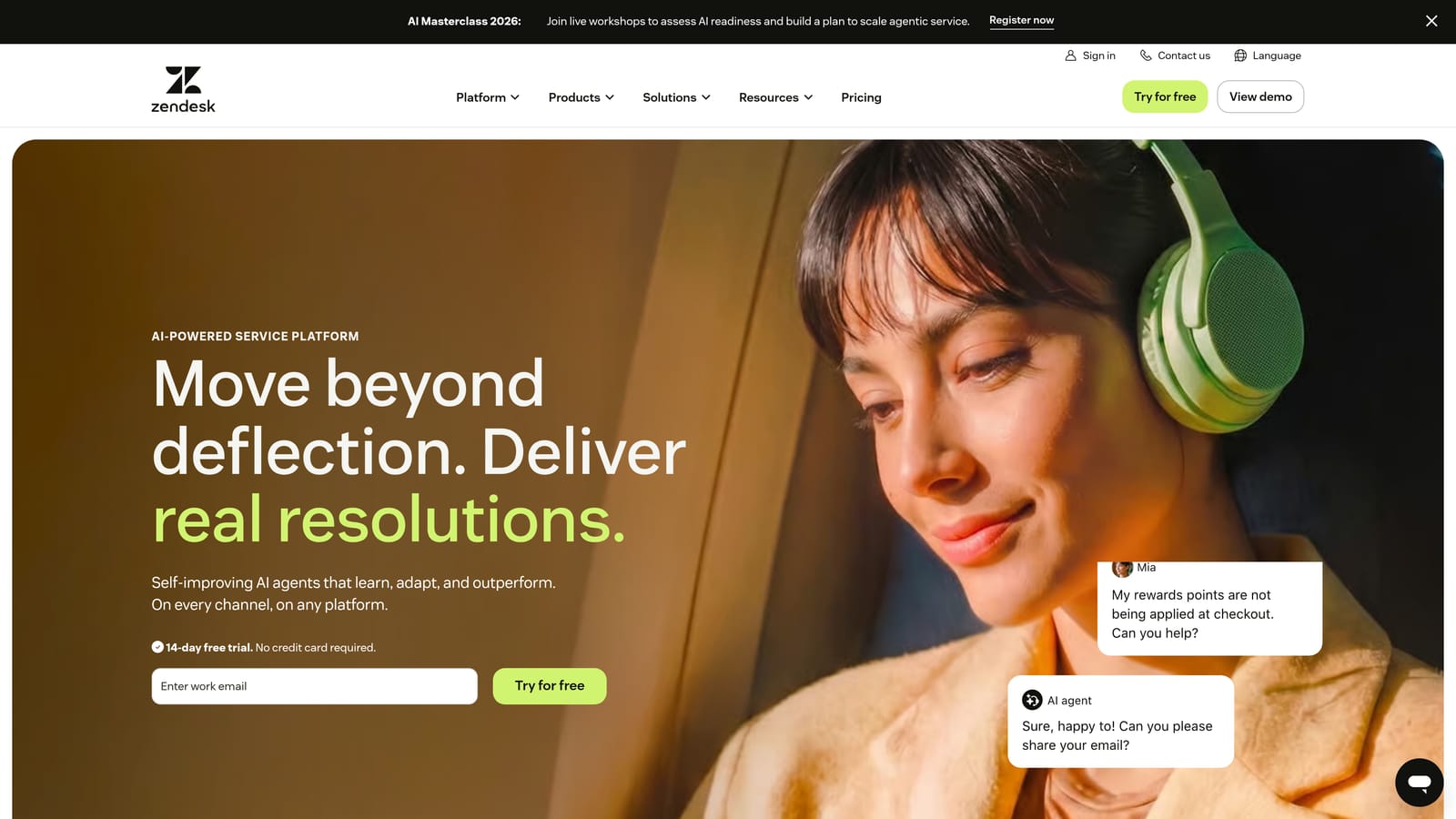
Zendesk is one of the most established enterprise support platforms, with AI Copilot for agent assistance and a broad automation layer built on decades of helpdesk infrastructure.
Where This Tool Shines
Zendesk's strength is breadth. With over 1,000 marketplace integrations and a mature compliance posture covering SOC 2, GDPR, and HIPAA, it's a low-risk choice for large enterprises with complex procurement requirements. The platform has been refined through years of enterprise deployments across virtually every industry.
The AI Copilot feature assists agents with real-time suggestions and auto-drafted responses, which works well for teams that want AI assistance rather than full autonomy. If your support operation has nuanced policies or edge cases that require human judgment on most tickets, the agent-assist model may suit your workflow better than a fully autonomous approach.
Key Features
AI Copilot: Provides real-time agent suggestions and auto-draft responses to reduce handle time on common ticket types.
Intelligent Triage: Routes tickets based on intent and sentiment analysis, directing issues to the right team or queue automatically.
Marketplace Ecosystem: Over 1,000 integrations covering CRM, ITSM, analytics, and communication tools.
Compliance Coverage: SOC 2, GDPR, and HIPAA certifications are available, which matters for enterprise procurement and legal review.
Workforce Management and QA: Built-in tools for scheduling, quality assurance, and performance monitoring at enterprise tiers.
Best For
Enterprises with large support teams, complex compliance requirements, and a preference for agent-assisted AI over fully autonomous resolution. Also strong for organizations with diverse tooling needs given the breadth of the integration marketplace.
Pricing
Suite Professional starts at $115 per agent per month. Enterprise pricing is custom and typically negotiated based on seat count and feature requirements.
3. Intercom
Best for: Product-led growth companies that want conversational support and proactive engagement in one platform.
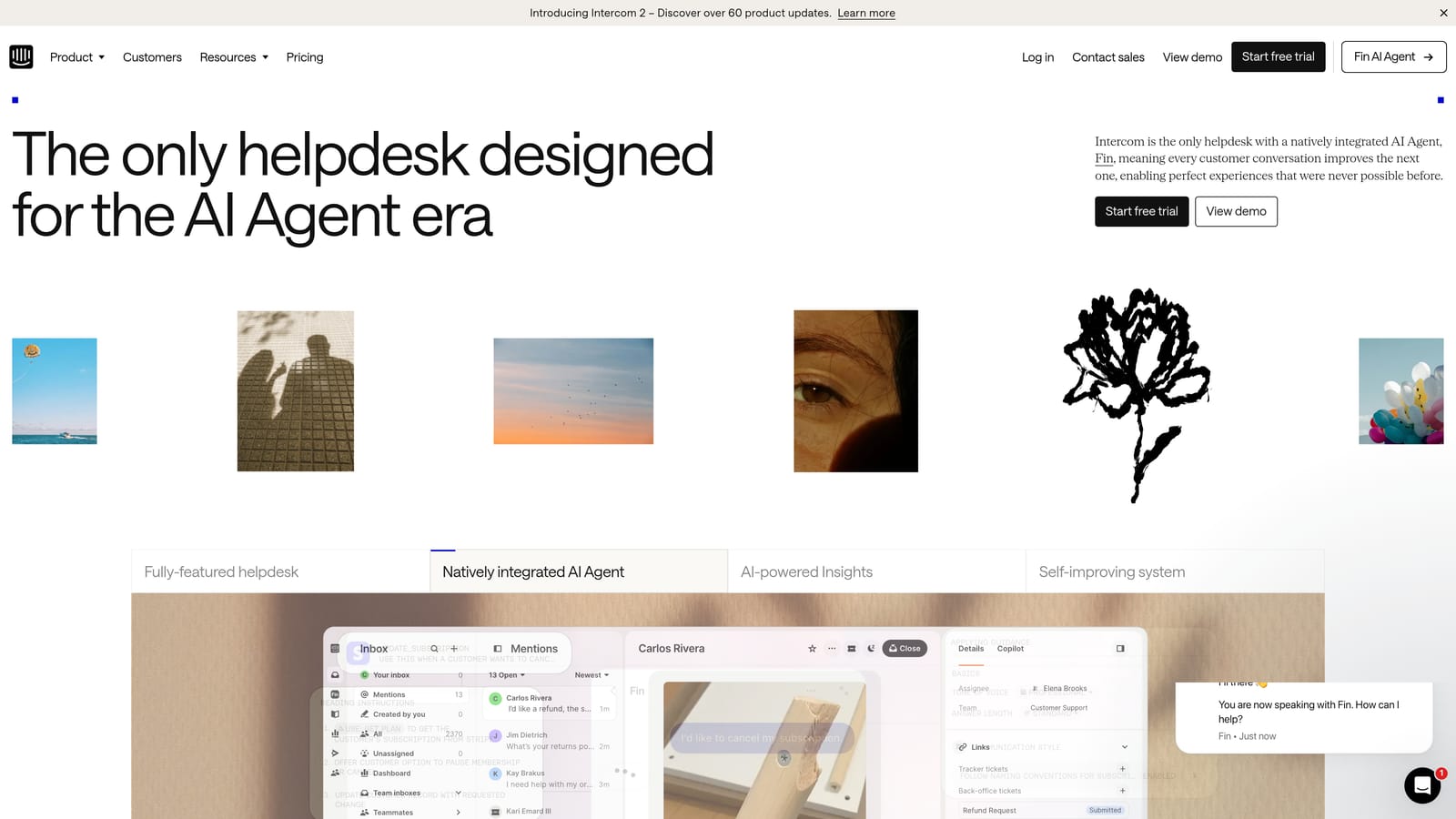
Intercom is a conversational support platform with Fin, an AI agent designed to resolve customer questions using your existing content without requiring manual bot-building.
Where This Tool Shines
Intercom's Fin AI agent stands out because it uses your existing help center content and conversation history to generate answers, rather than requiring you to build out decision trees or script responses manually. For teams with solid documentation already in place, this dramatically reduces time to value.
The platform also blends support and customer engagement more tightly than most tools on this list. In-app messaging, proactive outreach, and product tours all live alongside the support inbox, which makes Intercom particularly appealing for product-led growth companies where support and activation overlap.
Key Features
Fin AI Agent: Resolves customer questions autonomously using help center content and historical conversations, without requiring manual bot configuration.
In-App Messaging and Product Tours: Proactive engagement tools that reduce inbound support volume by guiding users before they hit a wall.
AI-Assisted Inbox: Conversation summarization and suggested replies help agents handle complex escalations more efficiently.
Workflows Builder: No-code automation across channels for routing, tagging, and escalation logic.
Unified Platform: Support, engagement, and product tours in a single tool, reducing the number of vendors your team manages.
Best For
Product-led growth SaaS companies and teams that want to combine proactive customer engagement with reactive support automation. Less suited for organizations that need deep ITSM integration or complex cross-department workflows.
Pricing
Fin AI Agent is priced per resolution rather than per seat. Full platform pricing is custom at enterprise tiers and can scale significantly with usage.
4. Freshdesk
Best for: Teams that need omnichannel support automation at more accessible price points than enterprise-tier alternatives.
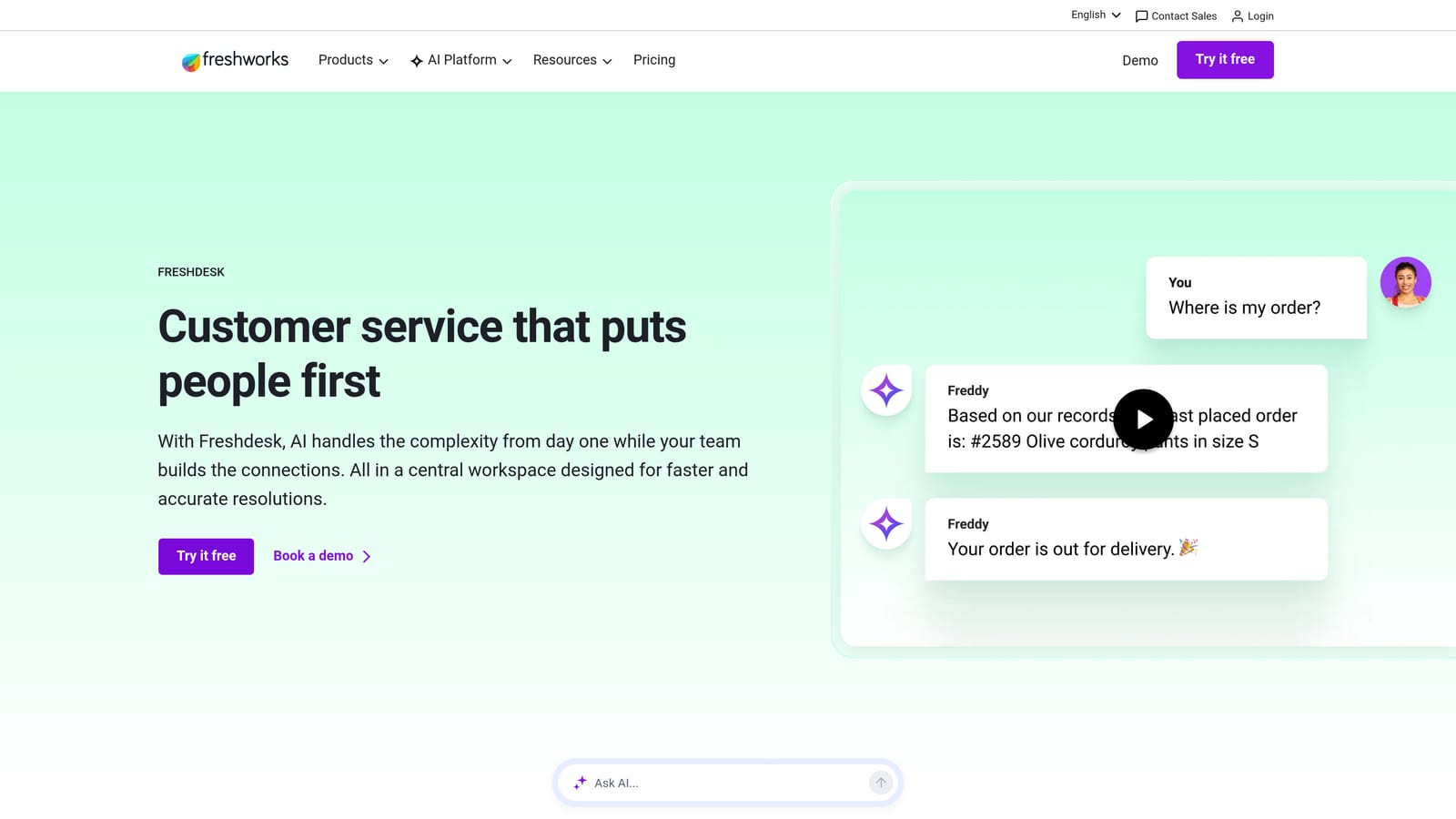
Freshdesk is an omnichannel support platform with Freddy AI powering deflection, agent assistance, and analytics across email, chat, phone, and social channels.
Where This Tool Shines
Freshdesk delivers a solid breadth of AI functionality at price points that are generally more accessible than Zendesk or Salesforce at comparable feature tiers. For growing enterprises that need omnichannel coverage without a six-figure platform investment, this is a meaningful differentiator.
Freddy AI covers the full automation spectrum: Freddy Self Service handles deflection before tickets are created, Freddy Copilot assists agents in real time, and Freddy Insights surfaces anomalies and trends in your support data. Getting all three capabilities under one Freddy umbrella means less integration complexity than assembling point solutions.
Key Features
Freddy Self Service: AI-powered deflection that answers customer questions before they become tickets, reducing inbound volume at the source.
Freddy Copilot: In-context agent suggestions, auto-summarization, and knowledge recommendations to speed up resolution.
Omnichannel Out of the Box: Email, chat, phone, and social channels are included without requiring add-ons or separate products.
Freddy Insights: Analytics layer that identifies anomalies, trends, and automation opportunities in your support data.
Marketplace Integrations: Connections to CRM, ITSM, and ecommerce tools for teams with diverse tech stacks.
Best For
Mid-market and growing enterprise teams that need comprehensive omnichannel support with AI across the ticket lifecycle, particularly those where budget flexibility is a constraint or where Zendesk pricing has become a concern.
Pricing
Growth plan starts at $15 per agent per month. Enterprise plans are available with custom pricing for larger deployments.
5. Salesforce Service Cloud
Best for: Large enterprises already operating on the Salesforce CRM platform who need support automation embedded in their existing ecosystem.
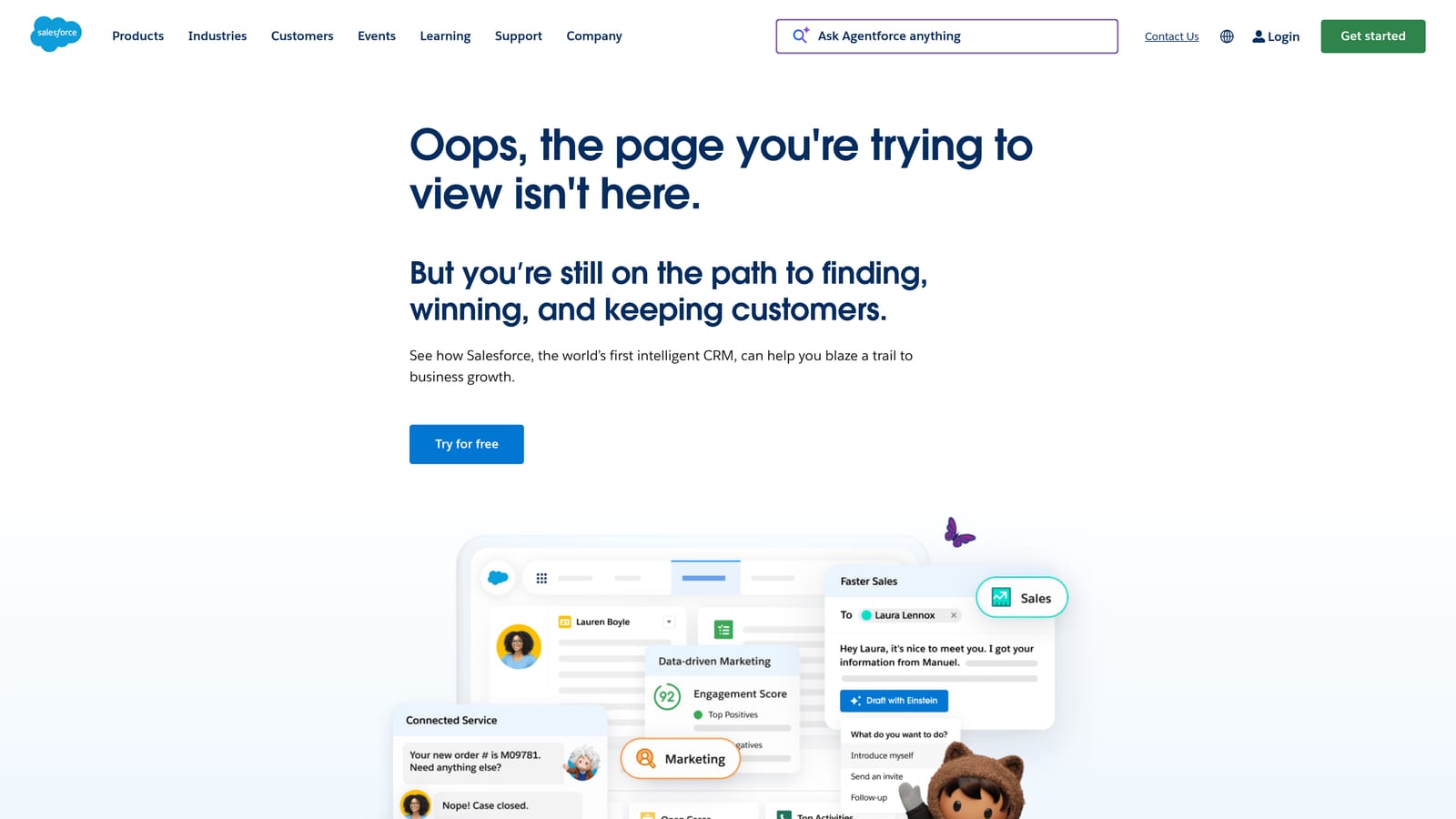
Salesforce Service Cloud is enterprise support automation embedded within the Salesforce CRM ecosystem, with Einstein AI providing context-rich automation for teams already invested in the platform.
Where This Tool Shines
The core value proposition of Service Cloud is the unified customer record. When your support agents can see the full sales history, contract details, and success interactions alongside the current support case, resolution quality improves significantly. For organizations already on Salesforce, this context is already there — Service Cloud simply activates it for support.
Einstein AI handles case classification, next-best-action recommendations, and knowledge surfacing, all informed by the richest customer data set in your organization. The tradeoff is implementation complexity and cost. Service Cloud is not a tool you stand up in a week, and the total cost of ownership is among the highest on this list.
Key Features
Einstein AI: Powers case classification, next-best-action recommendations, and knowledge article surfacing using full CRM context.
Unified Customer Record: Combines CRM, sales, and support history into a single view for agents, eliminating context switching.
Omni-Channel Routing: AI-driven prioritization and routing across all support channels based on case type, agent skill, and workload.
Service Console: Agent workspace designed for productivity, with full customer context available without leaving the interface.
Broad Platform Coverage: Field service, digital engagement, and voice are all available within the same Salesforce ecosystem.
Best For
Large enterprises already standardized on Salesforce where the integration value is highest. Organizations considering Salesforce Service Cloud as a standalone purchase without existing Salesforce investment should carefully evaluate the total cost of implementation.
Pricing
Enterprise edition starts at $165 per user per month. Unlimited and Einstein-tier plans are priced higher, and implementation costs add significantly to the total investment.
6. ServiceNow Customer Service Management
Best for: Large enterprises where support resolution depends on coordinating across IT, HR, and internal operations teams.
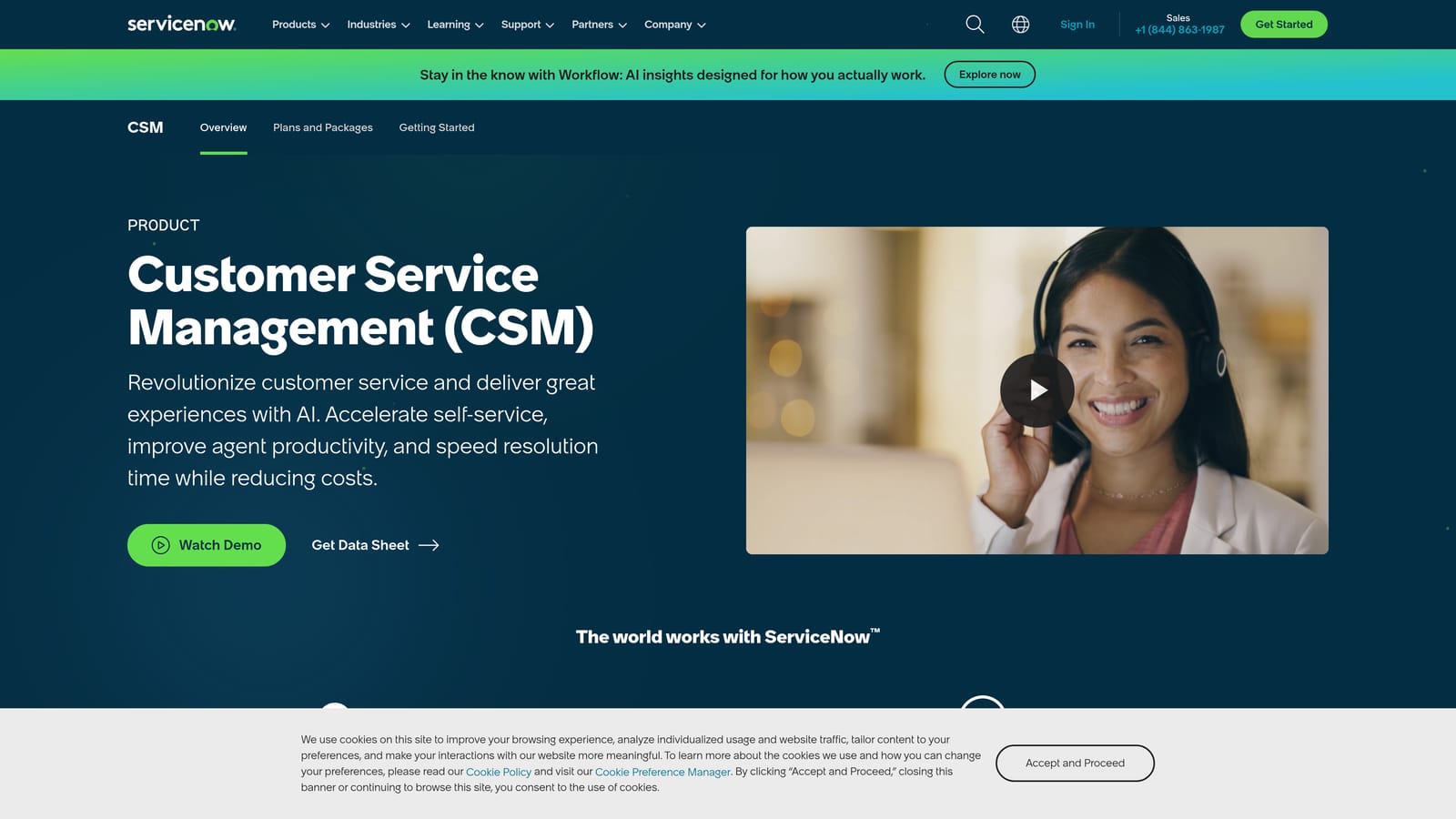
ServiceNow Customer Service Management connects customer support automation to internal ITSM, HR, and operational workflows in ways that pure support tools simply can't replicate.
Where This Tool Shines
ServiceNow's differentiation is cross-department orchestration. When resolving a customer issue requires action from IT to fix an infrastructure problem, HR to update an account, or facilities to address a service outage, ServiceNow's Now Platform can automate that entire chain. Most support tools stop at the agent's desk. ServiceNow extends automation through the entire organization.
For large enterprises with complex internal dependencies, this is genuinely powerful. For SaaS companies or leaner operations, it's likely more platform than you need, and the implementation investment reflects that.
Key Features
Cross-Department Workflow Automation: Connects customer support cases to IT, HR, and operations workflows, enabling resolution without manual handoffs between departments.
AI-Powered Virtual Agent: Handles self-service deflection and case creation for common request types before they reach a human agent.
Proactive Service Operations: Predictive intelligence identifies potential service issues before customers report them.
Case and Knowledge Management: AI-suggested resolutions and knowledge article recommendations to improve agent efficiency.
Enterprise Compliance and Security: Deep audit capabilities, access controls, and compliance certifications suited for regulated industries.
Best For
Large enterprise organizations, particularly those in regulated industries or complex operational environments, where support resolution regularly requires coordination across multiple internal departments. Not the right fit for teams looking for rapid deployment or lean-team operation.
Pricing
Custom enterprise pricing. Implementation typically requires significant investment in professional services, and total cost of ownership is among the highest in this category.
7. Kustomer
Best for: High-volume support operations where full customer history context drives resolution quality.
Kustomer is a CRM-native support platform that unifies every customer interaction into a single timeline, giving AI and agents full context for faster, more personalized resolution at scale.
Where This Tool Shines
Kustomer's unified customer timeline is the core differentiator. Rather than treating each ticket as an isolated event, every interaction across every channel is threaded into one continuous customer record. When an agent or AI picks up a new issue, they're not starting from scratch — they have the full history of that customer's relationship with your company.
This context richness is particularly valuable at high ticket volumes, where the ability to quickly understand a customer's situation without reading through scattered threads can meaningfully reduce handle time. Kustomer is owned by Meta, which brings both resource backing and some enterprise considerations around data governance worth evaluating during procurement.
Key Features
Unified Customer Timeline: Every interaction across all channels is consolidated into one continuous view, eliminating fragmented context for agents and AI alike.
AI-Powered Routing and Suggested Responses: Intelligent assignment and response recommendations based on customer history and issue type.
KIQ Customer Assist: Self-service deflection that uses customer data and content to resolve common requests before they reach an agent.
Deep CRM Data Integration: Customer data is embedded in every support interaction, not siloed in a separate system.
Flexible Data Model: Supports complex enterprise customer objects and custom data structures for organizations with non-standard customer relationships.
Best For
High-volume support operations, particularly in B2C or hybrid B2B/B2C environments, where customer history context has a direct impact on resolution quality and customer satisfaction. Teams with complex CRM data needs will find the flexible data model particularly useful.
Pricing
Enterprise plan starts at $89 per user per month. Ultimate plan is available at $139 per user per month. Custom pricing available for larger deployments.
8. Gladly
Best for: Brands where relationship quality and customer experience are as important as resolution speed.
Gladly is a people-centric support platform that replaces ticket numbers with persistent customer conversations, enabling AI to handle routine interactions while preserving relationship quality for human agents.
Where This Tool Shines
Gladly's philosophy is structurally different from most tools on this list. There are no ticket numbers. Every customer has one continuous conversation that spans all channels over their entire relationship with your brand. This sounds like a subtle distinction, but it changes how agents work and how customers experience support in meaningful ways.
Gladly Hero AI handles routine requests autonomously, while the platform's People Match routing connects customers with the most relevant human agent when escalation is needed. The model is particularly well-suited to premium consumer brands and high-touch B2C environments where relationship continuity matters. It's less commonly deployed in pure B2B SaaS contexts.
Key Features
Lifelong Conversation Threading: No ticket numbers, one continuous customer story across all channels and all time, giving agents instant context without digging through history.
Gladly Hero AI: Autonomous resolution of routine customer requests, including order management, returns, and common lookups.
Unified Agent View: Voice, chat, email, SMS, and social all visible in a single interface without switching between tools.
Task Automation: Handles structured requests like order status, returns, and account lookups without agent involvement.
People Match Routing: Connects customers with the agent best suited to their history and needs, improving both efficiency and relationship continuity.
Best For
Premium consumer brands and high-volume B2C operations where relationship quality and experience consistency are core to the brand promise. Teams in pure B2B SaaS environments may find other tools on this list better aligned to their specific workflows.
Pricing
Hero (AI-only) and full platform tiers are available. Custom enterprise pricing applies. Contact Gladly directly for quotes based on volume and channel requirements.
9. Forethought
Best for: Enterprises that want to add AI intelligence to an existing helpdesk without replacing it.
Forethought is an AI layer designed to sit on top of existing helpdesks like Zendesk, Salesforce, and Freshdesk, adding intelligent triage, deflection, and agent assistance without requiring a platform migration.
Where This Tool Shines
The core appeal of Forethought is pragmatism. Many enterprise support teams have significant investment in their existing helpdesk — custom workflows, years of ticket data, integrations, agent training. Replacing that infrastructure is expensive and disruptive. Forethought lets you add meaningful AI capability on top of what you already have.
The modular approach is well-designed: Triage AI handles routing and prioritization, Solve AI manages deflection, and Assist AI supports agents in workflow. You can adopt the modules that address your specific gaps rather than committing to a full platform replacement. For enterprises in the middle of a helpdesk contract or those that are otherwise satisfied with their current tool, this is a genuinely practical path to AI augmentation.
Key Features
Triage AI: Intelligently routes and prioritizes tickets before they reach agents, reducing manual sorting and improving queue management.
Solve AI: Autonomous deflection via self-service answers, reducing ticket volume without requiring customers to navigate a help center manually.
Assist AI: Surfaces relevant knowledge and suggested responses within the agent's existing workflow, reducing time spent searching for answers.
Discover Analytics: Analyzes your ticket data to identify automation opportunities you may not have recognized, helping prioritize where AI investment will have the most impact.
Native Helpdesk Integrations: Direct integrations with Zendesk, Salesforce Service Cloud, and Freshdesk, with no rip-and-replace required.
Best For
Enterprise teams that are satisfied with their current helpdesk but want to add an intelligent AI layer for triage, deflection, and agent assistance. Particularly well-suited for organizations mid-contract with an existing platform or those where change management makes a full migration impractical.
Pricing
Custom pricing based on ticket volume and which modules are selected. Contact Forethought directly for a quote tailored to your support environment.
Which Tool Is Right for Your Enterprise?
Every platform on this list solves a real problem, but the right choice depends heavily on your current infrastructure, team maturity, and what "automation" actually means for your support operation.
Here's a quick orientation by use case:
AI-first architecture for B2B SaaS: Halo AI is purpose-built for this. Autonomous resolution, page-aware context, business intelligence outputs, and deep integrations across your stack make it the strongest fit for SaaS teams that want AI to do the work, not just assist.
Mature enterprise helpdesk with broad compliance needs: Zendesk and Salesforce Service Cloud are the established choices here, with Salesforce being strongest for teams already on the CRM platform.
Conversational engagement alongside support: Intercom's combination of Fin AI, in-app messaging, and product tours makes it the natural choice for product-led growth companies.
Budget-conscious scale with omnichannel coverage: Freshdesk delivers strong AI capability across the ticket lifecycle at price points that are generally more accessible than the enterprise-tier alternatives.
Cross-department ITSM integration: ServiceNow is the clear choice when support resolution requires coordinated action from IT, HR, or operations.
High-volume operations with CRM context: Kustomer's unified timeline model makes it particularly effective for teams where customer history has a direct impact on resolution quality.
Relationship-first, premium brand experience: Gladly's people-centric model is built for this, particularly in high-touch consumer environments.
AI layer on an existing helpdesk: Forethought is the pragmatic choice for enterprises that want meaningful AI augmentation without a platform migration.
Your support team shouldn't scale linearly with your customer base. Let AI agents handle routine tickets, guide users through your product, and surface business intelligence while your team focuses on complex issues that need a human touch. See Halo in action and discover how continuous learning transforms every interaction into smarter, faster support.