9 Top Automated Support Platforms Built for Modern B2B Teams in 2026
This guide reviews the top automated support platforms available in 2026, evaluating each on AI capability, integration depth, deployment ease, and fit for B2B product teams. Whether you're replacing a legacy helpdesk or building a support stack from scratch, it provides the context you need to invest confidently.
 Grant CooperFounder13 min read
B2B support teams are under more pressure than ever: higher ticket volumes, leaner headcounts, and customers who expect instant, accurate answers at any hour. Automated support platforms have moved well beyond simple chatbots and canned responses. Today's best tools resolve tickets autonomously, surface business intelligence, and hand off to human agents without losing a single thread of context.
But not every platform is built the same. Some bolt AI onto legacy helpdesk infrastructure. Others are purpose-built for autonomous resolution from the ground up. That difference matters when you're deciding where to invest your team's time and budget.
This list covers the top automated support platforms available in 2026, evaluated on AI capability, integration depth, ease of deployment, and fit for B2B product teams. Whether you're replacing an aging helpdesk, layering AI onto an existing workflow, or building a support stack from scratch, this guide will help you find the right fit.
1. Halo AI
Best for: B2B SaaS and product-led teams that want AI-first autonomous support with deep business intelligence
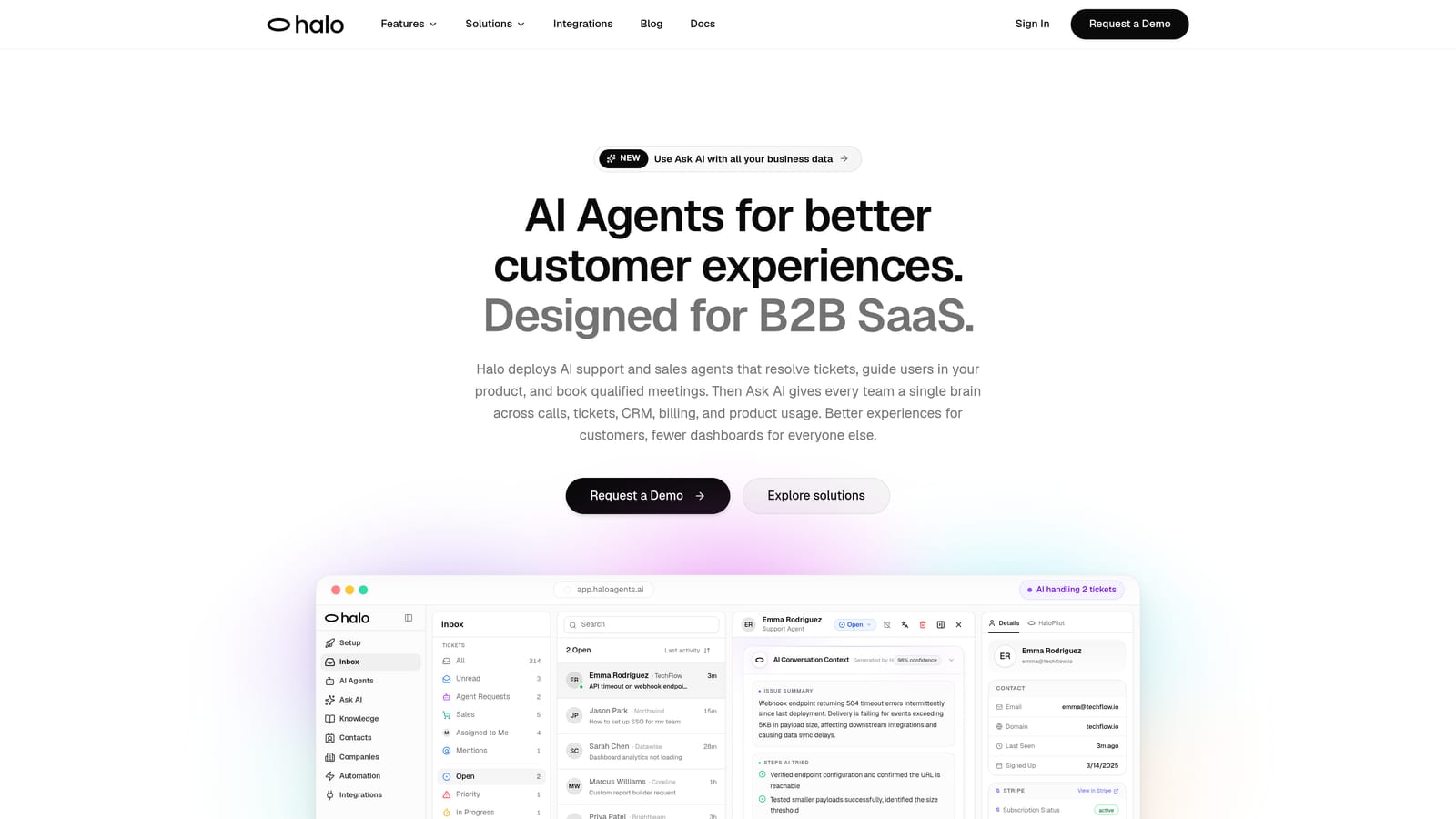
Halo AI is an AI-first customer support platform that deploys intelligent agents to resolve tickets, guide users through your product, and surface actionable business intelligence — all while learning from every interaction.
Where This Tool Shines
What separates Halo from most platforms on this list is its architecture. It wasn't built as a helpdesk with AI features added on top. It was designed from the ground up for autonomous resolution, which means the AI is doing real work rather than just suggesting responses for agents to approve.
The page-aware chat widget is a particularly compelling differentiator. The AI sees what the user sees in your product UI, enabling it to provide visual, contextual guidance rather than generic instructions. For product-led SaaS teams, this is the kind of in-product support experience that actually reduces churn rather than just deflecting tickets.
Key Features
Intelligent AI Agents: Autonomously resolve support tickets end-to-end, not just suggest replies for human review.
Page-Aware Chat Widget: The AI understands where users are in your product and provides context-specific visual guidance in real time.
Smart Inbox with Business Intelligence: Surfaces customer health signals, revenue anomalies, and support trend detection beyond standard ticket metrics.
Auto Bug Ticket Creation: Automatically identifies and routes product issues to Linear or connected project management tools without agent intervention.
Live Agent Handoff: Escalates complex issues to human agents with full conversation context preserved — no repetition required from the customer.
Deep Integrations: Connects to Linear, Slack, HubSpot, Intercom, Stripe, Zoom, PandaDoc, and Fathom for a genuinely unified business stack.
Best For
Halo AI is best suited for B2B SaaS companies and product-led growth teams that want support automation to do more than deflect tickets. If you need your support layer to feed customer health signals into your CRM, auto-triage bugs into your engineering workflow, and continuously improve without manual retraining, this is the platform built for that.
Pricing
Contact Halo AI directly for current pricing. Visit haloagents.ai to request a demo or explore plan details.
2. Intercom
Best for: Mid-market SaaS teams that want a mature, conversation-first support suite with strong AI deflection
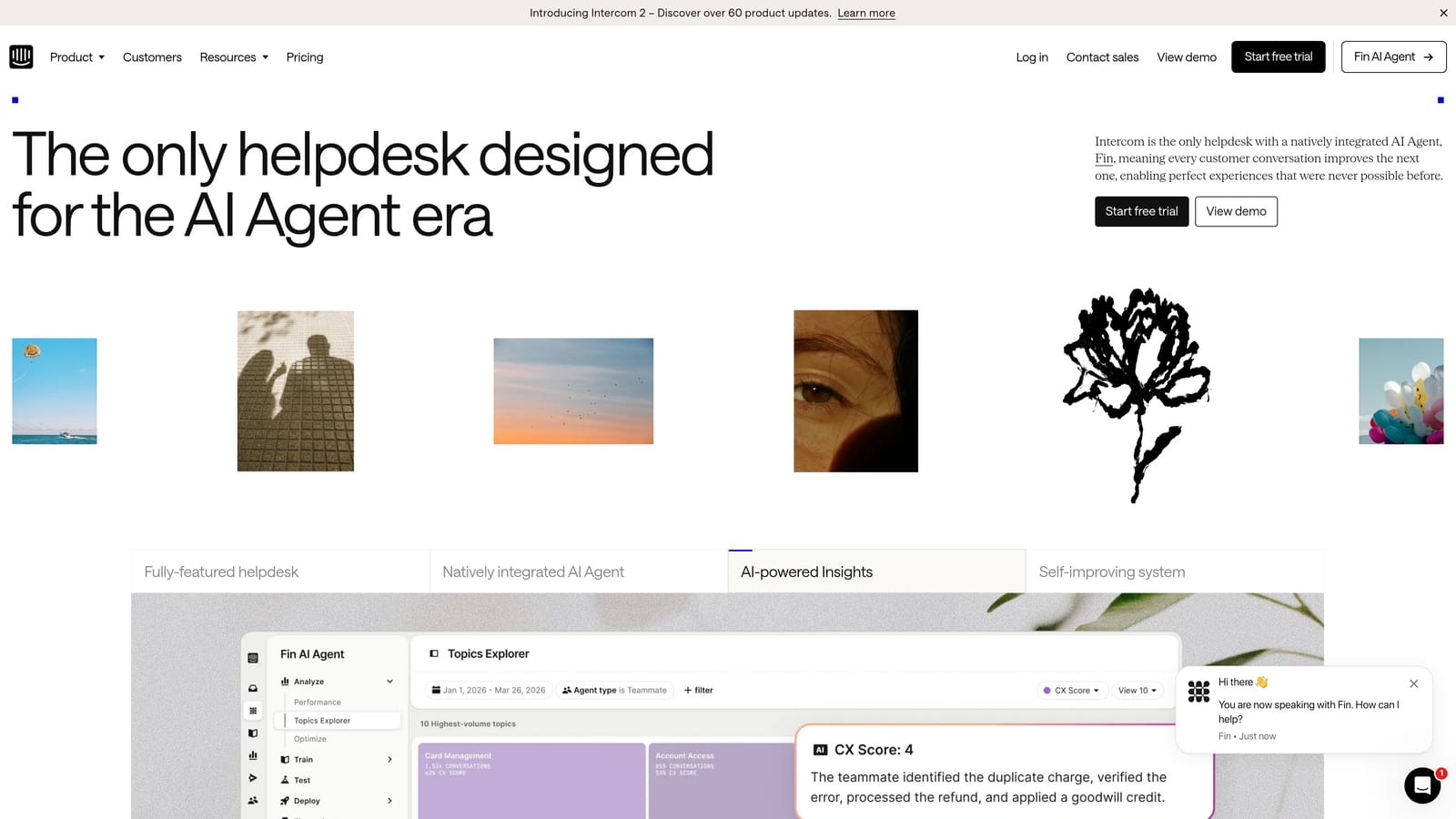
Intercom is a conversation-first support platform with its Fin AI agent for autonomous query resolution, a unified inbox, and a mature ecosystem of integrations used by thousands of SaaS companies.
Where This Tool Shines
Intercom's Fin AI agent is one of the more capable deflection tools in the market for FAQ-style queries. It connects to your knowledge base and resolves common questions without agent involvement, which meaningfully reduces inbound volume for teams with well-documented help centers.
The platform's strength is its completeness. Inbox, tickets, help center, proactive messaging, and onboarding flows all live in one suite. For teams that want to consolidate their support and customer communication tools into a single vendor, Intercom delivers that without much stitching required.
Key Features
Fin AI Agent: Resolves queries autonomously using connected knowledge sources and help center content.
Unified Inbox: Combines chat, email, and tickets into a single workspace for support teams.
Help Center: Self-service articles with AI-powered search to surface relevant content proactively.
Proactive Messaging: Trigger targeted messages and onboarding flows based on user behavior and product events.
Integrations: Connects with Salesforce, HubSpot, Stripe, and a broad range of SaaS tools.
Best For
Intercom suits mid-market SaaS companies with established knowledge bases and teams that want a polished, conversation-first experience. It's less ideal for teams that need deep business intelligence from their support data or autonomous resolution of complex, multi-step queries.
Pricing
Tiered plans based on seats and usage. Costs can scale quickly at higher volumes. Check intercom.com for current pricing.
3. Zendesk
Best for: Enterprise support organizations that need a battle-tested helpdesk with deep workflow customization
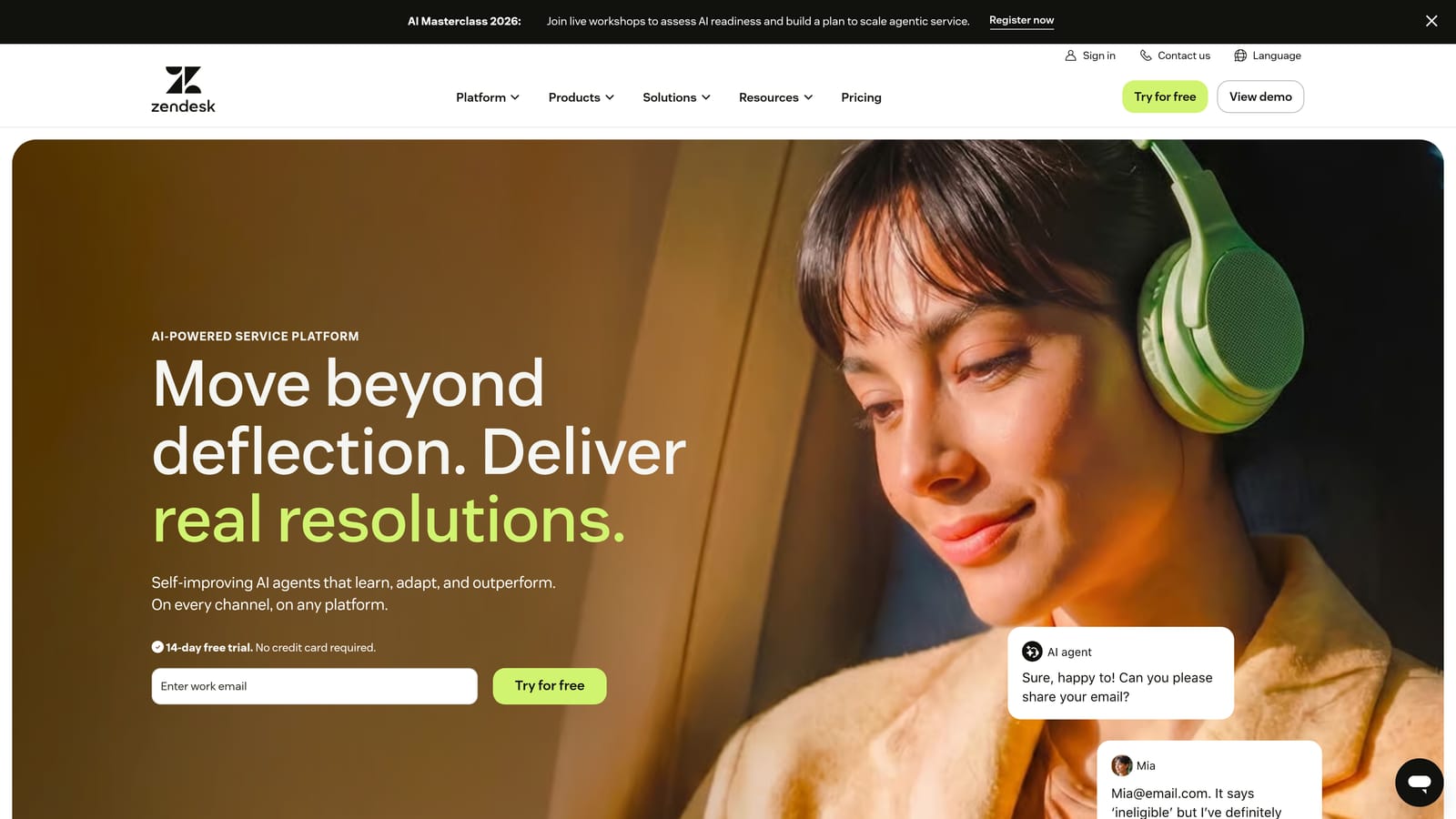
Zendesk is the industry-standard enterprise helpdesk with AI automation layered onto a powerful ticket management and workflow engine used by large support organizations worldwide.
Where This Tool Shines
Zendesk's core strength is its maturity. The ticket management engine, workflow automation via triggers and macros, and omnichannel support coverage are genuinely best-in-class for enterprise teams managing high volumes across many channels. If you need granular control over routing logic, SLA management, and reporting, Zendesk delivers that depth.
The AI layer, branded as Zendesk AI, handles ticket triage, intent detection, and Answer Bot deflection. It's capable, though it's worth noting that this AI was added onto an existing helpdesk foundation rather than built as a native autonomous agent. For teams with complex, custom workflows, that distinction may or may not matter depending on your use case.
Key Features
Zendesk AI: Covers ticket triage, intent detection, macro suggestions, and Answer Bot for self-service deflection.
Advanced Workflow Automation: Triggers, automations, and macros give teams fine-grained control over ticket routing and escalation.
Omnichannel Support: Email, chat, voice, social, and messaging channels managed in one platform.
Reporting and Analytics: Robust built-in reporting suite with custom dashboards and SLA tracking.
App Marketplace: Large ecosystem of third-party integrations for extending core functionality.
Best For
Zendesk is the right call for enterprise support teams with large agent headcounts, complex routing requirements, and a need for proven, scalable infrastructure. Smaller teams may find the admin overhead and cost hard to justify relative to lighter alternatives.
Pricing
Suite plans available at multiple tiers; enterprise pricing available on request. See zendesk.com for current plan details.
4. Freshdesk
Best for: SMBs and growing teams that want omnichannel support with AI capabilities at a competitive price point
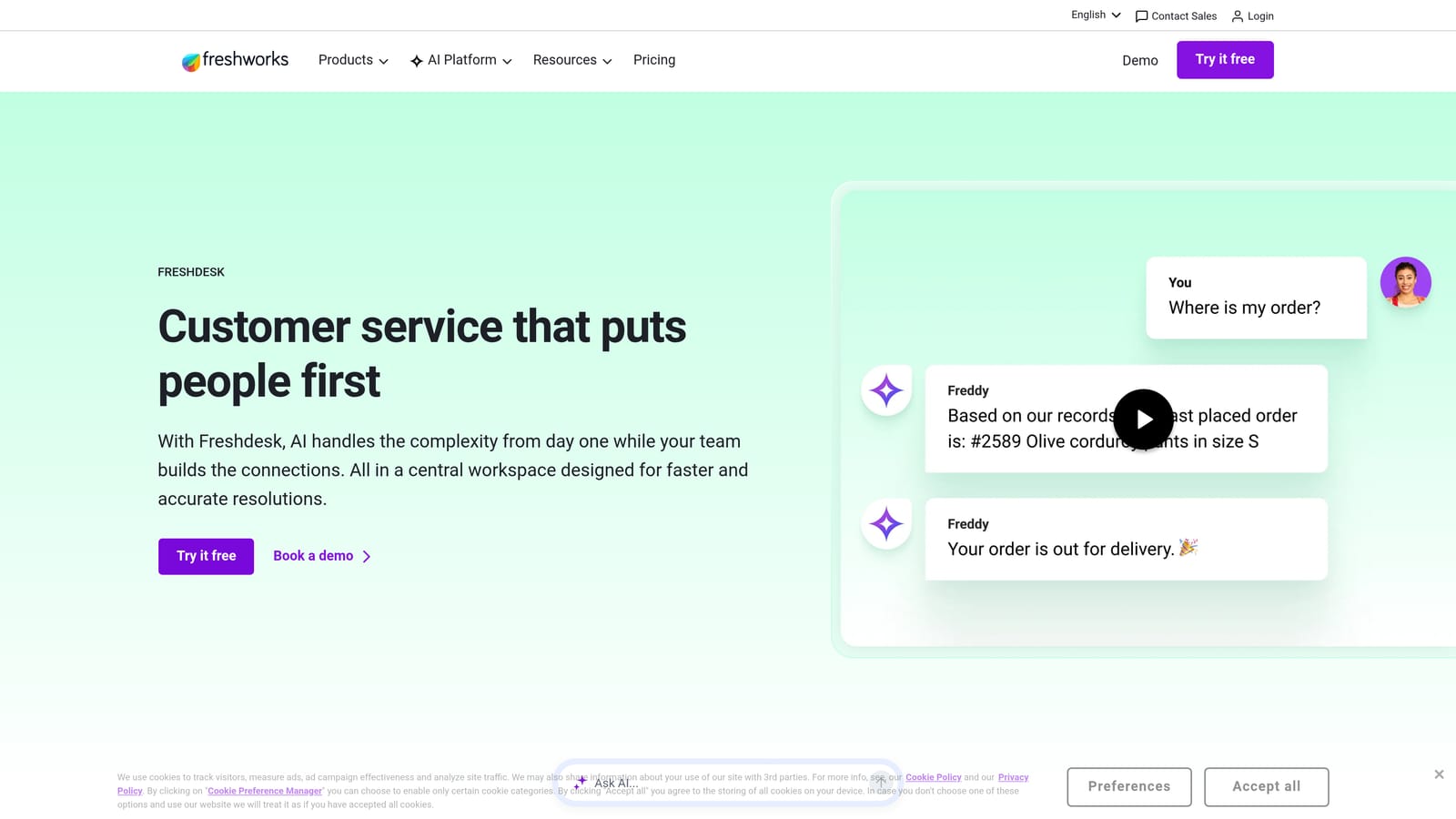
Freshdesk is a cost-effective omnichannel helpdesk from Freshworks with Freddy AI for ticket triage, agent assist, and self-service automation.
Where This Tool Shines
Freshdesk's value proposition is straightforward: you get a solid omnichannel helpdesk with meaningful AI features at a price point that won't strain a growing team's budget. Freddy AI handles ticket triage and suggests replies to agents, reducing the cognitive load on support staff without requiring a large implementation investment.
Freddy Self Service is a notable addition for teams that want to build AI-powered bots without writing code. It lowers the barrier to deploying self-service automation, which makes Freshdesk a practical choice for teams that don't have dedicated technical resources for support tooling.
Key Features
Freddy AI: Handles ticket triage and generates suggested replies to help agents respond faster and more consistently.
Freddy Self Service: No-code bot builder for deploying AI-powered self-service flows without engineering involvement.
Omnichannel Inbox: Email, chat, phone, and social channels managed from a single platform.
Collision Detection: Prevents multiple agents from working the same ticket simultaneously.
Competitive Pricing: Meaningfully more accessible than enterprise alternatives for comparable core functionality.
Best For
Freshdesk is a strong fit for SMBs and mid-market teams that need omnichannel coverage and AI-assisted workflows without enterprise-level complexity or cost. Teams that need deep autonomous resolution or advanced business intelligence will likely hit its ceiling.
Pricing
Free tier available for small teams. Paid plans scale by agent seat. See freshdesk.com for current rates.
5. Tidio
Best for: Small businesses and e-commerce teams that need fast, lightweight AI chat deployment with minimal setup
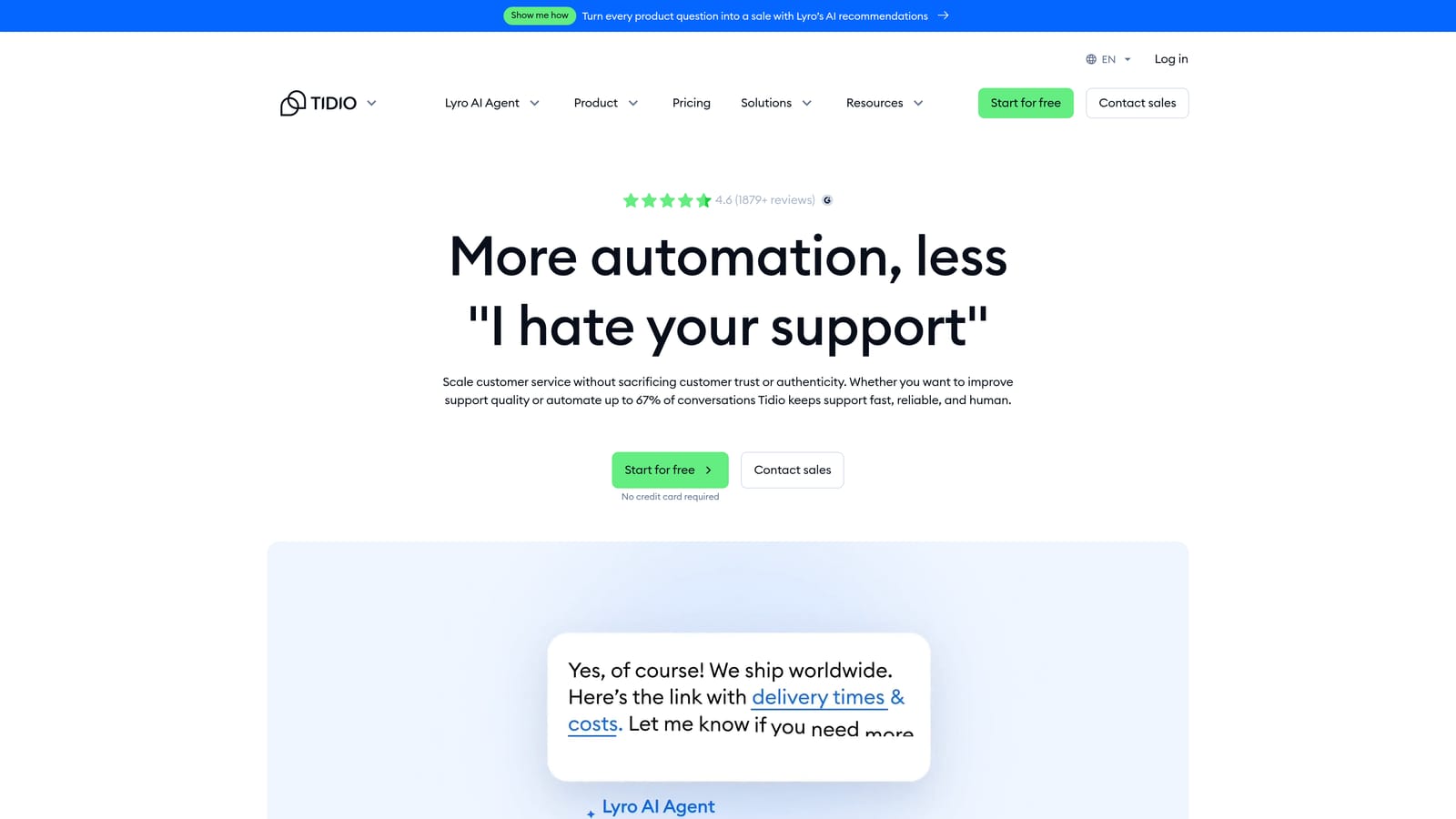
Tidio is a lightweight AI chat platform featuring the Lyro AI chatbot for fast query deflection with minimal configuration required out of the box.
Where This Tool Shines
Tidio's biggest advantage is speed to value. If you need an AI chatbot live on your site or store within hours rather than weeks, Tidio makes that possible. Its integrations with Shopify, WooCommerce, and Wix mean e-commerce teams can connect their store data and start deflecting repetitive queries almost immediately.
Lyro AI handles the conversational heavy lifting for common, repetitive questions. When a query exceeds its capability, the platform routes the conversation to a live agent cleanly. It's not trying to be an enterprise support platform, and that focus keeps it accessible and fast to deploy.
Key Features
Lyro AI Chatbot: Autonomously deflects repetitive queries using your existing knowledge base and FAQ content.
E-Commerce Integrations: Native connections to Shopify, WooCommerce, and Wix for quick deployment in retail contexts.
Live Chat Fallback: Smooth agent takeover when queries exceed the AI's resolution capability.
Visual Chatbot Builder: Drag-and-drop flow builder for creating custom conversation paths without code.
Free Tier: Entry-level access available for small teams testing AI chat before committing to a paid plan.
Best For
Tidio suits small businesses, e-commerce brands, and teams that want a low-friction entry point into AI chat. It's not designed for complex B2B support workflows or teams that need deep integrations with CRM, billing, and project management systems.
Pricing
Free plan available. Paid plans scale by conversation volume. See tidio.com for current pricing.
6. Gorgias
Best for: E-commerce brands on Shopify, Magento, or BigCommerce that need AI to handle transactional support at volume
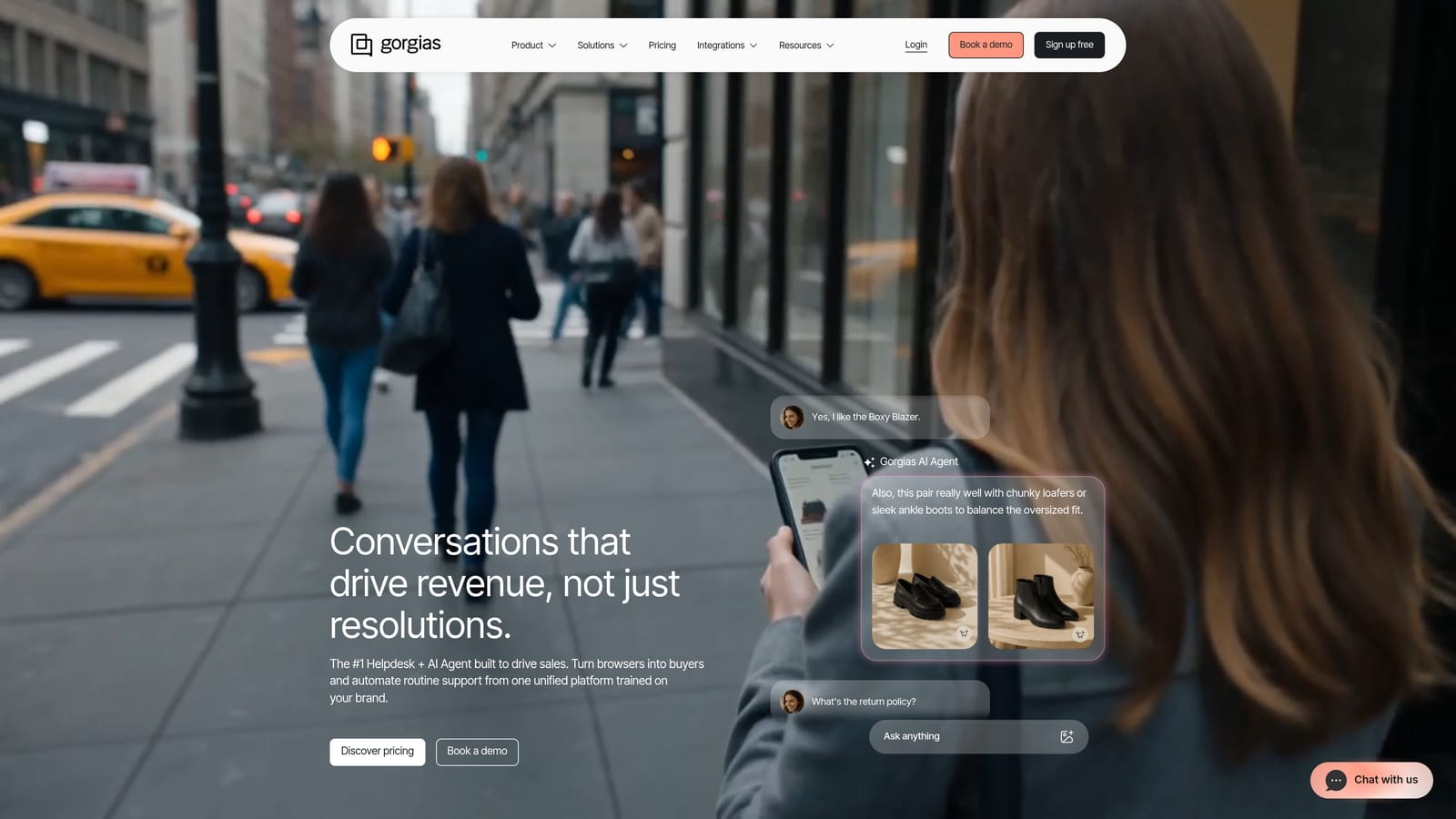
Gorgias is a support platform purpose-built for e-commerce brands, with deep integrations that allow AI to autonomously resolve order, shipping, and return queries using live store data.
Where This Tool Shines
Gorgias does one thing exceptionally well: e-commerce support. Its integrations with Shopify, Magento, and BigCommerce pull live order data directly into conversations, which means the AI can answer "Where is my order?" with a real, accurate answer rather than a generic holding message. For brands handling high volumes of transactional queries, this is a significant efficiency gain.
The rules and macros engine is also well-developed for repetitive, high-volume ticket types. Teams can automate responses to common scenarios without touching every ticket manually, and the revenue statistics tied to support interactions give managers visibility into how support performance connects to commercial outcomes.
Key Features
E-Commerce Data Integration: Pulls live order, shipping, and return data from Shopify, Magento, and BigCommerce directly into conversations.
AI Transactional Automation: Autonomously resolves order status, return, and shipping queries without agent involvement.
Rules and Macros Engine: Automates responses to high-volume, repetitive ticket types at scale.
Omnichannel Inbox: Email, chat, SMS, and social DMs managed in one unified workspace.
Revenue Statistics: Ties support interaction data to revenue metrics for operational visibility.
Best For
Gorgias is the clear choice for e-commerce brands with high transactional support volume. It's not built for B2B SaaS workflows, complex product guidance, or teams that need CRM and project management integrations beyond the e-commerce stack.
Pricing
Plans scale by ticket volume. See gorgias.com for current pricing tiers.
7. Help Scout
Best for: SaaS companies and service businesses that want AI-assisted efficiency without sacrificing relationship quality
Help Scout is a human-feeling support platform that positions AI as an agent assist tool rather than a replacement, prioritizing relationship quality alongside operational efficiency.
Where This Tool Shines
Help Scout's philosophy is a deliberate counterpoint to the bot-first approach. The platform uses AI to make agents faster and better informed, not to remove them from the conversation. AI Summarize condenses long threads so agents can get up to speed instantly. AI Drafts generates response suggestions that agents review and send. The human stays in the loop by design.
The Beacon widget handles in-product self-service well, surfacing relevant help articles proactively before a user needs to open a ticket. For SaaS teams that have invested in documentation and want to put it in front of users at the right moment, Beacon delivers that without aggressive bot interruptions.
Key Features
AI Summarize: Condenses long conversation threads so agents can context-switch quickly without reading every message.
AI Drafts: Generates suggested responses for agents to review, edit, and send rather than replacing agent judgment.
Beacon Widget: In-product self-service widget that surfaces help articles proactively based on user context.
Shared Inbox: Collision detection and private notes keep team coordination clean without separate project management tools.
Customer Profiles: Full conversation history and customer data consolidated in one view per contact.
Best For
Help Scout fits SaaS companies, nonprofits, and service businesses where relationship quality is a genuine competitive advantage. If your support philosophy is "we want to feel like a real team, not a bot farm," this platform is built around that value.
Pricing
Per-user monthly pricing; accessible for smaller teams. See helpscout.com for current plan details.
8. Drift (Salesloft)
Best for: B2B companies where support and sales overlap and a single conversational AI layer serves both functions
Drift is a conversational AI platform that blends B2B support and sales in a single interface, qualifying leads, booking meetings, and answering support queries through one AI-powered chat layer.
Where This Tool Shines
Drift's core insight is that for many B2B companies, the line between support and sales is genuinely blurry. A prospect asking a product question and a customer asking a support question often arrive through the same chat widget. Drift's AI handles both in a unified flow, routing to the right outcome based on context and account data.
Since its acquisition by Salesloft, Drift has leaned further into the revenue team use case. If your company uses Salesloft for sales engagement, the integration between the two platforms creates a more connected view of the buyer and customer journey. Teams that are purely support-focused may find Drift's sales orientation a distraction rather than an advantage.
Key Features
Conversational AI: Handles both support queries and sales qualification in a single chat interface.
Meeting Booking: Books meetings and routes leads directly from chat without human intervention.
Behavioral Targeting: Triggers messages based on visitor behavior, account data, and intent signals.
CRM Integrations: Connects with Salesforce, HubSpot, and Marketo for revenue team workflows.
Salesloft Integration: Native connection to Salesloft's broader revenue platform for teams using both tools.
Best For
Drift suits B2B companies with a clear overlap between inbound support and sales, particularly those already in the Salesloft ecosystem. Pure support teams without a sales motion will likely find more purpose-built options elsewhere on this list.
Pricing
Contact Salesloft for current Drift pricing. See drift.com for more information.
9. Kustomer
Best for: High-volume omnichannel operations that need a CRM-native support platform with a unified customer timeline
Kustomer is a CRM-native omnichannel support platform with AI automation for high-volume operations, offering a unified customer timeline view across all channels and touchpoints.
Where This Tool Shines
Kustomer's differentiator is its data model. Rather than organizing support around tickets, it organizes around customers. Every interaction across every channel, email, chat, SMS, voice, and social, appears in a single timeline view per customer. For teams handling complex, multi-channel customer relationships, this context-first approach reduces the time agents spend piecing together history before they can actually help.
The AI layer automates repetitive workflows and suggests responses at scale, which works well for high-volume operations. Kustomer is now owned by Meta, which brings enterprise-grade infrastructure and reliability to the platform. That backing is reassuring for large organizations, though it also means the platform's roadmap is influenced by Meta's broader priorities.
Key Features
Customer Timeline View: Consolidates all interactions across every channel into a single chronological view per customer.
AI Workflow Automation: Automates repetitive support workflows and surfaces suggested responses for agents.
Omnichannel Coverage: Email, chat, SMS, voice, and social managed in one unified platform.
CRM-Native Data Model: Customer-centric architecture rather than ticket-centric, enabling richer context for every interaction.
Enterprise Infrastructure: Meta ownership brings significant infrastructure reliability and security for large-scale deployments.
Best For
Kustomer is well-suited for high-volume B2C and omnichannel operations that need a customer-centric data model and enterprise-grade reliability. It's less common in pure B2B SaaS contexts where the integration requirements and pricing may not align with team size.
Pricing
Enterprise pricing. Contact Kustomer directly at kustomer.com for current rates.
Which Platform Is Right for Your Team?
The honest answer is that the right platform depends on how your team actually works today and where you need to be in twelve months. Here's a quick breakdown by buyer profile to help you cut through the noise.
B2B SaaS and product-led teams that want genuine autonomous resolution, in-product guidance, and business intelligence beyond ticket metrics should look at Halo AI first. It's the only platform on this list built AI-first from the ground up, with the integrations and learning capability that modern SaaS support stacks require.
Enterprise support organizations with large agent teams, complex routing requirements, and a need for proven infrastructure will find Zendesk hard to beat on depth and customization.
Mid-market SaaS teams already invested in the Intercom ecosystem will get strong value from Fin AI and the platform's conversation-first approach, particularly if their knowledge base is well-developed.
SMBs and budget-conscious teams that need omnichannel coverage with AI assist at an accessible price point should evaluate Freshdesk, which delivers solid functionality without enterprise-level cost.
E-commerce brands with high transactional support volume will find Gorgias the most purpose-fit option, particularly if they're on Shopify or BigCommerce.
Teams where relationship quality is the differentiator should look at Help Scout, which treats AI as an agent amplifier rather than a replacement.
The best platform is the one that fits how your team works today while giving you room to scale without rebuilding everything in two years. For teams ready to explore what AI-first support actually looks like in practice, See Halo in action and discover how continuous learning transforms every resolved ticket into smarter, faster support going forward.