8 Best AI Customer Support Platforms in 2026: Zendesk AI Features vs. Dedicated AI Solutions
This guide compares Zendesk AI Features Vs Dedicated AI Platform across eight leading customer support tools in 2026, helping SaaS teams and enterprises understand the real difference between AI bolted onto a helpdesk and purpose-built AI-first infrastructure. Whether you need autonomous ticket resolution or AI-assisted agents, this breakdown covers capabilities, trade-offs, and which platform fits your scale.
 Grant CooperFounder13 min read
If you're evaluating Zendesk's built-in AI features against purpose-built AI support platforms, you're asking the right question at the right time. Zendesk has added meaningful AI capabilities over the past few years, but the gap between "AI features bolted onto a helpdesk" and "AI-first support infrastructure" is wider than most teams realize until they're mid-migration.
This guide breaks down platforms across the spectrum, from dedicated AI agents built for autonomous resolution to traditional helpdesks with AI add-ons layered on top. Whether you're a lean SaaS team looking to scale support without headcount, or an enterprise evaluating AI augmentation for existing agents, the right answer depends on your ticket volume, integration requirements, and how much you want AI doing versus assisting.
We've organized this list by AI depth: starting with dedicated AI-first platforms and moving toward traditional helpdesks with AI capabilities. Each entry covers what the tool genuinely does well and where it falls short.
AI-Augmented Helpdesk vs. AI-First Platform: Why the Distinction Matters
Before diving into the tools, it's worth being precise about terminology, because vendors use "AI" loosely and it can obscure real architectural differences.
AI-augmented helpdesk: A traditional ticketing or messaging platform that has added AI features, such as auto-suggestions, bot deflection, and summarization. AI assists human agents who remain the primary resolution layer.
AI-first platform: A platform where AI is the primary resolution layer. Humans handle escalations. The architecture is fundamentally different, built around autonomous resolution rather than agent productivity.
This distinction shapes everything from pricing models to integration requirements to how you measure ROI. Keep it in mind as you read through each tool below.
1. Halo AI
Best for: B2B SaaS teams that want autonomous ticket resolution and business intelligence without scaling headcount
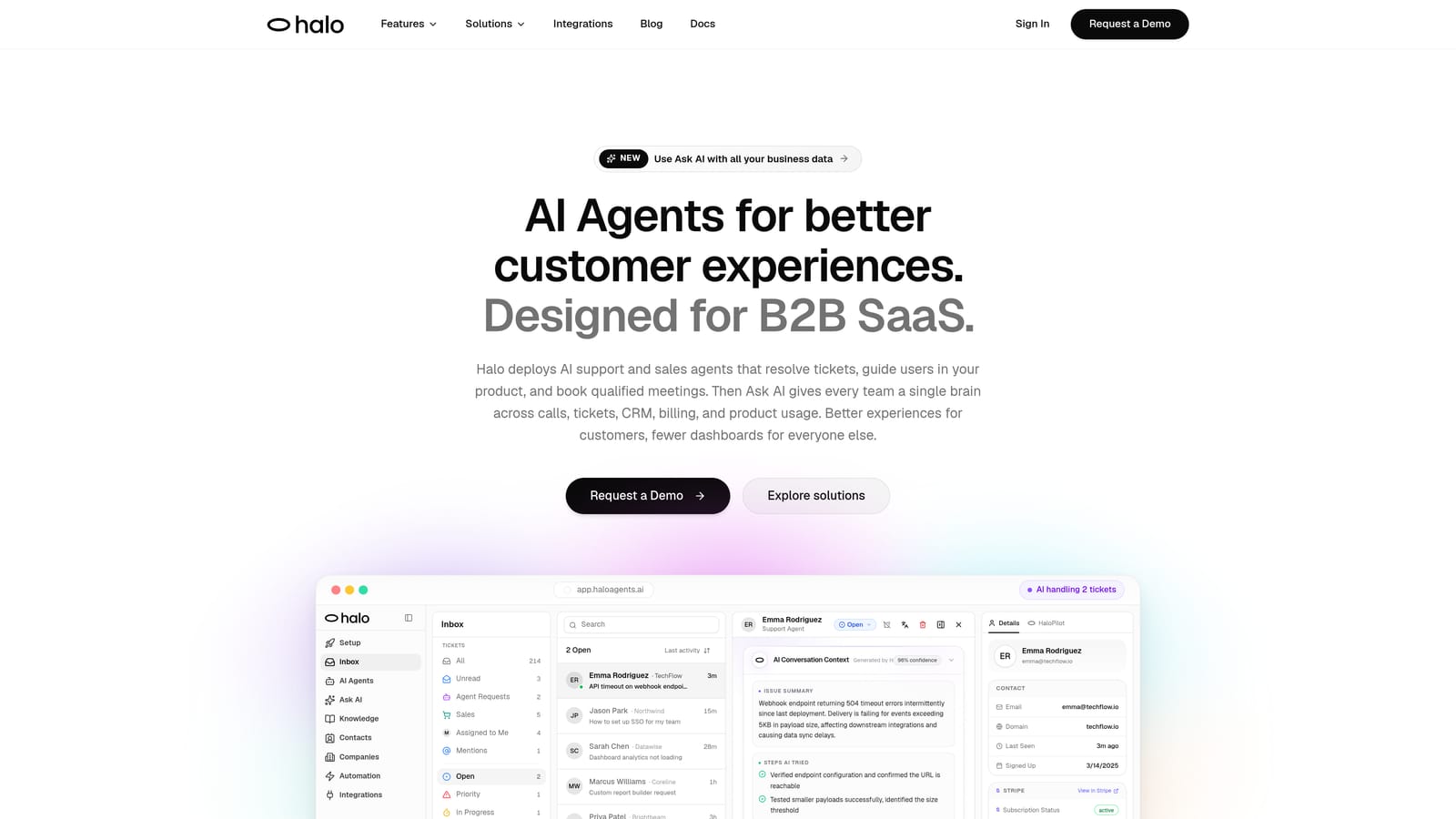
Halo AI is an AI-first customer support platform that deploys autonomous agents to resolve tickets, guide users through your product, and create bug reports while learning from every interaction.
Where This Tool Shines
Halo's standout differentiator is page-awareness: the AI agent sees exactly what the user sees inside your product, enabling contextual guidance that goes far beyond generic FAQ deflection. This is meaningfully different from a chatbot that searches a knowledge base and returns a link.
The platform also extends beyond support into business intelligence. The smart inbox surfaces customer health signals, revenue anomalies, and churn indicators, turning your support data into strategic insight. For SaaS teams, that's a significant value layer that traditional helpdesks don't offer.
Key Features
Page-Aware AI Agents: The AI sees what users see in your product, enabling contextual, in-product guidance rather than generic responses.
Autonomous Ticket Resolution: AI handles routine tickets end-to-end, with smart escalation to live agents when complexity warrants it.
Auto Bug Ticket Creation: Automatically generates and routes bug reports to engineering tools like Linear, closing the loop between support and product.
Smart Inbox with Business Intelligence: Surfaces customer health signals, revenue anomalies, and churn indicators alongside standard support metrics.
Broad Integration Stack: Connects with HubSpot, Slack, Stripe, Zoom, Intercom, PandaDoc, Fathom, and more, so AI context spans your entire business stack.
Best For
Halo is built for B2B SaaS companies that want AI to own routine resolution while surfacing business intelligence from support interactions. It's particularly well-suited to product-led growth companies where in-product guidance and user onboarding overlap with support. Teams that are already stretched thin and can't hire their way out of ticket volume will find the autonomous resolution model compelling.
Pricing
Contact for pricing. A demo is available at haloagents.ai. Given the AI-first architecture and business intelligence layer, this is positioned as a premium platform rather than a per-seat helpdesk.
2. Zendesk
Best for: Enterprise teams that need a mature, proven helpdesk with AI augmentation for human agents
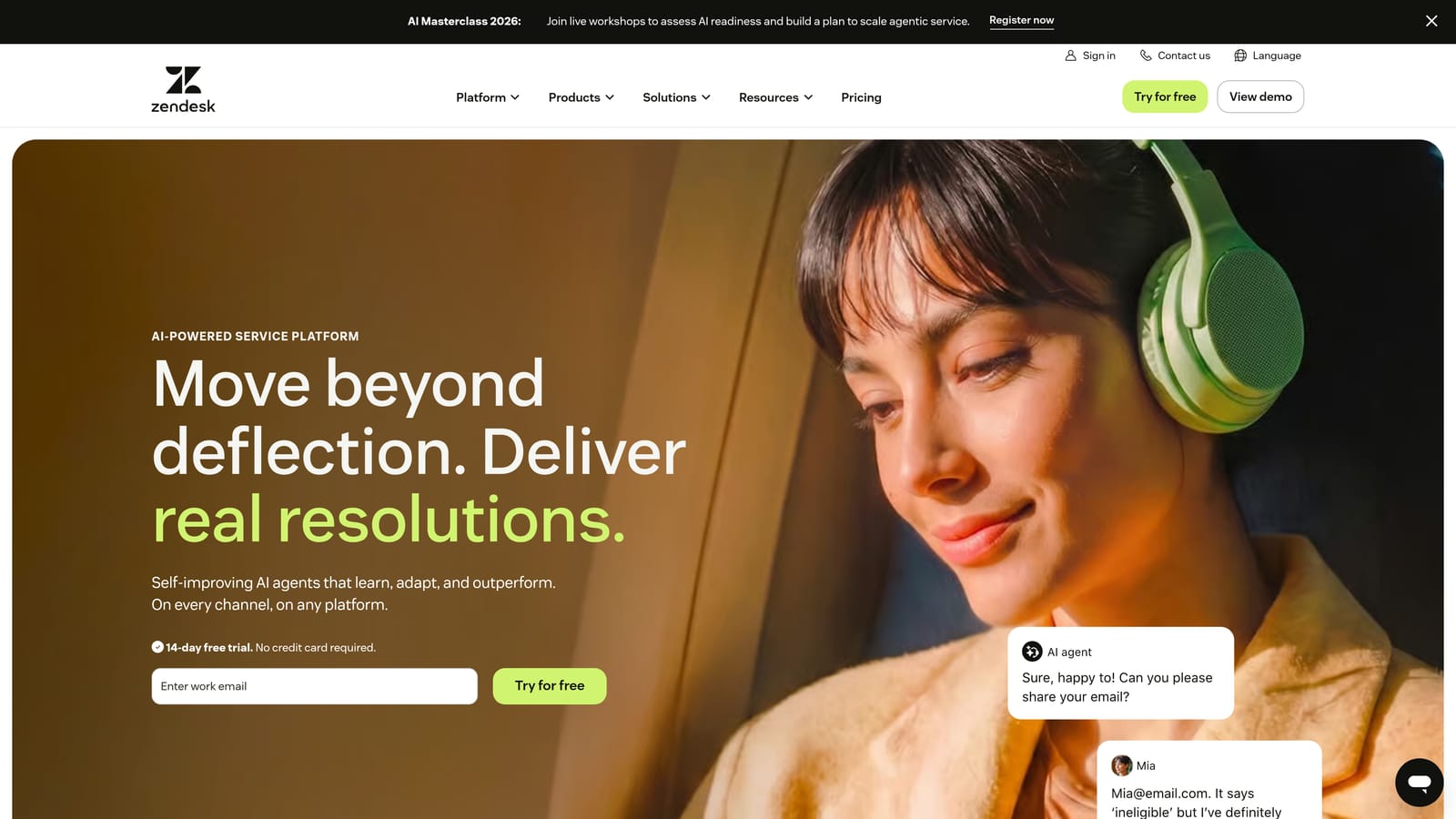
Zendesk is the market-leading helpdesk platform with AI features layered on top of its mature ticketing infrastructure, including AI Agents for deflection, Agent Copilot for human assist, and intelligent triage.
Where This Tool Shines
Zendesk's strength is its depth of ecosystem maturity. Over 1,000 integrations, decades of enterprise adoption, and reporting capabilities that most teams won't outgrow. If your organization has already built workflows, automations, and reporting around Zendesk, the switching cost is real and should factor into any evaluation.
The AI features are genuinely useful, particularly Agent Copilot for teams with high agent headcount. Intelligent triage reduces manual routing, and intent detection helps prioritize queues. These are meaningful productivity gains, even if the architecture isn't designed for autonomous resolution.
Key Features
AI Agents: Formerly Answer Bot, handles self-service deflection for common queries before tickets reach human agents.
Agent Copilot: Provides AI-generated reply suggestions and next-step recommendations to human agents during live conversations.
Intelligent Triage: Automatically routes tickets, detects intent, and performs sentiment analysis to prioritize queues.
Enterprise Reporting: Extensive analytics and dashboards for support operations at scale.
Advanced AI Add-On: Additional AI capabilities available as a paid add-on to existing plans, giving teams flexibility to adopt gradually.
Best For
Zendesk is best suited for mid-market and enterprise teams with established support operations and meaningful agent headcount. If AI augmenting your human agents is the goal rather than replacing the human-first model, Zendesk's approach fits that philosophy. Teams already invested in the Zendesk ecosystem should evaluate the Advanced AI add-on before considering migration.
Pricing
Suite Team starts at approximately $55 per agent per month. The Advanced AI add-on is priced separately, and costs can escalate quickly at enterprise scale with multiple add-ons layered in.
3. Intercom
Best for: Teams that want conversational AI with autonomous resolution capability and a strong in-app messaging experience
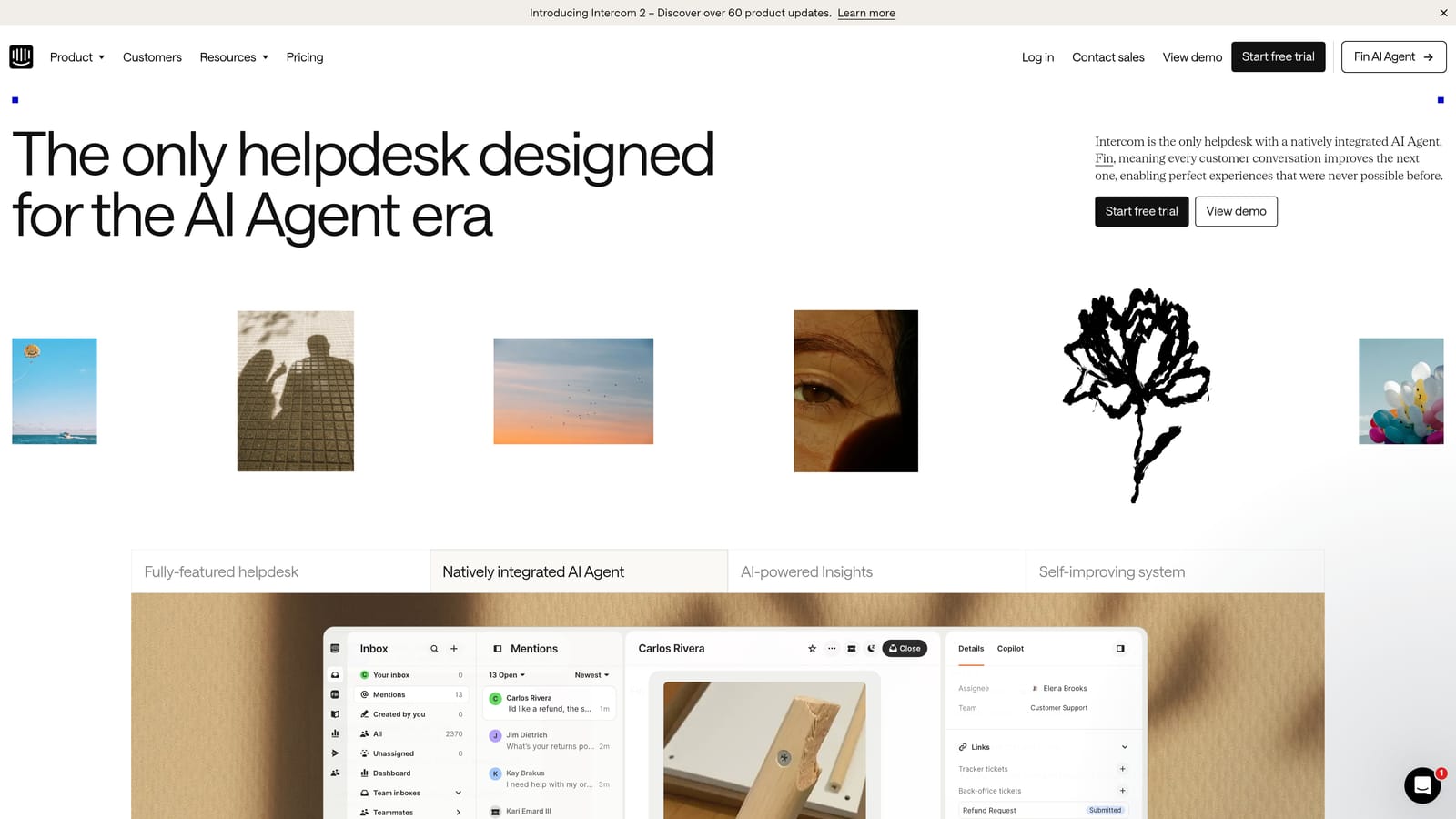
Intercom is a conversational support platform with Fin AI Agent, one of the more autonomous AI offerings from a traditional helpdesk vendor, blending support and sales messaging in one platform.
Where This Tool Shines
Fin AI Agent is genuinely more AI-forward than what most traditional helpdesk vendors offer. Its outcome-based pricing model (per resolution rather than per seat) aligns incentives in an interesting way: you pay for results, not capacity. For teams with high deflection potential, this can be economically attractive.
Intercom also bridges support, onboarding, and sales conversations in one platform, which is valuable for product-led companies where those boundaries blur. CRM context integration means Fin can personalize responses based on what Intercom knows about the customer.
Key Features
Fin AI Agent: Handles autonomous resolution with outcome-based per-resolution pricing rather than traditional seat-based billing.
In-App Messaging: Strong conversational AI for real-time, in-product support experiences.
CRM Context Integration: Personalizes AI responses using customer data already in Intercom.
Unified Platform: Bridges support, onboarding, and sales conversations without switching tools.
Human Handoff: Transfers to live agents with full conversation context preserved, so customers don't repeat themselves.
Best For
Intercom suits SaaS companies that already use the platform for in-app messaging and want to extend AI resolution without adopting a separate tool. It's particularly strong for teams where support and customer success overlap and where in-product messaging is central to the user experience.
Pricing
Fin AI Agent is priced per resolution. Full platform plans start at approximately $29 per seat per month, though the total cost depends heavily on resolution volume and which Intercom products are included.
4. Freshdesk
Best for: SMBs that need structured ticketing with AI assistance at an accessible price point
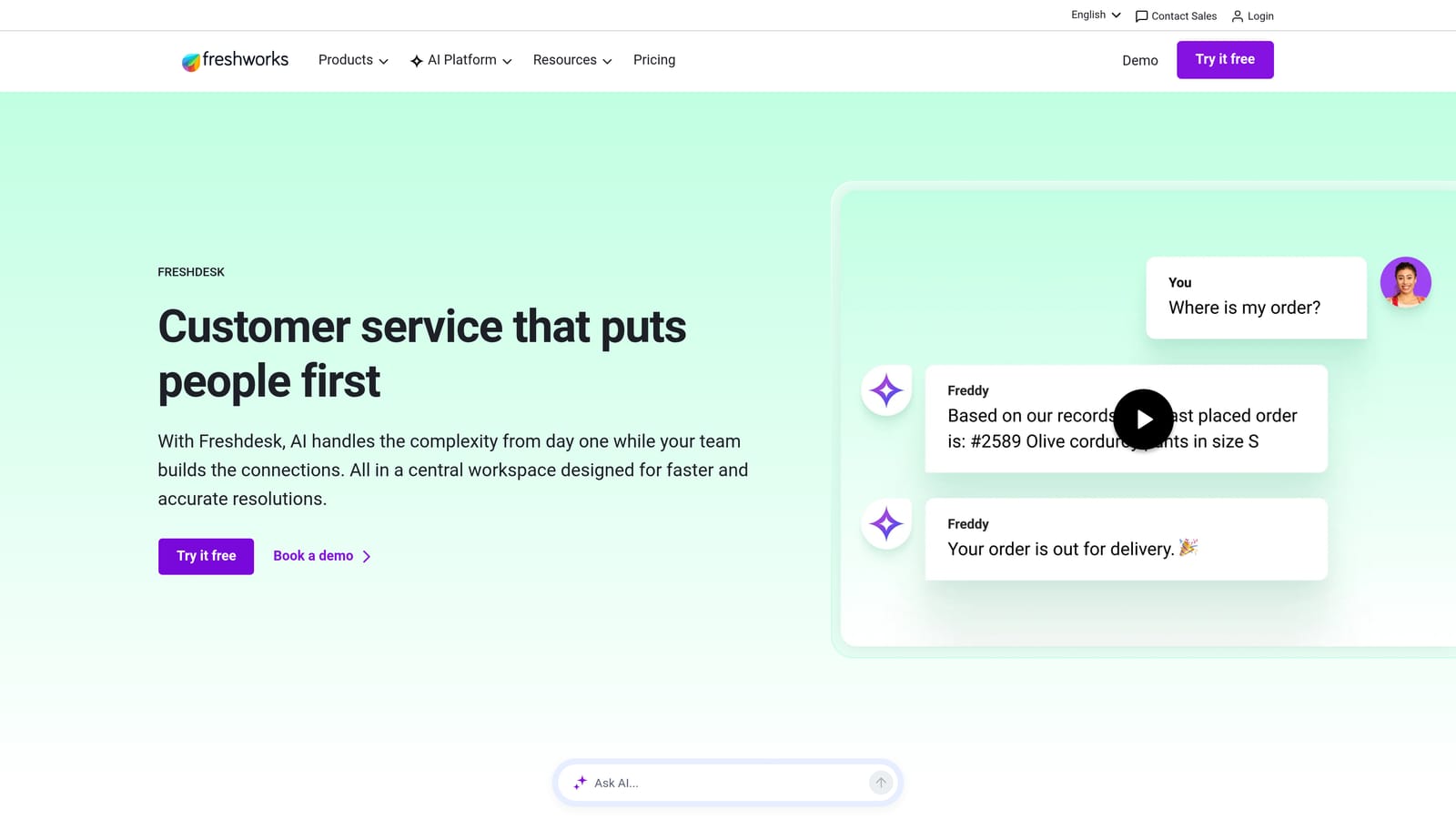
Freshdesk is a budget-friendly helpdesk with Freddy AI, a suite of AI tools covering self-service bots, agent assistance, and analytics, well-suited for smaller teams that need organized ticketing with AI assistance.
Where This Tool Shines
Freshdesk offers one of the most accessible entry points in the market without sacrificing the core helpdesk features most teams need. Freddy AI covers the main use cases: deflection via knowledge base, reply suggestions for agents, and ticket summarization. For SMBs that don't need the sophistication of enterprise platforms, this is a practical, cost-effective choice.
Freddy Insights adds AI-driven analytics for support performance, giving team leads visibility into trends without requiring a dedicated analytics tool or complex reporting setup.
Key Features
Freddy Self Service: AI-powered bot that deflects common queries using knowledge base content before they reach human agents.
Freddy Copilot: Provides reply suggestions, ticket summarization, and tone adjustment to help agents respond faster and more consistently.
Freddy Insights: AI-driven analytics for tracking support performance trends and identifying improvement areas.
Omnichannel Ticketing: Handles email, chat, phone, and social channels in a unified inbox.
Affordable Scaling: Lower per-seat cost compared to Zendesk or Salesforce makes it accessible for growing teams watching budget.
Best For
Freshdesk is the right choice for SMBs and growing teams that need structured, omnichannel ticketing with useful AI assistance but aren't ready to invest in enterprise-level platforms. Teams moving off shared inboxes or basic tools will find Freshdesk a significant upgrade without sticker shock.
Pricing
Growth plan starts from approximately $15 per agent per month. Freddy Copilot is available as a paid add-on, so factor that into total cost if agent assistance is a priority.
5. Salesforce Service Cloud
Best for: Enterprises with complex customer data requirements already invested in the Salesforce ecosystem
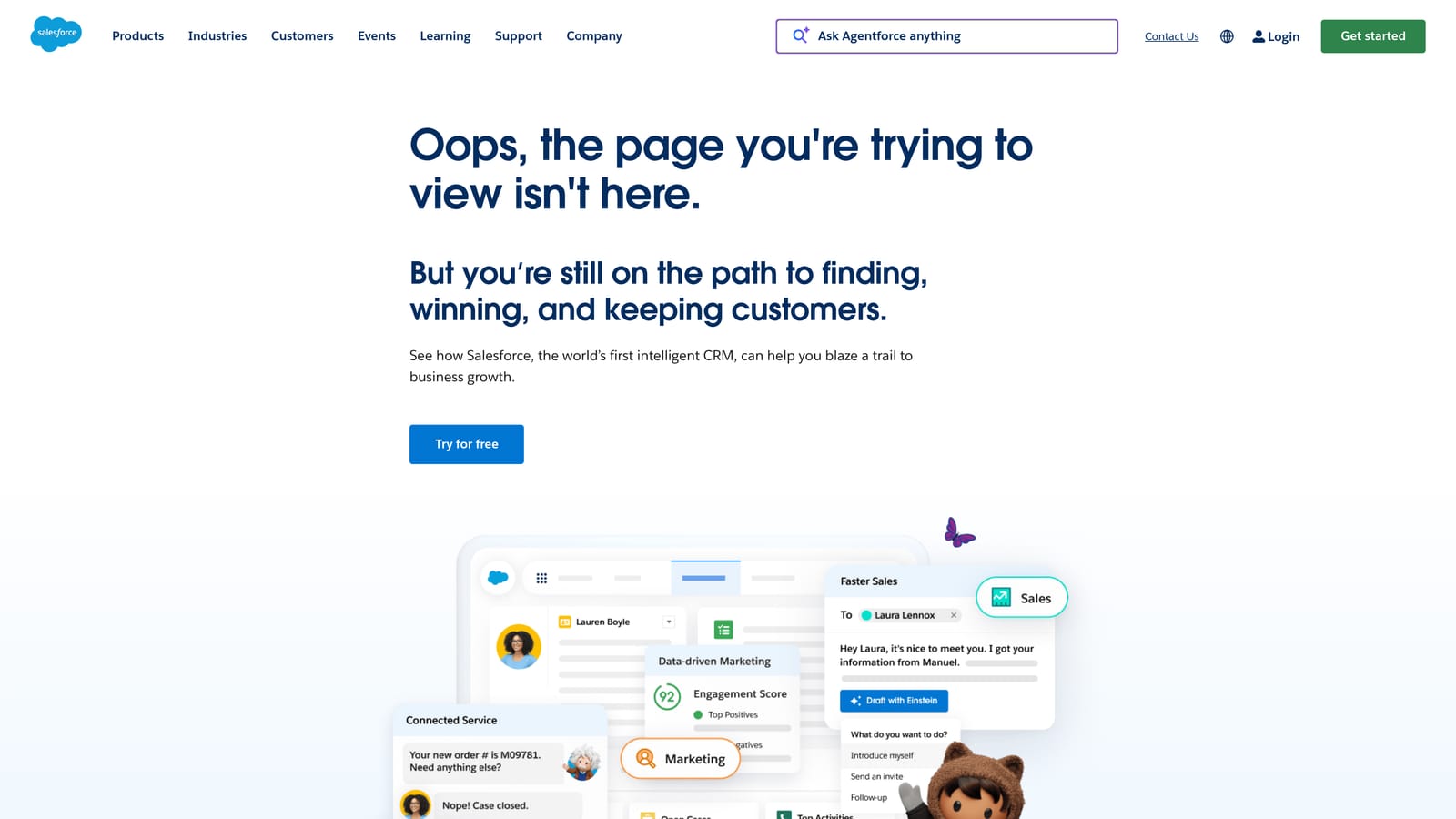
Salesforce Service Cloud is an enterprise support platform deeply integrated with Salesforce CRM, featuring Einstein AI for case classification, reply recommendations, and the newer Agentforce for autonomous service actions.
Where This Tool Shines
When your customer data already lives in Salesforce, Service Cloud's Einstein AI becomes genuinely powerful. Case classification and reply recommendations are informed by the full customer 360 view, combining support history with sales and marketing data in ways that standalone helpdesks can't replicate. Einstein Conversation Mining identifies patterns across support interactions at scale, which is valuable for enterprises dealing with high ticket volumes across complex product lines.
Agentforce represents Salesforce's push toward more autonomous AI service actions, and for organizations already deep in the Salesforce ecosystem, it offers a path to AI-first resolution without adopting a separate platform.
Key Features
Einstein AI: Case classification, intent detection, and reply recommendations all tied to Salesforce CRM data for contextual accuracy.
Agentforce: Newer autonomous AI agent capability for executing service workflows without constant human oversight.
Customer 360 View: Combines support history with sales and marketing data for a complete customer picture.
Einstein Conversation Mining: Identifies patterns and trends across large volumes of support interactions.
Enterprise Customization: Deeply configurable for complex workflows, compliance requirements, and multi-team operations.
Best For
Service Cloud is best suited for large enterprises where Salesforce is already the system of record for customer data. If you're not in the Salesforce ecosystem, the implementation complexity and cost are difficult to justify. For those who are, it's a powerful option for AI-augmented enterprise support.
Pricing
Enterprise plans start at approximately $165 per user per month. Significant implementation investment is typically required, and total cost of ownership is substantially higher than the license fee alone.
6. Help Scout
Best for: Teams where brand voice and human touch are central to the customer experience
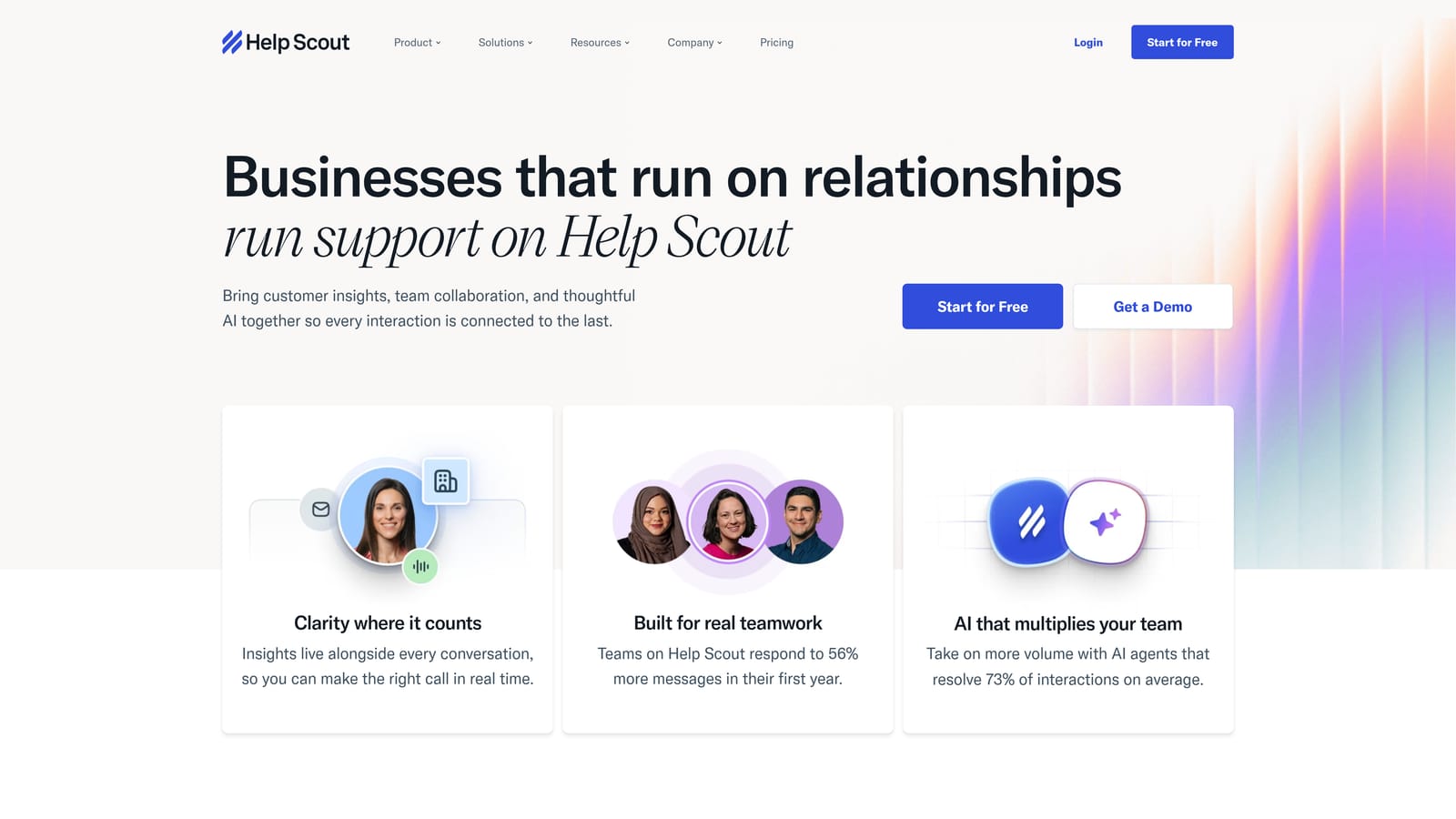
Help Scout is a human-first support platform with AI Assist features for drafting, summarizing, and refining agent replies, designed for teams where the personal touch matters as much as resolution speed.
Where This Tool Shines
Help Scout's deliberate philosophy is worth acknowledging: AI here supports agents rather than replacing them, and the product is designed accordingly. AI Assist drafts reply suggestions based on conversation context and knowledge base content, while AI Summarize condenses long threads so agents can get up to speed quickly without reading every message in a thread.
The clean, simple interface reduces cognitive load for agents, and the fact that AI features are included in standard plans (without add-on fees) makes the total cost predictable. For teams that have tried more complex platforms and found them overkill, Help Scout is a refreshing alternative.
Key Features
AI Assist: Drafts reply suggestions based on conversation context and knowledge base content, which agents can edit and send.
AI Summarize: Condenses long conversation threads so agents get context quickly without reading every message.
Tone and Length Adjustment: Helps agents refine their own replies for consistency and clarity.
Included AI Features: AI capabilities are part of standard plans, not a separate add-on, keeping pricing predictable.
Clean Interface: Simple, agent-focused design that prioritizes usability over feature density.
Best For
Help Scout suits small to mid-sized teams where brand voice, empathy, and human connection are core to the support experience. Companies in industries like financial services, healthcare-adjacent SaaS, or premium consumer brands often find the human-first approach aligns better with their customer expectations than aggressive AI deflection.
Pricing
Standard plan from approximately $22 per user per month; Plus plan from approximately $44 per user per month. AI features included in both tiers without additional fees.
7. Tidio
Best for: Small e-commerce businesses that need quick AI chat deployment without technical resources
Tidio is an SMB-focused live chat and AI chatbot platform with Lyro AI, a conversational AI designed for fast deployment, particularly popular with e-commerce businesses on Shopify and WooCommerce.
Where This Tool Shines
Tidio's biggest advantage is accessibility: no-code setup means a small team can deploy conversational AI without involving developers or running a lengthy implementation. Lyro AI handles common queries from knowledge base content and falls back to live chat when it reaches its limits, creating a simple but functional hybrid model.
For e-commerce businesses, the native Shopify and WooCommerce integrations provide order context that makes AI responses more relevant. Customers asking about their order status or return policy get answers grounded in actual transaction data rather than generic knowledge base content.
Key Features
Lyro AI: Conversational chatbot that handles common queries using knowledge base content with a natural conversational interface.
No-Code Setup: Deployable without technical resources, making it accessible for small teams without engineering support.
E-Commerce Integrations: Native Shopify and WooCommerce integrations provide order context for more relevant AI responses.
Live Chat Fallback: Smooth handoff to human agents when Lyro reaches the limits of its resolution capability.
Freemium Entry Point: Free plan available, with Lyro AI conversations priced by volume rather than per seat.
Best For
Tidio is purpose-built for small e-commerce businesses and consumer-facing SMBs. If you're a B2B SaaS company with complex product workflows, technical integrations, or enterprise customers, Tidio will feel limited quickly. For straightforward consumer support at small scale, it's a practical starting point.
Pricing
Free plan available. Lyro AI starts from approximately $29 per month for 50 conversations, with pricing scaling by conversation volume.
8. Kustomer
Best for: High-volume D2C brands and consumer apps that need CRM-native support with AI automation
Kustomer is a CRM-native support platform built for high-volume consumer support, with AI automation tied to full customer timeline data, well-suited for direct-to-consumer brands and consumer apps.
Where This Tool Shines
Kustomer's core strength is the full customer timeline view: every interaction, purchase, and support touchpoint in a single chronological record. When AI automation is layered on top of that data, auto-routing and sentiment analysis become more accurate because they're informed by complete customer history rather than just the current ticket.
For high-volume consumer support scenarios, the workflow automation capabilities handle repetitive scenarios efficiently. Omnichannel coverage across email, chat, SMS, social, and voice in one unified view reduces the operational complexity of managing multiple channel-specific tools.
Key Features
KustomerIQ: AI for auto-routing, sentiment analysis, and suggested replies, all informed by full customer history.
Full Customer Timeline: Combines purchase history, past interactions, and support data in a single chronological view.
Workflow Automation: Handles high-volume, repetitive consumer support scenarios with rule-based automation tied to customer attributes.
Omnichannel Unified View: Email, chat, SMS, social, and voice managed in one interface without switching between tools.
Behavior-Based AI Rules: Automation triggers based on customer attributes and behavior patterns rather than just ticket content.
Best For
Kustomer is best suited for D2C brands, consumer apps, and retail companies handling high volumes of consumer support across multiple channels. It's less suited for B2B SaaS companies with complex technical support needs or enterprise procurement requirements. The CRM-native model shines when customer data richness directly improves support outcomes.
Pricing
Enterprise pricing; typically starts at approximately $89 per user per month. This positions Kustomer firmly in the mid-market to enterprise range rather than the SMB tier.
Which Platform Fits Your Team?
The right tool here isn't universal — it depends on where AI sits in your support strategy and what your team actually needs to accomplish.
Lean SaaS teams scaling without headcount: Halo AI is the strongest fit. The AI-first architecture, page-aware agents, and business intelligence layer are built specifically for this scenario. Autonomous resolution with smart escalation means your team handles complexity while AI handles volume.
Enterprise teams already on Zendesk: Evaluate the Advanced AI add-on before committing to migration. If your workflows, integrations, and reporting are deeply embedded in Zendesk, the switching cost is real. The AI features are genuinely useful for agent augmentation even if they don't reach autonomous resolution.
SMBs watching budget: Freshdesk offers the best balance of structured ticketing, useful AI assistance, and accessible pricing. Tidio is the right starting point specifically for e-commerce businesses that need fast deployment without technical resources.
CRM-heavy enterprises: Salesforce Service Cloud is the natural choice if your customer data already lives in Salesforce. Kustomer suits D2C brands and consumer apps that need CRM-native support with full customer timeline context.
Teams prioritizing human touch: Help Scout's deliberate human-first philosophy and clean interface make it the right choice when brand voice and agent empathy are non-negotiable.
Your support team shouldn't scale linearly with your customer base. Let AI agents handle routine tickets, guide users through your product, and surface business intelligence while your team focuses on complex issues that need a human touch. See Halo in action and discover how continuous learning transforms every interaction into smarter, faster support.