7 Best Zendesk AI Alternatives for Smarter Customer Support in 2026
Frustrated with Zendesk's expensive AI add-ons that fail to automate repetitive support tasks? This guide explores seven best Zendesk AI alternatives built specifically for intelligent automation rather than retrofitted onto legacy ticketing systems. Discover AI-first platforms that deliver transformative support automation without enterprise-tier pricing, from conversational specialists to e-commerce automation experts designed to actually reduce your team's workload.
 Matt PattoliFounder14 min read
Your Zendesk subscription started reasonable. Then came the AI add-ons. Then the premium AI features. Then the enterprise tier to unlock what you actually needed. Suddenly, you're paying enterprise prices for what feels like a chatbot with training wheels—and your support team is still drowning in repetitive tickets that your "AI" can't handle.
You're not alone in this frustration. The legacy helpdesk model of bolting AI onto decade-old infrastructure creates exactly this problem: expensive complexity that delivers incremental improvements rather than transformative automation.
The good news? The market has responded. A new generation of AI-first platforms has emerged, built from the ground up for intelligent support rather than retrofitted onto traditional ticketing systems. These alternatives range from conversational specialists to e-commerce automation experts, each approaching the support challenge from a different angle.
This guide examines seven standout alternatives to Zendesk AI, focusing on what genuinely matters: autonomous resolution capabilities, integration complexity, time-to-value, and real-world performance beyond the marketing promises. We'll skip the feature checklists and dive into practical considerations—who each platform serves best, what makes their AI architecture different, and how to evaluate them against your specific support challenges.
Because choosing the right alternative isn't about finding the platform with the longest feature list. It's about finding the one that solves your actual problems without requiring a dedicated implementation team and a six-figure budget.
1. Halo AI: Autonomous Intelligence That Actually Learns
The Problem It Solves
Most AI support tools operate like sophisticated FAQ retrievers—they can surface relevant articles, but they can't actually resolve issues autonomously. Your team still handles the bulk of tickets manually, just with an expensive chatbot doing triage. The AI doesn't learn from resolutions, doesn't understand visual context when users are stuck in your product, and can't connect support insights to broader business intelligence.
This creates a scaling trap: your support costs still grow linearly with your customer base because the AI handles only the easiest 20% of tickets that users could have self-served anyway.
How Halo Approaches It Differently
Halo takes an AI-first architecture approach, meaning the entire platform is built around autonomous agents rather than traditional ticketing with AI bolted on. The core difference shows up in three ways: page-aware context, continuous learning, and business intelligence integration.
The page-aware capability means Halo's AI can see what your user sees—actual UI elements, specific screens, error states. When someone says "this button isn't working," the AI knows which button, on which page, in what context. It's the difference between a support agent who can screen share versus one working blind from text descriptions.
Continuous learning happens automatically. Every resolved ticket, every successful interaction, every escalation to human agents feeds back into the AI's knowledge base. The system doesn't just retrieve static answers—it evolves its understanding of your product, your customers, and your support patterns.
The business intelligence layer connects support data to your entire stack: Linear for bug tracking, HubSpot for customer health, Stripe for revenue signals, Slack for team coordination. Support stops being an isolated cost center and becomes an intelligence source for product, sales, and customer success.
Best Fit For
Teams who need genuine automation that improves over time rather than static chatbot responses. Particularly strong for B2B SaaS companies where product complexity demands contextual understanding, and where connecting support insights to product development and customer health creates compounding value.
Also ideal for companies tired of managing multiple disconnected tools—Halo's integration architecture means your AI agent has the same context your best human agents would have, across your entire business stack.
Implementation Considerations
The AI-first approach means you're not migrating a traditional ticket database—you're implementing an intelligent agent system. Initial setup involves connecting your key integrations and allowing the AI to learn your product through documentation, past tickets, and team interactions.
Time-to-value accelerates as the system learns. Early weeks focus on training and refinement. By month two, you're typically seeing autonomous resolution on common issues. By month three, the AI is handling edge cases that would stump most chatbots because it's learned from your team's expertise.
2. Intercom Fin: Conversational Fluency for Existing Users
The Challenge It Solves
Many AI support tools feel robotic—they can answer questions, but the interaction feels transactional rather than conversational. Users can tell they're talking to a bot, which creates friction and reduces engagement. For companies who've built their support strategy around conversational experiences, switching to a less natural AI feels like a step backward.
Additionally, migrating away from an existing platform creates integration headaches. Your team has workflows, automations, and data structures built around your current system. A complete platform switch means rebuilding all of that from scratch.
How Fin Approaches Conversation
Intercom built Fin specifically for natural dialogue. The AI maintains context across multi-turn conversations, handles clarifying questions smoothly, and adapts its tone based on the interaction. It feels less like a FAQ bot and more like an actual conversation with a knowledgeable team member.
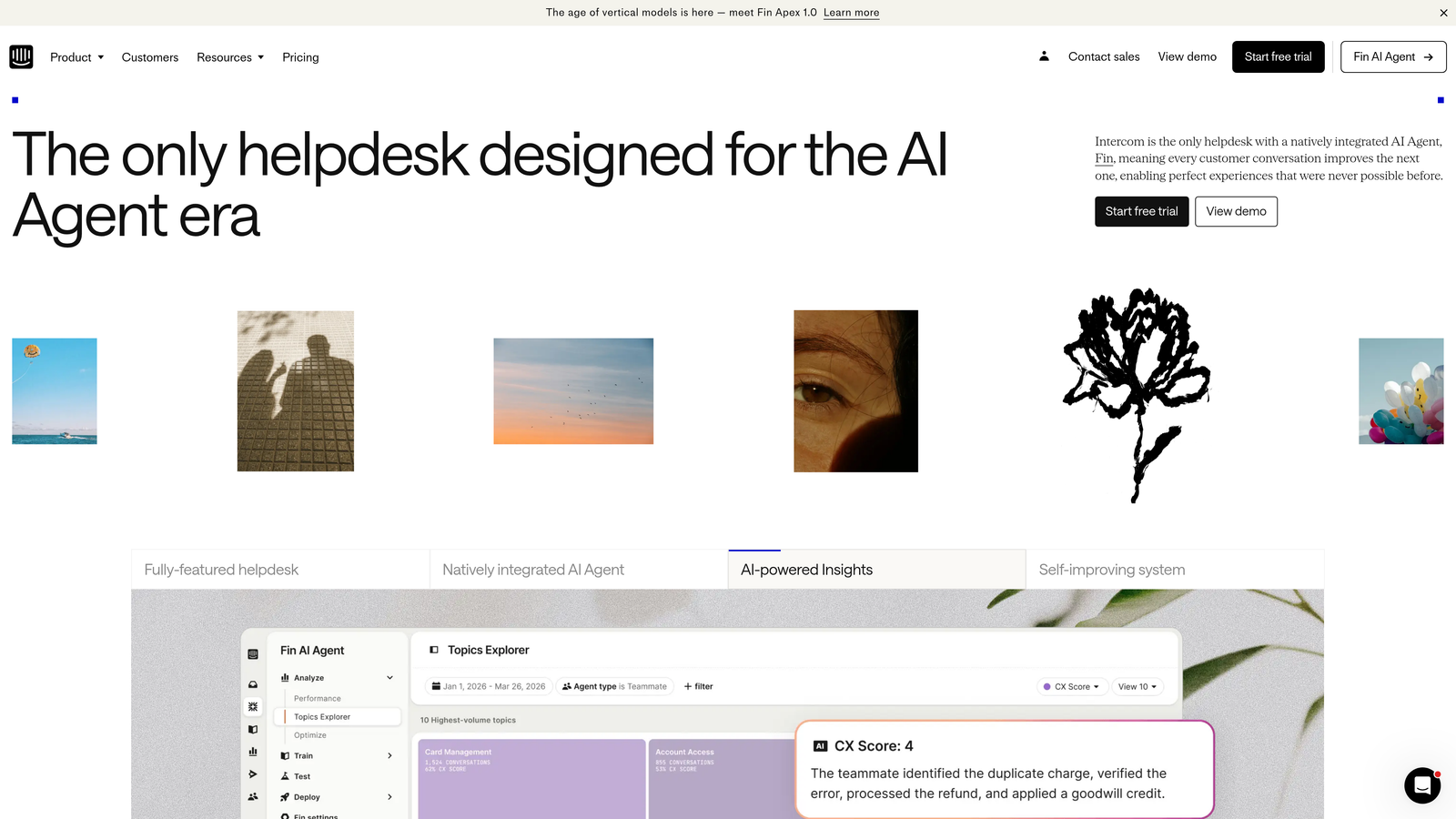
For existing Intercom customers, Fin integrates seamlessly into the platform you already use. Your conversation history, customer data, and team workflows remain intact. You're adding AI capability to your existing foundation rather than ripping out and replacing your entire support infrastructure.
The system works particularly well for companies who prioritize customer experience over pure efficiency metrics. Fin aims to make automated interactions feel personal rather than just fast. If you're evaluating options, our comparison of Intercom AI alternatives provides additional context.
Best Fit For
Current Intercom users who want to add AI capabilities without platform migration. Also strong for consumer-facing companies where conversational tone and brand voice matter as much as resolution speed.
Less ideal for teams seeking deep business intelligence integration or autonomous resolution of complex technical issues. Fin excels at conversational support, but it's still operating within Intercom's traditional messaging framework rather than reimagining support from an AI-first perspective.
Migration Reality Check
If you're already on Intercom, implementation is straightforward—you're enabling a feature rather than switching platforms. If you're coming from Zendesk, you're looking at a full platform migration with all the data transfer, workflow rebuilding, and team retraining that entails.
The conversational strength comes with trade-offs in autonomous resolution capabilities. Fin handles straightforward queries beautifully, but complex troubleshooting still typically requires human escalation.
3. Freshdesk Freddy AI: Budget-Conscious Automation
The Problem It Addresses
Enterprise AI platforms often price out growing teams who need automation but can't justify five-figure monthly commitments. You're stuck between expensive tools designed for Fortune 500 companies and basic chatbots that barely move the needle on support efficiency.
Meanwhile, your ticket volume is growing faster than your team budget. You need intelligent routing, categorization, and basic automation—not necessarily full autonomous resolution, but enough AI assistance to help your human agents work more efficiently.
Freddy's Practical Approach
Freshdesk Freddy focuses on augmenting human agents rather than replacing them. The AI excels at ticket categorization, intelligent routing to the right team members, and surfacing relevant knowledge base articles for agents to use in their responses.
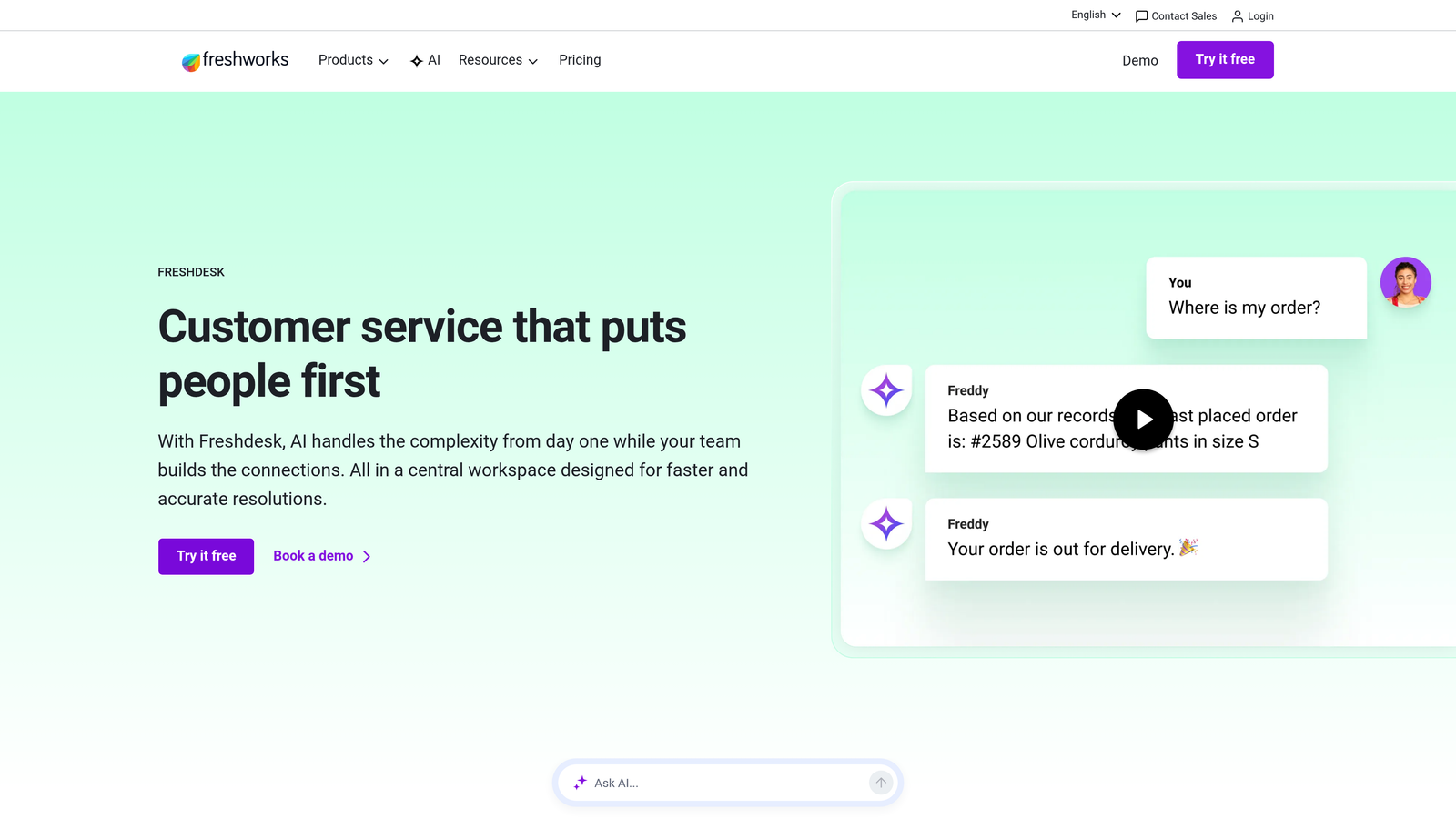
Think of it as an intelligent assistant for your support team rather than an autonomous agent. Freddy handles the organizational overhead—sorting, prioritizing, routing, suggesting responses—while your team maintains the human touch in actual customer interactions.
The pricing model reflects this positioning. You're not paying for enterprise-scale autonomous resolution; you're paying for intelligent automation that makes your existing team more productive. For teams exploring budget-friendly options, our guide to affordable chatbot software covers additional considerations.
Best Fit For
Growing companies with 5-50 support team members who need better organization and efficiency but aren't ready for full autonomous AI. Particularly strong for teams who value the human element in support and want AI to enhance rather than replace their agents.
Also suitable for companies with straightforward support needs where intelligent routing and categorization solve the majority of efficiency problems. If your bottleneck is organizational chaos rather than resolution complexity, Freddy addresses that directly.
Scaling Considerations
The agent-assistance model works well until ticket volume outpaces your ability to hire. At some point, making humans more efficient hits diminishing returns—you need actual autonomous resolution to break the linear scaling curve.
Freddy provides a practical middle ground for teams not ready to commit to full AI-first platforms, but it's worth considering whether you're solving today's problem or building for tomorrow's scale.
4. Ada: Enterprise No-Code Automation
The Challenge It Tackles
Enterprise companies face unique support challenges: multiple brands, global customer bases requiring multi-language support, complex approval workflows, and stringent compliance requirements. Traditional AI tools either lack enterprise features or require extensive developer resources to customize.
You need sophisticated automation that non-technical team members can manage, brand consistency across customer touchpoints, and the ability to handle complex decision trees without writing code. Most platforms force you to choose between power and accessibility.
Ada's Enterprise Focus
Ada built specifically for enterprise scale with a no-code interface that empowers support teams to build and modify AI conversations without developer dependency. The platform handles multi-language support natively, maintains brand voice consistency, and scales across multiple products or business units.
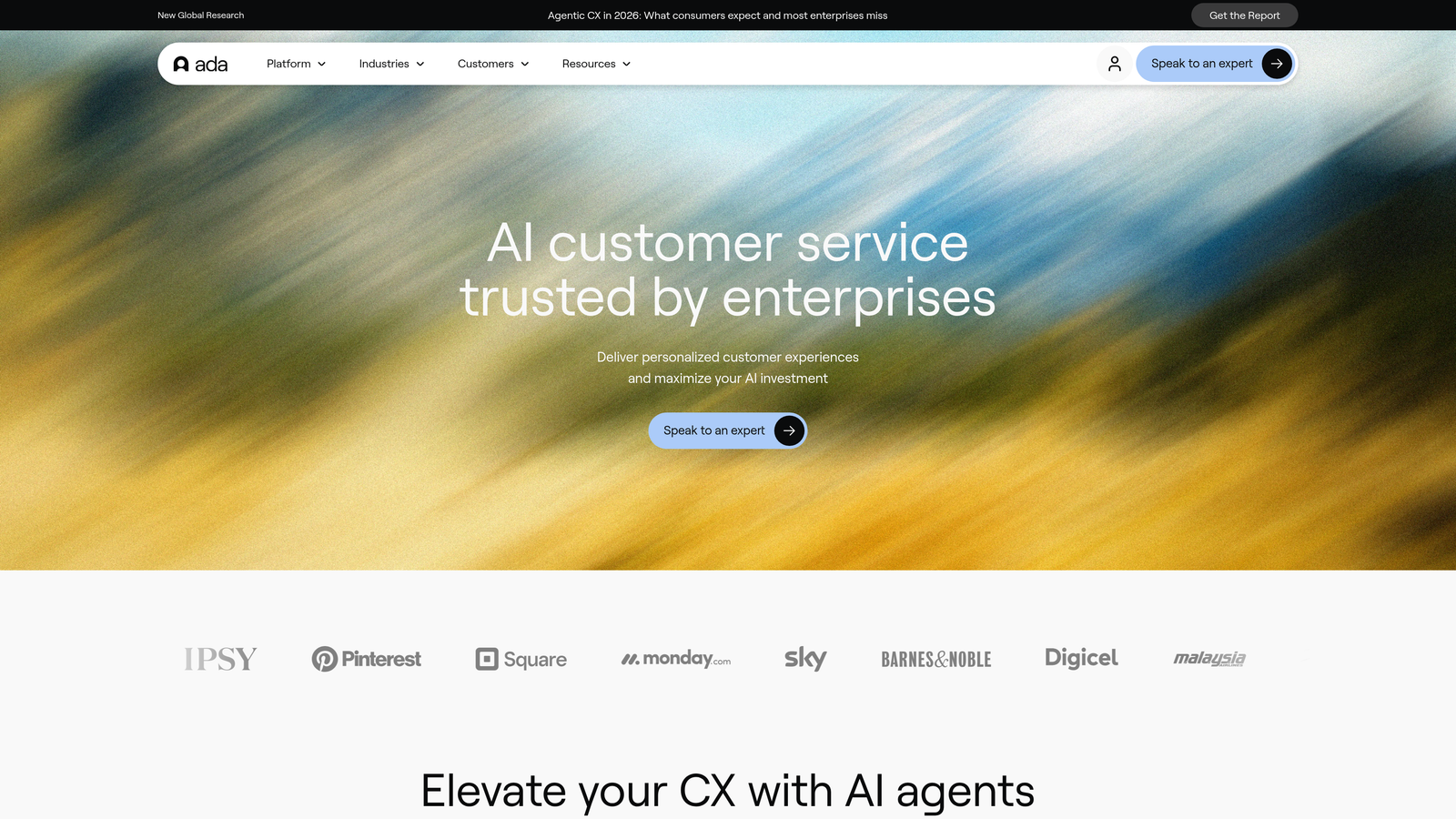
The no-code builder lets support managers create complex conversation flows, A/B test different approaches, and iterate based on performance data—all without submitting IT tickets or waiting for development cycles.
Enterprise features extend to security, compliance, and governance. Ada provides the audit trails, access controls, and data handling capabilities that large organizations require.
Best Fit For
Large enterprises with multiple brands, global operations, or complex organizational structures. Particularly valuable for companies where support teams need autonomy to iterate quickly without constant developer involvement.
The enterprise positioning comes with enterprise pricing. Smaller companies often find Ada's capabilities exceed their needs while the cost exceeds their budget. Our overview of enterprise chatbot solutions explores additional options for large organizations.
Implementation Reality
No-code doesn't mean no-effort. Building effective conversation flows still requires strategic thinking, content development, and ongoing optimization. The platform removes technical barriers, but you still need dedicated team members managing the AI strategy.
For enterprises already dealing with multi-language support, brand consistency challenges, and complex workflows, Ada's specialized capabilities justify the investment. For smaller companies, the platform may offer more than you need.
5. Kustomer IQ: CRM-Native Intelligence
The Problem It Solves
Traditional support platforms treat each ticket as an isolated transaction. Your agent sees the current issue but lacks context about the customer's history, sentiment trajectory, account value, or broader relationship with your company. This fragmented view leads to inconsistent experiences and missed opportunities.
High-value customers get the same automated responses as new trials. Frustrated customers showing churn signals receive generic support. Your team lacks the intelligence to prioritize based on relationship context rather than just ticket timestamp.
Kustomer's Unified Approach
Kustomer IQ builds AI on top of a unified customer view rather than a traditional ticketing system. The AI sees conversation history, purchase patterns, product usage, sentiment trends, and account health in a single interface.
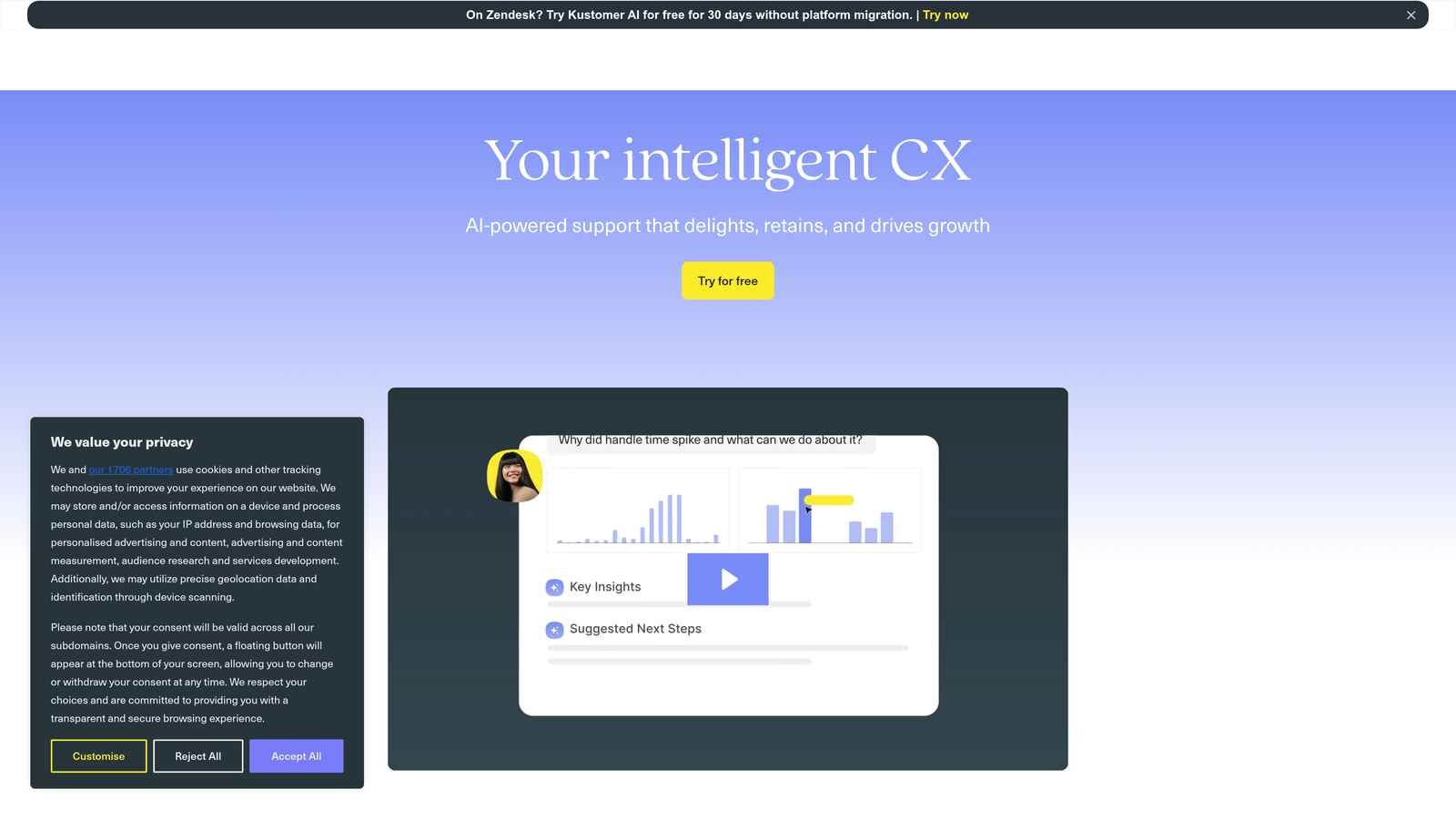
This context enables smarter automation decisions. The AI might escalate immediately for high-value accounts showing frustration, automate routine requests for healthy customers, or trigger proactive outreach when usage patterns indicate confusion.
The platform includes automated customer sentiment analysis running continuously, identifying not just what customers are asking but how they feel about your product and service. This emotional intelligence layer helps teams prioritize based on relationship risk rather than just ticket volume.
Best Fit For
Companies where customer lifetime value varies significantly and support strategy should reflect that reality. Particularly strong for B2B businesses with complex customer relationships where context and personalization matter more than pure resolution speed.
The CRM-first architecture makes most sense when you're treating support as a relationship management function rather than a cost center to minimize. If your goal is maximum automation with minimum human touch, other platforms may be more aligned.
Strategic Considerations
Kustomer IQ's strength—unified customer context—requires comprehensive data integration to deliver value. The platform works best when connected to your CRM, product analytics, billing system, and other customer data sources.
Implementation involves more than just support workflow migration. You're building a customer intelligence infrastructure, which creates more initial complexity but potentially more strategic value long-term.
6. Gorgias: E-Commerce Support Specialist
The Challenge It Addresses
E-commerce support has unique requirements that general-purpose platforms handle poorly. Your team needs instant access to order details, inventory status, shipping tracking, and return history. Customers want to modify orders, check delivery status, and resolve payment issues without leaving the conversation.
Generic support AI can answer product questions but can't actually process a return, update a shipping address, or apply a discount code. Your team ends up switching between the support platform and your e-commerce backend for every transaction-related ticket.
Gorgias's E-Commerce Integration
Gorgias built specifically for Shopify and e-commerce platforms, with deep integration that lets AI agents actually perform order operations, not just discuss them. The AI can process returns, update shipping addresses, apply discount codes, and check inventory—all within the support conversation.
This transactional capability transforms support from information exchange to problem resolution. A customer asking about a delayed order gets tracking details, a proactive shipping update, and potentially a discount code applied automatically—all without human intervention. Understanding AI support agent capabilities helps clarify what's possible with modern automation.
The platform understands e-commerce patterns: pre-purchase questions, order status inquiries, return requests, product recommendations. The AI is trained on e-commerce-specific scenarios rather than general support conversations.
Best Fit For
Shopify stores and e-commerce businesses where order-related tickets dominate support volume. The specialized capabilities deliver immediate value for online retailers but offer little advantage for SaaS or service businesses.
Particularly strong for high-volume stores where order status, shipping, and return inquiries create repetitive ticket loads that don't require human judgment—just system access and transaction processing.
Platform Limitations
The e-commerce specialization is both strength and limitation. Gorgias excels within its vertical but lacks the flexibility for companies with diverse support needs beyond transactional e-commerce.
If your support spans product education, technical troubleshooting, and complex customer success scenarios alongside order management, you may need Gorgias plus additional tools rather than a single unified platform.
7. Help Scout Plus AI: Human-Centered Assistance
The Problem It Solves
Some companies have built their brand on personal, thoughtful customer service. Full automation feels antithetical to your values—you want efficiency, but not at the cost of the human connection that differentiates your support experience.
You're caught between maintaining your high-touch approach and managing growing ticket volume with limited team resources. Pure automation platforms push you toward replacing human agents, but you want to enhance them instead.
Help Scout's Balanced Approach
Help Scout Plus AI positions itself explicitly as agent assistance rather than customer-facing automation. The AI helps your team write better responses, find relevant information faster, and maintain consistency—but the customer still interacts with a real person.
The system suggests response drafts that agents can edit and personalize. It surfaces knowledge base articles and past conversations for context. It helps maintain your brand voice while reducing the time agents spend on routine aspects of each response. This approach aligns with the broader chatbot vs live chat decision many teams face.
This approach preserves the human element while addressing efficiency concerns. Your team stays in the conversation, but with AI assistance that makes them faster and more consistent.
Best Fit For
Companies where brand identity centers on personal service and human connection. Particularly valuable for businesses serving customers who specifically chose you for your high-touch support approach.
Also suitable for teams transitioning toward AI who want to start with assistance before potentially moving to more autonomous automation. The human-in-the-loop model provides a safer entry point for AI adoption.
Scaling Trade-Offs
The human-centered approach maintains your brand values but doesn't fundamentally change your scaling economics. You still need to grow your team roughly in proportion to ticket volume—the AI just makes each agent more productive.
This works well until you hit the point where hiring and training costs become prohibitive. At that stage, you may need to reconsider the balance between human touch and autonomous automation.
Making Your Decision: Beyond Feature Checklists
Choosing the right Zendesk AI alternative starts with honest assessment of your actual pain points, not aspirational feature wishlists. Are you drowning in ticket volume that's fundamentally automatable, or do you need better tools for complex human-required support? Is your bottleneck organizational chaos or genuine resolution complexity?
Start by auditing your last 500 tickets. Categorize them by type, complexity, and whether they required human judgment or just system access and knowledge retrieval. This data reveals whether you need autonomous resolution, intelligent routing, transactional automation, or agent assistance.
Consider your integration ecosystem. AI that can't see your product usage data, CRM information, or business intelligence operates with one hand tied behind its back. The most sophisticated AI in isolation delivers less value than simpler AI with comprehensive context.
Evaluate time-to-value realistically. Some platforms require weeks of configuration before delivering benefits. Others provide immediate value but limited long-term sophistication. Match this timeline to your urgency and team capacity for implementation.
Run a focused pilot before committing to full migration. Choose your highest-volume ticket category and test how well each platform handles it. Real-world performance with your actual tickets matters more than demo scenarios with curated examples.
The pricing model deserves scrutiny beyond monthly costs. Per-seat pricing scales linearly with your team. Per-resolution pricing aligns costs with automation value. Percentage-of-savings models create partnership incentives. Consider total cost of ownership including implementation, training, and ongoing optimization—not just subscription fees.
Your support team shouldn't scale linearly with your customer base. Let AI agents handle routine tickets, guide users through your product, and surface business intelligence while your team focuses on complex issues that need a human touch. See Halo in action and discover how continuous learning transforms every interaction into smarter, faster support.
The right alternative isn't the one with the longest feature list or the most impressive demo. It's the one that solves your specific scaling challenge while fitting your team's capabilities, your customers' expectations, and your company's approach to support as either a cost center to minimize or a competitive advantage to amplify.