Continuous Learning Support Automation: How AI Systems Get Smarter With Every Ticket
Continuous learning support automation transforms traditional static chatbots into intelligent systems that improve with every customer interaction, automatically adapting to product changes and evolving customer needs without constant manual updates. Unlike conventional support automation that requires endless training and becomes outdated within months, these AI-powered systems learn from agent corrections and ticket resolutions, eliminating the maintenance burden while delivering increasingly accurate responses over time.
 Matt PattoliFounder17 min read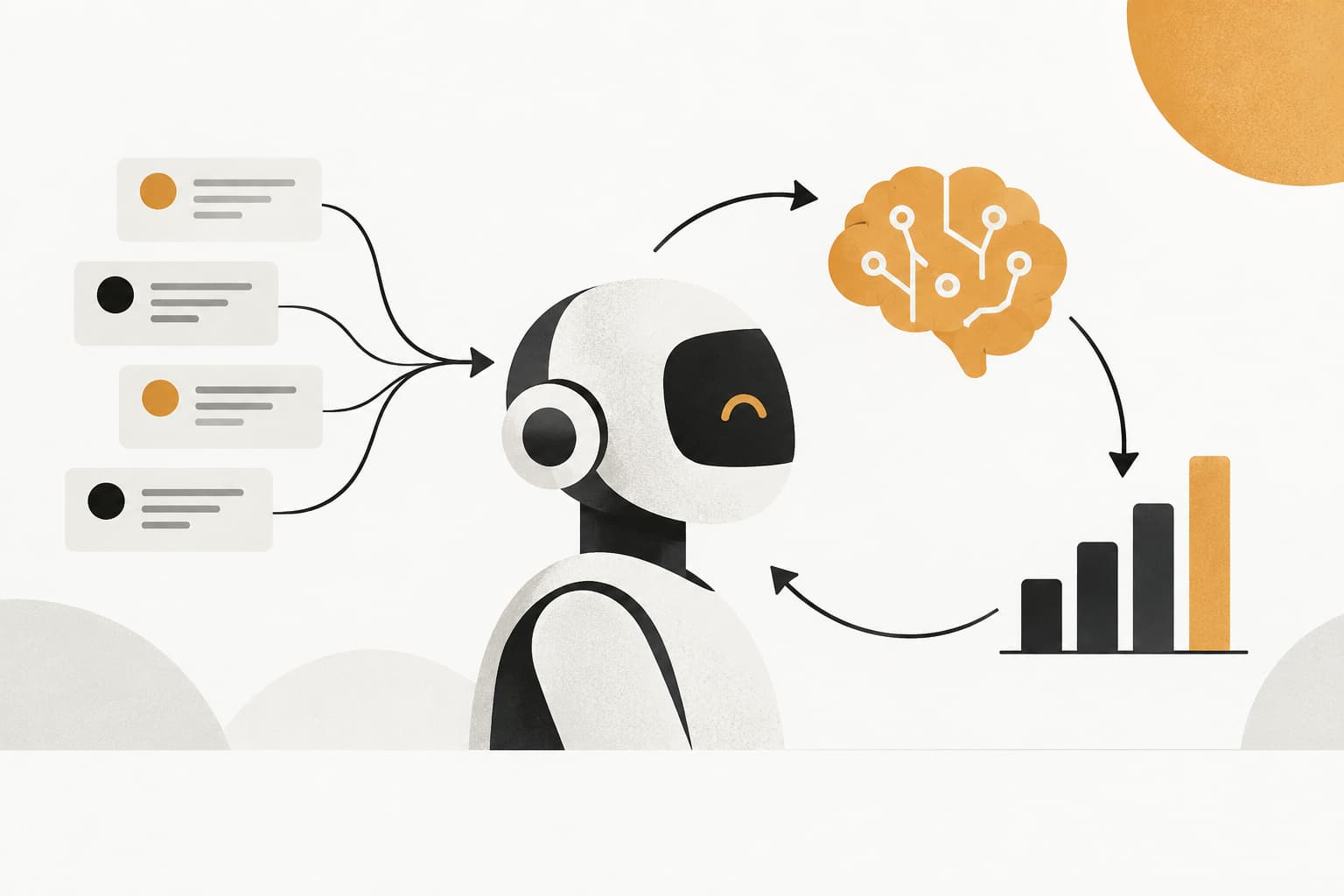
Picture this: You've just implemented a shiny new support automation system. For the first few weeks, it handles the basics—password resets, account questions, maybe some billing inquiries. Then three months later, you're still manually updating it every time your product changes. Six months in, your team is spending more time training the bot than actually helping customers. Sound familiar?
This is the reality of traditional support automation. You set it up, cross your fingers, and watch it become progressively less helpful as your product evolves and customer needs shift. It's like hiring a team member who refuses to learn anything new after their first week.
But there's a fundamentally different approach emerging: continuous learning support automation. Instead of static rules that decay over time, these systems actively improve from every customer interaction. They recognize patterns in how tickets get resolved, learn from agent corrections, and develop genuine expertise that compounds over time. The difference isn't incremental—it's the gap between a tool that needs constant maintenance and a system that becomes more valuable with every conversation.
Here's what makes this shift so significant: Traditional automation scales your limitations. Continuous learning automation scales your team's collective intelligence. One requires you to anticipate every possible customer question upfront. The other learns from the questions you didn't predict and gets better at handling them next time.
This article breaks down how continuous learning support automation actually works, why it represents a fundamental evolution in how companies scale customer support, and what to look for when evaluating solutions. Whether you're drowning in support tickets or planning for growth that would overwhelm your current team, understanding this technology isn't optional anymore—it's the difference between support that scales gracefully and support that becomes your biggest bottleneck.
Beyond Set-and-Forget: The Evolution of Support AI
Let's start with what most companies think of as "support automation." You know the type—chatbots that follow rigid decision trees, keyword-triggered canned responses, and FAQ systems that require a software engineer to update every time your product changes. These tools operate on a simple principle: if customer says X, respond with Y.
The problem? Your customers don't read from a script. They ask questions in countless variations. They describe problems using terminology you've never documented. They combine multiple issues into single messages that your decision tree can't parse. Traditional automation handles maybe 20% of these variations effectively, then throws up its hands and escalates everything else.
This is the set-and-forget trap. You invest significant time upfront mapping out conversation flows and writing response templates. The system works reasonably well for the scenarios you anticipated. Then reality hits—customers ask questions you didn't predict, your product evolves, new features launch, and suddenly your automation is outdated. Maintaining it becomes a second job. Many teams face these customer support automation challenges when relying on static systems.
Continuous learning systems flip this entire model. Instead of relying on predetermined rules, they analyze patterns in how tickets actually get resolved. When a human agent steps in to correct or refine a response, the system doesn't just log that correction—it learns from it. When customers rate their experience, that feedback directly informs how similar questions get handled next time.
Think of it like the difference between following a recipe and learning to cook. A recipe-based system (traditional automation) can only make dishes you've explicitly programmed. A learning system develops intuition about ingredients, techniques, and flavor combinations. It can handle variations, adapt to new situations, and improve its craft over time.
The technical shift here moves from "programmed" automation to "trained" intelligence. You're no longer telling the system exactly what to do in every situation. Instead, you're giving it examples of good support, feedback on its performance, and access to the context it needs to make informed decisions. The system develops its own understanding of what constitutes a helpful response.
This represents a fundamental evolution in how support automation works. Traditional systems are static tools that require constant manual intervention. Continuous learning systems are dynamic teammates that develop expertise through experience. The difference shows up in every metric that matters—resolution accuracy, customer satisfaction, and most importantly, the time your team spends maintaining versus improving your support operation.
The Learning Loop: How Smart Systems Improve Themselves
So how does an AI system actually get smarter without someone explicitly teaching it every new trick? The answer lies in feedback loops that capture expertise from every interaction and translate it into improved performance.
The most direct learning mechanism comes from agent corrections. When a support agent reviews an AI-generated response and refines it before sending, that correction becomes training data. The system doesn't just note that its original response was wrong—it analyzes the gap between what it suggested and what the expert agent actually sent. Over time, these corrections reveal patterns about tone, technical accuracy, and the level of detail customers need.
But here's where it gets interesting: The system doesn't just memorize individual corrections. It generalizes from them. If agents consistently add troubleshooting steps that the AI initially missed, the system learns to include similar steps proactively in related tickets. If agents regularly soften overly technical language, the system adjusts its communication style across the board. This is how customer support learning systems develop genuine expertise over time.
Customer satisfaction signals provide another crucial feedback layer. When customers rate their support experience or indicate whether their issue was resolved, that data flows back into the learning loop. The system correlates resolution approaches with satisfaction outcomes. Which types of responses lead to quick resolutions? Which explanations leave customers confused? This feedback helps the AI optimize not just for technical correctness, but for actual customer success.
Pattern recognition across ticket volumes reveals insights no individual agent could spot. When thousands of tickets flow through the system, machine learning algorithms identify emerging issues before they become obvious to humans. Maybe a specific feature is generating more confusion this week than last. Maybe certain error messages consistently lead to escalations. The system detects these patterns and adjusts its approach accordingly.
Knowledge synthesis represents the most sophisticated aspect of continuous learning. The AI doesn't just learn from support tickets in isolation—it connects information from your help center documentation, past ticket resolutions, product release notes, and even conversations in tools like Slack. When a new feature launches, the system correlates help center articles about that feature with how agents actually explain it to customers. Effective knowledge base automation makes this synthesis possible by keeping information organized and accessible.
This synthesis capability means the AI can handle questions about topics it's never explicitly been trained on. If it understands how Feature A works and sees patterns in how agents explain Feature B, it can make intelligent inferences about how to explain Feature C when it launches. The learning compounds in ways that static systems simply cannot replicate.
The feedback loop operates continuously, not in discrete training cycles. Traditional machine learning often requires periodic retraining—you collect data, retrain the model, deploy the update, repeat. Continuous learning systems update incrementally, incorporating new insights as they emerge. This means improvements appear quickly, sometimes within hours of a pattern becoming clear.
What makes this particularly powerful for support operations is that the learning happens in context. The system doesn't just get better at generic language tasks—it develops specific expertise in your product, your customers' common challenges, and your team's preferred resolution approaches. It becomes genuinely specialized in ways that generic AI models cannot match.
Real-World Impact on Support Operations
The technical capabilities sound impressive, but what does continuous learning actually change for support teams dealing with real customer issues every day? The impact shows up in three fundamental ways that transform how support operations scale.
Resolution accuracy improves over time without anyone manually updating knowledge bases or retraining models. In the first month, a continuous learning system might handle 30% of tickets fully autonomously. By month three, that number climbs to 45%. Six months in, it's resolving 60% of incoming volume. The curve keeps climbing because every resolved ticket—whether handled by AI or human agents—makes the system smarter about similar future issues.
This improvement happens automatically. Your team isn't spending weekends updating documentation or rewriting chatbot scripts. The system learns from the work they're already doing. An agent spends fifteen minutes crafting a detailed explanation for a complex billing question? That expertise is now permanently captured and available for every similar question that follows. Understanding these customer support automation benefits helps teams set realistic expectations for improvement curves.
Escalation rates decrease as the system learns edge cases from human agents. Traditional automation handles the obvious stuff but escalates anything remotely complex. Continuous learning systems develop nuance over time. They learn when a customer's frustration level requires immediate human attention versus when they just need a thorough explanation. They recognize scenarios that look simple but actually hide complexity requiring agent expertise.
This edge case learning is particularly valuable because it addresses the exact scenarios that overwhelm traditional automation. That customer who's asking about a billing issue but is actually confused about how your pricing tiers work? The system learns to recognize that pattern and provide context about pricing structure alongside the billing answer. These multi-layered resolutions emerge from observing how skilled agents handle similar situations.
New product feature onboarding becomes dramatically faster. When you launch a new capability, traditional automation requires someone to write new decision trees, update FAQs, and manually program responses. With continuous learning, the AI learns alongside your team. As agents start handling questions about the new feature, the system observes their explanations, notes which approaches work best, and begins handling similar questions independently.
This parallel learning means your support automation doesn't lag behind your product development. The gap between "feature launches" and "automation can handle questions about it" shrinks from weeks to days or even hours. Your team's early expertise with new features gets captured and scaled immediately.
The compounding effect is what really matters. Traditional automation delivers linear returns—you invest time upfront, get some efficiency, then invest more time maintaining it. Continuous learning delivers exponential returns—early investment yields increasing accuracy over time, with maintenance effort actually decreasing as the system develops expertise.
Teams report that after six months with continuous learning systems, they're spending 70% less time on routine tickets and dedicating that reclaimed time to complex issues that genuinely benefit from human expertise. The AI doesn't just handle more volume—it handles increasingly sophisticated issues, constantly pushing the boundary of what can be automated.
Key Components That Enable Continuous Learning
Not all systems that claim to "learn" actually deliver continuous improvement. Real continuous learning requires specific architectural components that enable the AI to develop genuine expertise rather than just memorize responses. Understanding these components helps you evaluate whether a solution will actually get smarter over time.
Integration depth determines how much context the system has to learn from. A continuous learning AI that only sees support ticket text is like a doctor who can only read your symptoms without accessing medical history, test results, or vital signs. It can make educated guesses, but it's missing crucial context. Exploring your support automation integration options early in the evaluation process helps ensure comprehensive data access.
Effective systems integrate with your entire business stack. They pull customer data from your CRM to understand account history and relationship context. They access product analytics to see how customers actually use your features. They connect to communication tools like Slack to observe how your team discusses and resolves issues internally. They integrate with project management systems to understand known bugs and planned improvements.
This integration depth enables the AI to learn holistically. When it sees that customers on a specific pricing tier consistently struggle with a particular feature, it can proactively provide tier-specific guidance. When it recognizes that an issue is tied to a known bug being tracked in Linear, it can set appropriate expectations about resolution timing. Context transforms generic responses into genuinely helpful support.
Page-aware context represents a particularly powerful integration capability. Traditional support systems are blind to what customers see when they reach out for help. Continuous learning systems that understand visual context—what page the customer is on, what UI elements they're interacting with, what data they're viewing—can provide dramatically more accurate assistance.
Think about the difference between "I can't find the export button" and having the AI actually see that the customer is on the reports page where the export button is located in the top-right corner but might be hidden by their browser window size. Page awareness turns vague questions into specific, actionable guidance. It also provides crucial learning data—the system can correlate UI confusion patterns with specific page layouts and learn to proactively address common stumbling points.
Human-in-the-loop architecture captures agent expertise without disrupting workflow. This is where many systems fail. They either require agents to explicitly "train" the AI (creating extra work that nobody has time for) or they learn passively without any quality control (leading to the AI reinforcing bad habits). Effective intelligent support workflow automation makes this capture seamless.
Effective architectures make learning invisible. When an agent reviews an AI-drafted response before sending it, any edits they make automatically become training data. When they choose to handle a ticket themselves instead of letting the AI respond, that decision signals something about the ticket's complexity or sensitivity. When they add context or explanation beyond what the AI suggested, that additional information gets incorporated into future responses.
This seamless capture means the system learns from your best agents' expertise without requiring them to change how they work. The learning happens as a byproduct of doing great support, not as an additional task.
The feedback loop architecture determines how quickly improvements appear. Some systems batch learning—they collect data for weeks, then retrain models, then deploy updates. This creates lag between when patterns emerge and when the system adapts. Real-time continuous learning incorporates insights as they happen, making the system responsive to emerging issues and changing customer needs.
These components work together to create systems that genuinely develop expertise. Integration provides context. Page awareness adds visual understanding. Human-in-the-loop architecture captures quality guidance. Real-time learning ensures improvements appear quickly. Without all these pieces, you get systems that might technically "learn" but never develop the nuanced understanding that makes automation feel intelligent rather than mechanical.
Evaluating Continuous Learning Capabilities
When vendors claim their systems use "AI" or "machine learning," how do you separate genuine continuous learning from marketing buzzwords? The right questions reveal whether a system will actually improve over time or just give you another tool to maintain manually.
How does the system learn? This is the foundational question. Push vendors to explain their learning mechanisms specifically. Do they use supervised learning from agent corrections? Do they incorporate customer satisfaction signals? How do they handle edge cases that don't fit existing patterns? Vague answers about "advanced AI algorithms" are red flags. You want specific explanations of the feedback loops that drive improvement.
What data does it use? Learning quality depends entirely on data quality and breadth. Ask which systems the AI integrates with and what information it extracts from each. Does it only see ticket text, or does it access customer history, product usage data, and business context? Can it correlate support patterns with product analytics to identify confusion points? The more comprehensive the data access, the more nuanced the learning.
How quickly do improvements appear? This question reveals whether you're dealing with real-time continuous learning or periodic batch retraining. If improvements take weeks to materialize, you're not getting true continuous learning—you're getting traditional machine learning with manual update cycles. Look for systems where agents notice the AI getting better at specific issue types within days of those issues emerging.
What happens when the AI makes mistakes? The answer reveals the quality control mechanisms. Good systems make it trivially easy for agents to correct AI responses, and those corrections immediately inform future behavior. Poor systems either make corrections difficult (requiring you to edit training data or update rules manually) or don't learn from them at all. Ask to see the exact workflow for how an agent would correct an inaccurate AI response.
How do you measure learning effectiveness? Vendors should be able to show you metrics that track improvement over time—resolution accuracy trends, autonomous resolution rates month-over-month, escalation rate changes, customer satisfaction scores for AI-handled tickets. Tracking the right support automation success metrics helps you validate whether continuous learning is actually working.
Red flags to watch for include systems that require constant manual retraining. If the vendor talks about "quarterly retraining cycles" or "monthly model updates that we manage for you," you're not getting continuous learning—you're getting traditional AI with a maintenance contract. True continuous learning happens automatically as part of normal operations.
Another warning sign is systems that need extensive rule configuration upfront. If implementation involves mapping out decision trees, writing response templates, or creating complex conditional logic, you're looking at traditional automation with AI features bolted on. Continuous learning systems should require minimal upfront configuration because they learn appropriate responses from observing your team's work.
The AI-first versus bolt-on distinction matters significantly. Some vendors built their platforms around continuous learning from the ground up. Others started with traditional helpdesk software and added AI features later. The architectural difference shows up in how naturally the learning integrates with daily workflows. AI-first systems make learning invisible—it happens as agents do their normal work. Bolt-on solutions often require agents to explicitly "train" the AI, creating friction that undermines adoption. A thorough support automation software comparison can help identify which platforms were built with learning at their core.
Ask about the underlying architecture. Was the system designed for continuous learning, or was learning capability added to an existing platform? The honest answer reveals whether you're getting technology built for this paradigm or legacy software trying to keep up with market trends.
Putting Continuous Learning to Work
Understanding how continuous learning works is one thing. Implementing it effectively requires strategic thinking about where to start, how to establish feedback loops, and what metrics actually matter for measuring success.
Start with high-volume, repetitive ticket categories where learning compounds fastest. Password resets, account access issues, basic billing questions—these categories generate enough volume that the AI can identify patterns quickly and validate improvements within days. Early wins in these areas build confidence and demonstrate value while the system develops expertise in more complex categories. Following a clear support automation adoption guide helps teams prioritize these quick wins effectively.
This focused approach also makes it easier to measure impact. If you're currently spending 20 hours per week on password reset tickets and that drops to 5 hours within a month, the ROI is immediately clear. You can then expand to more nuanced categories with confidence that the learning mechanisms work.
Establish feedback loops between AI resolution and human review. The most effective implementations create a workflow where agents can easily review AI-drafted responses before they go out, make edits when needed, and approve accurate responses with a single click. This review process serves double duty—it maintains quality control while generating the training data that makes the system smarter.
The key is making this review frictionless. If agents have to navigate multiple screens or copy-paste between systems, they'll skip the review and either let the AI send potentially inaccurate responses or handle everything themselves. Seamless review workflows ensure quality while capturing maximum learning value from agent expertise.
Measure improvement over time, not just initial accuracy. Many teams evaluate AI support based on day-one performance and miss the entire point of continuous learning. A system that handles 40% of tickets accurately on day one but plateaus there is less valuable than one that starts at 30% but climbs to 70% over six months.
Track metrics that reveal learning progress. Resolution accuracy trends show whether the system is actually getting better at handling tickets correctly. Autonomous resolution rate (percentage of tickets handled without human intervention) should climb over time. Escalation rates should decrease as the system learns to recognize and handle edge cases. Customer satisfaction scores for AI-handled tickets should improve as the system develops better communication patterns. Learning how to measure support automation success ensures you're tracking the right indicators of continuous improvement.
These trending metrics tell you whether you've implemented a tool or a learning system. Tools have static performance. Learning systems show continuous improvement curves that compound over time.
The Intelligence That Scales
Traditional support automation promised efficiency but delivered maintenance headaches. You invested time building knowledge bases and configuring chatbots, only to watch them become outdated as your product evolved and customer needs shifted. The tools never got better—they just got older.
Continuous learning support automation represents a fundamental shift from tools that need constant care to systems that grow more valuable with every interaction. The difference isn't just technical—it's the gap between scaling your limitations and scaling your team's collective intelligence.
The best implementations feel less like software and more like a support team member who never forgets a lesson learned. They develop genuine expertise in your product, your customers' common challenges, and your team's preferred resolution approaches. They handle increasingly sophisticated issues over time, constantly pushing the boundary of what can be automated while freeing your human agents to focus on complex problems that genuinely benefit from human judgment and creativity.
This technology enables support teams to scale quality, not just volume. As your customer base grows, your support operation doesn't need to grow proportionally. The AI handles routine queries with increasing accuracy, surfaces business intelligence that helps you improve your product, and gives your team the breathing room to deliver exceptional service on issues that matter most.
The companies that thrive in the next decade won't be those with the largest support teams—they'll be those who leverage continuous learning to make every customer interaction smarter than the last. Your support team shouldn't scale linearly with your customer base. Let AI agents handle routine tickets, guide users through your product, and surface business intelligence while your team focuses on complex issues that need a human touch. See Halo in action and discover how continuous learning transforms every interaction into smarter, faster support.
How Halo helps
Halo automates the full support loop: its AI agent resolves routine tickets autonomously, drafts replies for the rest, and routes what needs a human — with escalation rules your team controls. Learn more about how Halo resolves tickets autonomously.